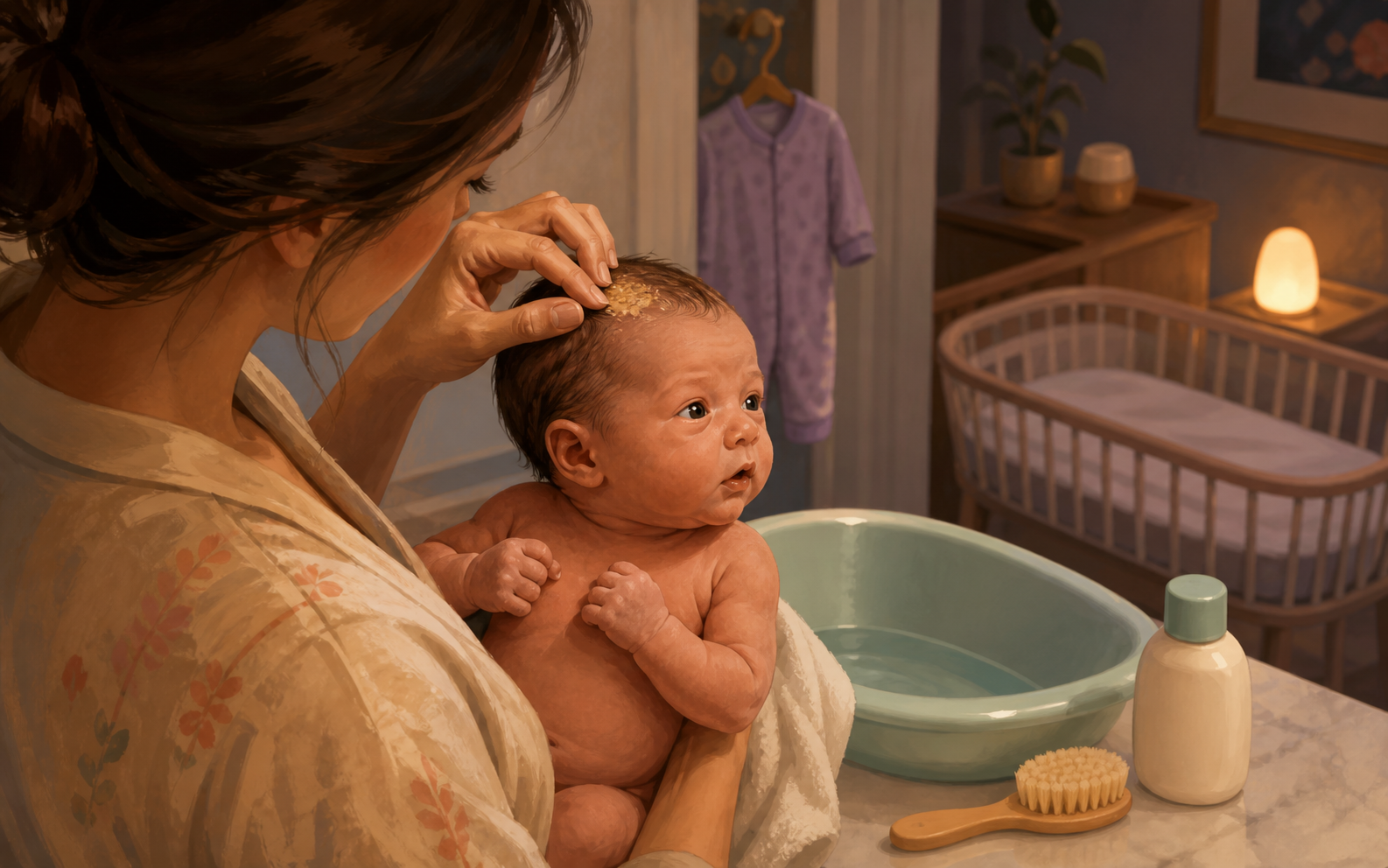
You part impossibly soft newborn hair under a night-light and find a yellow, waxy patch that was definitely not in yesterday’s mental inventory. Typical cradle cap looks dramatic, but on a comfortable baby it is usually harmless, not contagious, and not a sign that you missed a bath. You can leave it alone. If you want to loosen the scales, the safest goal is gentle care and intact skin—not a perfectly clear scalp by bedtime.
What changes the answer is not how impressive the flakes look. It is whether your baby seems bothered and whether the skin underneath is healthy. Pain, strong itch, bad smell, swelling, pus, weeping, or bleeding need a clinician’s attention. A baby who is difficult to wake, breathing abnormally, turning blue or gray, feeding poorly, or acting very ill needs urgent medical help; cradle cap does not explain those signs. The American Academy of Pediatrics lists these newborn illness warning signs. A baby 3 months or younger with a rectal temperature of 100.4°F (38°C) or higher needs prompt medical evaluation. The AAP explains the young-infant fever boundary here.
Start with the skin, not the scale
What looks typical—and what deserves a recheck
Greasy scale, comfortable baby
White or yellow waxy scale, intact skin, and little or no itch fit the usual cradle-cap pattern. Leave it alone or use gentle optional care.
Dry and distinctly itchy
Dry patches, scratching, rubbing, cheek or body involvement, or sleep disrupted by itch can point toward eczema or overlap. Ask before treating both as the same rash.
Sore, swollen, wet, or smelly
Pain, odor, pus bumps, ooze, swelling, unexplained bleeding, severe spread, or worsening belongs with the pediatrician or dermatologist—not a stronger brush.
Baby seems ill
Trouble breathing, blue or gray color, marked weakness, poor feeding, fever in a young infant, or difficulty waking is an urgent baby-health problem. Do not wait for a scalp treatment to help.
The small routines
Feeds, changes,
and a little time for rest.
The feeds and changes keep coming, and you’re figuring out where sleep fits between them. Watch our video below for practical ideas for settling your baby.
Prefer to read?Press play for a little help with your baby’s next bedtime.
Kind words about the original video
“Thank you so much for this video!”
“I'm truly impressed with how much information you share in your video.”
The SleepBaby Workshop
Get the Workshop.
Get the Workshop, including Our Night Handoff and the Caregiver Shift & Fatigue Plan. 15 guides and five audio tracks in a simple browser hub. Read, listen, and return to the part you need.
A conversation, if you want one.Night Owls is the SleepBaby chat room. Read what is there or join in.
What newborn cradle cap actually looks like
Cradle cap is the familiar name for infantile seborrheic dermatitis on the scalp. It often appears during the first weeks or months of life as thick or thin scale that can look white, cream, yellow, or brownish. The texture is usually the better clue: greasy, waxy, or crusted rather than simply dry. On lighter skin, the skin beneath may look pink or red. On darker skin, inflammation may appear lighter, darker, violet-toned, or otherwise discolored rather than bright red. The American Academy of Dermatology describes how seborrheic dermatitis can vary across skin tones.
The scale may stay on the crown or hairline, or show up around the eyebrows, behind the ears, beside the nose, or in body folds. A small nearby patch does not automatically mean something dangerous. A widespread, raw, painful, or rapidly worsening rash is different and deserves a medical look.
Cradle cap is not caused by dirty hair, careless bathing, or an allergy to you. Its exact cause is not fully settled. Oil-gland activity, normal skin yeast, and infant skin biology may all be involved, but none of that creates a useful reason to scrub harder. When I sort through those possible causes, I keep coming back to the practical fact: the scale is attached to delicate skin, and delicate skin wins every argument with the comb. My job here is not to make the biology sound tidier than it is; it is to help you protect the scalp underneath.
Typical cradle cap also is not usually very itchy or painful. That distinction matters. A parent can tolerate a surprisingly theatrical amount of yellow scale once they know the baby is comfortable; a small patch that hurts, wakes the baby, smells wrong, or weeps deserves much more attention than a large quiet patch. The American Academy of Pediatrics notes that cradle cap is generally harmless and not caused by poor hygiene.

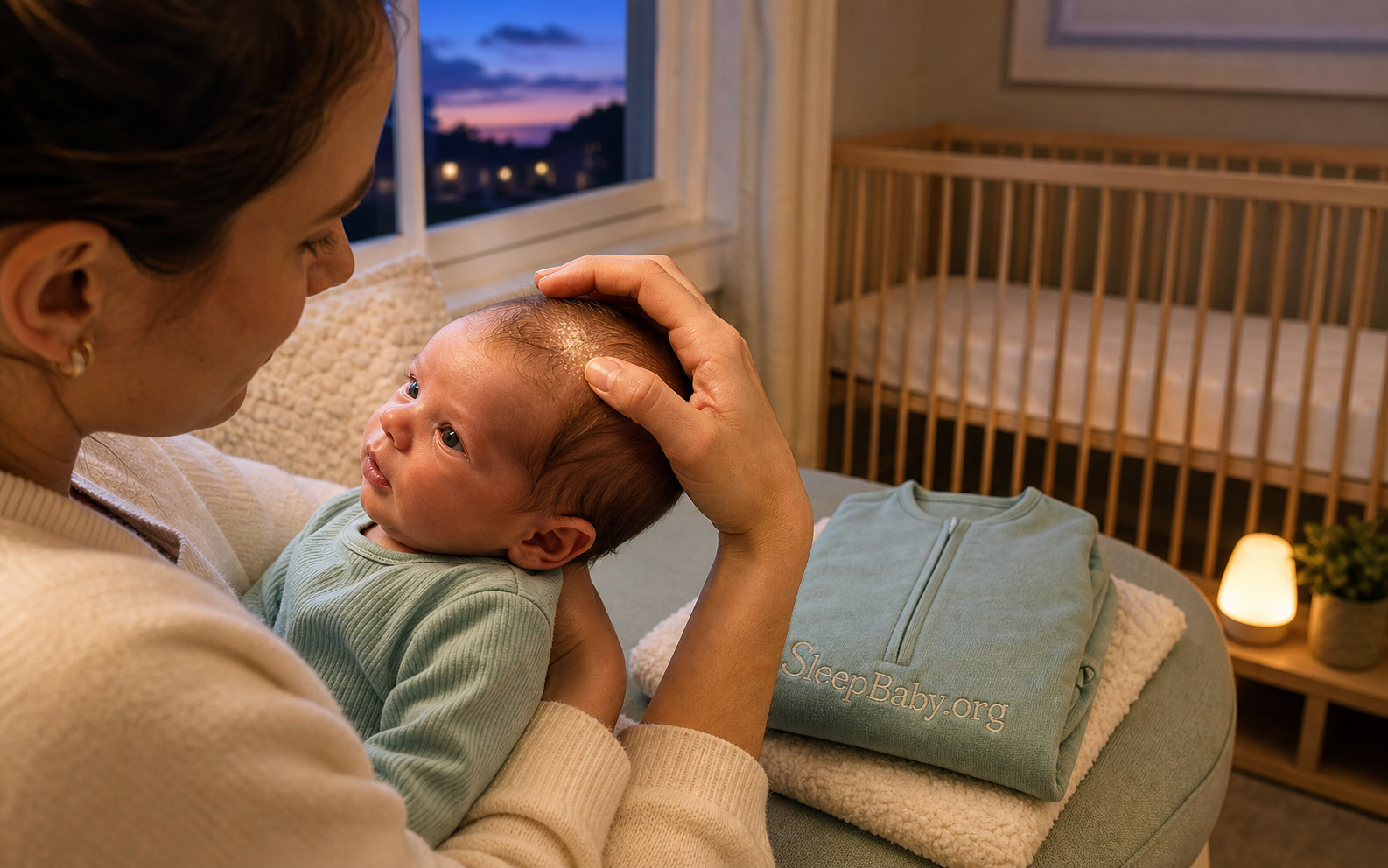
Do you have to treat cradle cap?
No. If the skin is intact and your baby is comfortable, doing less is a completely valid plan. Cradle cap commonly improves over weeks or months and often clears during infancy. Treatment is mainly about loosening visible scale; it is not necessary to protect an otherwise well baby from the condition. A Cochrane review found only a handful of small, low-quality treatment studies, so there is no well-proven winning remedy that every family needs to follow.
This is where internet advice tends to become more confident than the evidence. One page prefers one oil, another forbids it, and a third somehow makes a newborn scalp sound like a weekend restoration project. I would not turn a self-limited skin condition into a six-product routine. If normal shampooing and time are acceptable to you, stop there.
If the scale catches in the hair, bothers you cosmetically, or is thick enough that you want to help it lift, gentle care is reasonable. The success condition I use is skin that stays intact. I would rather see a few stubborn scales after the bath than a perfectly clear scalp made sore by persistence. To me, stopping there is not a failed treatment. It is the moment you showed good judgment.
A low-pressure cradle cap treatment
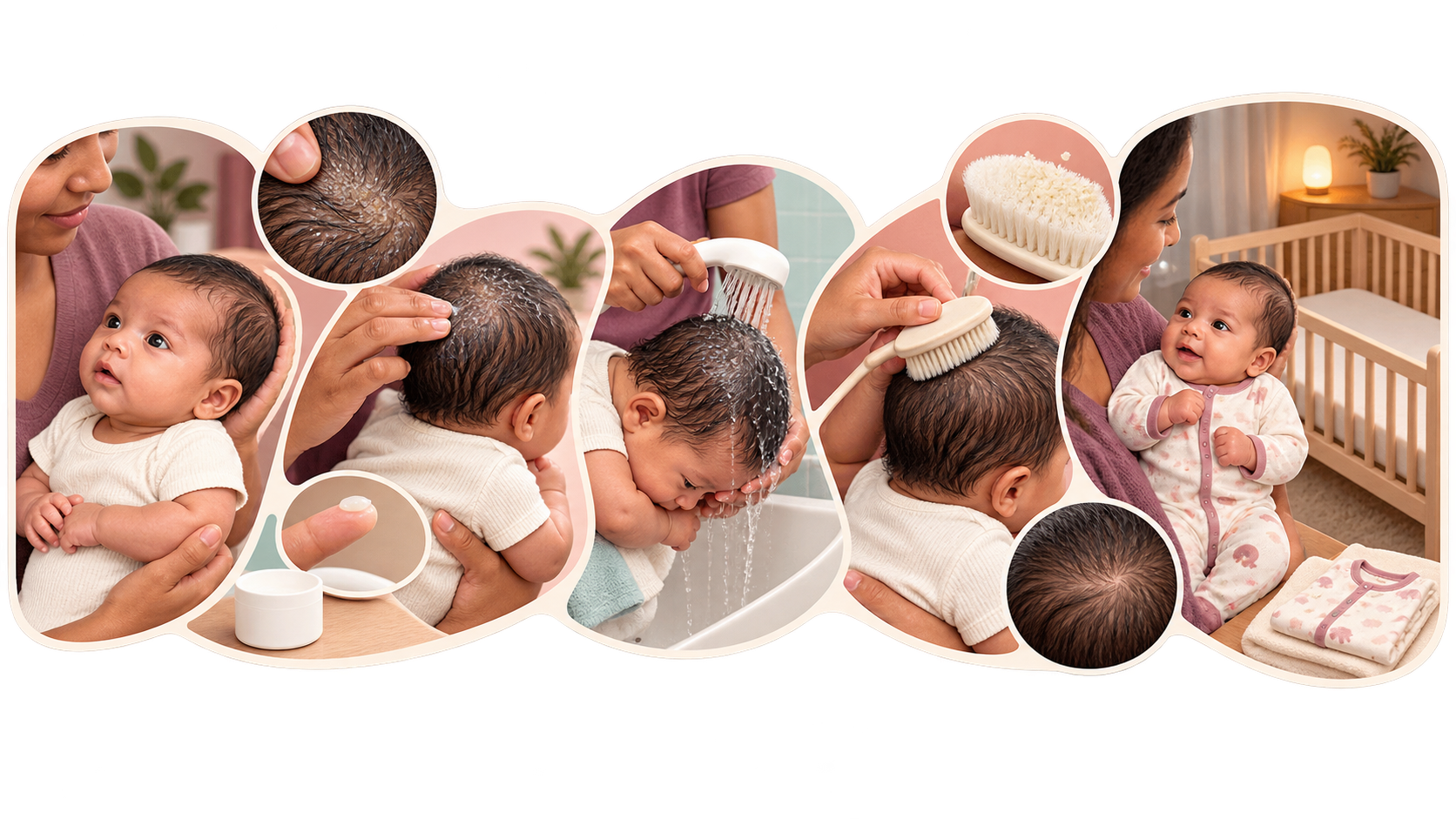
Soften only if needed, wash, lift what is ready, then stop
Do this while your baby is awake and supervised, ideally before a bath. Nothing needs to stay on the scalp during sleep.
-
Look before you loosen
Check for soreness, broken skin, swelling, odor, wetness, or obvious pain. If any are present, skip home removal and call the clinician.
-
Soften stubborn scale only if you need to
Rub a tiny amount of plain fragrance-free mineral oil, petroleum jelly, or a pharmacist-recommended emollient into the scaly area. Let it sit briefly while baby is awake. You may skip this step entirely.
-
Wash gently and rinse well
Use a mild fragrance-free baby shampoo and your fingertips, not your nails. Keep shampoo and softener out of the eyes, then rinse until the hair and scalp no longer feel oily.
-
Move only what releases easily
Pass a very soft baby brush or fine baby comb through loosened scale with almost no pressure. Work in a small area. A scale that holds on is not ready.
-
Stop before the skin objects
End the session if a patch resists, the skin looks pinker or more discolored, your baby seems uncomfortable, or you feel tempted to scrape. Some scale can wait for another day.
You can repeat this gentle routine as needed if the scalp tolerates it, but more frequent is not automatically better. I would change only one part of the routine at a time so we can tell what the scalp is tolerating. Daily mild shampooing for a short period is common professional advice; a baby with very dry skin or possible eczema may need a different frequency. If washing seems to make the scalp drier or more irritated, my next move would be to pause and ask the pediatrician instead of adding another product.
How gentle is gentle enough?
Use the pressure you would use to smooth a wet eyelash away from skin—not the pressure you would use to clean a pan. A soft brush should bend easily against your finger. Hold the hair aside, make one or two short passes through an already loose patch, then look again. If the skin changes color, your baby pulls away, or the scale stays fixed, that patch is finished for the day.
Fine newborn hair can make every shed flake look larger and every loose strand feel alarming. Do not brush the same spot repeatedly to prove the scale is gone. Rinse fully, pat rather than rub, and check the scalp once it is dry. Wet skin can look more irritated than it will ten minutes later, which is another good reason not to keep working while you are uncertain.
If you cannot tell whether the scale is loosening or the skin is being lifted, stop. I would take one clear photo in ordinary light and compare it after the next bath instead of testing it with a fingernail. That gives us useful information without turning observation into another treatment. I trust a calm before-and-after comparison more than what my eyes think they see after several minutes of close inspection under bathroom light.
Do not pick with fingernails, use a hard comb, or scrub with a rough cloth. Picking can create tiny openings where bacteria can enter, and it makes it harder to tell whether later redness came from the condition or the removal attempt. The American Academy of Dermatology’s cradle-cap guidance emphasizes mild shampoo, fingertips or a soft brush, and no picking.
Watch the pressure, not a promise of perfection
See dermatologists demonstrate gentle cradle-cap care
The useful part of this American Academy of Dermatology video is the sequence: mild shampoo, fingertips, and a soft brush only after scale has loosened. It is not a challenge to clear the whole scalp today.
Takeaway: If a patch stays attached, leave it. Intact skin is the success condition. Pain, odor, ooze, worsening, or disruptive itch belongs with the clinician.
If the player does not load, watch “4 cradle cap tips from dermatologists” on YouTube.
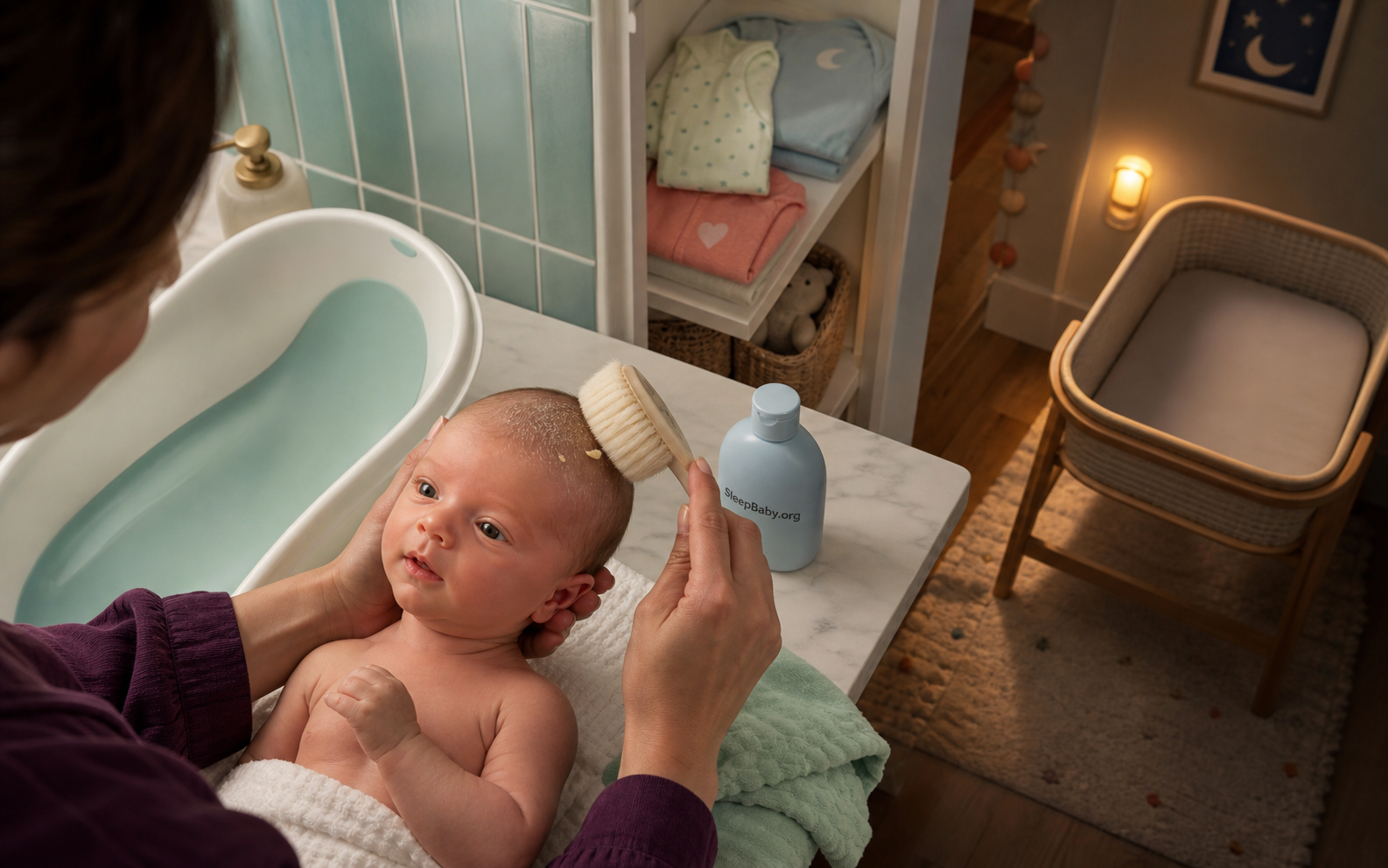
What to use, what to skip, and what needs a clinician
Product advice is the messiest part of cradle cap treatment because reputable organizations do not name exactly the same oils. Some allow coconut oil; some discourage food oils. The Society for Pediatric Dermatology handout says plain mineral oil can be reasonable but advises against baby oil and olive oil. Other professional guidance mentions baby oil. That disagreement is a reason to simplify, not to choose a side with false certainty.
My conservative path is this: you do not need an oil. I start with plain shampoo because it keeps the decision small and lets me see whether anything more is actually necessary. If plain shampoo is not enough and you want to soften stuck scale, I would use a small amount of plain fragrance-free mineral oil, petroleum jelly, or an emollient recommended by a pharmacist or your baby’s clinician. Apply it before the bath while your baby is awake, then wash it out. I do not want a greasy scalp overnight, and I do not want us turning a head covering into treatment equipment.
A simpler product boundary for a newborn scalp
Reasonable first choices
Use gently
- Mild fragrance-free baby shampoo
- Fingertips and a very soft baby brush
- Optional plain mineral oil or petroleum jelly before bathing
- A pharmacist-recommended fragrance-free emollient
Avoid the irritation lottery
Skip at home
- Picking, scraping, hard combs, and rough cloths
- Olive oil, peanut oil, and scented oils
- Perfumed products, soap, and fragranced shampoo
- Adult dandruff shampoo or salicylic-acid products
- Overnight hats, wraps, towels, or caps
Diagnosis before medicine
Ask first
- Hydrocortisone or another steroid
- Ketoconazole or another antifungal
- Medicated shampoo of any kind
- Treatment for a rash that is painful, itchy, wet, or spreading
“Natural” is not a safety category. Olive and peanut oils are specifically discouraged in current NHS cradle-cap guidance, and fragrance can irritate newborn skin. Adult dandruff products are formulated for adult scalps, not tiny bodies that absorb ingredients differently. Mayo Clinic guidance also warns against salicylic-acid dandruff shampoo for babies and keeps hydrocortisone or ketoconazole behind medical advice. Read Mayo Clinic’s treatment boundaries.
What might the clinician recommend?
If gentle care is not enough, a pediatrician or dermatologist may first confirm that the rash really is seborrheic dermatitis. That matters because eczema, fungal infections, bacterial infection, psoriasis, and several less common scalp conditions do not all improve with the same product. A clinician may recommend a short course of an antifungal or a low-strength anti-inflammatory medicine when the diagnosis and severity justify it. The useful word there is recommend: the product, strength, location, amount, and duration should come from someone treating your baby, not from an adult dandruff bottle already in the shower.
Bring the names or photos of anything you have already used. I would mention whether the rash became redder, wetter, itchier, or more widespread afterward. If the baby has eczema elsewhere, allergies, broken skin, or was born prematurely, I would say that too. Those details help the clinician answer the question I care about: which bland-looking product is actually bland for this particular scalp?
Do not keep using a medicated product simply because it helped once. Ask how many days to use it, what improvement should look like, where it must not be applied, and when to stop. Newborn skin care gets safer when the plan has an exit, not when the bathroom shelf gets more crowded.
Store every jar, tube, shampoo, and brush out of reach as soon as care is finished. If a baby swallows a topical product, keep the container so you can identify the ingredients and amount. In the United States, use webPOISONCONTROL or call Poison Control at 1-800-222-1222; do not induce vomiting or improvise based on the label. If petroleum jelly was swallowed rather than staying on the scalp, this guide explains what to do when a baby eats petroleum jelly. And if the product was an eczema cream, use our separate instructions for what to do if a baby gets eczema cream in their mouth. Those links address ingestion, not cradle-cap treatment.

Is it cradle cap, eczema, or an infected rash?
No article can diagnose a newborn rash from a description, and color alone is especially unreliable. Use the pattern to decide what to do next, not to declare a diagnosis at home.
Typical cradle cap is usually greasy or waxy, white to yellow, and only mildly itchy if at all. Your baby generally behaves like themselves. Eczema is more characteristically dry and itchy. Babies may rub their face or scalp, scratch when they can, or become harder to settle because itch is uncomfortable. Eczema often involves the cheeks or other body areas, and cradle cap and eczema can occur together. The AAP’s eczema overview describes the dry, itchy pattern and the way it can disturb sleep.
Infection or another scalp condition becomes more likely when the area is painful, hot, swollen, foul-smelling, weeping, crusted with fresh fluid, dotted with pus bumps, or bleeding without being picked. Broken hairs, a distinct patch of hair loss, or a rash that persists past infancy also deserves a clinician’s eye. A few hairs can come away with loosened cradle-cap scale, and they usually grow back; an expanding bald patch is not the same thing.
Cradle cap can extend outside the scalp, but a severe or widespread rash should not be managed by applying more of the same product everywhere. Skin folds, the diaper area, and the face have different moisture and friction conditions. If the pattern is spreading, itchy, raw, or uncertain, stop treating by category and let the pediatrician or dermatologist look at the whole baby.
Track the pattern without turning your phone into a microscope
One photo every few days in similar natural light can be more useful than ten close-ups in one evening. I would include enough of the head to show location and spread. I would note whether the patch is greasy or dry, whether your baby rubs it, whether it smells or leaks, and whether anything changed after shampoo or a softener. Color can shift with lighting; when I am trying to decide whether to call, I give more weight to texture, comfort, and change over time.
Also look beyond the scalp. Are there dry itchy cheeks, a rash in skin folds, new pus bumps, a circular patch with broken hairs, or symptoms elsewhere on the body? You are not trying to name the condition. You are collecting the exact details a clinician would need to decide whether this still fits routine cradle cap.
The practical distinction I keep coming back to is comfort plus skin integrity. Greasy scale on an unbothered baby gives you time. Itch, pain, wetness, odor, or a baby who seems unwell changes the job from “loosen flakes” to “find out what this actually is.” That is the point where I would stop guessing.

When home care ends
Wait, call, or get urgent help?
-
Wait and watch
The scale is greasy, skin is intact, baby is comfortable, and there is no odor, wetness, swelling, bleeding, or severe spread. Leave it alone or keep care gentle.
-
Call the pediatrician or dermatologist
There is pain, disruptive itch, odor, pus, ooze, bleeding, swelling, patchy hair loss, severe spread, worsening, no improvement after a few weeks, persistence beyond about 12 months, or doubt about the diagnosis.
-
Get urgent medical help
Your baby cannot be awakened, is weak or floppy, has blue or gray color, struggles to breathe, feeds markedly less, or looks very sick. For a baby 3 months or younger, a rectal temperature of 100.4°F (38°C) or higher also needs prompt evaluation. Do not wait for morning or call unusual lethargy “deep sleep.”
If you are unsure whether a sleepy baby is normally drowsy or unusually unresponsive, I want you to try to rouse them and assess the whole picture. I would not let the presence of cradle cap explain away a breathing, color, feeding, or responsiveness change. Our guide to what to do when a baby is unusually hard to wake can help us organize the next steps, but serious changes belong with emergency services.
What to say when you call
Lead with your baby’s age and the symptom that made you stop home care. Then describe when the scale began, where it is now, whether it is greasy or dry, whether the baby seems itchy or sore, and whether there is odor, drainage, swelling, bleeding, fever, feeding change, or unusual sleepiness. List every product used and how long it stayed on the skin. A short, specific account helps the clinician sort a cosmetic scalp problem from irritation, eczema, infection, or illness much faster than “the cradle cap looks bad.”
If you are calling because of fever in a young infant, breathing trouble, abnormal color, marked weakness, or difficulty waking, say that first. Do not spend the opening of the call describing flakes. The scalp can wait while the urgent symptom gets the right attention.

Where cradle-cap care belongs in the bedtime routine
Ordinary cradle cap usually does not hurt or itch enough to explain repeated waking. If your baby suddenly cannot settle, wakes from scratching, or cries when the scalp is touched, I would not keep changing sleep routines to solve a skin-comfort problem. I would treat that disruption as information and ask whether eczema, irritation, infection, or another diagnosis fits better. Our sleep plan cannot make an itchy or painful scalp comfortable.
Keep any scalp session in an awake, supervised window before a bath—not after your baby is already drowsy and everyone has lost patience with the evening. Wash out the softener, rinse the shampoo, pat the hair and scalp dry, put products away, and finish with a clean, dry, uncovered head. If damp hair itself is worrying you, our guide to what wet hair does and does not mean at bedtime separates comfort questions from safe-sleep rules.
Cradle cap does not change the safe-sleep setup. Put your baby on their back for every sleep on a firm, flat approved surface with no pillows, loose blankets, towels, head wraps, or other soft items. Keep the head uncovered and avoid overheating. The CDC summarizes the clear-surface, back-sleeping guidance. A hat or cap should not be used indoors to hold oil on the scalp while a baby sleeps.
The goal is not a polished scalp before bedtime. It is intact skin, a clean dry uncovered head, and one less experiment happening after the lights go low. That is the line I would remember when a stubborn patch makes “just one more pass” feel tempting.
What to expect over the next weeks
Cradle cap often improves gradually, not in one satisfying before-and-after reveal. A patch may soften, shed, return in a lighter form, and disappear again. That does not mean you caused it or treated it incorrectly. Many babies are mostly clear within weeks or months, and most cases resolve during infancy. DermNet describes cradle cap as generally self-limited and recommends reconsidering the diagnosis when it persists beyond about 12 months.
A few fine hairs may come out with scales that were already loosening. The hair usually grows back. Call if you see clear bald patches, broken hairs, inflammation, pain, or continued hair loss rather than a few strands attached to flakes.
Recurrence is common enough that you may think the routine “did not work” when a lighter patch returns. Cradle cap is not dirt being removed once; it is a skin pattern that settles on its own timetable. Return to the least intensive step that previously kept the skin comfortable. If you need progressively stronger care to hold it back, that is useful information for the clinician.
By the first birthday, persistent heavy scale deserves another look even if it never seemed urgent. The diagnosis may still be benign, but the age changes which alternatives the clinician considers. Earlier review is appropriate whenever the pattern is painful, very itchy, infected-looking, or associated with patchy hair loss.
If the scalp remains comfortable, judge progress over several baths, not several minutes. Keep the routine boring: mild shampoo, gentle hands, a soft brush only when useful, and no contest with the last patch. Newborn skin does not award medals for thoroughness.
Sources
- American Academy of Pediatrics: Cradle Cap
- American Academy of Dermatology: How to Treat Cradle Cap
- American Academy of Dermatology: Seborrheic Dermatitis Signs
- American Academy of Dermatology: Cradle Cap Care Video
- NHS: Cradle Cap
- Society for Pediatric Dermatology: Seborrheic Dermatitis
- Cochrane: Treatments for Infantile Seborrhoeic Dermatitis
- American Academy of Pediatrics: Eczema in Babies and Children
- CDC: Providing Care for Babies to Sleep Safely
- American Academy of Pediatrics: Fever and Your Baby
- American Academy of Pediatrics: Newborn Illness Signs
- Poison Control
- Mayo Clinic: Cradle Cap Diagnosis and Treatment
- DermNet: Cradle Cap
Close the scalp-care caddy before the night begins
Let bedtime be about sleep, not the last stubborn scale
Gentle cradle-cap care can end with some scale still present and the important things protected: intact skin, a dry uncovered head, products put away, and a safe empty sleep space. If the rest of the night still feels hard, build the sleep plan around your baby’s actual pattern—not around making the scalp look finished.
SleepBaby can help you step back from one worried evening and make a calmer, practical plan for the nights ahead. It does not replace your pediatrician or emergency care.
The SleepBaby.org Workshop
Make a plan for
the next bedtime.
Practical help for wake-ups, short naps, and sharing the night shift. Watch the original video, then get 15 guides and five audio tracks for $9.
$9 USD, paid once. No subscription. Digital access.
Watch the original Baby Sleep Miracle presentation
Press play for a little help with your baby’s next bedtime.
Original presentation. Watch before you decide.
15practical guides
5audio tracks
1one-time payment
Kind words about the original video
“Thank you so much for this video!”
“I'm truly impressed with how much information you share in your video.”
Inside the Workshop
Start with the night
you're having.
You don't need to read all 15 guides before bedtime. Choose the one that answers the question in front of you, then come back for the next part.
Before you buy
A few things
made clear.
A straightforward purchase, with space to decide what fits your family.
What am I buying?
The SleepBaby.org Workshop includes 15 digital guides, five audio tracks, and the original Baby Sleep Workshop PDF as an additional download. It costs $9 USD, paid once, with no subscription. Nothing is shipped.
Where should I start?
Try Tonight Rescue when you need a starting point. If your question is more specific, go straight to the guide on naps, a caregiver handoff, the sleep space, or another topic. You can read at your own pace.
Is this personal sleep coaching?
No. This is an educational collection for parents of babies and young children. Use the age-specific guidance, and bring feeding, breathing, growth, illness, or other health concerns to your child's clinician. It does not diagnose a problem or promise a sleep result.
Is the video the paid Workshop?
You can watch the original Baby Sleep Miracle presentation on this page. Your purchase is the SleepBaby.org Workshop collection of guides, audio tracks, and the original PDF described here.
How do I find it after checkout?
On your thank-you or order-status page, look for Open Workshop access, then Open your SleepBaby Workshop. Keep your order confirmation so you can return. If you need help finding your access, use our Workshop download help.
The SleepBaby.org Workshop
Have somewhere to start
at the next bedtime.
15 practical guides. Five audio tracks. One $9 purchase.


What part of “Cradle Cap: Gentle Scalp Care, What to Avoid and When to Call” feels most painfully specific in your house right now?
Sometimes the smallest detail—what time it happens, what changed recently, or what finally helps—reveals the pattern. Share the exact version below, and the SleepBaby Team can help you think through it.