
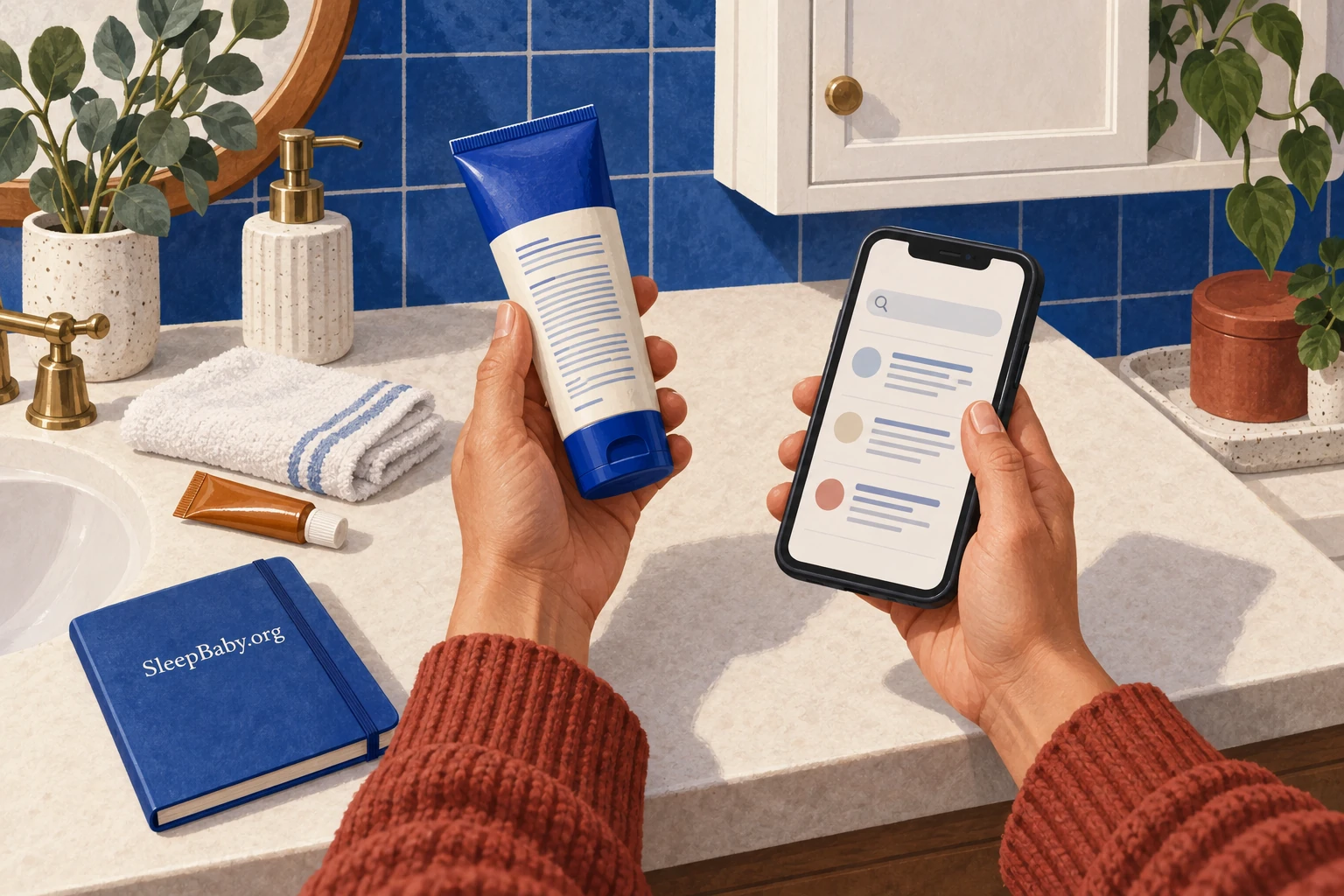
If your baby ate eczema cream, take the container away and call Poison Control at 1-800-222-1222 in the U.S. with the exact product in hand. Gently wipe away visible cream from the mouth with a damp cloth. Do not make your baby vomit. If your baby has trouble breathing, collapses, has a seizure or cannot be awakened, call 911 immediately.
A small taste of ordinary moisturizer often causes little trouble. A medicated cream needs a different assessment. I would turn the tube over before relying on the words “baby,” “natural” or “eczema” on the front.
What to do right now
- Stop further contact. Move the cream and loose cap out of reach. Wipe visible residue from your baby’s lips and mouth gently; do not reach deep into the mouth.
- Call with the container. Give the full product name, active ingredient and strength, if listed. Call promptly for a medicated, prescription or unidentified cream, even if your baby looks comfortable.
- Skip home remedies. Do not induce vomiting. Ask the specialist what, if anything, your baby should drink or eat for this specific exposure.
Do not give anything by mouth if your baby is having trouble swallowing, vomiting or less alert. Outside the U.S., use your local poison service or emergency number.
These first steps draw on Maryland Poison Center’s first-aid guidance, Poison Control’s emergency guidance and MedlinePlus’s swallowing precautions.
“Eczema cream” tells you the purpose, not the contents
That phrase can describe a moisturizing cream, an oatmeal skin protectant, a steroid medicine or another prescription treatment. A familiar brand may sell several of them. A tube next to the changing mat can also belong to an adult.
The useful question is: Which exact formulation could have gone into your baby’s mouth? A photograph of the front and back can help you keep the details straight, but do not delay the call to make a perfect record.
Three labels that lead to different conversations
- Moisturizer or emollient
- Read the complete name and ingredient list. Missouri Poison Center describes small tastes of ordinary lotion as generally low risk, with possible mild stomach upset or a loose stool. That reassurance does not cover every medicated cream.
- Colloidal oatmeal skin protectant
- An active ingredient does not automatically mean a steroid. For example, the checked Aveeno Baby Eczema Therapy Moisturizing Cream label lists colloidal oatmeal 1%. It still says to get medical help or contact Poison Control if swallowed.
- Hydrocortisone or another medicine
- Read the medicine name and percentage, including the pharmacy label. Hydrocortisone 1% labeling directs prompt help after swallowing. Elidel’s pimecrolimus label also directs medical advice after oral ingestion.
Sources: Missouri Poison Center; the checked oatmeal, hydrocortisone and pimecrolimus labels. These are examples for identification, not instructions to use those products on your baby.
What I would not infer from the front label
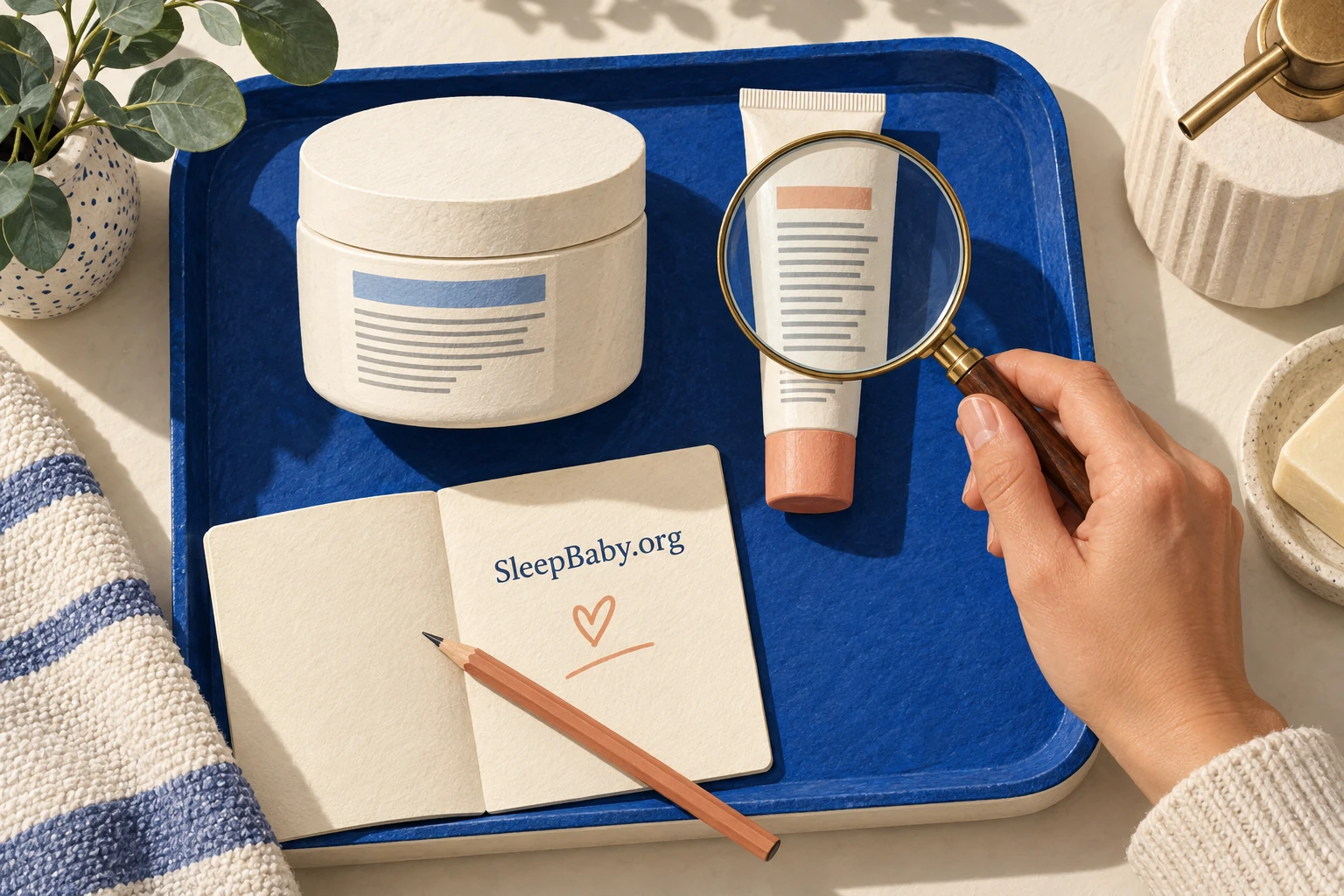
“Steroid-free” does not make a cream food. “For babies” describes its intended skin use, not a safe swallowing amount. And a cream’s white color or mild smell cannot identify the ingredients.
If you have a decanted travel pot, a homemade mixture or a label you cannot read, tell Poison Control that the contents are uncertain. Keep any original packaging you can find. Do not substitute the ingredient list of a similar-looking product.
I would also separate a swallowed amount from a skin-treatment question. This article cannot tell you whether a particular steroid strength is appropriate for your baby’s eczema. Keep using medicines only as your baby’s clinician directs, and ask that clinician about future application if mouthing is becoming a pattern.

Make the call with four details: label, amount, time, baby
You do not need to solve the exposure before calling. The point of the call is to get help with it. Poison Control asks about the product and circumstances so it can give advice for the individual situation.
Your four-line call note
LABEL: Full name, active ingredient, strength, and whether this was the original container. Keep both the tube and carton if they show different useful details.
AMOUNT: What you actually saw: a lick from skin, cream on a finger, a squeezed tube, or an unknown amount. Say “I don’t know” when that is the honest answer.
TIME: When it happened, or the last time you know the cream was out of reach. A time range is clearer than an invented exact minute.
BABY: Age, known weight, current symptoms, and anything you have already done. Do not guess a weight you do not know.
A smear on pajamas does not measure a swallowed dose. Neither does the size of the mess on the floor. I would describe those observations separately instead of subtracting them from a guessed amount missing from the tube.
If another adult saw the incident, ask them to describe it directly. One person may have seen the baby mouth a capped tube while another only saw cream on the hand. Those are different pieces of information. Keep the container nearby until the specialist has finished asking questions.

AFTER THE MEDICAL QUESTIONS
Give the cream a home. Give bedtime one starting step.

Once you have followed the advice for this exposure, an ordinary evening can have a small, repeatable order: prescribed skin care, the tube put away, pajamas, then your usual settling routine. If you want help choosing a sleep step, try the free planning preview at SleepBaby.org. It offers three choices and one suggested starting step, in your browser, without a sign-up or card.
The optional paid SleepBaby.org Workshop adds short lessons you can revisit and a seven-night tracker. I would use the tracker for ordinary bedtime notes, while keeping poison-control instructions in their own clear place.
Neither the preview nor the Workshop treats an ingestion, manages eczema or tells you when monitoring can stop. Follow the medical plan first; sleep planning can wait.
Which symptoms change the next step?
Some plain lotions can cause stomach upset, vomiting or diarrhea after swallowing. But the risk from a medicated cream depends on the actual ingredients and exposure. Do not use a list of common lotion symptoms to dismiss an unfamiliar medicine.
Match the observation to an action
Trouble breathing, collapse, seizure or inability to wake: call 911 now. Do not wait for an online assessment.
Coughing after swallowing the cream: call Poison Control promptly. Washington Poison Center warns that coughing can mean lotion has entered the lungs. Breathing difficulty is an emergency.
Vomiting, diarrhea or another new symptom: tell Poison Control what has changed, especially if symptoms persist or your baby seems less alert. Follow its instructions for reassessment.
No symptoms yet: still get advice for a medicated, prescription or unknown product. Looking well does not identify the contents or the amount.
References: emergency signs, lotion and coughing, and medicated-cream precautions.
What if cream got in an eye?
Start rinsing the eye gently with lukewarm water and contact Poison Control. Maryland Poison Center advises flushing a chemical eye exposure for 15 minutes. Have another adult call while you rinse if possible, and tell the specialist the exact cream. Do not rub the eye or improvise with another skin product.
Can you feed your baby or let them nap?
Ask those questions during the call. A recommendation about an older child taking a sip of water is not a feeding plan for every baby. I would ask, “Should I offer the usual breastfeed or bottle now, and is there anything I should avoid?” Do not force fluids to wash the cream down.
Before a nap or bedtime, ask whether your baby can follow their usual routine, what you need to observe, and for how long. Get the answer for this product and this exposure. There is no single waiting period that covers all eczema creams.
Unusual drowsiness or difficulty waking should not be written off as a missed nap. If your baby cannot be awakened, call emergency services. A monitor cannot decide whether an exposure is safe.
When your baby is following the clinician’s or poison specialist’s plan and sleeping normally, keep the usual safe sleep setup: on the back, on a firm, flat, level infant sleep surface with only a fitted sheet. NICHD’s safe sleep guidance supports an empty sleep space. Do not add a wedge, pillow or loose bedding after a cream incident.
Before handing care to another adult
Write down the product, time, advice received, symptoms to report, observation instructions and callback number. Put the exact container somewhere secure and tell the next adult where it is.
I would read the plan back in my own words before ending the call. “Keep an eye on her” is too vague to pass between two tired adults; write the actual instructions you were given.

Make putting the cream away part of applying it
The useful prevention change is often at the point of use. A locked storage cupboard does little if the tube stays on the changing mat after every application.
Keep creams in their original labeled containers, close them after use, and return them to a secure place out of your child’s reach. St. Louis Children’s Hospital recommends securing medicines, keeping harmful products in original packaging and using cabinet latches. Check visitor bags and the small tube kept in a diaper bag too.

Apply. Close. Return.
Apply according to your baby’s care plan, keeping the open container under adult control.
Close the cap before moving on to clothing or another task. Do not give the tube to your baby as a distraction.
Return it to its secure storage place. A high, locked location is more useful than a basket that only looks tidy.
If cream is regularly being licked from treated hands, ask the prescriber how to apply that particular product safely. Do not improvise with bandages or change a prescription schedule on your own.
Optional: add a latch where the creams actually live
As an Amazon Associate I earn from qualifying purchases.
The Safety 1st OutSmart Flex Lock, white two-pack, is one option to consider for a compatible cupboard with paired handles or knobs. I would consider a storage barrier before buying another eczema product in response to an ingestion scare.
Check the manufacturer’s fitting instructions against your own cupboard. Adult installation and a firm security check matter. The manufacturer describes this as a deterrent: children may defeat it, and it does not replace supervision. Replace a damaged lock and stop relying on one your child can open.
Already-owned alternative: use an existing secure, locked storage space out of reach, with creams in their original containers. You do not need a new organizer to put a tube away promptly.
See the optional cupboard lock on Amazon
Fit and guidance: Safety 1st’s home safety help center. This is a storage option, not treatment for an exposure or a guarantee against access.
Watch later: a hospital’s home poison-prevention guide
St. Louis Children’s Hospital’s “How to poison-proof your home” is a useful follow-up once you have dealt with the exposure. It is prevention guidance, not an assessment of the cream your baby swallowed.
Written takeaway: secure medicines, keep original packaging, check that cabinet latches stay closed, and ask visitors to store their medicines safely. The hospital’s written companion provides these steps if the player is unavailable.

A few details parents often need to clarify
What if it was only a lick from skin?
Describe that exact contact when you call, including when the cream was applied and its name. A trace on treated skin is a different history from squeezing a tube into the mouth. I would report the distinction without using it to calculate a safe dose myself.
What if the tube looks chewed but you saw no cream?
Tell the specialist whether the seal or cap was intact and whether any packaging pieces may be missing. Do not assume the missing material was swallowed, and do not assume it was not. Mention the packaging question separately from the cream.
Should you throw the cream away immediately?
Keep it securely out of reach while getting advice. The label and remaining contents may help identify what happened. If you are directed to seek care, take the container with you if possible. Decide about later use or disposal after the immediate questions are settled.
How much is too much?
There is no useful universal teaspoon rule for “eczema cream.” Formulation, strength, amount, age and symptoms all matter. The most useful answer you can give is what you know, what you saw and what remains uncertain.
I would finish with two concrete things: clear instructions for this baby and this exposure, and a secure home for the cream before its next use.
Sources
- Poison Control: first aid for poisonings
- Poison Control: getting help and preparing for the call
- St. Louis Children’s Hospital: how to poison-proof your home
- NICHD Safe to Sleep: reducing sleep-related risks
- Safety 1st: home safety help center and product guides
- Maryland Poison Center: first aid
- Missouri Poison Center: lotion and medicated creams
- Washington Poison Center: lotion exposure and coughing
- MedlinePlus: hand lotion poisoning
- DailyMed: hydrocortisone 1% cream label
- DailyMed: Aveeno Baby Eczema Therapy Moisturizing Cream label
- DailyMed: Elidel (pimecrolimus) cream label
ONE THING YOU CAN MAKE SIMPLER
A clear place for the tube. A clearer plan for the evening.
For this incident, keep the exact product and professional advice together. For ordinary bedtime, a small starting step may be more useful than a complete routine overhaul.
The free SleepBaby.org planning preview lets you consider that next step when you are ready. Medical instructions always come first.





What viewers said10 comments · 4 replies+
Archived comments from the original Baby Sleep Miracle presentation. Not independently verified by SleepBaby.org; individual experiences vary.
Thank you so much for this video! I had no idea about the dangers of baby swings :O
Hi Mary-Ann. I have a question: Is method in any way similar to the ones recommended by Dr Bucknam, Dr. Weissbluth or Dr. Karp? We tried those but none of them help.
Hi Regina, thank you for your question. The short answer is no. The techniques I share in my guide are based on newest scientific research and this is why I have never seen any approach similar to the one I recommend.
This method really works! I tried it on my son Jesus and after just one week he went from waking up more than 5 times a night to waking up just once or twice. You are a lifesaver, Mary-Ann!
I'm truly impressed with how much information you share in your video. And all for free! I can feel that you truly care about mothers like myself, and that's hard to find these days. I have recommended your site to several of my friends already.
Mary-Ann, our child suffers from autism. Is your approach still suited?
Chloe, I made sure my method can be used with any child, even babies who are special like yours. Please note that I'm not a doctor and that I always advice to consult with your physician because nothing is more important than the safety and well-being of your love.
Hallo Mary-Ann, I'm from Germany. Do you have your guide in German?
Hello Heide, we do! Normally you should already see our video in German. If not, please contact our support so they can guide you
Thenk you for your answer, Mary-Ann!
I just completed your approach and I have to say, it worked almost too well. Yes, it took a bit of getting used to with your bedtime routine but the difference is huge. My son George used to take 1 hours to go down and now he's firmly asleep in no more than 10 minutes! You're the best!
It seems I'm the only man watching this video, lol! What you shared about the 'emotional backpack' made immediate sense to me and I can't wait to help my little girl Mila to unpack it!
Hey there, just discovered your site and this really sounds different. Just wanted to say thanks for sharing :)
For everyone who's still thinking about getting Mary-Ann's guide I want to advise you to go ahead. I wasn't sure myself but now I'm so thankful I invested in this program. It made a huge difference in our life as a family and yes, my baby girl does sleep through the night now.