Skip to the baby sleep guide
SleepBaby.org
Tonight’s routeStart here
Full plan

For the parent awake again

Your baby won’t sleep. Let’s figure out what tonight is asking for.

Tired parent comforting a crying baby beside a clear, flat bassinet at 2:13 a.m. 2:13A.M. AWAKE AGAIN
Read the night—not your worth.1 Safety2 Needs3 Pattern
The direct answer

If your baby won’t sleep, first check breathing, fever, feeding, diaper, and pain. If they seem well, common reasons include normal waking for their age, too much or too little awake time, overstimulation, changing sleep cues, or a developmental shift. Age, the exact pattern, and whether it began suddenly determine what to try next.

Written by Kacey Safety evidence AAP + NICHD cited inline Updated July 28, 2026

You have already rocked, fed, bounced, whispered, walked the hallway, and stared at the clock as if the clock personally caused this. The goal here is not thirty more tricks. It is one safe order for deciding what tonight needs.

Tired parent comforting a crying baby beside a clear, flat bassinet in a dim nursery
2:13 a.m. is not a character test. It is a hard hour that needs a short, safe decision order.
2:13A.M.

Read the night in this order1 Safety2 Needs3 Pattern

The 2 a.m. starting point

Choose the kind of help you need before another tab opens.

Three paths. One page. No guessing which section matters first.

The 2 a.m. starting point

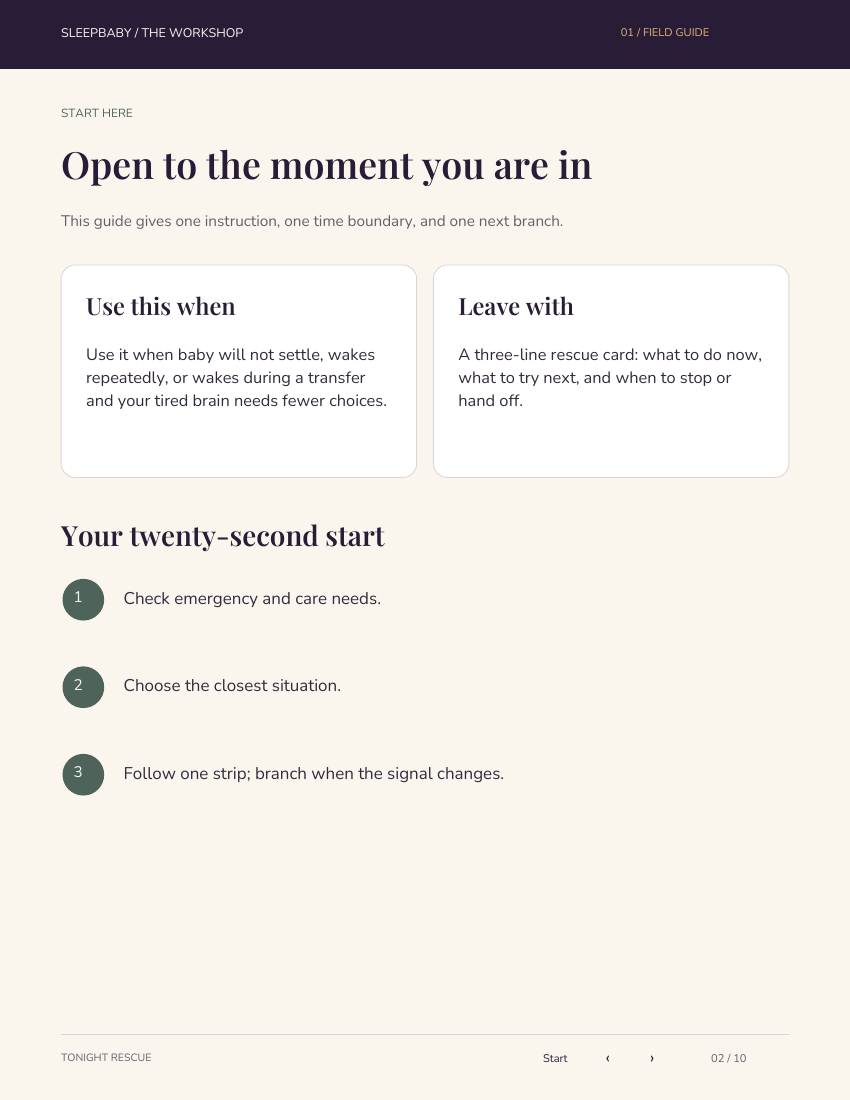
Start with three checks—not thirty random hacks.

Exhaustion makes every new trick feel urgent. A fixed decision order reduces the number of things your brain has to hold.

01

Safety and breathing

Place your baby on the back in a clear, firm, flat sleep space. Notice breathing, color, temperature, responsiveness, and whether anything feels sharply different from normal. Safety guideline · NICHD

02

Needs and discomfort

Consider feeding, diaper, burping, congestion, teething, pain, illness, temperature, and whether the baby settles differently upright versus flat.

03

Timing and cues

Then look at naps, awake time, stimulation, light, sound, routine, and the exact conditions present during the last few minutes before sleep.

Baby sleeping on the back in an empty crib while loose objects remain on a dresser away from the crib
The safe sleep space is wonderfully boring: baby, fitted sheet, firm flat surface. The personality can live everywhere else in the room.

Three levels of concern

Know when to stop troubleshooting sleep.

This is a decision boundary, not a diagnosis.

Emergency now

Breathing, color, seizure, or extreme difficulty waking

Get emergency help for trouble breathing, blue or gray color, seizure, unusual floppiness, or a baby who is extremely difficult to wake.

Contact a clinician promptly

Young-infant fever or a sudden unwell pattern

A baby younger than 3 months with a temperature of 100.4°F (38°C) or higher needs prompt medical assessment. Poor feeding, clearly fewer wet diapers, repeated vomiting, or sudden distress also deserve a call. AAP fever guidance

Arrange routine assessment

Persistent snoring, gasping, pain, reflux concerns, or ongoing disruption

Bring a three-night pattern log. Specific observations are more useful than “sleep is terrible.”

SleepBaby signature tool

The Night-Shift Sleep Decoder

Choose the closest age and pattern. This does not diagnose your baby—it points you toward the first question worth checking and keeps the important routes right here on the page.

Playful map connecting feeding, timing, comfort, sound, and change as baby sleep clues
A difficult night is usually a cluster of clues—not a verdict that you have failed.
1 How old is your baby?

Older than 12 months? Open the toddler sleep guide library →

2 What is the hardest part tonight?
3 Did this begin suddenly?

Your starting route

Begin with needs, then reduce inputs.

Why this route
When settling is hard, unresolved needs and too much input are the safest first things to sort.
Try this first
Check feeding, diaper, temperature, pain, and illness. Then dim the room and repeat one short sequence.
Stop and call if…
Breathing, color, fever, feeding, pain, responsiveness, or a sudden change concerns you.
Open the exact-problem route

Six routes searchers actually mean

“Baby won’t sleep” is six different nights hiding inside one sentence.

These are on-page routes—not endorsements of older articles that have not completed the current safety rewrite.

Crib branch

Baby won’t sleep in the crib

Start with a clear, firm, flat surface and one low-pressure transfer. Compare the sensory change between arms and mattress.

Open the crib route ↓
Bassinet branch

Baby won’t sleep in the bassinet

Check fit, flatness, transfer timing, feeding, and whether discomfort appears specifically when the baby lies flat.

Open the bassinet route ↓
Held-sleep branch

Baby only sleeps while held

Protect against accidental adult sleep first, then practice one transfer during the easiest sleep—not every sleep at once.

Open the held-sleep route ↓
Hourly-waking branch

Baby wakes every hour

Track the interval, the original sleep conditions, feeding, discomfort, and the smallest response that works.

Open the hourly-waking route ↓
Short-nap branch

Baby wakes after a short nap

Look at the exact nap length, last feed, awake time, environment, and whether the waking is calm or distressed.

Open the short-nap route ↓
Medical-concern branch

Baby’s sleep changed and something feels wrong

Start with breathing, fever, feeding, diapers, pain, vomiting, responsiveness, and your sense that this is not the usual pattern.

Open the safety ladder ↑

The semantic center of this guide

12 reasons your baby won’t sleep—and the clue each pattern gives you

01
Common pattern—not a diagnosis

Baby fights sleep even when exhausted

What it looks like: Yawning, rubbing eyes, fussing, arching, or seeming suddenly energetic when sleep should be close.

Open the practical breakdown
Why it may happen
The timing may be a little early or late, or the baby may be too stimulated to shift from alertness into sleep. “Very tired” does not always mean “able to settle right now.”
Try tonight
Lower light and interaction, use the same short ending, and test bedtime by only 10–15 minutes for three nights before making another change.
Get advice when
Ask for advice if distress is intense, the change was sudden, feeding is poor, pain is suspected, or sleepiness is unusual.
Supporting source · AAP baby sleep guidance ↗
02
Common newborn pattern

Baby sleeps by day but not at night

What it looks like: Longer daytime stretches followed by alert, hungry, or unsettled periods after the household is ready for bed.

Open the practical breakdown
Why it may happen
Newborn body clocks are still developing, and frequent feeding remains normal. Day and night become clearer gradually rather than through one perfect schedule.
Try tonight
Keep daytime feeds and ordinary daylight active; keep nighttime care dim, quiet, and boring while still responding to feeding and comfort needs.
Get advice when
Contact a clinician about poor feeding, fewer wet diapers, fever, breathing concerns, extreme sleepiness, or difficulty waking.
Supporting source · AAP newborn sleep guidance ↗
03
Pattern clue

Baby wakes after 20–45 minutes

What it looks like: A nap or first bedtime stretch ends almost as soon as you sit down, often at a fairly repeatable interval.

Open the practical breakdown
Why it may happen
A light-sleep transition, hunger, discomfort, timing, or a large difference between how sleep began and what the baby finds on waking may all matter.
Try tonight
Track the exact interval, last feed, last nap, and smallest response that works. Protect one sleep period instead of trying to rescue every nap at once.
Get advice when
Get advice for painful waking, repeated vomiting, breathing noise, poor growth, or a sudden change from the baby’s normal pattern.
Supporting source · AAP sleep-cycle overview ↗
04
High-intent branch

Baby wakes every hour

What it looks like: The baby settles, then wakes through the night at short intervals and seems to need a full reset each time.

Open the practical breakdown
Why it may happen
Feeding, discomfort, schedule, development, illness, or needing the original falling-asleep conditions restored can overlap.
Try tonight
For three wakes, record what happened immediately before sleep and what the smallest effective response was. Change one repeated condition, not the whole day.
Get advice when
Discuss loud snoring, gasping, breathing pauses, persistent pain, poor feeding, fewer wet diapers, or a sudden distressed pattern with a clinician.
Supporting source · AAP baby sleep guidance ↗
05
Common pattern—not a bad habit

Baby won’t sleep without nursing, rocking, or a pacifier

What it looks like: The same comfort is needed at bedtime and again after many wakings, even when other needs appear met.

Open the practical breakdown
Why it may happen
The comfort has become a strong, familiar sleep cue. That is information—not proof that you “caused” a broken sleeper.
Try tonight
Keep the comfort, then change only the final minute: pause the motion sooner, add a consistent phrase, or let the sleep space become part of the ending.
Get advice when
Ask for feeding help when nursing is painful, intake is uncertain, weight gain is a concern, or the baby cannot settle even while feeding.
Supporting source · AAP settling guidance ↗
06
Transfer pattern

Baby sleeps held but wakes in the crib or bassinet

What it looks like: Sleep feels deep in your arms, but the baby startles, cries, or fully wakes during or shortly after the transfer.

Open the practical breakdown
Why it may happen
Warmth, scent, pressure, movement, position, and the startle reflex all change at once during a transfer.
Try tonight
Practice during the easiest sleep, lower slowly, keep your hands in place briefly, and count one calm transfer as useful practice even when it does not last.
Get advice when
If you may fall asleep holding the baby, place the baby on the back in a separate firm, flat, clear sleep space. Avoid couches and armchairs, and ask another adult to take over when possible.
Supporting source · AAP guidance for exhausted parents ↗
07
Change-first route

Baby suddenly stopped sleeping

What it looks like: A baby who had a recognizable pattern becomes much harder to settle or starts waking far more often over a short period.

Open the practical breakdown
Why it may happen
Illness, pain, feeding change, travel, a new skill, separation, teething, or a nap shift may be involved. “Regression” is not the only explanation.
Try tonight
List what changed in the previous 72 hours, preserve the familiar wind-down, and check physical needs before adding a tougher sleep tactic.
Get advice when
Promptly contact a clinician for fever in a young infant, breathing changes, poor feeding, repeated vomiting, unusual lethargy, or a change that alarms you.
Supporting source · AAP fever and urgent-sign guidance ↗
08
Exact-problem route

Baby won’t sleep in the crib or bassinet

What it looks like: The baby settles elsewhere but protests the sleep space, wakes on contact with the mattress, or lasts only a short time there.

Open the practical breakdown
Why it may happen
The sleep space may feel like a sudden sensory change, the transfer may happen during light sleep, or discomfort and feeding may become more obvious when flat.
Try tonight
Use a clear, firm, flat surface; repeat one low-pressure transfer at the easiest sleep; and keep the final cue the same. Never add pillows, positioners, inclined products, blankets, or parent-scented clothing to the sleep space.
Get advice when
Seek advice if lying flat consistently causes pain, choking, breathing difficulty, poor feeding, or forceful/repeated vomiting. Do not incline the crib for reflux.
Supporting source · NICHD safe sleep environment ↗
09
Low-risk experiment

Baby is too alert after a busy day

What it looks like: Fast movement, squealing, darting eyes, repeated second winds, or distress that grows as the routine becomes longer.

Open the practical breakdown
Why it may happen
Bright light, noise, faces, screens, a long routine, or repeated technique changes can keep adding input when the baby needs less.
Try tonight
For the last 15 minutes, reduce faces, words, lights, and movement. Use one short sequence and do not add a new “fix” every thirty seconds.
Get advice when
Get advice when the baby cannot be consoled, appears in pain, has unusual movements, or the behavior is a sharp change from normal.
Supporting source · AAP sleep-habit guidance ↗
10
Needs-first route

Feeding or physical discomfort is interrupting sleep

What it looks like: Rooting, repeated feeding attempts, arching, gas, congestion, coughing, or waking that changes with position.

Open the practical breakdown
Why it may happen
Hunger, feeding mechanics, congestion, teething, illness, temperature, or digestive discomfort may be part of the picture. Sleep advice cannot diagnose which one.
Try tonight
Check the feed, burp, diaper, temperature, and congestion; note whether the baby seems comfortable and alert after feeding; and keep the sleep surface flat.
Get advice when
Contact a clinician or feeding professional for poor intake, pain, coughing/choking with feeds, fewer wet diapers, blood, repeated vomiting, or poor growth.
Supporting source · AAP reflux guidance ↗
11
Safety guideline

The swaddle or startle pattern has changed

What it looks like: A young baby startles awake, breaks free repeatedly, or suddenly seems less comfortable in a swaddle.

Open the practical breakdown
Why it may happen
The startle reflex changes over time, and rolling attempts make swaddling a safety issue rather than merely a settling choice.
Try tonight
Always place a swaddled baby on the back. Stop swaddling when the baby shows signs of trying to roll, and never use weighted swaddles or weighted sleep products.
Get advice when
Ask the pediatrician about safe transition options when rolling begins early, the baby repeatedly escapes, or you are unsure whether the product is appropriate.
Supporting source · AAP swaddling safety ↗
12
Low-risk experiment

Light, sound, or room conditions keep changing the pattern

What it looks like: The baby settles in one room or condition but wakes with doors, siblings, bright light, sudden noise, or a change in temperature.

Open the practical breakdown
Why it may happen
The environment can become part of the sleep cue, but “more” is not always better—especially with sound volume or added crib items.
Try tonight
Keep the crib clear, dim the room, and use a steady modest sound only if helpful. Keep sound machines as far from the baby’s head as practical and never use sound to mask a baby’s needs.
Get advice when
Discuss hearing concerns, persistent congestion, breathing noise, overheating, or a baby who appears unwell with a healthcare professional.
Supporting source · AAP infant noise guidance ↗

Is this normal by age?

What baby sleep can look like by age—without turning wake windows into a report card

Use age as context, not a rigid promise. Feeding, growth, health, temperament, and development still matter.

0–3months

Frequent waking and feeding can be normal

What to expect: Sleep is spread across day and night, and stretches can be short.

Try: protect feeding, keep nighttime care dim, and focus on safe sleep rather than a strict schedule.

Call when: feeding, wet diapers, breathing, fever, color, or responsiveness concerns you.

4–6months

Cycles and sleep cues become easier to see

What to expect: The CDC’s general range for ages 4–12 months is 12–16 hours in 24 hours, including naps—not a requirement for every individual day. CDC sleep duration

Try: compare the final nap, the last five minutes before sleep, and one small timing change.

Call when: waking is painful, sudden, or paired with feeding or breathing concerns.

7–12months

Movement, separation, and nap changes join the night

What to expect: The same 12–16-hour 24-hour range includes naps, while individual patterns vary. New skills can temporarily make sleep louder.

Try: fill the connection cup before bed, keep the ending recognizable, and test one nap variable.

Call when: snoring, gasping, pain, poor feeding, or a dramatic change persists.

AAP expert perspective · safe sleep + real life

Safe sleep rules are clear. Exhausted nights are not.

That is why this American Academy of Pediatrics conversation belongs here. Host Edith Bracho-Sanchez, MD, FAAP, speaks with Rachel Moon, MD, FAAP, who helped write the AAP safe-sleep recommendations. Together they separate the safety rules from the practical habit-building choices families can adapt.

01

Keep the sleep space clear

Use a separate, firm, flat, approved sleep surface with the baby placed on the back.

02

Build habits around the safety rule

The calming routine can fit your family; the safe sleep surface does not become optional.

03

Respond to the baby in front of you

Age, feeding, health, and the exact waking pattern matter more than a one-size-fits-all script.

Not watching right now? The page already gives you the practical takeaway above. The video is here when hearing two pediatricians talk through the gray areas would feel more reassuring.

Read NICHD safe-sleep guidance ↗
Why it belongs here: This is not a random sleep clip. It is an AAP conversation about safe sleep, the difficulty of following guidance while exhausted, and when families may begin discussing sleep training.

Save this for the next hard night

Tonight’s 15-minute reset

The first page is the fast reset. The free kit also includes a safety check, six-pattern night map, three-night tracker, transfer plan, and morning debrief.

Download the free 9-page Night-Shift Reset Kit
  1. 00–03
    Check needs

    Feeding, diaper, burping, temperature, congestion, pain, and anything suddenly different.

  2. 03–06
    Lower the room

    Dim light, fewer words, slower movement, and one steady sound environment.

  3. 06–09
    Repeat familiar cues

    Use the same short phrase, touch, song, or routine ending.

  4. 09–12
    Choose one response

    Feed, hold, rock, pause, or transfer based on the actual need—not guilt.

  5. 12–15
    Reassess

    If distress is rising, return to needs and health. If the baby is settling, stop adding inputs.

Original, ungated tool

One change. Three nights.One change.
Three nights.

Pick one change. Compare three nights before changing the plan again.

PickRepeatCompare
Night 1Start here
Night 2Open this night
Night 3Open this night
Nothing is sent to SleepBaby.org.

Questions parents actually type

Baby won’t sleep: exact-scenario answers without the perfect-parent fantasy

Pricing and checkout questions live on the purchase page, so these answers stay focused on the sleep problem that brought you here.

Why won’t my baby sleep in the crib or bassinet?

The transition may change warmth, scent, pressure, movement, and position all at once. Use a clear, firm, flat sleep surface; practice one transfer during the easiest sleep; and keep the final cue familiar. Do not add pillows, wedges, loose blankets, positioners, or parent-scented clothing to make the space feel cozier.

Why does my baby wake as soon as I put them down?

The baby may still be in light sleep, may notice the sudden loss of contact and motion, or may be uncomfortable when flat. Lower slowly, keep your hands in place briefly, and treat one transfer as practice. Repeated pain, choking, breathing trouble, or forceful vomiting needs professional advice—not a crib incline.

Why does my exhausted baby fight sleep?

A very tired baby can also be too stimulated, slightly mistimed, hungry, uncomfortable, or expecting a long chain of cues. Lower input and test one small timing adjustment for several nights instead of rebuilding the whole schedule after one hard bedtime.

Why does my baby wake every hour?

Hourly waking can involve feeding, discomfort, development, timing, illness, or needing the original falling-asleep conditions restored. Track the interval and smallest effective response. Loud snoring, gasping, pain, poor feeding, fewer wet diapers, or a sudden distressed change needs medical advice.

What if my baby only sleeps while being held?

Contact sleep is understandable because your warmth, scent, pressure, and movement are powerful cues. Practice one low-pressure transfer during the easiest sleep. If you may fall asleep, place the baby on the back in a separate clear, firm, flat crib or bassinet and avoid couches and armchairs.

Is frequent newborn waking normal?

It can be. Newborn sleep is immature and feeding needs are frequent. The whole picture matters: feeding, wet diapers, growth, breathing, temperature, color, and responsiveness. Contact a clinician when those areas concern you or the waking pattern changes sharply.

Can white noise help?

A steady modest sound can reduce the contrast of sudden household noise, but volume and placement matter. Keep the device away from the baby’s head, use the lowest useful volume, and never let sound replace checking feeding, comfort, breathing, or illness.

When is baby sleep trouble a medical concern?

Get emergency help for breathing trouble, blue or gray color, seizure, unusual floppiness, or extreme difficulty waking. Contact a clinician promptly for a young infant’s fever, poor feeding, fewer wet diapers, repeated vomiting, pain, or a sudden change. Arrange routine assessment for persistent snoring, gasping, reflux concerns, or ongoing sleep disruption.

Why did my baby suddenly stop sleeping?

A sudden change can follow illness, pain, feeding changes, travel, a new skill, a schedule shift, separation awareness, or a different sleep environment. Start with health and comfort before treating it as a habit problem. Contact a clinician when the change is paired with fever, breathing trouble, poor feeding, fewer wet diapers, repeated vomiting, unusual sleepiness, or pain.

Why does my baby sleep all day and stay awake at night?

Newborn day-and-night rhythms are still developing, and frequent feeding remains normal. Use ordinary daylight and interaction during daytime feeds, then keep nighttime care dim, quiet, and predictable. Do not try to force a newborn to stay awake for long stretches; feeding, wet diapers, growth, breathing, and responsiveness matter more than a perfect clock.

Stylized editorial portrait of a smiling mother near palm trees and the ocean
Editorial illustration

Who this comes from

A parent-built decision guide with evidence clearly labeled

Kacey created the original SleepBaby.org method after Benjamin’s sleep changed at five months and a pile of confident advice left the family with more contradictions than clarity. The parent story explains the framework; it does not replace medical expertise.

“I was not looking for a perfect baby. I was looking for a plan I could remember while holding a crying one.”

Clinical-review honesty

No clinician is named until a real clinician reviews this exact page.

Safety and medical statements are linked to current AAP, NICHD, CDC, and HealthyChildren guidance. WordPress settings include dedicated reviewer fields; when a qualified reviewer completes and documents the review scope, their real name and credentials will appear here and in structured data. SleepBaby.org does not fabricate medical review.

Updated: July 28, 2026

Evidence labels: Safety guideline · Parent experience · Common pattern—not a diagnosis · Low-risk experiment.

Primary sleep and safety sources10 references · citations also appear beside relevant claims
  1. NICHD Safe to Sleep: Safe Sleep Environment for Baby
  2. American Academy of Pediatrics / HealthyChildren.org: Baby Sleep
  3. American Academy of Pediatrics: Safe Sleep Tips for Sleep-Deprived Parents
  4. American Academy of Pediatrics: Fever—When to Call the Pediatrician
  5. American Academy of Pediatrics: Swaddling Safety
  6. American Academy of Pediatrics: Infant Reflux
  7. American Academy of Pediatrics: Noise and Newborn Hearing
  8. CDC: How Much Sleep Do I Need?
  9. American Academy of Pediatrics: Corrected Age for Preemies
  10. American Academy of Pediatrics / HealthyChildren podcast: Sleep—Teaching Good Habits Early
The full method—not a mini version
Cartoon illustration of a tired crying baby

Normally $40.We’re testing flexible family-first pricing because everyday costs feel especially heavy.

Regular price$40

Choose what works today

Why we’re testing flexible pricing

The full $40 method. A little breathing room for real-life budgets.

SleepBaby.org normally charges $40. We’re testing a family-first price choice because diapers, groceries, and family life are expensive. The method does not change: every chapter and all three bonuses stay included.

01Choose today’s price02Pay securely03Open the full method
Get the full method — choose today’s price

Regular price: $40 · Same complete method at every allowed amount.

Full method3 bonusesOne-time payment365-day guarantee
This is a family-first pricing experiment—not a clearance sale, subscription, or stripped-down version.