
Before anyone reaches for the baby
A newborn can sometimes attend a family reunion – but there is no magic safe age
Decide from the baby’s health, the gathering, the travel, and the recovering parent’s capacity – not from family pressure or a date on the calendar. A short visit may be reasonable for a healthy full-term newborn when sick people stay away, handwashing and no-kissing boundaries are respected, the space is not crowded or overheated, feeding and an approved safe-sleep surface are available, and you can leave immediately. Ask the baby’s clinician first if the baby was premature, medically fragile, recently hospitalized, is unwell, or you are unsure about a very young newborn during a high-respiratory-virus period.
The household at bedtime
Different people.
One household at night.
If you’re also caring for a baby and want help with sleep, our video is below. Watch when that’s the question you want to work on.
Prefer to read?Press play for a little help with your baby’s next bedtime.
Kind words about the original video
“Thank you so much for this video!”
“I'm truly impressed with how much information you share in your video.”
The SleepBaby Workshop
Get the Workshop.
Get the Workshop and explore its resources for everyday baby sleep and nighttime care. 15 guides and five audio tracks in a simple browser hub. Read, listen, and return to the part you need.
A conversation, if you want one.Night Owls is the SleepBaby chat room. Read what is there or join in.
A family reunion has a group photo, a buffet line, and one relative who can detect a newborn from three rooms away. None of those gets a vote over the baby’s airway, feeding, or your recovery.
The kindest plan begins before the door opens. You decide who may come close, who may hold the baby, where feeds happen, where a safe nap can happen, how long you are willing to stay, and which adult says, “We’re heading home now.” The baby is not a reunion pass-the-parcel, and a polite boundary is still polite when it is delivered before someone has both arms out.
Newborns are not all carrying the same level of risk. A healthy baby born at term and feeding well is a different decision from a baby who arrived early, has a heart or lung condition, has recently been in the hospital, is struggling with feeds, or seems unwell today. The venue matters too. A breezy afternoon with six healthy relatives and a private room is not the same event as 70 people in a warm hall during a respiratory-virus surge.
Make the plan around the least flexible person in the room: the newborn, followed closely by the adult who gave birth. That is not being difficult. It is accurate event planning.


Use four questions to choose go, shorten, or postpone
There is no single number of days or weeks after birth that makes every reunion appropriate. Instead, look at four parts of the actual day: the baby, the gathering, the travel, and the caregiver. A “yes” in one column does not cancel a serious concern in another.
The decision is allowed to be smaller than the invitation
Go, make it a short hello, or stay home?
GO WITH A PLAN
The baby is healthy and feeding normally; the gathering is small or well ventilated; nobody is ill; your boundaries are welcome; you have a quiet base, safe sleep option, and an easy exit; and the recovering parent genuinely wants to go.
MAKE IT A SHORT HELLO
The event is larger, indoors, warm, noisy, or farther away; several people want to hold the baby; the parent is tired; or feeding and sleep will be awkward. Arrive after the opening rush, keep the baby with one caregiver, skip the long meal, and leave before the plan becomes fragile.
POSTPONE
The baby or caregiver is unwell; a high-risk baby has not been cleared; sick or cold-sore guests may attend; the venue cannot provide safe temperature or sleep; boundaries will be argued with; travel is too demanding; or you simply do not have the physical or emotional capacity today.
Sleep connection: a shorter, controlled visit protects the next feed and sleep period better than staying until everybody is overtired and the only remaining plan is endurance.
If the answer is postpone, offer another kind of connection: a short outdoor visit with two relatives, a video call during the group photo, or a later meal when the baby and parent have more reserve. Missing one event does not erase the baby’s place in the family.
Ask the host five questions before you pack
Do not arrive hoping the useful details will reveal themselves. Ask in advance:
- Has anyone been sick? Ask about fever, cough, sore throat, runny nose, vomiting, diarrhea, or a new rash – including children who are “mostly better.”
- Will the gathering be indoors, outdoors, or both? Ask about ventilation, shade, cooling, and whether you can move away from the main crowd.
- Is there a private, low-traffic room? You need somewhere to feed, change, settle, and breathe without a parade of visitors opening the door.
- Is there space for the baby’s approved sleep setup? A spare adult bed, couch, recliner, blanket on the floor, stroller, or car seat is not the plan.
- Can you park or leave easily? Do not let your car become boxed in, your supplies migrate across the property, or your exit depend on a group decision.
Tell the host the boundaries at the same time, so they can help rather than be surprised: “We’re keeping the baby with us, asking everyone to wash hands, doing no kisses, and skipping visits with anyone who is sick. We may only stay a little while.” A supportive host can repeat that before you arrive. This is much easier than asking a newly postpartum parent to enforce every rule while holding a hungry baby.
Keep illness, vaccines, hands, and kisses in their proper lanes
Newborn immune systems are still developing. CDC recommends that family members and caregivers be current on routine vaccines, including Tdap and seasonal influenza when indicated, ideally at least two weeks before meeting the baby.1 Babies do not begin their own pertussis vaccine series until about 2 months, and babies younger than 6 months are too young for a flu vaccine. Vaccinated adults create useful protection around a baby; vaccination does not turn an actively sick person into a safe visitor.
CDC says people with respiratory-virus symptoms should stay home until their symptoms are improving overall and they have been fever-free for at least 24 hours without fever-reducing medicine, then use added precautions for five days.3 For a newborn reunion, you can use the simpler family rule: if someone is sick, they do not meet the baby that day. You do not need to debate whether a cough is allergies at the front door.
RSV often looks like an ordinary cold in adults, but infants – especially those younger than 6 months – can become seriously ill and may develop bronchiolitis or pneumonia.2 The goal is not to make relatives prove they are germ-free. It is to remove avoidable close contact when illness is present.
One doorway rule saves twelve awkward conversations
Who comes close to the newborn?
COME CLOSE
Healthy people who wash and dry their hands, follow no-kissing and holding rules, and return the baby immediately when asked.
WAVE FROM A DISTANCE
Anyone with uncertain recent symptoms, a recent exposure, or a child who cannot reliably keep hands away from the baby’s face. Connection does not require close contact.
MEET ANOTHER DAY
Anyone currently ill, feverish, vomiting, newly rashy, or with a current or recent cold sore who may kiss or touch the baby. No exception for the group photo.
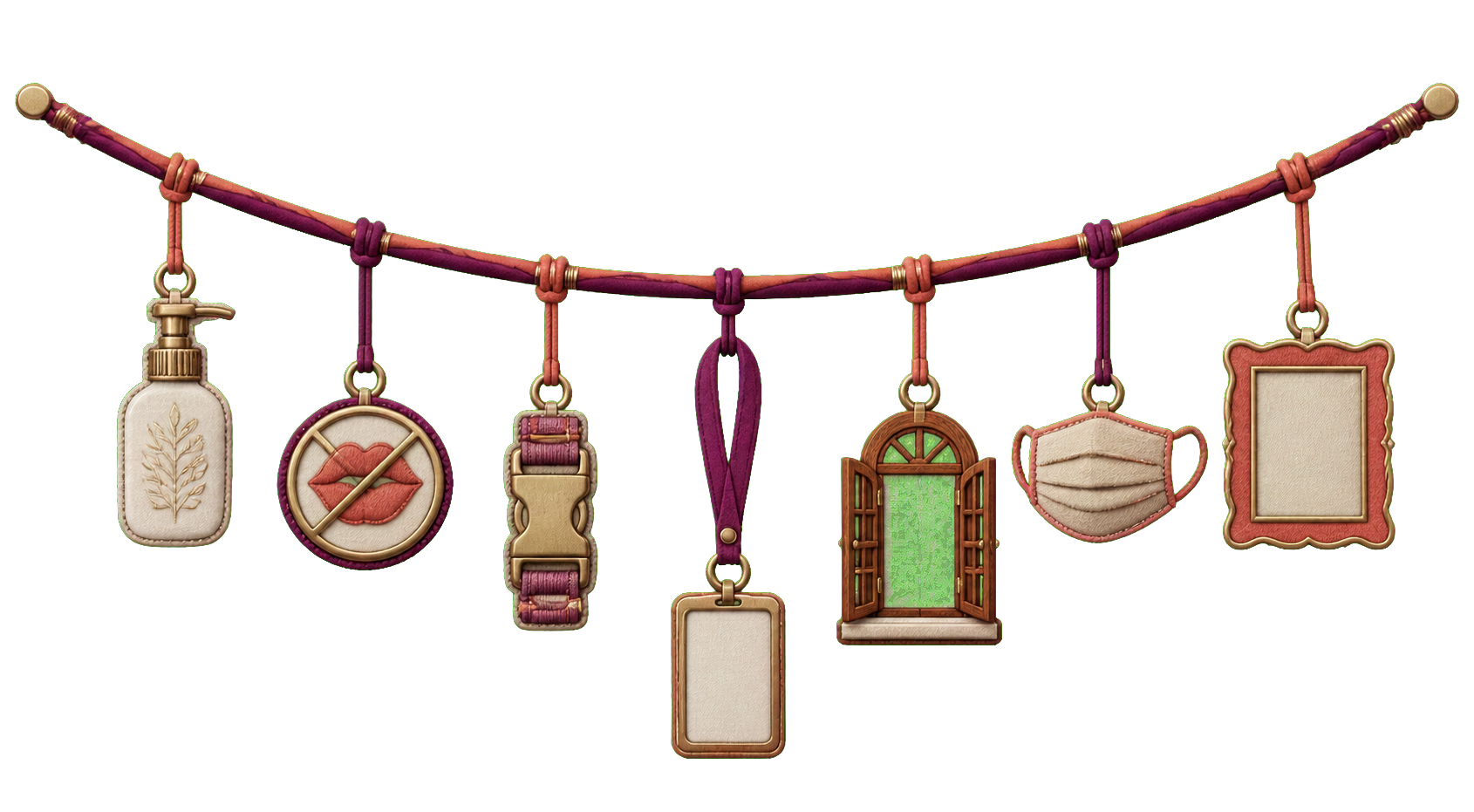
Everyone who will touch the baby should wash hands with soap and water, scrubbing for about 20 seconds. When soap and water are unavailable, CDC recommends sanitizer containing at least 60% alcohol.4 Let hands dry, keep sanitizer closed and away from the baby, and focus on the moments that matter rather than wiping every chair in the house.
No kissing is a reasonable newborn rule. NHS guidance warns that the herpes virus can be dangerous for a young baby and can spread through a cold sore. Everyone should wash hands before handling the baby; discourage kisses near the baby’s face; and anyone with a current or recent cold sore should not kiss the baby.7 If contact with a cold sore has already happened, our guide to what to do when a baby touches a cold sore gives the immediate next steps without pretending a web page can examine the baby.
Choose one adult to be the gatekeeper
The person holding the newborn should not also have to defend every boundary, find the diaper bag, answer health questions, and judge the exit. Give one adult the gatekeeper job. That person greets people first, points toward the sink, answers holding requests, watches the room, and says when the family is taking a break.
Use short scripts. Long explanations invite negotiation:
- “We’re keeping holding limited today.”
- “Please wash your hands, and we’re doing no kisses.”
- “We’re taking a quiet feeding break now.”
- “The baby is staying with us for the photo.”
- “We’re heading home now. We loved seeing you.”
Babywearing can reduce casual handoffs when the carrier is appropriate for the baby’s size, fitted according to its instructions, and used with the baby’s face visible and airway position monitored. It is not a social-force field. People still need a direct boundary, and the adult must watch heat, bending, fatigue, and their own physical recovery.
If you want one group picture, decide before arrival whether the baby stays in a caregiver’s arms, who may stand nearby, and whether the image may be posted. Family access is not automatic internet consent. Our guide to sharing baby photos more deliberately can help you set the group-chat and social-posting rule before 14 versions of the same photo leave the room.
Arrive, build one home base, then greet people
Do not carry the baby directly from the car into the center of the room. First, one adult finds the quiet space and sets down the reachable supplies. Keep milk at the correct temperature, put diapers and a change of clothes within reach, locate the bathroom and sink, and set up the approved sleep space if you brought one. The other adult keeps the baby secure and out of the greeting swirl.
- Pause outside. Feed or change the baby if needed, secure loose bags, agree on the likely departure time, and name the gatekeeper.
- Build the quiet base. Put feeding, diapering, clothing, and safe-sleep supplies in one private room before they are urgent.
- Wash hands. Caregivers wash first, then anyone invited to come close does the same.
- Make one introduction. Let people look and talk without passing the baby. The gatekeeper answers requests before the holding caregiver has to.
- Leave while the exit is still easy. Do not wait for the baby to prove the plan has failed.
This sequence may look overly deliberate until the group photo is called at the same moment the baby needs feeding. Then the reachable bag and closed quiet-room door feel like excellent family diplomacy.
Protect feeding and diaper care from the crowd
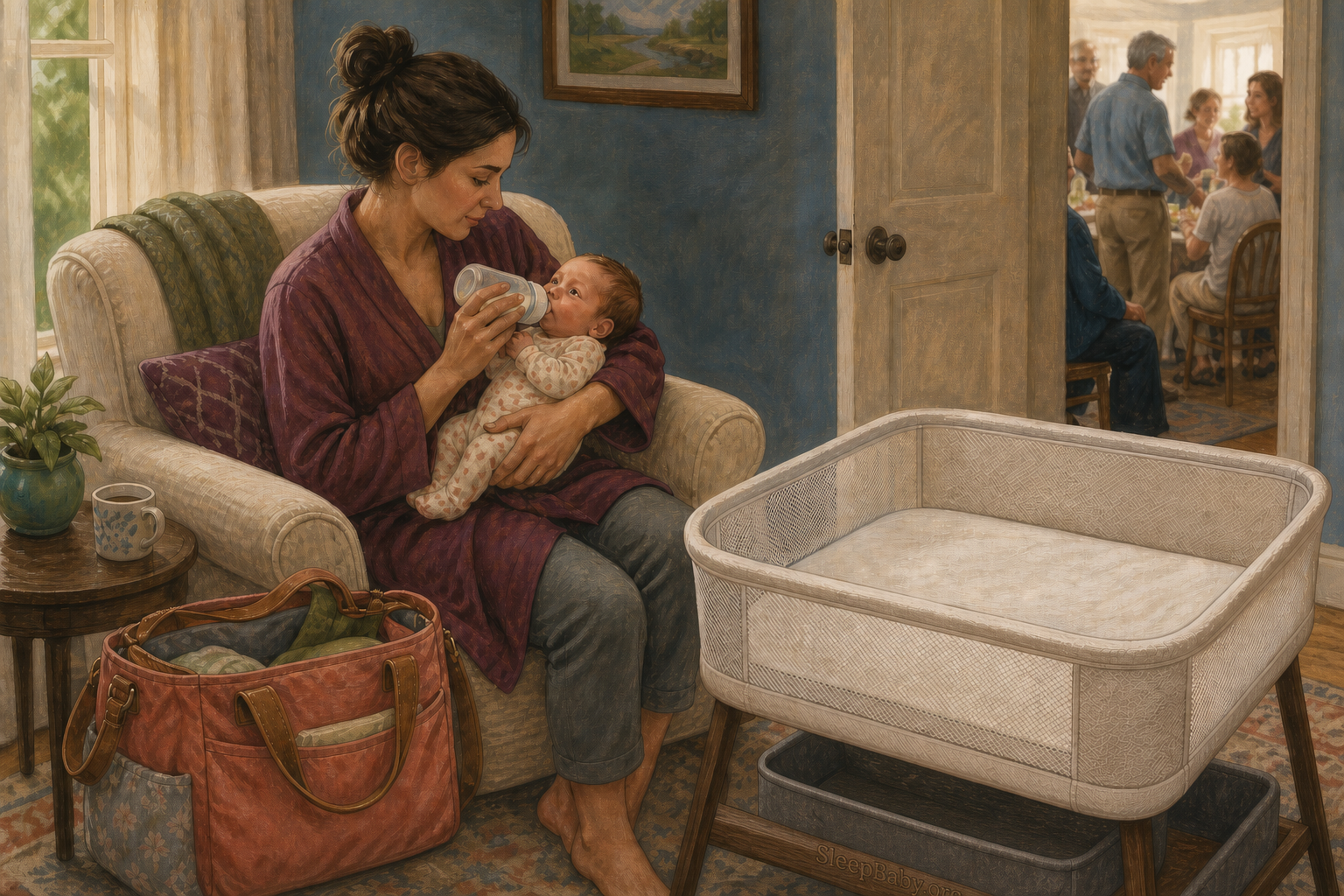
Follow the baby’s usual feeding cues and plan. Do not delay a newborn feed for the meal, speeches, or photo. If nursing, pumping, or bottle-feeding feels easier in private, use the quiet room and close the door. Privacy is not a punishment for the family; it is how a baby eats without every conversation moving closer.
For formula, wash hands and use clean, sanitized equipment. CDC says prepared formula should be used within two hours of preparation and within one hour after feeding begins. If feeding has not started, refrigerate prepared formula immediately and use it within 24 hours. Discard leftovers from a feed because saliva allows bacteria to grow.10 Babies younger than 2 months, babies born prematurely, and babies with weakened immune systems need extra preparation precautions; follow CDC and the baby’s clinician.
Bring the water and formula plan you already know how to use safely rather than experimenting at the event. Do not warm a bottle in a microwave. Label pumped milk clearly, keep cold items cold, and make sure a well-meaning relative does not move the cooler to make room for potato salad.
Use a stable, clean changing surface within reach of the supplies. Keep one hand on the baby. Bag soiled items and wash hands afterward. Do not turn a bed, couch, or high counter into an unattended changing station, even for a second.
Pack by the next job, not by the whole weekend
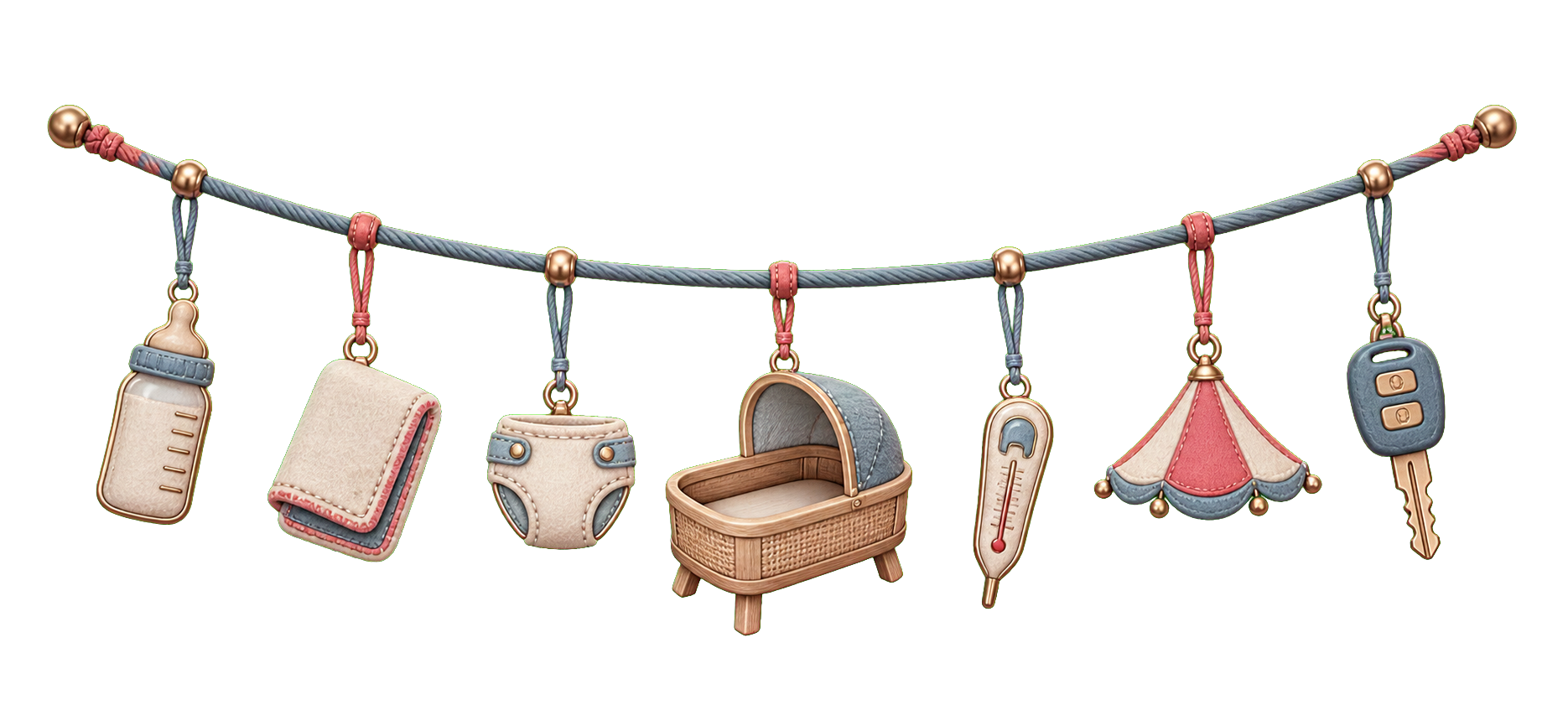
Keep four small kits where the baby actually is
FEED
The baby’s usual milk plan, clean bottles or pump parts, cloths, cooler and ice packs if needed, and a simple timing note.
CHANGE
Diapers, wipes, a compact mat, two clothing changes, and closed bags for wet or soiled items.
SLEEP
An approved portable crib, bassinet, or play yard if the baby may sleep; fitted sheet made for it; and the familiar sleep clothing appropriate for the room.
LEAVE
Car keys, phone, charger, caregiver medication, water and snack for the adult, and one bag that can be picked up without repacking the room.
A reunion nap still needs the baby’s real safe-sleep setup
The American Academy of Pediatrics recommends placing babies on their backs for every sleep on a firm, flat surface in an approved crib, bassinet, portable crib, or play yard. Keep the sleep space empty: no pillows, blankets, quilts, bumper pads, positioners, stuffed toys, or another person.5
If the baby falls asleep in a car seat, stroller, swing, carrier, sling, or another sitting device, move the baby to the approved firm, flat surface on the back as soon as possible.5 The car seat is for correctly restrained vehicle travel. It does not become the reunion bassinet when carried into the house.
A spare adult bed is not the answer. Neither is a couch, armchair, recliner, pile of coats, blanket on the floor, or a relative volunteering to hold the sleeping baby. Couches and armchairs are especially dangerous places to doze with a baby. If there is no approved sleep surface and the baby needs a proper sleep, that may be the moment to go home.
Keep the room comfortably cool and avoid overdressing. AAP advises no more than one extra layer compared with what an adult would wear in the same environment and watching for sweating, a hot chest, or flushed skin.5 Do not drape a blanket over a stroller or carrier to create darkness; it can reduce airflow and trap heat.
If the newborn resists the portable bassinet in an unfamiliar room, do not solve it by moving to an unsafe surface. Our guide to a newborn who will not sleep in the bassinet walks through safe settling options. At a reunion, the most practical option may still be ending the visit.
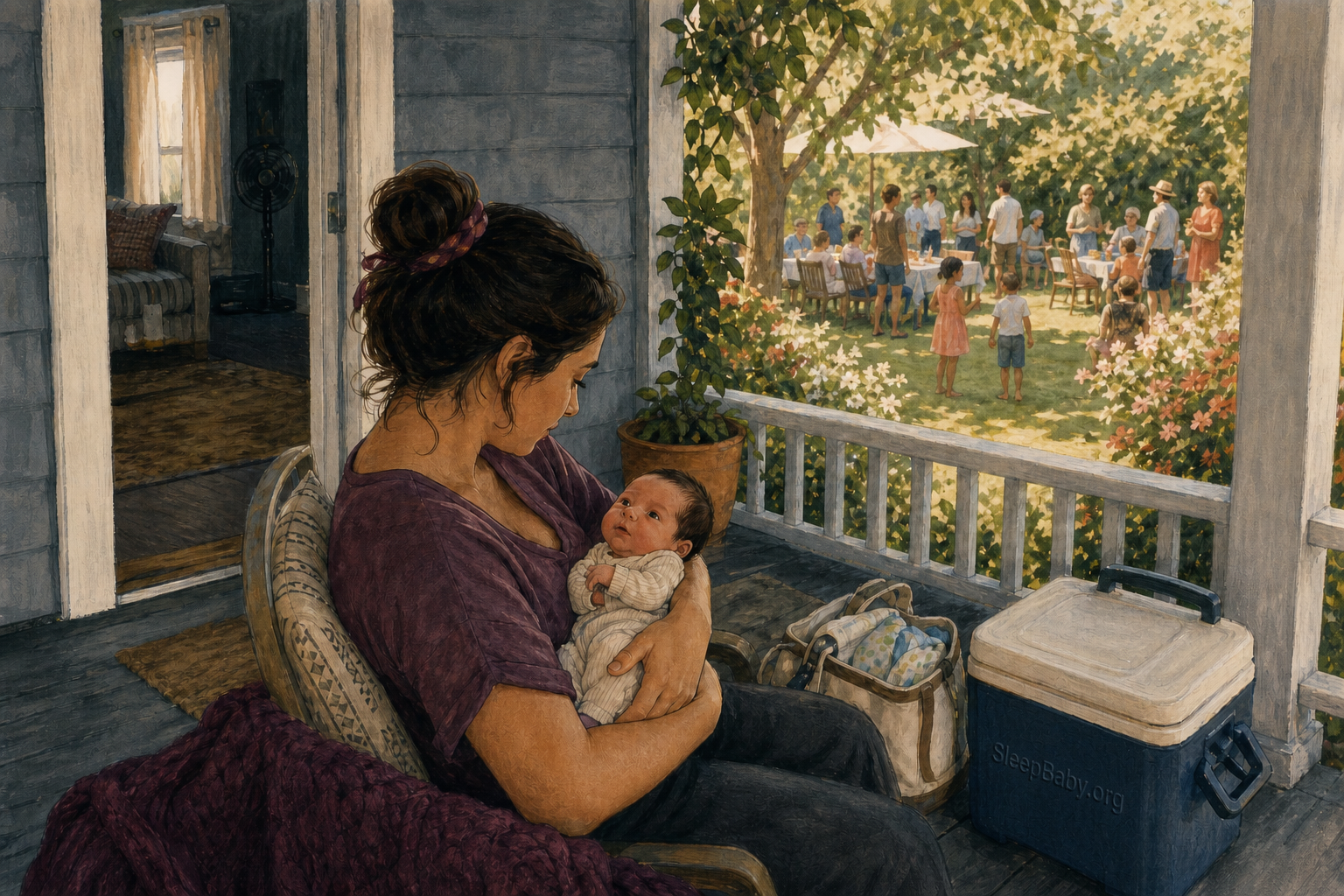
For an outdoor reunion, shade is the starting point, not the whole heat plan
AAP advises keeping babies younger than 6 months out of direct sunlight. Use deep shade, a brimmed hat, and lightweight clothing that covers the skin. If adequate clothing and shade are unavailable, a small amount of sunscreen may be used on small exposed areas, but shade remains the first choice.9
Shade does not cool hot air. Have access to a safely cooled indoor space, check the baby frequently, and shorten or cancel the visit when the temperature or humidity makes the plan unreliable. A parked car – running or not – is never the quiet, cool nap room.
Watch for a hot chest, sweating, unusual sleepiness, feeding trouble, fewer wet diapers, rapid breathing, or a baby who simply seems wrong. Move to a cooler place and seek medical advice promptly if the baby is unwell. A newborn does not need to stay for the picnic to prove the family prepared enough shade.
Plan the car ride and the recovering adult as carefully as the event
NHTSA says babies from birth through 12 months should ride rear-facing in the back seat in the correct car seat, following the car-seat and vehicle instructions.8 Use the correct restraint on every trip, including a short ride with a relative. Do not feed the baby while the vehicle is moving and do not loosen the harness to improve a nap.
Arrange the seat before the day of the reunion. Do not let the first installation happen in a crowded driveway while relatives offer six conflicting memories of how their own children rode. If you need hands-on help, use a qualified car-seat inspection resource before the trip.
The adult who gave birth is not luggage. Sitting in a car, walking across a field, standing through introductions, feeding, bleeding, pain, sleep loss, and having no private bathroom can make a simple event physically expensive. The recovering parent gets a full vote, including a no that arrives on the morning of the reunion.
If another adult is driving, that person can also own the bags, food, host communication, and exit. Protect the recovering parent’s job list from quietly expanding because they are the one who knows where everything is.
Know the leave-now signs before you arrive
You do not need to wait for danger. Leave when the room becomes crowded, the boundaries are slipping, the baby cannot feed or settle, the safe-sleep plan is not usable, the temperature is wrong, the caregiver is depleted, or your instincts say the visit has reached its useful end.
Do not finish the goodbye before acting
Get medical help for a sick newborn
For a baby younger than 3 months, a temperature of 100.4 F / 38 C or higher means calling the pediatrician right away.6 Seek urgent help for breathing difficulty, blue or gray color, unusual limpness or difficulty waking, a seizure, severe dehydration signs, repeated vomiting, or a baby who looks very ill. Do not stay to take another temperature for the family or wait for the event to end.
Use the thermometer method your clinician recommends and do not give fever medicine to a young newborn unless a clinician directs it. If you are deciding whether a feverish baby should go outdoors, the answer is not the outing; it is medical guidance.
For nonmedical exit signs, a prepared phrase is enough: “We’re at the end of the baby’s visit, so we’re leaving now.” Start moving while you say it. One adult secures the baby in the correct car seat; the other collects the one reachable bag. The quiet room should not contain six unpacked tote bags that require a committee.


Practical questions parents ask before the reunion
How old should a newborn be before a family gathering?
There is no universal age. A clinician may give different advice based on prematurity, medical conditions, current illness, local respiratory-virus activity, feeding, and the type of gathering. The event itself matters: six healthy people outdoors for 30 minutes is different from a full indoor weekend. If you are unsure, ask the baby’s clinician about this baby and this event.
Can relatives hold the newborn?
They do not need to. If you choose to allow holding, limit it to healthy adults who have washed and dried their hands, are seated, follow the no-kissing rule, and return the baby immediately. Avoid repeated handoffs. A relative can build a relationship by talking, bringing food, taking a photo for you, or washing dishes while the baby stays with a caregiver.
Should guests wear masks around a newborn?
A well-fitting mask can be one added layer, especially after a recent illness or exposure, but it does not replace staying away while sick, hand hygiene, ventilation, or the family’s close-contact limits. Ask the baby’s clinician for individual guidance when the baby is premature, medically fragile, or at higher risk.
What if someone kisses the baby after we said no?
Take the baby back, end close contact, and calmly repeat the rule. If the person has a current or recent cold sore or the baby later develops concerning symptoms, contact the baby’s clinician promptly. You are allowed to leave because a boundary was ignored; you do not have to wait for it to happen twice.
Where can the newborn nap at the reunion?
On the back in an approved crib, bassinet, portable crib, or play yard with a firm, flat mattress and an empty sleep space. A car seat, stroller, carrier, couch, armchair, adult bed, pile of coats, or relative’s chest is not the planned sleep surface. If you cannot provide the approved space, schedule the visit between sleeps or leave when the baby needs one.
How long should we stay?
There is no evidence-based universal visit length. Pick a brief first plan that fits one feed and one calm stretch, then leave earlier if the baby or parent needs it. Do not extend the visit because the baby is finally asleep in a sitting device or because a relative arrived late.
What if the baby falls asleep in the car on the way home?
Keep the baby correctly buckled for the moving car. At the destination, move the baby to the usual firm, flat sleep surface on the back as soon as possible. If the car nap lands close to bedtime, our guide to a baby falling asleep in the car before bedtime can help you make one small timing decision without sacrificing safe sleep.
Watch: five safe-sleep essentials from the AAP
This official American Academy of Pediatrics video shows the safe-sleep basics that still apply in a relative’s house. Watch it before packing the sleep setup, then use the written reunion plan because the video does not cover illness screening, cold sores, formula timing, heat, car travel, or exit boundaries.
Watch 5 Safe Sleep Essentials for Your Baby on YouTube if the embedded player is unavailable or not useful with your assistive technology.
Written takeaway: place the baby on the back on a firm, flat approved sleep surface; keep the sleep space empty; use the baby’s own separate space; avoid overheating; and move a baby out of a sitting device to that safe surface as soon as possible.11
After the reunion, make the evening smaller
A reunion can be full even when it goes beautifully: new voices, brighter rooms, several feeds, a car ride, arms reaching, a quieter room, and then the sudden stillness of home. You do not need to repay the day minute by minute. Check when the baby last fed and slept, lower the lights, change into familiar sleep clothing, and use the usual short routine.
If sleep was scattered, make the smallest reasonable adjustment rather than stretching the baby to preserve an ideal clock. If travel or a multi-day reunion shifted several sleep periods, our guide to baby sleep problems after travel can help you reset gradually.
What I want you to remember is this: a successful reunion is not the one you stayed at longest. It is the one you could leave while everyone still had a little steadiness left. The family can love the baby from across a room. The baby can miss the group photo. The parent can change their mind. Connection survives all three.
When the house goes quiet but the day is still humming
Bring the evening back to one familiar thing at a time
New voices, brighter rooms, several feeds, a car ride, and a shorter nap can leave the evening slightly out of order. Keep the next routine small and recognizable, then let SleepBaby help with the night instead of trying to compensate for every minute of the reunion.
Sources
- CDC: Vaccines for Family and Caregivers – routine vaccines around a newborn, including Tdap and seasonal influenza.
- CDC: About RSV – infant risk and serious respiratory illness.
- CDC: Precautions When Sick – staying home, symptom improvement, fever-free timing, and added precautions.
- CDC: About Hand Hygiene – handwashing and at least 60% alcohol sanitizer.
- American Academy of Pediatrics: How to Keep Your Sleeping Baby Safe – back sleep, approved firm flat surfaces, empty sleep spaces, sitting devices, and overheating.
- American Academy of Pediatrics: Fever Without Fear – the 100.4 F / 38 C threshold for babies younger than 3 months and urgent illness signs.
- NHS: Neonatal herpes – handwashing, kissing, cold sores, and young-baby risk.
- NHTSA: Car Seats and Booster Seats – correct rear-facing restraint use for vehicle travel.
- American Academy of Pediatrics: Sun Safety – direct sun, shade, clothing, and limited sunscreen use for babies younger than 6 months.
- CDC: Infant Formula Preparation and Storage – preparation, use, refrigeration, and leftover timing.
- American Academy of Pediatrics: 5 Safe Sleep Essentials for Your Baby – official safe-sleep video companion.
The SleepBaby.org Workshop
Make a plan for
the next bedtime.
Practical help for wake-ups, short naps, and sharing the night shift. Watch the original video, then get 15 guides and five audio tracks for $9.
$9 USD, paid once. No subscription. Digital access.
Watch the original Baby Sleep Miracle presentation
Press play for a little help with your baby’s next bedtime.
Original presentation. Watch before you decide.
15practical guides
5audio tracks
1one-time payment
Kind words about the original video
“Thank you so much for this video!”
“I'm truly impressed with how much information you share in your video.”
Inside the Workshop
Start with the night
you're having.
You don't need to read all 15 guides before bedtime. Choose the one that answers the question in front of you, then come back for the next part.
Before you buy
A few things
made clear.
A straightforward purchase, with space to decide what fits your family.
What am I buying?
The SleepBaby.org Workshop includes 15 digital guides, five audio tracks, and the original Baby Sleep Workshop PDF as an additional download. It costs $9 USD, paid once, with no subscription. Nothing is shipped.
Where should I start?
Try Tonight Rescue when you need a starting point. If your question is more specific, go straight to the guide on naps, a caregiver handoff, the sleep space, or another topic. You can read at your own pace.
Is this personal sleep coaching?
No. This is an educational collection for parents of babies and young children. Use the age-specific guidance, and bring feeding, breathing, growth, illness, or other health concerns to your child's clinician. It does not diagnose a problem or promise a sleep result.
Is the video the paid Workshop?
You can watch the original Baby Sleep Miracle presentation on this page. Your purchase is the SleepBaby.org Workshop collection of guides, audio tracks, and the original PDF described here.
How do I find it after checkout?
On your thank-you or order-status page, look for Open Workshop access, then Open your SleepBaby Workshop. Keep your order confirmation so you can return. If you need help finding your access, use our Workshop download help.
The SleepBaby.org Workshop
Have somewhere to start
at the next bedtime.
15 practical guides. Five audio tracks. One $9 purchase.


A quiet parent-to-parent note
What would you add about Parenting & Family?
Share one useful detail, question, or experience. No account is needed. Please leave out names, medical records, and other private details.
There is room for the first useful note.
If you have a thoughtful question or detail about Parenting & Family, you can begin the conversation below.