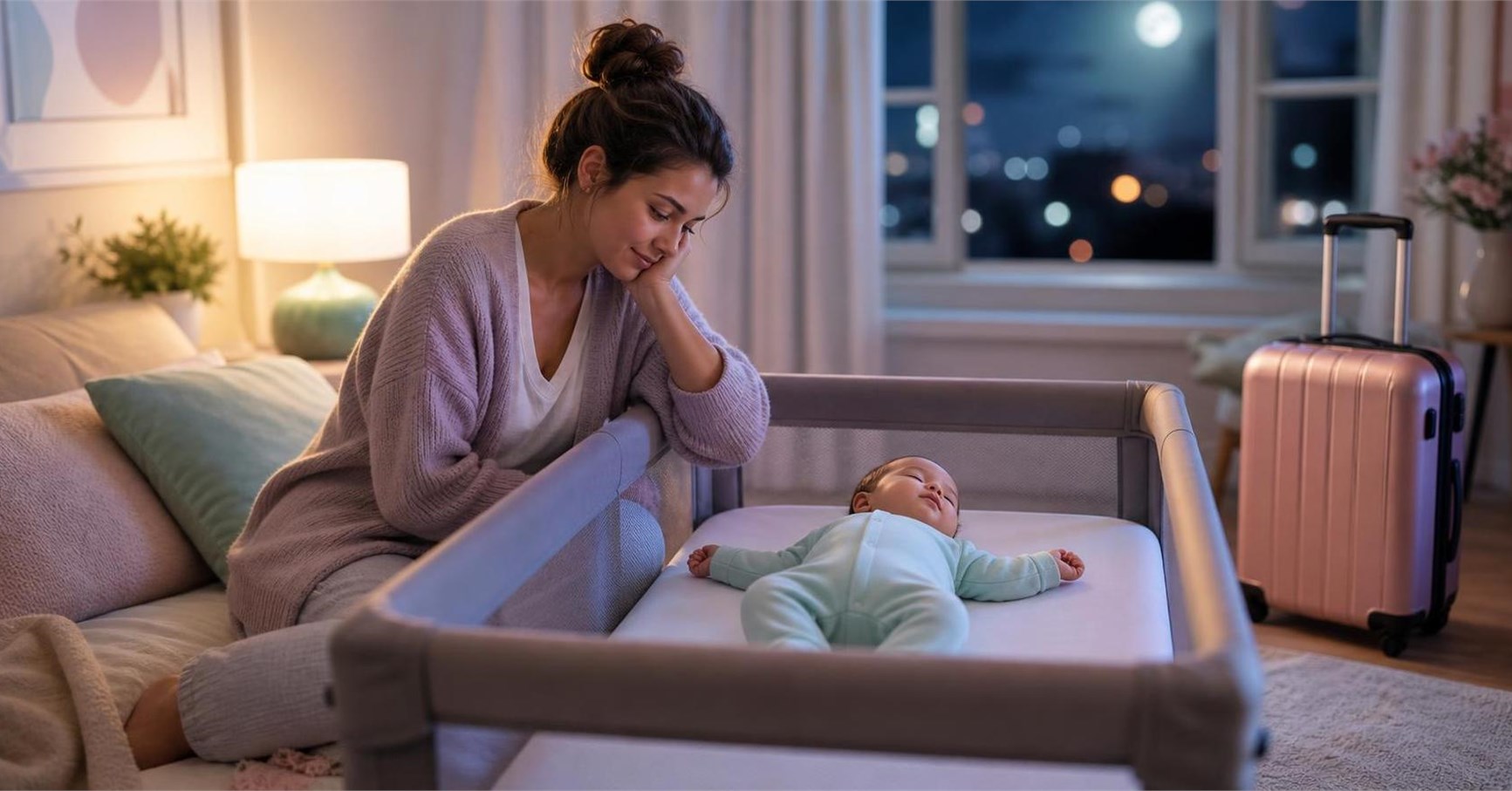
The answer while the suitcase is still open
Reset the anchors, not the whole baby
The home clock says bedtime, the suitcase is half unpacked, and your baby appears to have brought a private afternoon home in their body. Baby sleep problems after travel are usually temporary, and the safest useful response is not to force everything back in one night. First ask whether you crossed time zones or whether sleep unraveled because light, noise, naps, feeds, routine, and the sleep setting changed. Then anchor the next few days to local morning light, ordinary daytime activity, needed feeding, age-appropriate naps, a dim evening, and the familiar short bedtime sequence. [1][3][4]
I would not make an exhausted baby prove anything on the first night home. Offer a recovery nap when it is needed, protect safe sleep and feeding, and move toward local time with repeated cues rather than heroic wakefulness. Travel can temporarily scramble timing and expectations. It does not prove that every sleep skill disappeared, that you must immediately restart sleep training, or that your baby needs a sedating shortcut.

Before you fix the schedule, name what travel changed
The phrase baby jet lag gets used for almost every bad night involving luggage. But true jet lag has a specific engine: the body’s circadian clock is out of step with the destination or home time after crossing time zones. The Centers for Disease Control and Prevention describes jet lag as a mismatch between the internal clock and the local schedule, often made worse by the sleep loss that comes with travel itself. [1]
A weekend two hours away can produce a spectacular bedtime mess without producing meaningful circadian jet lag. Naps happened in motion. The room was brighter or noisier. Feeds shifted. The crib smelled different. A relative tried to fit three days of affection into the final twenty minutes before bed. Your baby may be overtired, undertired, overstimulated, uncomfortable, or simply expecting the travel version of the routine.
That distinction matters because I would not answer both problems the same way. A body-clock mismatch needs repeated local-time cues and time. A routine or environment disruption often improves as familiar cues return. Both may need recovery sleep. Neither is repaired by keeping a miserable baby awake until the wall clock wins.
You crossed time zones
The body clock is reading another place
Sleepiness, alertness, hunger, and early waking may arrive at the old time. Use local daylight, local meals and feeds, ordinary daytime activity, sensible naps, and a dim local evening as repeated orientation cues.
Do not promise yourself an exact number of recovery days per time zone. Direction, number of zones, age, sleep loss, illness, and individual biology all change the adjustment.
You stayed near home time
The routine and environment changed
Restore the few cues your baby can actually recognize: the usual start of day, feeds, nap opportunities, room conditions, pajamas, short book or song, and safe sleep surface.
Check what was different before rewriting the entire schedule. Light, noise, temperature, motion sleep, missed naps, extra naps, late social activity, and illness are more useful clues than the label “regression.”
The private fear is usually not “Which circadian mechanism is this?” It is “Did travel undo everything?” I want to make that fear answerable. Look for a temporary mismatch first. One rough homecoming night is data about this night, not a verdict on every skill your baby had before the trip.

A hypothetical Kacey-and-Benjamin homecoming
When the wall clock and the baby file separate reports
Imagine hypothetical Benjamin is the baby in this scene. The suitcase is open across the bedroom floor, one sock has escaped under the chair, and the home clock says 7:38 p.m. Benjamin’s face says he has arrived for a perfectly reasonable midafternoon meeting.
My first exhausted thought would be to keep him awake until bedtime became undeniable. My second would be to move bedtime earlier because he had slept badly on the trip. Those two ideas can coexist in a tired brain without either one being useful. I would stop trying to make the entire schedule confess and ask a smaller question: What local cue can I give him next without denying a real need?
If he needed feeding, I would feed him. If he was falling apart from sleep loss, I would allow recovery sleep rather than treating wakefulness as a character-building exercise. At the next local morning, I would open the curtains, begin the ordinary day, offer feeds and age-appropriate nap opportunities, and let evening become dim and boring again. I would repeat the same short bedtime sequence even if the result was not beautifully immediate.
This scene is explicitly hypothetical. It is not Kacey’s or Benjamin’s verified family history, dialogue, age, travel, product use, symptom, advice, or outcome, and it is not evidence. Its practical job is to show the decision that matters: you do not need to reconstruct every old minute before you can give the body one clear local anchor.
The first local morning does more work than the first perfect bedtime
I would begin the reset at the start of the local day, not by grading the night that just happened. Open the curtains. Get outside or into ordinary daylight when weather and health allow. Feed according to your baby’s age and plan. Use normal daytime voice and activity. Then offer the next nap based on the baby in front of you, not on a fantasy schedule untouched by airports, car naps, and midnight unpacking.
Light is an important cue for the circadian system, and general travel guidance supports aligning daytime light and activity with local time. [1][3][4] But this is not permission to copy an adult bright-light treatment chart onto a baby. Timing light incorrectly can shift a clock in the wrong direction, and an infant’s sleep, feeding, and medical context deserve individualized judgment. Ordinary local morning light and a normal local day are the safer editorial boundary here.
The reset also does not require rebuilding every minute. Pick a handful of dependable anchors: morning light, feeds, nap opportunities, a dimmer evening, and the familiar bedtime sequence. The clock may wobble around those anchors for a few days. That is adjustment, not failure.
The local-time anchor ladder
Morning light. Ordinary day. Nap rescue. Dim evening. Familiar bedtime.
- Mark local morning: curtains open, ordinary daylight, feeding, and calm daytime activity.
- Keep the day recognizable: offer connection, floor play, feeds, and nap opportunities appropriate to your baby’s age and condition.
- Use naps as recovery: do not force an exhausted baby to stay awake, but watch whether a very long late nap is becoming the new night.
- Let local evening look different: reduce light and stimulation instead of expecting the body to obey a number on the first night.
- Repeat the short bedtime sequence: familiar steps can orient the baby even when sleep timing is still imperfect.
This ladder is an editorial memory tool assembled from circadian and routine guidance. It is not a studied infant treatment, a rigid schedule, or a promise that five steps produce sleep on command.
If you need age-aware context for how naps and night sleep may fit across the first year, use the first-year sleep schedule guide for age-aware naps and a flexible rhythm reset. I would use those ranges as orientation, then adjust for feeding, illness, prematurity, your clinician’s plan, and the sleep debt the trip actually created.


Use a recovery nap without letting it quietly become the new night
“Do not let the baby nap” is the kind of travel advice that sounds decisive because the person saying it is not currently holding the exhausted baby. Sleep loss can worsen jet-lag symptoms, and a baby who missed sleep in transit may need recovery. [1] I would not use forced wakefulness as a shortcut.
At the same time, a very long nap ending close to local bedtime can keep the mismatch rolling. The useful choice is not nap versus no nap. It is how much recovery the baby needs now, how late the nap begins, what the baby’s age and usual rhythm suggest, and whether illness or poor feeding is changing the picture.
Nap rescue, not nap takeover
Ask four questions before you intervene
- How much sleep was actually missed? A baby who barely slept during travel has a different need from a baby who collected several motion naps.
- How close is local bedtime? An early afternoon recovery nap has a different tradeoff from a nap that begins when the household is dimming for night.
- What does age change? Young infants need frequent sleep and feeding; older infants may have more predictable nap structure, but no single wake-window number overrides visible exhaustion or a medical plan.
- What is the baby’s daytime condition? Poor intake, fever, pain, unusual lethargy, vomiting, diarrhea, or breathing symptoms move the family out of nap math and into care.
If a late nap is becoming long enough to push bedtime much later, you may gently wake an otherwise healthy older infant when that fits your established routine. But I would not wake a newborn to chase a generic schedule, override a feeding or growth plan, or keep a sick baby awake. When you are unsure, ask the clinician who knows your baby’s age and history.
After travel, wake windows are especially easy to turn into a courtroom. If you are refreshing an app every few minutes and treating a range like a deadline, read how to use wake windows as planning ranges rather than post-travel deadlines. The range can help you notice readiness. It cannot know how much sleep your baby lost in a terminal, whether an ear hurts, or whether the old time zone is still pulling.

Direction matters, but babies do not follow a tidy time-zone formula
After eastward travel, local bedtime arrives earlier than the body expects. Your baby may look astonishingly ready to inspect the ceiling at the moment everyone else is hoping for sleep. After westward travel, sleepiness and early waking may arrive earlier on the local clock because the body still expects the old morning. The number of time zones, the trip’s direction, sleep loss, light timing, and individual sensitivity all shape the adjustment. [1]
I would use direction to understand the pattern, not to invent a precise infant protocol. Eastward, you may need to move the bedtime cues toward local time over several evenings rather than demanding an abrupt earlier sleep. Westward, keep the pre-dawn response dark and quiet when it is still night, then mark the chosen local morning with light and the ordinary start of day. In either direction, feed the baby who needs feeding and care for the baby who needs care.
A no-time-zone trip can still mimic both patterns. Late family dinners can produce later sleep. Dawn leaking around unfamiliar curtains can produce earlier waking. Car and stroller naps can reduce sleep pressure. A warm room or noisy hallway can fragment sleep. That is why the travel debrief is often more useful than a generic rule.
The travel debrief
What changed besides the clock?
- Light: later evenings, brighter rooms, earlier dawn, or more time indoors?
- Noise: hotel doors, family voices, traffic, airport-adjacent rumble, or a suddenly silent home?
- Motion: more sleep in a car seat, stroller, carrier, or adult arms than usual?
- Surface: an unfamiliar crib, a borrowed play yard, or an unsafe improvised setup that should not continue?
- Feeds: changed timing, distracted feeding, poor intake, or a plan that needs to be protected?
- Body: ear discomfort, fever, congestion, vomiting, diarrhea, pain, or unusual behavior?
Choose the branch you can actually support. Fix a bright room with darkness at local night. Fix inconsistent noise with a controlled environment. Fix the sleep surface by returning to a safe stationary crib or bassinet. Fix illness with care, not scheduling. Fix circadian mismatch with repeated local cues and time.
A portable sound cue can steady the room, not reset the body clock
If the debrief points to changing environmental noise, one portable cue can be useful. I want to keep that job narrow. A sound machine can make a hotel hallway, family guest room, or newly quiet home sound more consistent. It cannot correct jet lag, treat illness, prevent SIDS, or guarantee sleep.
Homecoming exhaustion does not change the safe sleep surface
Travel is very good at making unsafe shortcuts look temporary. A baby falls asleep in the car seat, the adult bed is already open, a favorite blanket smells familiar, and everyone is too tired to negotiate with reality. But every infant sleep still belongs on the back, on a firm, flat, level sleep surface covered only by a fitted sheet, with blankets, pillows, toys, bumpers, positioners, and other loose items kept out. [2][7]
If your baby falls asleep in a sitting device during travel, move them to an appropriate sleep surface as soon as practical. At home or away, inspect a borrowed crib or play yard instead of assuming the label “baby bed” settles the question. Use the correct mattress and fitted sheet for that product, confirm it is assembled as directed, and remove added padding and loose comfort objects. The American Academy of Pediatrics also advises families to inspect hotel or borrowed cribs. [5]
The familiar cue can be pajamas, a short book, a song, your voice, the order of the steps, or the room becoming dim. It does not need to be a loose blanket in the crib. I would rather have a safe routine feel slightly less magical for a few nights than make an unsafe object responsible for familiarity.
American Academy of Pediatrics · safe sleep after any trip
Five essentials that travel fatigue does not suspend
This AAP video belongs here because the moment families are most tempted to improvise is often the exhausted return home. It supports the safe-sleep surface; it does not prove that a schedule, product, or method fixes post-travel sleep.
Article-specific takeaway: return to back sleep on a firm, flat, level surface with a fitted sheet only. Remove loose blankets, toys, pillows, bumpers, and travel add-ons before sleep.
If the player does not load, use the NICHD Safe to Sleep environment guide.
Age and feeding decide how much “reset” belongs in the plan
I do not use the same homecoming plan for a six-week-old and a healthy ten-month-old. Infants younger than four months have highly variable sleep, and feeding or growth needs can make a generic schedule actively unhelpful. The American Academy of Sleep Medicine provides a population sleep range of 12 to 16 hours per 24 hours, including naps, for infants 4 to 12 months, but timing, regularity, and individual context still matter. [8]
Newborn or young infant
Feeding, diaper care, contact, medical guidance, and frequent sleep come before a behavioral reset. Do not force wakefulness or stretch feeds to make the clock look organized. Use local light and a calm day-night distinction gently.
Healthy older infant
Restore morning, nap, and bedtime anchors while allowing reasonable recovery sleep. If you already use a responsive sleep approach, you may return to it after physical needs and the safe sleep environment are settled.
Premature, growth-monitored, ill, or medically complex baby
Keep the individualized feeding, medication, oxygen, positioning, or care plan exactly as directed. Call the care team before applying a generic nap, wake-window, light, or sleep-training reset.
Needed responsiveness is not inconsistency. A hungry baby gets fed. A baby in pain gets comfort and evaluation. A newborn does not need to demonstrate independent settling because the family crossed an airport. The schedule is the flexible part.
A realistic first-three-days plan after travel
The body clock changes through repeated information, not one dramatic bedtime. I would use a small plan that survives real family life and tells you what to do when the night is imperfect.
The first three local days
Keep the anchors stable while the clock catches up
Day 1: recover and orient
Mark local morning, feed, use ordinary daytime light and activity, allow needed naps, inspect the sleep space, and repeat the familiar bedtime sequence. Do not judge success by whether bedtime is exact.
Day 2: watch the pattern
Notice when sleepiness, alertness, hunger, and waking arrive. Keep morning and evening cues clear. Adjust a late nap gently when appropriate rather than changing five variables at once.
Day 3 and beyond: refine, do not panic
If the pattern is moving toward local time, keep going. If it is worsening, daytime behavior or intake has changed, or symptoms appear, stop treating it as ordinary travel adjustment and call the clinician.
During night waking, keep the response age-appropriate and boringly familiar. Feed when feeding is needed. Change a soiled diaper. Comfort pain. Keep light low when it is still local night. Return to the safe sleep surface. If you had a sleep-training or settling approach before travel and your healthy older infant’s needs are met, you may resume it without announcing a total restart. I would not use one chaotic night as proof that the old approach failed.
Prevention for the next trip can be equally modest. The AAP suggests that families may begin shifting sleep gradually before travel and use daytime activity and light after arrival. [5] Bring the safe sleep equipment or verify what will be provided, carry familiar non-loose routine cues, protect feeds, and plan for recovery sleep. You do not need to engineer a miniature international time laboratory in the nursery.


The open suitcase is no longer evidence that sleep is broken
Return to that first night: home bedtime on the clock, afternoon energy in the baby, laundry spilling out of the suitcase like it also objected to the trip ending. At the beginning, the mismatch looked like proof that every bit of progress vanished.
Now it has a name and a next step. If time zones changed, the body clock needs repeated local cues and days, not punishment. If time did not change, rebuild the environment and routine that travel interrupted. In both cases, protect feeding, use naps as recovery rather than leverage, keep the infant sleep space safe, and let symptoms outrank the schedule.
I would measure progress by direction, not by one perfect bedtime: morning is becoming more local, naps are finding useful places again, evening looks more like evening, and the familiar sequence no longer feels completely foreign. The clock may still wobble. You are no longer asking it to win an argument with your baby. You are giving the body the same calm information often enough that home begins to feel like home again.
Sources
- Centers for Disease Control and Prevention, Yellow Book: Jet Lag Disorder
- CDC Yellow Book / NCBI Bookshelf: Traveling Safely with Infants and Children
- Centers for Disease Control and Prevention: Jet Lag
- NICHD: Other Sleep FAQs
- American Academy of Pediatrics / HealthyChildren.org: Family Travel Tips
- American Academy of Pediatrics / HealthyChildren.org: Getting Your Baby to Sleep
- NICHD Safe to Sleep: Safe Sleep Environment for Baby
- American Academy of Sleep Medicine: Recommended Amount of Sleep for Pediatric Populations
- American Academy of Pediatrics: Preventing Excessive Noise Exposure in Infants, Children, and Adolescents






What viewers said10 comments · 4 replies+
Archived comments from the original Baby Sleep Miracle presentation. Not independently verified by SleepBaby.org; individual experiences vary.
Thank you so much for this video! I had no idea about the dangers of baby swings :O
Hi Mary-Ann. I have a question: Is method in any way similar to the ones recommended by Dr Bucknam, Dr. Weissbluth or Dr. Karp? We tried those but none of them help.
Hi Regina, thank you for your question. The short answer is no. The techniques I share in my guide are based on newest scientific research and this is why I have never seen any approach similar to the one I recommend.
This method really works! I tried it on my son Jesus and after just one week he went from waking up more than 5 times a night to waking up just once or twice. You are a lifesaver, Mary-Ann!
I'm truly impressed with how much information you share in your video. And all for free! I can feel that you truly care about mothers like myself, and that's hard to find these days. I have recommended your site to several of my friends already.
Mary-Ann, our child suffers from autism. Is your approach still suited?
Chloe, I made sure my method can be used with any child, even babies who are special like yours. Please note that I'm not a doctor and that I always advice to consult with your physician because nothing is more important than the safety and well-being of your love.
Hallo Mary-Ann, I'm from Germany. Do you have your guide in German?
Hello Heide, we do! Normally you should already see our video in German. If not, please contact our support so they can guide you
Thenk you for your answer, Mary-Ann!
I just completed your approach and I have to say, it worked almost too well. Yes, it took a bit of getting used to with your bedtime routine but the difference is huge. My son George used to take 1 hours to go down and now he's firmly asleep in no more than 10 minutes! You're the best!
It seems I'm the only man watching this video, lol! What you shared about the 'emotional backpack' made immediate sense to me and I can't wait to help my little girl Mila to unpack it!
Hey there, just discovered your site and this really sounds different. Just wanted to say thanks for sharing :)
For everyone who's still thinking about getting Mary-Ann's guide I want to advise you to go ahead. I wasn't sure myself but now I'm so thankful I invested in this program. It made a huge difference in our life as a family and yes, my baby girl does sleep through the night now.