A calm yes, with an exit plan
Many healthy babies can go to a drive-in movie when the setup protects sleep, hearing, temperature, and the ride home
Choose one family-friendly feature, confirm the venue rules, park near an exit, keep the sound low, and leave before either the baby or the driver is running on fumes. Use the car seat correctly whenever the vehicle moves. Once parked, do not turn the car seat, stroller, cargo area, pillows, or the back of the car into an infant sleep space. If your baby will sleep during the show, the workable plan is a firm, flat, approved crib, bassinet, portable crib, or play yard in a venue-approved protected area. If that is not possible, head home when sleep arrives.
The household at bedtime
Different people.
One household at night.
If you’re also caring for a baby and want help with sleep, our video is below. Watch when that’s the question you want to work on.
Prefer to read?Press play for a little help with your baby’s next bedtime.
Kind words about the original video
“Thank you so much for this video!”
“I'm truly impressed with how much information you share in your video.”
The SleepBaby Workshop
Get the Workshop.
Get the Workshop and explore its resources for everyday baby sleep and nighttime care. 15 guides and five audio tracks in a simple browser hub. Read, listen, and return to the part you need.
A conversation, if you want one.Night Owls is the SleepBaby chat room. Read what is there or join in.
I understand why this question carries more emotion than it seems to. You are not only asking whether a baby can look at a giant screen. You may be asking, Can we still do one normal, summery, slightly romantic thing without packing the entire nursery or regretting it at 11:47 p.m.?
Yes, sometimes. A drive-in can be gentler than an indoor theater because you control your own sound, you can step outside, feed or change the baby without crossing a row of strangers, and leave whenever you need to. It can also turn into a hot, loud, buggy, overtired parking lot very quickly. The difference is not whether your baby is “easy.” The difference is whether the plan has safe answers for the boring parts.
The best drive-in night with a baby may be one movie, half a movie, or twenty peaceful minutes under the marquee before you decide everyone has had enough. Leaving early is not a failed outing. It is the plan working.
Make the go, adjust, or skip decision before buying the ticket
Start with your actual baby on this actual day. Age matters, but so do feeding, illness, weather, start time, the length of the drive, and whether a rested adult can drive home. A four-month-old who slept well and feeds predictably may have an easier evening than a nine-month-old cutting a tooth after a short-nap day. Neither baby is doing anything wrong.
Choose the version that protects the landing
One family outing, three honest answers
GO
The weather is mild, the baby is well, the venue allows your setup, the first feature is a reasonable fit, and you have a safe sleep or early-exit plan plus a rested driver.
ADJUST
Choose an earlier season, weeknight, shorter movie, closer venue, parking spot near the exit, portable FM radio, second adult, or a firm cutoff after the first hour.
SKIP TONIGHT
The baby is ill, feverish, medically fragile without guidance, or already struggling; heat, smoke, cold, storms, or insects are hard to control; no safe sleep option exists; or the driver is too tired.
The small rule: if the outing works only when the baby sleeps in an improvised place or an exhausted adult drives home, it does not work tonight.
For a newborn or premature infant, I would make the plan especially conservative. Ask the pediatrician about crowded outings, temperature control, feeding needs, and any medical concern that changes ordinary advice. A very young baby does not need to “practice” staying out late. You are allowed to wait for a cooler month, an earlier sunset, or a season when the outing asks less of everyone.
Call the venue with baby-specific questions, not just ticket questions
Drive-ins vary more than indoor theaters. One may allow hatchbacks, lawn chairs, outside food, portable radios, and a small play yard in a designated lawn. Another may require everyone to stay within the vehicle footprint, prohibit outside equipment, assign tall vehicles to the back, forbid idling, or close the gate after showtime. Policies can change with the event.
Ask before you go:
- Are infants allowed, and is admission charged per person or per vehicle?
- May you sit outside the vehicle, and is there a protected non-traffic area where an approved portable crib or play yard is permitted?
- How is sound delivered: FM radio, speaker, app, or another system?
- Can a portable FM radio be used without the car accessory system?
- Are vehicles allowed to idle for climate control? If not, what happens during a heat or cold concern?
- Where are restrooms and diaper-changing surfaces, and are they lit after the show begins?
- Is re-entry allowed if you leave to settle or feed the baby?
- Which rows are easiest for an early departure without shining headlights across the screen?
Then check the forecast, air quality, sunset, gate time, trailer time, feature runtime, and drive-home duration. “Movie starts at 8” may mean gates at 6:30 and the feature after dusk. In midsummer, darkness can arrive much later than a baby’s bedtime.
Family drive-in guides commonly recommend arriving an hour or more early for a good spot, but that can add a full wake window to the night. With a baby, the best spot is often not the closest view. It is the place with a clear exit, a little distance from loud neighboring speakers, and enough room to care for the baby without stepping into a traffic lane.
Keep three safety zones separate: moving, parked, and sleeping
This is the distinction most general drive-in lists miss. A car seat is protective equipment for travel. A parked car is not automatically a safe nursery. A sleep surface must still meet infant sleep guidance even when the whole evening feels casual.
The three-zone map
The safe choice changes when the car stops
1. VEHICLE MOVING
Baby is correctly buckled in the right car seat for age and size, installed according to both manuals. Infants ride rear-facing. No feed, diaper change, or unbuckled soothing happens while the car moves.
2. PARKED AND AWAKE
Baby can be fed, changed, held by an awake adult, or spend supervised awake time in approved gear. Keep the child within arm’s reach and away from traffic, cords, hot surfaces, loose hatch hardware, and other vehicles.
3. BABY SLEEPING
Place baby on the back on a firm, flat approved sleep surface with a fitted sheet only. If the venue cannot permit that surface in a protected level area, the safe next step is the ride home and a crib transfer.
NHTSA advises choosing a car seat for the child’s age and size, following the car-seat and vehicle manuals, and using it correctly every ride. Babies under one should always ride rear-facing, and children should stay rear-facing until they reach the seat manufacturer’s stated height or weight limit.2 If you take the baby out after parking, rebuckle and recheck the harness before the vehicle moves again. Do not loosen straps, add unapproved padding, or leave blankets under the harness because the evening is long.
The AAP recommends a firm, flat crib, bassinet, portable crib, or play yard that meets current safety standards, with a fitted sheet and no loose bedding. When a baby falls asleep in a car seat, stroller, carrier, sling, or swing, the AAP says to move the baby to a firm sleep surface on the back as soon as possible.1 The car seat can be appropriate for sleep that happens during travel; it should not become the baby’s multi-hour parked sleep plan.
If a venue allows an approved portable sleep space, put it only on firm, level ground in a designated area protected from moving cars. Do not balance it in a truck bed, cargo area, folded vehicle seat, sloped patch, or between parking lanes. Keep the setup clear of pillows, toys, blankets, cords, clips, covers, and improvised canopies. If the only available “bed” is the cushioned back of the car, leave.
If your baby often protests the restraint itself, our guide for when a baby hates the car seat can help you check fit, heat, timing, reflux signs, and motion-sickness clues without weakening the harness.
Run the comfort check before the previews: temperature, sound, and bugs
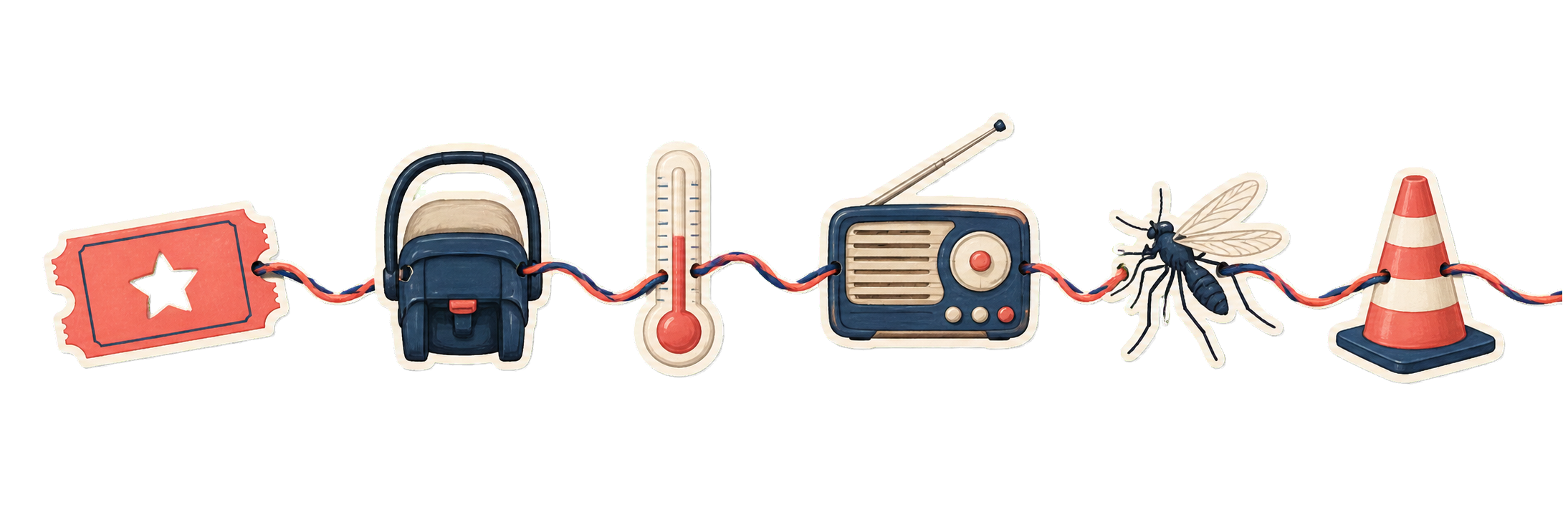
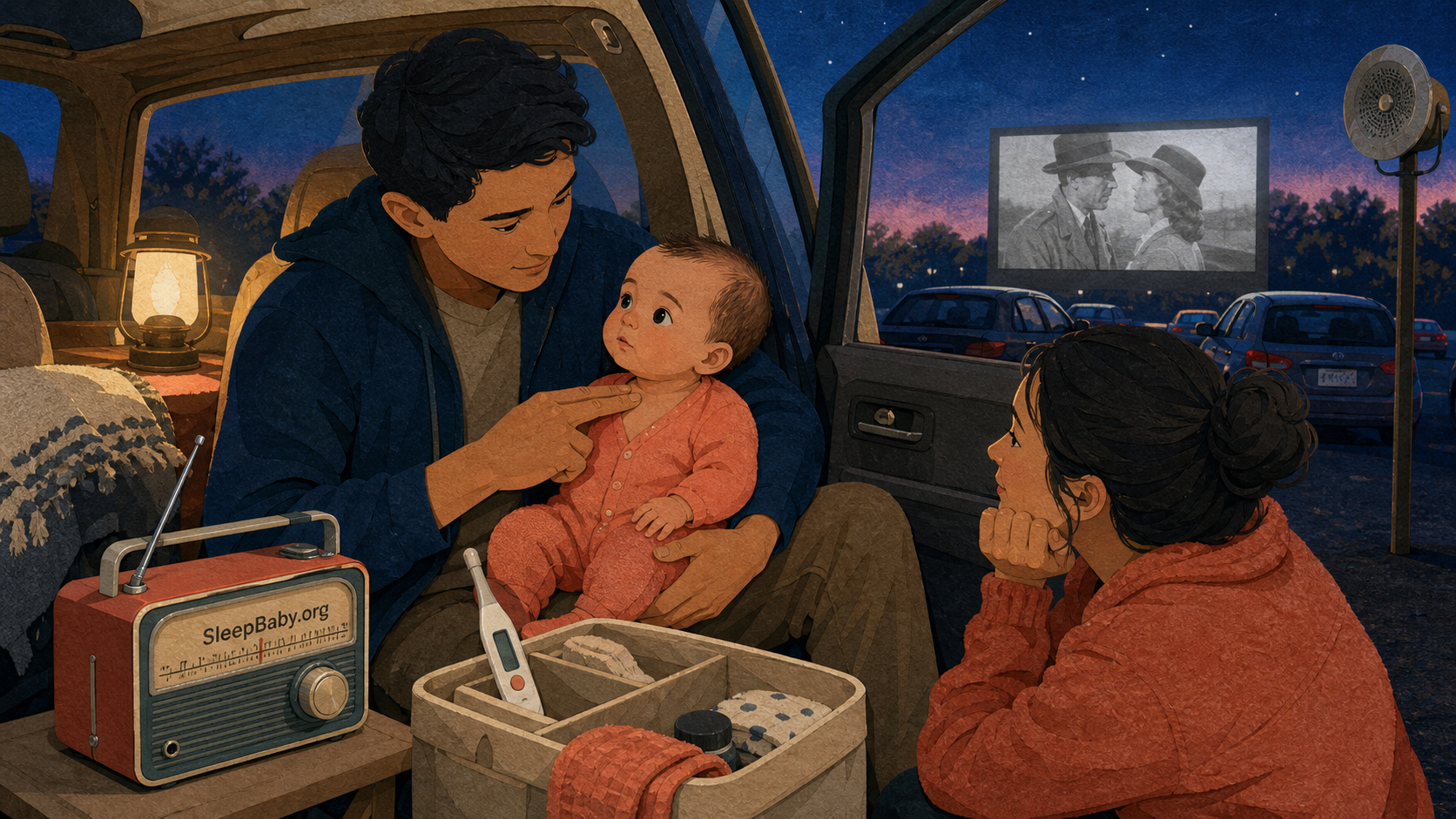
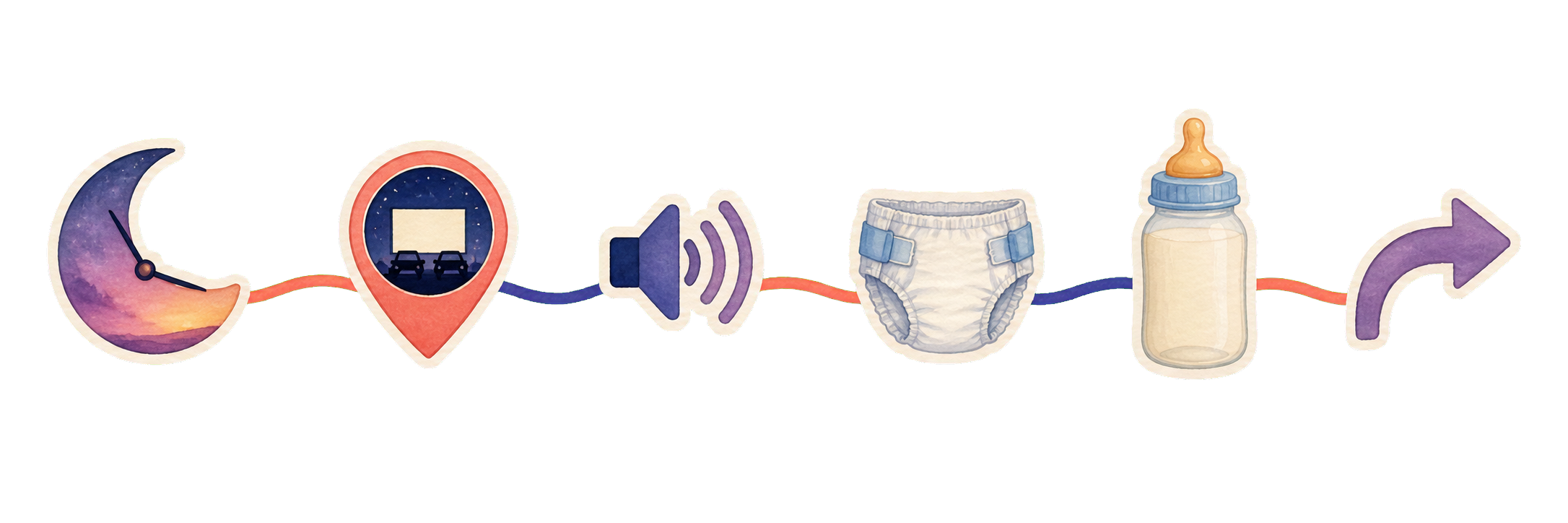
These three things change as dusk settles. A comfortable arrival does not guarantee a comfortable second hour. Set a repeating habit: check the baby’s chest or back, look at breathing and color, listen to the local sound at the baby’s position, and inspect the netting or exposed skin. Do not wait for crying to be the instrument panel.
The dusk reset
Three checks, one exit rule
- TEMPERATURE
- Check the baby’s chest or back, not only hands and feet. Sweating, a hot chest, flushed skin, unusual sleepiness, or a car you cannot keep comfortably ventilated means cool the baby and leave.
- SOUND
- Place the radio away from the baby’s head and use the lowest clear volume. If adults must raise their voices at the baby’s position, reduce the sound, increase distance, add properly fitted infant earmuffs, or leave.
- BUGS
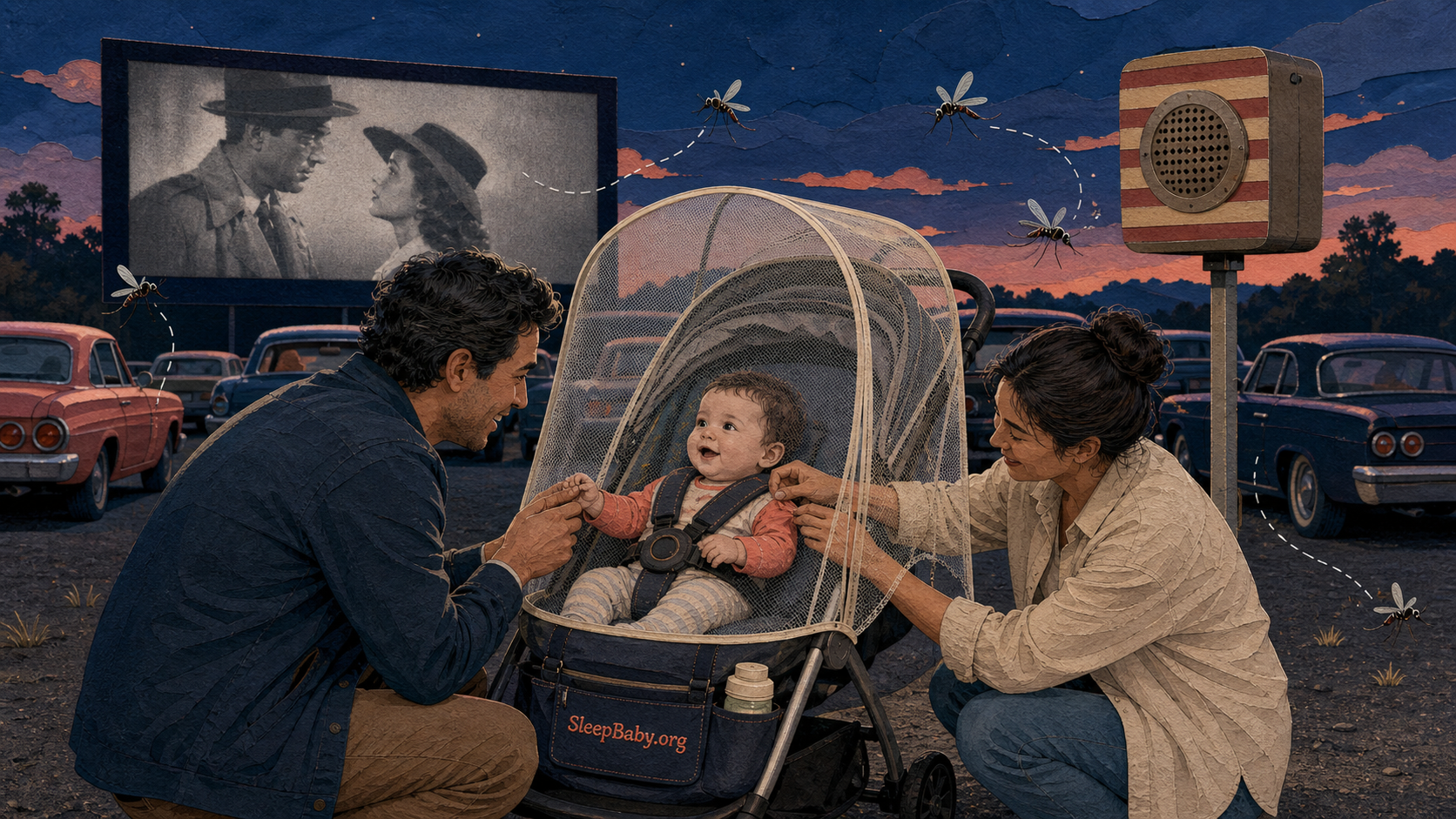
- Use clothing, venue-safe netting, and age-appropriate EPA-registered repellent as directed. Check that netting is secure, breathable, away from the face, and never turned into a sleep-space cover.
Exit rule: if one of these cannot be corrected quickly without improvising, the movie is over for your family. That is a clean decision, not a debate in the dark.
Do not use the parked car as a temperature experiment
NHTSA says never leave a child unattended in a vehicle for any length of time; cracked windows and shade do little to change interior temperature.3 At a drive-in, “unattended” includes the quick concession run while the baby sleeps and the other adult has wandered to the restroom. Name the supervising adult before anyone steps away.
If the vehicle is becoming hot, opening the hatch or window may not be enough. Follow the venue’s idling and vehicle-position rules. If maintaining a safe temperature depends on running the engine in a crowded row, ignoring a no-idle rule, or hoping the breeze returns, leave for a cooler place. In cold weather, dress the baby in light layers that do not interfere with the harness, then remove hats and extra outerwear indoors or in the warmed car as appropriate. The AAP warns against overheating and recommends no more than one additional clothing layer compared with an adult in the same environment.1
Control the sound at the baby’s ears, not at the dashboard
NIDCD explains that hearing risk depends on how loud, how close, and how long. Sounds at or below 70 dBA are unlikely to cause hearing loss even after long exposure, while long or repeated exposure at or above 85 dBA can cause damage; its reference range for movie theaters is 74 to 104 dBA.4 A drive-in gives you one advantage: your speaker is local and controllable.
Use a battery-powered portable FM radio when the venue supports it, place it well away from the baby’s head, and set it only loud enough for the adults to follow. Car speakers directly beside a rear-facing seat can sound much louder at the baby’s position than at the front seat. A phone decibel app can show trends, but it is not a calibrated safety guarantee. Infant over-ear hearing-protection earmuffs can be an added layer when they fit correctly, but they do not make a too-loud setting safe.
If the baby repeatedly startles, cries when the sound rises, cannot settle, or you have to shout at arm’s length, turn it down or go. The dramatic scene is not worth proving the baby can tolerate it.
Use a mosquito plan that matches the baby’s age
CDC recommends clothing that covers arms and legs, mosquito netting over strollers and carriers, and EPA-registered repellents used exactly as labeled. Products containing oil of lemon eucalyptus or PMD should not be used on children under age three.5 The AAP adds that parents should be especially cautious about applying repellent to newborn or premature infant skin and should use netting, clothing, and label-directed products thoughtfully.6
Do not spray repellent near the baby’s face, hands, food, bottle, or enclosed car. Apply it outdoors, follow the label, and wash treated skin when you return inside. A fan may help in an approved outdoor setup, but keep cords, clips, batteries, and moving blades out of reach. If insects are swarming despite the plan, go home.
Pack for one feature, not a mobile apartment
The classic family drive-in list is blankets, pillows, snacks, chairs, glow sticks, and a radio. That may be perfect for older children. For a baby, the order changes: safe transport, feeding and diapering, temperature, sound, insects, approved sleep or exit, then everyone else’s cozy extras.
The one-feature bag
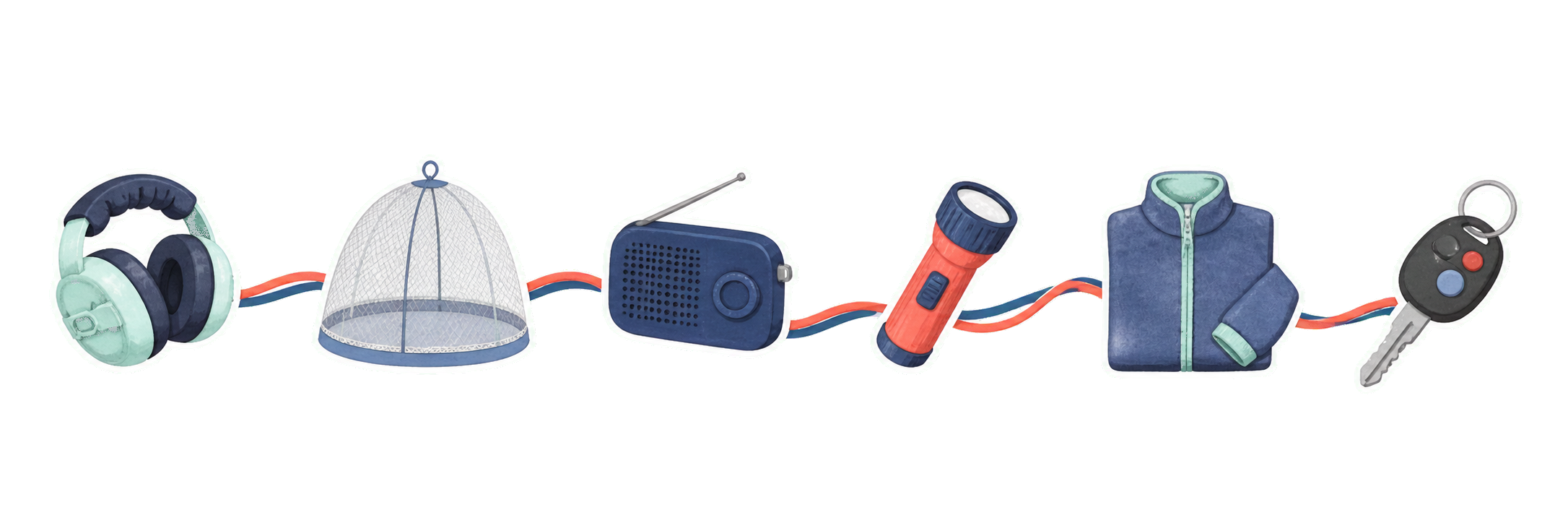
Four small groups are easier to find in the dark
TRAVEL
- Correctly installed rear-facing car seat
- Vehicle and seat manuals available
- Keys kept with the responsible adult
- Rested backup driver or early cutoff
- Portable jump pack if you use vehicle accessories
BABY CARE
- Usual milk or age-appropriate food
- Burp cloth and bib
- Diapers, wipes, changing mat, bags
- Two weather-appropriate clothing layers
- Dim red or warm flashlight for care
OUTDOOR COMFORT
- Portable FM radio and fresh batteries
- Properly fitted infant hearing protection
- Mosquito netting and label-directed repellent
- Water for adults
- Light layers, never loose bedding in infant sleep space
SLEEP OR EXIT
- Approved sleep surface only if venue permits a protected location
- Fitted sheet only
- Familiar sleep sack if appropriate and not weighted
- Pre-agreed leave time
- Clear crib ready at home
Keep the changing kit and feed within reach before darkness falls. A small warm-colored light is kinder to everyone than the vehicle dome light and less likely to blast the screen. Change the baby on a stable surface with one hand on the baby; a car seat, sloped cargo floor, or open tailgate is not a changing table. If the restroom has a clean stable station, use it. If it does not, use your own flat changing mat on a safe, stable surface while another adult watches the surroundings.
Feed only while parked. An adult may breastfeed or bottle-feed in the stationary vehicle or another safe seated area. Do not bottle-prop, feed a reclined baby unattended, or try to continue feeding after the car starts moving. Pack what the baby normally eats; a movie night is not the moment to introduce a new snack in poor light.
Treat the screen as background to a family evening, not a baby-development project
A baby does not need the movie. The outing is for the family, and that is okay. The AAP’s current media guidance focuses on the larger ecosystem: infants under 18 months learn best from real-world interaction, and heavy solo screen use can crowd out language, social learning, play, and sleep.7 A single outdoor family event is not a reason to panic or pretend the baby is receiving enrichment from the film.
Keep the baby oriented toward you, feeding, cuddling, looking at the night sky, or playing quietly while awake. Choose a film without sustained explosive sound or flashing intensity, even if the baby cannot follow the story. If the baby locks onto the screen and becomes wired, turn the seat or your body away from it and lower the sound. If that does not help, take a calm walk in the approved area or leave.
Protect the bedtime landing more than the bedtime clock. One unusual evening does not need a complicated recovery protocol. Keep the familiar cues you can control: a feed if due, clean diaper, usual sleep clothing, dark quiet ride, and the same short sequence at home. If the baby sleeps in the car before bedtime, use our car-nap-before-bed plan to make the safe transfer first and adjust timing without panic.
Use an arrival-to-home timeline with decision points
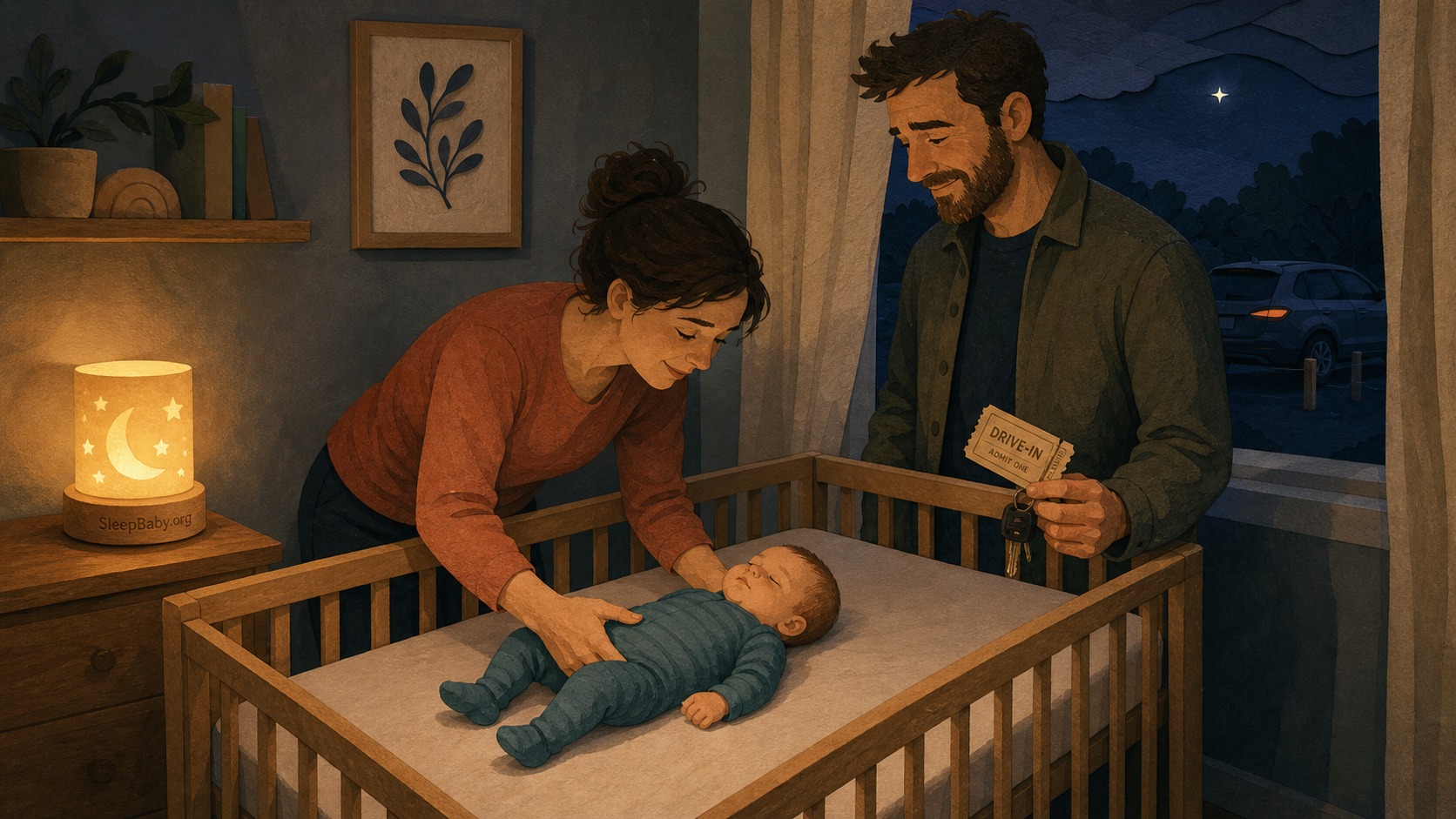
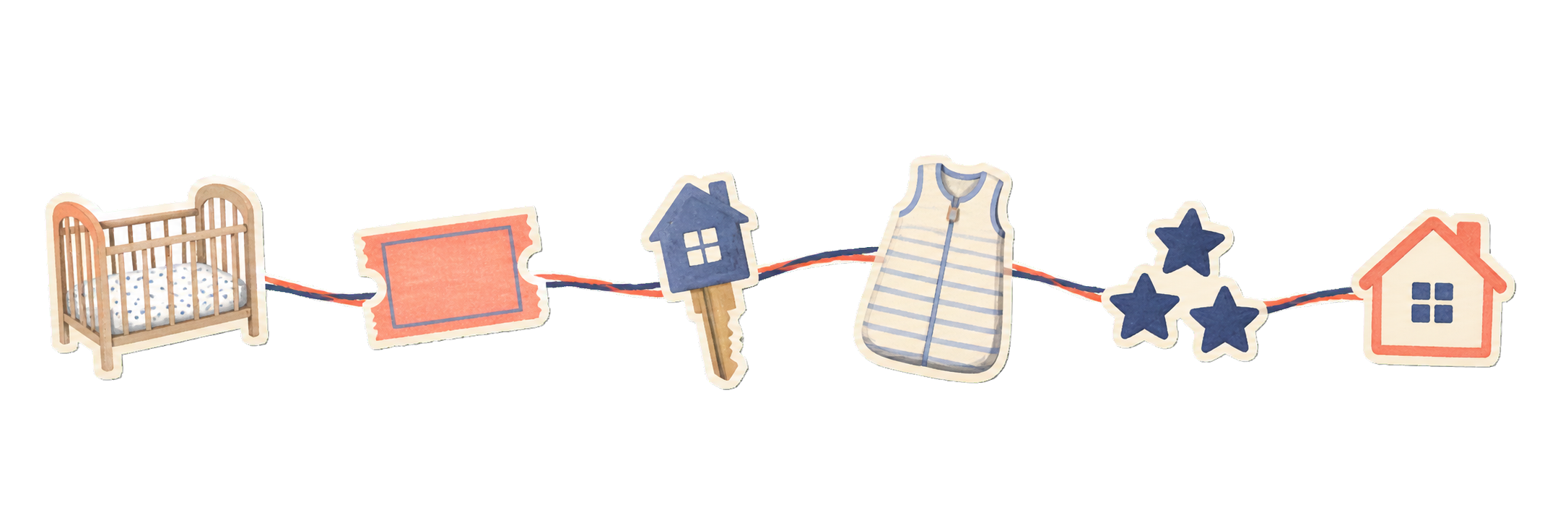
- Before leaving home: feed if due, check weather and air, install and buckle correctly, place the clear crib or bassinet ready for the return, and name the latest leave time.
- At the gate: confirm the screen, FM frequency, restroom, early-exit route, idling rule, and the exact area in which any baby equipment is allowed.
- Before dusk: complete the diaper change, arrange the feed, test the radio at low volume, secure netting, and remove every object that could become loose around the baby’s sleep area.
- During the feature: repeat the temperature-sound-bug check, keep one adult explicitly responsible, and leave at the first sustained mismatch rather than waiting for a full meltdown.
- Before the car moves: pack the area, account for every person and item, rebuckle the baby from the beginning, check the back seat, and confirm the driver is alert.
- At home: move the sleeping baby from the car seat to the prepared firm flat sleep surface on the back, keep the routine brief, and let tomorrow be ordinary.
NHTSA notes that fatigue from a new baby, a late night, or sleep restriction can impair cognition and driving performance, and drowsy-driving crashes occur most often between midnight and 6 a.m. or in the late afternoon.8 Decide who drives before the movie. If that adult becomes sleepy, do not treat coffee, cold air, or loud music as a safety plan. Switch to a rested driver, stop in a safe place, or leave early enough that the problem never develops.
Leave while the problem is still small
Babies rarely give a formal two-minute warning. Watch for the pattern changing: repeated startling, frantic rooting, an unusually hot chest, flushed skin, shivering, escalating crying, stiffening or arching that is not settling, persistent coughing, breathing difficulty, vomiting, a wet mosquito net touching the face, or a parent who is becoming too tired or frustrated to make careful decisions.
Breathing difficulty, blue or gray color, unresponsiveness, seizure, signs of severe allergic reaction, or a baby who is dangerously hot requires emergency help, not a quiet drive home. Call local emergency services and follow professional instructions.
For ordinary overload, move away from the speaker and screen, reduce stimulation, feed or change if due, and give the baby a few calm minutes. If the baby resets and the environment is safe, you can decide whether to stay. If the same distress returns, go. The goal is not to teach endurance. The goal is to protect a pleasant family memory from becoming a long recovery night.
How the plan changes with age
Can I take a newborn to a drive-in movie?
There is no universal birthday that makes the outing safe. Newborns need frequent feeding, close temperature monitoring, infection-conscious choices, and a safe place for every sleep. Premature or medically fragile babies may have additional needs. Ask the pediatrician when health or development changes the ordinary plan, choose mild weather and a short first feature, and skip any setup that depends on sleeping in the car seat after arrival.
What if my baby sleeps through the whole movie?
Then the sleep surface matters more, not less. Travel sleep in a properly used car seat can happen while the vehicle is moving. Once parked, transfer the baby as soon as possible to a firm, flat approved surface on the back. If the venue does not allow a protected, level location for that surface, the better plan is to go home when the baby falls asleep.
Can the baby sleep in the open hatch or truck bed?
No improvised cargo setup meets the infant sleep plan. Cargo floors, folded seats, truck beds, mattresses, cushions, pillows, nests, and blankets can be sloped, soft, unstable, exposed to hardware, or close to traffic and exhaust. Older children and awake adults may use some cozy drive-in setups under venue rules; an infant needs a separate approved sleep surface.
Are baby earmuffs enough for a loud movie?
They are a backup, not permission to turn the volume up. Use properly fitted over-ear hearing protection made for infants, keep the local radio low and away from the baby’s head, increase distance from noisy neighbors, and leave if the setting still feels loud or the baby repeatedly startles.
Should I keep the baby awake so bedtime is not ruined?
No. Do not fight sleep to preserve a schedule. Protect the safe surface and the calm home landing. A short late nap may shift bedtime, while an overtired baby may also struggle. Respond to the baby in front of you, keep the return routine familiar, and avoid turning one evening into a sleep-accounting emergency.
Is a drive-in better than an indoor movie theater for a baby?
It can be more flexible because you control the local volume, can move around, and can leave without crossing an auditorium. It also adds temperature, insects, traffic lanes, a later start, and parked-car sleep questions. If you want an earlier, climate-controlled option, compare the plan with our guide to taking a baby to an indoor movie and look for a baby-friendly screening.
A one-minute visual reminder for the home landing
The official NICHD Safe to Sleep campaign demonstrates why the crib should stay clear. The drive-in takeaway is simple: prepare the sleep space before you leave so a tired parent does not have to make safety decisions after the movie.9
Video takeaway: put baby on the back on a firm, flat approved surface, and keep pillows, blankets, toys, and other soft items out. Watch the official NICHD video on YouTube.
The night succeeds when everyone gets home safely, not when the credits finish
A drive-in with a baby can be a sweet little bridge between the life you had and the family life you are building. It does not need to look cinematic from inside the car. You may miss dialogue. Someone may need a diaper at the exact moment the plot becomes important. You may eat cold popcorn while standing beside a portable radio and feel oddly triumphant.
Choose one feature. Keep the car seat for travel, the approved sleep surface for sleep, and the exit lane easy to reach. Control the local sound. Check the baby’s temperature and the driver’s alertness. Let the baby’s needs end the evening without negotiation.
The last scene is not on the screen. It is the quiet transfer home, the clear crib waiting, and the relief of knowing you did not have to stay late to make the memory count.
Sources
- AAP: How to Keep Your Sleeping Baby Safe
- NHTSA: Car Seat & Booster Seat Safety
- NHTSA: Child Heatstroke Prevention
- NIDCD: Noise-Induced Hearing Loss
- CDC: Preventing Mosquito Bites
- AAP: Choosing Insect Repellent for Children
- AAP: Helping Kids Thrive in a Digital World
- NHTSA: Drowsy Driving
- NICHD Safe to Sleep Videos
After the marquee goes dark
Turn the ride-home landing into a familiar sleep cue
A special night does not need a special sleep battle. Bring the evening back to the small cues your baby knows: dim light, your steady voice, a clear sleep space, and a brief predictable sequence. SleepBaby.org can help you build that gentle landing into a rhythm you can use on movie nights and ordinary nights alike.
The SleepBaby.org Workshop
Make a plan for
the next bedtime.
Practical help for wake-ups, short naps, and sharing the night shift. Watch the original video, then get 15 guides and five audio tracks for $9.
$9 USD, paid once. No subscription. Digital access.
Watch the original Baby Sleep Miracle presentation
Press play for a little help with your baby’s next bedtime.
Original presentation. Watch before you decide.
15practical guides
5audio tracks
1one-time payment
Kind words about the original video
“Thank you so much for this video!”
“I'm truly impressed with how much information you share in your video.”
Inside the Workshop
Start with the night
you're having.
You don't need to read all 15 guides before bedtime. Choose the one that answers the question in front of you, then come back for the next part.
Before you buy
A few things
made clear.
A straightforward purchase, with space to decide what fits your family.
What am I buying?
The SleepBaby.org Workshop includes 15 digital guides, five audio tracks, and the original Baby Sleep Workshop PDF as an additional download. It costs $9 USD, paid once, with no subscription. Nothing is shipped.
Where should I start?
Try Tonight Rescue when you need a starting point. If your question is more specific, go straight to the guide on naps, a caregiver handoff, the sleep space, or another topic. You can read at your own pace.
Is this personal sleep coaching?
No. This is an educational collection for parents of babies and young children. Use the age-specific guidance, and bring feeding, breathing, growth, illness, or other health concerns to your child's clinician. It does not diagnose a problem or promise a sleep result.
Is the video the paid Workshop?
You can watch the original Baby Sleep Miracle presentation on this page. Your purchase is the SleepBaby.org Workshop collection of guides, audio tracks, and the original PDF described here.
How do I find it after checkout?
On your thank-you or order-status page, look for Open Workshop access, then Open your SleepBaby Workshop. Keep your order confirmation so you can return. If you need help finding your access, use our Workshop download help.
The SleepBaby.org Workshop
Have somewhere to start
at the next bedtime.
15 practical guides. Five audio tracks. One $9 purchase.


A quiet parent-to-parent note
What would you add about Parenting & Family?
Share one useful detail, question, or experience. No account is needed. Please leave out names, medical records, and other private details.
There is room for the first useful note.
If you have a thoughtful question or detail about Parenting & Family, you can begin the conversation below.