
The short answer
Bring your baby if the program allows it, but do not let one tour-day mood make the decision
Ask before bringing your baby, visit while the program is operating normally, and bring another adult if you can. One person can care for the baby while the other watches, listens, and takes notes. Before the visit, verify the program’s license and inspection history. During it, look for the everyday habits behind the answers: how caregivers respond to crying, how infant sleep is handled, how bottles and diapers are managed, how doors and visitors are controlled, and how families are told about injuries or changes. A calm baby is lovely; a fussy baby is ordinary. Neither proves the quality of care.
A daycare tour is not a test of whether the lobby feels charming. It is a short chance to watch what adults do when nobody has staged the moment for you.
That can be hard to remember when you are holding a baby, a phone, a list of questions, and the quiet fear that choosing care means handing part of your day to people you have just met. The director may be warm. The cubbies may have tiny painted clouds. Everyone may know the right words. Those things can matter, but the useful evidence is smaller and more ordinary: a caregiver finishing a diaper change before answering the door, a bottle label checked twice, a crying infant acknowledged before the cry becomes background noise, a crib that is actually empty.
You are not looking for a room with no crying, no mess, and no imperfect moment. Babies cry. Toys migrate. Lunch happens. You are looking for adults whose habits stay safe, kind, and organized while real life is happening around them.
Listen to the answer, then look for the matching habit in the room.
I would trade ten polished reassurances for one ordinary minute in which a caregiver notices the second baby before the crying becomes the room’s wallpaper. That is the scale of evidence I trust on a daycare tour.

Decide whether to bring the baby, go alone, or reschedule
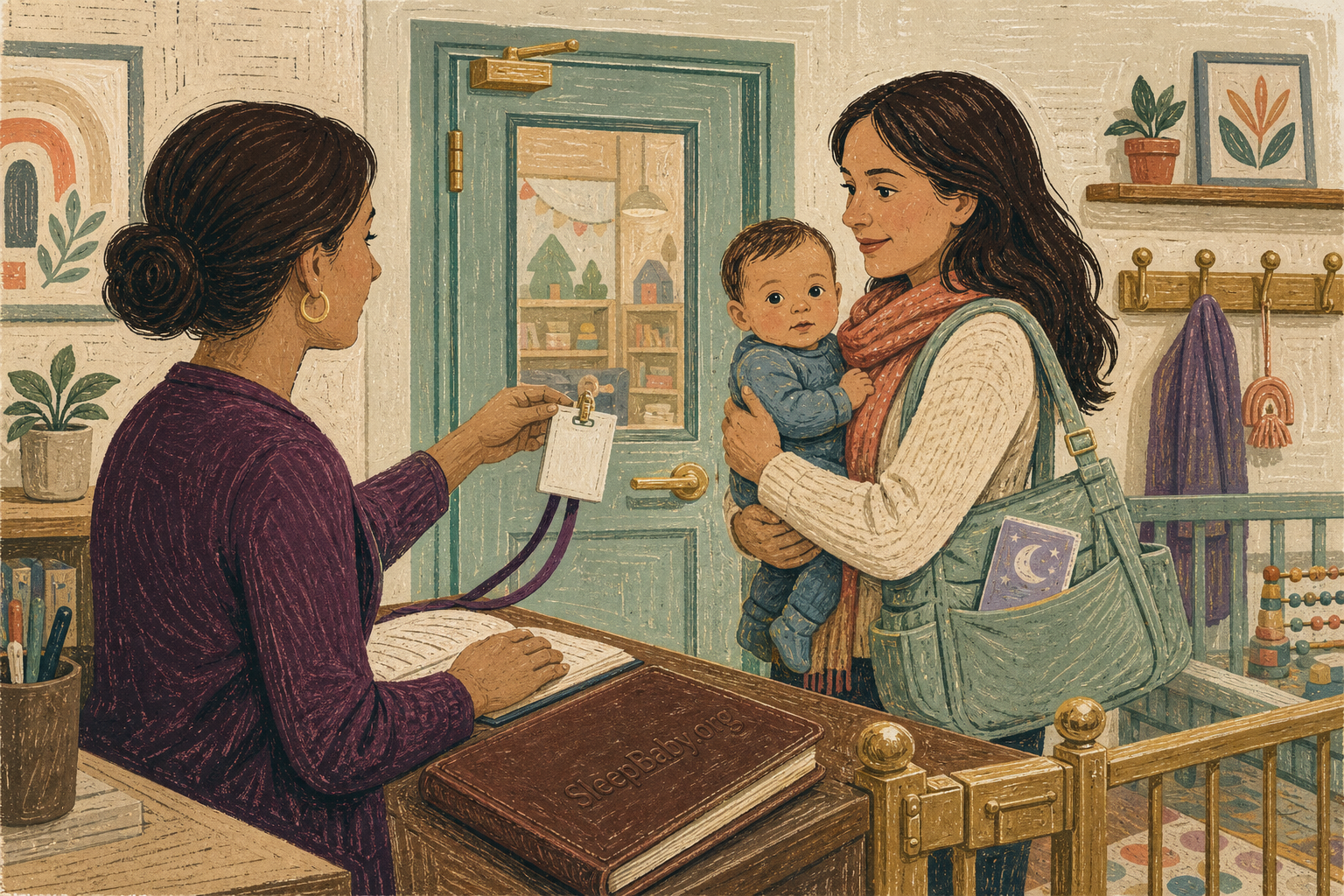
Start by asking the program whether babies may attend tours and whether there are health, visitor, vaccination, shoe-cover, photo, or timing rules. Some programs welcome children. Others limit visitors in infant rooms or offer an observation window, virtual visit, or after-hours walkthrough. A policy that protects children from unnecessary exposure is not automatically a red flag; the program should still be able to show you enough to make an informed decision.
Choose the version that lets you notice
Bring baby, go solo, or choose another day?
BRING THE BABY
Useful when the center allows it, the baby is well, and you want to see the actual entry, sound, light, and room fit. Bring another adult when possible so feeding or fussing does not erase the tour.
GO WITHOUT THE BABY
Useful when you need both hands and full attention, the program restricts infant visitors, or your baby would be safer and more comfortable elsewhere. Ask for a separate meet-and-greet before enrollment.
RESCHEDULE
Choose another day if the baby is ill, the visit falls in a predictably difficult feed or nap window, the center can show only an empty room, or you are too rushed to observe ordinary care.
Keep the meaning small: a baby’s response is one moment of information about noise, novelty, hunger, or fatigue. It is not a rating system.
If you bring the baby, pack only what makes the visit work: the usual feed, one diaper change, a spare outfit, a clean cloth, and the comfort item you normally use while the baby is awake. Do not arrive with the baby’s whole life hanging from a stroller. You need enough free attention to notice the room.
Plan roughly 30 to 45 minutes as a starting estimate, then ask the program how long its visit normally takes. A large center may need longer. A second visit can be more useful than turning the first one into a two-hour interrogation while your baby melts into your collarbone.
Do the paperwork investigation before you walk through the door
ChildCare.gov recommends checking licensing status, inspection reports, substantiated complaints, corrective actions, and quality ratings before choosing care.1 That work belongs before the tour because it changes what you ask. A recent violation that was promptly corrected leads to a different conversation than a repeated pattern or a missing explanation.
Use your state or territory’s child care search and licensing site. Record the program’s exact legal name and address; centers with similar names are easy to confuse. Look for:
- Current status: licensed, registered, certified, legally exempt, suspended, revoked, or another local classification.
- Inspection dates: how recent the visits are and whether the posted record looks complete.
- Violations and corrections: what happened, what the program changed, and whether the same issue returned.
- Substantiated complaints: what the agency found to be valid, not merely every allegation ever made.
- Quality rating or accreditation: useful added context, while remembering that neither replaces current inspection history or direct observation.
ChildCare.gov explains that monitoring reports should show the inspection date, health and safety violations, corrective actions by the program, action by the state, and substantiated complaints.2 Save the report or take a screenshot before you go. If the director says, “That was fixed,” you can ask what changed and look for the change instead of trying to remember a code number in the hallway.
Also confirm the practical fit: hours, closures, tuition and fees, waitlist, minimum attendance, notice period, late pickup, what happens when the center closes unexpectedly, and whether there is backup care. A beautiful program that closes before your real commute ends is not a workable program.
Use the first quiet three minutes before the sales tour begins
Notice how entry works. Were you asked for identification? Did someone control the door behind you? Could you walk in behind another family without being challenged? Are children visible from the lobby or photographed on a public board with full names? Does the person greeting you know why you are there, or does the room have to stop while staff work it out?
Then listen. Not for silence. Listen for the emotional weather of the room.
Do adults use children’s names? Do they narrate what they are doing before picking up or wiping a baby? When two infants need help, does the caregiver acknowledge the baby who must wait? Do staff speak about children with respect when the children cannot answer? Does the noise come from ordinary play and care, or from adults calling across the room because routines are not coordinated?
A warm room can be busy. A well-run room can have a crying baby. What matters is whether the adults remain connected to the children while solving the next task.
A brochure can promise communication. The room shows you whether a caregiver can finish comforting one baby, greet another parent, and still know which bottle belongs to whom.
Imagine one ordinary 4:47 p.m.: a bottle needs labeling, one baby wants arms, another has just filled a diaper, and a parent is waiting at the door. I am not looking for a room that never frays at the edges. I am looking for the repair: the acknowledged baby, the clean handoff, the second adult who steps in without turning the whole room into a small emergency. This is an imagined scene, not evidence; it is a way to test whether the program’s systems still make sense when the day is tired.

Use three evidence buckets: notice, ask, confirm
Long daycare checklists become a blur on a phone. Instead, sort each important topic into three buckets. Notice what is visible now. Ask how the program handles the situation. Confirm the answer later in a policy, inspection record, staffing plan, or written agreement.
The three-proof tour
Do not make one polished answer carry the whole decision
NOTICE
- How entry and visitor control actually work
- Whether staff are on the floor and responsive to infant cues
- What is in the cribs right now
- Whether diapering and food areas are separated
- How names, bottles, belongings, and photos are handled
ASK
- Who becomes your baby’s primary caregivers
- How breaks, absences, crying, feeding, naps, and injuries are handled
- What training infant staff complete and how often
- What happens in an emergency or evacuation
- How families receive routine and urgent updates
CONFIRM
- Current license and inspection history
- Applicable ratio and group-size rules
- Written safe-sleep, illness, medication, allergy, and emergency policies
- Fees, closures, notice, and refund terms
- Photo, app-access, retention, and incident-reporting terms
Decision rule: when the answer, the room, and the written record agree, confidence has somewhere solid to stand.
You do not need every answer on the spot. “I will send that policy this afternoon” can be a perfectly reasonable response. Record it under confirm. The problem is not a staff member checking a fact. The problem is an important safety question that keeps dissolving into reassurance without a document, named person, or follow-up date.
In the infant room, safe sleep is a practice you should be able to see and hear clearly
For babies up to age one, the American Academy of Pediatrics recommends placing the baby on the back for every sleep, using a firm, flat approved sleep surface with a fitted sheet, and keeping pillows, blankets, toys, bumpers, and other soft items out of the sleep space.3 The AAP also advises moving a baby who falls asleep in a car seat, stroller, swing, carrier, or sling to a firm sleep surface on the back as soon as possible.3
Look at occupied and unoccupied cribs if privacy and the room setup allow it. A display crib staged for tours is less informative than the sleep spaces in use. Ask the caregiver, not only the director, to talk through an ordinary nap.
A crib-side proof set
What does “we follow safe sleep” mean here, in this room?
PLACEMENT
Babies are placed on their backs for every sleep. Ask what staff do when a baby can roll independently and how that milestone is documented and communicated.
SURFACE
Each sleep happens on a firm, flat approved surface with a fitted sheet. Swings, loungers, nursing pillows, strollers, and car seats do not become routine sleep spaces.
EMPTY SPACE
No loose blanket, pillow, toy, bumper, weighted item, positioning device, bottle, or sleep prop is in the crib. Ask how warmth and pacifiers are handled.
Medical exception boundary: ask how an individualized clinician-directed plan is received, verified, posted for the right staff, and reviewed. A casual parent request should not quietly rewrite the room’s safety practice.
Ask how sleeping babies are observed, how often staff document checks, where cribs are positioned, and what happens when an infant arrives asleep in a car seat. Ask whether every adult who may cover the room receives infant safe-sleep training, including floaters and substitutes. ChildCare.gov lists safe sleep and SIDS prevention among ongoing health-and-safety training topics for licensed child care staff.4
If the room contains equipment you do not recognize, ask what it is used for. “Only while awake and directly supervised” is different from “sometimes babies nap there.” Follow the use, not the product label.
For a fuller reader-facing refresher on what belongs in an infant sleep space, see what babies can safely sleep with. The daycare question is whether the program can deliver that practice repeatedly across staff changes and busy moments.


Ask who will know your baby, not only how many adults are scheduled
Ratios and group-size rules vary by state, territory, age, and program type. Do not rely on a universal number from a blog post, and do not stop at “we meet ratio.” Verify the rule that applies to this room, then ask how the program stays within it during opening, closing, staff breaks, meetings, absences, diaper changes, and emergencies.
Look for a posted roster or ask who is working in the room today. Then ask:
- Who are the baby’s primary caregivers, and how many different adults may provide care in a normal week?
- How long have the lead and regular infant-room staff been here?
- Who covers lunch, breaks, late pickup, and unexpected absence?
- How are a baby’s feeding, sleep, comfort, and medical details handed from one adult to another?
- What training is required before someone may work alone with infants?
- How does the program respond when several babies cry at once?
ChildCare.gov points families toward staff education, experience, and ongoing training, including infant and child first aid and CPR, infectious-disease control, safe sleep, allergy response, emergency preparedness, and child development.4 Ask which roles hold which training and when it was last refreshed. “Our director is CPR certified” does not answer who is present with your baby at 4:45 p.m.
Watch the adult-child interaction at floor level. Does the caregiver wait for a baby’s cue before moving in? Is touch gentle and predictable? Are babies who cannot speak included in conversation? Does a caregiver make eye contact during a bottle, or is feeding treated as a task to clear? You are looking for responsive relationships, not a constant performance of cheerfulness.
Also notice staff language about hard moments. “He is having a hard time separating today” leaves room for care. “He is bad every morning” turns a child’s distress into identity. The difference matters.
Follow one imaginary bottle and one diaper through the room
Ask the caregiver to describe what happens from handoff to cleanup. The point is not to demand a perfect recital. It is to see whether the system has names, places, checks, and a backup when the room gets busy.
For feeding, ask how bottles and food are labeled, received, stored, warmed, checked against the correct child, and recorded. Ask how the center handles breast milk, formula, solids, food allergies, feeding plans, leftover milk, and a baby who refuses a feed. If the baby is breastfed, ask whether parents may feed onsite and whether there is a private, comfortable space. If a baby has a medical feeding plan, ask who can implement it and what documentation is required.
Look for bottles sitting in sleeping spaces, propped for unattended feeding, or shared preparation surfaces that are not reset between tasks. Ask what happens if a label is missing or two bottles look alike. A good system should stop the feed until identity is clear.
For diapering, look for a dedicated stable surface near handwashing, supplies within adult reach but away from children, and a flow that does not move contamination toward food preparation. Ask how the surface is cleaned between children, how soiled clothing is contained, how creams and medications are authorized, and how staff keep one hand on a baby while getting supplies.
ChildCare.gov identifies handwashing, diapering, toileting, cleaning, infant rest, sick-child handling, medication practices, building safety, and emergency planning as core health-and-safety areas.5 The tour is not a laboratory audit. You are checking whether the program’s everyday layout makes the safe action the easy action.
Trace the handoff
Four small systems that should have no mystery step
- Identity: the right child, bottle, food, medicine, cream, bag, and written plan are matched before care begins.
- Clean hands and surface: the adult can wash, prepare, complete the task, and reset the space without leaving the baby unsafe.
- Observation: intake, output, reaction, refusal, injury, and unusual change have a named place to be recorded and escalated.
- Family handoff: the right information reaches the right adult at pickup or sooner when it is urgent.
Ask the uncomfortable questions while nothing is wrong
Find out how the program handles fever, vomiting, diarrhea, respiratory symptoms, contagious illness, medication, allergies, injury, suspected abuse, evacuation, shelter-in-place, power loss, severe weather, and reunification. You do not need to rehearse every disaster in the lobby. You do need to know that the plan exists, staff practice it, emergency contacts are current, and infants who cannot walk have a specific evacuation method.
Ask where emergency supplies and evacuation cribs are kept, how attendance is reconciled outside the room, who brings medications and medical plans, and how families are contacted if regular phone or internet service fails. If the center transports children, ask about driver qualifications, restraints, vehicle checks, attendance verification, and the exact ages and routes involved.
For illness, ask two separate questions: when must a child stay home, and when will the center call for pickup? Then ask what happens while the child waits. A policy can be strict and still compassionate. What you want to avoid is a rule that changes depending on which staff member answers the phone.
Treat photos and the parent app as part of the safety tour
Daily photos can feel reassuring, especially during a new separation. They also create a record of children’s faces, names, rooms, routines, and relationships. Ask who can take photos, where they are stored, who can see them, whether images are ever posted publicly, and how access is removed when a family or staff member leaves.
Ask what happens when several children appear in one image and one family has declined photo sharing. Ask whether visiting parents may take pictures in shared rooms. Ask whether staff use center-owned devices or personal phones. Ask how long messages and images remain available and whom to contact if something is sent to the wrong account.
Do not accept “the app is secure” as the entire answer. The program may use a reputable platform and still need strong operating rules. Access, consent, device use, retention, and mistakes are human systems as much as software features.
For a fuller decision rule on children’s images, see safer sharing of baby photos in the AI era. The daycare version begins with a simple boundary: another child’s image is not yours to capture or distribute.

Red flags are patterns that make safe care hard to verify
One awkward answer is not automatically a reason to leave. A new employee may check with a supervisor. A room may be noisy at lunch. A baby may cry through your entire visit. Pause when several signals point in the same direction:
- You cannot confirm the exact license, inspection history, or legal operating status.
- Staff dismiss recent violations or complaints instead of explaining the correction.
- Visitor entry is uncontrolled, or you are encouraged to photograph other children.
- Infants routinely sleep in swings, loungers, car seats, strollers, or cribs with loose or soft items.
- Caregivers cannot explain who covers the room during breaks or absences.
- Children are handled roughly, ignored for long stretches, mocked, threatened, or described with contempt.
- Bottles, food, medicine, or belongings are not reliably matched to a child.
- Diapering and food handling share space or hands without a clear cleaning sequence.
- Important policy answers change depending on who is asked, and written follow-up never arrives.
- You are pressured to enroll or pay before you can review the contract, policies, and current records.
If you see an immediate danger to a child, follow the program’s escalation path only if that is safe and contact the appropriate state licensing or child-protection authority. A tour is not the time to personally investigate or confront someone in a way that increases risk.
Let the baby’s response inform logistics, not choose the center
A baby may stare, cling, smile, cry, fall asleep, refuse a bottle, or become fascinated by a ceiling fan. That response can tell you whether the room is bright, loud, novel, warm, or badly timed for this particular feed and nap. It cannot tell you how a caregiver behaves on an ordinary Thursday three months from now.
Watch what the staff do with the response. Do they ask before touching the baby? Do they give you space to settle? Do they notice cues without performing for approval? If the baby cries, does the adult become more curious and gentle, or does the crying seem irritating? The baby’s mood is not the test. The adults’ response to a normal baby moment is useful information.
If the visit cuts across a nap, treat the rest of the day as adjustable. Our flexible sleep-schedule guide can help you protect the rhythm without trying to force the clock back into place.
Compare evidence after you leave, before the details blend together
Do not make the final decision in the parking lot while the director’s voice is still in your ear. Feed the baby, get home, and write the comparison while the details are fresh. If you visit several programs, use the same headings for each one.

The parking-lot pause, done later
Sort each program into facts, follow-ups, and fit
FACTS
License and inspections, staffing, safe-sleep practice, hours, fees, closures, written policies, room observations, and answers that matched what you saw.
FOLLOW-UPS
Missing policy, unresolved violation, exact ratio rule, allergy plan, app terms, caregiver roster, reference, second visit, or a promise that needs a date and owner.
FIT
Commute, schedule, budget, feeding and sleep support, communication style, values, accessibility, and whether the plan still works on a hard workday.
Do not average away a safety boundary. A gorgeous outdoor space does not cancel unsafe infant sleep. A modest lobby does not erase responsive caregivers and a strong record.
Use a simple confidence mark beside each important item: seen, said, or documented. The strongest evidence often has more than one mark. If a critical item is only “said,” ask for the policy or a second observation. If the program refuses, that refusal becomes information.
Call references if they are available, but ask about process rather than popularity: How were injuries communicated? Did staff turnover affect care? Did feeding or sleep plans survive room transitions? Were billing and closures predictable? How did the center respond when the family raised a concern?
Once you choose, the work shifts from evaluation to transition. Our guide to preparing a baby for nursery or daycare covers the first-day handoff, familiar routines, and the emotional part that rarely fits neatly into enrollment paperwork.
Protect the next sleep period without turning tour day into a recovery project
A tour can add a car nap, a missed nap, a short stroller doze, a late feed, or twenty minutes of bright-room fascination. You do not need to “fix” all of it. Check how much sleep actually happened, how long the baby has been awake, and how the baby looks now.
- If the baby slept briefly on the way home: treat it as real sleep, even if it was inconvenient. The next nap or bedtime may need a little more wake time.
- If the baby missed a nap and is unraveling: use a calmer afternoon and an earlier next sleep opportunity rather than stretching toward the usual clock at all costs.
- If the baby seems completely fine: return to the usual routine. Do not create a special schedule because the tour felt important to the adults.
- If childcare naps become short after enrollment: track the pattern before changing everything at home; our guide to very short baby naps can help sort timing, environment, and age.
The right program does not make every worry disappear; it gives each important worry a clear, observable answer.
What I want you to carry home is not a perfect-center fantasy. It is a quieter kind of confidence: you saw the habits, you know what still needs confirming, and you can let evidence—not the cloud-painted cubbies or one heroic baby mood—do the choosing.
Watch before you visit
Choosing Quality Child Care
This 10-minute, 17-second overview comes from the North Carolina Department of Health and Human Services. It is a useful orientation to quality child care and a calm companion to your own state records and center-specific questions. It is supplemental guidance, not a substitute for the current license, inspection history, or written policies.
Watch directly on YouTube if the embedded player is unavailable.
Bring the decision back to sleep
Build the home rhythm that can flex around childcare
A good daycare plan includes the hours after pickup: the short nap, the missed bottle, the suddenly quiet car ride, and the bedtime that needs less pressure rather than more. SleepBaby’s tools help you read the day you actually had and choose the next gentle step.
No perfect-tour score. No perfect nap required. Just clear evidence, a workable handoff, and enough room to adjust.
Sources
- ChildCare.gov: Getting Started—Simple Steps for Finding and Choosing Child Care. Licensing, inspection, quality-rating, contact, visit, and comparison guidance. Accessed August 9, 2026.
- ChildCare.gov: Monitoring and Inspections. What state monitoring reports should show, including violations, corrections, state actions, and substantiated complaints. Accessed August 9, 2026.
- American Academy of Pediatrics / HealthyChildren.org: How to Keep Your Sleeping Baby Safe. Back placement, firm flat surface, empty sleep space, and transfer from sitting devices. Accessed August 9, 2026.
- ChildCare.gov: Staff Qualifications and Required Training. Training topics for licensed child care staff. Accessed August 9, 2026.
- ChildCare.gov: Health and Safety Requirements. Sanitation, diapering, rest, illness, medication, building safety, and emergency planning. Accessed August 9, 2026.
- ChildCare.gov: Look, Listen, and Ask Tip Sheets. In-person observation and center-tour guidance. Accessed August 9, 2026.
- Child Care Aware of America: Selecting a Child Care Program. Tour checklists and local Child Care Resource and Referral support. Accessed August 9, 2026.