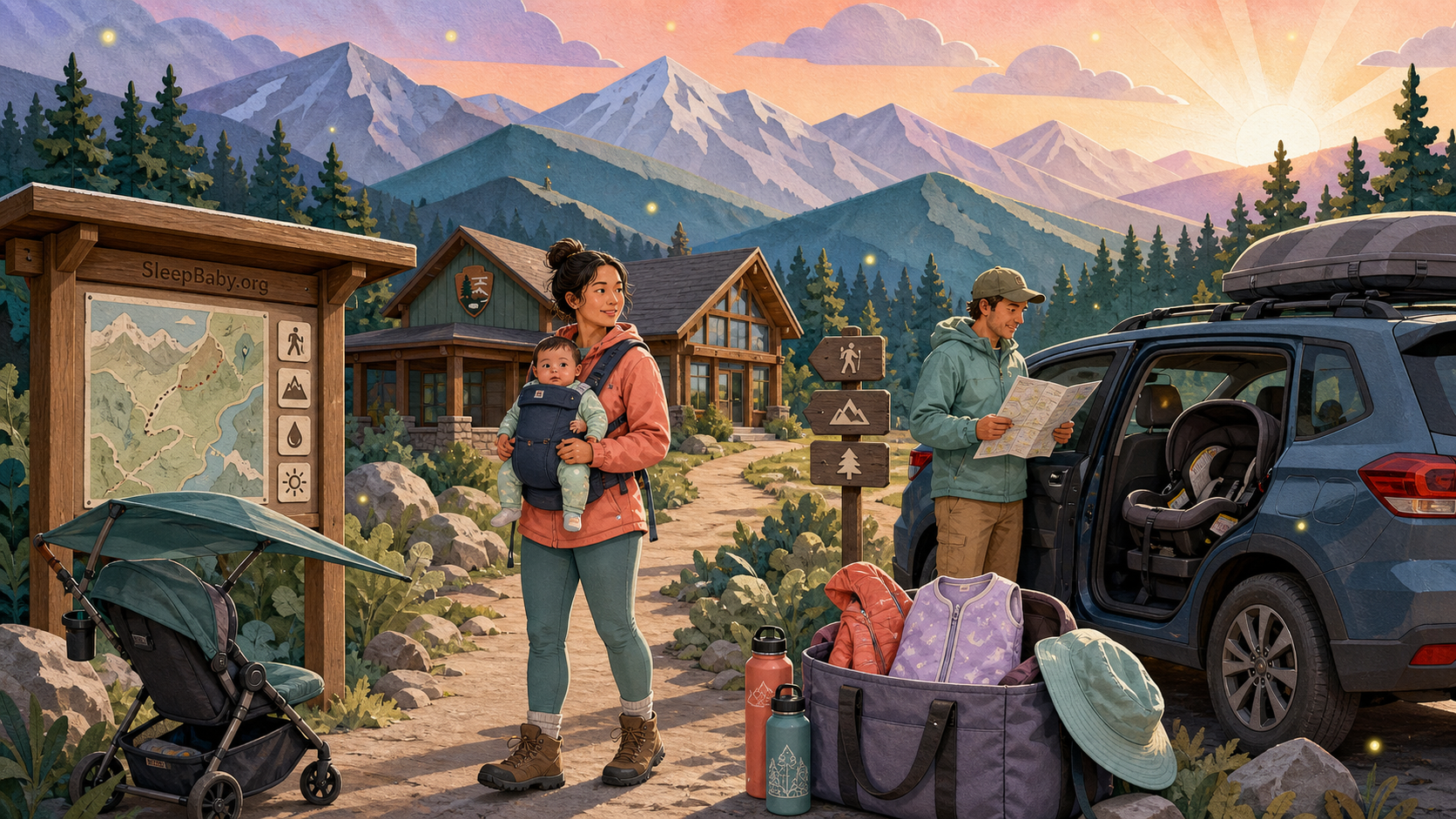
The trailhead answer
Yes – if the day stays smaller than the park
Most healthy babies can visit a national park when you choose a short park-specific route, check current alerts and elevation, protect shade and feeding, keep wildlife far away, and leave before the plan gets brittle. A long hike, extreme heat or smoke, a high sleeping elevation, limited medical access, or a baby who is ill or struggling can turn the answer into “not today.” The win is not reaching the viewpoint. It is giving your family a gentle encounter with the park and getting everyone home or back to camp safely.
The household at bedtime
Different people.
One household at night.
If you’re also caring for a baby and want help with sleep, our video is below. Watch when that’s the question you want to work on.
Prefer to read?Press play for a little help with your baby’s next bedtime.
Kind words about the original video
“Thank you so much for this video!”
“I'm truly impressed with how much information you share in your video.”
The SleepBaby Workshop
Get the Workshop.
Get the Workshop and explore its resources for everyday baby sleep and nighttime care. 15 guides and five audio tracks in a simple browser hub. Read, listen, and return to the part you need.
A conversation, if you want one.Night Owls is the SleepBaby chat room. Read what is there or join in.
If you are picturing a national-park day as a tiny expedition – matching hats, a heroic trail, a sunset photo in which nobody has leaked anything – let me take some pressure off. A baby does not need the park’s greatest hit. A baby needs regulated adults, a workable feed, clean air, a safe temperature, and an exit that remains easy.
The park can still feel enormous. You may hear pines moving above you, watch light travel over a canyon wall, or stand quietly while your baby studies one extremely important leaf. Those moments count. They often count more than the mile marker you had in mind.
This guide is built around that version of the day: specific enough to be safe, loose enough to survive an inconvenient diaper, and honest about the point where flexibility becomes risk.
First decide: go, adjust, or skip
Before packing the stroller like a rolling general store, make one decision about the actual conditions. “We are going to a national park” is not yet a plan. “We are visiting the shaded visitor-center loop at 8 a.m., turning around after the first overlook, and eating in the picnic area near the car” is a plan.
A three-minute decision
Match the park day to the baby you have today
Go
Baby is feeding and breathing normally, the route is short and reversible, the forecast is mild, air quality and park alerts are acceptable, and the adults have enough capacity to supervise without rushing.
Adjust
Move earlier, stay lower, trade the trail for a scenic drive or accessible loop, shorten the outing, add a shade-and-feed stop, or choose the visitor center instead of the remote trailhead.
Skip
Baby is sick, unusually hard to wake, breathing differently, feeding poorly, or cannot stay comfortably warm or cool. Also skip when smoke, storms, extreme heat, road conditions, elevation, or access to help exceed your backup plan.
Skipping is not failing the family memory. It is the kind of boring, competent parenting that keeps a beautiful place from becoming the setting of a bad decision. The mountains will continue being mountains without your attendance.
Plan the exact park, not an imaginary one
National parks can contain desert heat, alpine cold, ocean cliffs, bears, flash-flood channels, long shuttle lines, rough roads, and trailheads with no water – sometimes in the same park. Start with the official page for the exact park and date. Check alerts, closures, entrance or vehicle reservations, road and shuttle status, weather, air quality, wildlife notices, water availability, and where the nearest staffed help is.
The National Park Service recommends researching the specific park, identifying hazards, preparing a trip and emergency plan, and leaving the plan with someone who is not on the trip.1 For a baby outing, your trip plan can be wonderfully uncinematic: which entrance, which parking area, which short route, what time you expect to return, and the point at which you will turn around even if the view is supposedly “only ten more minutes.”
Download or screenshot what you need before service disappears. The NPS Ten Essentials includes navigation, sun protection, insulation, illumination, first aid, food, water, and emergency shelter, and specifically advises checking the park website and telling someone your plans.2 You do not need to carry an expedition store for a paved half-mile loop, but you do need enough margin to handle a delay without borrowing safety from luck.
Build a reversible route
Trailhead basecamp + short loop + easy return
1. Basecamp
Park legally near shade, restrooms, water, or a staffed area when possible. Change, feed, layer, and confirm the route before moving away from the car.
2. The small loop
Choose one accessible or clearly maintained objective with known distance, elevation, exposure, and surface. Give yourself permission to turn around halfway through half of it.
3. The clean return
Return before the last feed, last diaper, last adult snack, or last ounce of patience. Keep enough capacity to buckle the car seat correctly and drive rested.
This layout also makes it easier to split the day. One adult can take an older child to a longer viewpoint while the other stays on the short loop with the baby, as long as both adults have communication, keys, supplies, and a reunion time. Nobody should discover at the overlook that the car key went up the other trail.
Ask what “accessible” means on this route
An accessible trail can be a wonderful baby route, but the label does not automatically answer every stroller question. Look for current details about grade, width, surface, curb cuts, boardwalk gaps, rest areas, closures, and whether the route returns the same way. A paved path in full sun may be harder for a young baby than a compacted path in deep shade. A short boardwalk may be easy until the elevator or shuttle that connects to it is out of service.
If the park uses shuttles, learn whether strollers must fold, whether a car seat can or must be carried, how long the queue usually lasts, and where you can step out if the baby needs a feed. Do not assume the final shuttle leaves on the schedule you remember from another season. Keep the carrier available when wheels are allowed but awkward, and keep both hands free enough to board without passing a baby over a crowd.
Visitor-center staff and rangers can often help you choose between two routes, identify a shaded stop, or explain a closure. Give them the useful version of the question: “We have a six-month-old, a stroller, and about forty-five comfortable minutes. Which current route has the easiest return?” That gets you a better answer than “What is the best hike?”
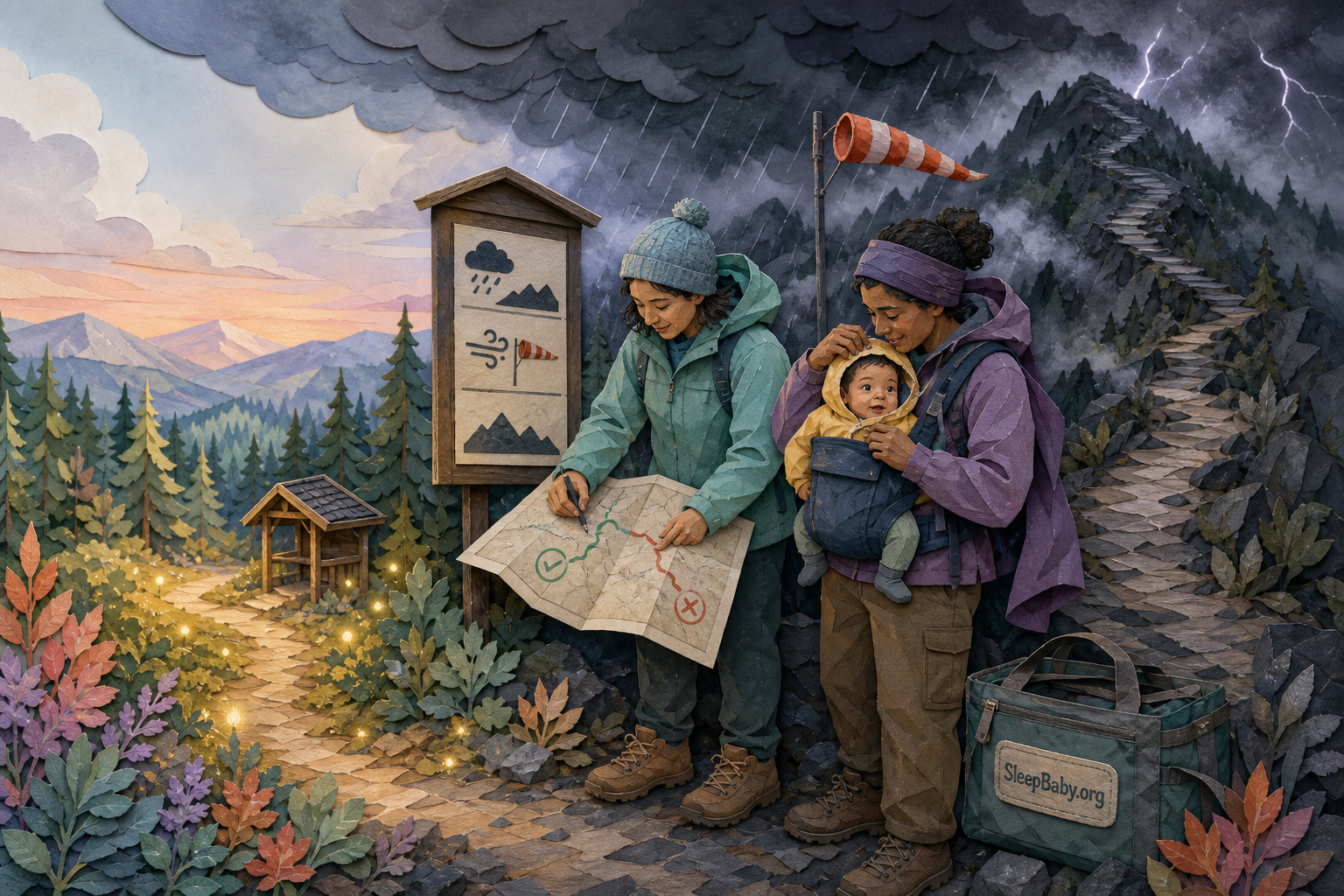
Let weather, sun, smoke, and elevation edit the itinerary
The weather at the entrance sign may not be the weather at the overlook. Temperatures can fall with elevation, open rock can radiate heat, and wind can turn a comfortable forecast into a cold baby very quickly. Look at the hourly forecast for the part of the park you will actually visit, then check again at the trailhead. If the safe window is small, make the outing smaller.
For a baby under six months, shade is the primary sun plan
The FDA advises keeping infants younger than six months out of direct sunlight, using shade and protective clothing such as long sleeves, pants, and a brimmed hat, and asking the baby’s pediatrician before using sunscreen. It also notes that the sun is strongest between 10 a.m. and 2 p.m. and that infants can overheat more easily than adults.5
That points toward an early start, a shaded route, a real canopy or umbrella when appropriate, and frequent temperature checks at the neck or torso rather than guessing from hands and feet. A muslin cloth draped over a stroller can restrict airflow and trap heat; use the stroller’s designed shade and keep air moving. If you cannot maintain shade without covering the baby’s face or turning the stroller into a tent, change locations.
Elevation is about sleeping height and symptoms, not bravado
The CDC notes that children are as susceptible to altitude illness as adults and that risk becomes more relevant for unacclimatized travelers sleeping at about 8,000 feet or higher. Gradual ascent helps. In preverbal children, possible signs can include unusual irritability, poor appetite, and pallor, but those signs are nonspecific; do not use a fussy afternoon as a do-it-yourself diagnosis.4
Do not keep ascending when someone has altitude symptoms. If symptoms worsen or become severe, descend and seek medical help. For a young infant, a history of prematurity, heart or lung concerns, or a plan to sleep high, ask the child’s clinician about the specific elevation and itinerary before the trip. “We are driving up, taking one photo, and driving down” still deserves thought if the baby is not acting normally.
Smoke and storms are not scenery
Check air-quality information and the park’s current fire or weather alerts. If smoke is visible, air quality is poor, lightning is approaching, a flash-flood watch affects the route, or wind is moving branches and dust, leave the exposed area. A car can be an exit vehicle; it should not become a place where you wait indefinitely with a baby while conditions worsen.
Carrier, stroller, or both?
The right answer depends on the route surface, temperature, crowds, and the adult bodies doing the carrying. A stroller can provide storage and designed shade on paved or accessible paths. It can also become an awkward wheelbarrow on stairs, sand, roots, boardwalk gaps, or a shuttle that requires folding. A carrier can go where wheels cannot, but it adds body heat and demands careful fit and frequent checks.
Before the trip, practice the carrier at home. Follow its age, weight, positioning, and fit instructions. In the park, keep the baby’s face visible, chin off the chest, and nose and mouth unobstructed. Recheck after adding or removing layers, after feeding, and whenever the adult starts sweating heavily. Do not count a loose sun cloth over the carrier as shade if it covers the baby’s face or blocks airflow.
If your baby strongly objects to the ride before the trail even starts, the plan may need a quiet reset rather than a faster buckle. Our guide to a baby who hates the car seat can help you separate a normal protest from a fit, temperature, or timing problem. During vehicle travel, keep the baby correctly restrained in the properly installed seat; the carrier begins after the vehicle is parked.
Make feeding and diapering part of the route
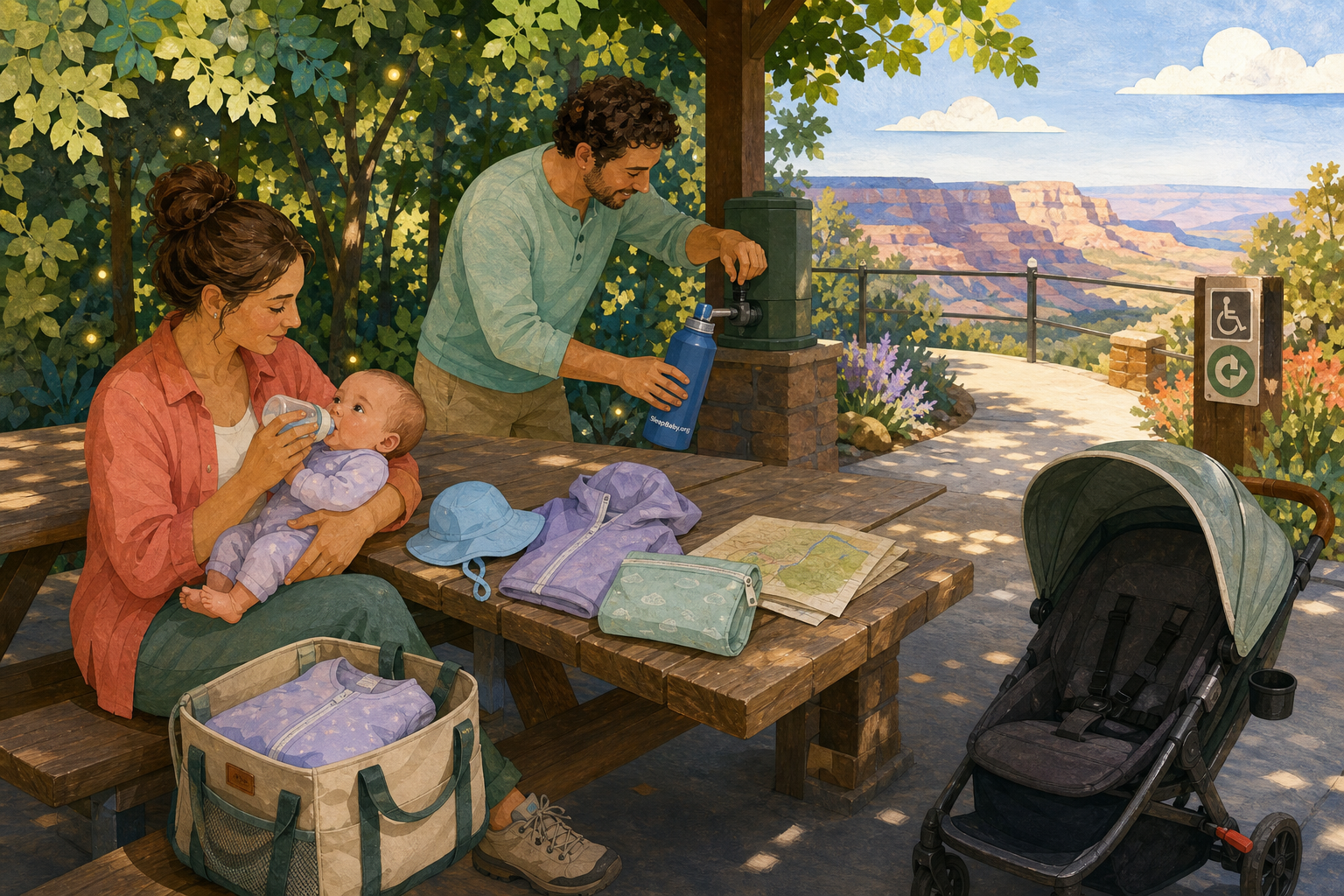
A feed is not a delay in the national-park experience. It is part of the experience, preferably in deep shade with the adult sitting securely and the rest of the group not narrating how much trail remains.
Identify two possible feeding places before leaving the trailhead: one near the car or visitor center, and one along the route. For bottle feeding, carry safely prepared milk or formula and follow your usual storage and handling plan; do not improvise with untreated stream water. For nursing, pack for your own comfort and hydration. For the baby’s hydration, continue breast milk or formula unless the baby’s clinician has given a different plan. An infant is not a tiny hiker who needs a surprise bottle of water because the adults are thirsty.
Bring more diapers and wipes than the mathematical minimum, a washable changing layer, hand-cleaning supplies, and a sealable bag for everything you must pack out. Change on a stable, permitted surface with one hand on the baby. A picnic table used for food is not automatically the best changing table; use designated facilities when available and clean up completely.
Mosquito and tick plans begin with route choice, clothing, and netting. The CDC recommends EPA-registered repellents used according to the label, clothing that covers arms and legs, and mosquito netting over strollers or carriers. Products containing oil of lemon eucalyptus or PMD should not be used on children under three. Adults should keep repellent away from a child’s hands, eyes, mouth, and irritated skin; when sunscreen is also used, sunscreen goes on first.6
If you are using netting, secure it so it cannot fall onto the baby’s face and keep checking airflow and temperature. Repellent does not make tall grass, ticks, or a swarm suddenly ideal for a baby. Sometimes the smartest product is the car key.
Let wildlife stay wild – and far away
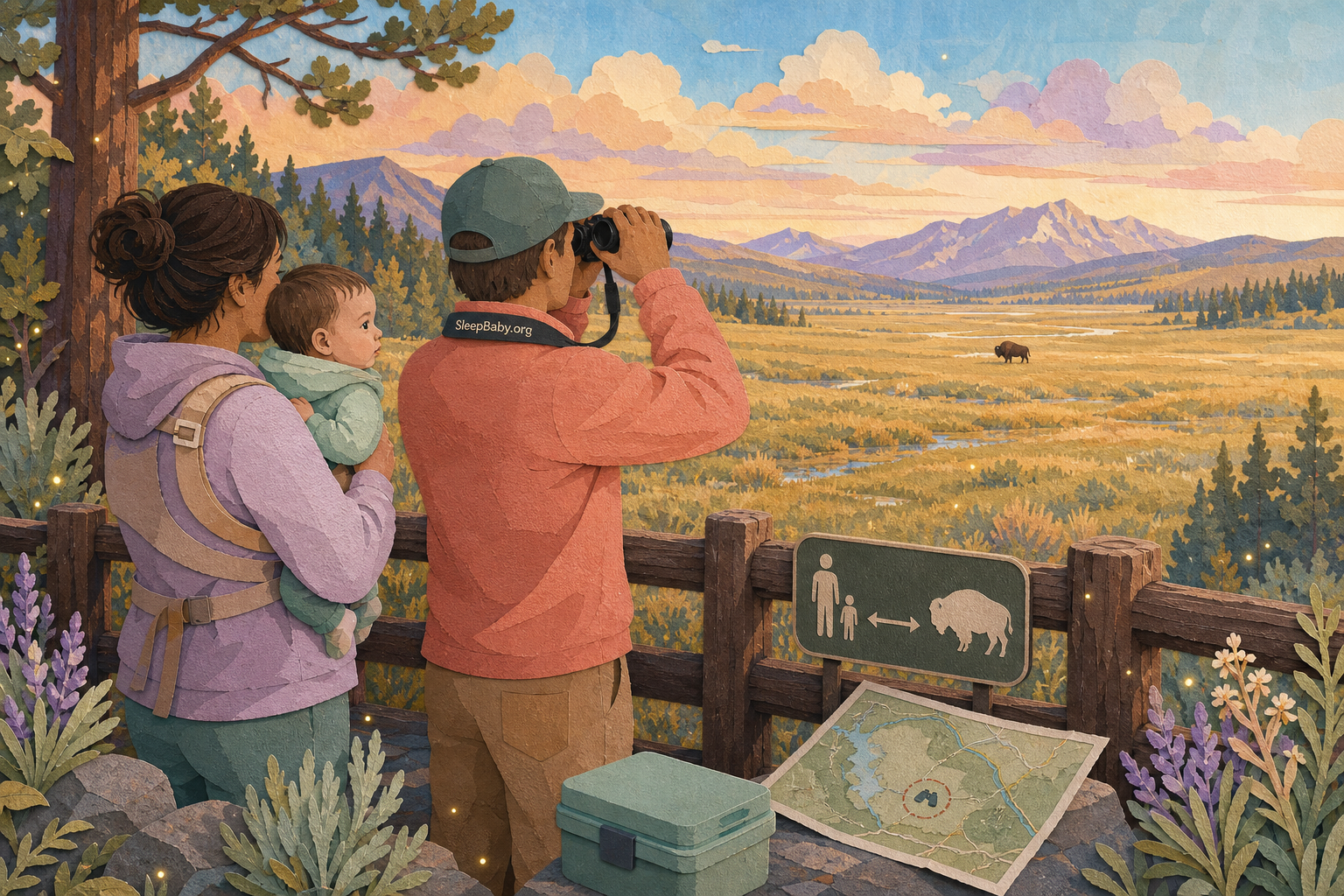
The National Park Service puts the principle plainly: leave animals alone – no touching, feeding, or harassing – and keep your distance.3 The exact safe distance and required behavior vary by park and species, so read the rules for the park you are visiting and follow ranger instructions.
With a baby, build more margin than the minimum. Do not set a blanket on the ground near animals, stop to feed at a wildlife jam, or walk closer because the baby “wants to see.” The zoom lens gets closer; the baby does not. If an animal changes its behavior because of you, blocks your route, approaches, or appears agitated, move away according to park guidance and ask a ranger for help.
Food belongs sealed and managed exactly as the park requires, including formula, snacks, used bottles, and anything scented. Never balance food storage rules against the hope that you will only be away from the car for a minute. A raccoon does not respect the emotional complexity of your diaper bag.
Pack in three zones, not one bottomless bag
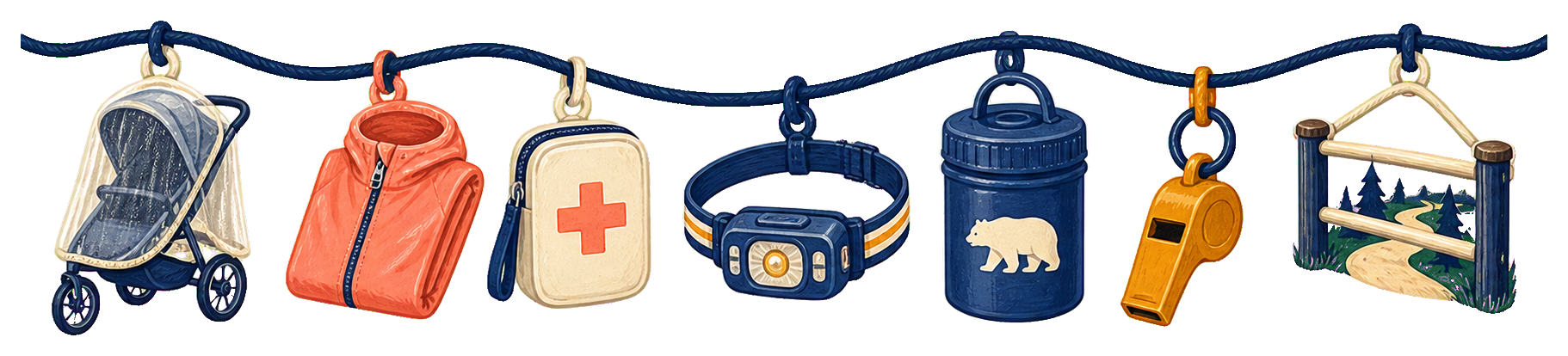
The fastest way to make a small problem feel large is to bury the solution under six backup outfits and a family-size bag of trail mix. Use three zones so the adult holding the baby can reach what matters without unloading the trailhead onto the ground.
The three-zone pack
Carry what you need where you will need it
On the adult
Phone, offline map, car key, ID, any essential medication, small first-aid items, and a light. The exit should not depend on finding the big bag.
Quick access
One feed, two diapers, wipes, changing layer, burp cloth, spare baby layer, adult water, sun protection, and sealed waste bag.
Car reserve
Remaining feeds and diapers, full clothing reset, adult food and water, weather layers, towels, charging cable, and the approved sleep setup for the destination.
The parked car is a supply base only while a responsible adult is present. NHTSA warns never to leave a child alone in a parked vehicle; shade and cracked windows do little to change how quickly the interior heats.7 Not for one photo, not for a restroom dash, and not while the baby appears peacefully asleep.
Protect the sleep destination, not a perfect schedule
A national-park day may scramble naps. That is inconvenient, not automatically disastrous. Keep familiar cues portable: the usual feed order, a short phrase or song, dimmer light at the destination, and the same sleep sack if it is appropriate for the baby and temperature. Do not try to rebuild the entire nursery at an overlook.
If a baby falls asleep during ordinary vehicle travel, keep the car seat installed and used exactly as directed. Once you arrive, a car seat, stroller, carrier, or sling should not become the regular sleep destination. NICHD recommends a firm, flat, level sleep surface designed for infant sleep, covered only by a fitted sheet, with no blankets, pillows, toys, bumpers, or other objects; when a baby sleeps in a sitting or carrying device, move the baby to the regular sleep space as soon as possible.8
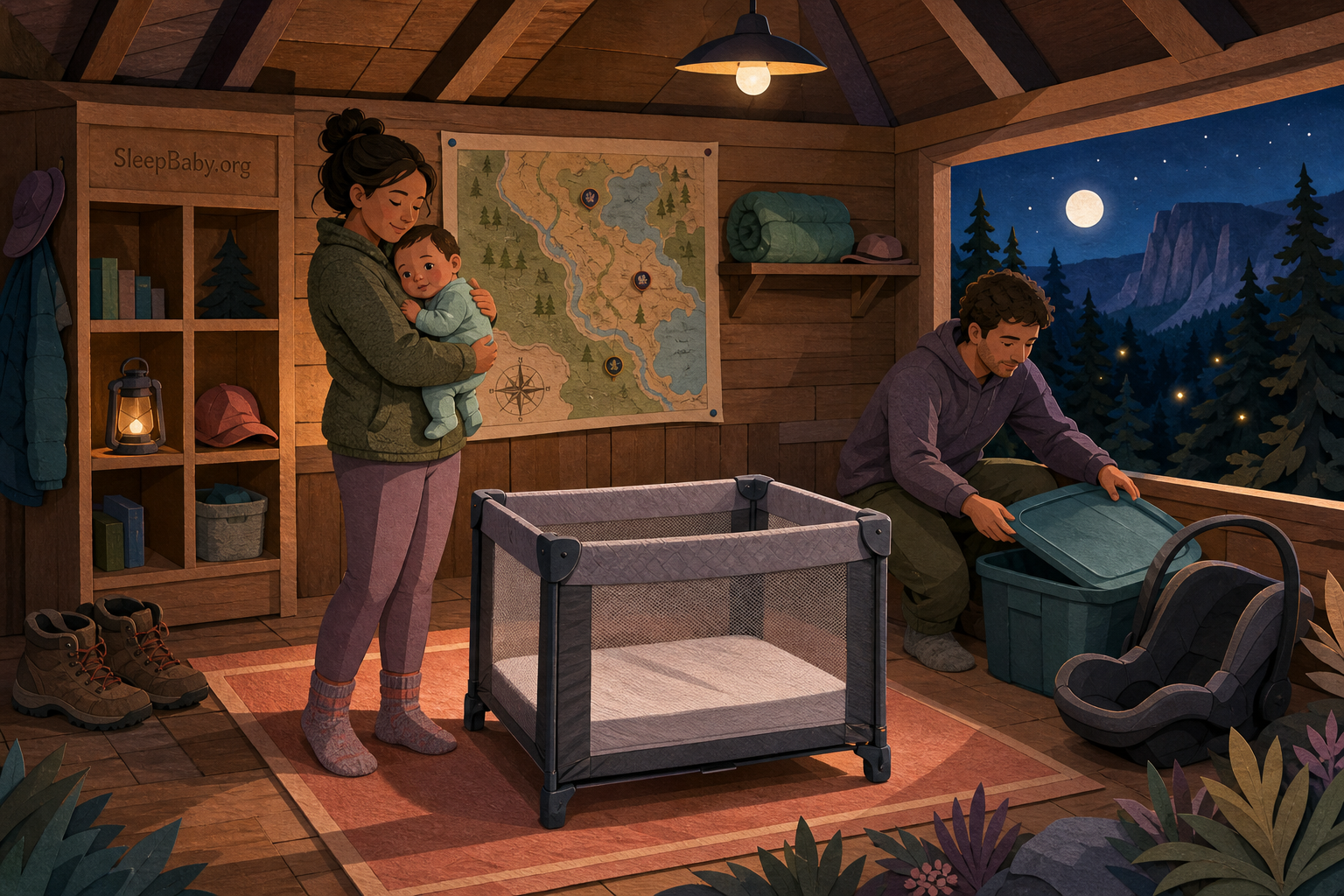
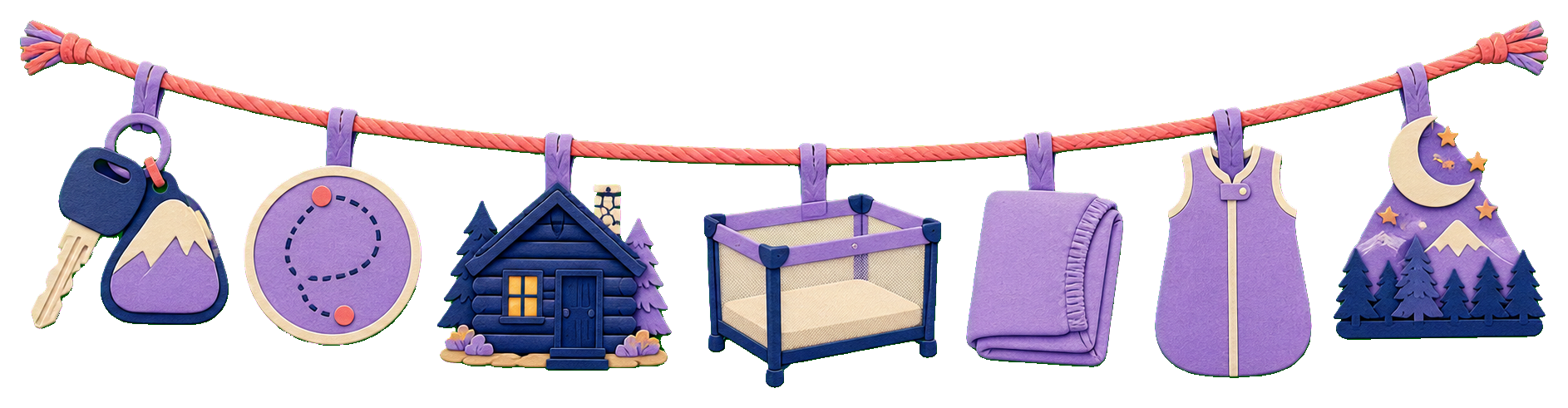
For a day trip, prepare the home sleep space before leaving. For an overnight stay, bring or confirm an approved crib, bassinet, portable crib, or play yard that fits the child and can be assembled correctly on a level surface. Campground glamour can wait. The empty sleep space is the luxury item.
I would rather see you carry one clear sleep plan and leave a beautiful trail early than improvise a sleep space after dark because the original itinerary won an argument. That is not being overcautious. It is protecting the soft landing the whole day still needs.
If the last car nap lands painfully close to bedtime, use the actual arrival time and your baby’s behavior rather than forcing the original clock. The guide on what to do when a baby falls asleep in the car before bedtime walks through that handoff without treating one late nap like a family emergency.
Half-day visit versus overnight stay
These are different projects. A half-day visit is mainly a route-and-exit problem. An overnight adds sleep-surface, temperature, food-storage, darkness, noise, and next-morning capacity.
Choose the smaller operating plan
Half-day
Route: one short objective with easy return.
Sleep: prepare the approved home sleep space before leaving.
Supplies: quick-access bag plus supervised car reserve.
Best exit: leave before the final feed and adult energy disappear.
Overnight
Route: short first-day objective plus energy to set camp safely.
Sleep: verify an approved firm, flat, level crib or play yard and keep it empty.
Supplies: full feeding, diaper, layer, lighting, food-storage, and next-day reserve.
Best exit: abort before setup if weather, smoke, altitude, feeding, or adult fatigue makes a safe night doubtful.
This comparison stacks cleanly on a narrow phone instead of trapping the reader in a sideways chart. In real life, the plan should reflow too. If the overnight becomes too much, a nearby hotel or a drive home is not a consolation prize. It is an available safety system.
Turn around while turning around is still easy
Leave early for a baby who cannot settle enough to feed, has fewer wet diapers than expected, repeatedly vomits, seems unusually pale or limp, is difficult to wake, has a rapidly worsening rash, or is behaving in a way that feels meaningfully wrong to you. Move immediately toward emergency help for trouble breathing, blue or gray color, unresponsiveness, a seizure, severe heat illness, or any rapidly worsening condition.
For adults, dizziness, confusion, severe headache, chest pain, breathing difficulty, or inability to carry and supervise safely also ends the outing. Two depleted adults do not combine into one rested adult. Tell a ranger or call emergency services when help is needed; do not rely on cell service farther down the trail.
You can also turn around for ordinary reasons: the baby hates the wind, the stroller wheel is sulking, the restroom is closed, or everyone is simply done. A good exit does not require a diagnosis.
What a successful park day can look like
You arrive early. One adult feeds the baby while the other checks the ranger board and downloads the last map. You walk a short loop. You stop in shade before anyone needs the stop. The baby sees moving leaves, hears water, and falls asleep for seventeen minutes at a deeply inconvenient time. You turn around without bargaining. Back at the car, you change the baby, buckle carefully, and leave with enough energy to manage the next part.
That is not the miniature version of a national-park day. It is a complete family day at the scale your baby can use.
One useful video before you go
Clear the sleep space before the adventure
The official NICHD Safe to Sleep demonstration shows why an infant sleep space stays firm, flat, level, and empty. The national-park takeaway is practical: assemble and clear the home, cabin, hotel, or campsite sleep surface before the adults are exhausted, so a carrier or car seat never becomes the improvised overnight plan.8
If the player does not load, watch the official NICHD video on YouTube.
For a deeper look at what belongs in an infant sleep space, see what babies can safely sleep with. And if you are working out how to keep a curious baby separate from unpredictable animals in a more familiar setting, the planning principles in taking a baby to a dog park offer a useful companion – with the important reminder that each national park’s wildlife rules control here.
Sources
- National Park Service: Trip Planning Guide
- National Park Service: Ten Essentials
- National Park Service: Watching Wildlife
- CDC Yellow Book: High-Altitude Travel and Altitude Illness
- FDA: Should You Put Sunscreen on Infants?
- CDC: Preventing Mosquito Bites
- NHTSA: Prevent Hot Car Deaths
- NICHD Safe to Sleep: Safe Sleep Environment
Bring the calm part home
Turn the park’s simple rhythm into tonight’s gentler landing
A small route, an early turn, a familiar cue, and a clear sleep space work after the trail too. Visit SleepBaby.org for practical next steps shaped around the baby and evening you actually have.
The SleepBaby.org Workshop
Make a plan for
the next bedtime.
Practical help for wake-ups, short naps, and sharing the night shift. Watch the original video, then get 15 guides and five audio tracks for $9.
$9 USD, paid once. No subscription. Digital access.
Watch the original Baby Sleep Miracle presentation
Press play for a little help with your baby’s next bedtime.
Original presentation. Watch before you decide.
15practical guides
5audio tracks
1one-time payment
Kind words about the original video
“Thank you so much for this video!”
“I'm truly impressed with how much information you share in your video.”
Inside the Workshop
Start with the night
you're having.
You don't need to read all 15 guides before bedtime. Choose the one that answers the question in front of you, then come back for the next part.
Before you buy
A few things
made clear.
A straightforward purchase, with space to decide what fits your family.
What am I buying?
The SleepBaby.org Workshop includes 15 digital guides, five audio tracks, and the original Baby Sleep Workshop PDF as an additional download. It costs $9 USD, paid once, with no subscription. Nothing is shipped.
Where should I start?
Try Tonight Rescue when you need a starting point. If your question is more specific, go straight to the guide on naps, a caregiver handoff, the sleep space, or another topic. You can read at your own pace.
Is this personal sleep coaching?
No. This is an educational collection for parents of babies and young children. Use the age-specific guidance, and bring feeding, breathing, growth, illness, or other health concerns to your child's clinician. It does not diagnose a problem or promise a sleep result.
Is the video the paid Workshop?
You can watch the original Baby Sleep Miracle presentation on this page. Your purchase is the SleepBaby.org Workshop collection of guides, audio tracks, and the original PDF described here.
How do I find it after checkout?
On your thank-you or order-status page, look for Open Workshop access, then Open your SleepBaby Workshop. Keep your order confirmation so you can return. If you need help finding your access, use our Workshop download help.
The SleepBaby.org Workshop
Have somewhere to start
at the next bedtime.
15 practical guides. Five audio tracks. One $9 purchase.

A quiet parent-to-parent note
What would you add about Parenting & Family?
Share one useful detail, question, or experience. No account is needed. Please leave out names, medical records, and other private details.
There is room for the first useful note.
If you have a thoughtful question or detail about Parenting & Family, you can begin the conversation below.