The short answer
Share less information, with fewer people, on purpose
Sharenting baby photos in the AI era calls for a smaller-audience default. Before posting, pause long enough to check the child’s dignity, the identifying details in the image and caption, the background and reflections, the real audience, and whether the same family connection could happen in a direct message, private album, printed photo, or in-person visit.
Generative AI makes it easier to alter convincing images, but that does not mean every public baby photo is automatically used to train every AI model. The simpler, better-supported concern is that anything publicly reachable can be copied, saved, searched, redistributed, or manipulated beyond the family’s original context. A privacy setting reduces exposure; it does not create a guarantee.
Skip public posting when an image includes nudity, bathing or toileting, medical vulnerability, intense distress, an embarrassing moment, a full name or birth date, a home or school location, a visible uniform, or another clue that could identify or humiliate the child later. When the decision feels close, keep the photo and make the audience smaller.
The photo can be tender even when the distribution choice is not
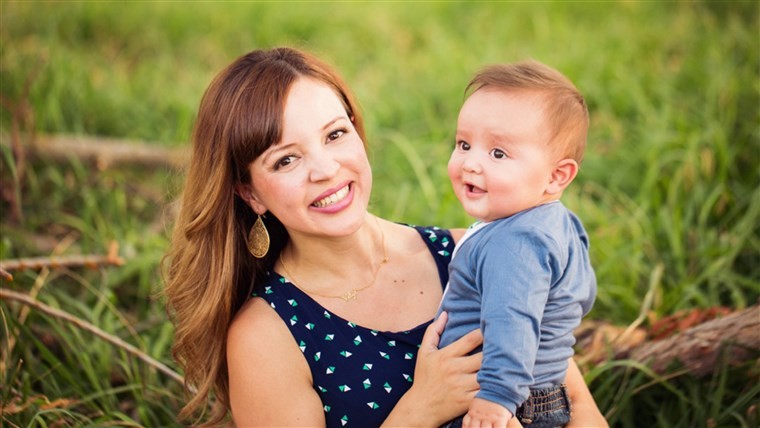
A baby’s new expression can make a tired adult want to beam it toward every person who has ever asked, “How are you all doing?” Sharing is often an act of affection, belonging, reassurance, or practical family connection. The goal is not to shame that impulse. It is to separate the beautiful moment from the widest possible delivery system.
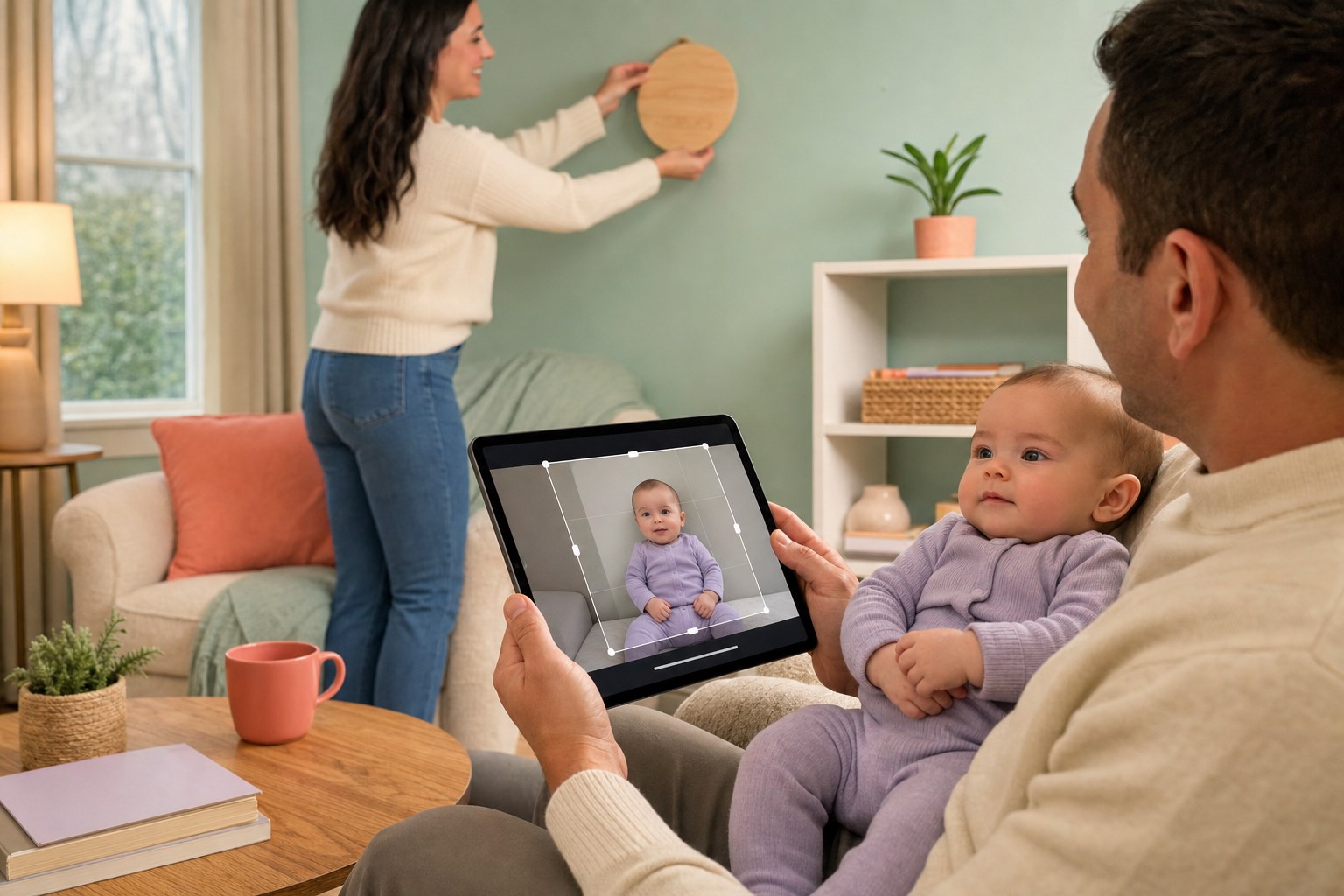
In a clearly labeled editorial composite, I can imagine holding the perfect round-cheek photo over the Post button while a house number sits quietly in a window reflection behind me. The baby is the subject, but the whole frame is talking. A crop, a new angle, or a direct family share can keep the joy while removing the accidental map.
The internet also changes the lifespan of a choice. A photo shared for one afternoon may be screenshotted, downloaded, indexed, reposted, or paired with information from another account. Deleting the original can reduce future access, but it cannot reliably retrieve every copy. That is why the useful safety moment happens before posting, not only after regret.
The Five-Second Photo Pause
Read the whole frame before anyone else can
- Child: Is the child fully clothed, comfortable, and shown with dignity rather than during pain, fear, discipline, bathing, toileting, or medical care?
- Clues: Does the image or caption reveal a full name, exact birthday, address, school, daycare, uniform, appointment, travel plan, routine, or live location?
- Frame: Check signs, mail, badges, documents, screens, windows, mirrors, shiny appliances, metadata, and other people in the background.
- Audience: Can you name who needs to see it, and do the account, album, tagging, resharing, download, and discovery settings match that answer?
- Future: Could you explain this post kindly to the child when they are older? If the answer is “maybe,” move inward or do not share.
This pause is a decision tool, not a promise that one checklist can make public posting risk-free. Platform controls and policies change. Review them regularly, remove stale followers, and assume an authorized viewer can still make a copy.
SleepBaby.org Five-Second Photo Pause: child, clues, frame, audience, future.
What AI changes—and what it does not prove
Generative AI can create or alter realistic-looking images quickly. NIST’s generative-AI risk profile describes risks that include harmful synthetic content, privacy problems, and misuse of data. The National Center for Missing & Exploited Children warns that generative AI can be used to create or alter exploitative imagery involving children. Those are reasons to reduce unnecessary exposure and to respond seriously to misuse.
They are not evidence that a particular family photo has been fed into a model, nor that every service handles images in the same way. Avoid certainty that the evidence cannot support. Read the current privacy policy and audience controls for the exact service you use, including any language about uploaded content, facial recognition, model improvement, public discovery, third-party access, and deletion.
AI also makes visual inference easier to overlook. A cropped name may not solve a visible school logo; a removed location tag may not hide a landmark; a covered face may not erase a unique room, sibling, or caption. Treat the image, caption, account history, tags, comments, and posting time as one information package.
Privacy starts before a child can pronounce the word
A baby cannot give informed permission for an enduring public record. That does not make every family photo unethical; it gives the adult a stronger duty to choose on the child’s behalf. Use the least revealing version, the smallest audience, and the shortest useful lifespan.
As children begin to understand photos, ask before sharing and honor a no. Let them see the image and understand the audience in language they can manage. Consent at four is not the same as adult consent, but practicing respect teaches that their image and body are not automatically public family property.
If I could not explain a post kindly to my child at thirteen, I would make the audience smaller today. That future-child test catches content that looks cute only because the child is too young to object: tears, toilet training, illness, punishment, nudity, and jokes at their expense.
Do not post another child without their caregiver’s permission, and do not assume permission for an event equals permission for a public account. Crop or blur other children, identifying badges, rosters, and location cues—or choose a different photo.
The Four-Ring Share Map
Move inward until the audience fits the reason
Ring 1 · Keep
Private device, encrypted backup, or printed copy
Best for the family archive, vulnerable moments, and photos that do not need an audience. Protect devices and cloud accounts with updates, strong unique passwords, and multifactor authentication where available.
Ring 2 · Send
One-to-one or a deliberately small family circle
Useful when a few known people are the real audience. Ask them not to repost, and still choose a dignified, low-information image because recipients can save or forward it.
Ring 3 · Limit
A reviewed private album or restricted group
Check membership, invitation, download, face-tagging, location, link-sharing, and expiration settings. Remove people who no longer belong in the circle.
Ring 4 · Public
Only for content safe to lose control of
Use a non-identifying, fully clothed, respectful image without live-location or routine clues. Public reach is not required proof that a family moment mattered.
Start at Ring 1. Move outward only when a specific benefit justifies the added exposure. “The relatives would enjoy this” usually points to Ring 2, not an open feed.
SleepBaby.org Four-Ring Share Map: keep, send, limit, public.
The caption can reveal more than the picture
A carefully cropped photo can still arrive with a child’s full name, birth date, regular park, pediatric appointment, daily schedule, school start, or holiday absence written underneath it. Combine that caption with older posts and the account may disclose a pattern that no single image showed.
Use a nickname or no name, avoid exact dates and recurring locations, post after leaving rather than live, and do not announce that a home is empty. Turn off automatic location sharing and review whether the camera saved location metadata. Some platforms strip some metadata during upload; do not rely on that behavior across every service or download path.
Check decorative milestones too. A first-day board can bundle a full name, age, school, teacher, favorite place, and date into one charming little identity dossier. Keep the board for the family archive, photograph a blank side, or crop tightly. The chalkboard does not need a better résumé than the adult holding it.
Secure the account that holds the family album
Privacy settings cannot help if the account is taken over. Use a unique password stored in a reputable password manager, enable multifactor authentication, install platform and device updates, and review active sessions and connected apps. Do not share login credentials across a family group.
Consider whether a child-focused account is necessary at all. An account built around a child’s full identity can become a searchable timeline of face, age, home, activities, health, and routines. If an older account already exists, audit it from the beginning: archive or delete overly revealing posts, remove public tags, tighten audience settings, and ask relatives to remove copies they reposted.
Set one family rule that is easy to remember: nobody posts the child publicly without checking with the caregivers first. Explain the rule before gatherings, births, birthdays, and school events rather than trying to negotiate it after an excited relative has uploaded a carousel.
A smaller share can carry more care
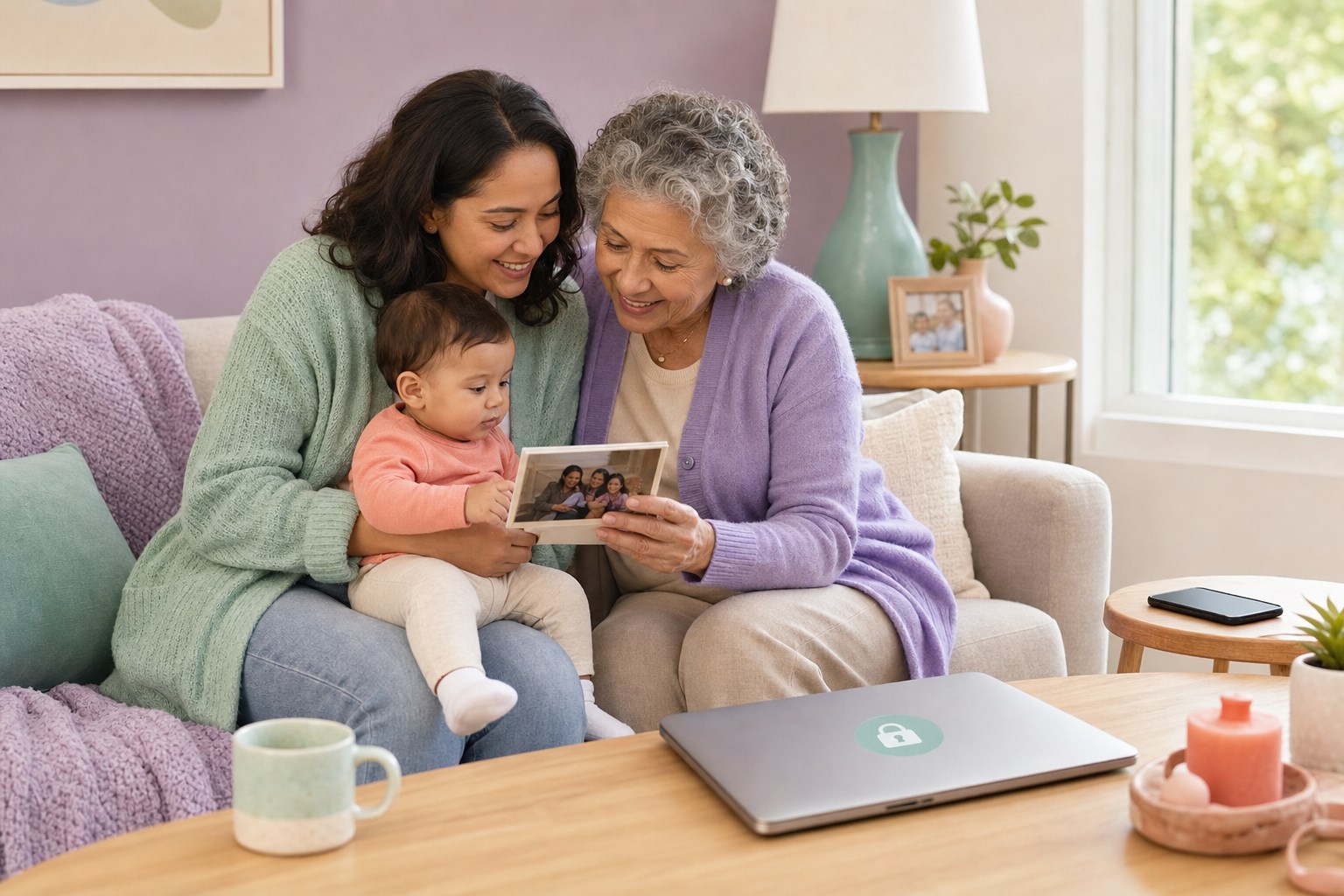
Private does not have to mean cold or secretive. Send one image with a voice note. Print a monthly card for a grandparent. Use a family album whose members you review. Show the photo during a call and keep the file offline. These choices may create more actual conversation than a public post followed by a row of hearts.
Talk with recipients about forwarding and reposting. A “private” group still contains individual people with phones. If someone repeatedly ignores the boundary, stop sending them child photos; the relationship can continue through calls, visits, and updates without an image file.
Digital boundaries are easier when the whole household practices them. If devices already trigger constant reaching or conflict, the practical reset in helping a child who is obsessed with a phone can help adults redesign access without shame. For a wider family media plan, use the routines in responding when a young child seems obsessed with TV.
The Copy–Report–Lock Response
If a child’s image is copied or manipulated, preserve evidence before cleaning up
- Copy evidence privately. Save the URL, username, date, messages, and screenshots needed to show what happened. Do not publicly reshare harmful material to prove it exists, and do not download or circulate suspected illegal sexual-abuse imagery.
- Report the content and account. Use the platform’s privacy, impersonation, harassment, child-safety, or non-consensual-image route. Keep confirmation numbers and report from the original caregiver account when practical.
- Lock the source. Tighten audiences, remove tags and followers, change compromised passwords, enable multifactor authentication, review sessions, and ask known reposters to delete their copies.
- Use the right specialist route. In the United States, report suspected child sexual exploitation to NCMEC’s CyberTipline. Use NCMEC’s Take It Down only for nude, partially nude, or sexually explicit images or videos taken when the person was under 18—not for an ordinary clothed baby photo. Report relevant manipulated-image crime, fraud, or extortion to the FBI’s Internet Crime Complaint Center and local law enforcement as appropriate.
If there is an immediate threat to a child, contact emergency services. If someone is demanding money, more images, secrecy, or contact with the child, stop engaging, preserve the messages, and seek law-enforcement and child-safety help. Do not pay or send additional material on the promise that copies will be deleted.
SleepBaby.org Copy–Report–Lock Response: preserve, report, secure, escalate through the matching specialist channel.
Know what each reporting tool is for
NCMEC’s CyberTipline accepts reports of suspected online child sexual exploitation. NCMEC’s Take It Down service can help limit online sharing of nude, partially nude, or sexually explicit images or videos taken when the person depicted was under 18; it works by creating a digital fingerprint on the user’s device, so the image itself does not have to be uploaded to NCMEC. Its scope matters: it is not a general takedown service for every ordinary family photo.
The FBI’s IC3 has warned that malicious actors can use benign photos and videos to create manipulated explicit content and use it for harassment or extortion. If that happens, preserve the account names, links, demands, and transaction information without redistributing the harmful image, then report through the relevant platform and official channel.
Removal can take persistence. Keep a dated log of reports and responses. Search the child’s name and distinctive account names periodically if an incident has occurred, but avoid repeatedly opening harmful material. A lawyer or victim-support professional can advise on jurisdiction-specific privacy, copyright, impersonation, or removal options; this article is general safety information, not legal advice.
Make the rule simple enough to survive a birthday party
Families do not need a 30-page social-media treaty. Try: “Ask before posting; never share undressed, distressed, medical, embarrassing, school-identifying, or live-location images; and use the smallest audience that fits.” Put the rule in an event invitation or family message before cameras come out.
If relatives disagree, keep the boundary about the child rather than the adult’s intention: “I know you are proud. We are not putting identifiable photos of the baby on public accounts. Please text that one to us instead.” Offer a safe alternative—a back-of-head photo, a cropped detail, a group shot without the child, or a private call.
Review the rule as the child grows, the audience changes, and platforms introduce new AI, discovery, tagging, or reuse features. Yesterday’s private setting is not a permanent contract.
Watch a practical parent guide to sharing children’s images
Creator: NCA-CEOP Education. Watch “Thinkuknow. Parent and carers guide to sharing images (Primary)” on YouTube.
Why it is here: the guide helps adults think through sharing children’s images and online safety. Platform names and controls can change, so verify the current settings on the service you actually use.
Takeaway if you cannot watch: Before sharing, check what the image reveals, who can access or copy it, and whether a smaller private audience can meet the same family need.
Keep the memory; choose the distribution separately
The loving part is noticing the moment. The protective part is deciding whether it needs to become searchable, copyable, and attached to the child’s identity.
Pause on the whole frame. Remove the clues. Move the audience inward. A baby photo can stay precious without becoming public.
When one beautiful photo feels too precious not to share
Keep the joy; make the audience smaller
The safest family photo plan is one you can use while tired, proud, and halfway through a group text. SleepBaby can help you turn the real pressure—relatives, platforms, privacy, and a child’s growing voice—into a small-circle sharing rule that protects connection without handing every memory to a public feed.
Sources
- American Academy of Pediatrics: Sharenting—5 Questions to Ask Before You Post
- National Institute of Standards and Technology: Artificial Intelligence Risk Management Framework—Generative Artificial Intelligence Profile
- National Institute of Standards and Technology: Privacy Framework
- National Center for Missing & Exploited Children: Generative AI
- FBI Internet Crime Complaint Center: Malicious Actors Manipulating Photos and Videos to Create Explicit Content and Sextortion Schemes
- National Center for Missing & Exploited Children: Take It Down
- National Center for Missing & Exploited Children: CyberTipline
- NCA-CEOP Education: Thinkuknow Parent and Carers Guide to Sharing Images