
Before you pack the diaper bag
You can often bring your baby to vote, but confirm the local rule first
Many caregivers vote in person with a baby, but child, stroller, photography, identification, and assistance rules are not identical everywhere. Check your state or local election office before you leave, verify the exact polling place and hours, and ask a poll worker before entering the voting area. Bring one secure baby base, the smallest useful diaper kit, and permission to step out if feeding, crying, temperature, or a diaper becomes the more important job.
The household at bedtime
Different people.
One household at night.
If you’re also caring for a baby and want help with sleep, our video is below. Watch when that’s the question you want to work on.
Prefer to read?Press play for a little help with your baby’s next bedtime.
Kind words about the original video
“Thank you so much for this video!”
“I'm truly impressed with how much information you share in your video.”
The SleepBaby Workshop
Get the Workshop.
Get the Workshop and explore its resources for everyday baby sleep and nighttime care. 15 guides and five audio tracks in a simple browser hub. Read, listen, and return to the part you need.
A conversation, if you want one.Night Owls is the SleepBaby chat room. Read what is there or join in.
I would rather make one 90-second phone call than spend the whole drive rehearsing an argument with a rule that may not exist.
That is the anxious little trap in this outing. The question sounds simple: “Can I bring my baby to vote?” But what a tired caregiver is really asking is whether the stroller will fit, whether the baby can come into the booth, whether a cry will feel like a public announcement, and whether leaving the line means giving up the vote.
The calm answer is not a dramatic yes or no. It is a small plan. Confirm the local rule. Choose one baby setup. Know what you need to bring. Keep your ballot private. Locate the exit before you join the line. If the baby needs you, use the exit without turning it into a moral verdict.
Picture a composite kitchen-counter scene: voter information on the phone, keys beside a folded carrier, one diaper, one bottle, one clean outfit, and a baby attempting to campaign for the corner of the envelope. The baby does not understand the civic milestone. The baby understands paper that crinkles. That scene is illustrative, not legal evidence. The election rules and infant-safety guidance below come from the official sources in the Sources section.


Can your baby come into the voting booth?
Often, yes. But do not turn “often” into a nationwide guarantee. The U.S. Election Assistance Commission explains that American elections are highly decentralized: states administer elections differently, local jurisdictions usually run them, and procedures may vary even within one state.1
Two state laws show why a local check matters. California Elections Code section 14222 says a voter may be accompanied in the voting-booth area by children under 18 who are in the voter’s care.3 Virginia Code section 24.2-643 expressly allows a voter to be accompanied into the booth by a child age 15 or younger.4 Those examples are useful because they are not identical. They do not tell you the current rule in a third state, a tribal jurisdiction, a territory, or your exact polling location.
Use the EAC’s state lookup to reach your state election office and local election-office directory. The EAC specifically tells voters to verify summary information through linked state and local sources because registration details, timelines, polling locations, and voting options change.2
Ask a concrete question: “May my infant come with me into the polling place and voting booth, and are strollers permitted at this location?” If you use a carrier, have twins, need a larger mobility setup, plan to bring another child, or require disability-related access, say that. The correct answer may depend on the building and the law, not merely the word “baby.”
Six checks before shoes
Confirm the trip while the baby is still at home
CHILD RULE
May the baby enter the polling place and booth with you? Is there an age rule for older children? Ask the election office, not a neighborhood comment thread.
PLACE AND TIME
Verify the exact address, date, opening hours, parking or transit plan, entrance, and whether the location is a precinct, vote center, or early-voting site.
WHAT TO BRING
Check current identification, registration, sample-ballot, and document rules for your jurisdiction. Pack the voting item beside the keys, not under six burp cloths.
STROLLER AND ACCESS
Ask whether the route, entrance, booth, and line can accommodate your stroller or carrier. Never block an accessibility route, door, or voting station.
PHOTOS AND CLOTHING
Confirm rules about cameras, ballot photographs, campaign clothing, buttons, and signs. Keep every candidate, party, and ballot-marking choice out of the baby’s gear plan.
OTHER OPTIONS
Ask what early, mail, absentee, curbside, accessible, or alternate-location options are available to you and what deadlines apply. Do not assume an option exists everywhere.
This is a preparation checklist, not a statement of one nationwide rule. Your election office controls the current local answer.
Save the office number and polling-place address in your phone. A screenshot is helpful if reception is weak, but check it close to voting day so you do not preserve an outdated location with great organizational confidence.
Choose the easiest legal voting window, not the most symbolic one
If your jurisdiction offers early voting, vote centers, mail voting, or another eligible option, compare them before deciding that Election Day at the busiest hour is the only authentic version of democracy. The best method is the one you are eligible to use, can complete correctly, and can manage without treating the baby’s hunger as a scheduling flaw.
Ask the local office which hours or locations are usually less busy, while understanding that no one can promise a line length. If you can choose, avoid the tightest overlap between commuting traffic, a fragile nap, and the feeding interval that always arrives three minutes earlier when you are holding paperwork.
I do not recommend planning the outing around a perfect wake window. Use your baby’s usual rhythm as information, not as a countdown clock. If timing is making the trip feel impossible, our guide to wake-window anxiety can help you choose a reasonable window without making the clock the third voter in the family.
Feed and change the baby shortly before leaving when that fits your normal routine. Then bring what the baby actually needs if the schedule shifts. The goal is not to guarantee a silent line. It is to make a normal baby need solvable.
Carrier or stroller: choose the setup that protects one free hand
Neither option wins everywhere. A carrier may be easier through a narrow room and keeps the baby close. A stroller can create a defined base for the diaper bag and reduce the temptation to balance documents while holding the baby. The building, the baby’s age and health, your body, and the local rule decide more than a generic packing list.
One free hand changes the day
Choose the setup you can enter, vote, and exit with safely
CARRIER
Useful when: the baby is comfortable in a correctly fitted carrier, the route is narrow, you can see the baby’s face, and your hands stay free for identification and the ballot.
Change plans when: the baby’s chin drops toward the chest, the face is covered, the carrier fit is uncertain, either of you is overheating, your body is uncomfortable, or marking the ballot would require awkward bending.
STROLLER
Useful when: the location permits it, the route and booth are wide enough, the harness and brake work, and the stroller can remain beside you without blocking another voter.
Change plans when: the entrance has an unworkable barrier, the room is too tight, you would need to park the baby away from you, or bags on the handle make the stroller unstable.
Shared rule: use the harness, keep the baby’s face visible, keep the setup within reach, and keep voting materials, bags, straps, and pens away from the baby’s mouth.
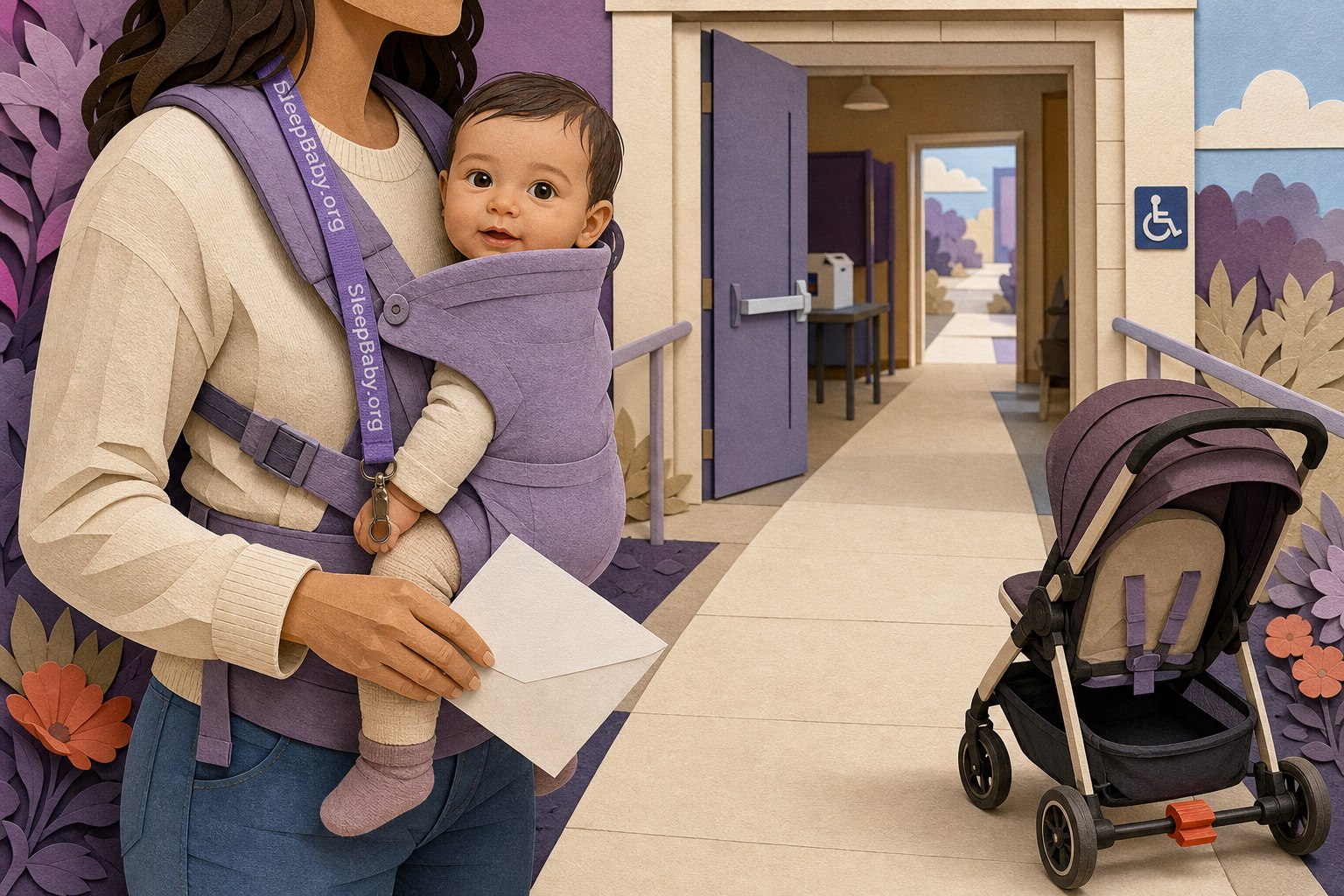
Do a dry run at home. Put on the carrier or open the stroller. Place the exact identification and voter information where you can reach them with one hand. Pick up the diaper bag. Open a door. If the setup requires three hands in the hallway, it will not discover a fourth hand at the polling place.
Keep the bag small: diapers, wipes, a compact changing mat, waste bags, one practical outfit, feeding supplies for the real outing, a clean cloth, and any routine medication or medical equipment. Add a quiet object that cannot become a choking or strangulation hazard. Skip loose campaign stickers, long toy cords, glass bottles if an alternative works for your baby, and the ceremonial blanket that will spend the trip sliding toward the floor.
If you are driving, the baby comes inside with you. NHTSA says never leave a child unattended in a vehicle for any length of time; shade and cracked windows do not make that safe.6 “I will only be two minutes” is not a car-seat setting.
Watch: what to check before voting in person
This official Arizona Citizens Clean Elections Commission video walks through finding the correct polling place or vote center, learning what to bring, and understanding voting-day rights. Use it as a preparation example, not as the rulebook for your state.
Watch What to Do When Voting on Election Day on YouTube if the embedded player is unavailable or not useful with your assistive technology.
Written takeaway: verify your location and requirements through your own election office, put the required voting item where one hand can reach it, and know whom to ask when the room does not match the plan.
If the line is long or the baby cries, protect the next decision
A crying baby is communicating, not heckling democracy. You do not owe the room a perfectly silent infant. You do owe the baby attention, and you deserve a plan that does not make every whimper feel like a public performance review.
Before joining the line, identify the exit, a place outside the voting area where you may feed or reset if permitted, and the nearest poll worker. Do not silently move barriers, leave the line with a ballot, or carry voting materials outside the authorized area. Tell a poll worker what you need and follow the exact local procedure.
When the plan changes in the line
L.I.N.E.: leave without losing the next step
LOCATE
Notice the exit, the poll worker, and any lawful place to step aside before the baby’s need becomes urgent.
INFORM
Tell a poll worker before moving if you have checked in, received a ballot, or entered the voting area. Do not guess what may leave the room.
NAME THE NEED
Use plain words: “My baby needs feeding,” “We need a diaper change,” “We are overheating,” or “I need to leave and understand how to return.”
EXIT AND RESET
Follow the poll worker’s instructions, care for the baby, and decide whether to rejoin, return later, use another eligible option, or contact the election office.
L.I.N.E. is a SleepBaby.org editorial memory aid. It does not replace election law or poll-worker instructions.
The framework matters most after check-in. Election materials have chain-of-custody and privacy rules. If you have a ballot in hand, stop improvising. Ask before stepping anywhere.
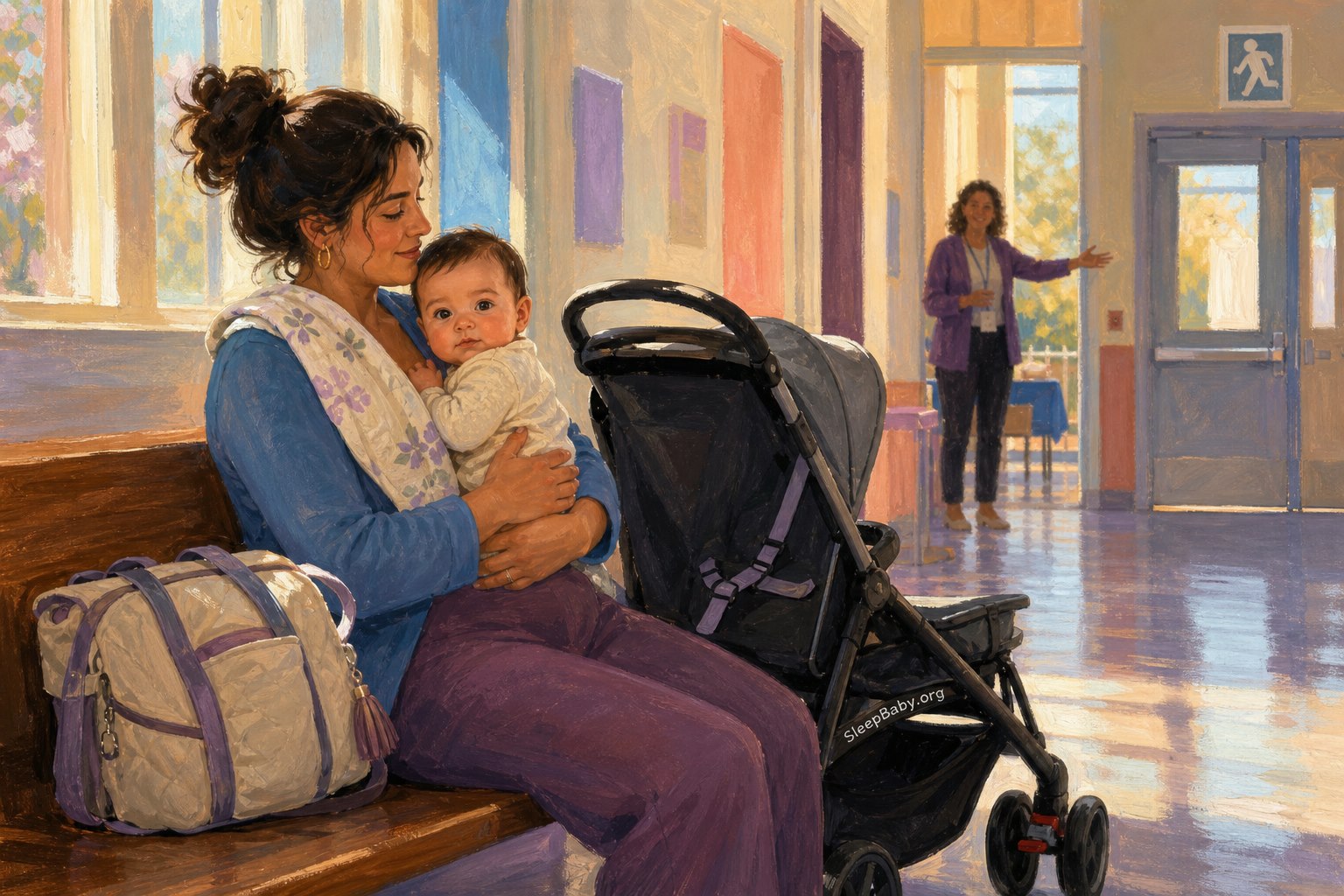
The trip is not a failure if you leave. That sentence sounds obvious until the baby is crying, you can see the front of the line, and sunk cost begins whispering that one more minute will surely fix everything. Sometimes one more minute is fine. Sometimes the only intelligent move is outside.
The baby does not need a perfect civic field trip. You need a private ballot and an exit that still belongs to you.
Keep the ballot private, even when the baby is adorable
A “first voting day” photo can feel sweet. The trouble is that camera and ballot-selfie rules differ, polling places protect voter privacy, and a background may reveal another person’s ballot, registration information, address, or face. Campaign clothing and political materials may also be regulated near a polling place.
Ask before taking any photo inside. Do not photograph a marked ballot, voting screen, check-in table, voter list, another voter, poll worker materials, or the inside of a booth unless your election office clearly says it is lawful and the poll worker confirms the location. The easiest safe memory is often outside, after voting, with no ballot visible and no live location posted.
Keep the baby’s clothing and gear nonpartisan unless you have confirmed the local electioneering rule. A plain sleeper is not surrendering your convictions. It is declining to make a poll worker interpret a onesie while a line forms behind you.
If you share the outing later, crop addresses, barcodes, voter documents, car plates, school names, location signs, and other people’s faces. Our guide to sharing baby photos more safely explains why a cute image deserves the same privacy check as any other family post.
The photo can wait
Three privacy checks before you tap the camera
IS IT ALLOWED HERE?
Check the election office’s current camera and ballot-photo rules, then ask the poll worker where photographs may be taken.
WHO ELSE IS VISIBLE?
Protect other voters, poll workers, ballots, screens, check-in materials, addresses, signatures, and identification.
DOES IT NEED TO BE LIVE?
Post later, remove location data when appropriate, and share the moment without publishing the family’s route in real time.
Feed, change, or leave without turning the booth into a nursery
Bring the normal feeding plan for a short outing. Ask where feeding is permitted if you need privacy, seating, or space. A bottle, pump part, or snack for an older baby stays in a clean closed bag until needed. Keep liquids away from ballots and voting equipment. If feeding cannot happen comfortably and lawfully in the available space, step out under the poll worker’s instructions.
Use a designated changing station when available, with your own compact mat and one hand on the baby. Do not change the baby on a voting table, booth shelf, check-in surface, bench used for election materials, stroller canopy, or the floor. If the building has no appropriate place, leave and change the baby somewhere safer.
Wash caregiver hands when possible after diapering and before handling feeding equipment. Keep sanitizer adult-controlled and away from the baby’s hands and mouth. Do not let a bag spill into the line, and do not attach so much gear to a stroller handle that the stroller becomes unstable.
If the baby has a fever, breathing trouble, repeated vomiting, poor feeding, unusual sleepiness, or is not acting like themselves, the voting outing is not the place to test whether the symptoms will settle. Get appropriate medical advice or urgent care, and contact the election office about lawful voting options and deadlines. Civic participation does not require ignoring a sick baby.
For outdoor lines, crowding, temperature, and noise deserve their own check. Our baby-at-a-parade guide has a fuller heat, noise, and crowd plan. Use those principles conservatively here: shade, appropriate clothing, access to feeding, a visible airway, and a fast exit matter more than preserving your exact place in line.
If the outing steals the nap, do not make bedtime pay interest
Voting can be a ten-minute stop or a bright, warm, oddly timed expedition. A short car nap may happen. A feed may land late. The baby may study every fluorescent light and then decide the afternoon is an excellent time to process democracy out loud.
Car seats, strollers, and other sitting devices are not recommended as a baby’s regular sleep or nap space. NICHD advises moving a baby who falls asleep in a sitting or carrying device to the regular sleep space as soon as possible; the sleep surface should be firm, flat, level, and covered only with a fitted sheet.5
During the necessary ride, use the car seat exactly as directed. Once you arrive, do not carry the seat indoors and treat it as a nap container. Move the baby to the normal safe sleep space when you can do so safely. Do not loosen straps, add a pillow or blanket around the head, prop the seat at a different angle, or leave the baby sleeping unattended.
Then make the rest of the day smaller. Offer the next feed according to the baby’s needs. Dim the house a little earlier if stimulation ran high. Keep the bedtime routine recognizable, but do not force every step to land at its usual minute. A missed nap is information, not an invoice.
I like a three-part reset: home, low, familiar. Get home when you can. Lower the sensory volume. Use the familiar sequence that tells the baby’s body what comes next. That may be feeding, a diaper, pajamas, a short book, a song, and the usual safe sleep space. It does not need to be a compensatory festival of extra steps.
If you have another errand planned, decide whether it still deserves the baby’s remaining bandwidth. The one-safe-base thinking in our guide to taking a baby to the laundromat applies here too: one controlled job and an easy exit can be the whole day.
Taking a baby to vote: practical questions
Can I take a newborn to a polling place?
Start with the local child-entry rule, then use a conservative health plan. A newborn’s feeding, temperature, medical history, prematurity, and tolerance for crowded indoor spaces may make another eligible voting option more practical. Ask the baby’s clinician when health concerns change what outings are appropriate. Do not count on a quiet line or a private feeding area.
Will I be asked to leave if my baby cries?
A brief cry is normal, but the poll worker applies the local procedures and protects an orderly voting space. If the baby cannot settle, tell a poll worker what you need. If you already have a ballot, get instructions before moving. Care for the baby, then ask how and when you may continue under the local rules.
Can I take a stroller into the voting booth?
Do not assume. Ask the election office about the exact location and stroller access. Even where a baby may accompany a voter, the room, booth dimensions, entrance, and accessibility routes may affect the setup. Never park the baby away from you or block another voter’s route.
Can I feed my baby while waiting to vote?
Ask where feeding is permitted and use the option that keeps the baby, ballot materials, equipment, and other voters safe. If the baby needs a longer or more private feed, tell a poll worker and step out under their instructions. Feeding the baby is not losing focus; it is responding to the actual person in your care.
Can I bring more than one child?
Rules vary by jurisdiction and may include child-age provisions. Confirm the number and ages with the local election office. If you cannot keep each child with you, protect ballot privacy, and move through the building without blocking the room, bring another caregiver or use another eligible voting option.
Can I take a first-voting-day photo with my baby?
Usually the lowest-risk plan is a photo outside after voting, with no ballot, voter document, other voter, or live location visible. Camera and ballot-photo rules vary, so confirm them before taking any picture inside. Ask the poll worker where photos are allowed.
What if my baby falls asleep in the car seat or stroller?
End the outing and move the baby to the regular firm, flat, level sleep space as soon as possible. Sitting devices are not regular sleep spaces. Never leave the baby unattended in a vehicle, even for a quick return to the polling place.
A private ballot and an easy exit are enough
You do not need matching outfits, a perfect nap, a silent line, or a baby who appreciates the historical significance of the sticker. You need the right location, the current local rule, the required voting item, one secure baby setup, and a plan for what happens if the outing changes.
Make the call. Pack the small bag. Ask the poll worker. Keep the ballot private. Leave when the baby or your body tells you the plan has reached its edge.
Later, when the sticker is on the counter and the baby is asleep in the usual safe place, the day may not look ceremonious. It may look like one uncapped pen, a carrier on the chair, and a clean diaper you somehow never used. That is still the whole story: you voted, you cared for your baby, and neither job had to erase the other.
When the sticker comes off
Bring the whole day back toward bedtime
The vote may be brief, but the car nap, bright room, late feed, or long line can follow everyone home. You do not need to rescue the schedule with a perfect evening. SleepBaby helps you choose the next gentle cue, rebuild a familiar rhythm, and let one unusual outing stay one unusual outing.
Sources
- U.S. Election Assistance Commission: Voter FAQs – decentralized election administration, local election officials, poll-worker roles, and state variation.
- U.S. Election Assistance Commission: Register and Vote in Your State – official state and local election links, polling information, registration, and voting options.
- California Elections Code §14222 – children under 18 in the voter’s care may accompany the voter in the voting-booth area.
- Virginia Code §24.2-643 – a voter may be accompanied into the booth by a child age 15 or younger.
- NICHD Safe to Sleep: Safe Sleep Environment – firm, flat, level infant sleep surfaces and moving a sleeping baby from a sitting or carrying device.
- NHTSA: You Can Help Prevent Hot Car Deaths – never leave a child unattended in a vehicle, even briefly.
- Arizona Citizens Clean Elections Commission: What to Do When Voting on Election Day – preparation overview for location, what to bring, and voting-day rights; local official guidance controls.
The SleepBaby.org Workshop
Make a plan for
the next bedtime.
Practical help for wake-ups, short naps, and sharing the night shift. Watch the original video, then get 15 guides and five audio tracks for $9.
$9 USD, paid once. No subscription. Digital access.
Watch the original Baby Sleep Miracle presentation
Press play for a little help with your baby’s next bedtime.
Original presentation. Watch before you decide.
15practical guides
5audio tracks
1one-time payment
Kind words about the original video
“Thank you so much for this video!”
“I'm truly impressed with how much information you share in your video.”
Inside the Workshop
Start with the night
you're having.
You don't need to read all 15 guides before bedtime. Choose the one that answers the question in front of you, then come back for the next part.
Before you buy
A few things
made clear.
A straightforward purchase, with space to decide what fits your family.
What am I buying?
The SleepBaby.org Workshop includes 15 digital guides, five audio tracks, and the original Baby Sleep Workshop PDF as an additional download. It costs $9 USD, paid once, with no subscription. Nothing is shipped.
Where should I start?
Try Tonight Rescue when you need a starting point. If your question is more specific, go straight to the guide on naps, a caregiver handoff, the sleep space, or another topic. You can read at your own pace.
Is this personal sleep coaching?
No. This is an educational collection for parents of babies and young children. Use the age-specific guidance, and bring feeding, breathing, growth, illness, or other health concerns to your child's clinician. It does not diagnose a problem or promise a sleep result.
Is the video the paid Workshop?
You can watch the original Baby Sleep Miracle presentation on this page. Your purchase is the SleepBaby.org Workshop collection of guides, audio tracks, and the original PDF described here.
How do I find it after checkout?
On your thank-you or order-status page, look for Open Workshop access, then Open your SleepBaby Workshop. Keep your order confirmation so you can return. If you need help finding your access, use our Workshop download help.
The SleepBaby.org Workshop
Have somewhere to start
at the next bedtime.
15 practical guides. Five audio tracks. One $9 purchase.

A quiet parent-to-parent note
What would you add about Parenting & Family?
Share one useful detail, question, or experience. No account is needed. Please leave out names, medical records, and other private details.
There is room for the first useful note.
If you have a thoughtful question or detail about Parenting & Family, you can begin the conversation below.