Quick answer
A baby can go to a parade when you can control the edges
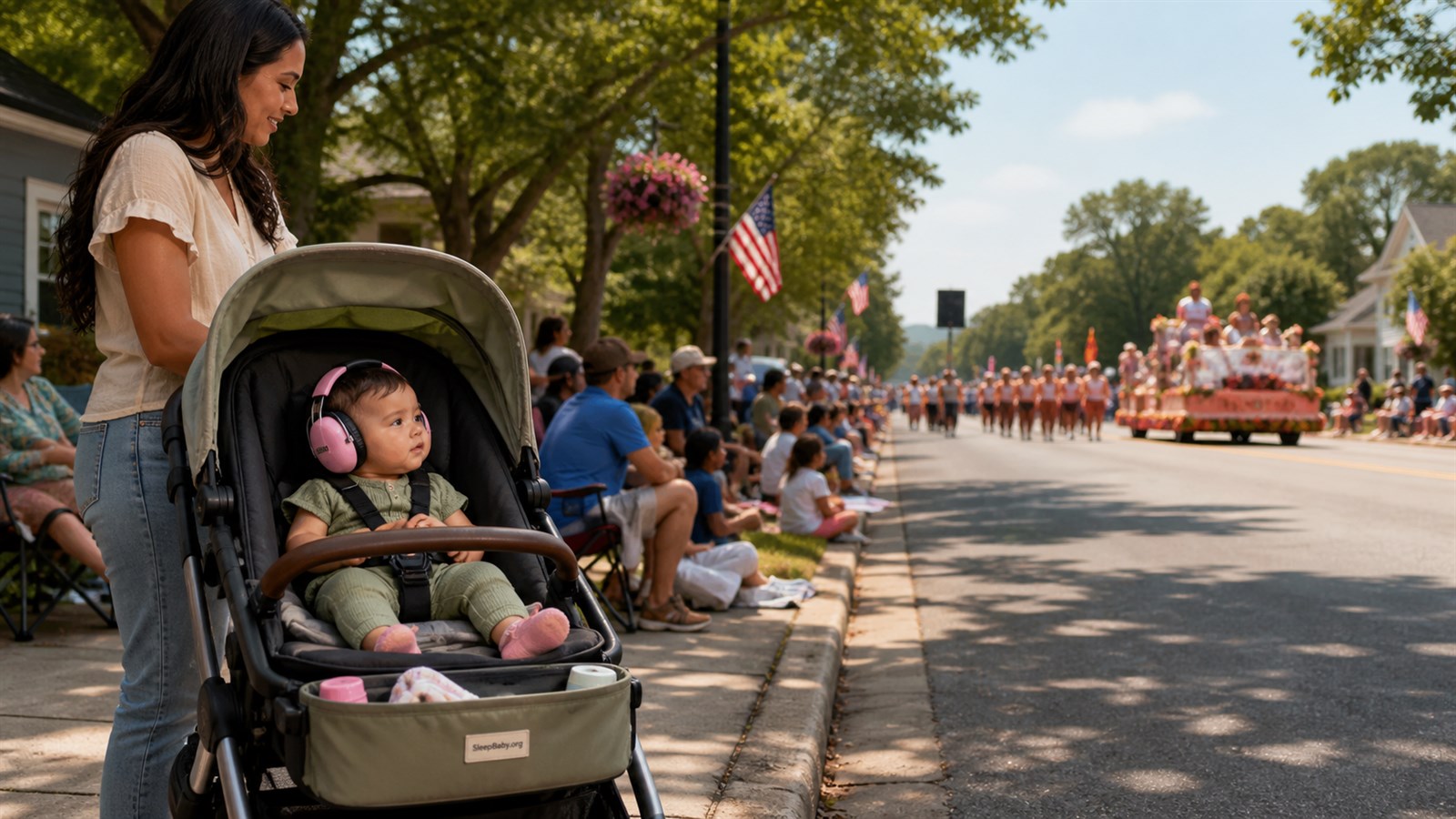
You can take a baby to a parade if you can keep them well away from speakers and vehicle turns, use correctly fitted hearing protection, hold or harness them securely, provide real shade and airflow, and leave without fighting through the crowd. Skip the parade if you cannot find a quieter outer-edge position, the heat is unsafe, your baby is unwell, or the exit depends on crossing a packed or active route. A short visit that ends after one good float is still a complete parade.
The household at bedtime
Different people.
One household at night.
If you’re also caring for a baby and want help with sleep, our video is below. Watch when that’s the question you want to work on.
Prefer to read?Press play for a little help with your baby’s next bedtime.
Kind words about the original video
“Thank you so much for this video!”
“I'm truly impressed with how much information you share in your video.”
The SleepBaby Workshop
Get the Workshop.
Get the Workshop and explore its resources for everyday baby sleep and nighttime care. 15 guides and five audio tracks in a simple browser hub. Read, listen, and return to the part you need.
A conversation, if you want one.Night Owls is the SleepBaby chat room. Read what is there or join in.
For Benjamin’s first parade, I packed as though the local marching band had asked us to establish a small field hospital. There were diapers, wipes, milk, a hat, a spare hat, two muslin cloths, one muslin cloth of uncertain purpose, hearing earmuffs, a fan, snacks for me, snacks I did not remember packing, and a change of clothes for a weather event that existed only in my imagination.
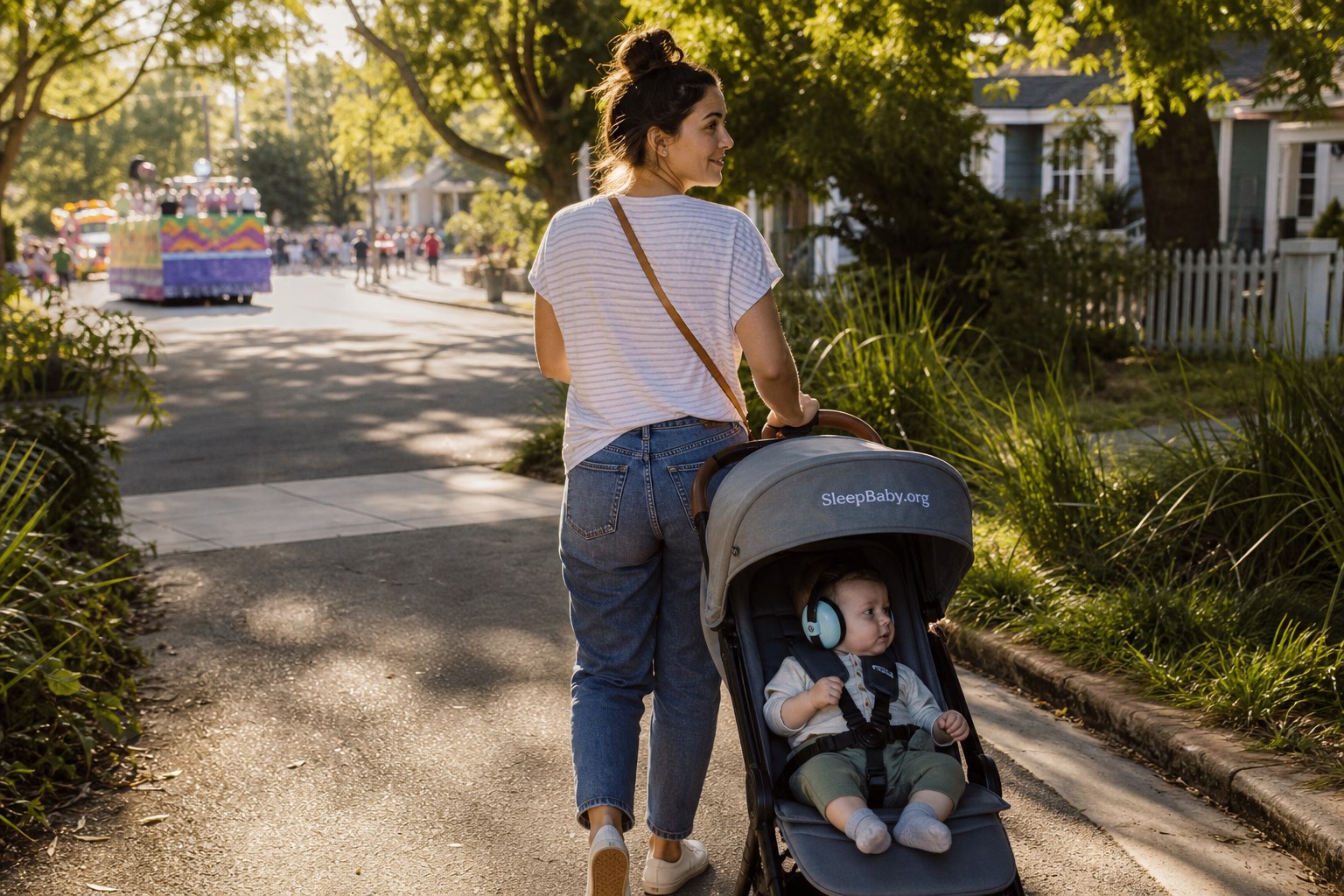
Benjamin ignored all of it. He watched the loose tail of one red balloon tap a stroller handle. Then the drum line turned the corner, and his whole face said, with impressive precision, we have learned enough about percussion for today.
That is a family scene, not evidence. But it captures the useful truth: a parade is not one fixed environment. The curb by the loudspeaker, the shaded side street, the stroller parked behind three rows of adults, and the quiet walk home are four very different experiences for a baby.
Your job is not to make the entire parade work. Your job is to control the edges: where you stand, how close the sound is, whether air can move, and how quickly you can leave. Protect the exit before you protect the itinerary.

Should I take my baby to this parade?
Start with the actual event, not a universal age. A calm neighborhood parade with open shade, a broad sidewalk, and an easy side-street exit may be manageable. A packed nighttime route with amplified music, fireworks, extreme heat, and no place to step away may not be. The same baby can reasonably attend one and skip the other.
Before you promise anyone a photograph beside the grand marshal, answer these questions:
- Can I choose distance? You need room to move farther from speakers, horns, sirens, drums, and revving vehicles. Hearing protection does not turn the front row into a baby zone.
- Can I choose shade and airflow? A canopy can help with sun, but the baby still needs open airflow. A blanket draped over the stroller is not a cooling plan.
- Can I keep the baby physically secure? Use the stroller harness or a correctly fitted carrier, and keep one responsible adult in charge of the baby rather than passing supervision around by implication.
- Can I leave directly? Your car, transit stop, or walk home should not require crossing the moving parade, squeezing through the densest crowd, or waiting for a road to reopen.
- Is my baby well enough today? Fever, breathing trouble, poor feeding, vomiting, unusual sleepiness, or a clinician’s specific restriction makes this a stay-home day.
If one answer is no, change the plan before arrival. Watch from farther away. Visit the lineup before the route begins only if it is quieter and permitted. Choose a five-minute appearance at the end of a side street. Or stay home. Missing one parade is not a developmental emergency.
Use the Parade Perimeter Plan before you unpack
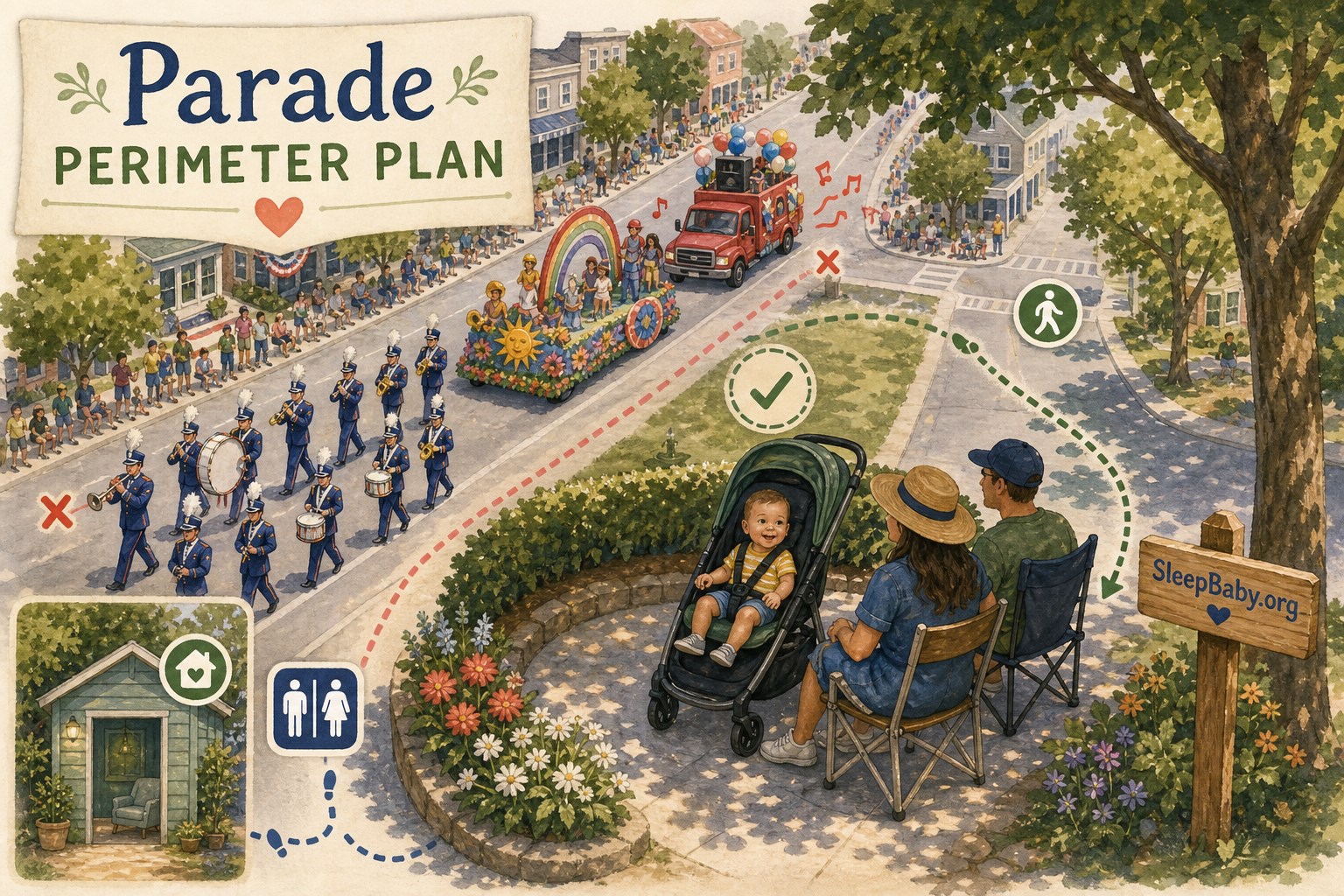
The most important choice is not what goes in the bag. It is where the bag lands. I use a simple location test: far from the loud and moving hazards, near the things that let us care for the baby, and on the outside edge of the crowd.
SleepBaby route-position map
Far. Near. Outer edge.
FAR FROM
Speakers, drum lines waiting to start, vehicle horns, sirens, revving engines, fireworks, intersections, tight turns, barricade openings, and the front-row curb.
Move if: you need to raise your voice at arm’s length, the baby startles repeatedly, or the sound still feels forceful through your own hearing protection.
NEAR
Stable shade, a quieter retreat, a diaper-changing option, a feeding spot, a restroom for the caregiver, and the route back to your car or transit stop.
Move if: the shade will disappear, the only retreat is behind the crowd, or you cannot meet a feed or diaper need without losing the exit.
OUTER EDGE
Stand behind the deepest curb crowd or at a side-street opening where permitted. Keep the stroller out of pedestrian flow and pointed toward the way out.
Move if: people box in the wheels, bags hang into the walkway, or spectators begin pushing closer when a popular float arrives.
Decision: when the position gives you distance, care access, and a clean retreat, settle in. If it gives you only a good view, keep walking.
The Parade Perimeter Plan is a SleepBaby.org editorial framework built from current hearing, heat, stroller, and pedestrian-safety guidance.
Try the position before the parade reaches you. Set the stroller brake. Look behind you and imagine leaving with both hands busy. Notice whether a person using a wheelchair or another stroller could pass without entering the street. Then listen. A spot that seems charming while the route is empty can become the loudest place on the block when a speaker truck stops at the intersection.
Protect hearing with distance, time, and fit
Noise-induced hearing loss is preventable, but it can follow one intense sound or loud exposure that lasts too long. The NIH’s National Institute on Deafness and Other Communication Disorders says loudness, duration, and distance from the source all matter, and specifically tells adults to protect children who are too young to protect their own ears.1
That gives us three layers of protection:
- Distance first. Stand well away from speakers, sirens, air horns, drum lines, and vehicle exhaust notes. Move farther back before adding gear.
- Shorter exposure. Arrive for the piece you care about and leave before the loudest finale. Take a quiet break if the route has several loud groups in a row.
- Properly fitted hearing protection. Use baby hearing earmuffs made for the child’s size, follow the product instructions, and practice the fit at home. Do not put foam earplugs or loose objects into a baby’s ears.
NIOSH offers a practical adult warning sign: sounds around 85 dBA may force you to raise your voice to be heard three feet away, and sounds around 95 dBA may make you shout.2 Those are occupational signposts, not a baby-specific allowance. At a parade, needing to raise your voice is a reason to move away, not a reason to calculate how many minutes remain.
Earmuffs are a layer, not a force field. If a baby keeps startling, cries at each horn blast, paws at the earmuffs, or cannot be comforted, create more distance or leave. If the earmuffs slip, press painfully, or prevent you from monitoring the baby’s comfort, stop and refit them in a quiet place.
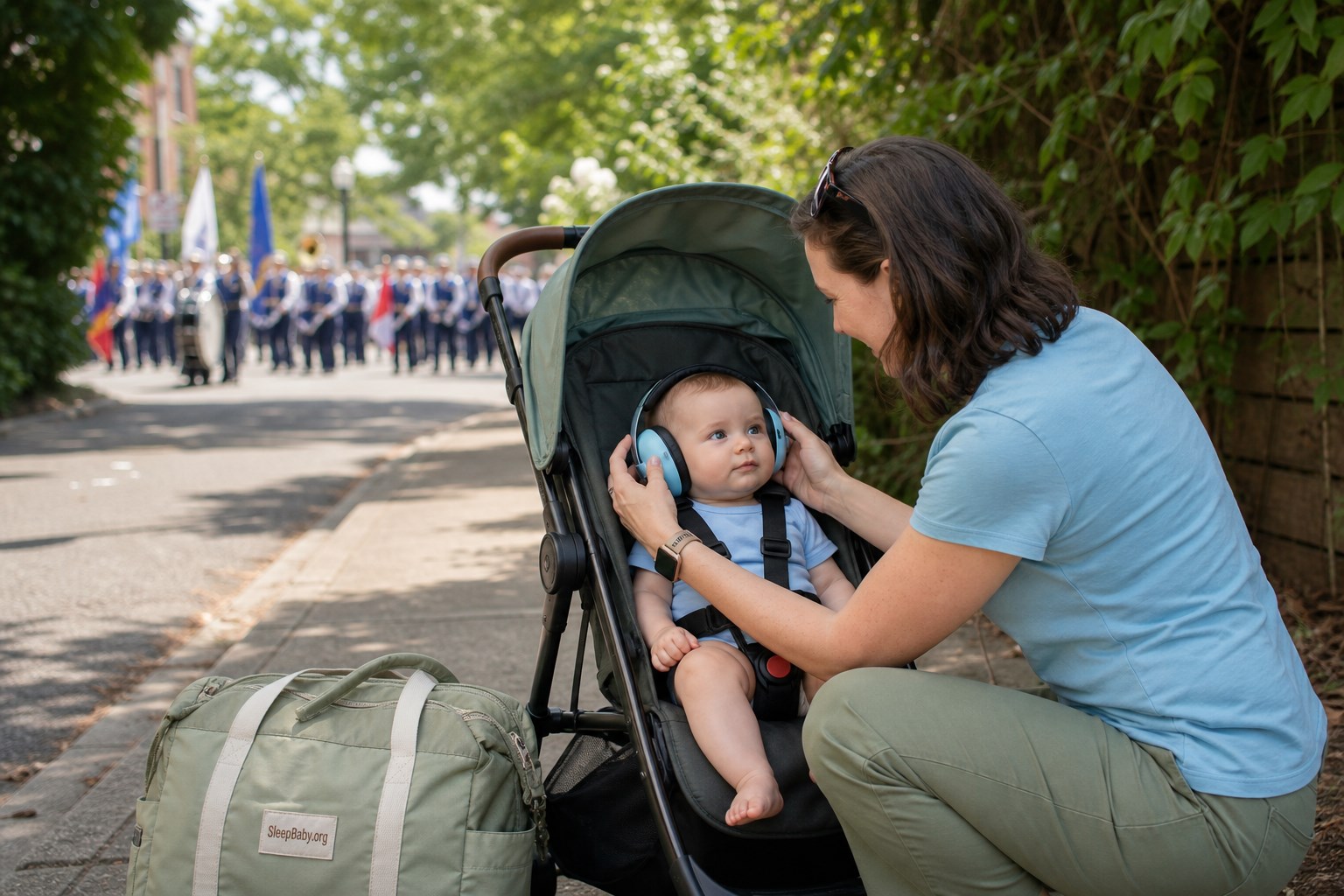
Do not cover the baby’s ears with a blanket, your hands, or improvised padding while staying beside the speaker. Improvised protection gives you no reliable fit, and staying close preserves the hazard. The safest useful move is often wonderfully unglamorous: walk half a block away.

Run the P.A.C.E. Parade Check
A four-part decision path
Protect. Anchor. Cool. Exit.
PROTECT HEARING
Create distance, shorten the visit, fit baby earmuffs correctly, and step away before a loud group reaches your section.
ANCHOR THE EXIT
Keep the stroller pointed out, identify one quiet retreat, and make sure the route home does not depend on the parade clearing.
COOL AND SHADE
Use open shade, light clothing, a breathable canopy position, normal age-appropriate feeds, and frequent checks of the baby’s chest and behavior.
EXIT ON CUES
Leave for repeated startling, escalating crying, heat signs, poor feeding, unusual sleepiness, breathing trouble, or any caregiver sense that the baby is not acting right.
If all four are working: enjoy one small stretch. If one fails: move back, cool down, or go home. Do not wait for three failures to make the exit feel official.
P.A.C.E. is a SleepBaby.org planning framework, not a medical test or a guarantee of safety.
Shade must still let air move
Babies younger than 6 months should be kept out of direct sunlight. The American Academy of Pediatrics prioritizes shade, lightweight covering clothing, and a brimmed hat; sunscreen is a backup for small exposed areas when shade and clothing are not available.3 For an older baby, use a broad-spectrum sunscreen as directed, but do not let sunscreen persuade you to stay in heat that is no longer comfortable.
CDC notes that infants and young children rely on adults to keep them cool and hydrated. It recommends loose, lightweight, light-colored clothing and prompt medical care for symptoms of heat-related illness.4
A stroller canopy can create shade while leaving the sides open. A loose blanket draped over the whole stroller can reduce airflow and hide the baby’s face and body from view. If the only way to make the location tolerable is to seal the baby behind fabric, the location is not tolerable.

Check the baby’s chest or back, not only hands and feet. Move to a cooler place and reassess if the baby is unusually flushed, hot, sweaty, weak, irritable, sleepy, feeding poorly, or vomiting. Seek medical care promptly for heat-illness symptoms. Call emergency services if the baby is difficult to wake, has a seizure, collapses, struggles to breathe, or is not responding normally.
Feed according to your baby’s normal age-appropriate plan. For a young infant, that means breast milk or formula rather than casually adding water because the day is hot. If illness, prematurity, medication, or feeding problems change what hydration should look like, ask the baby’s clinician before the event.

Stroller or carrier: choose the safer exit tool
A stroller gives you a harness, shade canopy, storage basket, and a clear physical boundary in a crowd. A carrier keeps the baby close and may make a narrow route easier. Neither is automatically best; choose the option you can use correctly for the weather, the baby’s age and medical needs, and the route.
If you use a stroller
Use the five-point harness every time. Set the brake whenever you stop. Keep bags in the low basket rather than hanging them from the handles, where weight can tip the stroller backward. Never leave the baby unattended while you step toward the curb, take a photograph, or find the snack that has migrated to the least accessible pocket.5
Park behind the active walking line, not across it. Keep hands on the stroller when the crowd moves. Do not let another person lean on the handle, and do not attach balloons with long cords where they can tangle around the baby or wheels.
If you use a carrier
Use a carrier appropriate for the baby’s size and follow its instructions. Keep the baby’s face visible, airway clear, chin off the chest, and body supported. Watch heat closely because your body adds warmth. Avoid loose flags, beads, necklaces, or giveaway strings near the baby’s face and hands.
When vehicles, horses, bikes, or performers are moving nearby, stay behind the barrier and away from the curb. A carrier keeps the baby close; it does not make stepping into the route safe.
If the baby falls asleep
A doze on the way back to the car is not a reason to panic, but a stroller or carrier should not become the planned sleep space. AAP safe-sleep guidance says that when a baby falls asleep in a stroller, car seat, swing, carrier, or sling, move them to a firm, flat sleep surface on their back as soon as possible.6
If the parade overlaps a nap, build a short visit around the baby’s real cues rather than trying to force sleep beside drums. Our guide to wake-window anxiety can help you use timing as a clue instead of a pass-fail test. If a late outing nap happens, this three-way bedtime test gives you a calmer next decision.
The balloon, the drum line, and the early exit
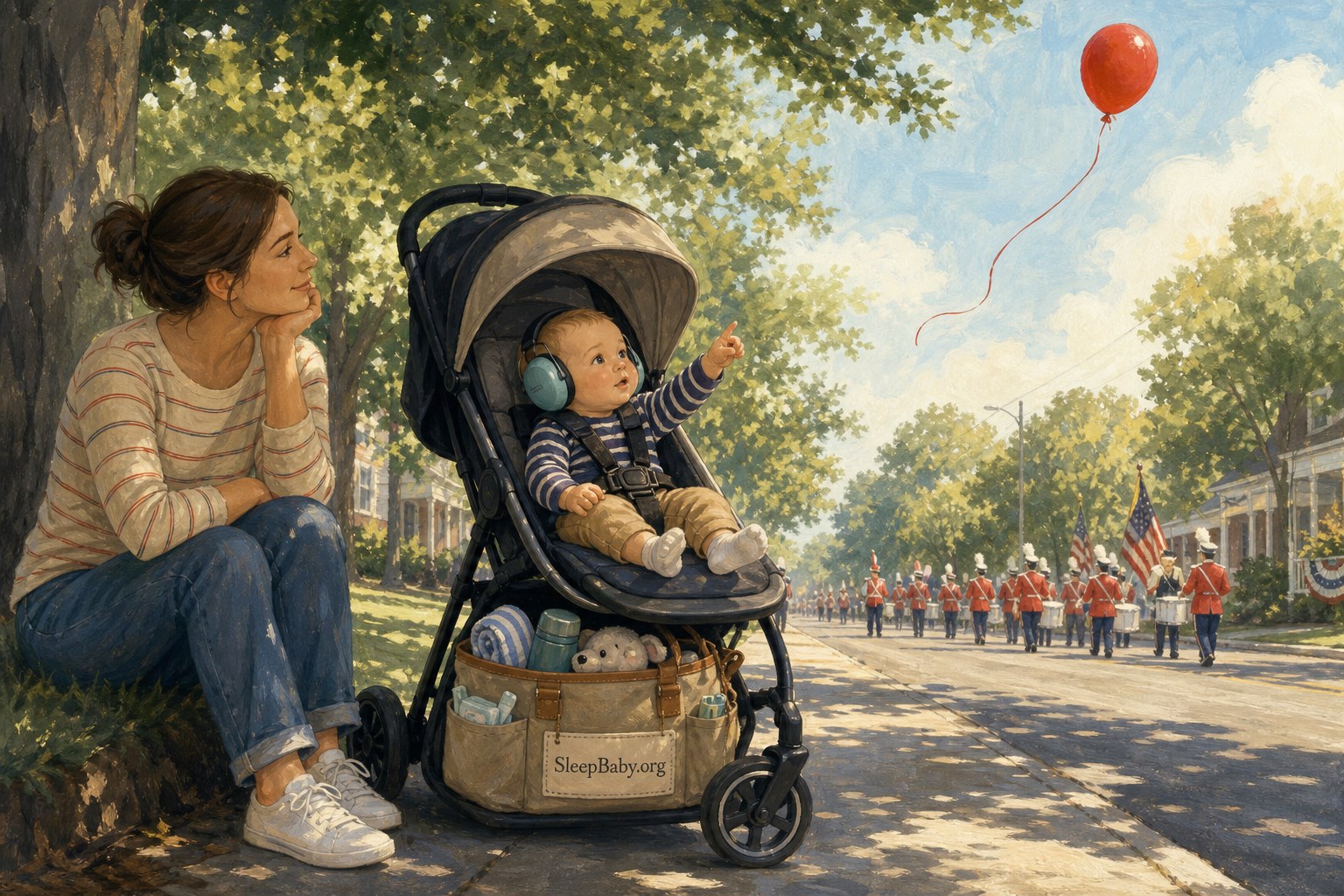
I had imagined Benjamin waving at a float, smiling at a costumed mascot, and perhaps offering the sort of delighted expression that makes a parent think, yes, this outing will become a core memory.
He watched the balloon tail. When the first drum line arrived, I noticed that I was raising my voice to talk to the person beside me. His shoulders jumped. I moved us behind a row of adults, then farther into the side street. The sound softened. He relaxed enough to inspect the balloon again, which was apparently the only scheduled attraction he had approved.
We saw one float. We left before the marching band returned on its second loop. The bag remained absurdly qualified, but the exit worked because I had parked on the quiet side of the route.
Again, this is human experience, not proof. The hearing, heat, stroller, and pedestrian guidance comes from the cited sources. The story simply shows what the plan looks like when the baby, rather than the event schedule, gets the deciding vote.
What to pack for a parade with a baby
The bag supports the plan
Pack protection, feeding, cleanup, and retreat
PROTECTION
Baby hearing earmuffs, brimmed hat, light layers, stroller canopy or portable shade used with open airflow, and sunscreen when age-appropriate.
FEEDING
The baby’s normal milk, formula, or age-appropriate snacks; feeding supplies; and water and a snack for the caregiver who is doing all the route geometry.
CLEANUP
Diapers, wipes, a small waste bag, a changing pad, and one realistic clothing change. The parade does not require a full nursery relocation.
RETREAT
Phone battery, transit or parking plan, event map saved offline, emergency contacts, and one quiet place identified before arrival.
Skip long cords, loose necklaces, dangling beads, and toys that attach across the stroller. Keep hearing protection accessible rather than buried under six celebratory outfits. If you must unload the entire bag to find the one safety item, the packing order has become a practical hazard.
Arrival and exit are part of the safety plan
Closed parade streets still have traffic around their edges. Watch parking-lot exits, driveways, alleys, bicycle paths, staging areas, and streets that reopen as the final group passes. The AAP recommends sidewalks or walking paths, crosswalks whenever possible, eye contact with drivers, and distraction-free crossing.7
Put the phone away before you push the stroller across. Look left, right, and left again, then keep scanning until every wheel and foot is fully across. A driver may be looking at the barricade, a police officer, or the sudden change in traffic flow rather than at you.
Watch: pedestrian safety at the parade edges
This short American Academy of Pediatrics video focuses on the habits children learn from adults. At a parade, the same habits protect the adult who is pushing the stroller or carrying the baby through complicated traffic.
Watch 7 Tips for Teaching Kids Pedestrian Safety on YouTube if the embedded player is unavailable or not useful with your assistive technology.
Written takeaway: use the crosswalk, put the phone away, make eye contact with drivers, and keep looking until the stroller or carrier is completely across.
Move back, leave now, or get help?
It helps to decide before the parade which cues change the plan. Otherwise, every signal becomes a small debate while the band keeps playing.
The no-debate exit ladder
Change distance early; leave before distress compounds
MOVE BACK
You are raising your voice, the baby startles at each burst, the earmuffs slip, people crowd the stroller, sun reaches the seat, or exhaust drifts toward you.
LEAVE NOW
The baby cannot settle after moving, cries harder, feels hot, feeds poorly, vomits, becomes unusually sleepy, has breathing trouble, or simply is not acting like themselves.
GET HELP
Call emergency services for collapse, seizure, severe breathing trouble, blue or gray color, inability to wake, or abnormal responsiveness. Seek prompt medical care for suspected heat illness or symptoms that concern you.
Do not use this article to rule out a medical problem. Trust a concerning change. The safest exit does not need to be dramatic; it can be one adult saying, “We are done,” while the other adult folds the chair.
The post-parade reset can be boring on purpose
After bright movement, loud sound, new faces, and a shifted feed, home does not need an encore. Lower the lights. Offer the next normal feed. Change the diaper. Use the familiar sleep routine. Keep the rest of the evening small.
A fussy bedtime after a parade does not prove that you damaged the schedule, and a smooth bedtime does not prove the sound was safe. Those are separate questions. Use your baby’s cues, protect normal safe-sleep practices, and ask the clinician about persistent changes in feeding, behavior, or hearing concern.
If you want another low-stakes outdoor outing, our first-playground guide uses the same principle: one manageable piece of the world is enough. And if a stroller trick online promises instant calm, read our safety review of viral stroller and tummy-time hacks before improvising.

Taking a baby to a parade: quick questions
Can I take a newborn to a parade?
There is no single birthday that makes every parade suitable. A young newborn needs especially careful temperature control, feeding access, sun avoidance, and protection from crowds and illness. Ask the baby’s clinician about prematurity, medical conditions, or recovery concerns. If you cannot guarantee distance from loud sound and a very easy exit, skip the event.
Do babies need earmuffs at a parade?
Use correctly fitted hearing protection when loud sound is possible, but also increase distance and shorten exposure. Earmuffs do not make a speaker-side position safe. Practice the fit before the event and leave if the baby cannot tolerate them or the sound remains forceful.
How far should a baby be from parade speakers?
No universal distance fits every speaker, horn, street, or building reflection. Choose the farthest practical position, avoid the direction speakers face, and move again if you need to raise your voice at close range or the baby startles repeatedly. Treat distance as a control you can keep increasing.
Can I put a blanket over the stroller for shade?
Do not drape a blanket over the stroller in a way that blocks airflow or hides the baby from view. Use open shade, a correctly positioned canopy, light clothing, and a different location when the heat cannot be controlled.
What if the parade is during nap time?
Choose a short window before or after the usual nap if that is easy, but do not force the clock. If the baby falls asleep in a stroller or carrier, move them to a firm, flat sleep surface on their back as soon as possible. A parade stroller is not a planned sleep space.
How long should a baby’s first parade be?
Long enough to enjoy one calm segment, not long enough to prove endurance. The weather, sound, route position, feeding, and baby’s cues matter more than a target number. Five comfortable minutes can be the right first visit.
What if the parade includes fireworks or cannon blasts?
Do not keep a baby near impulse noise and assume earmuffs solve it. Choose a viewing point far from the launch or blast area, leave before that portion, or skip it. A one-time intense sound can damage hearing.1
One good float is a complete parade
The successful version may not look like the event poster. It may be a stroller in the third row, a baby wearing earmuffs, one balloon tail, half a float, and an early walk home through the quiet street.
That is not a lesser outing. It is a caregiver noticing that the speaker truck is closer than expected, the shade is moving, and the baby’s shoulders are telling the truth before the schedule does.
Choose the perimeter. Protect hearing with distance, time, and fit. Keep air moving. Harness the baby. Anchor the exit. Then let one small, bright piece of the parade be enough.
Your calmer next step
Choose your parade perimeter before you pack
Open the route map. Mark one quiet outer-edge position, one shaded retreat, and one exit that never crosses the moving parade. If those three points do not exist, choose a different viewing plan. The bag comes second.
Sources
- National Institute on Deafness and Other Communication Disorders: Noise-Induced Hearing Loss – loudness, duration, distance, impulse noise, hearing protection, and protecting children’s hearing.
- CDC/NIOSH: Noise-Induced Hearing Loss – practical voice-level warning signs, exposure controls, and hearing protection.
- American Academy of Pediatrics: Sun Safety – shade, clothing, hats, sunscreen, and guidance for babies younger than 6 months.
- CDC: Infants and Children and Heat – cooling, hydration, lightweight clothing, parked-car danger, and medical-care boundaries.
- American Academy of Pediatrics: How to Choose a Safe Baby Stroller – five-point harnesses, brakes, storage, tip prevention, and supervision.
- American Academy of Pediatrics: How to Keep Your Sleeping Baby Safe – firm flat sleep surfaces and moving a sleeping baby from strollers, car seats, swings, carriers, or slings.
- American Academy of Pediatrics: Pedestrian Safety Tips for Families – sidewalks, crosswalks, driver visibility, distraction-free walking, and safe crossing habits.
The SleepBaby.org Workshop
Make a plan for
the next bedtime.
Practical help for wake-ups, short naps, and sharing the night shift. Watch the original video, then get 15 guides and five audio tracks for $9.
$9 USD, paid once. No subscription. Digital access.
Watch the original Baby Sleep Miracle presentation
Press play for a little help with your baby’s next bedtime.
Original presentation. Watch before you decide.
15practical guides
5audio tracks
1one-time payment
Kind words about the original video
“Thank you so much for this video!”
“I'm truly impressed with how much information you share in your video.”
Inside the Workshop
Start with the night
you're having.
You don't need to read all 15 guides before bedtime. Choose the one that answers the question in front of you, then come back for the next part.
Before you buy
A few things
made clear.
A straightforward purchase, with space to decide what fits your family.
What am I buying?
The SleepBaby.org Workshop includes 15 digital guides, five audio tracks, and the original Baby Sleep Workshop PDF as an additional download. It costs $9 USD, paid once, with no subscription. Nothing is shipped.
Where should I start?
Try Tonight Rescue when you need a starting point. If your question is more specific, go straight to the guide on naps, a caregiver handoff, the sleep space, or another topic. You can read at your own pace.
Is this personal sleep coaching?
No. This is an educational collection for parents of babies and young children. Use the age-specific guidance, and bring feeding, breathing, growth, illness, or other health concerns to your child's clinician. It does not diagnose a problem or promise a sleep result.
Is the video the paid Workshop?
You can watch the original Baby Sleep Miracle presentation on this page. Your purchase is the SleepBaby.org Workshop collection of guides, audio tracks, and the original PDF described here.
How do I find it after checkout?
On your thank-you or order-status page, look for Open Workshop access, then Open your SleepBaby Workshop. Keep your order confirmation so you can return. If you need help finding your access, use our Workshop download help.
The SleepBaby.org Workshop
Have somewhere to start
at the next bedtime.
15 practical guides. Five audio tracks. One $9 purchase.


A quiet parent-to-parent note
What would you add about Parenting & Family?
Share one useful detail, question, or experience. No account is needed. Please leave out names, medical records, and other private details.
There is room for the first useful note.
If you have a thoughtful question or detail about Parenting & Family, you can begin the conversation below.