
Quick answer
A laundromat trip can work when one safe baby base stays within reach
You can take a baby to the laundromat when you can keep them securely harnessed and continuously supervised, keep every detergent product closed and completely out of reach, separate feeding and diaper care from dirty laundry, and leave before the trip becomes hard to manage. Choose one small load. Skip the trip or bring another adult if there is no safe place for the baby, the room is crowded or overheated, exits are blocked, you would need to put the baby on a machine or cart, or you cannot handle chemicals and equipment without divided attention.
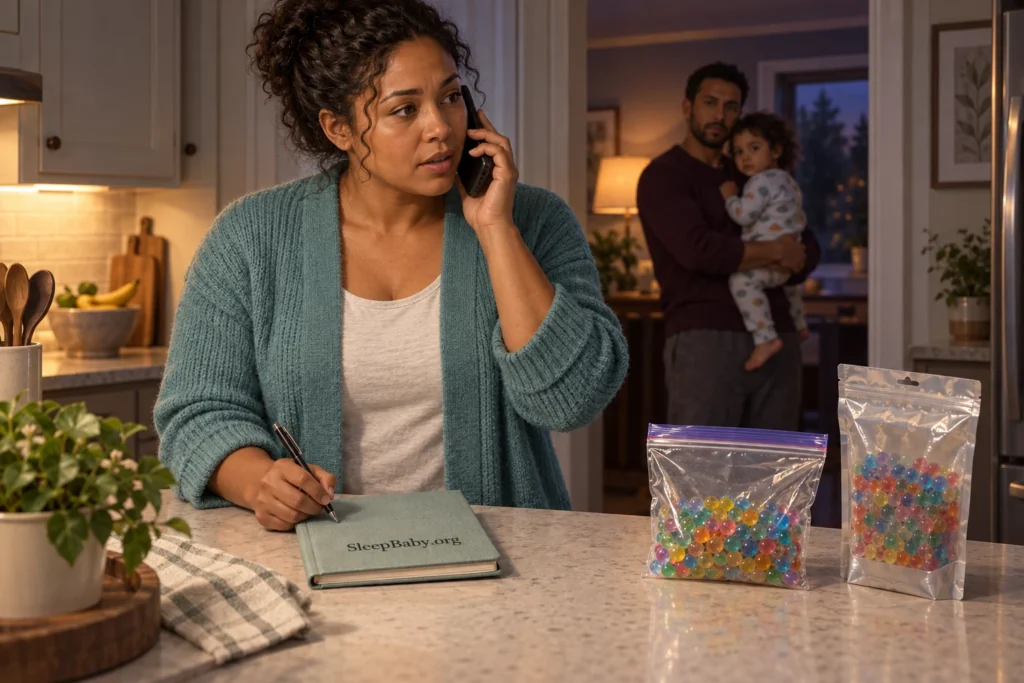
The household at bedtime
Different people.
One household at night.
If you’re also caring for a baby and want help with sleep, our video is below. Watch when that’s the question you want to work on.
Prefer to read?Press play for a little help with your baby’s next bedtime.
Kind words about the original video
“Thank you so much for this video!”
“I'm truly impressed with how much information you share in your video.”
The SleepBaby Workshop
Get the Workshop.
Get the Workshop and explore its resources for everyday baby sleep and nighttime care. 15 guides and five audio tracks in a simple browser hub. Read, listen, and return to the part you need.
A conversation, if you want one.Night Owls is the SleepBaby chat room. Read what is there or join in.
The first time I took Benjamin to a laundromat, I packed as if we were relocating there. Three outfits for him. Two for me. A blanket I was not going to use. Snacks he was too young to eat. Enough wipes to clean a midsize county.
Benjamin needed one clean sock.
Not to wear. To inspect. He held it with both hands while the washer turned behind us, looking from the sock to the round glass door as though he had personally approved a new form of public transportation. I had brought entertainment. The laundromat had brought a circle and a sock. The laundromat won.
That is an illustrative family scene, not evidence. The poisoning, hygiene, carrier, and safe-sleep guidance below comes from the medical and public-health sources in the Sources section. But the scene contains a useful truth: the outing does not need to become a heroic productivity challenge. It needs one safe place for the baby, one controlled job for the adult, and one exit that remains easy.
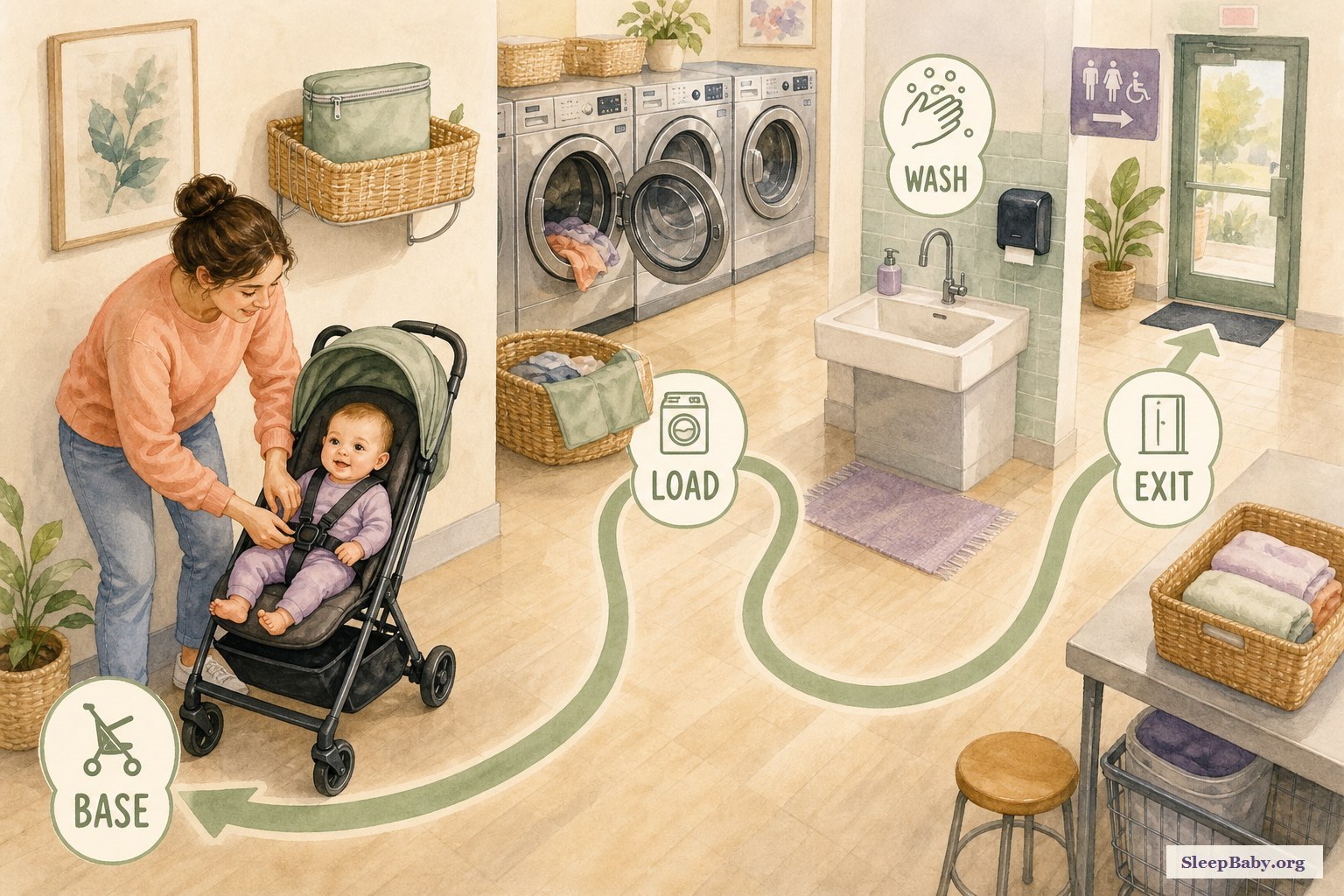
Build the trip around BASE: Brake the stroller, Adult-only detergent, Separate clean care from dirty laundry, and Exit easy. Then let one load be enough.

Should you take your baby to this laundromat today?
A laundromat is not automatically unsafe, and it is not automatically baby-friendly. The practical answer depends on the exact room, the baby’s needs, and whether the caregiver can stay close enough to supervise every second.
Before hauling the basket inside, look through the door and ask:
- Base: Is there a clean, low-traffic place for a brake-set stroller where the baby remains in sight and reach without blocking an aisle, door, or accessibility route?
- Chemicals: Can every detergent, stain product, sanitizer, and coin remain inside a closed adult-controlled pouch until the exact moment it is used?
- Machines: Can you load and unload without putting the baby on a washer, dryer, cart, folding table, bench, or floor?
- Care: Is there a workable place to feed and a designated changing station, or can you comfortably leave for those needs?
- Environment: Is the room cool enough, reasonably calm, and free of smoke, strong fumes, spills, broken equipment, and dangerous crowding?
- Exit: Can you abandon the fold, take damp clothes home, or end the cycle plan without negotiating with yourself?
If one answer is no, change the trip. Try a quieter time, choose wash-and-fold if it is available and affordable, ask someone to watch the baby, bring another adult, or return another day. A baby does not need laundromat exposure for enrichment. They have already met fabric. They are current on fabric.
If you want a lower-stakes practice outing before combining a baby with a chore, taking a baby to the playground uses the same helpful principle: keep the plan small enough to end while everyone is still comfortable.
SleepBaby laundromat plan
BASE: one secure place, one controlled load, one easy exit
BRAKE THE STROLLER
Use the harness every time. Set the brake on a level spot beside you, away from machine doors, carts, cords, trash, folding traffic, and the main walkway. Keep the baby’s face visible.
It fails if: you cannot touch the stroller quickly, a cart can roll into it, or another person must squeeze past.
ADULT-ONLY DETERGENT
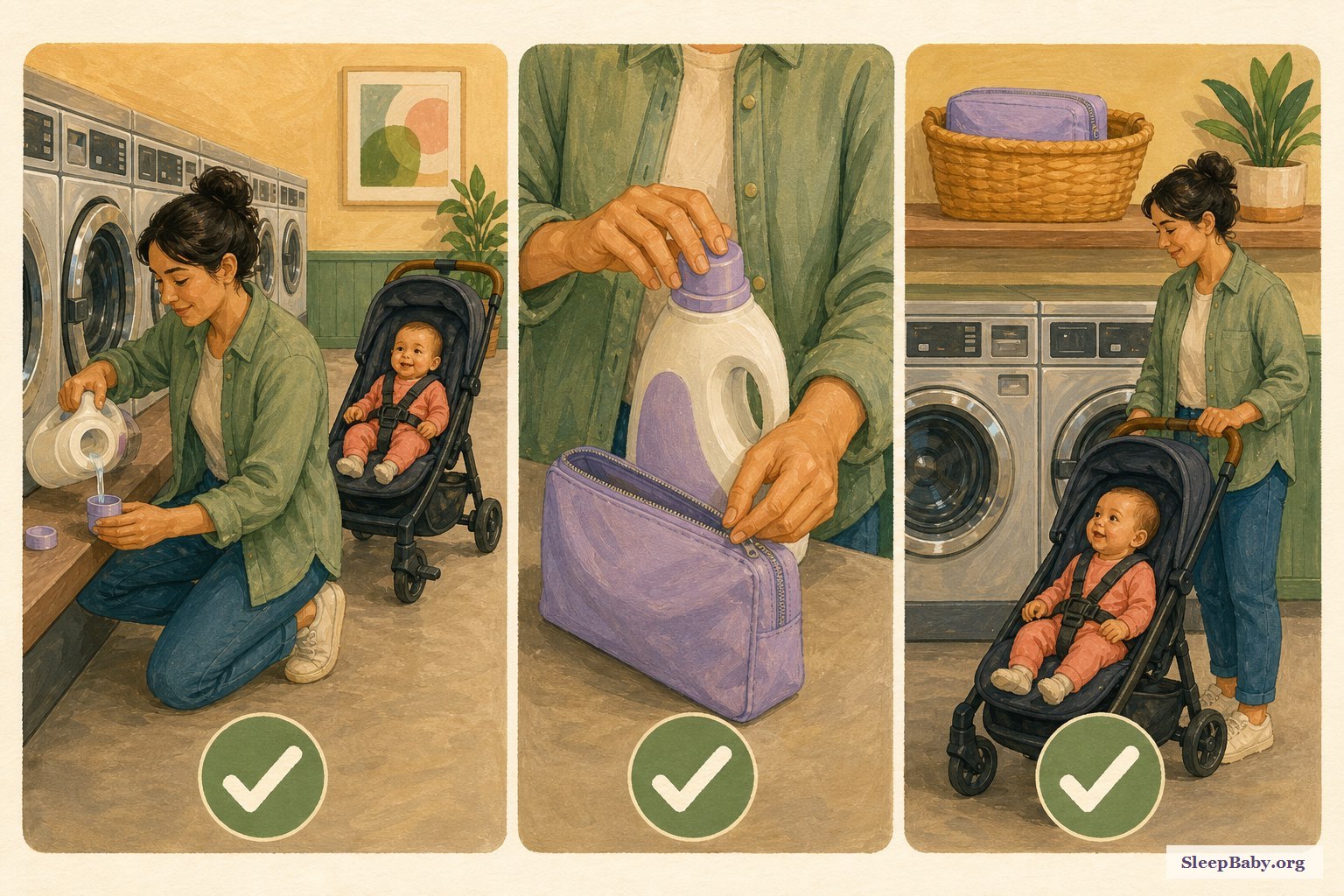
Keep detergent in its original closed container inside an opaque zipped pouch. Take it out only at the washer, pour or measure, close it immediately, and return it high and inaccessible.
It fails if: a pod, cap, cup, bottle, or pouch ever becomes something the baby can see, grab, mouth, or spill.
SEPARATE THE ZONES
Keep dirty laundry, detergent, clean feeding parts, diaper supplies, and folded clothes in distinct bags or sections. Wash hands before feeding and after diapering.
It fails if: bottles sit beside chemicals, a public folding table becomes a changing table, or dirty items spread into the clean-care space.
EXIT EASY
Choose one load and the machine nearest the safe base. Keep keys, phone, payment, and the exit route accessible. Leaving with unfolded or damp laundry is allowed.
It fails if: finishing the chore begins to outrank feeding, sleep, temperature, breathing, or a caregiver’s ability to supervise.
BASE is a SleepBaby.org editorial framework built from poison prevention, safe-sleep, carrier, handwashing, diaper-hygiene, and practical supervision guidance.
Machines and laundry carts are equipment, not baby furniture
Do not place a baby on top of a washer or dryer, even for a photograph, a buckle adjustment, or the twelve seconds you believe you need to find a sock. Machines can vibrate, doors open into the aisle, nearby people move carts, and a caregiver can be pulled away by a spill or payment problem. A changing pad does not turn a machine or folding table into a safe changing surface.
Do not place an infant seat inside a laundry cart. The seat may not fit or attach as designed, the cart can roll or tip, and the baby can end up beside dirty laundry or chemical residue. An empty cart stays parked away from the stroller. Older babies and toddlers do not ride in the basket, climb machine doors, press controls, or crawl on the laundromat floor.
Use the machine closest to the safe base, not the machine with the most flattering lighting. Keep the stroller beside you while loading. Close doors slowly. Before starting a machine, look inside, close the detergent pouch, and confirm the stroller brake is still set. When moving clothes to the dryer, move the stroller first, reset the brake, then move the basket. The order matters because “I will just reach over” is how divided attention announces itself.
Dryer doors and recently heated metal may be hot. Keep the baby’s hands and bare legs away. If a machine leaks, sparks, smells burned, shakes violently, has a damaged door, or leaves water across the route, stop using it and tell the attendant. Do not solve a broken laundromat with a baby parked beside the experiment.
Make detergent a one-minute adult-only job
Concentrated laundry packets deserve a hard boundary. Poison Control reports that biting a packet can cause rapid severe vomiting, breathing trouble, injury to the esophagus, and in serious cases coma; contents may also injure eyes and skin.1 CDC’s investigation found that young children exposed to pod detergent had gastrointestinal, respiratory, and mental-status effects more often than children exposed to non-pod laundry detergent.2
The simplest laundromat rule is not to bring pods at all. They are small, concentrated, and visually interesting. A loose packet in a pocket, cup holder, stroller basket, or open bag is too easy to drop or discover.
Bring liquid or powder in its original closed container. Keep the cap on and the label intact. Put the entire container inside an opaque zipped pouch that the baby never handles. Store that pouch high in the adult’s laundry basket, not in the stroller organizer. Hand sanitizer, stain remover, bleach, dryer sheets, coins, and medication belong under the same adult-only rule.
- Park and brake the stroller where the baby is safe, visible, and unable to reach the washer shelf.
- Take out the detergent only when the washer is open and ready.
- Measure or pour according to the product and machine directions. Never balance the cap on the stroller, folding table, or machine edge.
- Close the original container immediately.
- Zip it back into the opaque pouch and return the pouch high before touching the baby, bottle, pacifier, or clean laundry.
- Wash adult hands before feeding or handling anything that goes into the baby’s mouth.
Watch: why laundry packs stay out of the laundromat bag
This short Consumer Reports safety video shows why concentrated laundry packs require strict storage around children. Current Poison Control, AAP, and CDC written guidance controls the article if any older video detail differs.
Watch Laundry Detergent Packs Safety Alert on YouTube if the embedded player is unavailable or not useful with your assistive technology.
Written takeaway: skip detergent packets on this outing, keep every laundry product closed and inaccessible, and use Poison Help rather than home remedies after an exposure.

If detergent reaches a baby’s mouth, eyes, or skin
Do not wait for symptoms and do not induce vomiting. If a child bites or mouths a packet, Poison Control advises removing it, washing the child’s face and hands, gently wiping out the mouth, and contacting webPOISONCONTROL or calling Poison Help at 1-800-222-1222 for case-specific instructions.1
If packet contents enter an eye, Poison Control advises rinsing with gently running water for 15 minutes, then contacting Poison Help.1 Remove contaminated clothing and follow expert instructions for skin exposure. Call emergency services now for severe breathing trouble, seizure, collapse, blue or gray color, inability to wake, or abnormal responsiveness. AAP poison guidance also emphasizes keeping products in original containers and contacting Poison Help instead of guessing at treatment.3
Use the one-load rule to protect attention
One load is not a medical limit. It is a supervision limit you can understand. Every extra bag creates another transfer, machine, payment, timer, surface, and decision. The trip becomes safer and calmer when the adult’s hands are doing one job at a time.
Choose the smallest useful load and sort it at home. Check pockets, close zippers, and place dirty laundry in one washable or wipeable bag. Bring payment in a zipped adult pocket. If the laundromat uses an app, install it and sign in before leaving home so the baby is not waiting while you perform a password-reset ceremony beside a dryer.
Pick a time that avoids both the room’s busiest period and the baby’s most fragile stretch. You do not need to hit a perfect wake-window minute. Our guide to wake-window anxiety can help you use sleep timing as information rather than a deadline. Feed before the trip if that is how your baby normally does best, but still bring the supplies needed for the actual day.
Use one nearby washer and one nearby dryer. Set a quiet phone timer you can hear without waking the room. During the cycle, stay with the baby. Do not leave the stroller inside while you carry bags to the car. Do not leave a baby in the car while you start a load. If something must move outside, the baby moves safely with the caregiver.
A stroller is usually the clearer base; a carrier needs tighter boundaries
A stroller can create a defined, brake-set place where the baby remains visible and separated from chemicals and hot equipment. Use the harness. Keep bags low and light; do not hang a heavy laundry bag from the handle. Park parallel to the wall or machine row without blocking any route. Never drape a blanket over the stroller in a way that hides the baby’s face or restricts airflow.
A carrier can help on the walk from the car, but it is not always the best setup for pouring detergent, reaching into a washer, leaning over a cart, or opening a hot dryer. AAP carrier guidance says the baby’s face should remain visible, the neck straight, the chin off the chest, and the nose and mouth clear; fit must be checked often.7
If you are alone and the only workable plan requires wearing the baby while handling detergent or reaching deep into machines, that is a reason to bring another adult or change the plan. The goal is not to prove that enough careful body mechanics can turn every chore into babywearing content.
Create three clean care zones before you need them
The laundromat is full of shared surfaces and dirty textiles, but you do not need to sterilize the building. You need clean hands, separated supplies, and a plan that does not put feeding equipment beside laundry chemicals.
Clean-care map
Feed, change, wash: three zones that never overlap detergent
FEED
Choose a seated, low-traffic spot away from active detergent handling, dirty baskets, and machine tops. Keep prepared feeding parts inside a clean closed bag until adult hands are washed.
Leave instead if: the only option is balancing a bottle beside chemicals, hot equipment, or moving carts.
CHANGE
Use a designated changing station with your own waterproof mat. Keep one hand on the baby, contain the diaper and wipes, bag soiled clothes, and clean the surface as appropriate.
Leave instead if: the only options are a washer, dryer, folding table, bench, cart, or floor.
WASH
Wash caregiver and child hands with soap and clean running water after changing and before feeding. CDC says sanitizer with at least 60% alcohol is a fallback when soap and water are unavailable; it stays adult-controlled.5
Leave instead if: you cannot clean hands after a messy change or chemical spill.
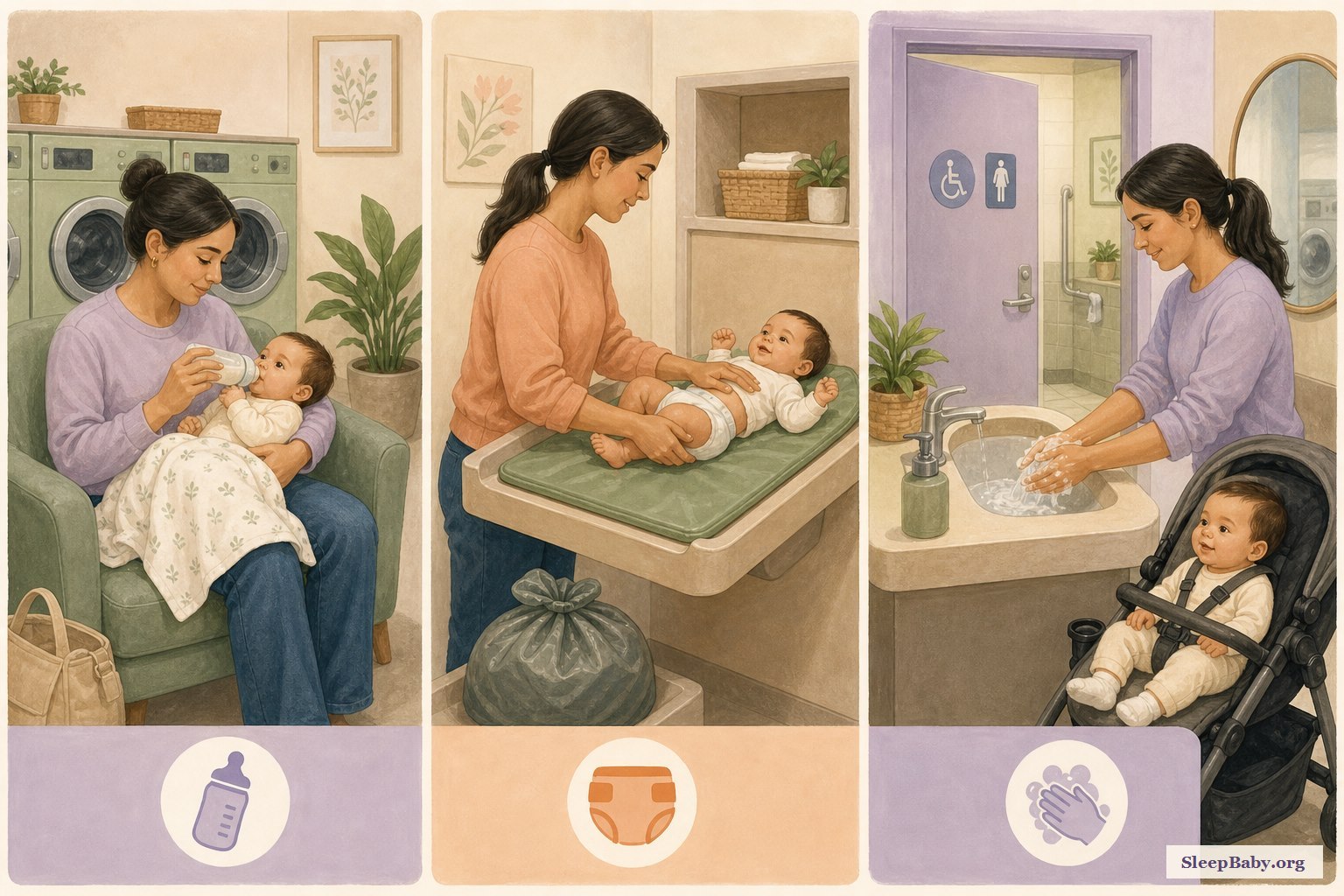
CDC diaper guidance says to keep one hand on the child, keep the dirty diaper and clothing away from surfaces that cannot be cleaned, contain waste, clean the changing surface, and wash both the child’s and caregiver’s hands.6 In a public setting, follow the facility rules and take everything you brought back out with you.

A stroller doze is a transition, not the laundry plan
The rhythmic machine sound may make a baby sleepy, or it may produce the opposite effect and inspire a forty-minute symposium on circles. Either way, do not build the trip around a planned stroller, car-seat, laundry-basket, or folding-table nap.
AAP safe-sleep guidance recommends putting babies on their backs on a firm, flat approved sleep surface. If a baby falls asleep in a stroller, car seat, swing, infant carrier, or sling, move them to a firm sleep surface on their back as soon as possible.4
If eyelids close during the final minutes of a cycle, keep the baby’s face visible, airway clear, and harness correctly used. End the chore rather than adding another load, and move the baby to the appropriate sleep surface as soon as practical. Do not unbuckle a sleeping baby inside the stroller, add loose blankets around the face, or improvise a bed from clean laundry.
If the trip produces a late doze and bedtime becomes confusing, use the before-bedtime nap guide once you are back in a safe sleep setting. The dryer does not need to become a sleep consultant.
Use ordinary hygiene, not a panic-cleaning side quest
CDC says washing with soap and clean running water is one of the best ways to reduce the spread of respiratory and diarrheal infections. Key moments include before eating or preparing food and after changing a diaper, touching garbage, coughing, sneezing, or blowing a nose.5
At the laundromat, keep pacifiers and feeding parts off public surfaces, wash adult hands before feeding, and wash both sets of hands after a diaper change. Wipe your own stroller handle and phone if needed. Keep sanitizer closed and out of reach. Do not spray disinfectant near the baby or mix cleaning products. Do not place the baby on the floor so you can wipe the stroller. The hygiene plan should reduce risk without creating a chemical fog or a second, stranger chore.
If the baby or caregiver is sick, or if the room is extremely crowded with no workable spacing, come back later if you can. No amount of surface wiping fixes a trip that already exceeds the family’s ability to supervise, feed, breathe comfortably, and leave.
The sock becomes the entire program

In the illustrative version of our trip, Benjamin and I took the bench at the quiet end of the room. His stroller brake was set. The detergent pouch was zipped high inside the basket. The washer was close enough that I could reach it without moving his stroller, and the exit was close enough that leaving did not require crossing a cart obstacle course.
I gave him one clean sock.
He looked at it. He looked at me. He looked at the washer window, where the sock’s relatives were having a much more eventful afternoon. Then he smiled with the solemn generosity of a person accepting a gift that had clearly cost the giver everything.
The cycle ended before his patience did. This is rare enough in parenting that I briefly considered having a plaque made.
I moved the stroller, reset the brake beside the dryer, transferred one basket, and stopped there. I did not start the second load I had optimistically left in the car. We fed in the clean zone, washed hands, folded only what folded without drama, and took the rest home.
The point is not that a sock will entertain every baby or that one cycle always works. The point is that the chore remained smaller than our exit. The story illustrates BASE; it does not prove the chemical, hygiene, carrier, or sleep guidance.
Pack three closed bags, not one laundry avalanche
The three-bag laundromat kit
Dirty, clean care, adult-only
DIRTY BAG
One sorted load in a washable or wipeable bag, plus one smaller wet bag for soiled baby clothes. Nothing from this bag shares space with bottles, pacifiers, or clean diapers.
CLEAN-CARE BAG
Normal feeding supplies, diapers, waterproof changing mat, wipes, waste bags, one practical outfit, burp cloth, and a clean pacifier if used. Keep it closed until hands are clean.
ADULT-ONLY POUCH
Original closed detergent container, payment, keys, phone, medication, stain product if truly needed, and sanitizer. Zip it every time and keep it out of sight and reach.
Hands-free rule: if you cannot move the stroller and carry the basket without hanging a dangerous load from the handle, reduce the load or bring another adult.
Bring one simple, washable toy that is too large to choke on, but assume the washer window may already have a stronger marketing department. Avoid coins within reach, long toy straps, loose dryer sheets, plastic laundry bags, and anything that can fall under equipment.
Use a no-debate exit ladder
The chore is allowed to end unfinished
Reset, leave, or get help
RESET
The baby needs feeding or a diaper, the room becomes busier, the stroller route narrows, the caregiver starts rushing, the detergent pouch was not returned, or the baby turns away and cannot settle.
LEAVE NOW
The baby feels too warm, feeds poorly, vomits, has escalating crying, becomes unusually sleepy, has breathing difficulty, or is simply not acting like themselves. Take the clothes in their current state.
GET HELP
Contact Poison Help immediately after a detergent exposure. Seek prompt medical care for concerning symptoms. Call emergency services for collapse, seizure, severe breathing trouble, blue or gray color, inability to wake, or abnormal responsiveness.
No sunk-cost clause: coins, a nearly finished cycle, and a basket that is 80% folded do not outrank the baby or the caregiver’s ability to supervise.

Taking a baby to the laundromat: quick questions
Can I take a newborn to a laundromat?
There is no universal age cutoff, but newborn feeding, temperature, sleep, medical history, and vulnerability to crowded indoor spaces deserve a conservative plan. Ask the baby’s clinician about prematurity, respiratory or cardiac concerns, recovery after birth, and the exact environment. If you cannot maintain continuous supervision, a clean care zone, and an immediate exit, use another plan.
Can I put the baby or infant seat in a laundry cart?
No. Laundry carts are not approved infant seating, and an infant seat may not attach as designed. The cart can roll or tip and may contain dirt or chemical residue. Use the baby’s correctly assembled stroller with the harness and brake, positioned on a level surface within reach.
Can I change my baby on top of a washer or folding table?
No. A machine can vibrate, surfaces may be hot or contaminated, and a folding table has no protective changing-station design. Use a designated changing station with your own waterproof mat and one hand on the baby. If no appropriate place exists, leave and change the baby somewhere safer.
Should I bring laundry pods because they are easier?
No. Concentrated packets can cause serious poisoning and eye or skin injury, and they are easy to drop or mistake for something touchable. Bring liquid or powder in its original closed container, store it inside an opaque zipped adult-only pouch, and put it away immediately after measuring.
What if my baby falls asleep during the wash cycle?
Keep the face visible, airway clear, and harness correctly used while you end the chore. Move the baby to a firm, flat approved sleep surface on the back as soon as possible. Do not create a sleep space in a laundry basket, cart, folding table, stroller, or on a pile of clean clothes.
Is a carrier safer than a stroller at the laundromat?
Not universally. A correctly fitted carrier can help during the walk, but it brings the baby close to detergent handling, machine doors, hot surfaces, and bending. A brake-set stroller often creates clearer separation. If neither setup allows safe equipment use and constant supervision, bring another adult or change the plan.
How long should the trip be?
Long enough for the smallest useful load, not long enough to prove endurance. The baby’s feeding, sleep, temperature, health, and cues matter more than a target duration. One calm cycle can be a complete trip. Finishing the fold at home still counts as clean laundry.
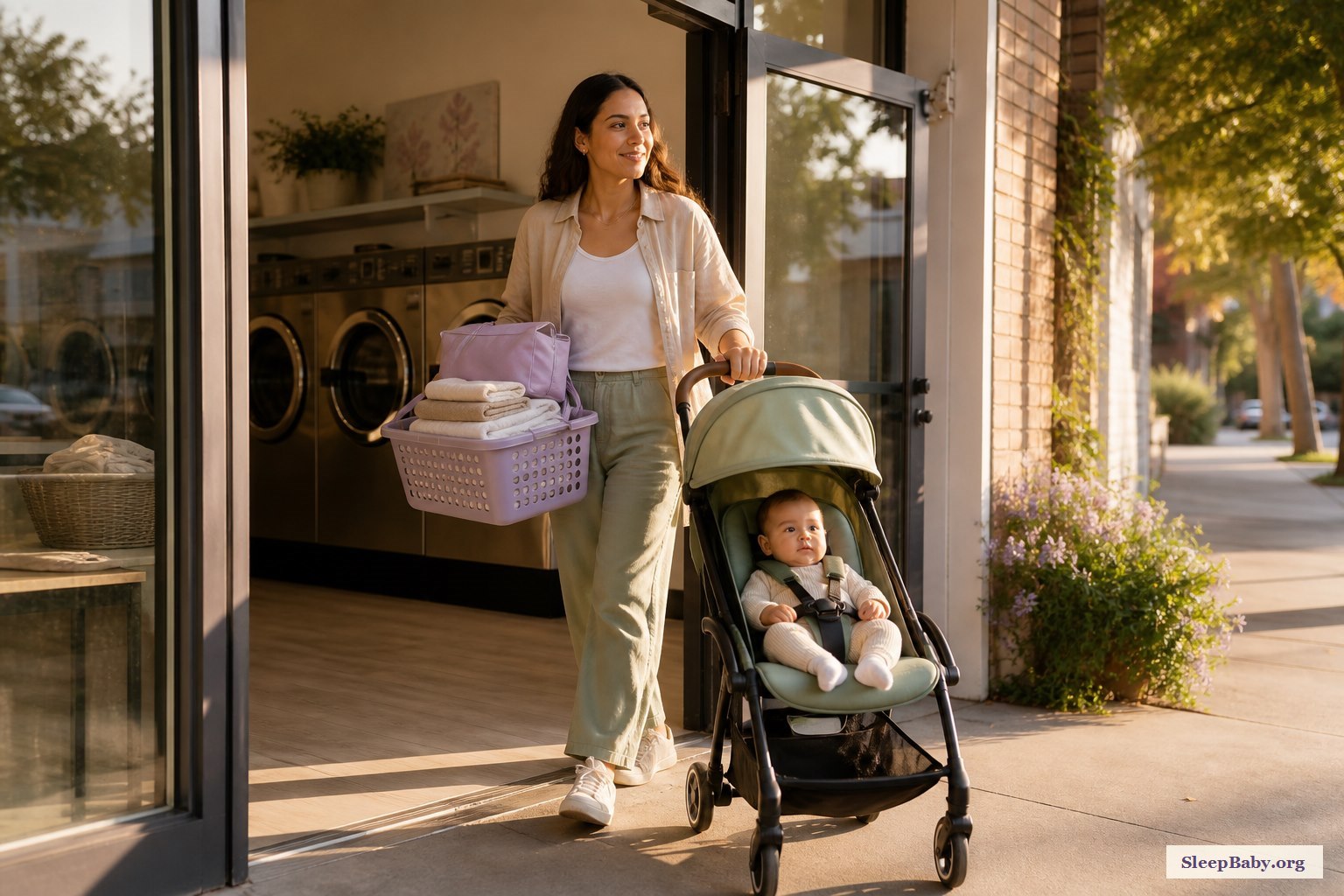
One clean load is a complete outing
The successful trip may not empty the hamper. It may be one washer, one dryer, one feeding break, and a basket that leaves with half its contents folded. Nothing about the baby requires the chore to become a test of efficiency.
Brake the stroller. Keep detergent adult-only. Separate the clean-care zone. Protect the easy exit. Those choices are more important than whether every tiny sleeper reaches a drawer before bedtime.
And if your baby spends the entire visit studying one clean sock, let the sock carry the entertainment budget. It has the qualifications.
Your calmer next step
Draw the BASE plan before you lift the basket
Choose the stroller spot, the one washer, the clean-care zone, and the exit. Put detergent in the adult-only pouch and reduce the clothes to one load. If the four points do not work in the real room, make a different plan before the baby has to absorb the improvising.
Sources
- Poison Control: What Happens If a Child Eats a Laundry Detergent Pod? – packet hazards, symptoms, first steps, eye rinsing, webPOISONCONTROL, and Poison Help.
- CDC MMWR: Health Hazards Associated with Laundry Detergent Pods – child exposure patterns and comparative gastrointestinal, respiratory, and neurologic effects.
- American Academy of Pediatrics: Poison Prevention & Treatment Tips – original-container storage, Poison Help, and avoiding improvised treatment.
- American Academy of Pediatrics: How to Keep Your Sleeping Baby Safe – back sleep, firm flat surfaces, and moving a baby from stroller, car seat, carrier, swing, or sling.
- CDC: About Handwashing – soap-and-water steps, key handwashing times, and sanitizer as a fallback.
- CDC: Healthy Habits – Diaper Changing – continuous contact, waste containment, surface cleaning, and handwashing.
- American Academy of Pediatrics: Baby Carriers – visible face, straight neck, chin position, airflow, fit, and medical cautions.
- Consumer Reports: Laundry Detergent Packs Safety Alert – short visual explanation of concentrated-packet risk; current written medical guidance controls.
The SleepBaby.org Workshop
Make a plan for
the next bedtime.
Practical help for wake-ups, short naps, and sharing the night shift. Watch the original video, then get 15 guides and five audio tracks for $9.
$9 USD, paid once. No subscription. Digital access.
Watch the original Baby Sleep Miracle presentation
Press play for a little help with your baby’s next bedtime.
Original presentation. Watch before you decide.
15practical guides
5audio tracks
1one-time payment
Kind words about the original video
“Thank you so much for this video!”
“I'm truly impressed with how much information you share in your video.”
Inside the Workshop
Start with the night
you're having.
You don't need to read all 15 guides before bedtime. Choose the one that answers the question in front of you, then come back for the next part.
Before you buy
A few things
made clear.
A straightforward purchase, with space to decide what fits your family.
What am I buying?
The SleepBaby.org Workshop includes 15 digital guides, five audio tracks, and the original Baby Sleep Workshop PDF as an additional download. It costs $9 USD, paid once, with no subscription. Nothing is shipped.
Where should I start?
Try Tonight Rescue when you need a starting point. If your question is more specific, go straight to the guide on naps, a caregiver handoff, the sleep space, or another topic. You can read at your own pace.
Is this personal sleep coaching?
No. This is an educational collection for parents of babies and young children. Use the age-specific guidance, and bring feeding, breathing, growth, illness, or other health concerns to your child's clinician. It does not diagnose a problem or promise a sleep result.
Is the video the paid Workshop?
You can watch the original Baby Sleep Miracle presentation on this page. Your purchase is the SleepBaby.org Workshop collection of guides, audio tracks, and the original PDF described here.
How do I find it after checkout?
On your thank-you or order-status page, look for Open Workshop access, then Open your SleepBaby Workshop. Keep your order confirmation so you can return. If you need help finding your access, use our Workshop download help.
The SleepBaby.org Workshop
Have somewhere to start
at the next bedtime.
15 practical guides. Five audio tracks. One $9 purchase.


A quiet parent-to-parent note
What would you add about Parenting & Family?
Share one useful detail, question, or experience. No account is needed. Please leave out names, medical records, and other private details.
There is room for the first useful note.
If you have a thoughtful question or detail about Parenting & Family, you can begin the conversation below.