
Quick answer
Skip tummy time in a moving stroller or pram
The viral stroller tummy-time hack is not a safe substitute for tummy time on a stable play surface. It places a baby face-down in equipment designed for transport and restraint, sometimes over a nursing pillow, while the stroller is pushed. That can leave the baby unrestrained on an unstable surface, make the face and breathing harder to watch, and add fall or tip exposure. For tummy time, place an awake baby on a clear floor or use a closely supported chest or lap variation. Stay within arm’s reach and watch continuously. If the baby gets sleepy, move them to a separate safe sleep space on their back.
Health and everyday sleep
Health first.
Rest, when you’re ready.
Take care of the health or safety question first. If you’re also looking for everyday baby-sleep help, you can watch our video below when you’re ready.
Prefer to read?Press play for a little help with your baby’s next bedtime.
Kind words about the original video
“Thank you so much for this video!”
“I'm truly impressed with how much information you share in your video.”
The SleepBaby Workshop
An everyday sleep resource.
For a separate look at ordinary nights: 15 guides and five audio tracks in a simple browser hub. Read, listen, and return to the part you need.
A conversation, if you want one.Night Owls is the SleepBaby chat room. Read what is there or join in.
The video arrives when you are already trying. Your baby lasts twelve unhappy seconds on the play mat. On the phone, another baby seems content in a fully reclined pram, belly down, looking through the open end while the stroller rolls along. The view is new. The crying has stopped. It can feel like someone finally solved the part everyone else made sound easy.
That is a disclosed composite of ordinary parent moments, not a report about one family. The pressure behind it is real: you want to give your baby useful awake play without turning every attempt into a battle. Wanting a gentler way is not the mistake.
The safer answer is also the simpler one. I would not trade a secure stroller ride for a moving tummy-time experiment. Use the stroller in the position and restraint system its manufacturer specifies. Move tummy time to a stable surface where the baby’s face, breathing, color, movement, and effort stay easy to see.

What is the viral tummy-time stroller hack?
In the version circulating online, a young baby is placed prone – on the stomach – in a stroller or pram that looks flat or nearly flat. Some videos add a nursing pillow or other support under the baby’s chest. The stroller may then be pushed so the baby can look forward through the opening rather than down at a mat.
A news report about the trend described pediatric and child-passenger-safety concerns about poor air circulation, an unstable surface, lack of restraint, falls, and tipping.7 Those concerns fit a more basic mismatch: the setup asks transport equipment to become a prone play station while it is moving.
That is not how authoritative tummy-time guidance defines the activity. NICHD’s Safe to Sleep program describes tummy time as placing a baby on the stomach while the baby is awake and someone is watching.1 The American Academy of Pediatrics gives floor, chest, lap, and side-lying variations, all with close supervision and a clear boundary between awake play and sleep.2
The one-minute safety swap
Keep the interesting view; change the surface
- Park the stroller. Return the baby to the position and restraint required for a normal ride.
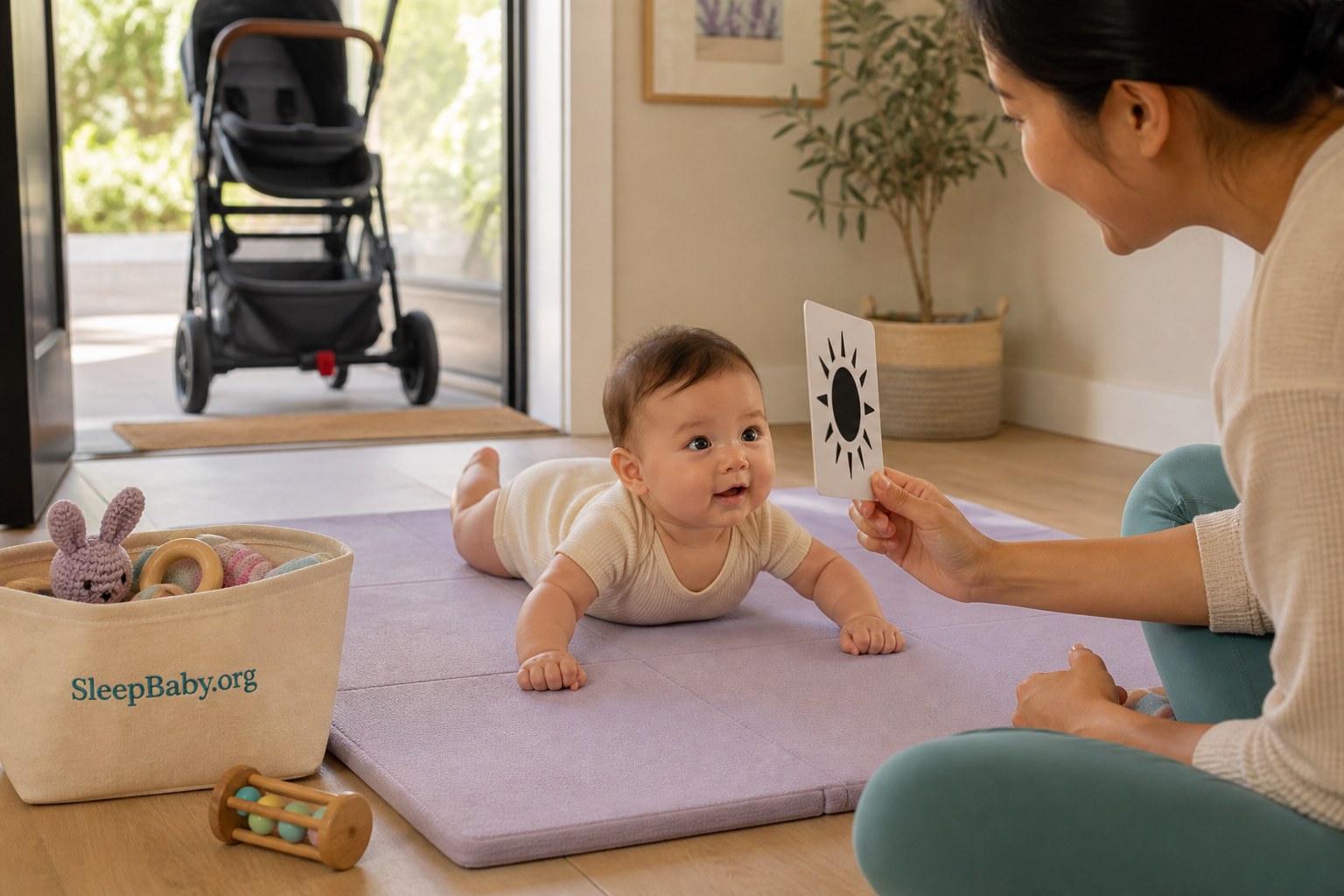
- Choose a clear, firm floor area. Use a secured blanket or play mat with no loose pillow near the baby’s face.
- Bring the view down. Lie face-to-face, place one high-contrast toy at eye level, or move the mat near a window without putting the baby in direct heat or sun.
- Try one short round. A calm minute or even several tolerated seconds can be repeated later. Stop before exhaustion turns practice into panic.
The goal is not to make the baby endure a long session. It is to create many safe chances to move against gravity.
Use the SURFACE / SUPERVISION / SIGNALS check
Viral baby hacks change faster than any article can. This three-part check lets you evaluate the next one without relying on the number of views, the calmness of the demonstration, or a creator’s good intentions.
SleepBaby safety filter
Surface. Supervision. Signals.
SURFACE
- Stable, level, and intended for awake floor play
- Clear around the baby’s face and arms
- No moving base, loose pillow, edge, gap, or tipping path
- Enough room for the baby to push, turn, and shift weight
Stop if: the idea depends on transport equipment, elevation, improvised supports, or an adult holding a moving object steady.
SUPERVISION
- An alert adult watches continuously
- The baby’s entire face and body stay visible
- The adult can reach the baby immediately
- The setup ends before the adult walks away or becomes distracted
Stop if: the angle, canopy, pillow, stroller frame, camera, or motion makes breathing and movement harder to observe.
SIGNALS
- Breathing, color, alertness, and movement look usual
- The baby can turn or lift the head as expected for them
- Fussiness stays recoverable rather than escalating
- Sleepiness ends the awake-play session
Stop now if: the baby’s face is obstructed, breathing changes, color changes, the body becomes unusually limp or stiff, or the baby cannot recover.
Created by SleepBaby.org for evaluating baby-positioning trends without turning a video into safety evidence.

The filter does not ask whether a setup is clever. It asks whether the baby has a suitable play surface, whether an adult can truly supervise, and whether the baby’s signals remain visible. A hack that fails one lane does not become safe because it performs well in the other two.

Why a fully reclined stroller is still not the floor
A seat can look flat in a short video and still slope, flex, cup the body, narrow at the shoulders, or change angle as the stroller rolls. The baby may slide toward an end or side. The stroller may meet a bump, driveway lip, curb, turn, or sudden stop. An adult holding the handle does not remove those forces.
The stroller’s ordinary safety system is also part of the problem. A harness is designed for the manufacturer’s approved riding position, not for a baby placed face-down. Leaving a baby unrestrained creates movement and fall risk. Improvising a harness around a prone baby can create pressure or entanglement that the equipment was never designed or tested to manage. Neither option converts the stroller into a tummy-time surface.
There is a developmental difference too. On the floor, a baby can press the forearms down, move the elbows, turn the head, shift weight, kick, and gradually explore a wider base. A shaped seat, sidewalls, canopy, pillow, and fabric contours can limit that movement or hide it from view. CDC encourages daily floor or play-mat time and advises avoiding too much time in strollers, swings, and bouncy seats.5
What if the stroller has a bassinet or carrycot?
A stroller bassinet can be appropriate for the uses, positions, age range, and conditions specified by its manufacturer. That does not make it a general-purpose prone play surface. Do not assume that a product described as flat, lie-flat, bassinet-style, or newborn-ready has been designed for supervised tummy time, especially while attached to a moving frame.
Follow the manual for the exact product. If the instructions do not explicitly authorize awake prone play, do not invent that use from a social video. The floor alternative costs less, gives the baby more movement room, and keeps the observing adult closer to the baby’s face.
Can a nursing pillow make stroller tummy time safer?
No. A nursing pillow or other loose support does not fix the moving base, lack of an approved prone restraint, fall or tip path, reduced visibility, or equipment-use mismatch. It may add a soft surface near the baby’s face and create another way for the body to slide or become wedged.
A small rolled towel can be used differently on a clear floor: NICHD suggests placing it under the baby’s arms to help lift the upper body while an adult stays close.1 The towel is not a sleep positioner and should not be placed under a sleeping baby. Its safer use depends on the rest of the setup: awake baby, stable floor, clear face, direct supervision, and immediate removal when the session ends.
What to do when your baby hates floor tummy time
Some babies protest the instant their chest touches the mat. That does not mean you have to choose between a distressed twenty-minute session and a risky workaround. Start where the baby can succeed, use a small amount of support, and repeat at calm points in the day.
Try after a diaper change or nap when the baby is alert, not immediately after a large feeding. Get all the way down so your face becomes the interesting thing. Place one toy or mirror at eye level rather than surrounding the baby with objects. If reflux, prematurity, a medical condition, or feeding discomfort changes what is comfortable, ask the baby’s clinician for an individualized starting point.2
A gentler progression
Six safer tummy-time options
1. Chest to chest
Recline while fully awake and hold the baby prone on your chest. Keep the face visible and the airway clear. Your voice and face can make the work feel more connected.
2. Across your lap
Place the awake baby belly-down across your thighs, supporting as needed and keeping the head and face clear. Stay seated, stable, and attentive.
3. Supported side-lying
AAP includes side-lying as an alternative position. Support the back as needed, bring the hands together, and switch sides. This is awake, supervised practice, not sleep positioning.2
4. Rolled towel on the floor
On a clear firm floor, place a small rolled towel under the arms and upper chest so the elbows come forward. Keep the towel below the armpits and the face unobstructed.
5. Face-to-face floor time
Lie down at the baby’s level. Talk, sing softly, or move one high-contrast object slowly from the center toward one side. The adult interaction is the activity.
6. A new safe view
Move the floor mat to another clear room, a shaded outdoor blanket on level ground, or near a bright window. Change the scenery without changing the safety structure.
Use the variation the baby tolerates today, then keep offering brief floor practice. The alternatives are bridges toward movement, not tests the baby has to pass.

Chest and lap variations still require an awake adult. If you are sleepy, medicated, on a couch where you could drift off, or likely to become distracted, choose a clear floor setup or wait. The adult body is a supported play option only while the adult is actively supervising.

How much tummy time does a baby need?
Think in accumulated practice, not one heroic session. NICHD suggests starting with two or three sessions of about three to five minutes each day and adding time as the baby grows. By around two months, a practical goal is about fifteen to thirty total minutes spread across the day.1 AAP guidance likewise starts with short awake-and-watched sessions and builds gradually.3
Those numbers are guides, not a reason to hold a crying baby in place. A newborn may tolerate only a short attempt. Several calm thirty-second or one-minute turns can be more useful than one long struggle. Pause when the baby needs feeding, comfort, or sleep. Try again later when the body is alert and settled.
I would count a baby who lifts, turns, then asks to be held after forty seconds as practicing – not failing. The useful measure is a pattern of safe opportunities, not whether one session looked impressive.
As tolerance grows, look for quality rather than a perfect timer: the baby turns the head both directions, briefly lifts or steadies it, presses into the forearms, opens the hands, moves the legs, and gradually explores more of the surface. Development does not arrive in a smooth daily line. Illness, hunger, fatigue, and growth can make one session look different from the next.

Can tummy time start in the newborn period?
Healthy newborns can begin with very short supervised practice when awake, using the floor or a closely supported chest or lap variation. Choose a moment when the baby is not exhausted or freshly full. If the baby was premature, has medical or feeding needs, recently had a procedure, or you were given special positioning instructions, use the clinician’s individualized guidance.
Does tummy time prevent SIDS?
No. NICHD is explicit that tummy time does not directly reduce the risk of sudden infant death syndrome.1 It supports motor development and helps reduce pressure-related flat spots. Safe sleep remains a separate practice: place the baby on the back for every sleep in a safe sleep space. Do not turn an awake-play recommendation into a prone-sleep recommendation.
When a movement or head-shape concern deserves a call
By two months, holding the head up while on the tummy is a milestone most babies can do, but milestone timing has a range.4 One short video, one fussy afternoon, or one awkward attempt cannot diagnose a problem. Patterns are what matter.
Contact the baby’s clinician if you notice a strong preference to look only one direction, difficulty turning the head, a persistent head tilt, a growing flat area, marked stiffness or floppiness, movement that is consistently different on one side, feeding or breathing difficulty during activity, or a baby who has lost a skill they previously used. AAP notes that head preference and torticollis can contribute to positional skull changes and may need evaluation or physical therapy.6
Make the appointment useful
Bring a short movement note
- Which direction the baby prefers to look
- Whether the pattern appears during play, feeding, carrying, and sleep
- How long the baby tolerates prone play and which setup works best
- Any head-shape change, pain response, feeding concern, breathing change, or lost skill
- A brief video of the usual movement on a safe floor, if the clinician’s office accepts it
This is not homework you must complete before asking for help. It simply gives the clinician a clearer view of the pattern you see at home.
Watch: the stroller trend and expert response
This short local-news segment shows the exact version of the viral trend and reports expert objections. Watch it for context, not as a demonstration to copy. The written guidance in this article stands on NICHD, AAP, and CDC recommendations whether or not you play the video.
Watch the tummy-time stroller trend segment on YouTube if the embedded player is unavailable or not useful with your assistive technology.
Written takeaway: the useful question is not whether the stroller appears flat. It is whether the baby has a stable play surface, visible face and airway, free movement, continuous supervision, and no added fall or tip path.8

Tummy time ends when sleep begins
Tummy time is awake play. If the baby nods off on your chest, lap, towel-supported mat, or any other prone setup, move them to a separate safe sleep surface and place them on their back. AAP guidance makes that transition explicit.2

Do not leave a sleeping baby on a nursing pillow, tummy-time pillow, adult chest, couch, stroller set up for prone play, or floor mat because the nap seems brief. Remove the play supports and use the baby’s normal safe sleep space. Our guide to what to do when a baby falls asleep during tummy time walks through that handoff.
The same boundary applies to other position trends. A technique can look calm, be widely shared, and still need to be checked against the baby’s age, the intended equipment use, and safe sleep guidance. The flipped-baby technique guide shows how to evaluate another viral positioning idea. If you are worried about a position your independently mobile baby reaches during sleep, see our guide to strange baby sleeping positions. And if a pillow has become part of the sleep question, start with why infant pillow preferences do not change the safe setup.
Frequently asked questions
Is stroller tummy time safe if the stroller is parked?
Parking removes motion but does not prove that the seat is a stable prone play surface, that the baby can be safely restrained in that position, or that the manufacturer allows the use. Use the stroller for its approved riding positions. For tummy time, move the awake baby to a clear floor or closely supported chest or lap variation.
What if I hold the stroller handle the entire time?
Holding the handle does not remove the sloped or flexible seat, edge and gap exposure, lack of an approved prone harness position, reduced movement space, or the possibility of a sudden shift. Direct supervision is required, but supervision does not repair an unsuitable surface.
What if my baby likes the stroller view more than the floor?
Keep the view and move the mat. Try a safe patch of shade on level ground, a room with more light, or a spot where you can lie face-to-face. One toy, a mirror placed safely at eye level, or another person talking from the front can give the baby a reason to lift and turn without adding a moving base.
Can I use a Boppy-style or nursing pillow for floor tummy time?
Use only supports appropriate for the baby’s age and exactly as directed, while the baby is awake and continuously watched. A small rolled towel under the upper chest and arms is an option described by NICHD. Keep all support away from the face, stop if the baby slips or becomes sleepy, and never use a tummy-time support for sleep.
Should I stop every time my baby cries?
Some effort sounds and brief protest can happen during a new movement. You do not need to force the session through escalating distress. Try changing your position, bringing your face closer, using a supported variation, or ending the round and trying later. Seek medical advice for pain, breathing changes, unusual color, repeated vomiting, marked stiffness or floppiness, feeding difficulty, or any pattern that worries you.
How long after feeding should we try?
There is no single interval that fits every baby and feeding. Choose a comfortable alert period rather than immediately after a full feed, especially if the baby spits up easily. Ask the clinician for individualized timing if reflux, poor weight gain, swallowing concerns, or other medical needs affect positioning.
Is tummy time on a bed safe?
A bed is soft, elevated, and easier to roll or fall from. A clear floor or secured floor mat is the more stable choice. If you use your chest or lap as a variation, stay fully awake, stable, and continuously attentive.
Will my baby fall behind if we skip a day?
No single missed day decides development. Return to short, repeatable opportunities when the baby is well and alert. If you see a persistent movement difference, strong head preference, loss of skills, or another developmental concern, contact the baby’s clinician rather than trying to make up minutes with longer sessions.
Keep the view; move to the floor
The stroller video may be fifteen seconds. The safety decision has to survive the whole walk. A moving pram does not become a tummy-time station because the seat looks flat, the view is interesting, or an adult keeps a hand on the handle.
Return to the three things that travel well beyond this trend: a stable surface, continuous supervision, and readable baby signals. Use short floor sessions, chest or lap bridges, a rolled towel on the floor when appropriate, and a view worth lifting toward. If the baby dislikes it today, that is information for the next small attempt – not a reason to improvise with transport equipment.
You were never wrong for wanting the baby to see more and struggle less. The safer path simply brings both of you closer to the floor.
Your next safe step
Build one calm, repeatable practice window
Choose one awake moment tomorrow, clear one small floor space, and try one short supported round. Keep what your baby tolerates, notice what changes, and bring persistent movement or head-shape concerns to the pediatrician.
Sources
- NICHD Safe to Sleep: Tummy Time for Baby – awake-and-watched definition, benefits, gradual timing, clear-floor setup, and rolled-towel guidance.
- American Academy of Pediatrics: 3 Tummy Time Activities to Try With Your Baby – chest, lap, side-lying, supervision, and sleep handoff.
- American Academy of Pediatrics: Back to Sleep, Tummy to Play – short sessions, gradual total time, and floor play.
- CDC: Important Milestones – Your Baby By Two Months – head control during tummy time, floor play, supervision, and developmental concerns.
- CDC: Important Milestones – Your Baby By Four Months – daily floor or play-mat time and limiting container time.
- American Academy of Pediatrics: Positional Skull Deformities and Torticollis – head preference, flattening, tummy play, and evaluation.
- Parents: The Viral Tummy Time Stroller Trend – trend description and quoted pediatric and child-passenger-safety concerns.
- Your California Life: Tummy Time Hack – current trend context only; authoritative written guidance remains in the sources above.
The SleepBaby.org Workshop
Make a plan for
the next bedtime.
Practical help for wake-ups, short naps, and sharing the night shift. Watch the original video, then get 15 guides and five audio tracks for $9.
$9 USD, paid once. No subscription. Digital access.
Watch the original Baby Sleep Miracle presentation
Press play for a little help with your baby’s next bedtime.
Original presentation. Watch before you decide.
15practical guides
5audio tracks
1one-time payment
Kind words about the original video
“Thank you so much for this video!”
“I'm truly impressed with how much information you share in your video.”
Inside the Workshop
Start with the night
you're having.
You don't need to read all 15 guides before bedtime. Choose the one that answers the question in front of you, then come back for the next part.
Before you buy
A few things
made clear.
A straightforward purchase, with space to decide what fits your family.
What am I buying?
The SleepBaby.org Workshop includes 15 digital guides, five audio tracks, and the original Baby Sleep Workshop PDF as an additional download. It costs $9 USD, paid once, with no subscription. Nothing is shipped.
Where should I start?
Try Tonight Rescue when you need a starting point. If your question is more specific, go straight to the guide on naps, a caregiver handoff, the sleep space, or another topic. You can read at your own pace.
Is this personal sleep coaching?
No. This is an educational collection for parents of babies and young children. Use the age-specific guidance, and bring feeding, breathing, growth, illness, or other health concerns to your child's clinician. It does not diagnose a problem or promise a sleep result.
Is the video the paid Workshop?
You can watch the original Baby Sleep Miracle presentation on this page. Your purchase is the SleepBaby.org Workshop collection of guides, audio tracks, and the original PDF described here.
How do I find it after checkout?
On your thank-you or order-status page, look for Open Workshop access, then Open your SleepBaby Workshop. Keep your order confirmation so you can return. If you need help finding your access, use our Workshop download help.
The SleepBaby.org Workshop
Have somewhere to start
at the next bedtime.
15 practical guides. Five audio tracks. One $9 purchase.


A quiet parent-to-parent note
What would you add about Health & Safety?
Share one useful detail, question, or experience. No account is needed. Please leave out names, medical records, and other private details.
There is room for the first useful note.
If you have a thoughtful question or detail about Health & Safety, you can begin the conversation below.