

The nap that arrived wearing bedtime’s name tag
This is a disclosed composite-mom scene, not a customer story or medical evidence—but it is happening in somebody’s kitchen tonight.
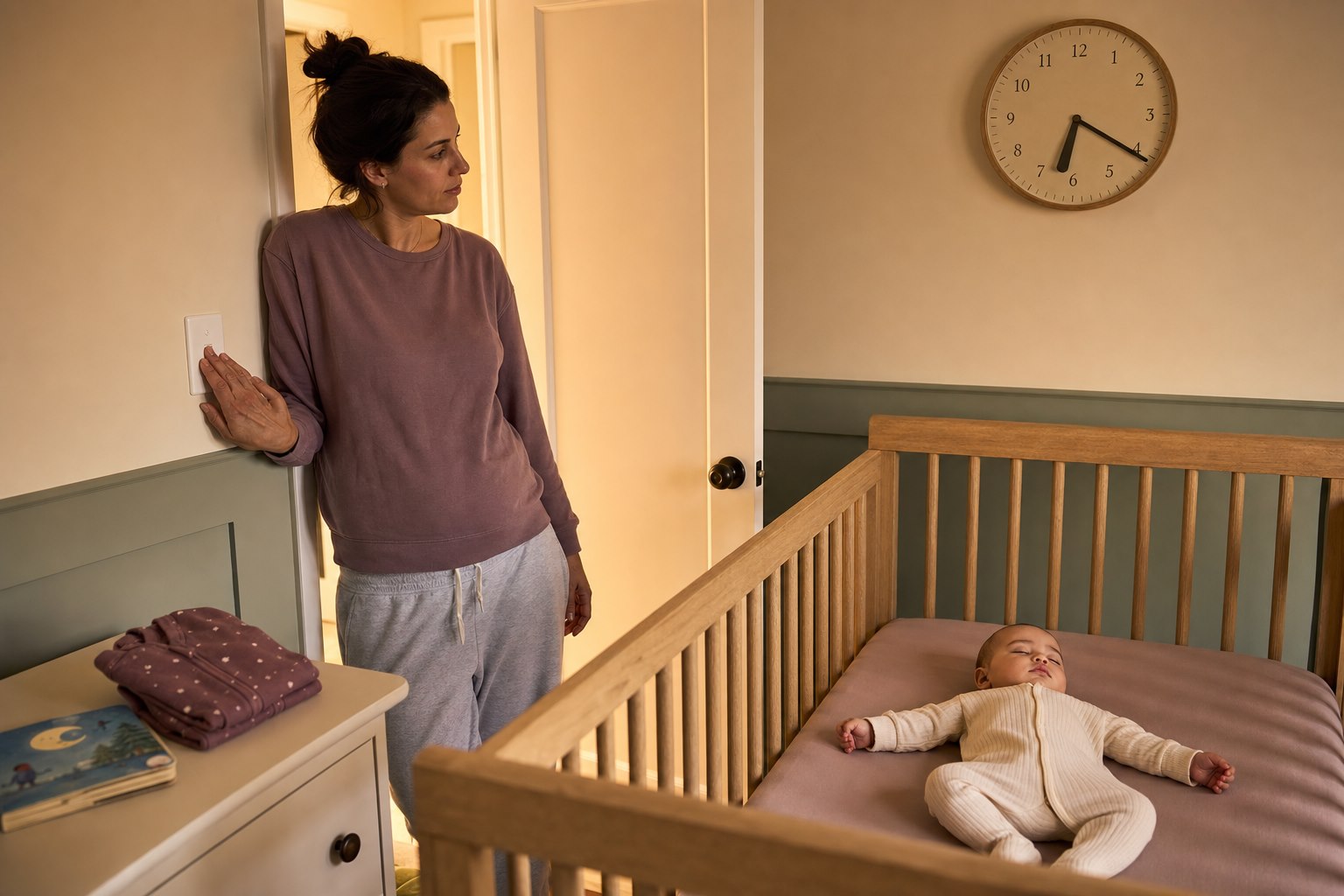
At 6:18 p.m., I had planned a bath, a book and one morally superior little lullaby. The baby had scheduled an unauthorized nap. She was asleep against my shoulder while the pasta water boiled, and bedtime was close enough to wave.
My brain immediately produced two dramatic options: wake her and ruin the evening, or let her sleep and ruin the evening in a more mysterious way. What I actually needed was a third option: stop treating every patch of evening sleep as the same event.
I do not want you making the decision from that panic. I want you to notice what the sleep changed, protect the needs that outrank the schedule and choose one next move.
A late sleep is not automatically a bad nap. It can be a bridge, bedtime arriving early or a proper nap that has purchased more awake time. The useful job is naming which one happened before you rearrange the rest of the night.
Use the Last-Nap Fork before you touch the clock
Start with the exception that sample schedules often bury: age, feeding and health needs can change the entire decision. Then choose the branch that matches the sleep you actually saw.
The Last-Nap Fork
Choose the branch that describes the baby and the sleep—not the branch with the prettiest clock time.
Let feeds, weight gain, prematurity and clinician instructions lead. Wake for a due feed when your baby’s plan requires it; do not stretch wakefulness for an artificial bedtime.
If your older baby fell asleep safely near the normal bedtime and stays asleep, treat it as an early bedtime. Skip optional routine steps; safety and sleep outrank completing the production.
If your baby wakes refreshed after meaningful sleep, accept that the nap changed sleep pressure. Keep the evening calm and move bedtime later instead of attempting bedtime three times.
How close to bedtime is “too close”?
There is no universal cutoff that becomes medically true at 5:00, 6:00 or 7:00 p.m. Bedtime, nap needs and tolerance for awake time vary by age and by baby. Use the zones below as practical starting points, not promises.
If sleep begins 15 to 30 minutes before bedtime
If your older baby falls asleep safely in the crib just before the routine would normally end, treating it as bedtime is usually the cleanest option. Do not wake a sleeping baby solely to complete a bath, read the correct number of books or preserve the ceremonial order of pajamas. The routine helps signal sleep; it does not authorize it.
If the baby fell asleep somewhere unsuitable for ongoing sleep—such as a car seat after the drive ended, a swing or a lounger—move them to an approved firm, flat sleep surface on their back. That transfer may wake them. Safety still wins.
If sleep begins roughly 30 to 90 minutes before bedtime
This is the most ambiguous zone. A visibly depleted baby may need a short bridge nap, while a baby who has already had generous daytime sleep may be beginning a real nap that will move bedtime. Let the baby’s wake-up state tell you what the sleep bought rather than deciding from the clock alone.
If the baby wakes drowsy after a brief sleep, keep lights low, meet the immediate need and use a shortened routine. If the baby wakes delighted to have acquired a second evening, stop attempting bedtime every ten minutes. Give calm awake time and wait for sleepiness to return.
If sleep begins one to two hours before bedtime
A very tired baby may not reasonably bridge that whole gap. A short nap can protect the evening from overtiredness. But if the nap runs long and the baby wakes alert, bedtime will probably need to move later. The goal is not to “save” the original bedtime at any cost; it is to avoid asking a rested baby to perform sleep.
Newborns do not need a pre-bedtime wake-window performance
Newborn sleep is spread across day and night and organized around frequent feeding. This is not the stage for holding a visibly tired baby awake so a family bedtime can begin on schedule. Mayo Clinic describes newborn sleep as irregular, with waking commonly tied to feeding.
The important exception is a baby who must be woken to feed. HealthyChildren.org notes that a newborn sleeping longer than four hours at night should be awakened and encouraged to nurse. Some babies need more frequent feeds or individualized waking because of prematurity, jaundice, weight gain, illness or a clinician-directed plan.
If your newborn is difficult to wake, cannot stay awake to feed, is feeding much less effectively than usual or has fewer wet diapers, call the pediatric clinician. That is not a bedtime-adjustment problem.
For an older baby, ask what the sleep purchased
Sleep lowers sleep pressure—the biological drive that builds during awake time. A few drowsy minutes may only soften the sharpest edge of exhaustion. A longer nap may buy enough alertness that the usual bedtime no longer fits. You do not need an exact universal minute cutoff to see the difference.
The Sleep Receipt
Baby wakes still drowsy or upset. Use a short routine and try bedtime soon.
Baby wakes calm, not fully recharged. Give quiet awake time, then use the familiar routine once.
Baby wakes bright and ready. Treat the sleep as a real nap and accept a later bedtime.
The receipt is behavior, not just minutes: how the baby wakes tells you what the sleep changed.
If your baby fell asleep before the bottle, feed or routine
A skipped bath is simple. A skipped feed may not be. If your baby is a newborn, has a feeding plan, is gaining weight slowly, was born early or has a medical instruction, follow that plan and wake when it says to wake. If you are unsure whether a feed can be skipped, ask the pediatric clinician rather than using a generic sleep schedule.
For an older healthy baby who is feeding and growing well, consider the usual pattern. If the pre-bed feed is important to total intake or your clinician has told you to maintain it, gently wake and offer it. If the baby commonly feeds later overnight and no individualized instruction says otherwise, a single unusual evening is not automatically a crisis. Do not prop a bottle or try to feed an unresponsive sleeping baby.
If you choose to wake, lower the drama: turn on a soft light, open the sleep sack, change the diaper if needed, hold the baby upright and speak normally. You are looking for genuine wakefulness before a feed, not attempting a stealth bottle while everyone remains asleep.
Age changes the shape of the decision
About 4 to 6 months
Naps and nights are beginning to organize, but the day may still be variable. A final catnap can be useful when earlier naps were short. If the catnap becomes a long, restorative sleep, bedtime may move. Watch the pattern over several days before deciding the baby has outgrown it.
About 7 to 9 months
Many babies are moving toward a more predictable two- or three-nap rhythm. A late third nap can protect bedtime on a rough-nap day, yet it can also become the reason bedtime drifts. The repeating clue is not the age printed on a schedule; it is that the final nap becomes difficult to offer, bedtime becomes difficult after it, and the day works better without it.
About 10 to 12 months
A very late nap may have a larger effect on bedtime because many babies can comfortably stay awake longer than they could months earlier. Still, illness, travel, a missed nap or a daycare day can create a real need for recovery sleep. One late snooze does not prove a nap transition.
Toddlers
A toddler who falls asleep near bedtime after skipping a nap may be showing you that bedtime should happen early. A toddler who takes a late car nap and wakes cheerful may need a later, quieter bedtime. Protect the next morning’s general rhythm when possible, but do not turn the remaining evening into a two-hour battle for a clock time the nap has made unrealistic.
Three worked evenings: what the decision looks like
A ten-minute doze at 6:10 before a 7:00 bedtime
The baby wakes when the car stops, looks glassy-eyed and fusses through the transfer. That sleep probably removed the sharpest edge without refilling the battery. Keep the homecoming boring: feed if due, dim the room, use the shortest recognizable routine and try bedtime near the usual time. If the baby settles, the doze functioned as a bridge. You do not need to prevent every future ten-minute car nap on the strength of this one evening.
If the same tiny doze consistently creates a long, alert bedtime delay, the baby’s sensitivity is giving you better information than a generic schedule. On future days, change the timing of the ride if practical, keep the final awake stretch calm or accept a slightly later bedtime. Choose the least disruptive option that the family can repeat.
A crib nap begins at 6:35 before a 7:15 bedtime
The baby had poor naps all day, falls asleep quickly in the empty crib and remains deeply asleep. This may be bedtime arriving forty minutes early. Let it be bedtime. The missed bath can happen tomorrow. If a normal feed or medical instruction requires waking, follow that need; otherwise, completing the routine is not more important than the sleep.
If the baby wakes at 7:05 upset and still sleepy, use a quiet, abbreviated bedtime response rather than turning on the house and beginning a new wake window. A short first stretch does not prove the early bedtime was wrong. Hunger, discomfort, overtiredness or a simple transition between sleep cycles may also be involved.
A forty-five-minute nap ends at 6:45 before a 7:30 bedtime
The baby wakes smiling, makes immediate eye contact and wants to practice a newly discovered consonant at full volume. That nap purchased real alertness. Feed if appropriate, keep the environment ordinary and low-key, and wait for genuine sleepy cues before attempting bedtime. Repeating the full routine at 7:30, 7:50 and 8:10 will not restore sleep pressure; it will mostly make the routine feel like an unsuccessful touring production.
Tomorrow, do nothing yet if this was a one-off recovery day. If the same nap and the same bedtime delay recur, use the Three-Night Evidence Card below. Then try one change: offer the final nap earlier, gently end it earlier or deliberately move bedtime. Holding all three variables steady except one is what tells you whether the adjustment helped.
These examples are not schedules to copy. They show the reasoning: protect needs, read what the sleep changed, make one honest bedtime attempt and save structural changes for a pattern.

What about daycare, car, stroller or contact naps?
Daycare days are not laboratory conditions. If the last nap ends later than it does at home, ask what actually happened instead of assuming the evening is broken. A ten-minute car doze on the way home may only take the edge off. A forty-minute crib nap at daycare may genuinely move bedtime. The Sleep Receipt still applies.
If the late nap happened in a moving car, arrive safely first. Once travel ends, move an infant from the car seat to a firm, flat approved sleep surface. Our guide to handling a car nap before bedtime separates travel safety from bedtime math.
A supervised contact nap may be the bridge that gets a baby through a difficult evening, provided the adult remains awake and the setup is safe. If the caregiver might fall asleep, move the baby to an approved infant sleep space. A couch or armchair is not a safe compromise.
Watch: use the next sleep as the test
SleepBaby takeaway: Lindsay from Holistic Sleep Coaching suggests asking whether a nap supports the next sleep or works against it. That pattern-based question is useful. The video also mentions a two-hour nap threshold; treat that as her practical suggestion, not a universal medical cutoff. Feeding, illness, recovery and your baby’s individual response still lead.
If the late nap causes a false start
A false start is a bedtime sleep that ends shortly after it begins. Too little sleep pressure can contribute, but so can overtiredness, discomfort, hunger, illness and a routine that became stimulating. That is why “keep the baby awake longer tomorrow” is not a universal fix.
After a false start, meet ordinary needs, keep the environment dim and use one familiar settling response. If the baby is fully alert, allow a short quiet reset instead of repeating the entire bedtime routine like a stage play whose lead actor has left the building.
If the baby wakes upset and still looks exhausted, the late sleep may have been only a bridge—or discomfort may be interrupting sleep. If the baby wakes bright, social and ready to inspect every lamp in the house, the sleep may have been a real nap. Either way, tonight’s behavior is one data point, not a diagnosis.
Use a three-night test before changing the schedule
When the problem repeats, collect only the facts that answer the decision. You do not need a forensic sleep spreadsheet. For three comparable evenings, record the last nap’s start and end, how the baby acted after waking, when the bedtime attempt began, roughly how long settling took and whether a false start followed.
The Three-Night Evidence Card
Last nap, wake-up mood, bedtime attempt, settling and false start.
Keep the response ordinary. See whether the same cause-and-effect appears.
Move or shorten the last nap, or move bedtime. Do not change all three.
Stop tracking when the answer is clear. The card is a decision tool, not a new evening chore.
If bedtime is consistently easy after the nap, the nap is probably not a problem. If the same late nap repeatedly produces a long, alert bedtime delay, gently end it earlier next time, offer it earlier or shift bedtime. Our guide to adjusting a baby’s schedule without rebuilding the whole day can help you test one change at a time.
If the final nap is difficult to offer across many days and the day works better without it, read the signs that a baby may be ready to drop to two naps. Nap transitions are patterns, not one refusal or one inconvenient snooze.
Do not solve one late nap with an overtired baby
Parents often hear that a late nap will “ruin” bedtime, then try to keep a wilting baby awake at all costs. Overtiredness can also make settling harder. I would rather have you choose a brief bridge nap or an honest early bedtime than create an exhausted baby to preserve a theoretical clock.
The American Academy of Sleep Medicine recommends 12 to 16 hours of sleep per 24 hours, including naps, for infants 4 to 12 months, and 11 to 14 hours for children 1 to 2 years. Those are broad population ranges, not a minute-by-minute schedule. Look at the full day and how your baby functions, not one nap in isolation.
Longer sleep can also be recovery after a poor night, travel, vaccination or illness. If a nap is suddenly much longer than usual or your baby seems unusually sleepy, use our guide to check waking, feeding, diapers, breathing and the whole 24-hour pattern. Seek medical advice for breathing trouble, bluish or gray color, unusual limpness, severe difficulty waking, markedly poor feeding or another urgent change.
Keep the safe-sleep rules exactly the same
Whether you call it a nap, a bridge or bedtime, place an infant on their back on a firm, flat sleep surface in a crib, bassinet or play yard that meets current safety standards. Keep pillows, loose blankets, toys, bumpers and positioners out of the sleep space.
Do not leave an infant sleeping in a parked car seat or carry the seat inside as the night’s sleep space. Do not use a couch or adult bed to preserve a contact catnap when the caregiver may fall asleep. The schedule can flex. The sleep surface does not.
Tonight’s four-move repair
- Protect needs first. Safe sleep, feeds and health instructions outrank bedtime.
- Name the sleep. Early bedtime, brief bridge or real nap?
- Make one bedtime attempt. Short routine if still drowsy; quiet awake time if recharged.
- Change tomorrow only if it repeats. Move or shorten the final nap, or shift bedtime—one variable at a time.
You do not need to rescue the exact bedtime you planned. You need to respond to the sleep that actually happened. Let the nap hand you a receipt, choose one path, and leave tomorrow’s schedule alone until tomorrow.
Sources
- American Academy of Pediatrics / HealthyChildren.org: Healthy Sleep Habits—How Many Hours Does Your Child Need?
- American Academy of Pediatrics / HealthyChildren.org: How to Keep Your Sleeping Baby Safe
- American Academy of Pediatrics / HealthyChildren.org: Warning Signs of Breastfeeding Problems
- Mayo Clinic: Baby Naps—Daytime Sleep Tips
- Mayo Clinic: Helping Baby Sleep Through the Night
- American Academy of Sleep Medicine: Recommended Amount of Sleep for Pediatric Populations





Your turn
Join the night-shift chat