Quick answer
A baby can visit before they can use the equipment
You can take a baby to the playground before walking. The first visit can be shade, watching, caregiver-held exploring, or clean ground play away from equipment fall zones. Move to a bucket swing or low toddler feature only when it fits your baby’s size and physical control, the posted guidance allows it, and you can stay within reach. Never take a baby down a slide on your lap. A short visit that ends well absolutely counts.
The household at bedtime
Different people.
One household at night.
If you’re also caring for a baby and want help with sleep, our video is below. Watch when that’s the question you want to work on.
Prefer to read?Press play for a little help with your baby’s next bedtime.
Kind words about the original video
“Thank you so much for this video!”
“I'm truly impressed with how much information you share in your video.”
The SleepBaby Workshop
Get the Workshop.
Get the Workshop and explore its resources for everyday baby sleep and nighttime care. 15 guides and five audio tracks in a simple browser hub. Read, listen, and return to the part you need.
A conversation, if you want one.Night Owls is the SleepBaby chat room. Read what is there or join in.
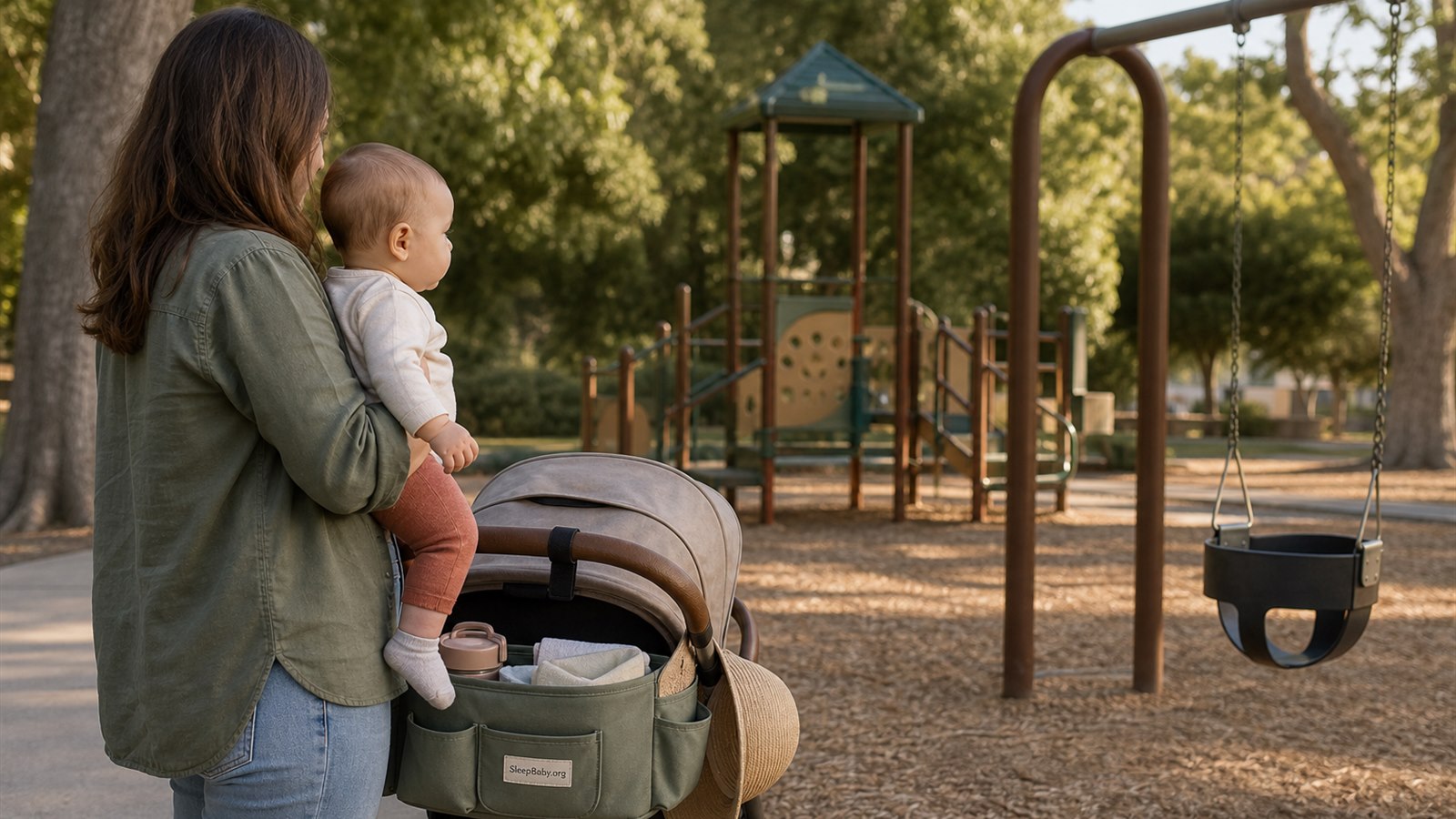
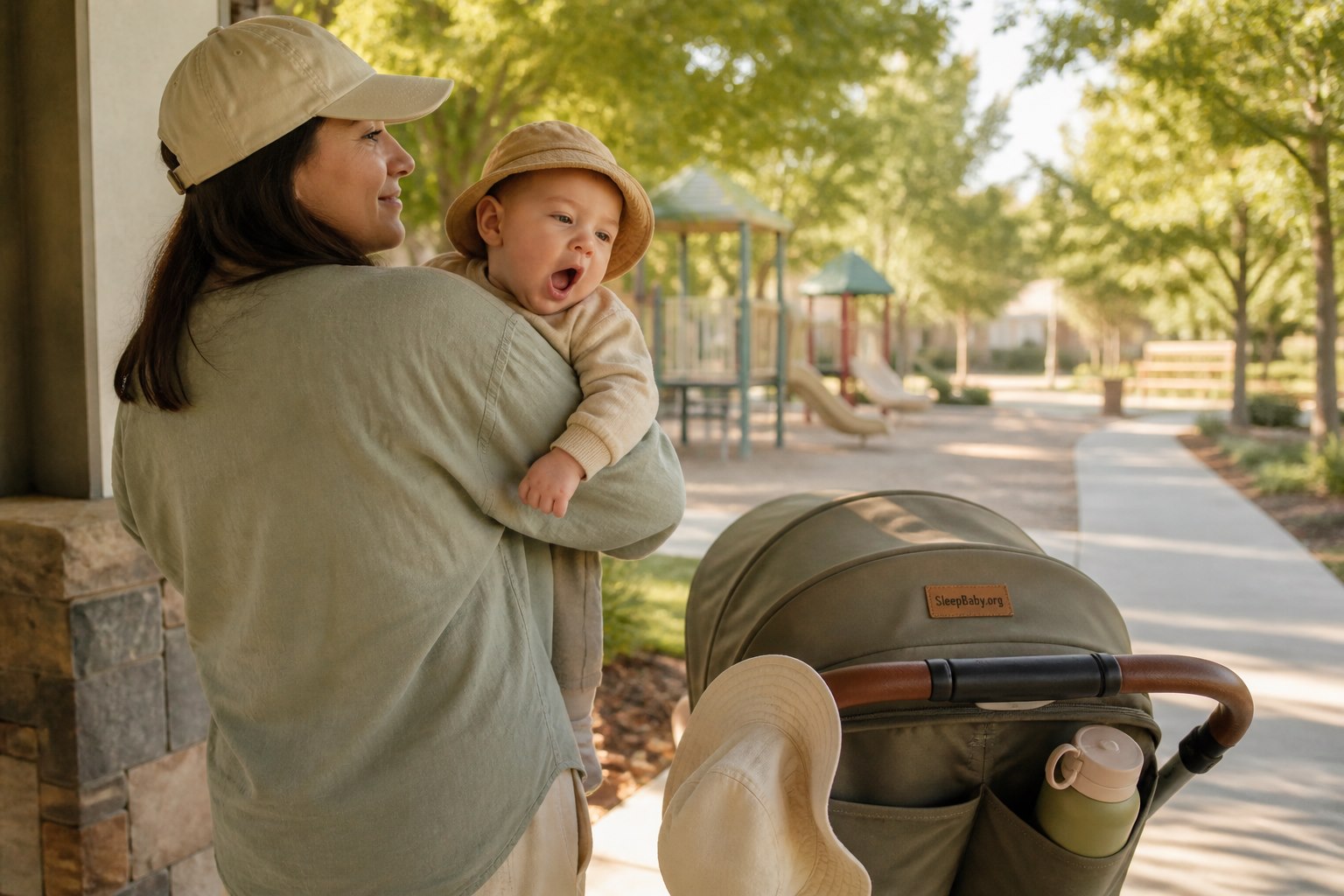
For our first playground trip, I packed enough supplies to establish a small embassy: hat, spare hat, wipes, muslin cloth, backup muslin cloth, water, milk, snacks, two outfits, and one tiny wooden toy Benjamin had never expressed the slightest interest in.
Benjamin looked past the entire operation and spent the opening minutes watching sunlight blink on a swing chain. Not touching it. Not swinging. Just watching the glint move back and forth as if the park had arranged a private planetarium.
That is an illustrative family scene, not evidence. But it gets at the answer many age charts miss: the playground is a landscape before it is a ladder. Your baby does not have to climb, slide, or achieve anything for the outing to be useful.
A first visit can be fifteen calm minutes. You scan the space, settle in the shade, let your baby look and listen, try one appropriate activity if the baby is ready, and leave while the story still has a pleasant ending. No milestone audition required.


Why take a baby to a playground before walking?
Because play begins long before playground equipment makes sense. The American Academy of Pediatrics describes early play as face-to-face interaction, movement, floor play, sensory exploration, and outdoor discovery. For babies in the later part of the first year, its examples include safe crawling, grass, bubbles, and exploring the world with a caregiver.1
At a playground, a baby can watch older children move, hear footsteps change from path to mulch, track a swing, feel a breeze, touch a broad leaf you are holding, or practice sitting on a clean blanket. Those are not consolation activities while you wait for the “real” playground. They are the real playground for that stage.
If your baby seems restless at home, our guide to what baby boredom can look like has more low-pressure sensory ideas. The goal is not constant stimulation. It is a manageable change of scene with a responsive adult nearby.
A stage, not an age race
The Playground Participation Ladder
1. WATCH
Hold your baby, use the stroller at the edge, or sit together in shade. Narrate one or two things instead of producing a nonstop nature documentary.
Ready now: nearly every healthy baby can have a short, weather-appropriate outdoor observation visit when the caregiver can meet feeding, temperature, and medical needs.
2. GROUND PLAY
Use a clean blanket in an open area away from swings, slide exits, running paths, and equipment fall zones. Stay within reach; mulch has a famous talent for reaching a mouth before an adult finishes saying “please don’t.”
Ready when: the position already works safely for your baby at home and you can keep the surface and nearby objects under control.
3. SUPPORTED LOW EQUIPMENT
Consider a correctly fitted bucket swing or another low feature designed for the baby’s size only when head and trunk control are strong, the seat fits, and posted guidance includes the child.
Ready when: your baby can maintain an upright position without the head flopping, slumping, or tipping against the seat, and you remain within reach.
4. INDEPENDENT TODDLER EQUIPMENT
Low steps, short platforms, and feet-first slides belong later, when a child can use that specific feature with the balance and coordination it requires.
Ready when: the equipment matches the child’s posted age range, size, ability, and developmental level – not simply because another child of the same age uses it.
Created by SleepBaby.org to separate “going to the playground” from “using every piece of equipment.”
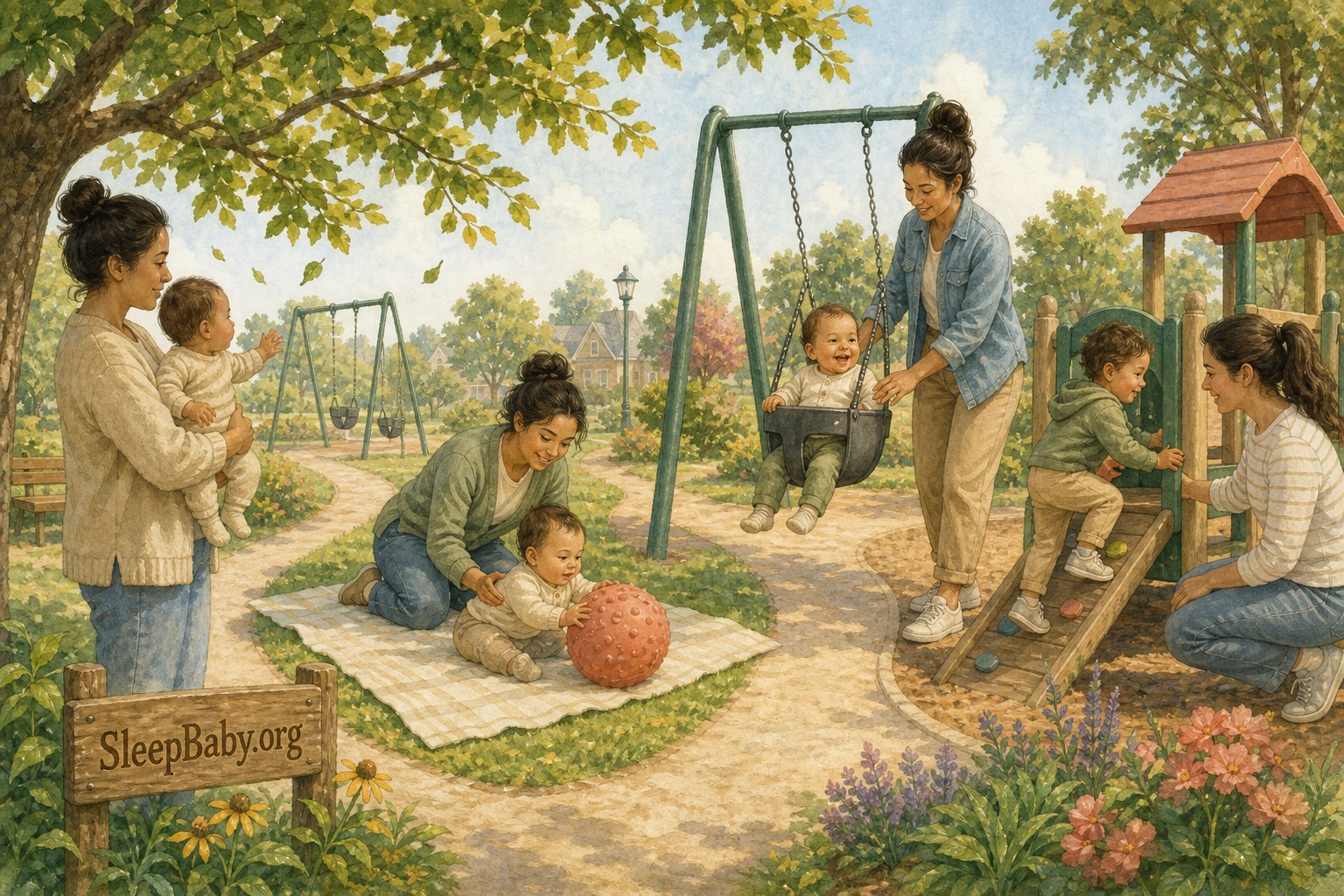
Do the 4-S Playground Scan before you settle in
Before the diaper bag touches the ground, take one slow look. The AAP recommends equipment that matches a child’s age, size, ability, and developmental level, plus active adult supervision. Falls, hot surfaces, entanglement hazards, and poor surfacing are predictable enough to scan for before play begins.2
SleepBaby decision path
Shade. Surface. Size. Space.
SHADE
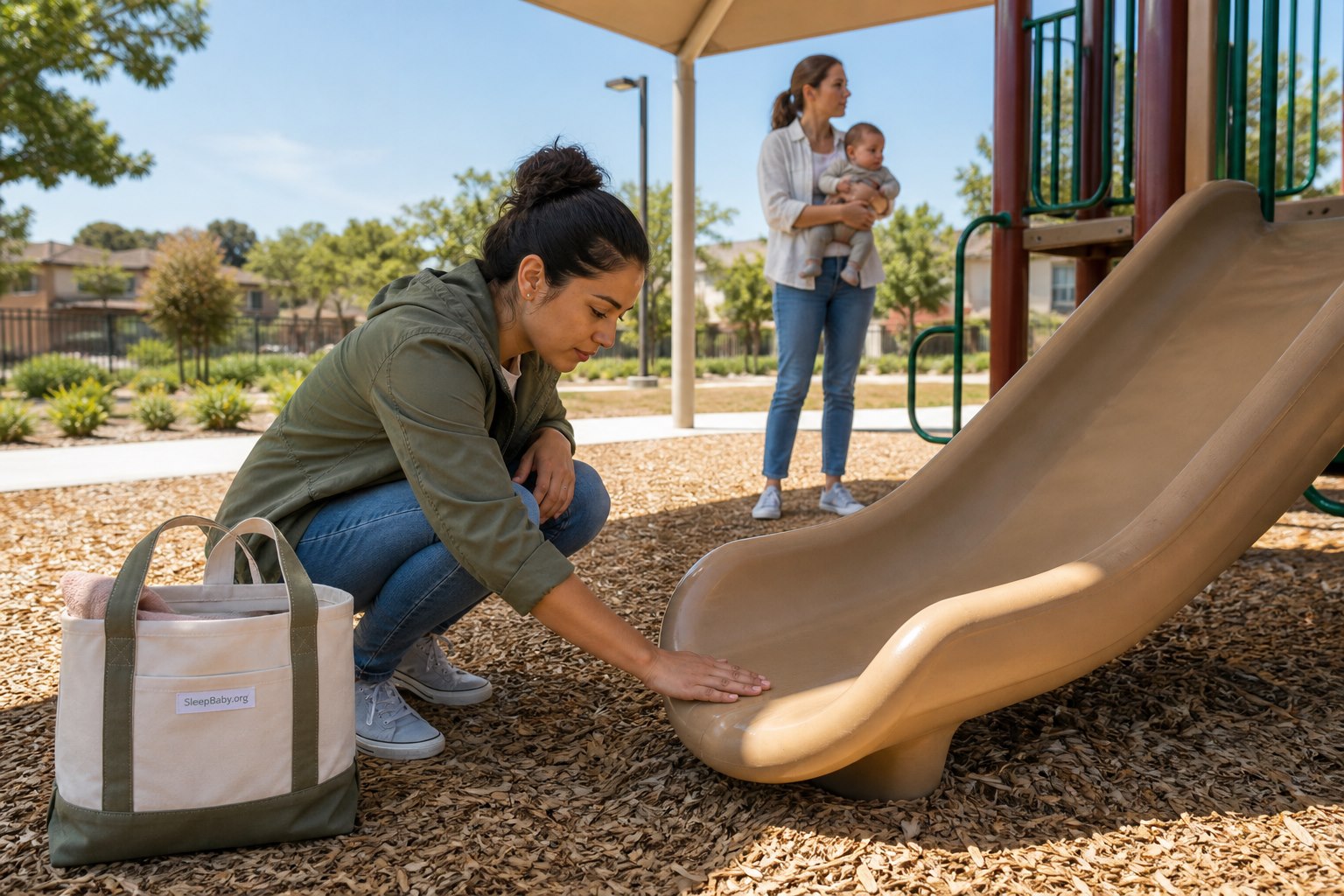
Find where you can actually stay cool, not where a narrow shadow will disappear in four minutes. Touch slides, seats, and rails with your hand before bare skin meets them.
Pause if: equipment is hot, the shade is inadequate, or your baby is flushed, unusually fussy, very sleepy, or feeding poorly.
SURFACE
Under elevated equipment, look for maintained impact-absorbing material rather than concrete, asphalt, packed earth, or grass. Keep blanket play outside equipment fall zones.
Pause if: surfacing is displaced, compacted, littered, sharply edged, or missing around likely landing areas.
SIZE
Read posted age guidance and look at the actual fit. A deep bucket seat is not automatically appropriate if a baby slumps, the openings are too large, or the structure is meant for older children.
Pause if: you have to hold the baby’s body in an awkward position to make the equipment work.
SPACE
Notice swing paths, slide exits, fast children, climbing traffic, open platform edges, and where your stroller or blanket would block movement.
Pause if: you cannot stand close without entering another child’s landing or running path.
Decision: if all four answers are workable, choose one simple activity. If one answer is not, change zones, stay with watching, or leave. The scan is a practical organizer, not a guarantee against injury.
The 4-S Playground Scan is a SleepBaby.org editorial framework built from current pediatric and public-playground safety guidance.
Watch: a federal playground safety scan
This short video comes from the U.S. Consumer Product Safety Commission. It covers close supervision, fall surfaces, hot equipment, and clothing or ropes that can catch. Current written AAP and CPSC guidance in the Sources section controls if a detail in the older video differs from updated recommendations.
Watch Playground Safety Tips on YouTube if the embedded player is unavailable or not useful with your assistive technology.
Written takeaway: stay close, inspect the landing surface, test hot equipment, and keep drawstrings, ropes, pet leashes, necklaces, and similar catch hazards away from play structures.

What is actually safe to try by stage?
Held watching and blanket play
This is the best starting point because it lets you learn how your baby responds without adding an equipment problem. Choose an open patch away from traffic and fall zones. Keep your baby within reach, and assume every leaf, wood chip, and interesting pebble has submitted an application to become lunch.
Grass can be lovely for supervised ground exploration, but it is not considered protective surfacing under elevated playground equipment.2 Those are two different uses of ground. A blanket on a safe lawn at the park edge is not the same as placing a baby beneath a slide or climbing structure.
For younger babies doing floor play, keep the setup ordinary and supervised. Our guide to viral tummy-time hacks and safer alternatives explains why clever-looking elevated setups are not an upgrade over a stable floor.
Bucket swings
There is no one birthday that makes every bucket swing fit every baby. Look for strong, steady head and trunk control; an upright position that does not collapse forward or sideways; leg openings and a seat shape that fit securely; and posted guidance that includes your child. If the playground or swing manufacturer gives an age or size restriction, follow it.
Start with a tiny motion while you remain within reach. Stop if your baby slumps, stiffens, tries to climb out, seems frightened, or cannot stay centered. Never improvise padding, tie a baby into the seat, or use a carrier or leash to secure the child to equipment.
An enthusiastic grin is useful information. So is a face that says, very clearly, “I preferred the chain from over there.” You are not obligated to continue because you completed the paperwork of leaving home.
Slides – and the lap-slide rule
Do not take a baby or young child down a slide on your lap. The AAP warns that a child’s foot can catch while the adult’s weight carries both bodies forward, causing a leg injury.2 It looks supportive. The mechanics are not.
Wait until a child can use an age-appropriate low slide with the balance and coordination to sit and travel feet first. Stay close to the side, keep the landing area clear, and do not send a child down while another child is still at the bottom. Test the surface first; slides can become hot enough to burn skin.
Climbers, platforms, and steps
These belong to the child’s current ability, not the adult’s ability to catch. If you must hold most of the child’s weight, place each hand and foot, or stand beneath a drop you cannot reliably prevent, choose a lower feature. AAP guidance calls for equipment that matches age, size, ability, and developmental level.2
Stay close enough to intervene without steering every movement. For an older mobile baby or toddler, the learning often lives in the pause before a step, the hand that tests a rail, and the decision to back down. That is more useful than being lifted onto the highest available platform for a photograph.
A realistic fifteen-minute first visit
The first outing does not need an itinerary with breakout sessions. Use this small sequence once, then adjust.
One delight, then leave
Your first-visit plan
- Minute 0-2: Scan. Check Shade, Surface, Size, and Space before unloading the whole household.
- Minute 2-7: Watch. Hold your baby or sit in the shade. Let the movement and sound arrive slowly.
- Minute 7-12: Try one thing. Ground play, touching a broad safe object you hold, or a correctly fitted low activity is enough.
- Minute 12-15: Close the loop. Offer milk or a feed as your normal plan requires, clean hands, gather the bag, and leave before hunger, heat, or fatigue becomes the loudest part.
These minutes are a sample rhythm, not a developmental prescription. A newborn may only be carried through the shade. A curious older baby may happily stay longer in mild weather. The successful part is matching the visit to the child and conditions.
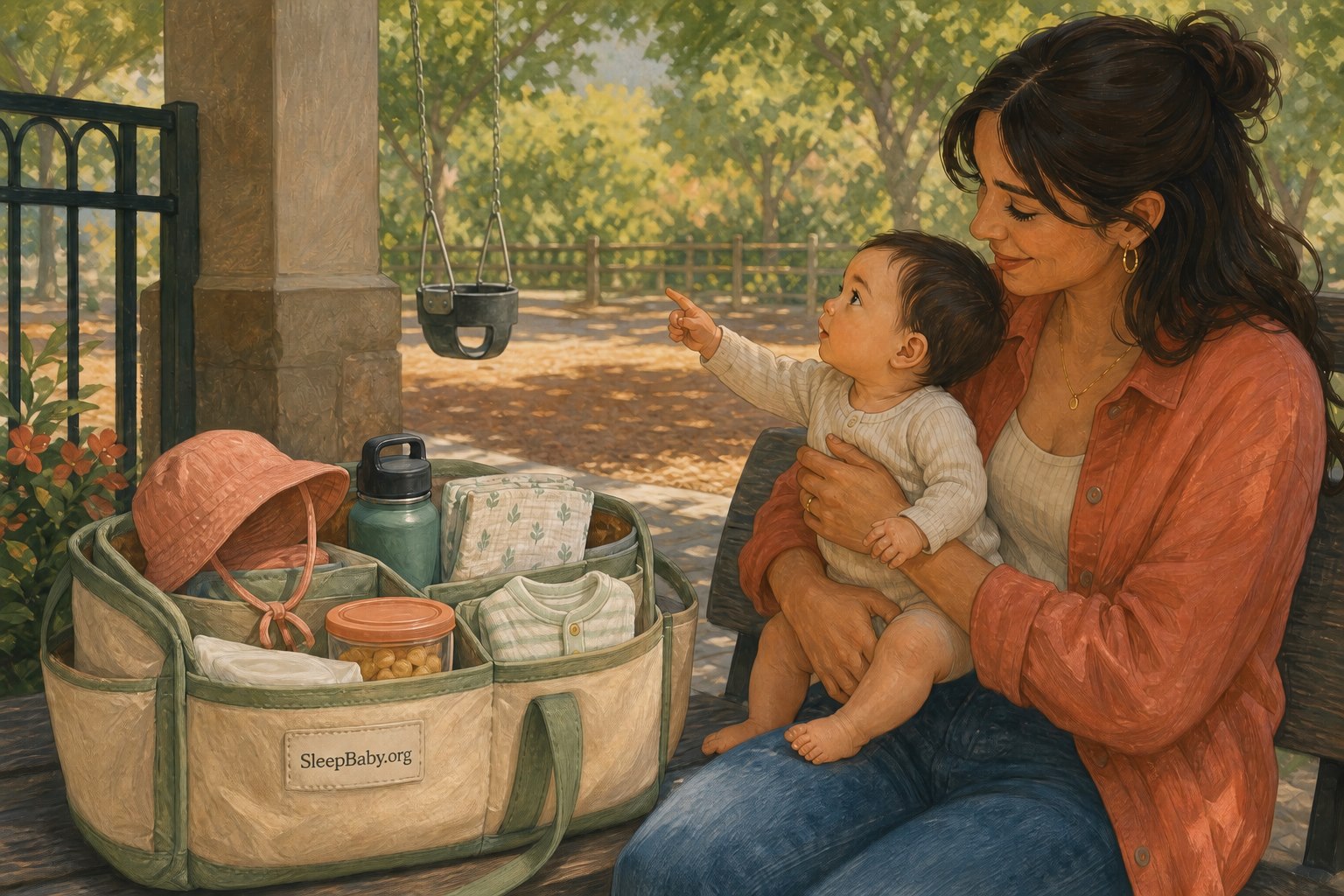
I had imagined Benjamin might touch the textured panel, perhaps test the bucket swing, and then look back at me with the glowing expression of a child whose mother had selected exactly the right enrichment opportunity.
He watched the chain. Then a leaf. Then another child squealed, and his eyebrows rose with the solemn attention of a tiny town official. We sat on the bench, used none of the supplies except the hat, and left before the outing became a negotiation.
The bag was overqualified. The visit was not a failure. It gave him a manageable piece of the world, and it gave me a better read on what he might enjoy next time.
Again, that story shows human experience. The safety and developmental guidance comes from the cited sources, not from one baby’s excellent leaf review.
What to pack for a baby’s playground visit
Protection before entertainment
The small bag that does the real work
Weather
A brimmed hat, light layers, shade plan, and weather-appropriate cover that does not trap heat or block airflow.
Feeding
Milk, formula, water, or snacks according to your baby’s normal age-appropriate plan – plus water for the caregiver who somehow remembers everyone else’s cup first.
Cleanup
Diapers, wipes, a small waste bag, and one change of clothing. Bring soap-and-water access into your plan when food is involved.
Ground play
One washable blanket and perhaps one large familiar toy. Avoid bringing necklaces, long cords, jump ropes, or anything that could be attached to equipment.
Do not drape a blanket over a stroller in a way that reduces airflow and traps heat. Do not attach a pet leash, toy cord, or carrier strap to playground equipment. Remove clothing drawstrings, necklaces, scarves, and helmets before a child uses play structures because they can catch.2
Sun, heat, and hot equipment
Infants depend on adults to keep them cool and hydrated. Choose cooler parts of the day, use shade, dress the baby in loose lightweight clothing, and do not leave a child in a parked car – even briefly.3 If the playground has no usable shade or the equipment is hot, the correct activity is a different place.
CDC sun guidance uses layers of protection: shade, protective clothing, a hat, and sunscreen when appropriate.4 For babies younger than 6 months, FDA guidance emphasizes keeping them out of direct sunlight, using protective clothing and shade, and asking the baby’s pediatrician before applying sunscreen.5
Touch the slide, swing seat, rails, and dark rubber surfaces with your hand. Test more than one spot; a seat can be cool in shade and hot where the sun crosses it. If it is too hot for your hand, it is too hot for bare legs.
Leave and cool the baby if you notice unusual fussiness, flushed or hot skin, weakness, vomiting, poor feeding, or behavior that feels wrong. Seek prompt medical care for signs of heat illness; call emergency services for severe symptoms such as confusion, loss of consciousness, seizure, or inability to respond normally.3

Mulch, sand, gravel, and those very fast hands
A baby will try to mouth the environment. This is not a character flaw. It is also not a reason to let wood chips become a tasting flight.
Stay within reach during ground play, choose an area with the least debris, and redirect calmly. If something reaches the mouth, remove loose pieces you can see without blindly sweeping deep into the mouth. Our guide to what to do when a baby eats gravel covers choking, swallowed objects, and when to call for help.
Wash hands with soap and water before eating and after diapering when facilities are available. CDC recommends adult hand sanitizer with at least 60% alcohol when soap and water are not available, but keep it out of children’s reach and supervise its use.7 For a baby’s hands, soap and water are the cleanest plan before fingers return to the mouth; use an age-appropriate wipe when needed until you can wash.
When you are supervising a baby and an older sibling
This is where a lovely theory meets two children moving in opposite directions. Choose the playground zone for the child who needs the closest physical supervision, not the most exciting equipment. Park the stroller where it does not block a route or create a tip hazard, keep the baby with you, and set one visible boundary for the older child before play begins.
If the older child’s chosen structure would take you out of reach of the baby, or the baby needs a feed or diaper change that would take your eyes off the older child, pause play. Bring another adult, use a fenced smaller playground, choose a quieter time, or save that structure for a different outing. “I can probably watch both from here” is not a supervision system.
A baby carrier may make simple watching easier when used according to its instructions and the baby’s airway remains visible and clear. Take the baby out before you climb, slide, or enter moving-equipment zones. The carrier keeps the baby close; it does not turn adult playground use into infant-safe play.
After a fall or head bump: when to get help
Even close adults cannot prevent every stumble. Stay calm enough to look at what happened: the height, surface, body part that hit, whether the child lost consciousness, and how the child acts afterward.
Call emergency services after a head impact if your child has a seizure, loses consciousness, is difficult to wake, has unequal pupils, has repeated vomiting, behaves very unusually, or has fluid or blood from the nose or ears. For an infant, inability to console or refusal to feed after the injury also needs urgent medical evaluation.6
Call the child’s clinician for guidance if you are unsure, symptoms are changing, or the fall was significant. Do not use this article to rule out an injury. The point of a calm first visit is not to create confidence theater; it is to make safer choices and respond quickly when something is wrong.
Leave while one good thing is still the headline
A baby does not need to “get their money’s worth” from a free public swing. If the baby turns away repeatedly, stiffens, rubs the face, becomes harder to settle, feeds poorly, or seems too hot, end the visit. If you are spending the whole outing preventing older children from colliding with your blanket, change zones or leave.
You can loosely place the outing between a feed and the next rest without letting a wake-window timer run the park. If planning the timing is making the trip feel impossible, our wake-window anxiety guide offers a calmer way to use ranges and real-time signals.
The first visit does not have to end with a bucket-swing photograph. It can end with a yawn, a clean pair of hands, and the private satisfaction of leaving before anybody becomes a siren.

Taking a baby to the playground: quick questions
Can I take a newborn to a playground with an older sibling?
Often, yes, as an outing rather than equipment play. Keep the newborn shaded and temperature-comfortable, meet feeding needs, avoid placing the baby in equipment, and follow any medical guidance specific to prematurity, illness, or recovery. Choose a position where you can supervise the older child without leaving the baby unattended.
What age can a baby use a bucket swing?
Do not use one birthday as a universal rule. Wait for strong, steady head and trunk control, secure fit, and posted age or size guidance that includes your child. Stay within reach and begin with very small movement. If the baby slumps or the seat does not fit, stop.
Can I go down the slide with my baby on my lap?
No. A child’s foot can catch against the slide while the adult’s weight continues forward, causing a leg injury. Wait until the child can use a low age-appropriate slide feet first with close supervision.2
How long should the first playground visit be?
Long enough for one calm experience, not long enough to prove endurance. Ten to twenty minutes may be plenty for a young baby. Weather, feeding, the baby’s signals, and the caregiver’s capacity matter more than a target duration.
Does a non-walking baby need shoes?
Not for development. Use socks, soft booties, or flexible footwear only for warmth and surface protection as needed. A non-walking baby should not be placed barefoot on hot, sharp, or dirty equipment to make the outing look more authentic.
What if the playground is crowded?
Watching from the edge may be the whole visit. Avoid placing a blanket in a running route, swing path, or slide exit. If you cannot stay within reach without blocking other children or losing sight of siblings, choose a quieter zone or return another time.
One small piece of the world is enough
Your baby does not need a playground performance. They need an adult who notices the heat of the slide, the depth of the surface, the fit of the seat, the traffic around them, and the moment curiosity tips into fatigue.
Start with the landscape. Let the leaves, chains, voices, and movement be new. Add one activity when the child’s body is ready. Stay close. Skip the lap slide. Leave on a good note.
The playground will still be there when your baby can climb. Today, watching the light move may be the whole adventure.
Your calmer next step
Plan one fifteen-minute first visit
Choose a mild-weather window, identify shade before you go, and promise yourself only this: scan the four S’s, let your baby watch, try one appropriate thing, and leave while the visit still feels kind.
Sources
- American Academy of Pediatrics: The Power of Play – early play, caregiver interaction, outdoor sensory exploration, and development.
- American Academy of Pediatrics: Safety on the Playground – supervision, surfacing, equipment fit, slides, swings, heat, and entanglement hazards.
- CDC: Heat and Infants and Children – cooling, hydration, parked-car danger, heat-illness signs, and urgent response.
- CDC: Sun Safety – shade, clothing, hats, sunscreen, and layered UV protection.
- FDA: Should You Put Sunscreen on Infants? – shade, protective clothing, direct-sun avoidance, and clinician guidance for babies younger than 6 months.
- American Academy of Pediatrics: Concussions in Babies – head-injury warning signs and emergency-care boundaries.
- CDC: About Hand Hygiene – soap-and-water priorities and supervised adult sanitizer use when a sink is unavailable.
- U.S. Consumer Product Safety Commission: Public Playground Safety Handbook – current public-playground equipment, use-zone, surfacing, and maintenance guidance.
The SleepBaby.org Workshop
Make a plan for
the next bedtime.
Practical help for wake-ups, short naps, and sharing the night shift. Watch the original video, then get 15 guides and five audio tracks for $9.
$9 USD, paid once. No subscription. Digital access.
Watch the original Baby Sleep Miracle presentation
Press play for a little help with your baby’s next bedtime.
Original presentation. Watch before you decide.
15practical guides
5audio tracks
1one-time payment
Kind words about the original video
“Thank you so much for this video!”
“I'm truly impressed with how much information you share in your video.”
Inside the Workshop
Start with the night
you're having.
You don't need to read all 15 guides before bedtime. Choose the one that answers the question in front of you, then come back for the next part.
Before you buy
A few things
made clear.
A straightforward purchase, with space to decide what fits your family.
What am I buying?
The SleepBaby.org Workshop includes 15 digital guides, five audio tracks, and the original Baby Sleep Workshop PDF as an additional download. It costs $9 USD, paid once, with no subscription. Nothing is shipped.
Where should I start?
Try Tonight Rescue when you need a starting point. If your question is more specific, go straight to the guide on naps, a caregiver handoff, the sleep space, or another topic. You can read at your own pace.
Is this personal sleep coaching?
No. This is an educational collection for parents of babies and young children. Use the age-specific guidance, and bring feeding, breathing, growth, illness, or other health concerns to your child's clinician. It does not diagnose a problem or promise a sleep result.
Is the video the paid Workshop?
You can watch the original Baby Sleep Miracle presentation on this page. Your purchase is the SleepBaby.org Workshop collection of guides, audio tracks, and the original PDF described here.
How do I find it after checkout?
On your thank-you or order-status page, look for Open Workshop access, then Open your SleepBaby Workshop. Keep your order confirmation so you can return. If you need help finding your access, use our Workshop download help.
The SleepBaby.org Workshop
Have somewhere to start
at the next bedtime.
15 practical guides. Five audio tracks. One $9 purchase.


A quiet parent-to-parent note
What would you add about Parenting & Family?
Share one useful detail, question, or experience. No account is needed. Please leave out names, medical records, and other private details.
There is room for the first useful note.
If you have a thoughtful question or detail about Parenting & Family, you can begin the conversation below.