
Before you touch the double gate
You may be allowed to bring a baby to a dog park, but permission is only the first check
Check the exact park’s child and stroller rules, watch from outside before entering, keep your baby off the dog-park ground and away from unfamiliar dogs, and leave as soon as your attention has to split. If possible, use two adults: one handles the dog and one stays responsible for the baby. A perimeter walk, a bench outside the fence, or skipping the off-leash area can be the better outing even when babies are technically permitted.
The household at bedtime
Different people.
One household at night.
If you’re also caring for a baby and want help with sleep, our video is below. Watch when that’s the question you want to work on.
Prefer to read?Press play for a little help with your baby’s next bedtime.
Kind words about the original video
“Thank you so much for this video!”
“I'm truly impressed with how much information you share in your video.”
The SleepBaby Workshop
Get the Workshop.
Get the Workshop and explore its resources for everyday baby sleep and nighttime care. 15 guides and five audio tracks in a simple browser hub. Read, listen, and return to the part you need.
A conversation, if you want one.Night Owls is the SleepBaby chat room. Read what is there or join in.
I do not treat “allowed” and “a setup I would choose” as the same answer. A posted sign can tell you whether a baby may enter. It cannot promise that the three dogs pressed against the gate will suddenly develop excellent boundaries because your stroller has arrived.
The question beneath this search is usually not just, “Can I go?” It is, “Can I exercise my dog, care for my baby, and keep both of them out of trouble with the same pair of hands?” Sometimes yes. Sometimes only with another adult. And sometimes the honest answer is that the fenced dog run is doing exactly what it was built to do—giving loose dogs room to be loose dogs—which makes the outside of the fence the sensible place for the baby.
Here is the line I would keep: a baby never becomes part of the dog-park social experiment. Do not invite greetings, place the baby on the ground, let dogs investigate the stroller, or rely on “he’s friendly.” The CDC notes that any dog can bite, particularly when scared, nervous, eating, playing, or protecting something, and that young children are more likely than adults to be bitten and can have more severe injuries.1 A baby cannot read a dog’s warning or follow instructions about how to approach. The adults have to provide the distance.
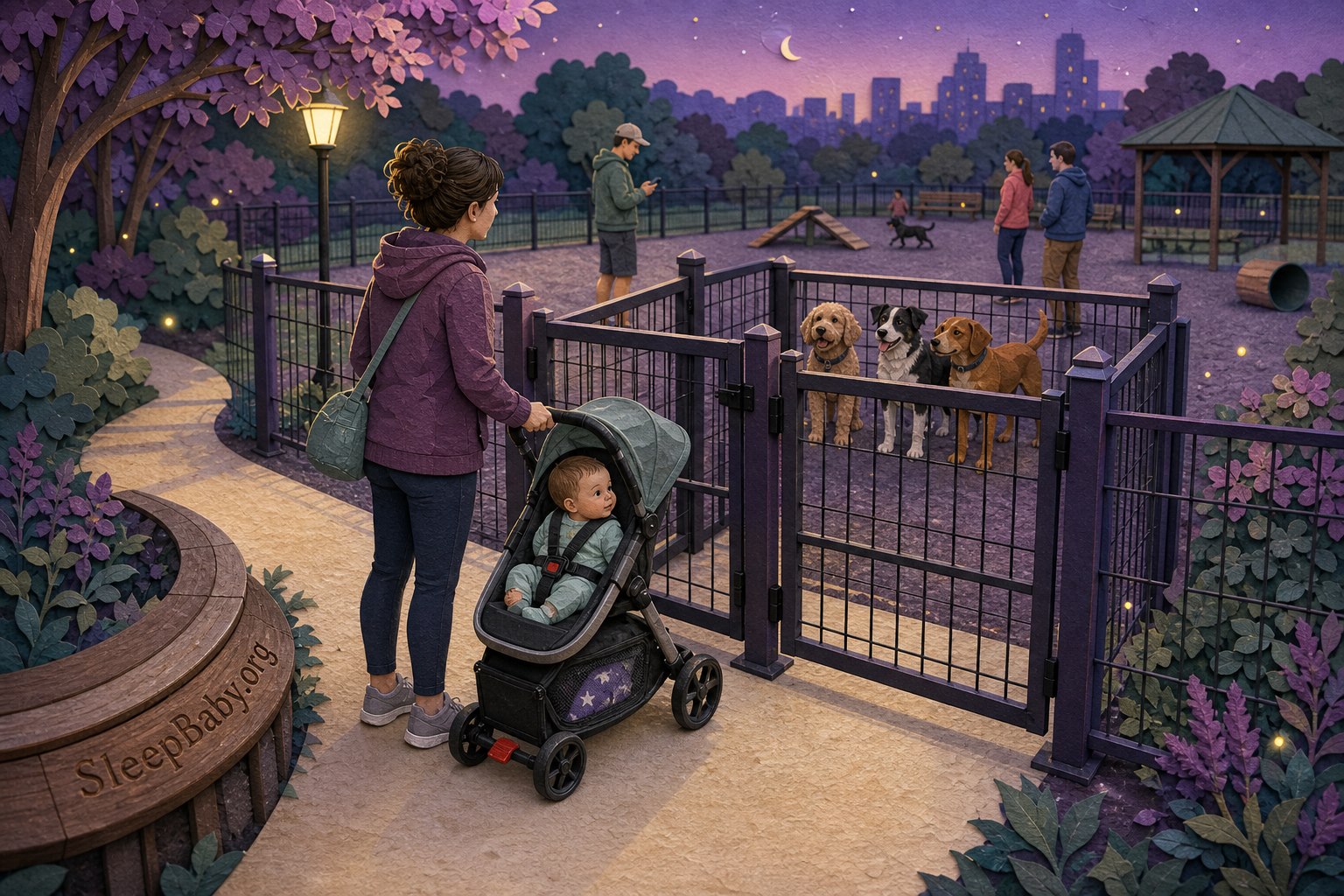
Check the park before you make the baby part of the plan
Dog parks are local facilities, not one national system. The rules may address children, strollers, food, toys, vaccination, licensing, membership, dog size, hours, and who may use each enclosure. Read the park or municipal page, then read the sign at the entrance. If the two disagree, use the stricter instruction and contact the parks department before another visit.
Do one reconnaissance visit without the baby when you can. The American Kennel Club recommends scouting a dog park before bringing the dog and looking at fencing, double-gate entry, separate size areas, cleanliness, crowding, and whether owners are actually watching their dogs.3 That advice becomes more important when an infant is coming too. You are not only asking whether your dog will enjoy the park. You are asking whether you can keep a protected baby zone while loose dogs, swinging leashes, opening gates, bowls, mud, and excited people move around it.
Stand outside for five minutes. Watch the entrance, not just the middle. Do dogs rush every arrival? Do owners call them back? Is the airlock really an airlock, with one gate closed before the other opens? Is there a clear perimeter where you could stay without becoming the obstacle everyone circles? Is the ground clean enough that you would feel comfortable setting the diaper bag down—and then remember that the better answer is not to set the diaper bag down?
Three honest versions of the outing
Choose where the baby belongs before the gate opens
ENTER BRIEFLY
Consider this only when the posted rules permit it, the park is quiet, the gates and fencing are sound, your dog is a good fit, the baby has one secure adult-controlled base, and a second adult owns one of the two jobs.
STAY OUTSIDE
One adult can remain with the baby on a perimeter path or bench while the other exercises the dog. You keep the outing, the fresh air, and the easy handoff without putting the baby inside off-leash traffic.
SKIP TODAY
Leave when dogs crowd the gate, owners are distracted, waste or standing water is everywhere, weather is uncomfortable, your dog is overstimulated, the baby needs hands-on care, or you cannot describe exactly who is responsible for whom.
Why this matters tonight: leaving before the outing becomes chaotic protects the feeding, nap, and bedtime decisions you still have to make at home.
The outside option is not a consolation prize. It is often the cleanest design. One adult gets focused dog time. One adult gets focused baby time. Nobody has to pretend a stroller is a force field.
One adult can carry two bags; one adult cannot watch in two directions at once
Dog parks reward attention. The AKC tells owners to stay present, watch dog body language, notice rough play, and intervene or leave when the interaction is wrong for the dog.3 Babies also require present attention. A carrier strap shifts. A bottle comes out. A diaper becomes urgent. A stroller brake needs to stay set. None of those jobs pauses the loose dogs around you.
This is the part I would not negotiate with myself: if I am the only adult, the baby is the primary job. That means my dog remains leashed outside the off-leash area, we take a perimeter walk, or we choose a different exercise plan. I cannot be fully available to recall my dog from a tense interaction while also using my body to keep an unfamiliar dog away from Benjamin. Owning an impressively compartmentalized diaper bag does not produce a second nervous system.
Assign the jobs out loud
Who handles the dog, the baby, and the exit?
Mobile note: this comparison scrolls sideways inside its own clearly bounded region when needed; vertical page scrolling remains free.
| Setup | Dog job | Baby job | Best exit |
|---|---|---|---|
| One adult | Keep the dog leashed and choose the perimeter or another walk. | Baby remains the adult’s primary attention. | Turn around before opening the off-leash gate. |
| Two adults | One adult watches and handles the dog without also managing baby gear. | One adult controls distance, feeding, shade, and stroller or carrier. | The baby adult leaves immediately; the dog adult follows. |
| Meet a friend | Agree who owns each dog and whether anyone can reliably take over. | Do not assume the friend became the baby barrier without asking. | Use one plain phrase: “We are leaving now.” Debrief later. |

Say the assignment before you leave the car. “You have the dog. I have the baby. If either of us says out, we go.” That sentence is more useful than a complicated choreography improvised while three dogs are sniffing the gate.
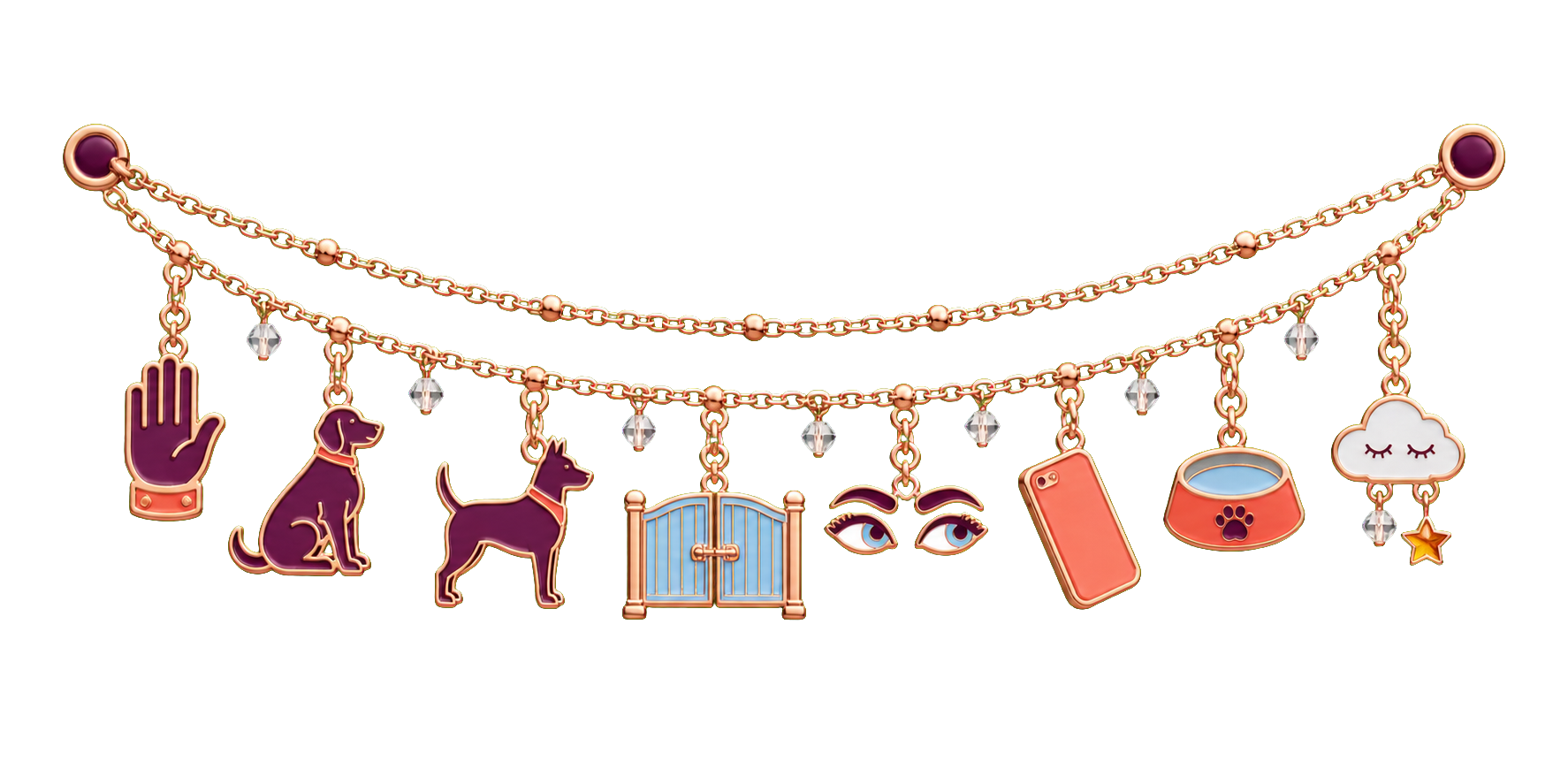
Pause outside the gate and let the first minute make the decision
The entrance is often the highest-energy part of a dog park. Dogs may gather because arrivals are interesting. Leashes tighten. People reach for latches. An excited dog can move toward wheels, dangling straps, food smells, or the new person without intending harm. Intent does not change the physics.
- Stop before the airlock. Set the stroller brake or stabilize the carrier. Put away the phone. Confirm which adult opens the gate and which adult controls the baby’s distance.
- Watch the dogs nearest the entrance. Wait if they are crowding, jumping, fixating, barking at arrivals, or ignoring their owners. You do not need to label the behavior; you need room.
- Check the human attention. Owners should be watching, moving toward their dogs when needed, and making space for an arrival. A row of people looking at phones is information.
- Locate the clean exit path. The baby adult should be able to leave without crossing the center of play, stepping around waste, or waiting for the dog adult to collect every item.
- Decide once. Enter, stay outside, or leave. Do not stand half through the gate while reconsidering; that is the least useful place to hold a baby plan.
If a cluster of dogs does not disperse, wait or go. The AKC specifically advises waiting for dogs to move away from the entrance rather than bringing a dog into a rush.3 With a baby present, I would make that boundary even simpler: no clear lane, no entry.
Carrier or stroller? Neither one makes a dog greeting safe
A correctly fitted carrier can keep the baby close and remove wheels that may attract attention. It also places the baby on your body, which means a jumping dog can reach you, and it can make it harder to pivot quickly without affecting the baby’s position. Keep the baby’s face visible, protect the airway, monitor heat, and do not bend toward unfamiliar dogs.
A stroller creates a stable base when the brake is set and the harness is used. It also has moving wheels, baskets, straps, snack smells, and a low baby position. Dogs may investigate it. Do not let a dog put its face into the stroller, lick the baby, jump on the frame, tug a hanging toy, or urinate on a wheel. Back away early instead of testing how polite the dog intends to be.
Do not park the stroller against the fence and walk away with your dog. Do not hang so much gear from the handle that the stroller can tip. Do not cover the stroller in a way that prevents you from seeing the baby or monitoring comfort. And do not place a portable blanket, play mat, car seat, or baby on the dog-park ground. Loose dogs, waste, saliva, shared water, paws, and unpredictable movement make that a poor baby surface even on a quiet day.
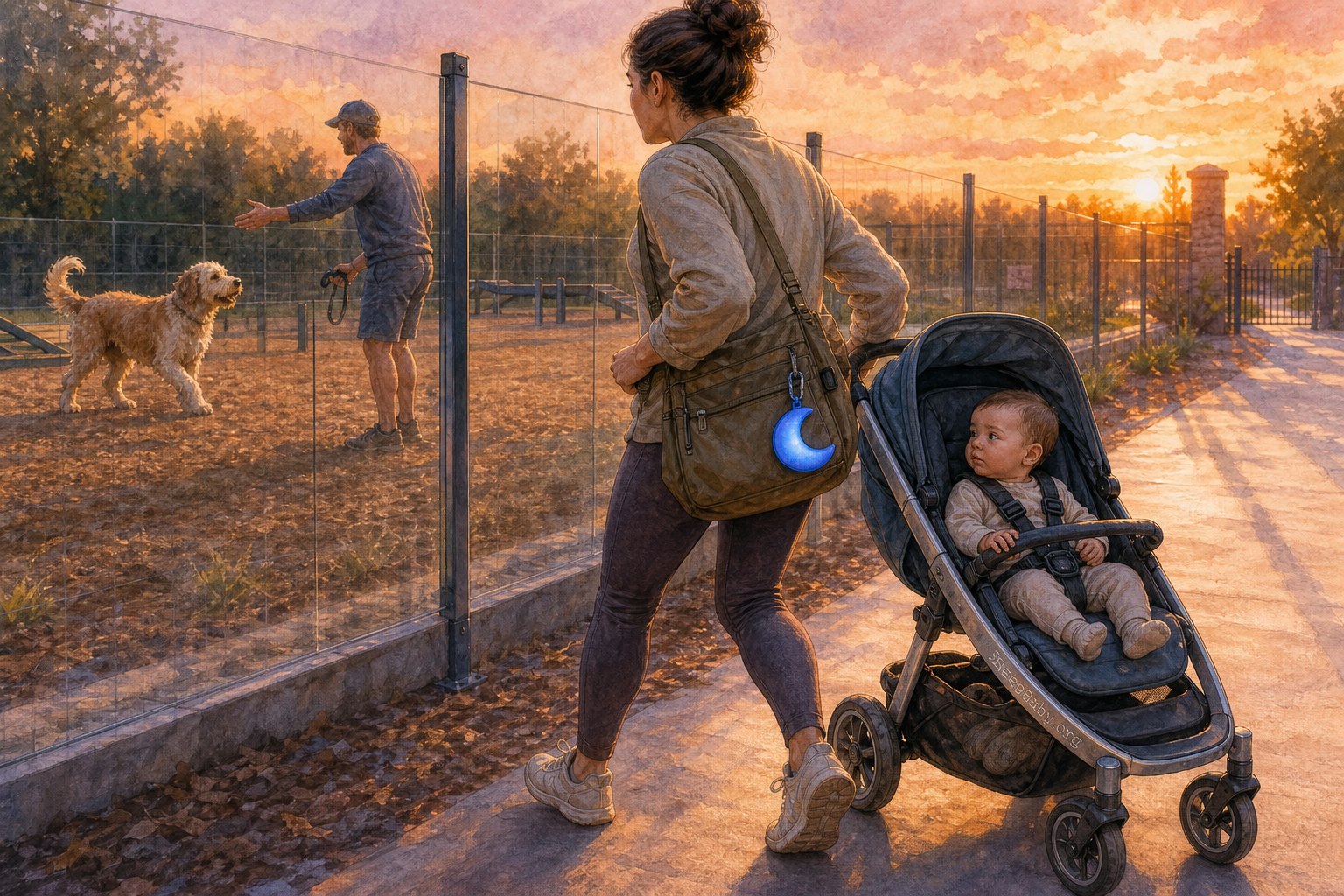
The strongest position is usually boring: baby beside the responsible adult, exit within a few steps, no dog greeting, no food open, no straps dangling, and no hope that everybody will become calmer after another ten minutes.
You do not have to decode every dog; you only have to notice when the margin is gone
Dog body language is contextual, and this Article cannot teach you to diagnose a dog from one tail, ear, or bark. A wag is not a safety certificate. A familiar breed label is not one either. Use visible changes as reasons to create distance and leave, not as an invitation to keep testing.
- Dogs crowd or rush the entrance
- Wait outside. If owners cannot create space, use the perimeter or leave.
- A dog repeatedly fixes on the stroller, carrier, food, or baby
- Turn sideways, create distance, and exit. Do not offer the dog a closer look.
- Play becomes relentless, stiff, noisy, or hard to interrupt
- The dog handler collects the dog; the baby adult is already moving out.
- Your own dog stops responding or camps beside you
- Respect the information. Dog parks are optional, and a walk is still exercise.
- The baby needs feeding, changing, cooling, repositioning, or soothing
- Leave the enclosure. Baby care is not a side task performed while loose dogs investigate the gear.
Leave before the cue becomes an incident
Sleep connection: a calm early exit is easier to recover from than an overstimulated outing that runs through the next feed and into bedtime.
Do not run from an unfamiliar dog or put your hands into a dog fight. The CDC advises staying calm around an unfamiliar dog and avoiding attempts to break up fights.1 If there is conflict, the baby adult moves away and calls for help; the baby is not carried toward the dogs so another adult can “just grab a collar.”
Pack for separation, not for a long stay
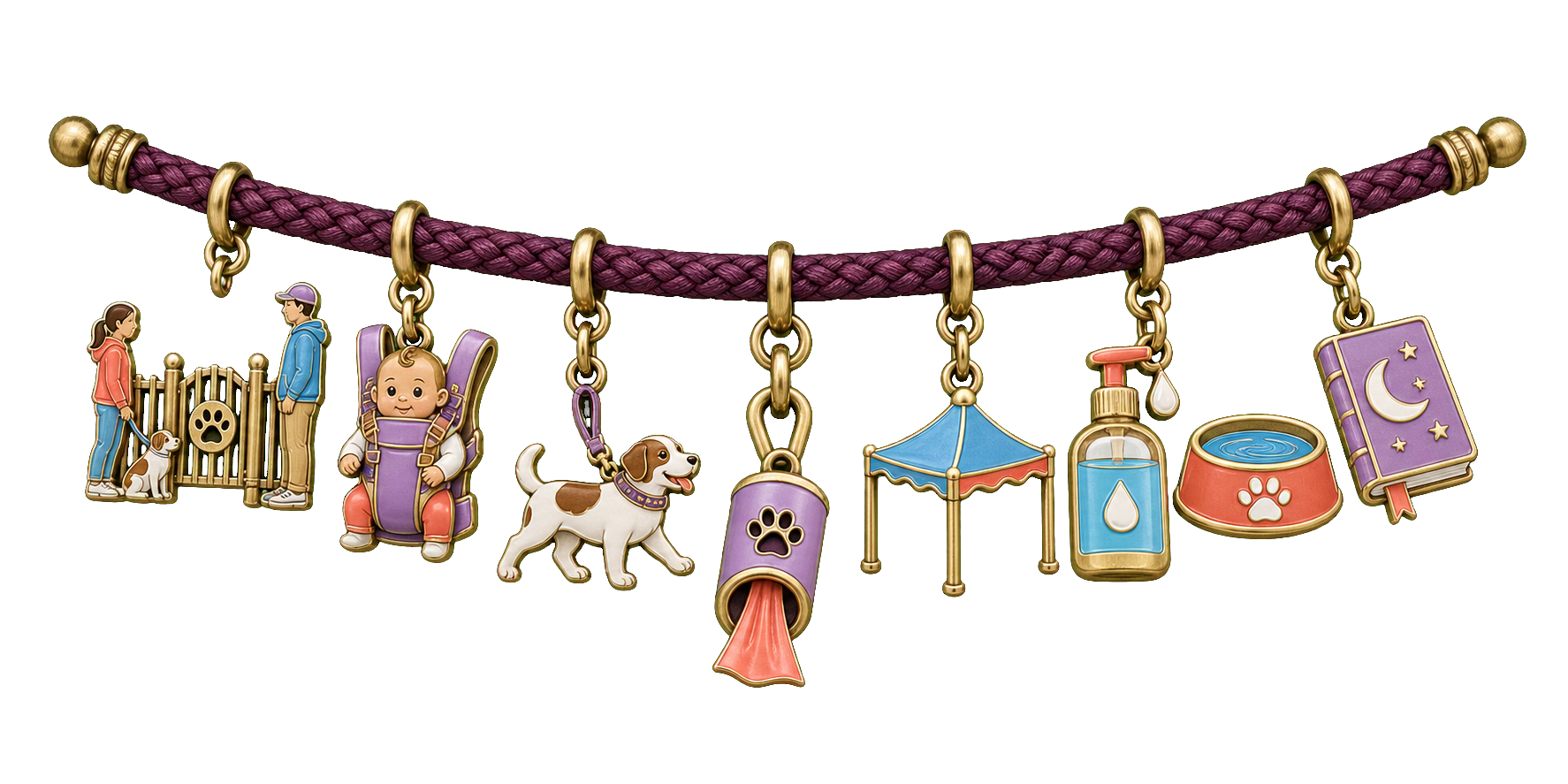
The useful dog-park bag has two clean zones. Dog supplies live together: leash, waste bags, dog water, personal bowl, and whatever the posted rules permit. Baby supplies stay closed and separate: diapers, wipes, changing mat, feeding supplies, clean cloth, spare clothing, sun protection, and any routine medical item.
Do not use a communal dog bowl for anything involving the baby. Do not put a bottle or pacifier on the bench where leashes, paws, and waste bags have been. Do not let the baby mouth a dog toy, leash, bowl, gate, fence, or wood chip. The CDC recommends handwashing after handling dogs, saliva, waste, food, toys, bowls, or supplies and before eating or drinking; sanitizer with at least 60% alcohol can be used when soap and water are not readily available.1
Sanitizer remains adult-controlled and away from the baby’s hands and mouth. Use it as a bridge to proper handwashing, not as permission to feed the baby with one hand while the other is still holding a used waste bag. I appreciate an efficient outing. I do not need it to become a live demonstration of why diaper-bag compartments were invented.
Small bag, clean lanes
What earns space in the bag
FOR THE DOG
- Secure leash and identification
- Waste bags in a closed pocket
- Fresh water and a personal dog bowl
- Only park-permitted items
FOR THE BABY
- Diapers, wipes, and a compact changing mat
- Closed feeding supplies and a clean cloth
- Shade, hat, and weather-appropriate clothing
- One spare outfit and routine essentials
KEEP OUT
- Open human food inside the dog run
- Long dangling toys or straps
- Loose blankets on the dog-park ground
- Anything that makes the exit take two trips
Shade and temperature can end the outing before the dogs do
Dog parks are often open fields with limited shade. The American Academy of Pediatrics advises keeping babies younger than six months out of direct sunlight, using shade and protective clothing, and limiting exposure during the strongest UV hours.2 Check the real shade at the time you plan to visit; a tree that protects the bench at 8 a.m. may have moved its useful shadow by late afternoon.
Watch the baby, not just the weather app. Leave for unusual sleepiness, poor feeding, vomiting, breathing trouble, a temperature concern, or behavior that makes you think the baby is unwell, and get appropriate medical advice. A dog park is not the place to see whether an infant “pushes through” discomfort.
Your dog has weather limits too. Hot ground, lack of water, crowding, illness, and fatigue can change the visit. If either dependent is done, everybody is done. This is not a family referendum.

Watch: why adults have to control the approach
This brief American Veterinary Medical Association video features AVMA President Dr. Lori Teller and President-Elect Dr. Rena Carlson discussing why children need guidance about how—or whether—to approach a dog. A baby cannot use those rules independently, which is why distance and adult supervision do the work at a dog park.
Watch Dog Bite Prevention Week 2023 — Educating children on YouTube if the embedded player is unavailable or not useful with your assistive technology.
Written takeaway: do not treat an unfamiliar dog’s approach as a lesson the baby needs. The adult asks the owner for space, moves the baby away, and ends the interaction before hands, paws, mouths, wheels, or food share the same small area.
If a dog bites or scratches, leave the park and switch from outing mode to care mode
Separate the baby from the dog and get to a safe place. Do not chase the dog through the park while holding the baby. Ask another adult to obtain the owner’s contact information and the dog’s rabies-vaccination information when that can be done safely. Report the incident to the appropriate local animal-control or police agency, particularly when vaccination status is unknown or the dog is acting strangely; CDC guidance explains why those details matter.1
For a minor bite or scratch, the CDC advises washing the wound thoroughly with soap and water and covering it with a clean bandage. Seek medical care promptly for a deep or serious wound, uncontrolled bleeding, severe pain, loss of function, infection signs such as redness, swelling, pain or fever, unknown rabies vaccination, or other concerns. Call emergency services if bleeding will not stop or the person feels faint or weak.1
Tell the clinician it was a dog bite or scratch. The clinician and public-health authorities can assess tetanus and rabies questions based on the wound, animal, vaccination information, and local risk. Do not wait for the wound to “look dramatic” before asking about an infant. Do not use the dog owner’s reassurance as medical clearance.
Even without broken skin, end the outing after a frightening collision, knockdown, or dog-on-stroller incident. Check the baby, contact the baby’s clinician when there is any concern about impact or behavior, and document the facts while they are fresh. Nobody needs to return through the gate to prove the family is not overreacting.
The dog can have a good day without an off-leash park
Dog parks are optional. The AKC notes that many owners choose other forms of exercise and socialization, including walks, training, dog sports, and planned play with known dogs.3 When a baby changes the attention equation, alternatives are not lesser care. They may be better care for this season.
Try a perimeter walk while the baby is secured and one adult can manage the dog, a two-adult handoff where one person uses the park and the other walks with the baby, a quiet sniff walk, a training session, or a planned meeting with one known compatible dog in a controlled place. If the point is fresh air and a change of scenery, our guide to taking a baby to a parade has a fuller outdoor-crowd and exit plan. Use the crowd principles; skip the noise.
If the real problem is solo logistics, taking a baby to the laundromat shows how one controlled base and one exit path can keep a moving-hazard outing manageable. And the permission-check thinking in taking a baby to vote applies here: verify the exact location instead of building the whole plan around somebody else’s experience.
There is no prize for combining every family responsibility into one outing. Sometimes the smartest schedule is dog first, baby second, and coffee whenever the household committee permits it.
If the outing rearranges the nap, keep the evening familiar
A short car or stroller nap may happen. A feeding may land later. The dog may return home gloriously tired while the baby seems to have collected every sound, face, and moving tail for future review. Do not turn one unusual outing into five simultaneous schedule changes.
Car seats, strollers, and other sitting devices are not recommended as a baby’s regular sleep or nap space. Safe to Sleep advises moving a baby who falls asleep in a sitting or carrying device to the regular sleep space as soon as possible; that space should be firm, flat, level, and covered only by a fitted sheet.5
Once home, wash hands, change any dirty clothing, put dog supplies away from feeding gear, and lower the sensory volume. Offer the usual feed according to the baby’s needs. Use the familiar bedtime sequence without trying to compensate for the outing with extra wake time, an unusually early bedtime chosen in panic, or a brand-new settling strategy.
If a ten-minute stroller doze has you preparing a full spreadsheet, our guide to wake-window anxiety can help. I would treat the nap as one piece of information, watch how the baby is doing, and make the smallest reasonable adjustment. The park has already had enough excitement. It does not need to redesign the night.
Taking a baby to a dog park: practical questions
Can I take a newborn to a dog park?
Start with the exact park rule and your baby’s medical context, then choose a conservative outdoor plan. A newborn’s temperature regulation, feeding, prematurity, health, and tolerance for crowds may make a quiet perimeter walk more appropriate than entering an off-leash enclosure. Ask the baby’s clinician when health circumstances change what outings are reasonable. Keep babies younger than six months out of direct sun.2
Are strollers safe inside a dog park?
A stroller can keep the baby contained, but it does not prevent a dog from jumping, sniffing, licking, urinating on a wheel, tugging a strap, or colliding with the frame. Some parks may restrict strollers or children. Check the posted rule, keep distance, set the brake, use the harness, remove dangling items, and leave at the first unwanted dog interest. Staying outside the fence is usually the easier stroller plan.
Is a baby carrier better than a stroller at a dog park?
A correctly used carrier removes wheels and keeps the baby close, but it places the baby on the adult’s body where jumping dogs can still reach. It also makes that adult a poor choice for breaking up dog conflict or handling a difficult dog. Use the carrier only as intended, keep the face visible, monitor heat and position, and assign another adult to the dog.
Should I let a friendly dog lick or sniff my baby?
No dog-park greeting is necessary for the baby. Decline politely, create distance, and keep unfamiliar dogs away from the baby’s face, hands, feeding items, stroller, and carrier. “Friendly” describes an owner’s belief; it is not a guarantee about this exact interaction. Wash hands after dog or saliva contact and before feeding.1
Can I feed or change the baby at the dog park?
Leave the off-leash enclosure first. Use a clean appropriate place away from dog waste, bowls, toys, gates, and active dog traffic. Keep feeding supplies closed until needed, wash or sanitize adult hands, and do not place the baby or changing mat on dog-park ground. If the park has no clean private-enough option, go home or use another suitable facility.
How long should the visit be?
There is no baby-specific universal number. Keep it shorter than the first sign that the dog, baby, weather, or adult attention is deteriorating. The AKC notes that even a 30-minute dog-park visit may be plenty for a dog and recommends leaving when the dog is tired, overstimulated, or staying by the gate.3 With a baby present, five calm minutes and an easy exit can be a successful first visit.
The best dog-park plan is the one that makes leaving boring
You do not need a baby who loves dogs, a dog who loves every dog, or a stroller that can survive a small stampede. You need the exact rules, a quiet scan from outside, one adult per job when possible, clean separation between dog and baby supplies, and an exit that nobody debates.
If the gate is crowded, stay out. If a dog fixates, move. If the baby needs hands-on care, leave. If your own dog is done, believe the dog. These are not dramatic choices. That is the point.
The composite version I can see clearly is not a triumphant family photo inside the run. It is Benjamin secure beside me on the perimeter, our dog getting a short focused turn with another adult, and all of us leaving before somebody needs to prove anything. The dog gets movement. The baby gets distance. I get to arrive home with enough attention left for the next ordinary thing.
When the park plan has to fit the nap plan
Keep the outing from borrowing the whole night
A short dog-park visit can still shift the nap, feed, or evening rhythm. You do not need to rescue the schedule with a perfect bedtime. Leave before everyone is spent, use one quiet familiar reset at home, and let SleepBaby help you choose the next sleep cue instead of rebuilding the whole day around one unusual outing.
Sources
- CDC: Dogs — Healthy Pets, Healthy People — supervision, bites and scratches, germs, hand hygiene, first aid, escalation, and reporting.
- American Academy of Pediatrics: Sun Safety — shade, clothing, and sun protection for babies and children.
- American Kennel Club: Should You Take Your Dog to a Dog Park? — scouting, gates, crowding, owner attention, dog fit, and leaving.
- American Veterinary Medical Association: Educating Children About Dog Bites — why adults must guide how or whether a child approaches a dog.
- NICHD Safe to Sleep: Safe Sleep Environment — firm, flat, level sleep and moving a sleeping baby from a sitting or carrying device.
The SleepBaby.org Workshop
Make a plan for
the next bedtime.
Practical help for wake-ups, short naps, and sharing the night shift. Watch the original video, then get 15 guides and five audio tracks for $9.
$9 USD, paid once. No subscription. Digital access.
Watch the original Baby Sleep Miracle presentation
Press play for a little help with your baby’s next bedtime.
Original presentation. Watch before you decide.
15practical guides
5audio tracks
1one-time payment
Kind words about the original video
“Thank you so much for this video!”
“I'm truly impressed with how much information you share in your video.”
Inside the Workshop
Start with the night
you're having.
You don't need to read all 15 guides before bedtime. Choose the one that answers the question in front of you, then come back for the next part.
Before you buy
A few things
made clear.
A straightforward purchase, with space to decide what fits your family.
What am I buying?
The SleepBaby.org Workshop includes 15 digital guides, five audio tracks, and the original Baby Sleep Workshop PDF as an additional download. It costs $9 USD, paid once, with no subscription. Nothing is shipped.
Where should I start?
Try Tonight Rescue when you need a starting point. If your question is more specific, go straight to the guide on naps, a caregiver handoff, the sleep space, or another topic. You can read at your own pace.
Is this personal sleep coaching?
No. This is an educational collection for parents of babies and young children. Use the age-specific guidance, and bring feeding, breathing, growth, illness, or other health concerns to your child's clinician. It does not diagnose a problem or promise a sleep result.
Is the video the paid Workshop?
You can watch the original Baby Sleep Miracle presentation on this page. Your purchase is the SleepBaby.org Workshop collection of guides, audio tracks, and the original PDF described here.
How do I find it after checkout?
On your thank-you or order-status page, look for Open Workshop access, then Open your SleepBaby Workshop. Keep your order confirmation so you can return. If you need help finding your access, use our Workshop download help.
The SleepBaby.org Workshop
Have somewhere to start
at the next bedtime.
15 practical guides. Five audio tracks. One $9 purchase.

A quiet parent-to-parent note
What would you add about Parenting & Family?
Share one useful detail, question, or experience. No account is needed. Please leave out names, medical records, and other private details.
There is room for the first useful note.
If you have a thoughtful question or detail about Parenting & Family, you can begin the conversation below.