Quick answer
A baby can go to Comic-Con when the exit plan is stronger than the schedule
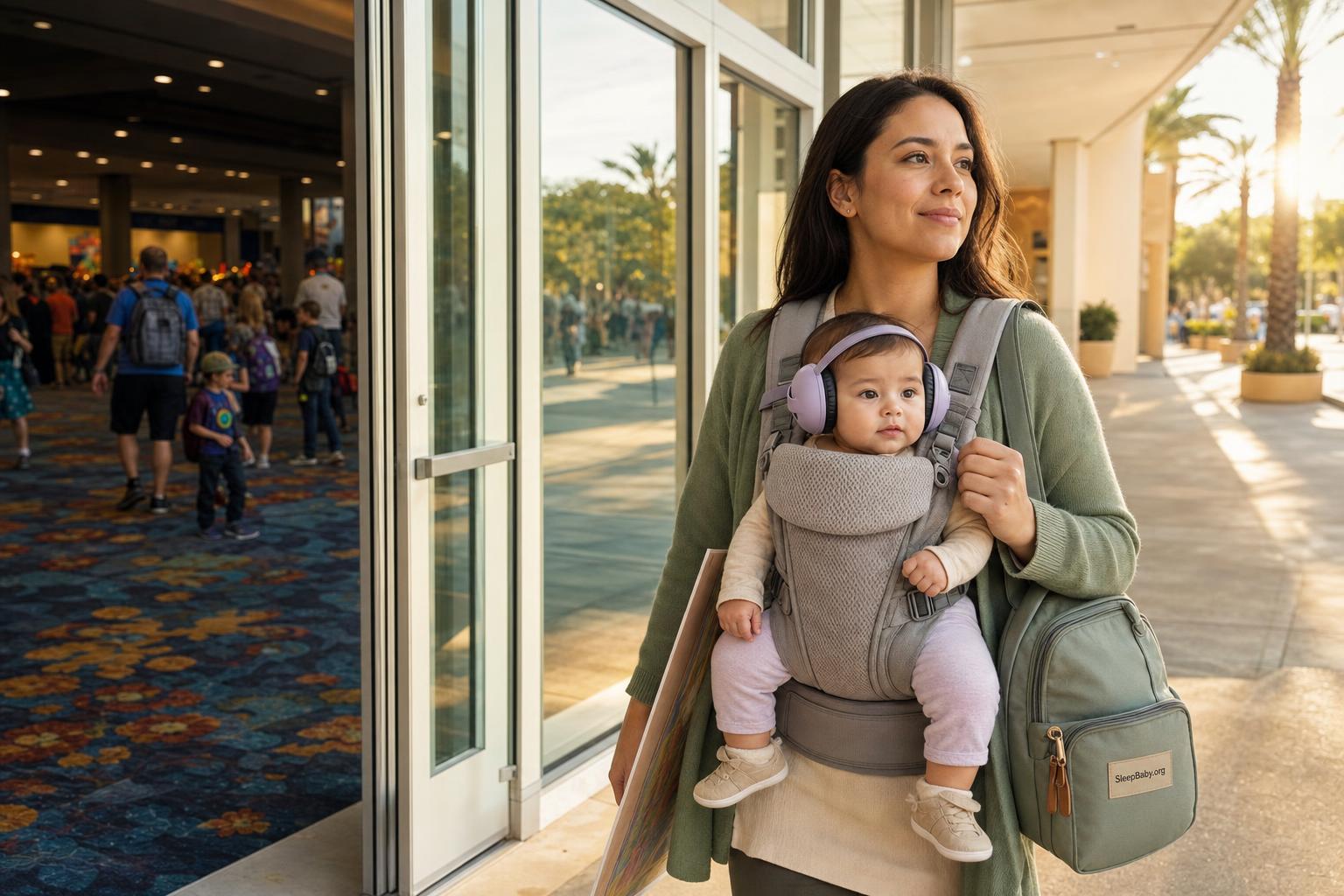
You can take a baby to Comic-Con when the exact event rules work for your stroller or carrier, you can protect hearing and temperature, feeding and diaper care are easy to reach, the route avoids the densest crowd flow, and you can leave immediately. Skip the visit if you cannot create distance from loud programming, the baby is unwell, heat or crowding cannot be controlled, or your only plan depends on getting through a long panel or packed exhibit loop. One quiet artist aisle and a tiny cape photo can be the whole successful day.
For Benjamin’s first comic convention, I pictured a small, charming montage: the two of us admiring handmade art, waving at a gentle costumed hero, and finding one tiny book that would someday become a meaningful family treasure.
Benjamin found a laminated badge swinging from my lanyard.
That badge was his convention. The elaborate costumes, glowing displays, and six-foot foam creature walking past us were merely background actors in a serious investigation of one plastic clip. I had packed enough supplies to cross a minor desert, but the thing I needed most was not in the bag. It was permission to make the day smaller.
That is a family scene, not evidence. The safety guidance in this article comes from the event’s current policies and the medical sources in the Sources section. But the scene gets one thing exactly right: babies do not experience a convention as a checklist. They experience sound, light, temperature, hunger, pressure, faces, and the arms holding them.
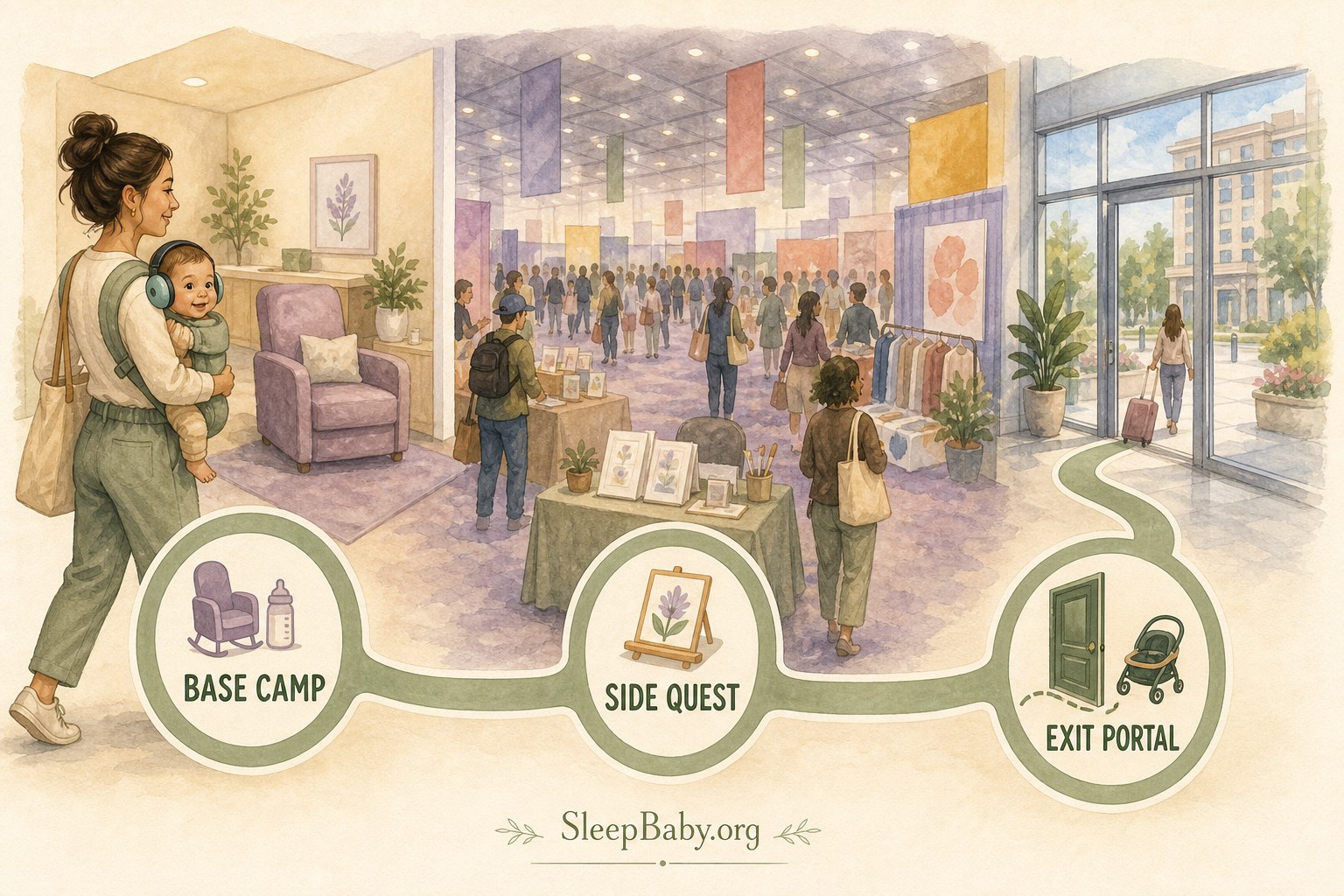
So do not plan the whole convention. Plan a Base Camp, one Side Quest, and an Exit Portal. Everything else is bonus content.

Should I take my baby to this comic convention?
There is no universal minimum age and no single version of Comic-Con. A local library convention with wide halls and a quiet family room is not the same environment as a sold-out weekend inside a huge convention center. Even within one event, the bright outer lobby, a crowded exhibit aisle, an amplified stage, and a dim panel room can feel like four different planets.
If you want a lower-stakes practice run first, our guide to taking a baby to the playground uses the same useful question: can the outing stay small enough to end while everyone is still comfortable?
Before you buy, travel, or promise a full day, run this six-condition check:
- Rules: Have you checked the exact event’s child-badge, stroller, bag, re-entry, prop, feeding, and room policies close to the date?
- Sound: Can you stay far from speakers and stage bursts, use correctly fitted infant hearing protection, and reach a genuinely quieter area quickly?
- Temperature: Can you avoid hot outdoor lines, overheated costumes, direct sun, and stuffy crowd pockets while keeping the baby’s face visible?
- Care: Do you know where you can feed, change a diaper, sit, wash hands, and move a sleeping baby to an appropriate sleep space?
- Flow: Can you move without wedging a stroller into packed aisles, standing beside swinging props, or depending on elevators with no time buffer?
- Exit: Can one adult say, “We are done,” and reach the car, hotel, or transit without crossing the busiest floor again?
If one answer is no, change the visit before arrival. Choose the first quiet hour. Attend only an outdoor family activation if weather is safe. Meet a friend in the lobby. Ask another adult to be your support person. Or skip this event and try a calmer one. Missing a convention is not depriving a baby of enrichment; babies are famously capable of finding enrichment in zipper pulls.
Read the venue rules before deciding stroller or carrier
At the time of this update, Comic-Con International’s San Diego policies prohibit oversized strollers in the Exhibit Hall and all strollers in programming rooms. The event offers unstaffed, first-come stroller parking and does not allow people to sit in Exhibit Hall aisles.1 Its 2026 child-badge policy says children age 12 and under may attend free with a paying adult, up to two children per paid adult, but the child must be present for on-site registration and the adult must provide emergency contact information.2
Those details are useful examples, not rules for every convention. Events change policies, and fire-marshal restrictions can differ by room. Save the current policy page to your phone and ask specific questions:
- Is my stroller size allowed in the exhibit hall, panel rooms, elevators, and special attractions?
- If stroller parking exists, is it supervised? What must I remove before leaving the stroller?
- Are there lactation rooms, family restrooms, changing stations, quiet rooms, first aid, or accessibility desks?
- Can I bring prepared formula, breast milk, water, ice packs, medications, and the bag size I actually need?
- Can I leave and re-enter? Must I tap a badge out or use a particular door?
- Where are costume-prop inspections, and are oversized costumes restricted during heavy crowding?
Do not treat an unstaffed stroller-parking area like a coat check. Take valuables, medications, feeding supplies, hearing protection, and anything needed for the exit. A folding carrier can be a useful backup only if it fits the baby correctly and you can use it safely; it is not a policy loophole or an airway compromise with shoulder straps.
SleepBaby convention floor plan
Base Camp. Side Quest. Exit Portal.
BASE CAMP
Mark one legal, low-traffic place for feeding, changing, cooling down, checking the carrier, and hearing your own voice. It might be a family room, quiet lobby, outdoor shade area, or hotel room nearby.
It fails if: it is still beside amplified sound, requires a long line, or disappears behind the crowd when the hall fills.
SIDE QUEST
Choose one baby-sized goal: one artist, one short family panel, one costume photo, or one aisle at a quiet time. Give it a generous time window and no emotional obligation.
It fails if: success requires skipping a feed, stretching the visit through distress, or protecting a place in line at the baby’s expense.
EXIT PORTAL
Name the exact door, elevator, pickup point, and adult who can carry the bag. Keep the route on the outside edge of the floor rather than across its busiest center.
It fails if: you need an announcement, another person’s permission, a panel ending, or the crowd thinning before you can leave.
Decision: if all three work, try the small visit. If Base Camp is imaginary or the Exit Portal depends on luck, the Side Quest waits for another day.
Base Camp / Side Quest / Exit Portal is a SleepBaby.org editorial framework built from event-policy, hearing, heat, carrier, sleep, and respiratory guidance.
Treat the exhibit floor as a changing sound environment
A convention can sound manageable until a trailer starts, a microphone feeds back, a nearby stage runs a contest, or a crowd reacts all at once. The National Institute on Deafness and Other Communication Disorders says sound at or above 85 dBA can cause hearing loss, and the louder the sound, the faster damage can happen. Very loud sound can cause damage in less than 15 minutes.3
That is not a countdown clock for a baby. It is a reason to control the environment in layers:
- Move away first. Do not stand near speakers, stage wings, gaming demos, musical performances, or surprise effects simply because the baby is wearing earmuffs.
- Shorten exposure. Cross a noisy zone once rather than browsing there. Take quiet breaks before the baby looks overwhelmed.
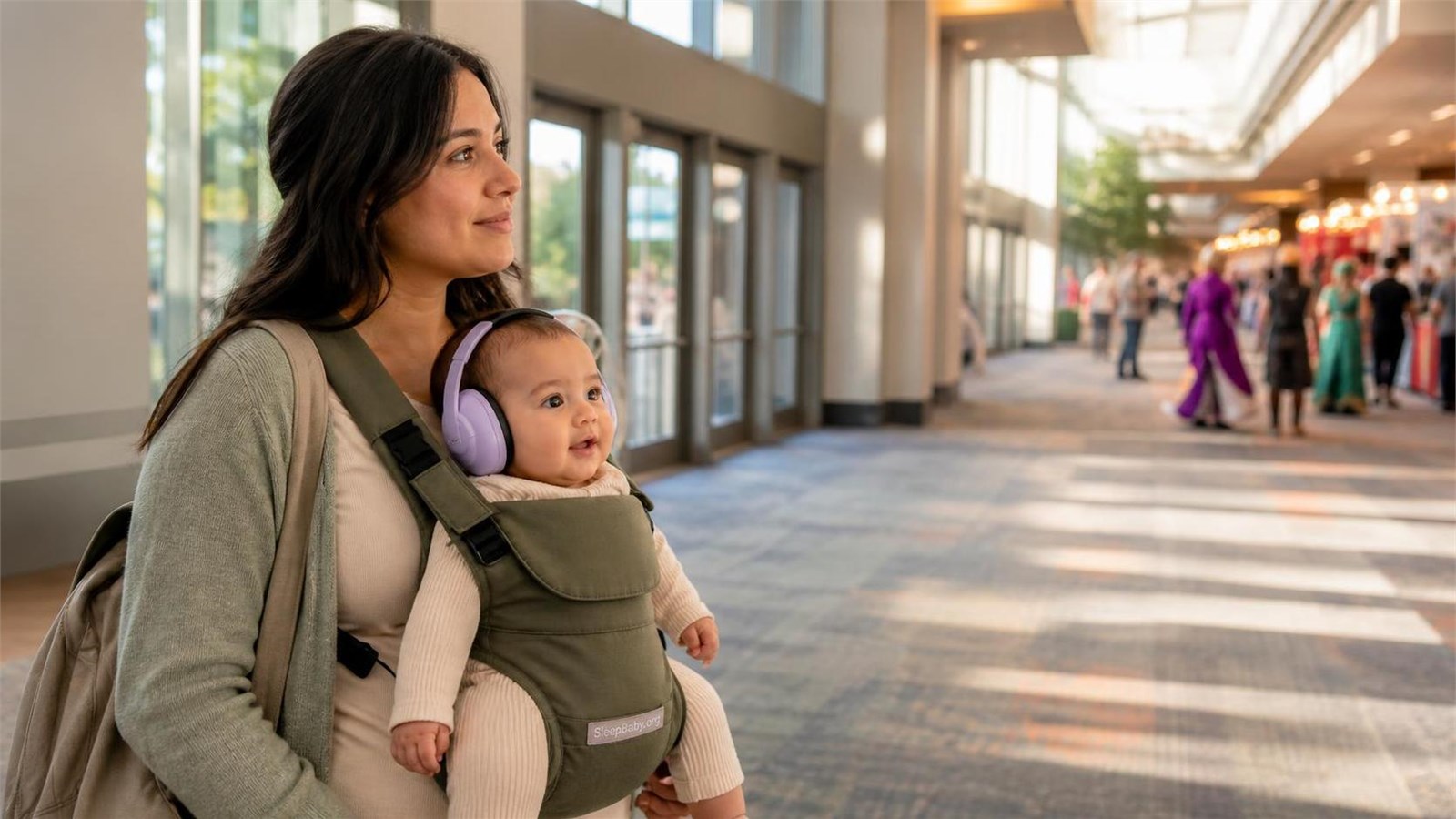
- Use correctly fitted protective earmuffs. Choose infant-sized hearing protection, follow the manufacturer instructions, and practice at home. The ear cups need a comfortable seal around both ears.
- Keep monitoring. Earmuffs reduce sound; they do not block all sound or reveal whether a room is safe. Watch the fit, baby’s body cues, and your distance.
NIDCD notes that hair, hats, or glasses can break an earmuff seal and that the most protective device is not useful if it is uncomfortable enough to be removed.3 AAP guidance also describes loud concerts, sports events, and celebrations as potential hearing hazards and notes that noisy environments can affect children’s sleep, stress, and ability to understand speech.4
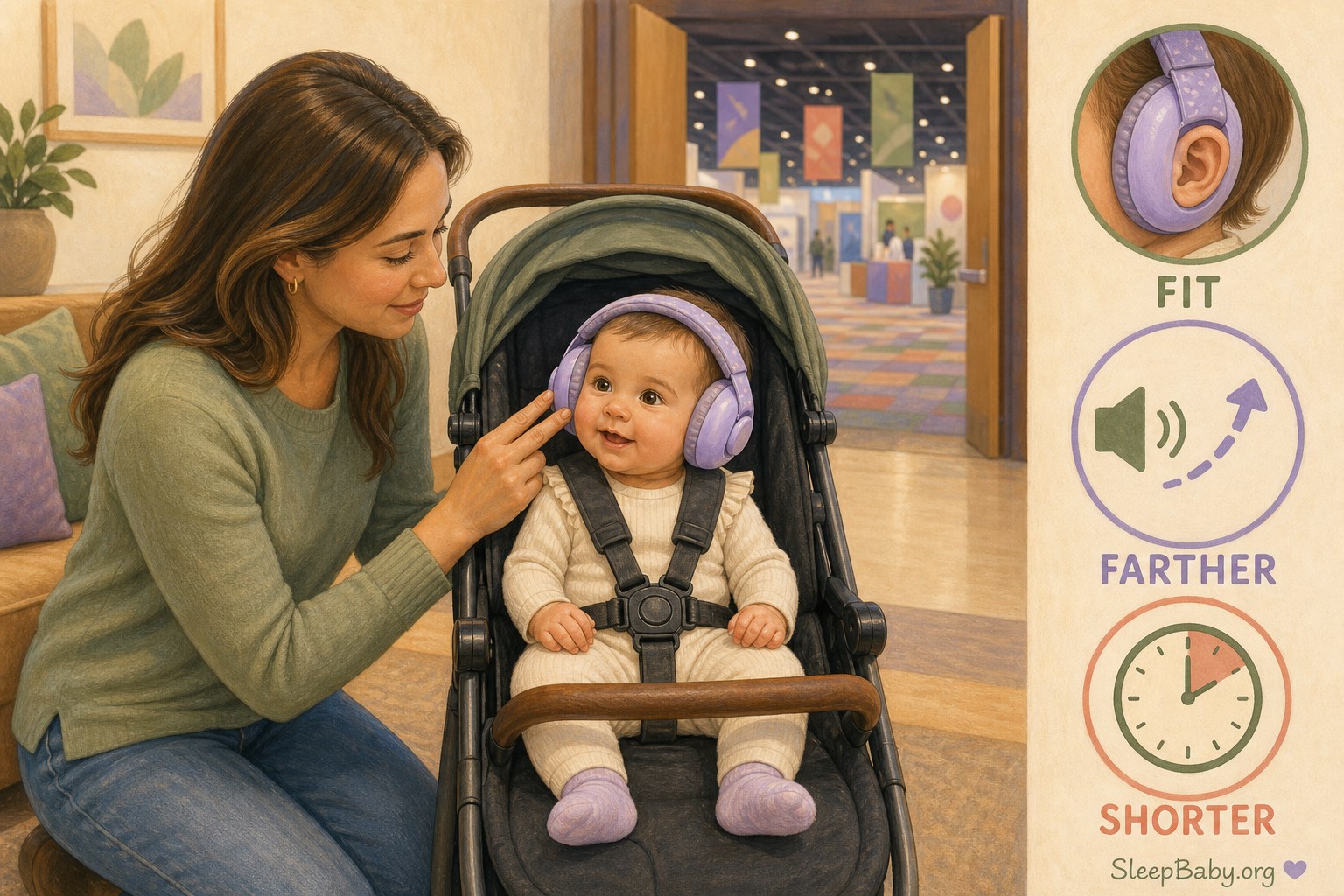
If you need to raise your voice at close range, the baby startles repeatedly, the earmuffs keep slipping, or the sound feels physically forceful, move farther away. A phone sound-meter app can help you notice a change, but it does not certify a convention floor safe, and it cannot measure the fit around a baby’s ears.
The honest hearing plan is distance plus time plus fit. If any layer fails, the plan becomes more distance or an exit, not a pep talk beside the speaker.
Watch: a 105-second hearing check before the exhibit floor
This short American Academy of Pediatrics video explains why loud events matter and how families can build everyday hearing-protection habits. It supplements the written plan; it does not make any specific convention sound-safe.
Watch Hearing Protection: Tips to Safeguard Your Child’s Hearing on YouTube if the embedded player is unavailable or not useful with your assistive technology.
Written takeaway: reduce the source when possible, move away, shorten the time, and use protective earmuffs that fit. Hearing protection is one layer, never permission to stay in distressing sound.

Choose the movement system that keeps the airway and exit clear
The stroller-versus-carrier debate becomes strangely philosophical online. At a convention, it is more practical: which permitted setup can you use correctly in this building, in this temperature, with this baby’s needs, while still leaving?
Convention movement check
Stroller, carrier, or a very short visit?
STROLLER WORKS WHEN
The exact rooms allow it, aisles are wide enough, elevators are practical, the harness is used, bags stay low, the baby remains visible, and you can park without blocking flow.
Not when: policy forces repeated parking, the crowd traps the wheels, or the stroller becomes the only sleep plan.
CARRIER WORKS WHEN
It fits the baby’s size, the face remains visible, the neck is straight, the chin is off the chest, the nose and mouth stay clear, and both baby and caregiver can remain cool.
Not when: the baby has a condition that makes upright carrying inappropriate, fabric blocks airflow, or the caregiver cannot inspect the baby easily.
SHORT VISIT WINS WHEN
Neither setup works across the planned rooms. Meet your people in the lobby, do one accessible activation, or attend a quieter hour rather than swapping the baby between compromised options.
Success: the route fits the baby instead of the baby being made to fit the route.
HealthyChildren advises that in any carrier, the baby’s face should remain visible, the neck should be straight, the chin should not press into the chest, and the nose and mouth should stay free of fabric or the caregiver’s body. Check frequently. Babies born prematurely or with respiratory problems may need individualized advice before upright positioning.6
In a crowd, also watch what enters the baby’s reach: lanyards, badge clips, costume pieces, loose beads, prop tips, giveaway strings, hot drinks, and strangers’ hands. A carrier keeps the baby close but does not create a bubble. Ask before touching is a fair family rule; “no holding today” is a complete sentence.
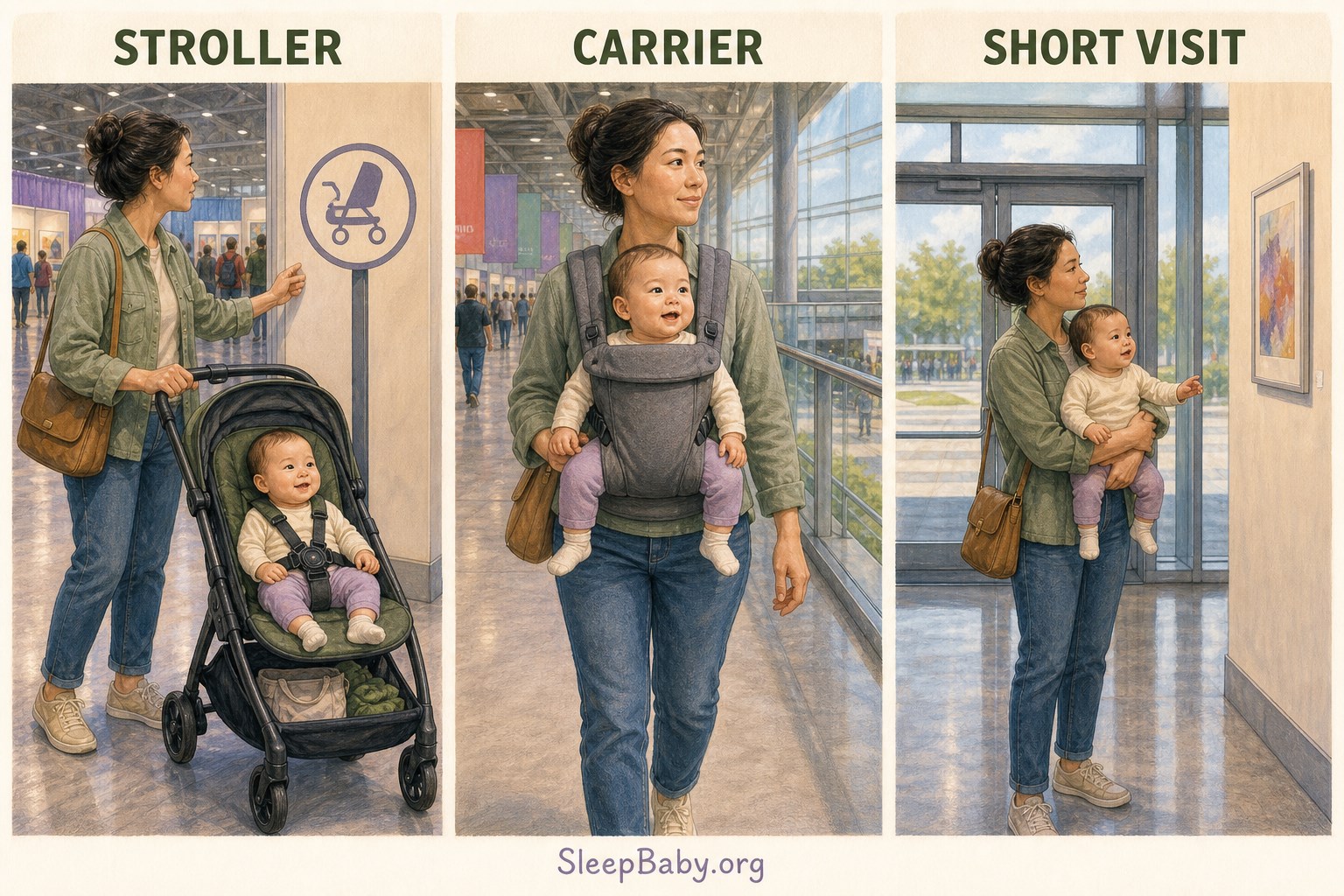
If a stroller is allowed, use the harness and brake, keep bags in the low basket rather than hanging heavy loads from the handle, and keep it out of doorways and aisles. Do not count on the canopy as hearing protection, and do not drape fabric over the stroller in a way that hides the baby or restricts airflow.
Plan for the hot parts that are not on the exhibit map
The convention center may be cool while the badge line, shuttle stop, parking walk, outdoor activation, or hotel bridge is not. The AAP says a heat index of 90 degrees Fahrenheit or higher can be dangerous, especially for babies and young children, and heat illness can develop quickly.5
Start with the least glamorous route research:
- How long is the outdoor walk from parking or transit?
- Is badge pickup shaded and indoors?
- Can you bring normal feeding supplies and a cold pack?
- Where is the nearest quiet feeding area, family restroom, and first-aid desk?
- Which exit avoids the afternoon sun or the longest pickup queue?
If badge pickup or the walk to the venue behaves more like an outdoor event, borrow the shade, sound-distance, and perimeter ideas from taking a baby to a parade. The convention-center doors do not erase the conditions outside them.
Dress the baby lightly for the actual environment, not the costume photograph. A breathable onesie and one soft accessory can be a full costume. Avoid tight masks, face coverings, heavy foam, dangling cords, glitter near eyes, rigid headpieces, and anything that blocks the face, neck, hands, or carrier fit. The tiny armored suit can wait until its wearer can complain about the ventilation personally.
Check the baby’s chest or back and behavior. Move to a cooler place and reassess for unusual warmth, sweating, flushed skin, weakness, vomiting, poor feeding, marked irritability, or unusual sleepiness. Seek medical care promptly for possible heat illness. Call emergency services for collapse, seizure, severe breathing trouble, inability to wake, or abnormal responsiveness.
Follow the baby’s normal age-appropriate feeding plan. Wash or sanitize adult hands before preparing a bottle or touching feeding parts, keep supplies protected from public surfaces, and do not let an exciting line stretch a hungry baby beyond what you can comfortably manage. If your baby has feeding, hydration, prematurity, or medical concerns, ask the clinician for an event-specific plan.

A carrier nap is a transition, not the convention itinerary
Convention guides often suggest timing the floor around a stroller nap. For an infant, safe sleep needs a clearer boundary. The AAP recommends putting babies on their backs on a firm, flat sleep surface. If a baby falls asleep in a stroller, car seat, swing, infant carrier, or sling, move them to a firm sleep surface on their back as soon as possible.7
You do not need to panic over every eyelid droop during the walk back to the hotel. You do need to avoid turning a monitored on-the-go doze into hours of planned sleep while you browse. Keep the face visible and airway clear, leave the stimulating floor, and move the baby to an appropriate sleep space as soon as practical.
If the event collides with the usual timing, use the baby’s cues rather than trying to win against the clock. Our guide to wake-window anxiety can help you treat timing as useful information without turning a delayed nap into a family emergency.
If a late convention doze puts bedtime in question, use the before-bedtime nap guide after you are back in a safe sleep setting, not as a reason to extend the visit on the floor.
Reduce crowd exposure without pretending risk is zero
Indoor crowds bring close conversation, shared surfaces, and people arriving from many places. CDC’s core respiratory-virus strategies include staying current with recommended immunizations, regular handwashing, cleaner air, and staying home when sick. Additional layers can include distance, masks for people who can use them appropriately, and testing in relevant situations.8
For a baby at a convention, practical risk reduction can look like this:
- Choose the least crowded arrival window and outer aisles.
- Keep the baby out of shoulder-to-shoulder queues and packed stage audiences.
- Do not attend when the baby, caregiver, or support person is sick.
- Clean adult hands before feeding, pacifier handling, or touching the baby’s face.
- Decline strangers’ requests to touch, hold, or pose closely with the baby.
- Use outdoor or better-ventilated reset spaces when weather and safety permit.
No checklist removes infection risk. A very young baby, a baby born prematurely, or a child with a medical vulnerability may need a more conservative plan from their clinician. The useful question is not, “Can I guarantee nothing will happen?” It is, “Does this optional crowd make sense for this baby today?”
The lanyard clip wins the convention
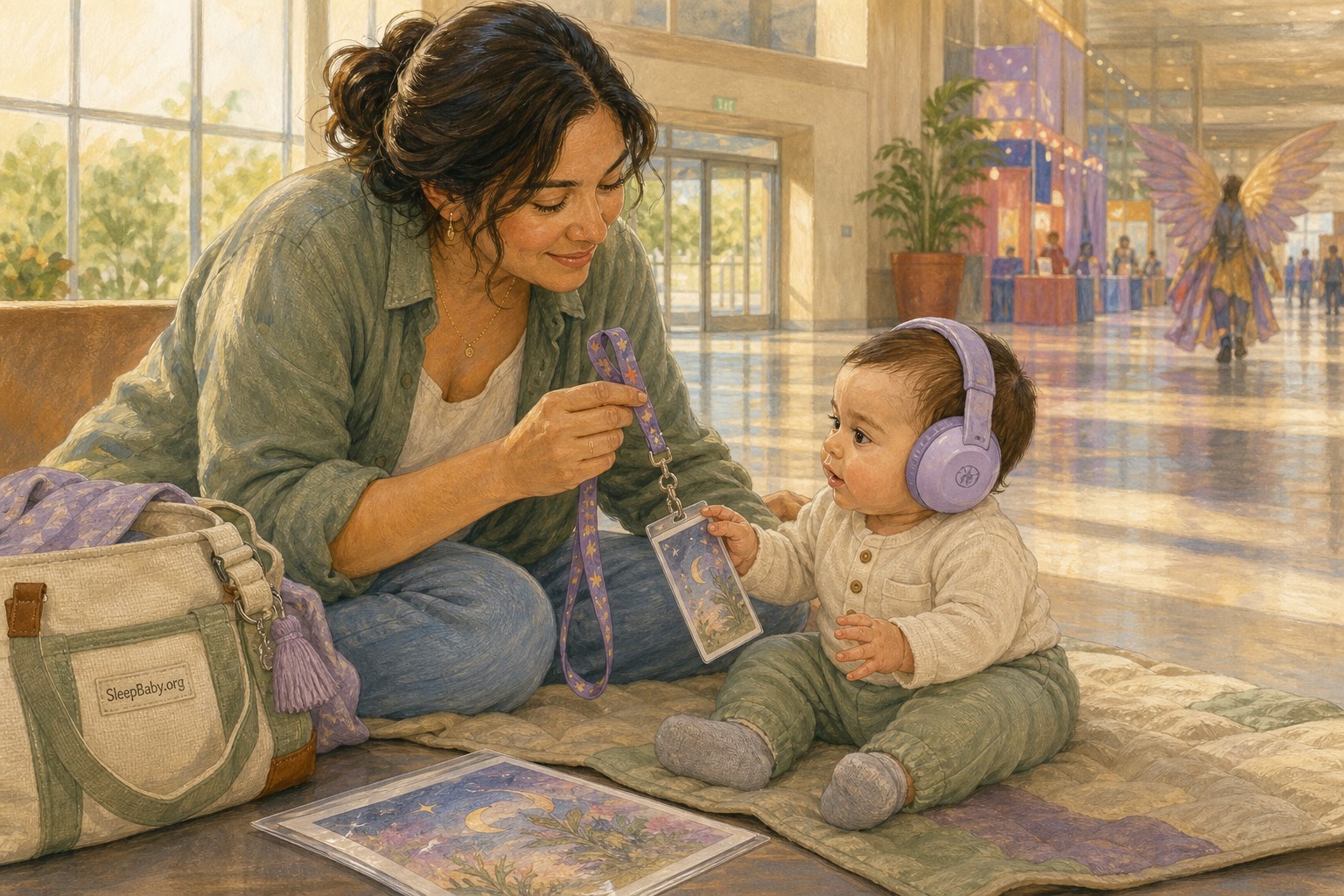
We made Base Camp in a bright lobby where I could hear Benjamin’s little conversational noises without leaning close. Our Side Quest was one illustrator whose work I had loved for years. The Exit Portal was not metaphorical; it was the glass door beside the escalator, followed by a short walk to the hotel.
Then a costumed character with enormous wings passed the entrance, and every adult in the lobby turned. Benjamin did not. He was still studying the lanyard clip with the solemn concentration of a tiny engineer asked to certify an aircraft.
We visited the illustrator. We bought one print, stored it flat, and did not add five more bags simply because convention-me briefly believed I had unlimited arms. A burst of sound rolled from the exhibit hall. Benjamin’s shoulders lifted. We returned to Base Camp, checked the earmuff fit, fed him, and took the Exit Portal before distress became the story.
He had been inside for forty-three minutes. I had imagined three hours. The smaller day was better. Not because forty-three is a magic number, but because the plan still worked when the baby changed it.
Again, the story illustrates the framework; it does not validate the hearing, heat, carrier, sleep, or infection guidance. Those claims remain attached to their sources.
Pack for thirty-second access, not a fantasy expedition
At a convention, an item buried under souvenirs is only theoretically packed. Organize the bag by what must be reachable while standing at the edge of a crowd.
The thirty-second convention bag
Top pocket, care cube, exit layer
TOP POCKET
Infant hearing earmuffs, one clean pacifier if used, burp cloth, wipes, phone, badge, and the room/exit map. These are the things you may need before there is space to unpack.
CARE CUBE
Diapers, changing pad, waste bags, one practical clothing change, normal feeding supplies, medication if prescribed, and a clean bag for used items.
EXIT LAYER
Carrier backup if appropriate, weather layer, portable charger, hotel or transit key, emergency contacts, and the minimum supplies needed if the stroller must be parked.
Souvenir rule: if a purchase blocks the care cube or makes one adult unable to carry the baby and exit bag safely, ship it, collect it later, or leave it at the booth.
Bring fewer loose toys than you think. Convention floors already offer more visual input than most babies requested. Avoid long cords, badge reels within reach, small pin backs, loose costume gems, and anything that could detach into a choking hazard.
Navigate the edges, not the center
The shortest route on the map can be the slowest route in the building. Main cross-aisles collect queues, photo stops, large costumes, rolling cases, and people who have just remembered a panel on the opposite side of the center.
Use these crowd habits:
- Walk the outside wall when possible, even if it adds distance.
- Stop fully out of flow before checking a phone or adjusting the carrier.
- Do not squeeze between a costume and its handler; props can have blind zones and wide turning arcs.
- Skip any queue that blocks the return to Base Camp.
- If two adults attend, name one as baby lead and one as route/bag lead. Do not pass responsibility through eye contact and optimism.
- Write the caregiver’s phone number where staff can find it, and agree on a meeting place if adults are separated. Do not rely on public-address paging.
If you need accessibility support, use the event’s official services rather than improvising around barriers. Ask about elevators, rest areas, companion seating, medical devices, and queue accommodations in advance. A baby does not cancel the caregiver’s access needs, and a caregiver should not have to choose between using an accommodation and meeting the baby’s care needs.
Use a no-debate exit ladder
The exit is part of the ticket
Reset, leave, or get help
RESET AT BASE CAMP
The earmuffs need refitting, the baby turns away repeatedly, a feed or diaper is due, the carrier feels warm, the stroller route is narrowing, or the caregiver is rushing.
LEAVE NOW
The baby cannot settle in the quiet area, has repeated startling or escalating crying, feels hot, feeds poorly, vomits, becomes unusually sleepy, has breathing trouble, or simply is not acting like themselves.
GET HELP
Use on-site first aid and seek prompt medical care for concerning heat or illness symptoms. Call emergency services for collapse, seizure, severe breathing trouble, blue or gray color, inability to wake, or abnormal responsiveness.
No sunk-cost clause: badges, travel, a rare panel, and a friend’s expectations do not outrank a baby’s condition. Leaving is the plan working.

Taking a baby to Comic-Con: quick questions
Can I take a newborn to Comic-Con?
There is no universal age cutoff, but a newborn’s feeding, temperature regulation, sleep, medical history, and vulnerability to crowds deserve a conservative plan. Ask the baby’s clinician about prematurity, respiratory or cardiac concerns, recovery after birth, and the specific event. If you cannot guarantee a short, quiet visit with an immediate exit, skip it.
Does a baby need earmuffs at a comic convention?
Bring correctly fitted infant hearing-protection earmuffs when amplified sound or sudden crowd noise is possible, and practice the fit first. Also create distance and shorten exposure. Earmuffs do not make a stage-side or distressing environment safe.
Are strollers allowed at Comic-Con?
It depends on the event and room. Comic-Con International currently prohibits oversized strollers in its Exhibit Hall and all strollers in programming rooms, but another convention may have different rules. Check the exact event’s current policy, stroller dimensions, parking arrangements, and re-entry route before relying on one.
What is a safe Comic-Con costume for a baby?
Choose light, breathable clothing that leaves the face, neck, hands, and carrier or harness unobstructed. Avoid masks, long cords, rigid props, tight headwear, loose gems, heavy layers, and anything that impairs airflow or visibility. A printed onesie is a costume; no baby has ever demanded screen accuracy.
What if my baby naps at the convention?
Leave the stimulating floor, keep the face visible and airway clear, and move the baby to a firm, flat sleep surface on their back as soon as possible. A stroller, car seat, carrier, or sling should not become the planned sleep space for the rest of the day.
How long should a baby’s first convention visit be?
Long enough for one comfortable Side Quest, not long enough to prove endurance. Sound, heat, feeding, sleep, crowd density, and the baby’s cues matter more than a target duration. Ten calm minutes can be a complete first visit.
Can strangers take photos of my baby in costume?
You decide. A cheerful “no photos, thank you” or “one quick photo from there” is enough. Do not share the baby’s name, schedule, hotel, or badge details, and do not let a photo request block the exit or bring large props into the baby’s space.
One Side Quest is a whole adventure
The successful version may be shorter than the walk from Hall A to Hall H. It may be one artist, one quiet family photo, one bottle in the lobby, and a baby who never notices the costume you stayed up finishing.
That is not a failed convention. It is a parent reading the room before the room overwhelms the baby. It is hearing protection used with distance. A carrier checked for airflow. A stroller route that respects policy and people. A feed that happens before the line. An exit taken while it is still easy.
Build Base Camp. Choose one Side Quest. Protect the Exit Portal. Then let the lanyard clip be fascinating enough.
Your calmer next step
Draw the three-point floor plan before you pack
Open the event map. Mark one Base Camp, one baby-sized Side Quest, and one Exit Portal that never crosses the busiest hall. If all three are real, build the bag around them. If one is missing, make the visit smaller now.
Sources
- Comic-Con International: Convention Policies – current stroller, programming-room, aisle, badge, prop, re-entry, and attendee-safety policies.
- Comic-Con International: Child Badge Policy – 2026 child eligibility, adult-to-child limit, on-site registration, and emergency-contact requirements.
- National Institute on Deafness and Other Communication Disorders: Protect Your Child’s Hearing – sound level, duration, distance, protective earmuffs, fit, and seal.
- American Academy of Pediatrics: How Noise Affects Children – hearing hazards and the effects of noisy environments on sleep, stress, learning, and speech perception.
- American Academy of Pediatrics: Extreme Heat – Tips to Keep Kids Safe – heat-index risk, cooling, hydration, and heat-illness warning signs.
- American Academy of Pediatrics: Baby Carriers – visible face, straight neck, chin position, airflow, fit, and medical cautions.
- American Academy of Pediatrics: How to Keep Your Sleeping Baby Safe – back sleeping, firm flat surfaces, and moving a sleeping baby from a stroller, car seat, carrier, swing, or sling.
- Centers for Disease Control and Prevention: Preventing Respiratory Illnesses – immunization, hygiene, cleaner air, staying home when sick, and optional added prevention layers.