Object permanence is the growing understanding that a person or thing still exists when your baby cannot see, hear, or touch it. It does not arrive on one exact birthday. Early pieces of the skill can show up during the middle of the first year, while the kind of deliberate searching parents can easily spot often becomes clearer from about 8 to 12 months. The CDC gives one especially useful real-life marker: by 9 months, most babies look for an object that has dropped out of sight, such as a spoon or toy.[1]
That is a guidepost, not a tiny cognitive driving test. A baby can notice that something should still be there before they have the attention, memory, balance, and hand control to uncover it. They can also understand the game perfectly well and decline to retrieve the wooden spoon for a sixth time because, frankly, they have delegated that position to you.
What object permanence actually means
Imagine a bright measuring spoon on the floor. Your baby watches it slide behind your leg. For an adult, the situation is boringly obvious: the spoon is still there. For a young baby, keeping track of that now-invisible spoon is a surprisingly layered job. They have to hold some representation of it in mind, connect that representation to a hidden place, remember what happened, and sometimes organize a reach or crawl toward it.
That is why the clean textbook definition and the messy living-room version can look different. Object permanence is not simply “baby remembers.” It is also not the claim that a newborn believes you have been erased from the universe every time you step behind the bathroom door. Babies recognize familiar voices, faces, smells, and patterns long before they can solve a classic hidden-toy task. Different forms of attention, recognition, expectation, and active searching develop together, but not in lockstep.
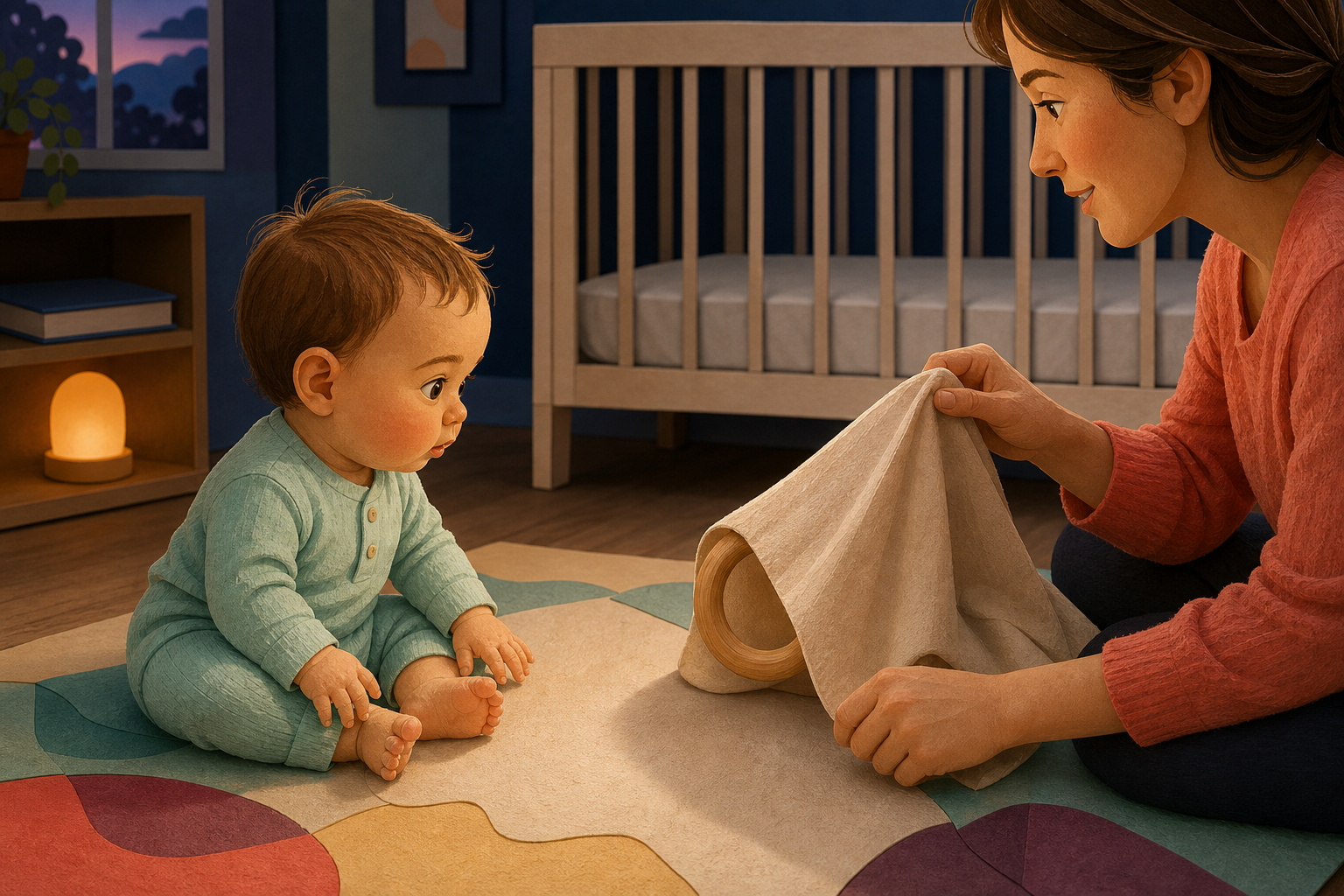
I learned this distinction during a game with Benjamin and a washcloth held in my hand. I covered half a wooden ring. He stared at the uncovered half, stared at me, then pulled the cloth away with the grave concentration of a person correcting an administrative error. When I hid the whole ring, he inspected my fingers instead. Same baby, same toy, different problem. The second game asked more of his memory and search plan, not more of his worth.
The disappearing-object staircase
Four jobs that can hide inside one game
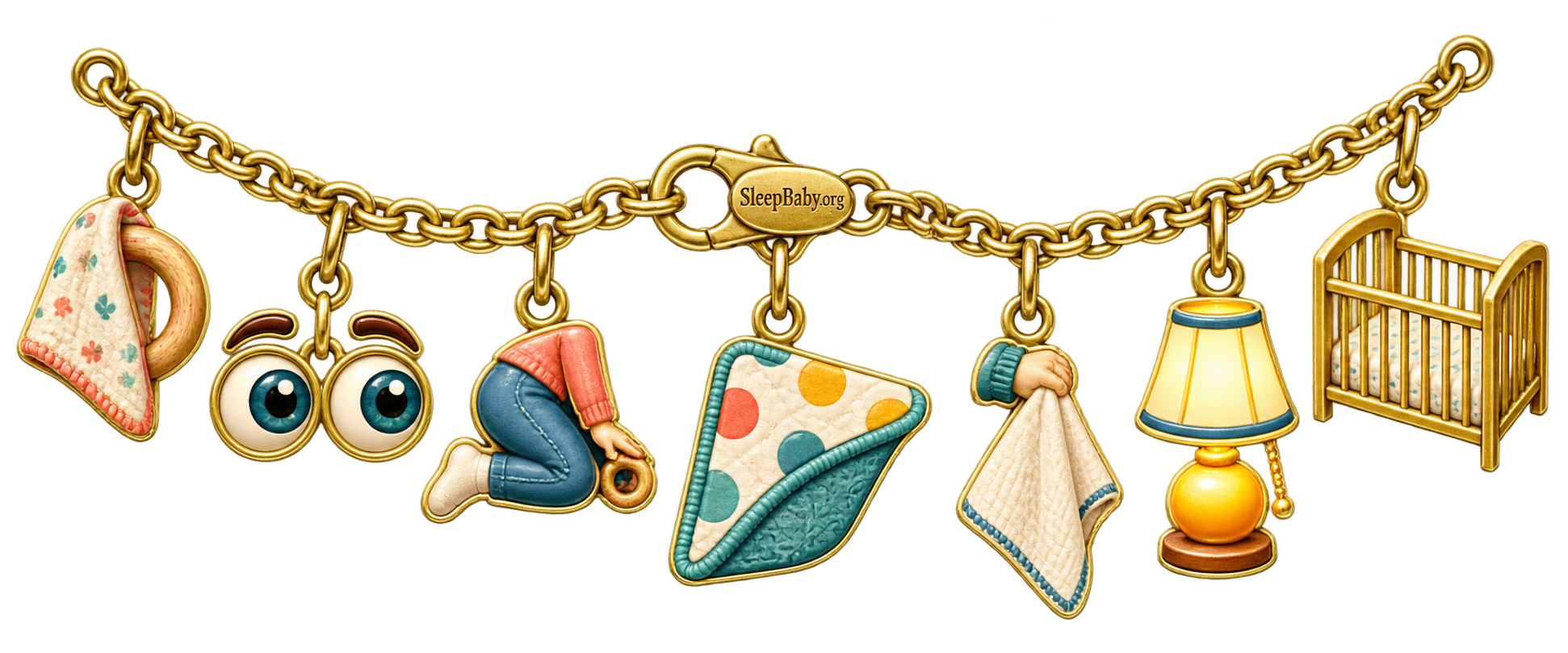
- Notice: The toy disappeared in a normal way rather than dissolving or blinking out.
- Hold: A trace of the toy remains in mind after it leaves view.
- Locate: The toy is connected to a likely place behind the cloth, cup, or caregiver.
- Act: The baby coordinates a look, reach, pull, crawl, or search that can reveal it.
Why this matters: a baby may manage the first two jobs before the fourth is easy to see. Looking and reaching are related evidence, but they are not the same test.
SleepBaby.org original developmental map
When do babies develop object permanence?
The most honest answer is gradually across the first year, with the visible answer changing according to the task. The American Academy of Pediatrics describes the discovery beginning toward the end of the 4-to-7-month period and continuing for many months. Its 8-to-12-month guidance describes an 8-month-old uncovering a toy beneath a scarf and a 10-month-old persisting when the disappearance becomes trickier.[2][3]
Meanwhile, laboratory studies have found signs that younger infants track hidden objects before they can retrieve them. In a well-known 1987 looking-time study, 3.5- and 4.5-month-old infants reacted differently to events that appeared possible or impossible when an object was hidden.[4] A later EEG study found that 6-month-olds’ brain activity differed when an object disappeared through normal occlusion rather than seeming to disintegrate.[5]
Those findings are interesting, but they do not mean a 4-month-old has an adult’s full concept in a miniature lab coat. Researchers themselves debate what looking, expectation, memory, and action each tell us. A major review called this the “paradox of early permanence”: young infants may show expectations about hidden objects well before they can recover one by reaching.[6] The practical conclusion is not that one age is right and every other age is wrong. It is that what you ask the baby to do changes the age at which the skill becomes visible.
| Rough window | What you may notice | What it does not prove |
|---|---|---|
| Birth to about 4 months | Recognition, tracking, anticipation, and strong interest in familiar people and repeating events. | That the baby can plan a hidden-object search. |
| About 4 to 7 months | More obvious expectation, cause-and-effect play, and interest when an object partly disappears. | A fixed start date or reliable full-cover retrieval. |
| About 8 to 10 months | Looking for a dropped item, lifting an easy cover, anticipating peekaboo, and searching where an object vanished. | That every baby will perform every version on cue. |
| About 10 to 12 months and beyond | More persistent searches and growing ability to follow an object through a location change. | Adult-like memory, impulse control, or flawless search. |
A range is useful when it helps you notice development without grading it. It stops being useful the moment it makes you compare a rested 10-month-old on their favorite rug with a hungry 8-month-old in a noisy waiting room as if the conditions were identical.
Signs of object permanence you can notice in ordinary play
You do not need special cards, an app, or a subscription box that arrives wearing the word “neuroscience” like a tiny bow tie. The best observations usually happen around objects your baby already cares about.
Your baby looks toward where something fell
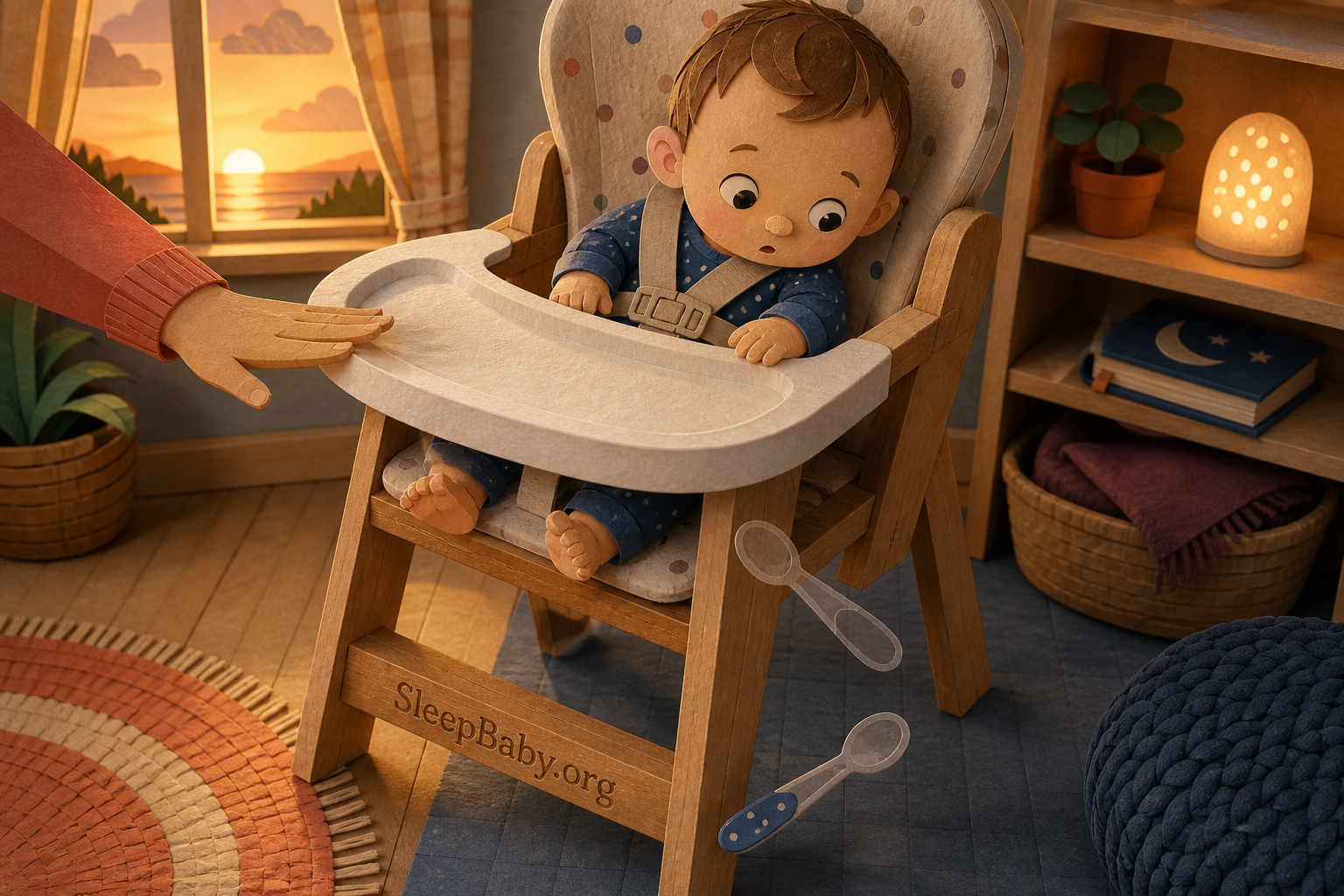
The spoon clears the high-chair tray, and your baby’s gaze drops toward the floor. This is the CDC’s practical 9-month example.[1] Repeated dropping also lets a baby study cause and effect: I release it, it falls, an adult makes that face, and somehow the spoon returns. The last part is apparently a very reliable natural law.
Your baby anticipates the return in peekaboo
A younger baby may simply enjoy the voice and face. Later, you may see a grin arrive before the reveal, hands pull at your fingers, or eyes shift toward the side where your face usually returns. Anticipation matters even when the baby does not remove a cover.
A partly hidden toy becomes a solvable problem
Leave a generous piece of the toy visible. Your baby may reach for that visible edge, uncover the rest, and repeat the process. Partial cover is kinder than jumping straight to a fully hidden toy because it provides a clue and reduces the memory load.
Your baby searches after a full cover
With awake adult supervision, place a familiar toy beneath an easy-to-lift cup or cloth while your baby watches. A look toward the cover, a reach, or an attempt to lift it can all be meaningful. The exact movement depends on what your baby can currently do with their body.
Your baby follows a simple location change
This is harder. Hide a toy under one of two cups, then move it while the baby watches. Searching in the new place asks the baby to update the object’s location rather than repeat yesterday’s successful reach. Wrong-place searches are not evidence that the whole concept vanished; habit and working memory are part of the task too.
What to watch
Look for a pattern, not a performance
Do they look toward the disappearance or expected return?
Can they sit, turn, reach, or pull the cover used in this version?
Is the object familiar and worth finding to this particular baby?
Does searching appear across days and settings, not only once?
SleepBaby.org original observation lens
Five object permanence games that grow with your baby
These games are invitations, not drills. Try them when your baby is awake, comfortable, and interested. Stop when they turn away, fuss, stiffen, rub their eyes, or switch their attention. The brain does not issue bonus points for finishing the lesson after the student has started eating the lesson plan.
The napkin-lab game ladder
Start with the easiest clue
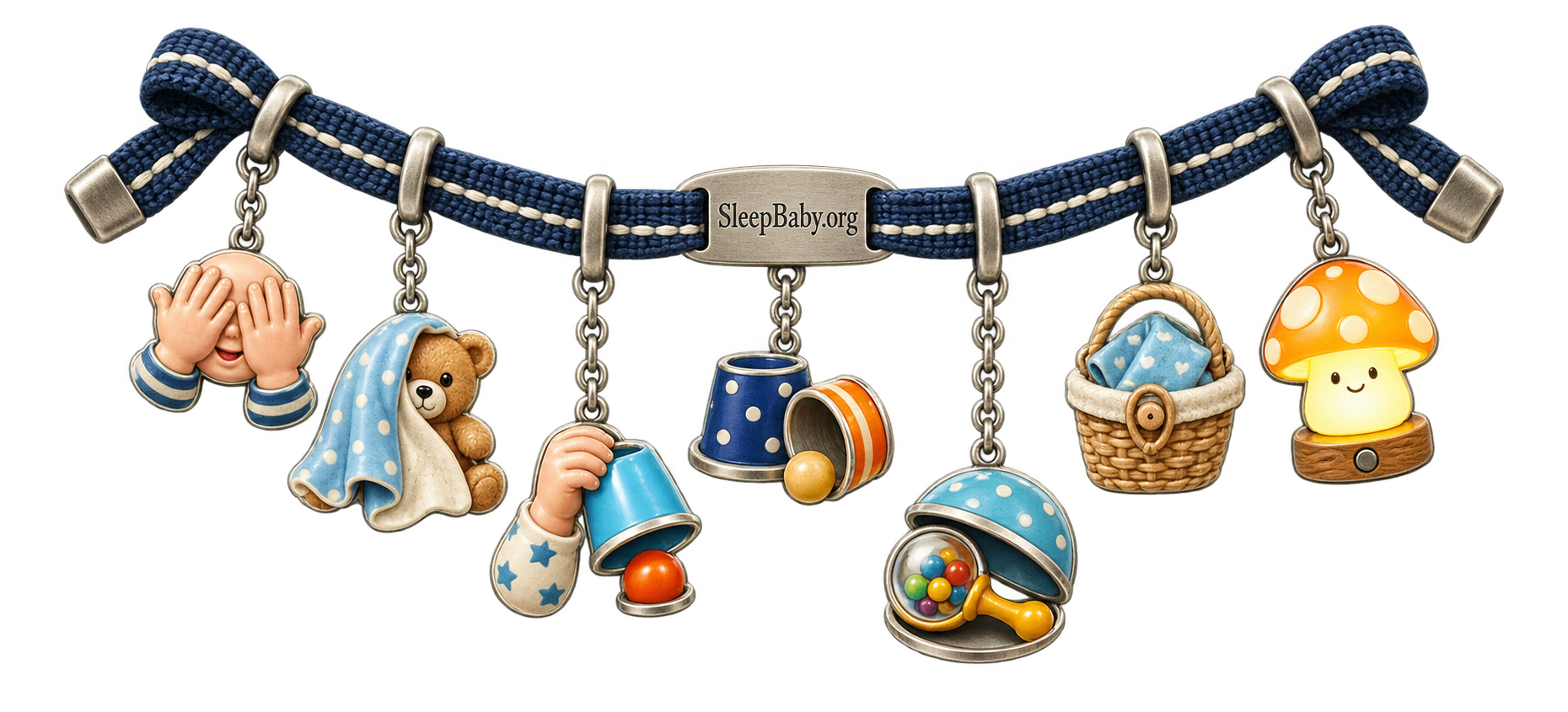
- Face reveal: Cover your own face with your hands, pause briefly, then return from the same side. Let your voice continue so the game feels predictable.
- Half-hide: Place part of a familiar toy beneath a lightweight cup or cloth, leaving an obvious edge. Wait. If your baby only looks, that still counts as information.
- Easy full cover: Hide the toy completely while your baby watches. Use one light cover that is simple to lift and reveal it after a short pause if the task stalls.
- Sound clue: Put a large, safe rattle beneath an upside-down bowl and make one quiet sound. The noise gives your baby another route to the hidden location.
- Two-place search: Use two cups. Hide the toy under one while your baby watches. Later, visibly move it to the other. Keep the first attempts slow and obvious.
Make it easier before you make it longer: shorten the pause, expose more of the toy, use one cover instead of two, or choose an object your baby genuinely likes.
SleepBaby.org original play progression
Keep the game pieces safe
Use lightweight, unbreakable objects too large to swallow, and inspect them for loose parts. Stay within arm’s reach. If your baby mouths every promising research instrument, this guide to normal mouthing and urgent object risks gives you the faster safety sort.
A cloth used for peekaboo stays in an adult hand, away from the baby’s nose and mouth, and comes off as soon as the game ends. Cups, cloths, toys, and bowls are for supervised awake play only. They do not belong in an infant sleep space. The AAP recommends a firm, flat sleep surface with only a fitted sheet and no loose blankets, toys, pillows, or other soft objects.[7]
Let your baby lead some rounds
Once your baby understands the pattern, pause before the reveal. They may pull your hands down, lift the cloth, or hide their own face. The turn-taking is useful in its own right. So are the shared attention, prediction, language, and delight. Object permanence is not the only development happening while everybody is yelling “There you are!” at a perfectly visible person.
Match the game to the skill your baby can use today
A hidden-object game is only as fair as its exit. If the solution requires sitting steadily, reaching across the body, pinching a thin edge, and remembering which of two cups moved, a baby can understand part of the event and still be unable to show you. I would rather lower one demand and see what changes than repeat the hard version until everybody is cross.
For a baby who mostly watches
Use your face, hands, and voice. Move slowly enough for your baby to track the disappearance. Keep the pause short. Reappear from the same place several times so the sequence becomes predictable. You are looking for attention and anticipation, not a reach. A widening smile, a body wiggle, or eyes moving toward the return side can be the whole game.
For a baby who reaches but does not uncover
Make the object more visible. Let a thick handle or bright corner stick out. Choose a shallow, lightweight cover that will move with an ordinary swipe rather than a careful fingertip grip. Put the game within an easy reach from a supported position. If your baby reaches for the visible piece and happens to uncover the rest, let the surprise breathe before you reset it.
For a baby who finds the easy hide every time
Change one thing, not four. Lengthen the pause by a second, cover the toy completely, or add a second possible place. Do not simultaneously switch toys, move rooms, invite an audience, and perform cup choreography at dinner. A clean change helps you see what the baby is learning. It also gives them a reasonable chance to notice the rule.
For a mobile baby who wants the whole room
Let a large ball roll partly behind a cushion that is on the floor and not part of a sleep space. Hide yourself partly behind a doorway while another adult remains with the baby. Place a familiar object inside a wide, stable container. Mobility turns object permanence into navigation: the baby can now travel toward the last-seen place, change viewpoint, and look around an obstacle.
Use simple language throughout: “The ring went under,” “You found it,” and “Now it is behind the cup.” The words do not need to teach the concept by themselves. They label the event your baby is already studying and make the shared game easier to follow.
Games can support learning without putting development on a timer
Peekaboo, container play, and gentle hide-and-find games create repetitions of disappearance and return. They also exercise attention, prediction, memory, motor planning, social turn-taking, and language. That is plenty of value. You do not need the stronger promise that a particular game will “unlock” object permanence or move a baby into the next stage by Friday.
Development is not a row of isolated switches. A baby may understand where the toy went but lose the location while shifting into a crawl. They may remember the location and lack the grip to lift the cover. They may solve it at home and freeze in a clinic. Practice can make a familiar task easier, while sleep, health, sensory load, movement, and interest still change the result.
This is also why a screen version is a poor substitute for the ordinary game. A real object can be tracked through three-dimensional space, touched, uncovered, dropped, and handed back. A real caregiver can notice when the challenge is too hard and adjust it in one second. The living-room rug does not need to become a tiny cognitive laboratory with a clipboard. It only needs a safe object, a patient adult, and enough curiosity for one more round.
A researcher’s view
Why the movement part changes what you see
In this six-minute interview from Pediatric Physical Therapy Journal, physical therapist and researcher Regina Harbourne discusses object-permanence tasks and sitting development, particularly in infants with motor delays. The study is narrower than this general guide; its value here is showing why a reach is not a pure cognitive score.
The useful takeaway: the body a baby can use changes the answer they can show. The video does not set a universal age or diagnose a developmental delay.
What if my baby does not look for a hidden toy?
First, do not diagnose a child from one game. A hidden-toy task can fail for reasons that have nothing to do with whether the baby retains an object in mind. The baby may be tired, hungry, overwhelmed, more interested in the cup, unable to reach from that position, or simply done cooperating with your living-room research department.
Not yet, not interested, or worth a check-in?
Use this five-question lens
- Was the baby ready? Try on a different day when they are alert and comfortable.
- Was the clue easy enough? Return to a partial cover or a shorter delay.
- Could their body solve it? Support a stable position and use a cover they can move.
- Does the pattern appear elsewhere? Notice dropped spoons, a caregiver behind a door, and favorite toys that roll under furniture.
- Is there a broader concern? Look at the whole developmental picture, including skills that were present and then disappeared.
Call the pediatrician rather than increasing the drill if your baby has lost a skill, is missing one or more milestones, or something about development concerns you. Ask about developmental screening and early-intervention options. You do not need to wait for a second problem to make the first concern legitimate.[1]
The CDC milestone is useful because it gives the conversation a concrete example: “At 9 months, I have not seen her look for a dropped toy, even when she is rested.” That is more helpful than arriving with a verdict you had to assemble from three late-night videos. Your pediatric clinician can consider the observation alongside vision, hearing, movement, attention, communication, birth history, and the rest of your baby’s development.
Object permanence and separation anxiety are related, not identical
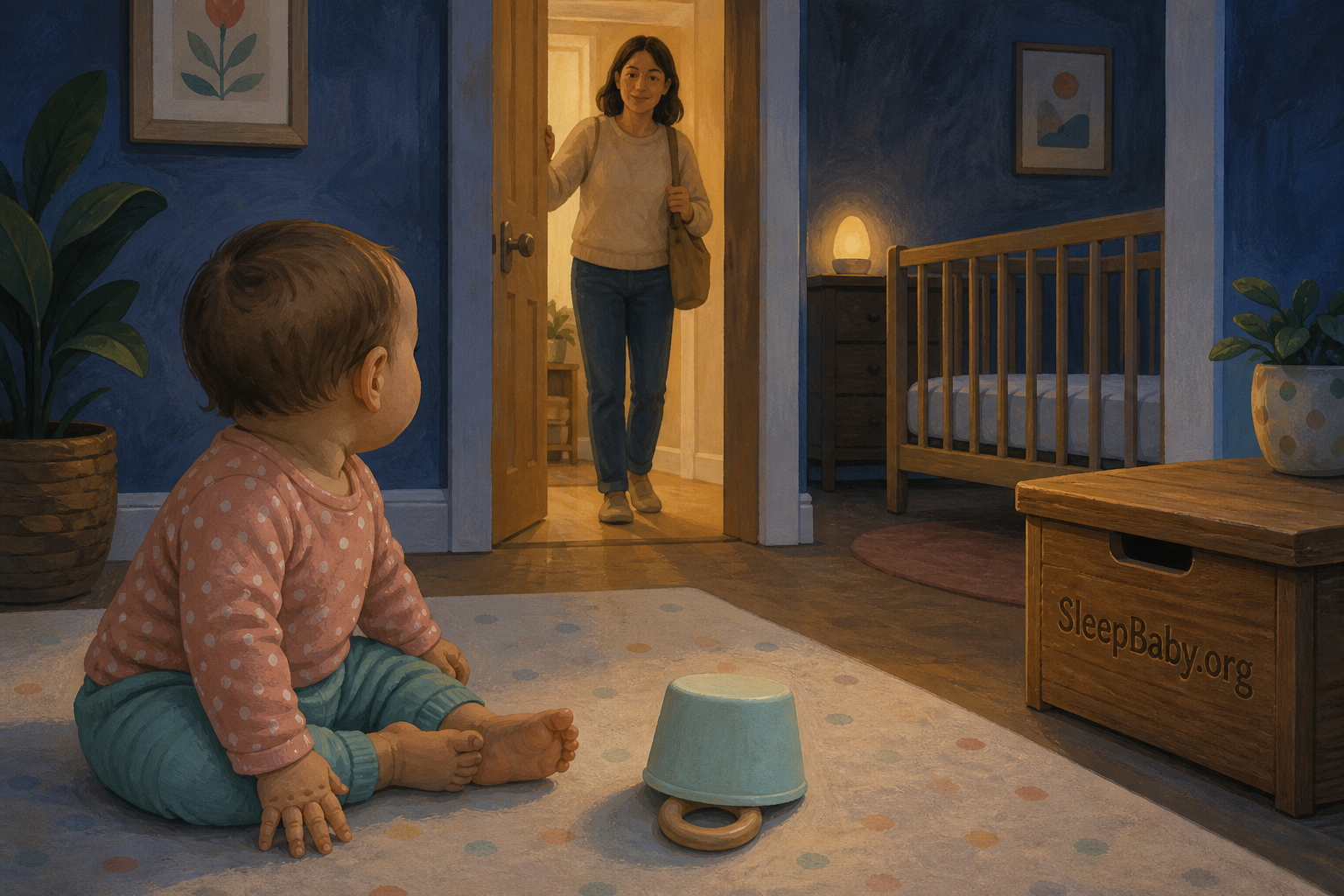
These ideas are often bundled together because both can become more visible in the later baby months. The CDC’s 9-month checklist keeps them in separate domains: looking for a dropped object is cognitive, while reacting when a caregiver leaves is social and emotional.[1] That is a useful clue about how to talk about them.
Object permanence can contribute to a baby’s growing awareness that you still exist somewhere beyond the doorway. Separation distress also involves attachment, temperament, experience, prediction, and the immediate situation. A baby can search for a hidden toy without melting down when a caregiver leaves. Another baby can protest a departure even when a toy-search game has never interested them. Neither response is a moral score for the parent-child bond.
If the real problem is crying the instant you move away at bedtime, keep this article’s cognitive explanation in its lane and use the separate responsive plan for separation anxiety at sleep time. It sorts separation from pain, hunger, schedule issues, and learned falling-asleep cues, then builds a predictable response. That deserves more than “they finally know you exist.”
Does object permanence cause sleep problems?
Not by itself, and it should not become the explanation for every rough night between 6 and 12 months. Development can change what a baby notices. A baby who is more aware of your departure may protest it. But a waking baby may also be hungry, uncomfortable, ill, undertired, overtired, between sleep cycles, startled by a transfer, or expecting the same conditions they had when they fell asleep.
I would use object permanence as context, not a diagnosis. Look at the timing. Does the protest begin at the exact moment your hand leaves the crib rail? Does the baby wake after a fairly consistent stretch of sleep regardless of where you are? Did the pattern start with congestion, travel, a nap change, or learning to stand? Those details decide what to try next.
If you are trying to understand the ordinary stirs and full wakes that happen between stages, the guide to baby sleep cycles by age separates cycle length, nap length, total sleep, and actual distress. No cognitive milestone cancels the need for safe sleep. Put an infant down on their back in a firm, flat, empty sleep space, and move game cloths and toys elsewhere before the wind-down begins.[7]
Common questions about object permanence
Can a 3-month-old have object permanence?
Studies suggest young infants can maintain some information about hidden objects and notice certain impossible events. That is not the same as proving a complete, adult-like concept or expecting a 3-month-old to retrieve a covered toy. It is more accurate to say early object representation may be present before deliberate search becomes visible.[4][6]
At what age do babies understand peekaboo?
Babies can enjoy the voice, rhythm, and face long before they can pull away a cover. Anticipation and active searching often become more obvious during the later baby months. CDC includes smiling or laughing during peekaboo among its 9-month milestones, but there is no single session that proves the whole concept.[1]
Why does my baby look under the wrong cup?
The baby may be repeating a previously successful reach, losing track during the move, or having trouble inhibiting the familiar response. A location-switch game asks for memory, attention, motor planning, and an update to the search plan. Make the move slower and more visible before assuming the concept is missing.
Can I teach object permanence faster?
You can offer warm, safe opportunities to practice attention, prediction, and search. You cannot put a cognitive milestone on a shipping schedule. Repetition helps a baby learn the pattern of a particular game; development still depends on many interacting systems. Keep play enjoyable and stop before either of you begins resenting the cup.
Is repeated throwing from the high chair object permanence?
It can involve object tracking, but it also teaches cause and effect, gravity, sound, social response, and the astonishing reliability of adults. Looking toward the dropped item is the more direct object-permanence clue. You are allowed to end the experiment after a reasonable number of spoon recoveries.
Does object permanence mean my baby misses me?
A growing ability to represent an absent caregiver can be part of the picture, but “missing you” includes attachment and emotion, not just object cognition. Watch what your baby actually does when you leave and return. If separation is disrupting sleep, use the dedicated separation plan rather than trying to solve an emotional bedtime pattern with harder peekaboo.
Sources
- CDC: Milestones by 9 Months. Developmental markers, play ideas, and when to act early.
- American Academy of Pediatrics: Cognitive Development, 4 to 7 Months.
- American Academy of Pediatrics: Cognitive Development, 8 to 12 Months.
- Baillargeon R. Object permanence in 3.5- and 4.5-month-old infants. Developmental Psychology. 1987.
- Kaufman J, Csibra G, Johnson MH. Oscillatory activity in the infant brain reflects object maintenance. PNAS. 2005.
- Meltzoff AN, Moore MK. Object representation, identity, and the paradox of early permanence. Infant Behavior and Development. 1998.
- American Academy of Pediatrics: How to Keep Your Sleeping Baby Safe.
From “where did it go?” to a calmer wind-down
Let return be predictable, then put the game away
A short hide-and-return game before the bedtime routine can become one familiar moment of connection: the ring disappears, the ring returns, the cloth goes back in the drawer, and the lights soften. It will not prevent every separation protest or night waking. It can give the evening a warm, repeatable handoff without leaving toys or loose cloth in the crib.