
Baby sleep cycles by age
Baby sleep cycles are short, active, and wonderfully untidy at first. A healthy newborn may move from active sleep to quiet sleep and back again in an average of about 50 to 60 minutes, although researchers have recorded a much wider range. Across the first year, those cycles gradually lengthen, quiet non-REM sleep takes up more room, and the order of the stages starts to look more mature. None of it changes on one magic birthday.
That explains a scene many parents know by heart: you finally lower the baby, tiptoe away, and—some suspiciously precise number of minutes later—an eyelid flutters, a knee lifts, or a small complaint rises from the crib. Sometimes the baby is still asleep. Sometimes they are briefly between cycles. Sometimes they are awake because they need something entirely ordinary. The stir itself is not evidence that your baby has “failed†sleep.
Two clocks, two different questions
“Sleep cycle†is used for two different biological rhythms. Mixing them together makes normal newborn sleep sound broken when it is simply young.
Clock one · inside sleep
The sleep-stage cycle
This is the repeating movement through active/REM and quiet/non-REM sleep during one nap or night. It is also called an ultradian cycle because it repeats more than once within 24 hours.
Clock two · across the day
The sleep-wake rhythm
This is the developing 24-hour, or circadian, pattern that gradually places more sleep at night and more alert time in daylight. Newborns arrive without a dependable version of it.
Why the distinction matters: a newborn can move through perfectly normal 50-to-60-minute sleep-stage cycles and still wake around the clock. Their inner sleep machinery is cycling; their day/night clock is still learning where midnight lives.
What happens inside a baby sleep cycle?
Adult sleep is usually described as non-REM stages followed by REM. Newborn sleep needs its own vocabulary because the mature pattern is still under construction. Clinicians commonly score it as active sleep, quiet sleep, and transitional or indeterminate sleep. The American Academy of Sleep Medicine’s infant-scoring review reports mean cycles around 50 to 60 minutes in healthy term newborns, with observed cycles ranging roughly from 30 to 70 minutes.1 That range is exactly why a stopwatch cannot tell you whether one baby is normal.
Active sleep: busy does not mean awake
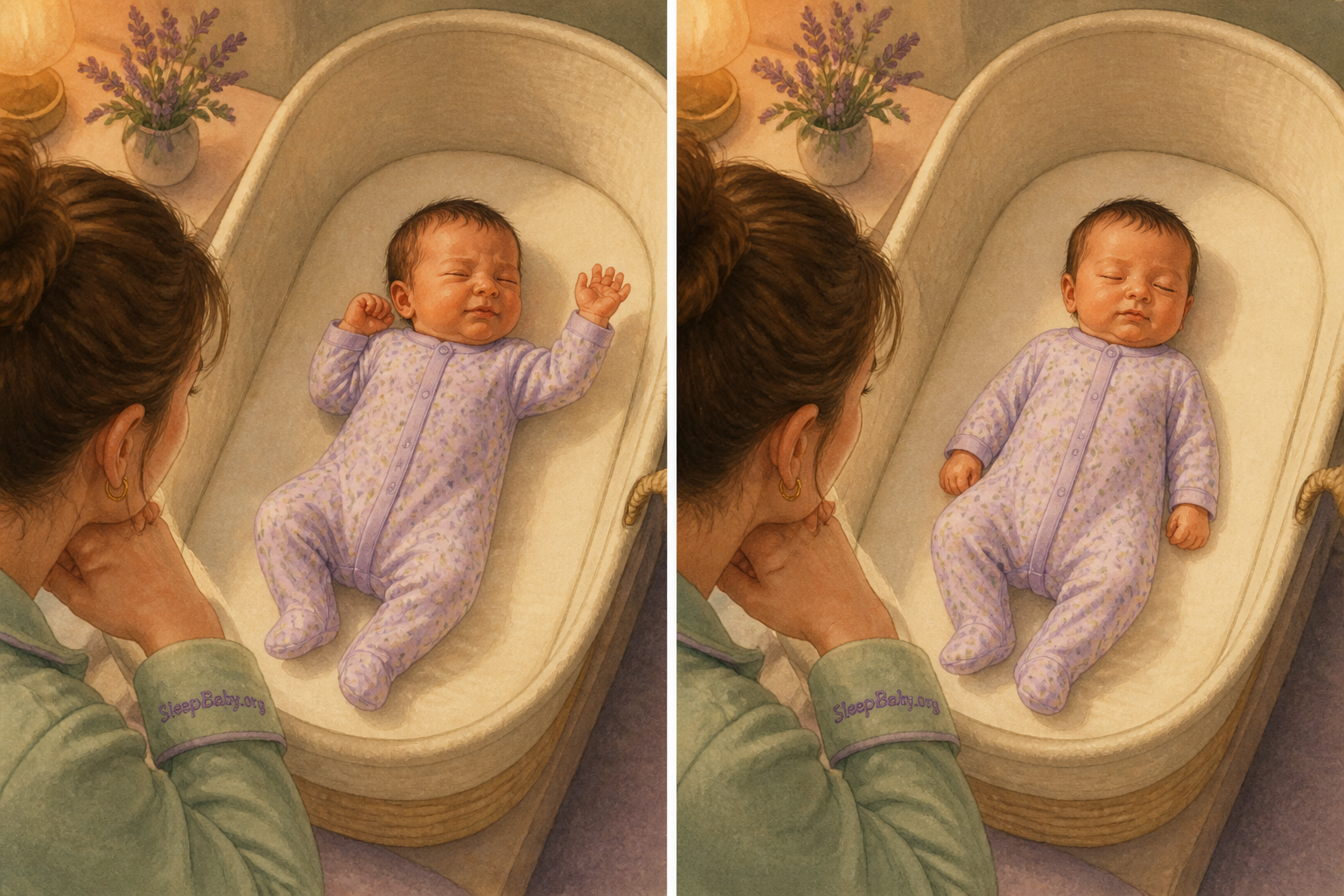
In active sleep, a newborn may twitch, suck, smile, grimace, make small cries, flutter the eyes beneath closed lids, or breathe in an irregular-looking pattern. The body can be surprisingly theatrical while the baby remains asleep. Newborns also commonly begin sleep in active/REM sleep, unlike older children and adults, who more often begin in non-REM sleep. If you want a closer look at those normal noises and movements, our guide to active sleep in babies stays focused on that visible state.
Quiet sleep: stiller, but not a prize to win
Quiet sleep is more still. Breathing tends to look more regular, movements are smaller, and the baby may be harder to rouse. It is tempting to call this the “good†sleep and active sleep the flimsy version, but both states are normal parts of newborn architecture. You do not need to make every sleep period quiet, and active sleep is not poor-quality sleep.
Between recognizable states, a baby may briefly stir or show mixed signs. That transition can look like waking from the outside. A pause long enough to observe—without ignoring hunger, discomfort, or distress—sometimes reveals that the baby was only changing gears.

Baby sleep cycles by age: what changes from birth to 2 years
Development is a slope, not a staircase. The bands below describe broad shifts supported by infant sleep research; they do not assign a required cycle length to an individual child. A 2023 systematic review that gathered 93 studies and data from roughly 90,000 children found a clear overall direction across the first two years: non-REM sleep increases while REM sleep decreases.2 The evidence is much denser in early infancy than from 7 to 24 months, so falsely exact month-by-month numbers would be decoration, not science.
| Age band | Architecture snapshot | What you may notice | Do not turn it into |
|---|---|---|---|
| Birth to about 2 months | Active, quiet, and transitional sleep; active-sleep onset is common. Mean cycles are about 50–60 minutes, with wide observed variation. | Twitching, brief cries, eye movement, uneven-looking breathing, then a stiller phase. Sleep is scattered across day and night. | A fixed 45- or 60-minute timer. |
| About 2–4 months | The day/night rhythm starts organizing and sleep-onset sequencing begins shifting. Active sleep remains prominent. | A little more nighttime concentration, but still plenty of variation and visible movement at transitions. | A universal “four-month switch.†|
| About 4–6 months | More recognizable non-REM staging appears; deeper non-REM sleep becomes better organized. | Transitions may become easier to spot. Waking can change without following one standard pattern. | Proof that sleep must now be adult-like. |
| About 6–12 months | Cycles tend to lengthen across the year. The share of active/REM sleep keeps falling as non-REM becomes more prominent. | Some sleep periods consolidate, while teething, illness, feeding, movement, and separation can still interrupt sleep. | A guarantee of uninterrupted nights. |
| 1–2 years | Architecture continues maturing toward the longer childhood pattern, with non-REM taking a larger share. | Longer, more consolidated sleep is common, but ordinary partial arousals and occasional waking remain possible. | A schedule prescription or a verdict that waking is “behavioral.†|
Birth to about 2 months: active sleep leads the parade
Newborns spend a much larger portion of sleep in active/REM sleep than adults and often enter sleep through that active state. Their sleep-stage cycles are shorter, and their immature circadian rhythm means those cycles appear in clusters around the clock. This is why “sleep-wake cycles in newborns†can refer both to what happens inside a 50-to-60-minute stretch and to the larger day/night pattern that is not yet settled.
The number is not the baby. One newborn might give you a long quiet-looking stretch; another might broadcast every transition like a tiny radio play. Feeding needs, gestational age, health, and individual temperament all shape what a parent sees. For infants under 4 months, the American Academy of Sleep Medicine does not set one total daily sleep recommendation because normal variation is wide and outcome evidence is limited.8
About 2 to 4 months: organization begins, gradually
Over these months, light exposure, feeding, social cues, and brain development help the 24-hour rhythm become more organized. The order of sleep stages also begins changing. This is real development, but it is not a trapdoor that opens on the first day of month four. A baby can show new waking patterns before, during, or after this band—and another baby may change so quietly that nobody labels it a “regression.â€
What is happening is more interesting than the internet shorthand: the brain is differentiating sleep states, the circadian system is gaining influence, and a growing baby is also changing physically and socially. Cycle transitions may become more obvious at the same time, but that does not mean a parent must teach a special skill at every stir.
About 4 to 6 months: non-REM becomes easier to recognize
During the first six months, more mature non-REM features and sequencing become increasingly recognizable.4 “More recognizable†is the careful phrase. Sleep is not suddenly adult sleep, and cycle length, naps, nighttime consolidation, feeding, and waking continue to change. If your particular worry is that your baby never seems to enter deep sleep, that focused guide helps separate noisy, active-looking sleep from signs worth discussing with a clinician.
About 6 to 12 months: cycles tend to lengthen
A 2026 longitudinal study followed 152 infants at 3, 6, and 12 months using more than 35,000 hours of actigraphy. Rhythmic periods of limb inactivity were near 60 minutes and lengthened by about 10 minutes from 3 to 12 months.3 This is useful evidence for gradual cycle lengthening, with one important footnote: actigraphy infers patterns from movement; it is not the same as a full sleep-lab recording of brain activity. It cannot assign one exact cycle length to your baby.
Longer cycles also do not erase waking. A baby can surface because of hunger, illness, temperature, discomfort, teething, a wet diaper, separation awareness, or an environment cue. Architecture changes the stage on which sleep happens; it does not write every scene.
One to 2 years: more mature, still developing
Through toddlerhood, non-REM sleep continues taking a larger share and sleep organization keeps moving toward the childhood pattern. Research in this age range is less dense than in early infancy, so there is no honest reason to print a precise cycle number for every toddler month. Toddlers may twitch, reposition, call out, or partially wake. Persistent snoring, labored breathing, unusual daytime sleepiness, or events involving color, tone, or responsiveness belong in a medical conversation—not in a chart about normal cycles.

Why babies stir at the seam of a cycle
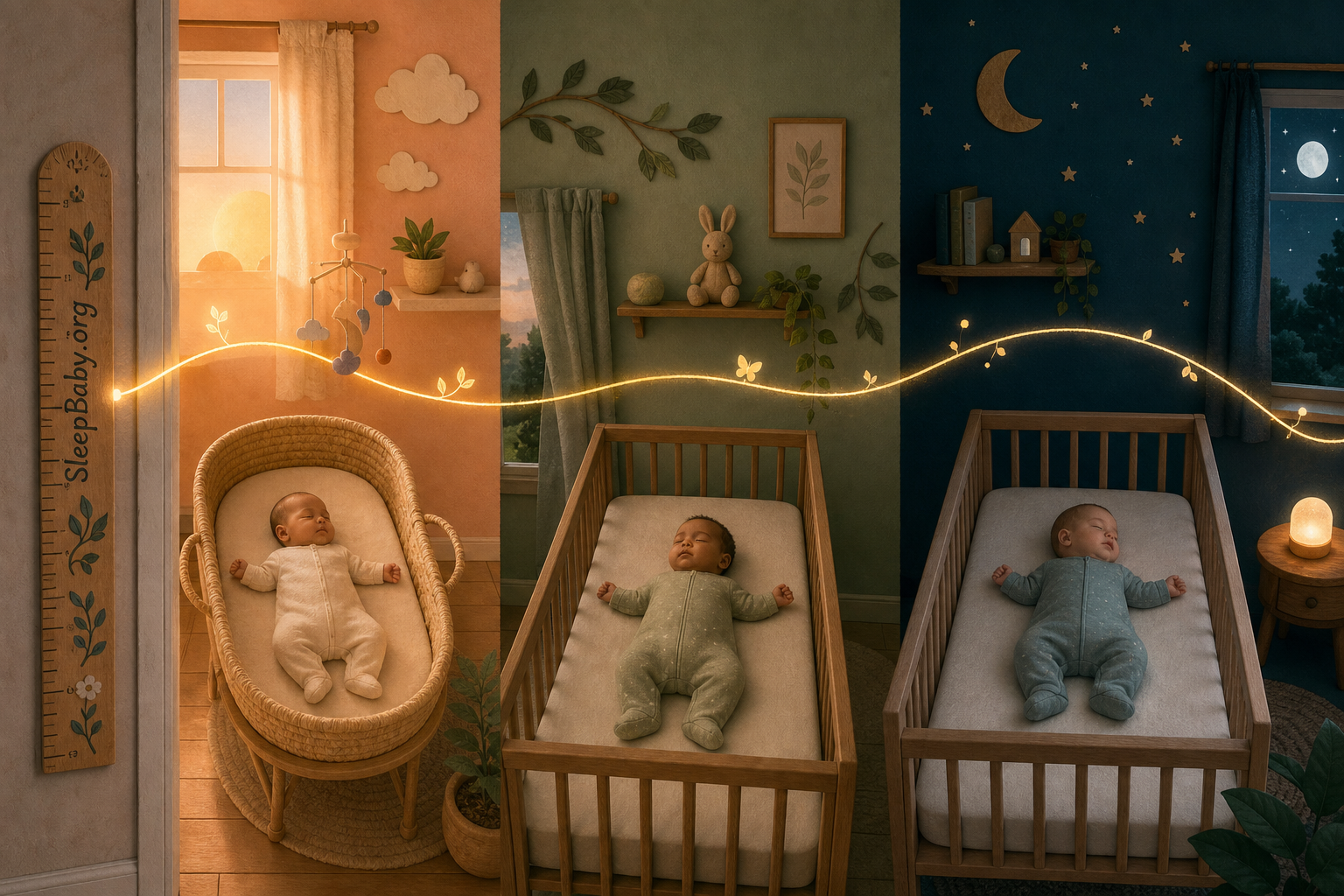
Sleep is not a single depth that stays put until morning. The brain moves between states, and transitions are lighter places. Adults surface briefly too; we usually turn over, pull a blanket, and remember none of it. Babies have shorter cycles, louder bodies, and more needs that require another person, so their seams are easier to witness.
A nap ending at 35, 45, or 60 minutes may line up with a transition, but the time alone cannot prove the cause. Sleep pressure may be low. Hunger may be rising. The room may have changed. Reflux, congestion, pain, light, noise, or a developmental leap may matter. Sometimes the nap was simply the amount of sleep the baby took that day. For a practical look at repeated short naps, visit our short-nap troubleshooting guide; this page stays with the architecture.
At the seam of a cycle
-
Still asleep or in active sleep?
Eyes stay closed; the movement or sound is brief; the body settles again. If your baby is safe and comfortable, a quiet moment of observation may be all that is needed. -
Briefly stirring?
Eyes may open, then close; fussing rises and falls. Pause only as long as feels safe and appropriate. You are gathering information, not running a test. -
Clearly awake or needing help?
Respond to the baby in front of you: feeding, comfort, diapering, temperature, illness, pain, or connection. Knowing about cycles should make your response calmer, not less responsive.
How to observe without turning your nursery into a sleep lab
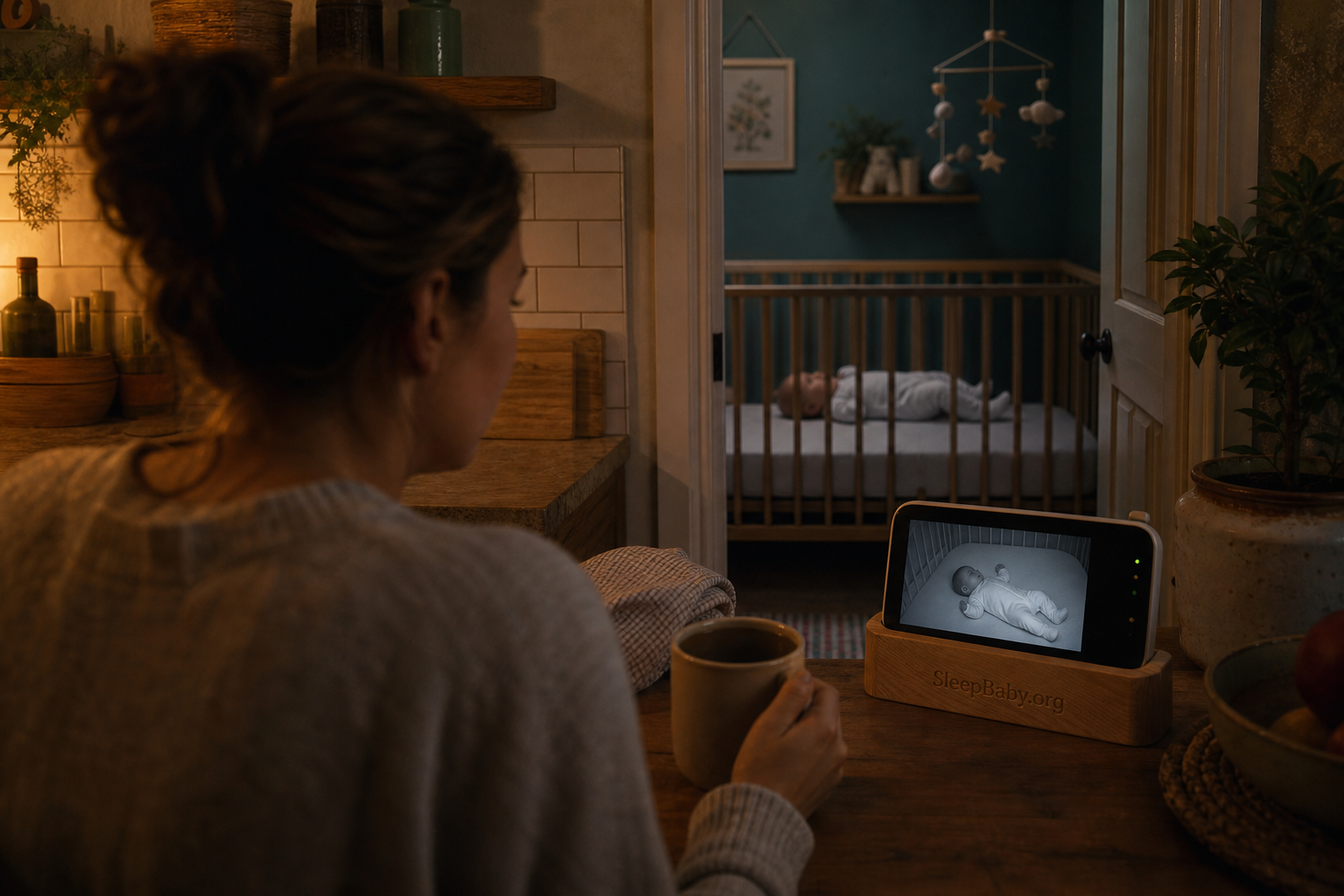
For two or three sleep periods, notice only a few broad things: when the baby fell asleep, when movement or sound changed, whether the eyes actually opened, and what happened without intervention. You are looking for a loose pattern, not trying to score REM from a monitor feed. Consumer monitors cannot diagnose sleep stages, apnea, or a sleep disorder.
If the baby gives one squeak and resettles, you have learned that at least some noises happen inside sleep. If they wake upset at a similar point repeatedly, you have a useful observation to bring to the wider context: feeding, comfort, illness, environment, and total sleep. If timing the minutes makes you more vigilant rather than more informed, put away the stopwatch. A parent’s nervous system deserves a seat at the table too.
Sleep-wake cycles in newborns: why day and night feel upside down
A newborn’s repeated sleep-stage cycles sit inside an immature 24-hour rhythm. Before birth, cues came through the pregnant parent’s body. After birth, the baby’s own circadian system has to become sensitive to the new world’s daylight, darkness, activity, and social rhythms. That development takes time, which is why normal newborn sleep is distributed across both day and night.
You can support the distinction gently: ordinary daylight and household life during daytime, lower stimulation during nighttime care, and a consistent safe sleep setting. That is not a clock-based schedule and it will not override feeding needs. It simply gives the circadian system honest environmental cues. If nights are the immediate struggle, our guide for a newborn who will not sleep at night offers practical next steps without confusing them with cycle architecture.
The reassuring piece is that an upside-down day/night pattern does not mean the baby lacks sleep cycles. The ultradian clock is already repeating active and quiet states. The circadian clock is the apprentice—taking notes, misplacing dawn, and slowly getting better at the job.
Cycle length is not nap length—or total sleep
Three numbers are often treated as interchangeable:
- Cycle length is the time associated with one repeating sequence of sleep states.
- Sleep-period length is how long one nap or nighttime stretch lasts; it may contain part of a cycle or several cycles.
- Total sleep is all sleep across 24 hours, including naps.
For context, the American Academy of Sleep Medicine recommends 12 to 16 total hours in 24 hours for infants 4 to 12 months and 11 to 14 hours for children 1 to 2 years, including naps.8 Those are population-level duration ranges, not uninterrupted stretches and not cycle measurements. Individual need varies, and there is no comparable consensus number for babies under 4 months.
This is also why “my baby wakes after one cycle†is an observation, not a diagnosis. The same pattern can sit inside many different stories. Look at the whole child: feeding and growth, breathing, comfort, alertness while awake, total sleep, and whether the pattern is changing or causing family strain.
Normal transition—or a reason to call for help?
Movement, small sounds, brief eye opening, and irregular-looking breathing can occur in active sleep. But “probably a cycle†should never be used to explain away a change in breathing, color, tone, responsiveness, or a pattern that worries you. You do not need to identify a sleep stage before asking for medical help.
Often part of ordinary sleep
- Brief twitching, sucking, smiles, grimaces, or little cries with eyes closed
- A short stir followed by settling
- Small position changes in an older baby or toddler
- Breathing that varies briefly without color, tone, or responsiveness change
If you are unsure, call your child’s clinician. A written list cannot evaluate your baby.
Act now for emergency signs
Call emergency services now if your baby has a breathing pause longer than 20 seconds, turns blue, gray, or very pale, becomes limp or unusually stiff, is difficult to wake, or has an event involving breathing, color, muscle tone, or responsiveness.
Frequent loud snoring, gasping, labored breathing during sleep, or marked daytime sleepiness also deserves prompt pediatric evaluation.9
Safe sleep does not change with the cycle
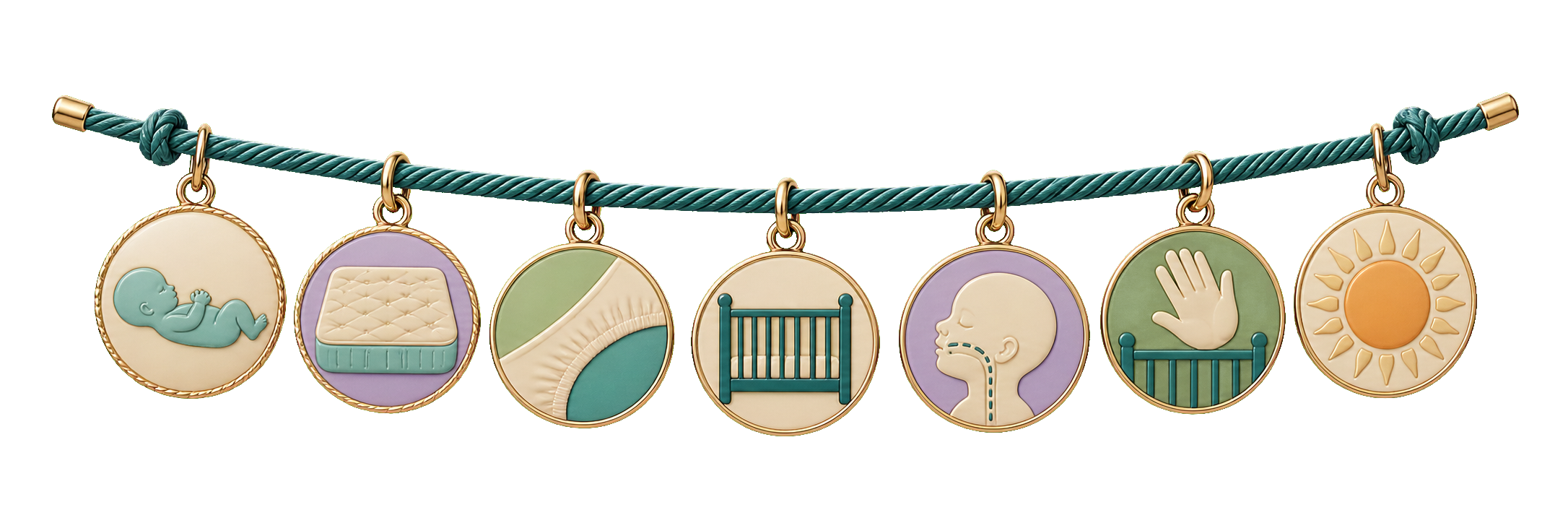
Place your baby on their back for every sleep on a firm, flat, level surface with a fitted sheet and no pillows, loose bedding, bumpers, toys, or other soft objects. Room sharing is safer than bed sharing. If a baby falls asleep in a car seat, swing, carrier, or other sitting device, move them to a firm, flat sleep surface as soon as practical.7
Do not use prone positioning, an incline, positioners, weighted sleep products, or extra bedding to “deepen†sleep or lengthen a cycle. Cycle knowledge is descriptive. It never outranks safe-sleep guidance.
Questions parents ask about baby sleep cycles
How long is a newborn sleep cycle?
Research in healthy term newborns commonly reports an average around 50 to 60 minutes, with observed cycles roughly 30 to 70 minutes.1 That is a study range, not a timer for home use. A shorter or longer sleep period does not, by itself, diagnose a problem.
Do all babies wake after every cycle?
No. Babies move toward lighter sleep and may partially arouse, but many transitions happen without a full waking that a parent sees. Whether a baby wakes and calls depends on age, hunger, comfort, sleep pressure, environment, health, and individual pattern.
Are 45-minute naps always one sleep cycle?
They may line up with a transition for some babies, but 45 minutes does not prove the cause. Newborn cycle observations span a wider range, and sleep periods can end for many reasons. Repeated short naps are best considered alongside the whole day and the child’s wellbeing.
When do baby sleep cycles become like adult cycles?
There is no single date. More mature non-REM features and sequencing become recognizable during the first six months, while cycle length and stage proportions continue developing through the first year and toddlerhood. “Gradually†is more accurate than “at four months.â€
Can I teach my baby to connect sleep cycles?
Sleep architecture matures biologically. Families can use consistent, responsive sleep cues and address comfort or environment, but a stir at a transition is not a skill failure. This article explains the mechanism rather than prescribing a sleep-training method.
Does lots of active sleep mean my baby is not getting deep sleep?
Not necessarily. Active sleep is a large, normal portion of newborn sleep, and what looks busy from the outside may still be sleep. If your baby seems uncomfortable, has concerning breathing, is difficult to wake, is feeding or growing poorly, or you simply feel something is wrong, contact a clinician rather than trying to identify stages by sight.
Sources
- Grigg-Damberger MM, et al. The Visual Scoring of Sleep in Infants 0 to 2 Months of Age. Journal of Clinical Sleep Medicine. 2016.
- Lenehan SM, et al. The Architecture of Early Childhood Sleep Over the First Two Years. Maternal and Child Health Journal. 2023.
- Charting infant sleep cycle development using actigraphy. Sleep. 2026.
- Stores G. Sleep physiology and sleep disorders in childhood. Nature and Science of Sleep. 2013.
- Eunice Kennedy Shriver National Institute of Child Health and Human Development. What happens during sleep?
- American Academy of Pediatrics. Stages of Newborn Sleep.
- American Academy of Pediatrics. How to Keep Your Sleeping Baby Safe: AAP Policy Explained.
- Paruthi S, et al. Recommended Amount of Sleep for Pediatric Populations. American Academy of Sleep Medicine consensus.
- American Academy of Pediatrics. Sleep Apnea in Children: Detection & Treatment; NIH MedlinePlus. Brief resolved unexplained event (BRUE).