Normal curiosity needs a fast safety sort
Putting things in the mouth is normal; what is in there changes the response
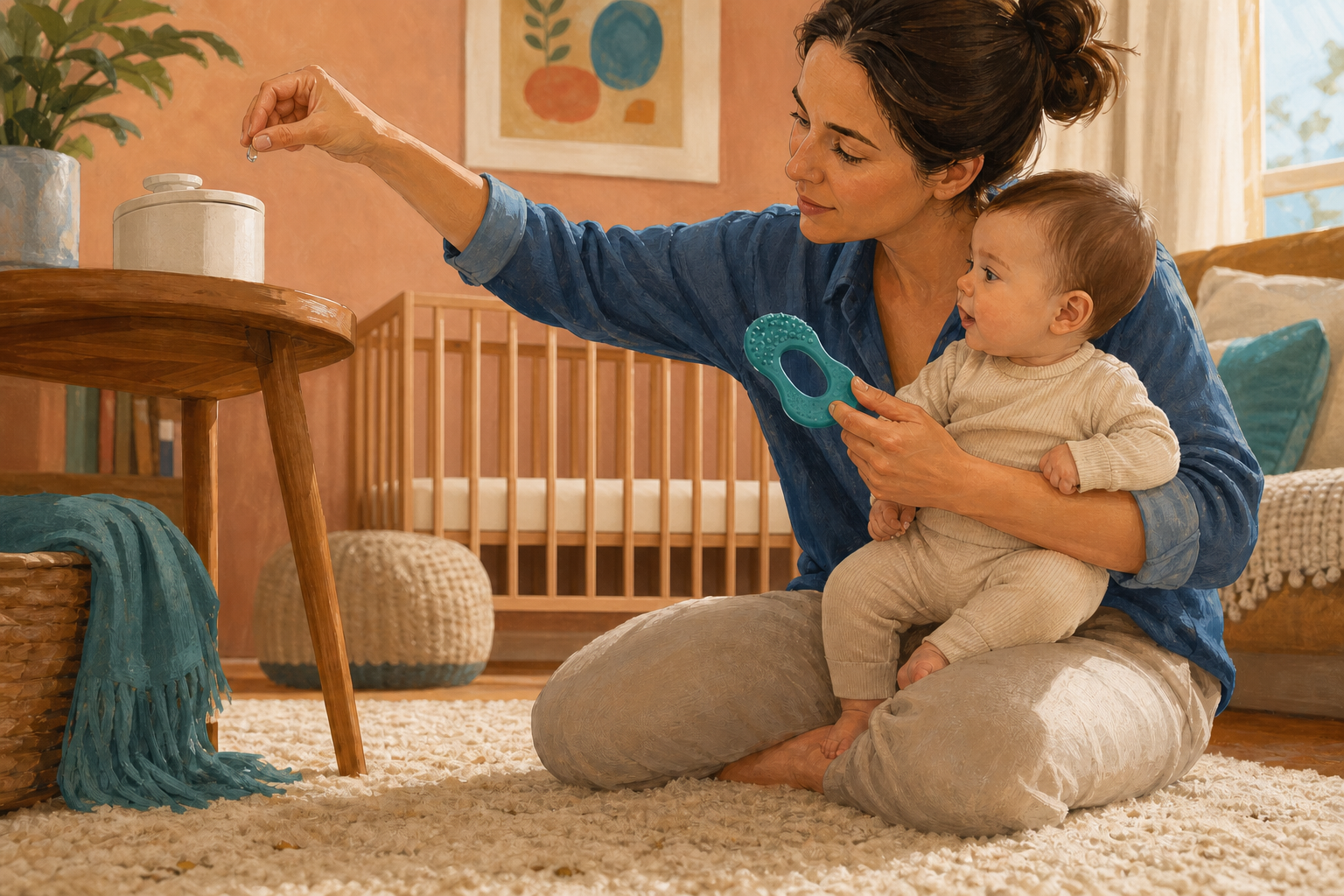
Babies use their mouths to explore, and the CDC includes putting things in the mouth to explore among six-month cognitive milestones. That is the reassuring part. The immediate part is to check whether your baby is breathing normally, identify what the object could be, and decide whether any piece may have been swallowed.1
If your baby cannot breathe, cry, cough effectively, or make sound, has a weak or absent cough, turns blue or gray, or becomes limp, call emergency services now and begin age-appropriate choking first aid as directed. Do not do a blind finger sweep.213
If breathing is normal but a button battery, high-powered magnet, sharp object, medicine, poison, or unknown substance may have been swallowed, do not wait for symptoms. Use the urgent object-specific route below. If this is an intact, age-appropriate object being mouthed while your baby is awake and supervised, calmly trade anything unsuitable for a safe substitute and make the reachable space safer.
The same new reach that lets a baby study a firm teether can find an earring back under a chair or a remote with a loose battery door. That does not make curiosity the problem. Curiosity is normal; access is the part adults can change.
Start with what you can observe right now. The developmental explanation can wait long enough to make sure this is not an airway emergency or a dangerous ingestion.
What you see decides the next move
What to do right now
BREATHING TROUBLE
Call emergency services. If the infant is responsive and has severe choking, use infant choking first aid appropriate to the child’s age and your training while help is activated. Remove an object only when it is clearly visible and easy to retrieve without pushing it deeper.213
MAY HAVE SWALLOWED
A battery, high-powered magnet, sharp object, poison, medicine, nicotine product, chemical, or unknown item needs urgent case-specific help even if your baby looks comfortable. Drooling, gagging, repeated vomiting, pain, refusing food or liquid, or trouble swallowing also needs urgent evaluation.451112
ROUTINE MOUTHING
Calmly trade an unsuitable object for an intact, age-appropriate item. Check whether a piece is missing, a battery door is loose, a magnet has detached, or the contents are unknown. If any of those checks fail, move to the possible-swallow route. Otherwise, supervise and let safe exploration remain safe.
Keep the categories separate: choking is an airway emergency. Swallowing can create poisoning, internal injury, or blockage while breathing still looks normal. Ordinary mouthing is a development and access question.
In the routine branch, make the trade boring and kind. Hold out the safe item, let the baby release the unsuitable one, and move the removed object completely away. A startled shout can turn the object into a prize or a chase. Once it is in your hand, look at the whole item: compare matching pieces when you can, press the battery cover, check seams and edges, and account for anything that could have detached. The calm tone is for the baby; the careful inspection is for you.

Why a baby’s mouth becomes an exploration tool
A baby cannot ask whether the cool rubber ring is smooth, springy, heavy, or easy to grip. The mouth supplies a great deal of sensory information before language can name any of it. Reaching, grasping, transferring an object, and bringing it to the mouth are connected pieces of learning, not four unrelated habits.
The CDC’s six-month milestone is a useful anchor, not a deadline. Its milestone lists describe what most children do by an age and do not replace standardized developmental screening. Babies begin, repeat, and ease away from mouthing on different schedules as mobility, access, temperament, and other skills change.1
Mouthing also does not automatically mean teething, hunger, boredom, anxiety, autism, pica, or a nutrient deficiency. Teething can overlap with the phase, but sometimes the reason is simply that the object was reachable and the baby’s current research department has one very enthusiastic employee.
Watch the whole child rather than trying to diagnose one behavior. Bring loss of skills, feeding difficulty, a broader developmental concern, or a pattern that worries you to your child’s clinician. If the fascination is specifically with fingers and hand discovery, the separate guide to why babies become absorbed in their hands continues that narrower developmental question. It is not a substitute for the CDC milestone guidance or clinical assessment.
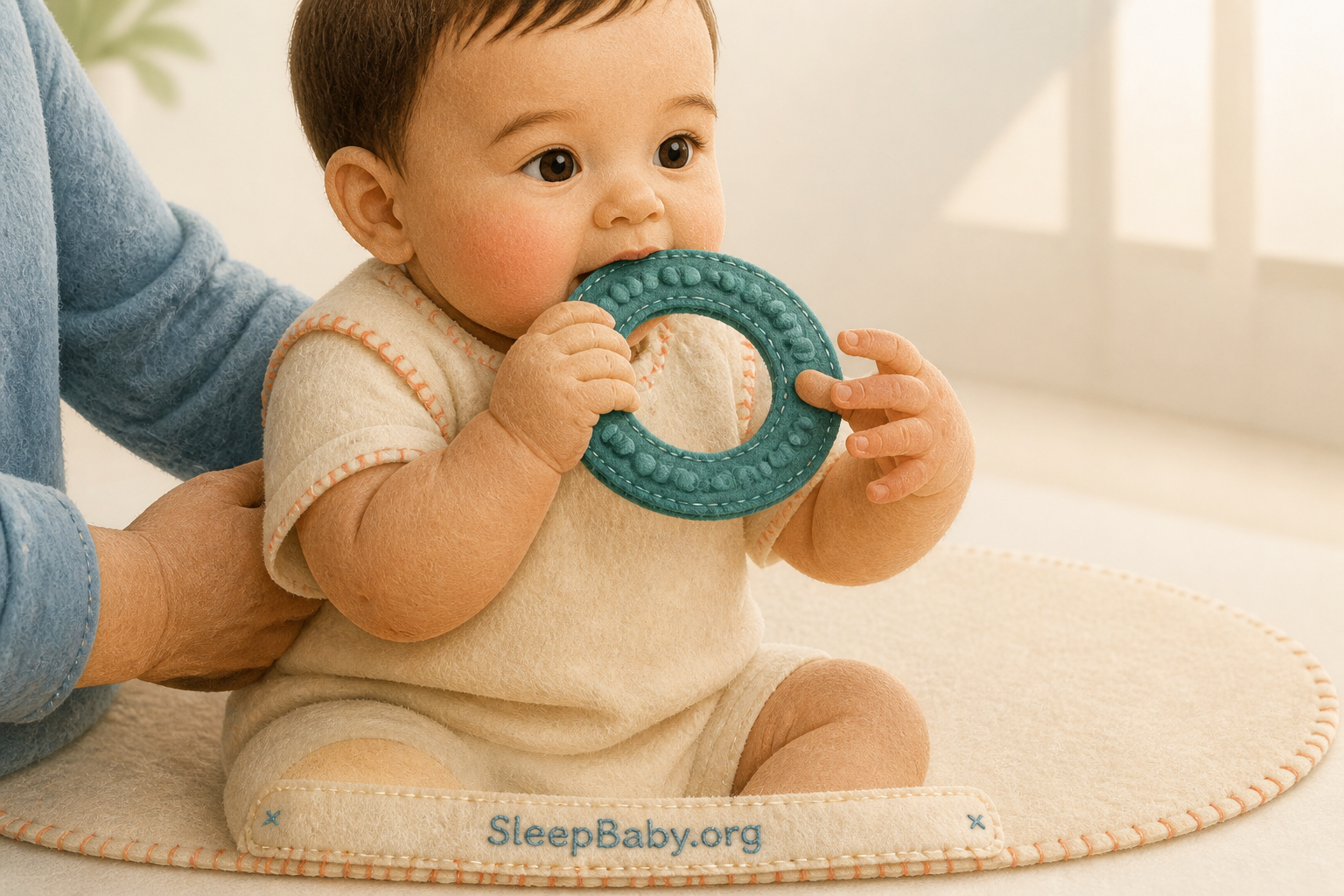
A safe object can be explored without turning the house into a laboratory or the caregiver into a full-time object confiscator. The useful standard is more ordinary: the item is appropriate for the child’s age and stage, it is intact, it is used while the child is awake and supervised, and the few high-consequence hazards are not within reach.
The few objects that change the plan immediately
A comfortable-looking baby is reassuring in many situations. It is not enough reassurance after a suspected button battery or high-powered magnet ingestion. Some dangerous objects can cause serious injury before an infant looks ill. Stop guessing about the object and use the exact route.
Do not wait for symptoms
Match the suspected object to the urgent action
BUTTON BATTERY
Call the National Battery Ingestion Hotline at 1-800-498-8666, Poison Help at 1-800-222-1222, or use webPOISONCONTROL immediately. Do not induce vomiting or delay care. This guide intentionally does not give a general honey instruction because Poison Control’s protocol has strict age, timing, swallowing, dose, and transport conditions, and honey is never for a child younger than 12 months.4
HIGH-POWERED MAGNET
Seek immediate medical attention. Two or more magnets, or a magnet and another metal object, can attract through tissue and cause severe injury. A missing magnet from an older child’s set is not a wait-and-see mystery.5
SHARP OBJECT
Seek emergency evaluation. Do not try to push a pin, shard, hook, screw, or other sharp object through with food, and do not attempt a home extraction when it is not plainly and safely retrievable.11
POISON OR UNKNOWN SUBSTANCE
If the child is unconscious, not breathing, or having a seizure, call emergency services. Otherwise, call Poison Help at 1-800-222-1222 or use webPOISONCONTROL for case-specific instructions. Do not induce vomiting or give a home antidote.12
POSSIBLE BLOCKAGE
Drooling, gagging, repeated vomiting, refusing food or liquid, pain, or trouble swallowing can mean an object is lodged. Get urgent clinical evaluation. Breathing trouble moves the situation straight to emergency services.11
When the object is unknown: uncertainty is part of the risk. A torn package, open compartment, detached piece, or missing count is a reason to call for object-specific help, not a reason to wait for the baby to look sick.
When the airway is the emergency
Severe choking signs in an infant include a weak or absent cough, inability to cry or make sound, inability to breathe, pale or blue color, or limpness. Activate emergency services. For a responsive choking infant, the American Red Cross teaches five back blows followed by five chest thrusts, repeated as needed while help is activated. Follow the dispatcher, and use the method appropriate to the child’s age and your training.213
Do not sweep a finger through a baby’s mouth when you cannot see the object. A blind sweep can push it deeper. If an object is clearly visible and easy to remove without forcing it farther back, retrieve it carefully. An article can remind you of the route; it cannot replace certified hands-on infant first-aid and CPR training.
For the official visual and written route, open the American Red Cross infant choking resource directly when you can learn calmly. In an active emergency, call emergency services rather than waiting for a page or video.
Teething can overlap without explaining every object
The FDA says teething commonly begins around 4 to 7 months. That timing helps explain why sore gums and developmental mouthing often arrive in the same season, but it is not a precise calendar and it does not make every household object a teething tool.6
For simple gum comfort, the useful choices are pleasantly unglamorous: a clean finger to massage the gums or a firm rubber teether intended for the child’s age. Cool an item only as its instructions allow; do not freeze it hard. Inspect it before use, and retire it when there is a tear, leak, detached piece, rough edge, or other damage.
Soothe the gums without adding a new hazard
Choose, inspect, or leave it out
USE WHILE AWAKE
- A clean finger for gentle gum massage
- A firm rubber teether intended for the child’s age
- Cooling only as the product instructions allow
INSPECT FIRST
- Age and developmental fit
- Tears, leaks, cracks, rough edges, or loose pieces
- Strings, clips, battery doors, or added attachments
DO NOT USE
- Benzocaine or lidocaine teething products
- Homeopathic teething tablets or gels
- Teething necklaces, bracelets, or other jewelry
- Objects frozen hard enough to injure gums
Keep food out of this shortcut: a food is not a teether unless the child is developmentally ready for that exact food and current feeding-safety guidance supports it. This is not a feeding-readiness guide.
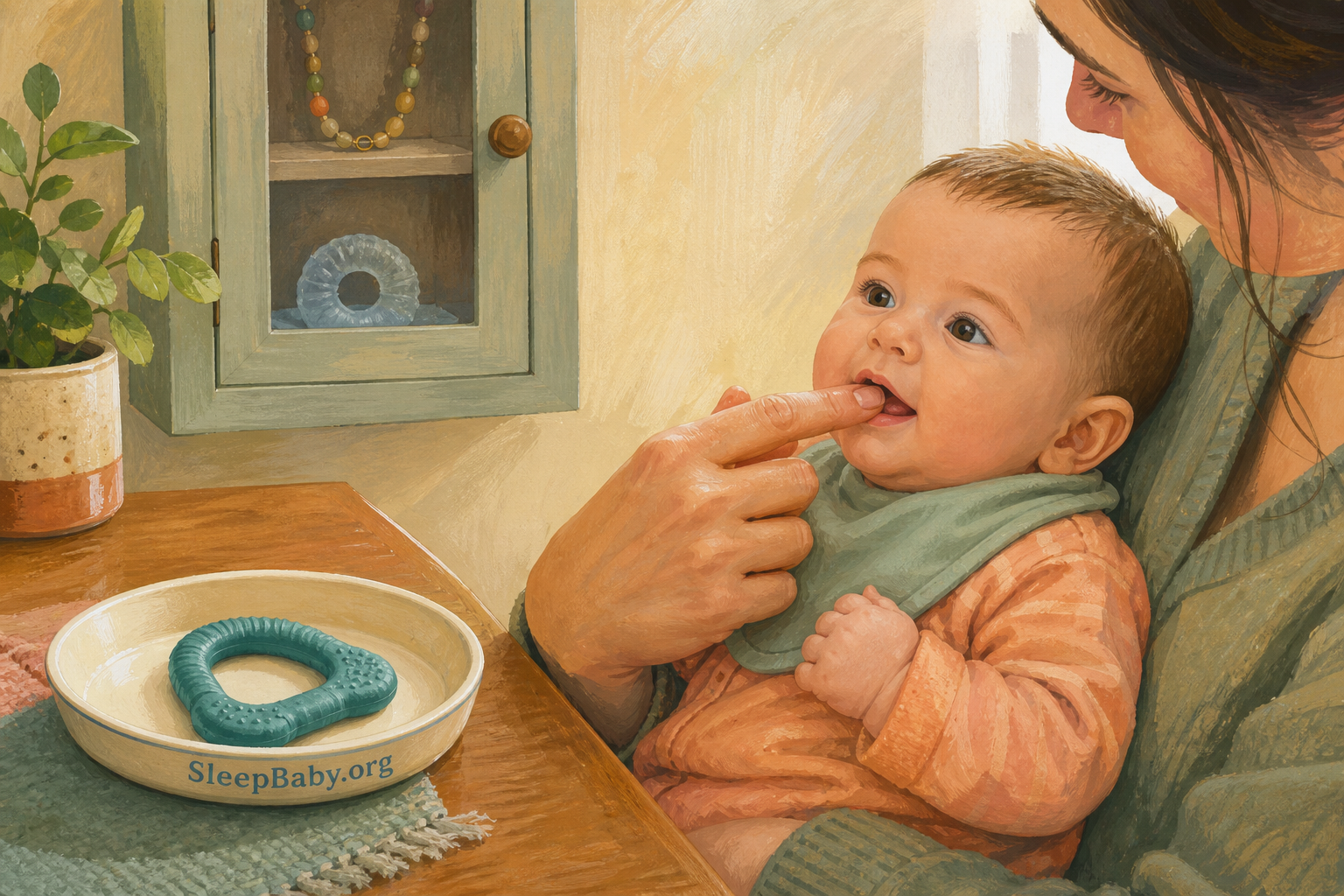
Teething jewelry adds choking and strangulation risk and does not become safe because a caregiver plans to watch closely. The same is true of an inappropriate small part: supervision matters, but it does not change the object’s construction or where it can lodge.6
Sweep what your baby can reach, from the baby’s height
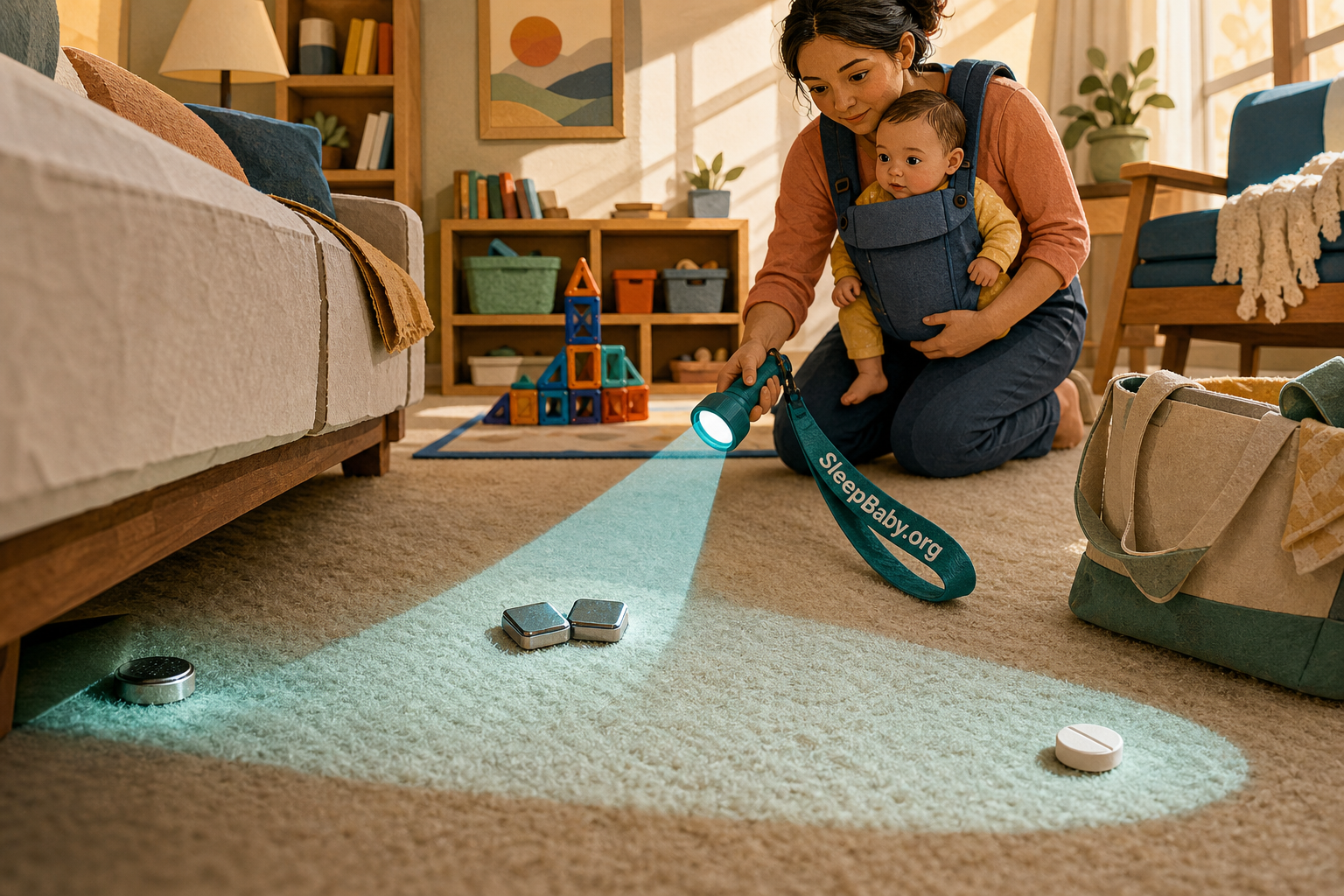
The floor can look clear from standing height and still hold a battery under the sofa lip, a pill beside a visitor’s bag, or a magnetic piece at the edge of an older child’s play mat. Get down on one knee. Keep the baby safely within arm’s reach or with another adult, then scan the actual path of hands that now stretch farther than they did last week.
This is not a cleanliness contest. You are not hunting every speck of ordinary life. You are removing the small set of objects that can obstruct an airway, burn tissue, poison, cut, attract through tissue, or break apart.
Follow the reach, not the room label
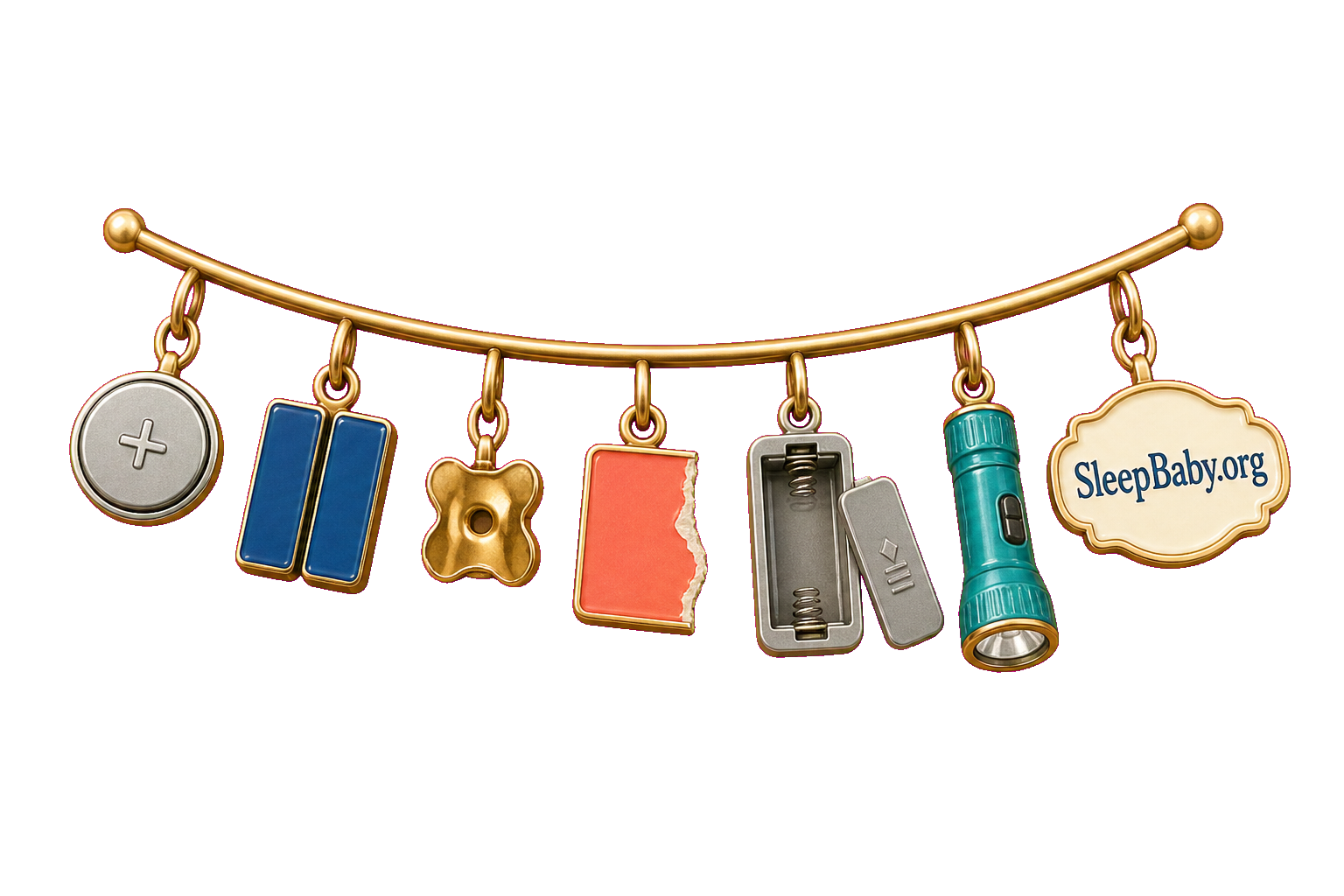
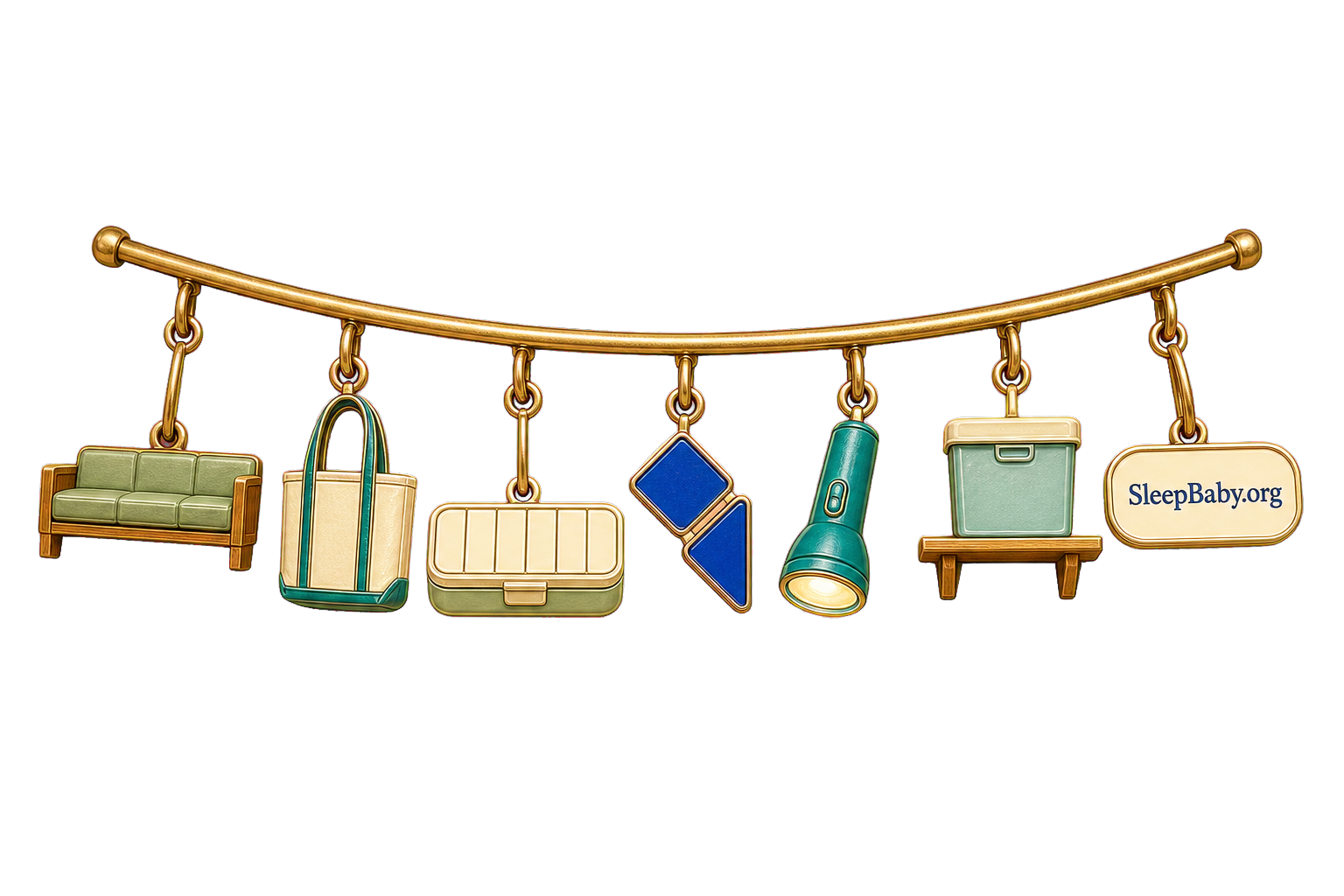
Five places small hazards hide
FLOOR AND FURNITURE
Look under sofas, beds, changing tables, and car seats; inside couch seams and low baskets; along rug edges, floor vents, and baseboards. Watch for coins, caps, beads, jewelry backs, pins, screws, glass, balloon pieces, and broken plastic.
DEVICES AND BATTERIES
Check remote controls, key fobs, scales, thermometers, greeting cards, light-up shoes, musical books, hearing devices, and toys. A battery door should be secure; a loose cover or missing battery changes the plan immediately.
BAGS AND POCKETS
Move diaper bags, handbags, visitor luggage, coat pockets, bedside items, pill organizers, nicotine products, cosmetics, essential oils, alcohol, medicines, vitamins, and cleaning products completely out of reach.
OLDER-CHILD PLAY
Give small-piece crafts, building sets, board games, magnetic toys, and school supplies one high shelf or closed container. Count high-powered magnets before and after play, then check the floor before the baby returns.
AWAY FROM HOME
Repeat the scan in hotel rooms, rental homes, waiting rooms, cars, playground edges, and grandparents’ houses. Outdoors, remember that soil and peeling-paint dust are exposure questions even when there is no obvious small object.
The older-sibling handoff: this is not blame. It is a predictable border between small-piece play and baby access, with a container, a count, and one floor check before the spaces mix again.
Repeat the sweep when the environment changes, not only on a cleaning schedule. A baby who begins rolling, crawling, pulling up, or cruising has a new reachable world. So does a room after visitors arrive, groceries are unpacked, a sibling finishes a project, a suitcase opens, or furniture moves. One high shelf for adult pocket contents and one closed place for small-piece play solve more than repeated reminders shouted across the room.
The AAP advises checking floors and older siblings’ play for choking hazards and securing medicines, poisons, and battery compartments.212 The CPSC small-parts cylinder is a defined regulatory instrument used in product rules. A cardboard tube or toilet-paper roll is not an exact substitute, a legal certification, or a guarantee that an object is safe. Product age labels, intact construction, and the child’s development still matter.3
If the worry is a specific ordinary item found on the floor, first clear the airway, battery, magnet, sharp-object, poison, and unknown-item exits in this guide. Then the separate guide to what to consider after a baby ate something off the floor can continue that narrower incident without replacing urgent advice.
Lead dust and soil need their own boundary
Hand-to-mouth behavior can also carry contaminants that are not shaped like a bead or coin. In older housing, deteriorating lead-based paint and renovation dust can settle on floors, windowsills, hands, and toys. The EPA identifies lead-contaminated paint dust as a major residential source of childhood exposure.7
Soil near older buildings, busy roads, or past industrial activity may contain lead that reaches the mouth on hands, shoes, or outdoor toys. Reduce tracked-in soil, wash hands and frequently mouthed toys after exposure, and use wet cleaning methods appropriate to the surface. Keep children away from peeling paint and renovation dust, and follow EPA-safe renovation practices rather than dry sanding or sweeping suspect dust into the air.78
A baby can look well despite lead exposure. If the home, renovation, soil, or another setting raises concern, ask the child’s clinician or local health department whether a blood lead test is appropriate. Ordinary mouthing does not prove lead poisoning, and one cleaning routine cannot guarantee prevention.
Mouthing is not automatically pica
Pica involves eating nonfood material over a sustained period, with age, development, the substance, and the pattern all shaping clinical assessment. Briefly mouthing an object, licking something, or having one isolated incident is not enough to label an infant with pica.10
Describe the pattern before naming it
What to notice for the clinician
USUALLY EXPLORATION
The child briefly mouths or licks an object, accepts a safe trade, and is not repeatedly seeking and swallowing the same nonfood material. Continue supervision and the reach sweep.
WRITE DOWN
Record what is mouthed versus swallowed, how often, for how long, where it comes from, whether pieces are missing, and any pain, vomiting, stool, feeding, or growth changes. Note paint, renovation, soil, battery, magnet, or medicine exposure.
CALL THE CLINICIAN
Discuss persistent intentional nonfood eating, repeated pursuit of the same substance, repeated swallowing, abdominal symptoms, feeding or growth concerns, or possible paint, soil, or lead exposure. Use the urgent routes above for batteries, magnets, sharp objects, poisons, blockage signs, or breathing trouble.
Bring observations, not a home diagnosis: a clinician may consider iron, zinc, lead, or other testing based on the exact pattern and exposure. Do not start supplements or attach an autism or psychiatric label to mouthing alone.
The point of a note is not to turn the week into surveillance. It is to preserve the details that disappear in a rushed appointment: whether the child was tasting, chewing, or swallowing; whether the same material keeps returning; and whether the environment adds a lead, medicine, battery, magnet, or obstruction concern.
From awake exploration to a bare sleep space
An item that is appropriate while a baby is awake and supervised does not automatically belong beside a sleeping infant. A teether, sensory toy, clip, necklace, or soft object leaves the sleep space before the baby goes down.
Use a firm, flat, noninclined infant sleep surface with only the fitted sheet. Keep toys, teethers, loose bedding, pillows, bumpers, positioning products, cords, clips, necklaces, and other objects out. Place the baby on the back for every sleep.9

Put the awake-time teether in a caddy or designated place outside the crib. Familiarity can come from the sequence instead: feed, diaper, sleep clothing, dim light, voice, and placement. The object does not have to remain with the baby to make the transition recognizable.
This is the SleepBaby.org handoff I would keep: the last floor sweep before bed is not a cleanliness contest. It is a handoff. Batteries, magnets, pills, coins, cords, and small pieces leave the baby’s reach; the teether leaves the crib; the familiar sleep sequence can begin without carrying awake-time objects into the sleep space.
Questions that change the next action
Should I stop my baby from mouthing everything?
Do not punish or shame normal exploration. Calmly remove unsuitable objects, offer an intact age-appropriate substitute, and change access. If the behavior involves repeated swallowing, a persistent nonfood material, symptoms, or broader developmental concerns, bring the pattern to the child’s clinician.
What if I did not see whether something was swallowed?
Inspect the object and surroundings. Look for a missing battery, magnet, sharp piece, medicine, chemical, nicotine product, or torn unknown package. Check for drooling, gagging, vomiting, pain, refusal to eat or drink, trouble swallowing, or breathing changes. A possible battery, magnet, sharp object, poison, or unknown item deserves urgent help even when there are no symptoms.4511
What if the object was a baby wipe?
Start with breathing and swallowing signs, and identify the exact product. If there is choking, trouble swallowing, repeated vomiting, suspected poisoning, or uncertainty about another substance, use emergency or Poison Control guidance. For the narrower intact-wipe incident, see what to do when a baby ate part of a baby wipe after those urgent exits are clear.
How clean do mouthed toys need to be?
Follow the manufacturer’s cleaning instructions and clean after obvious contamination or illness-related need. The safety goal is not a sterile house or a fixed daily quota. Integrity matters too: a clean toy with a tear, loose piece, leaking filling, unsecured battery door, or inappropriate size is not ready to return.
When do babies stop putting everything in their mouths?
There is no single stop date. The pattern usually changes as movement, play, language, and other ways of investigating the world expand, but the timing varies. Use the behavior in context. Loss of skills, feeding trouble, persistent intentional swallowing, symptoms, exposure concerns, or a pattern that troubles you belongs in a clinician conversation rather than an internet deadline.110
The one-minute household handoff
Before the room changes hands
Five quiet checks, then move on
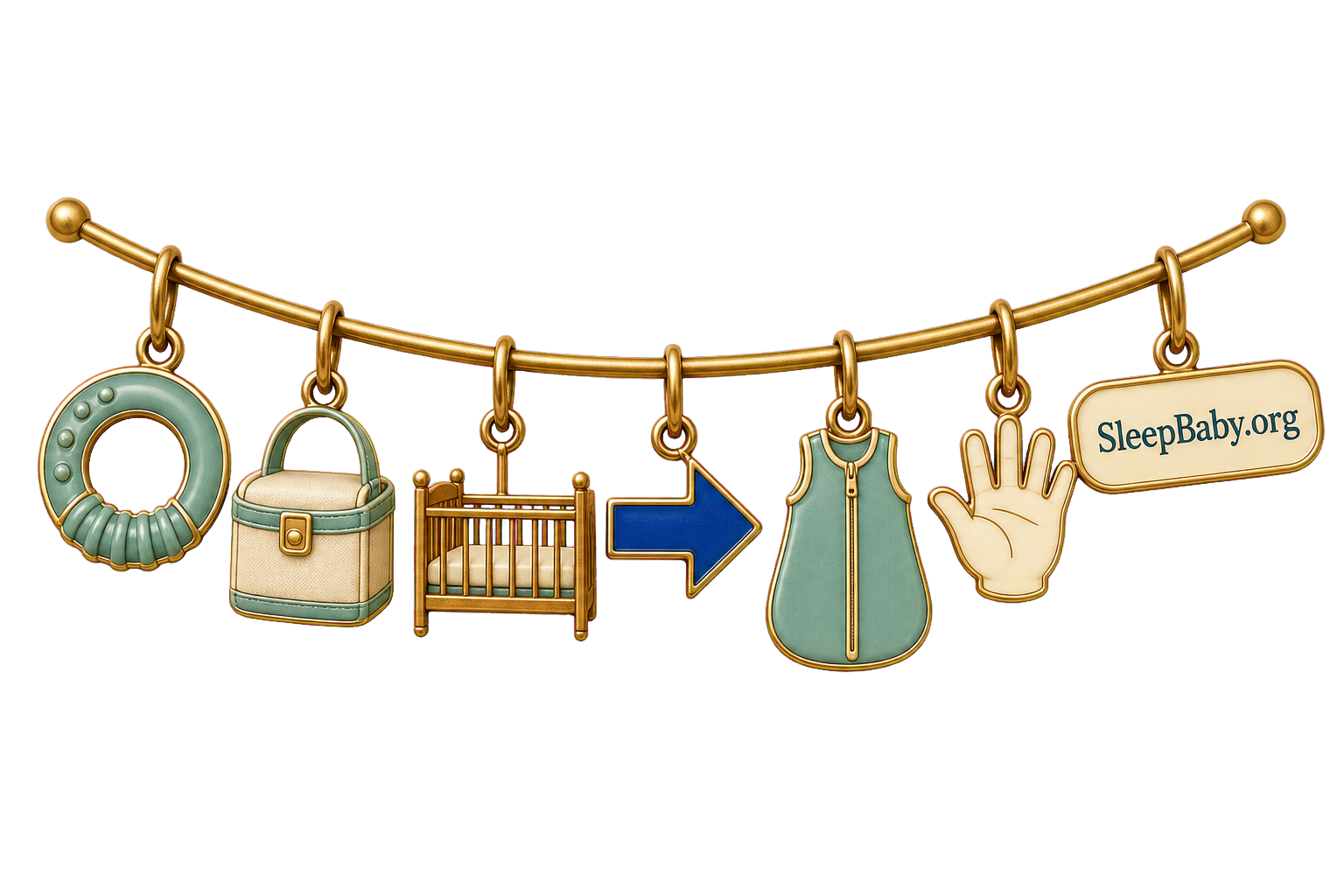
- Breathe: confirm there is no airway emergency before investigating the object.
- Identify: account for batteries, magnets, sharp pieces, medicines, poisons, and unknown contents.
- Trade: replace an unsuitable object with an intact age-appropriate item for supervised awake use.
- Sweep: check the floor, furniture edges, devices, bags, and older-child play from baby height.
- Put away: return the teether or toy to its caddy before the baby enters a bare sleep space.
The goal is not to stop the learning: it is to give normal curiosity a reachable world that does not hide the few objects capable of causing harm quickly.
Sources
- CDC: Milestones by 6 Months – mouthing as exploration, milestone context, and the act-early boundary.
- American Academy of Pediatrics: Choking Prevention and First Aid – choking signs, floor and sibling checks, small-object prevention, and emergency response.
- U.S. Consumer Product Safety Commission: Small Parts for Toys and Children’s Products – the regulatory small-parts cylinder, age labels, and detachable-part rules.
- Poison Control: Button Batteries – immediate hotline and Poison Control action, no waiting, no vomiting, and the tightly limited honey protocol.
- U.S. Consumer Product Safety Commission: Magnets Safety Education Center – immediate medical attention and internal injury risk.
- U.S. Food and Drug Administration: Safely Soothing Teething Pain – teething timing, safer soothing, and products to avoid.
- U.S. Environmental Protection Agency: Residential Childhood Lead Exposure – deteriorating paint dust, reachable surfaces, and hand-to-mouth exposure.
- U.S. Environmental Protection Agency: Lead in Soil – soil exposure, tracked-in contamination, hand and toy cleaning, and testing conversations.
- American Academy of Pediatrics: How to Keep Your Sleeping Baby Safe – firm flat noninclined surface, fitted sheet, back placement, and a bare sleep space.
- MedlinePlus: Pica – sustained nonfood eating, developmental context, exposure risks, and clinician-led testing.
- American Academy of Pediatrics: Swallowed Foreign Object – urgent objects, blockage signs, and breathing escalation.
- American Academy of Pediatrics: Childproofing Your Home – poison storage, battery compartments, emergency signs, Poison Help, and no induced vomiting.
- American Red Cross: Infant Choking – severe choking signs, emergency activation, back blows, chest thrusts, and no blind finger sweep.
When the reachable world is safer tonight
Give the evening one less loose end
The floor sweep, toy-caddy handoff, and bare crib can become one repeatable piece of the night instead of three anxious checks performed at random. The SleepBaby.org Workshop can help you build the wider bedtime order around the baby you actually have, without pretending curiosity or sleep follows one household script.