A calmer way to read the half-birthday
Six months is a developmental snapshot, not a tiny performance review
By the end of six months, many babies know familiar people, laugh, trade sounds, reach for things they want, explore objects with their mouths, roll from tummy to back, push up on straight arms, and lean on their hands while sitting. Those are examples of what development can look like now—not a demand that every baby unveil every skill on the exact day a half-birthday photo appears.
I know how quickly delight becomes an invisible scoreboard. One minute you are applauding a raspberry noise worthy of a very small, very damp trumpet section; the next, you are quietly wondering what it means that another baby in your group chat is already sitting. The useful question is not “Did my baby pass six months?” It is “What pattern of progress am I seeing across movement, communication, thinking, play, and connection?”
The CDC defines developmental milestones as skills that most children—75% or more—can do by a given age. That makes its six-month list a useful set of things to notice and share. It does not turn the list into a diagnosis, a race, or a promise of identical timing. The CDC also separates milestone monitoring from standardized developmental screening, which uses validated tools and professional interpretation. See the CDC’s six-month milestone guidance.
If you arrived searching for 6 month old milestones, 6 month baby milestones, or six month milestones, this guide keeps all three questions on one page: what you may notice, how ordinary variation works, ways to offer safe opportunities, and the point where I would stop watching quietly and ask for help.


The six-month snapshot
Four domains, one whole baby
These are the CDC’s specific six-month examples. Read them as conversation starters, not a home exam.
Connection
- Knows familiar people
- Likes looking in a mirror
- Laughs
Communication
- Takes turns making sounds
- Blows raspberries
- Squeals
Thinking and exploring
- Mouths objects to explore
- Reaches for a wanted toy
- Closes lips to refuse more food
Movement
- Rolls tummy to back
- Pushes up with straight arms
- Leans on hands while sitting
What is not on this list: crawling, pulling to stand, waving, saying words, using a pincer grasp, or sitting independently. Some babies may be experimenting with some of those. They are not required six-month checklist items.
Created for SleepBaby.org · A whole-child view keeps one flashy skill from carrying the entire story.
Social and emotional milestones often live in tiny ordinary moments
A baby may brighten when a familiar person leans over the play mat, study a face in the mirror as if meeting a fascinating new neighbor, or laugh when you repeat the same ridiculous sound for the fourteenth time. The skill is not “performs for company.” It is recognition, interest, and back-and-forth connection showing up in the baby’s own style.
Some babies laugh easily. Others offer a solemn stare, then a slow grin when the room gets quiet. Temperament changes the volume of a response; it does not make connection unimportant. Look for the baby noticing familiar people and participating in a shared moment. A look, kick, pause, smile, squeal, or lean toward you can all be part of that exchange.
A safe mirror can be especially revealing because there is no pressure to “do” anything. Sit together, name what you notice, and pause. If the baby turns away, that is useful communication too. I would rather see a parent follow a baby’s cue than keep chasing a milestone after the baby has clearly clocked out.
What I am listening for is an exchange, not a polished performance. A solemn stare followed by one tiny kick may carry more developmental information than the laugh an adult was trying to coax out for the camera.

Six-month communication is conversation before it is vocabulary
At this age, communication can sound like raspberries, squeals, vowel-like noises, protests, and delighted shrieks that make everyone in the grocery aisle look around. The CDC asks whether a baby takes turns making sounds. That turn-taking matters more here than whether the sound resembles a word.
Try one sound, then wait. If your baby answers, imitate it once and pause again. This is not speech therapy at the kitchen table, and it does not need flash cards. It is the early rhythm of “I did something; you noticed; now it is your turn.” Reading and singing belong here too, even when the baby contributes only a serious eyebrow and one enthusiastic foot.
A quiet baby may need more time or a less stimulating room before offering sounds. A loud baby may practice the same squeal until the dog questions the household arrangement. Notice changes over days, not one tired ten-minute window. Do not add requirements such as words, waving, or reliably responding to a name to the six-month checklist; those belong to later conversations and broader developmental windows.
I would make the room quieter before I made the conclusion bigger. Then I would try the same pause at a few ordinary times and notice whether the baby answers with a sound, face, movement, or expectant look. Communication at six months has more than one volume setting.

Reaching and mouthing are early research projects
A six-month-old does not politely inspect an object and return it to the shelf. The research method is usually reach, grab, rotate, bang, and mouth. The CDC includes bringing objects to the mouth to explore and reaching for a wanted toy. That is why the setup matters: the object must be clean, age-appropriate, too large to choke on, and free of loose, sharp, breakable, or button-battery parts.
Place one interesting object within reach rather than surrounding the baby with a toy-store avalanche. A textured ring, soft cloth book, or simple cup can reveal more than a pile because you can see the baby choose, reach, transfer attention, and persist. If the object rolls away, wait a beat before rescuing it. Curiosity needs room, but frustration does not need to become a character-building seminar.
The CDC also lists closing the lips to show that no more food is wanted. On this page, that is not a feeding schedule or solids plan. It is an example of agency and communication: the baby is expressing “no more” with the body. Follow feeding questions with your pediatrician, and keep the broader milestone lesson—your baby’s refusal cue is information, not misbehavior.
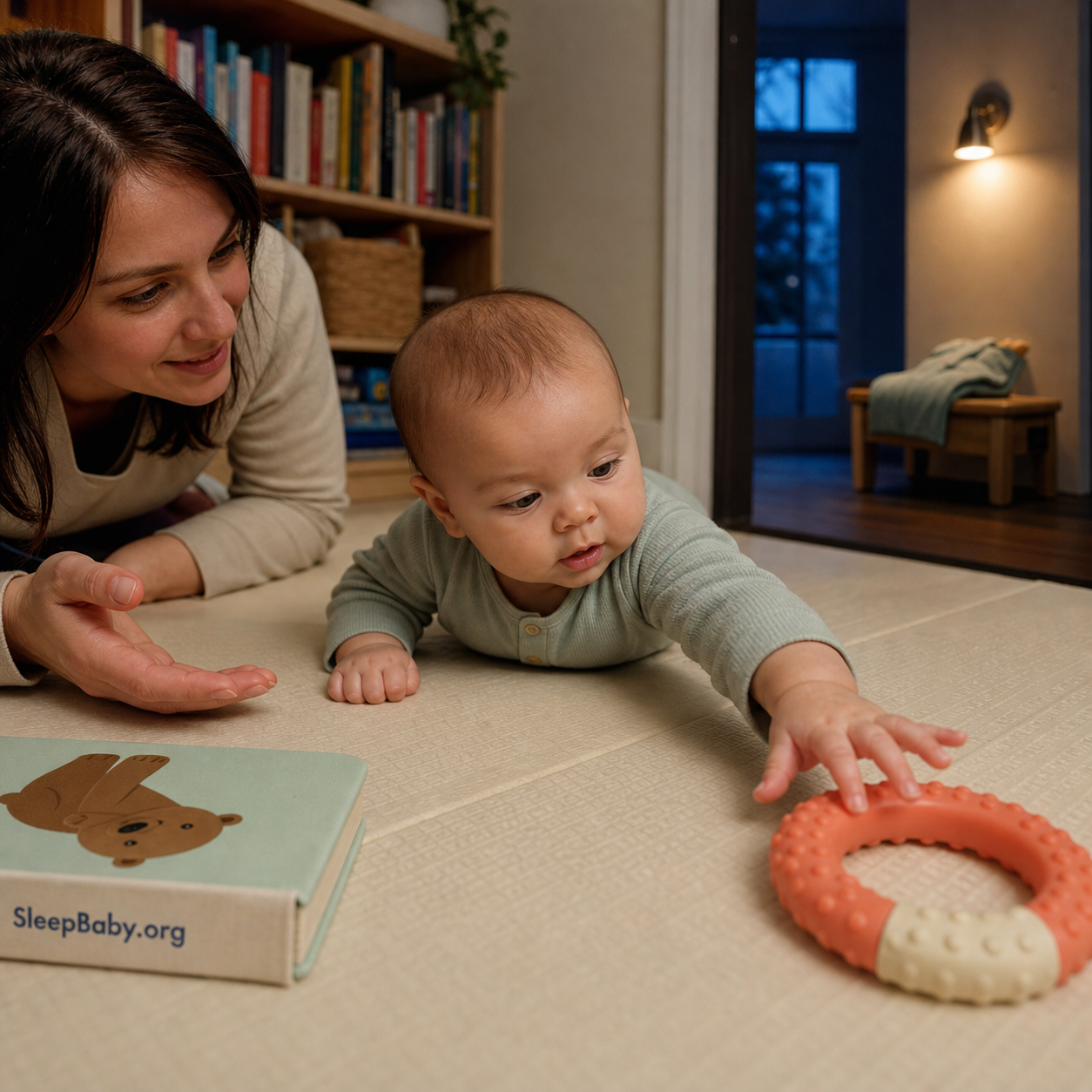
A floor-play menu
Offer an invitation, then let the baby answer
These are opportunities, not drills. Use the version that fits your baby’s awake, comfortable moment and stop when the baby is tired or distressed.
Smile, pause, answer
Copy one facial expression or sound, wait, and respond to whatever comes next. Invites: connection and sound turns.
Mirror hello
Sit with a securely placed baby-safe mirror and describe the face, hands, or smile. Invites: attention and shared delight.
One-toy reach
Place one safe object slightly to the side and within a reasonable reach. Invites: choice, reaching, and shifting weight.
Book-and-babble pause
Read one page, leave a pause, and treat a look or noise as a contribution. Invites: listening and turn-taking.
Supervised tummy-time view
Get down at eye level while the baby is awake on a firm floor surface. Invites: pushing up, head turning, and shared attention.
SleepBaby.org teaching note · Development grows through responsive everyday exchanges, not milestone boot camp.
Movement at six months: rolling, pushing, propping—and plenty of wobble
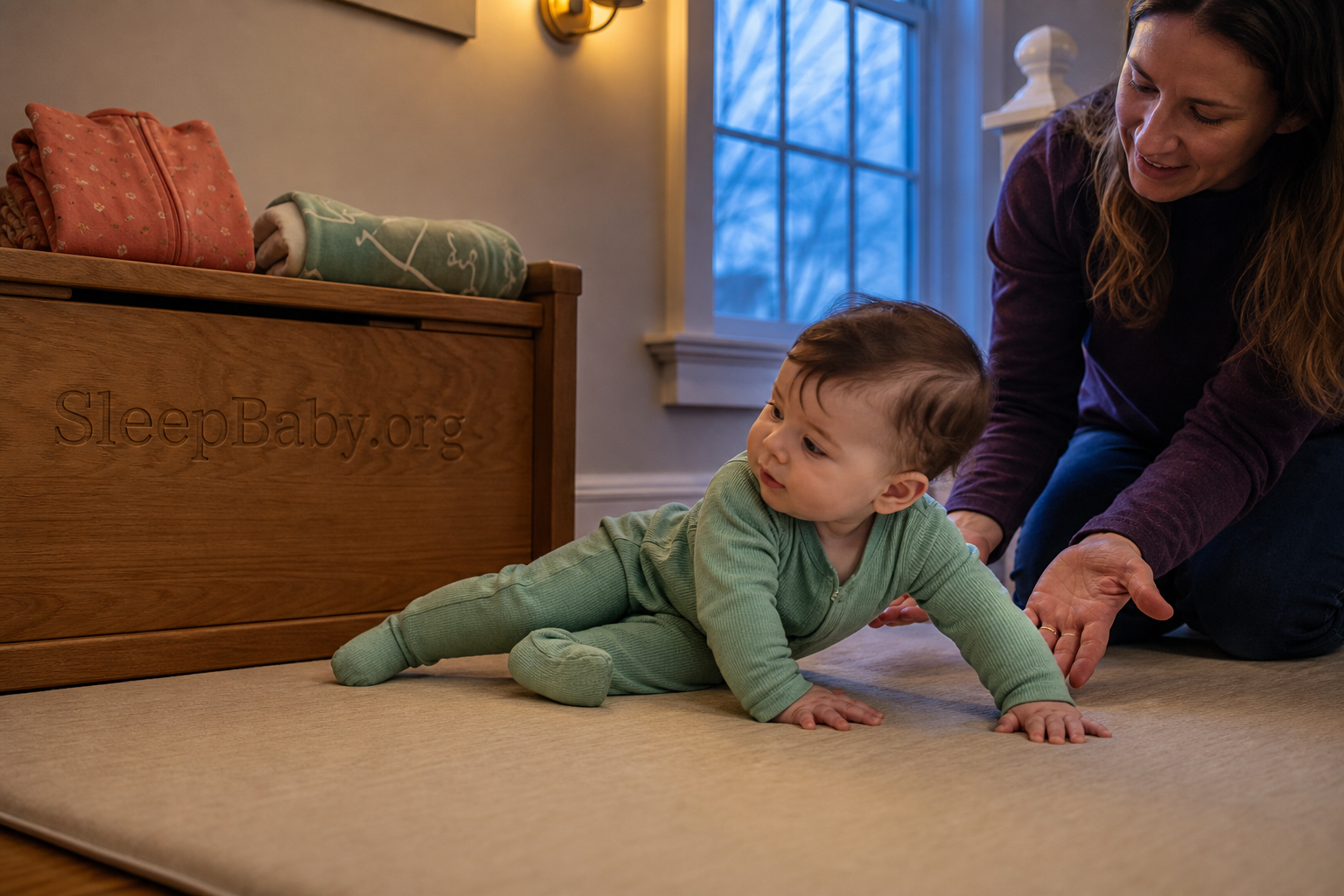
The official six-month movement examples are rolling from tummy to back, pushing up with straight arms during tummy time, and leaning on the hands for support while sitting. That last one is sometimes called tripod sitting. It is not the same as sitting independently, and independent sitting is not required for this checklist.
Crawling is not required either. Neither is getting onto hands and knees, pulling to stand, or moving in a particular sequence. Gross-motor skills unfold across broad windows, and babies solve movement in different ways. One may roll everywhere. Another may pivot on the belly. Another may be deeply interested in reaching and only mildly impressed by the idea of going anywhere.
Watch the quality and direction of progress across ordinary days: Is the baby using both sides? Is tummy time becoming easier? Is reaching more deliberate? Does the baby try again? Those observations are useful to share, but they are not a diagnosis. If something looks persistently uneven, movement seems unusually stiff or floppy, or you are concerned for any reason, bring the specific observation to the pediatrician rather than trying to name it from a search result.
For practice, awake supervised floor time is the honest workhorse. Put an appealing object a little to one side, give the baby room, and keep your hands close during supported sitting. Skip mobile baby walkers. The American Academy of Pediatrics says they do not teach babies to walk and can lead to serious injuries, including falls, burns, drowning, and access to hazards. Read the AAP walker safety guidance.

I would update the room before I tried to accelerate the baby. New rolling and reaching change what is accessible; they do not create a reason to buy a device that promises to hurry development along.
What a milestone checklist can—and cannot—tell you
A checklist is good at turning a vague feeling into a concrete observation. “I am worried about communication” is hard to hold in your head. “I have not noticed a back-and-forth sound exchange, even during quiet face-to-face play” is something you can describe. That clarity is the value.
The checklist cannot tell you why a skill is not showing up. It cannot assess hearing, vision, muscle tone, medical history, opportunity, temperament, or the full quality of an interaction from one tick box. It also cannot replace the clinician’s direct observation or a validated developmental screening tool. This is why one “not yet” should lead to curiosity and conversation, not a home diagnosis.
It also helps to separate a skill from the exact version you pictured. “Knows familiar people” does not require a dramatic reunion smile. “Takes turns making sounds” does not require a particular syllable. “Reaches for a wanted toy” does not require perfect aim or a graceful grab. “Leans on hands while sitting” explicitly describes supported balance, not independent sitting. When I read a milestone, I ask: what is the underlying job the baby is doing?
That question prevents two opposite mistakes. The first is overcalling a problem because the baby’s version looks different from a polished video. The second is explaining away a persistent concern with a cheerful “babies are all different.” The honest middle is specific: notice the underlying skill, watch its pattern, and share what you see when you are unsure.
How to notice progress without teaching to the checklist
You do not need to run all twelve examples in one sitting. In fact, a baby who is hungry, due for sleep, or surrounded by six enthusiastic adults may show you less than usual. Observation works better when it disappears into ordinary life.
Pick one or two questions that genuinely feel uncertain. Give them a natural opening several times across comfortable awake periods. For sound turns, sit close, make one simple sound, and leave quiet space. For reaching, place one safe object within view and reach. For pushing up, join the baby on the floor during awake supervised tummy time. For mirror interest, sit together rather than holding the mirror up like a surprise quiz.
Write down what actually happened in plain language. “Looked at the ring, moved the left hand toward it twice, then rolled away” is more useful than “failed reaching.” “Quiet in the morning; squealed back and forth with Dad after the nap” is more useful than “sometimes communicates.” A short phone note can keep worry from rewriting the memory of an entire week.
Notice conditions that change the response without using them as permanent explanations. A baby may be quieter during an illness, less coordinated when exhausted, or more willing to try on the floor than in a busy room. If the skill returns when the context improves, that is helpful information. If it remains absent, progress stalls, or your concern grows, the context has not closed the question; it has given the clinician a clearer one.
Most important, stop when the baby signals “enough.” Turning away, fussing, arching, rubbing the eyes, or losing interest does not mean the developmental opportunity failed. It means the baby communicated. The point is to see the child more clearly, not to squeeze a reassuring performance out of a tired six-month-old.
Read the whole pattern
A pattern matters more than the most photogenic skill
Sitting tends to get the camera. Laughter gets replayed. Rolling earns applause from adults who have temporarily forgotten that mobility will soon complicate every diaper change. But a quieter pattern may be just as meaningful: your baby studies a familiar face, answers one squeal, reaches with purpose, protests “all done” with closed lips, and pushes up a little higher than last week.
Think of development as several strands moving together rather than one ladder. A baby may pour energy into sounds while movement advances more slowly, or spend a week fascinated by hands and objects before a new roll appears. That unevenness can be ordinary. A consistently striking gap, persistent one-sided use, no forward change across time, or any parent concern still belongs in a real clinical conversation. A whole-child view is not permission to ignore one domain; it is protection against letting one flashy domain speak for all the others.
Normal variation needs anchors, not a shrug
“Every baby develops at their own pace” is true, but by itself it can feel like being handed fog. A more useful way to think about variation is to use three anchors.
- Look across domains and across ordinary days. A tired, hungry, overstimulated baby may not show a skill on request. Notice connection, sounds, exploration, and movement in real life rather than staging one high-pressure demonstration.
- Use corrected age when it applies. A baby born more than three weeks early should be compared using corrected or adjusted age. The CDC applies corrected age in its checklist, and AAP guidance commonly uses adjusted age through age two for tracking a preterm child’s development.
- Let concern outrank the calendar. Variation does not mean a parent must wait silently. A stalled pattern, a striking unevenness, or a lost skill deserves a conversation now.
This is where my rule gets blunt: variation should open a better observation, not close the conversation. I want every reassuring sentence attached to something you can actually watch and something that would change the next step.
Corrected age in one line
Chronological age minus the number of weeks born early = corrected age.
Example: a baby who is six months old but arrived eight weeks early may be compared with skills closer to a four-month window. Confirm the calculation and the most useful comparison with the child’s clinician, especially when medical history or development is complex. Read AAP guidance on preterm milestones.

When should you worry about six month milestones?
Start with the distinction the internet often blurs: a milestone checklist is monitoring, not diagnosis. One “not yet” does not prove a developmental disorder. It does give you something concrete to notice and discuss. Parent concern is itself meaningful information; you do not have to earn the right to ask by collecting a long list of missing skills.
I would not make a parent choose between panic and “wait until the next birthday.” There is a middle path with clear exits. If you are simply unsure whether you have seen a skill, create an ordinary opportunity over the next week or two and jot down what happens. That is a short observation window for uncertainty—not a universal waiting period when something feels wrong.
Watch · Help · Ask
A decision path that does not turn your baby into homework
Watch briefly when you are unsure
Offer the skill in ordinary play, across several comfortable days. Write down what you see rather than repeatedly testing.
Help by making the opportunity easy
Use floor space, one reachable toy, a mirror, a board book, sound turns, or supervised tummy time. Stop when the baby is tired or upset.
Ask now when concern remains
Contact the pediatrician for “not yet,” an uneven pattern, corrected-age questions, stalled progress, or simply a concern you cannot shake. Bring concrete observations and ask whether validated screening is appropriate.
Act promptly for skill loss. If your baby stops doing something they previously did, contact the child’s clinician promptly rather than watching for a few weeks. If concern persists, ask about specialist referral and contact your state’s early-intervention program; families can request an evaluation without waiting for a diagnosis. See the CDC’s act-early pathway.
SleepBaby.org decision aid · Calm does not mean passive; it means knowing what changes the next step.
Bring a better question to the six-month checkup
The well visit is a useful place to share what you have noticed about rolling, propped sitting, sounds, feeding cues, play, and childproofing. You do not need a polished presentation. A short list such as “rolls tummy to back but not the other way,” “uses both hands but reaches more with the right,” or “used to squeal and has become much quieter” gives the clinician something concrete to work with.
Ask what the clinician sees, whether corrected age changes the comparison, and whether a validated developmental screen or referral makes sense. Developmental surveillance happens through ongoing conversations and observation; screening is a more formal process with a validated tool. Neither should be confused with an internet checklist diagnosing a child. The American Academy of Pediatrics recommends surveillance at health visits and screening or referral whenever concerns arise, even outside routine screening ages. Read the AAP clinical guidance.

A real example, not an exam
What a six-month laugh may look like
A short official CDC clip can make an abstract milestone easier to recognize. Watch for the shared social moment—not for a performance your baby must copy.
Takeaway: one baby’s laugh shows what the skill can look like. It is not a standard for loudness, timing, personality, screening, or diagnosis.
Open the official CDC example on YouTube if the embedded player is unavailable.
Keep the sleep schedule question in its own lane
New rolling, louder practice sounds, more alert play, and a changing day can absolutely make sleep feel different. But there is no single “milestone sleep schedule” that belongs inside a whole-child development guide. For nap timing, wake windows, bedtime structure, and regression troubleshooting, use the separate 6-month-old sleep schedule. That page can do the schedule job properly without turning development into a reason to force the clock.
If you are looking a little farther ahead, the 8-month-old milestones guide explains the later whole-child window without pretending those skills are due now.
I keep returning to that clearly hypothetical mat-side moment with Benjamin: the sock, the raspberry, the wobble, the reach for my hand. I notice more when I slow down, write what I see, and bring my questions to the checkup. The half-birthday photo captures one second. Your clearer understanding comes from the pattern around it—what your baby notices, attempts, repeats, enjoys, avoids, and changes over time.
Sources
- CDC: Milestones by 6 Months
- CDC: 6 Month Online Milestone Checklist
- CDC: Concerned About Your Child’s Development?
- AAP: Developmental Surveillance and Screening
- HealthyChildren: Preemie Milestones
- HealthyChildren: The Power of Play
- NIH Safe to Sleep: Ways to Reduce Risk
- HealthyChildren: Baby Walker Safety
When the half-birthday changes the whole evening
A baby can be developing beautifully and still make bedtime feel newly complicated
Rolling practice, louder sound experiments, and a busier awareness of the room can follow everyone into the evening. You do not have to suppress the new skills or turn bedtime into another milestone test. Keep sleep safe, protect a calm wind-down, and get help with the sleep pattern itself when your household needs it.
Sleep support does not replace developmental screening, medical care, or early-intervention evaluation.






What viewers said10 comments · 4 replies+
Archived comments from the original Baby Sleep Miracle presentation. Not independently verified by SleepBaby.org; individual experiences vary.
Thank you so much for this video! I had no idea about the dangers of baby swings :O
Hi Mary-Ann. I have a question: Is method in any way similar to the ones recommended by Dr Bucknam, Dr. Weissbluth or Dr. Karp? We tried those but none of them help.
Hi Regina, thank you for your question. The short answer is no. The techniques I share in my guide are based on newest scientific research and this is why I have never seen any approach similar to the one I recommend.
This method really works! I tried it on my son Jesus and after just one week he went from waking up more than 5 times a night to waking up just once or twice. You are a lifesaver, Mary-Ann!
I'm truly impressed with how much information you share in your video. And all for free! I can feel that you truly care about mothers like myself, and that's hard to find these days. I have recommended your site to several of my friends already.
Mary-Ann, our child suffers from autism. Is your approach still suited?
Chloe, I made sure my method can be used with any child, even babies who are special like yours. Please note that I'm not a doctor and that I always advice to consult with your physician because nothing is more important than the safety and well-being of your love.
Hallo Mary-Ann, I'm from Germany. Do you have your guide in German?
Hello Heide, we do! Normally you should already see our video in German. If not, please contact our support so they can guide you
Thenk you for your answer, Mary-Ann!
I just completed your approach and I have to say, it worked almost too well. Yes, it took a bit of getting used to with your bedtime routine but the difference is huge. My son George used to take 1 hours to go down and now he's firmly asleep in no more than 10 minutes! You're the best!
It seems I'm the only man watching this video, lol! What you shared about the 'emotional backpack' made immediate sense to me and I can't wait to help my little girl Mila to unpack it!
Hey there, just discovered your site and this really sounds different. Just wanted to say thanks for sharing :)
For everyone who's still thinking about getting Mary-Ann's guide I want to advise you to go ahead. I wasn't sure myself but now I'm so thankful I invested in this program. It made a huge difference in our life as a family and yes, my baby girl does sleep through the night now.