

The short answer
Your baby may be waking because your absence is the change they notice most
Separation anxiety can absolutely disrupt naps, bedtime and night sleep, especially from the later baby months through the toddler years. A baby who was content last week may suddenly sit up, reach for you or cry the instant you move. That does not mean you damaged their attachment, made them “too dependent,” or now have to choose between staying beside the crib forever and walking away from a panicked child.
In this guide
- Your baby may be waking because your absence is the change they notice most
- What changes the answer tonight?
- What age does baby separation anxiety affect sleep?
- Use a presence ladder, not a disappearing act
- A gentle plan for an infant who wakes when you leave
- Why separation anxiety can look different at naps
- A toddler needs connection and a clear edge
First check whether the waking is really about separation: hunger, pain, illness, a schedule mismatch, a startling transfer or an unsafe sleep setup can look similar. Then use a predictable response and reduce one layer of your presence at a time. The goal is not to prove that your baby can need nobody. The goal is to help them experience the same reassuring truth over and over: you can move away, they can stay safe, and you come back.
When I hear, “He wakes the second I move,” I do not start by blaming attachment or handing the parent a stopwatch. I picture the actual moment: one hand easing off the crib rail, one floorboard giving its tiny traitorous click, and two eyes opening as if the night manager has caught somebody leaving early. The timing of that wake-up tells us more than the label does.
What changes the answer tonight?
Separation anxiety is one possibility, not a diagnosis you can make from a single wake. Use this sorter before you change the whole bedtime routine.
The four-signal doorway check
It happens when you move
Baby settles with your voice, hand or presence, then protests at the exact exit. Separation or a learned falling-asleep cue moves higher on the list.
It changed suddenly
Check feeding, fever, congestion, teething or other pain, a new room, travel, daycare, a nap change and anything else that changed at the same time.
It follows the clock
Long settling, playful pop-ups or an early-morning party can point toward sleep timing, while frantic overtired crying can make any separation harder.
Something feels medically off
A breathing problem, unusual color, limpness, a seizure or difficulty waking is urgent. Sudden severe distress with illness or pain signs needs pediatric guidance, not a sleep experiment.
Why this matters tonight: use the response that matches the signal. Do not ask a sick, hungry or undertired child to “practice independence,” and do not rebuild the schedule when the wake happens only at the doorway.
SleepBaby.org original decision aid
What age does baby separation anxiety affect sleep?
There is no birthday on which separation anxiety clocks in for the night shift. Development varies. The American Academy of Pediatrics notes that some babies show it around 4 to 5 months, while a stronger phase commonly appears around 9 months. The CDC lists reacting when a caregiver leaves as a 9-month social-emotional milestone, and the NHS describes separation anxiety as common from about 6 months to 3 years.[1][2][3]
Those are useful ranges, not a verdict. A 5-month-old can notice a missing body without having the same developmental separation anxiety as a 15-month-old. A 2-year-old may understand every word of your bedtime promise and still object to it with the lung capacity of a tiny town crier.
| Age or stage | What may be happening | What I would try first |
|---|---|---|
| Newborn to about 5 months | Feeding needs, immature sleep, the transfer from warm arms to a still mattress, startle, discomfort or overtiredness are often more useful clues than developmental separation anxiety. | Meet the need, use a calm repeatable cue, protect safe sleep and practice only when it is realistic. Independent settling is not a newborn exam. |
| About 6 to 12 months | Recognition, mobility and object permanence make your leaving more meaningful. Baby may reach, sit or pull up when you step away. | Practice tiny clear returns while awake, keep the bedtime sequence familiar and fade one presence cue at a time. |
| About 12 to 24 months | Separation can flare alongside walking, language, daycare changes and a fierce new opinion about who may leave which doorway. | Use one short script, a visible sequence and a return promise you can keep. Comfort first, then hold the same limit calmly. |
| About 2 to 3 years | Imagination, fear, delay tactics and genuine connection needs can arrive in the same pajamas. | Offer two small choices, finish needs before lights‑out, name the feeling and keep the boundary boringly predictable. |

Use a presence ladder, not a disappearing act
The most useful middle path is not a branded method. It is a way to see your current pattern clearly. Start with the least help that feels genuinely reassuring tonight, and move down only when that rung feels familiar. You can stay on one rung for several nights. You can move back up during illness or travel. Progress is not ruined because a baby needed more closeness on Tuesday.
One doorway at a time
The responsive presence ladder
- Meet the need. Feed when feeding is due, change a soiled diaper, address pain or illness, and make the sleep space safe. No strategy outranks a real need.
- Settle with full closeness. Hold, rock or feed if that is your chosen response, then transfer to the safe sleep space before you sleep. Notice which cue actually helps.
- Keep touch and voice, reduce motion. Try a still hand, a repeated phrase or a soft song at the crib instead of adding five new soothing inputs at once.[5]
- Keep presence, reduce contact. Sit beside the crib or bed. Let your words do more of the work while your hands do less.
- Move the chair, not the promise. Shift a little farther away every few settled nights. Keep the same phrase and the same return point.
- Use brief, predictable returns. Leave after a clear goodbye and return as promised. For a toddler, tie the return to something concrete: “I will put these books away and come back for one check.”
Tonight connection: choose one rung before bedtime. If it fails because the child is sick, frantic or plainly not sleepy, solve that problem rather than treating the ladder as a loyalty test.
SleepBaby.org original framework; not a diagnostic scale
I would rather change one bedtime signal for four ordinary nights than change the song, feeding, parent, check-in interval and crib approach in a single heroic evening. When everything changes, nobody knows what helped. Consistency is not emotional coldness. It is simply making the night legible.
A gentle plan for an infant who wakes when you leave
1. Start with the first wake, not a theory
If the baby wakes as your body leaves the mattress or crib rail, ask what changed: warmth, pressure, movement, smell, sound or the feeding connection. If they wake 40 minutes later, you may be seeing a normal transition between sleep cycles plus a wish for the same conditions they had at sleep onset. Neither pattern makes the baby manipulative.
2. Practice at one sleep
Choose the sleep with the best odds – often the first bedtime stretch or the first nap, not the shattered 4 a.m. stretch. Keep the familiar routine. On that one sleep, try setting baby down with one slightly smaller layer of help: rock until calm rather than fully asleep, or keep a still hand after the transfer instead of continuing motion. “Drowsy but awake” is an option, not a moral achievement.
3. Respond in a boring, recognizable order
Pause long enough to listen. A grunt, brief fuss and escalating distress are not the same sound. If baby is escalating, respond. Start with the cue you chose – your phrase, hand or pickup – and give it a fair moment before switching. The AAP’s calming guidance explicitly separates self-soothing from ignoring cries and recommends checking hunger, tiredness and pain first.[5]
4. Practice return during the day
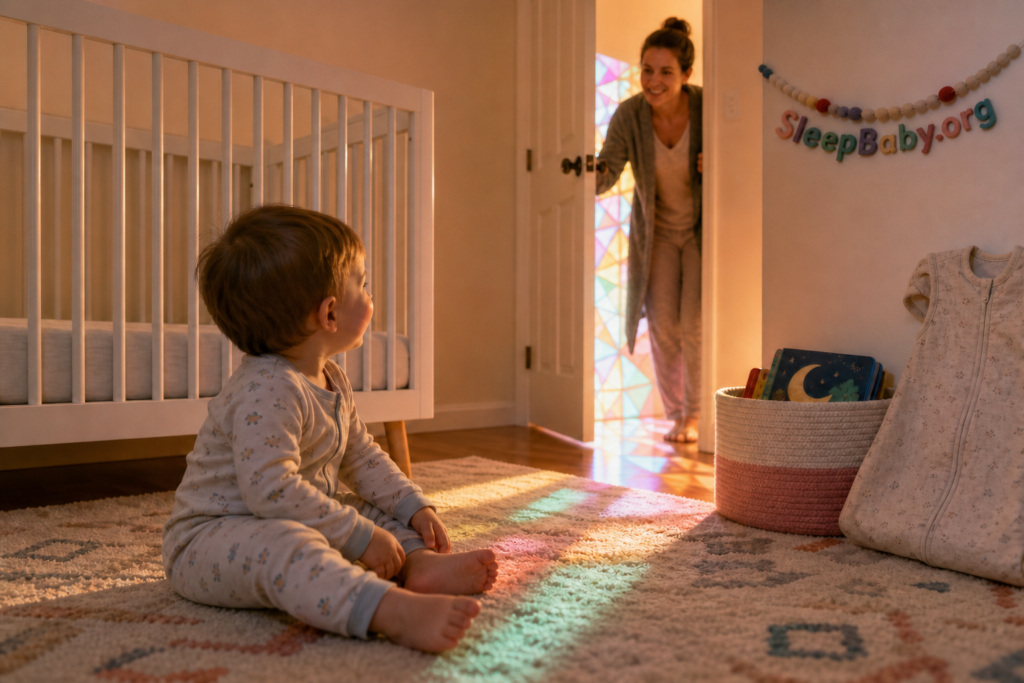
Peek-a-boo is not magic sleep training. It is low-stakes rehearsal for the idea that hidden is not gone. Step behind a doorway for two seconds, narrate that you are coming back, then return warmly. The CDC recommends quick, clear goodbyes rather than sneaking away, and the NHS suggests short practice separations with a familiar caregiver.[2][3]
If your baby also insists on sleeping on your body, use our safer contact-sleep and transfer guide for that specific next problem. The solution is not to test how long an exhausted adult can stay awake in a recliner.
Why separation anxiety can look different at naps
A child who manages bedtime with one song and a goodnight may treat the first nap like an entirely different legal case. Daylight is interesting, sleep pressure may be lighter, the routine is usually shorter, and the caregiver may be trying to leave quickly enough to answer an email or eat something with both hands. That makes naps a sensitive place to notice separation – but it also makes a schedule mismatch easier to mistake for separation.
Look at the first two minutes after you begin to leave. A child who reaches for you, settles when you return and protests again at the doorway is giving a different clue from a child who stands happily, chats for 30 minutes and never comes close to sleep. The first pattern makes the presence ladder useful. The second asks you to review wake time, nap timing and whether the child is ready to sleep.
A one-nap practice plan
- Pick one reasonable nap. Use the nap with the most reliable sleep pressure, not every sleep in the same day. Keep the wind-down short and recognizable: diaper, darkened room, the same phrase, then the level of presence you chose.
- Change one cue. If you usually hold until fully asleep, try holding until calm and finishing with a still hand at the crib. If you already sit beside the crib, move only far enough that your child can notice and succeed.
- Plan the rescue before you are frustrated. There is no virtuous number of minutes. Decide what you will do if sleep does not come: return to the usual support, offer a later nap when appropriate, or protect bedtime from becoming dramatically overtired. A rescued nap does not erase the practice.
- Judge the pattern, not one performance. Over several ordinary days, notice whether your child recovers more quickly, accepts a slightly smaller cue or tolerates one dependable exit. If distress intensifies, sleep timing looks wrong or the waking appears suddenly with discomfort, move back up the ladder and reassess.
Daycare note: home and childcare do not need identical routines. Ask what words and cues the caregiver already uses, then share your short goodbye phrase. Familiar language can bridge the two settings without asking one caregiver to copy another person’s entire method.
The measure I care about is not whether your child makes no sound when you leave. It is whether the sequence is becoming more understandable: the need is checked, the cue is familiar, the goodbye is clear, and the return happens when promised. That is progress even before the nap gets longer.

A toddler needs connection and a clear edge
Toddler separation anxiety at bedtime can be heartfelt and strategic at the same time. Your child can genuinely miss you and also discover that “one more sip” has an excellent track record of reopening negotiations. You do not need to decide which motive is pure. Meet the feeling; organize the limit.
Three sentences that hold the doorway
Name it: “You want me right beside you. It is hard when I leave.”
Say what stays true: “You are safe in your bed. I am close, and bedtime is still bedtime.”
Make a return you can prove: “I will put the cups in the sink, then come back for one quiet check.”
On the return, do not add a new event. Say, “I came back like I said. It is time to rest.” Trust grows from the kept promise, not from a longer speech.
Give two choices before the boundary
Would you like the blue pajamas or the striped pajamas? One book or two short books? Door open a little or nearly closed? Choice works best before lights-out and inside limits you can accept. “Would you like to sleep?” is not a useful referendum.
Close the request shop once
Do a last-call round: toilet, water, hug, blanket arrangement and one answer to the suddenly urgent question about where squirrels sleep. Then name that the shop is closed. Repeated requests get the same brief response, not a fresh emotional performance. This is especially useful when one parent has been lying beside the bed for 90 minutes and another child still needs care.
Do not sneak out
Sneaking may buy one quiet exit, but it turns every eyelid flutter into a security check. The AAP and CDC both favor short, predictable goodbyes and dependable returns.[1][2] A clear exit can bring protest. Protest is not proof that the boundary was cruel; it is information that the change is hard.

Is it separation anxiety, a sleep regression or a schedule problem?
“Sleep regression” is a convenient umbrella, not a lab result. Development, new movement, teething, illness, travel, naps and separation can overlap. Instead of naming the week, decode the pattern.
The night-waking decoder
- Wakes at the exact exit
- Separation or the missing sleep-onset cue is likely important. Use the presence ladder.
- Happy, chatty and awake for ages
- The child may not have enough sleep pressure. Review nap timing and bedtime before adding a more elaborate settling method.
- Frantic at every transition
- Overtiredness, discomfort or illness can amplify separation. Move bedtime modestly earlier or address the need; do not assume more distance is the answer.
- Only one caregiver works
- Let the preferred caregiver introduce the other caregiver inside the routine, then hand over one small, repeatable job before attempting the whole bedtime.
- Sudden screaming after good sleep
- Check pain, fever, breathing, feeding, ears, teeth, constipation, injury and other changes. A dramatic new pattern deserves a body check before a behavior plan.
Sleep connection: if timing is the real issue, our baby sleep schedule guide helps you read the whole day instead of chasing the doorway.
SleepBaby.org original pattern decoder

What if staying beside them is the only thing that works?
Then staying is data, not defeat. If the arrangement is safe and sustainable, you do not have to remove it because the internet called it a bad habit. If it is no longer sustainable, change the smallest piece that gives you breathing room.
- If touch is essential, keep the hand but stop the rocking.
- If your face is essential, sit where baby can see you and use one phrase instead of continuous conversation.
- If the toddler needs your body beside the bed, sit up first, then move to a chair, then move the chair.
- If every wake ends in an adult bed, decide the safe response before exhaustion makes the decision for you. For an infant, return baby to their own firm, flat sleep surface before you sleep.
- If you want a no-cry guarantee, I wish I could put one in a tiny envelope for you. A change may bring protest. The humane question is whether your child stays safe, receives a predictable response and is asked to manage only a tolerable step.
Families may choose a chair method, brief check-ins, bedtime fading, a more hands-on approach or no formal sleep-training method at all. A broad American Academy of Sleep Medicine review found evidence for several behavioral approaches, not one universally required technique.[6] Our guide to whether babies learn to sleep without sleep training gives that bigger-picture context.
Protect the exhausted adult, too
Separation anxiety can turn bedtime into a two-hour vigil and night wakes into a chair-side endurance sport. Exhaustion is not just unpleasant; it changes safety. If you are nodding off while holding an infant, the next right move is the empty crib or bassinet, even if baby protests. A couch or cushioned chair is especially dangerous for infant sleep.[4]
Use a handoff if one is available. The preferred caregiver can say the same phrase, then let the other adult take the final book, song or check. If you are alone, make the plan smaller: one safe practice sleep, one rung, one night. You are not required to solve attachment, development and the family calendar before breakfast.
When to call the pediatrician
Normal separation anxiety can be loud. It should not become the automatic explanation for every abrupt change. Contact your child’s clinician when:
- the distress is sudden, severe or very different from your child’s usual cry;
- sleep disruption comes with fever, breathing or feeding changes, vomiting, a new rash, signs of pain, unusual sleepiness, fewer wet diapers or another illness concern;
- your child has lost skills, seems unusually withdrawn during the day or you have a developmental concern;
- separation distress stays intense long after you leave, persists for weeks or keeps your child from participating in normal daily experiences;[3]
- you are so depleted, anxious or angry that you do not feel able to keep the night safe.
Seek emergency help for trouble breathing, blue or gray color, a seizure, unusual limpness or unresponsiveness, a serious injury, or if you cannot wake your child normally. Sleep advice waits; urgent care does not.
If the bigger question is whether the sleep pattern itself is concerning, use our red-flags and next-steps guide. For a child who refuses the crib even when you remain nearby, the crib troubleshooting guide separates the sleep-space problem from the separation problem.

Watch: easing toddler separation transitions
Pediatrician Dr. Mona Amin of PedsDocTalk explains why toddler separation anxiety can flare and how predictable transitions help. The useful takeaway for bedtime is not to copy a daycare goodbye word for word; it is to keep the message short, calm and repeatable. This optional video includes commercial course and store links in its description. SleepBaby does not endorse those products, and the written plan above remains complete without playback.
Sources
- American Academy of Pediatrics: How to Ease Your Child’s Separation Anxiety
- CDC: Milestones by 9 Months
- NHS: Separation anxiety
- American Academy of Pediatrics: How to Keep Your Sleeping Baby Safe
- American Academy of Pediatrics: Self-Soothing – Help Your Baby Learn This Life Skill
- Mindell et al.: Behavioral treatment of bedtime problems and night wakings in young children
You can leave the doorway without leaving the connection
Build a bedtime your child can recognize, even after you step away
Tonight may still include a hand on the crib, a chair by the bed or one promised return after the cups reach the sink. That is not failure. It is a starting rung. SleepBaby helps you turn the real pattern in your house into a calmer, repeatable next step – without making your child’s need for you the enemy.
Try this tonight
Keep the safety line clear.
Use this plan only for non-urgent routine observations. Breathing, color, responsiveness, feeding, growth, illness, or a gut-level concern belongs with a qualified clinician.
What to notice
Record the exact concern, when it appears, and what changes before and after it.
One change
Follow the clearest age-appropriate safety action in this guide. For a medical question, make the one change a call to your child’s clinician.
Do not change
Do not improvise around safe-sleep guidance or delay care in order to run a sleep experiment.
Reassess
Reassess immediately if the concern changes or worsens. Do not wait three nights when symptoms or safety are involved.
3-night tracker
Look for a pattern, not a perfect night.
Use this tracker only for a non-urgent routine pattern after immediate safety and medical concerns have been ruled out.
Time · first cue · your response · what happened next
Use the same small step and note what feels easier or harder
Keep · adjust · pause · bring the notes to a clinician