
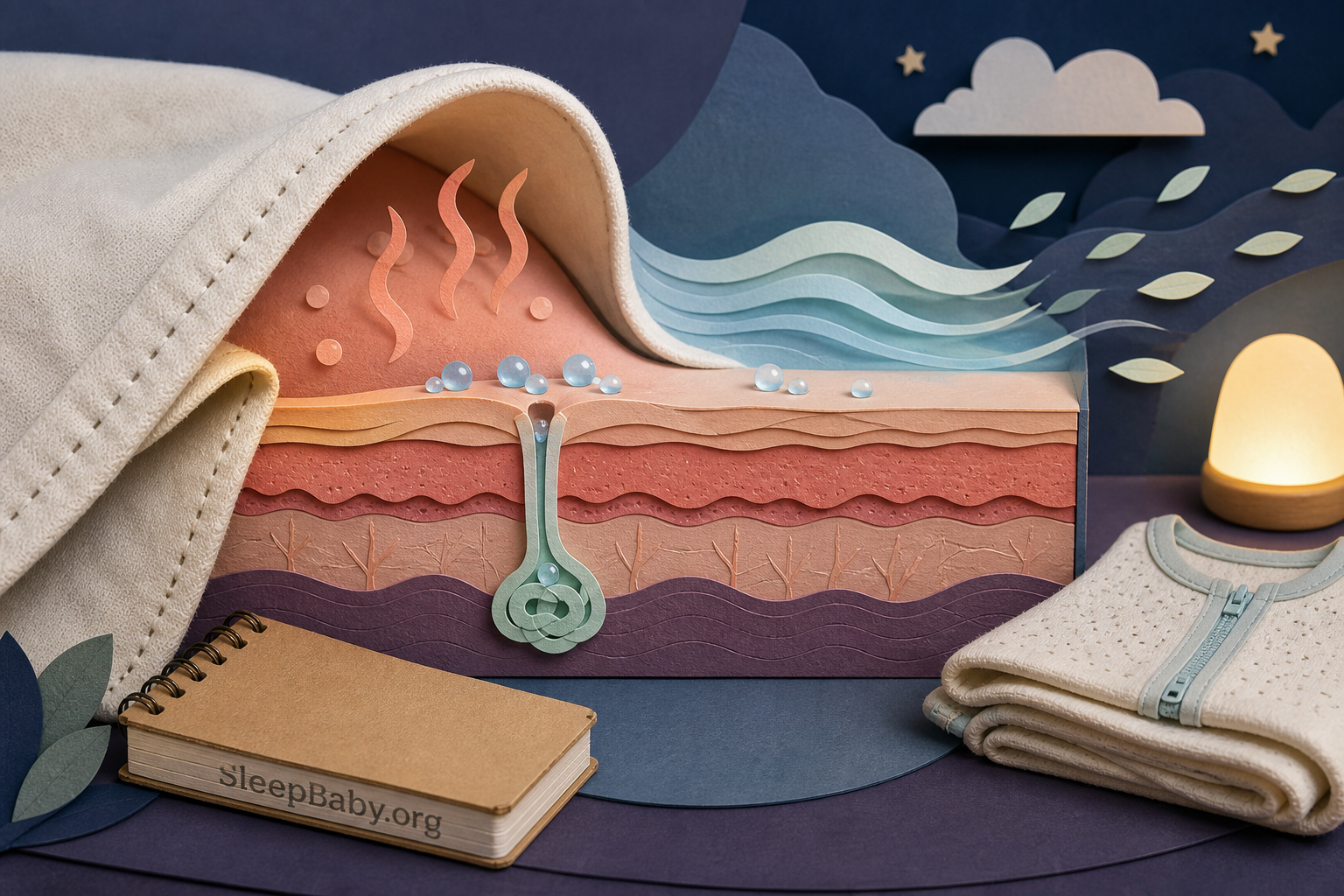
Baby heat rash happens when sweat gets trapped in blocked sweat ducts. It often appears as clusters of tiny raised bumps or very small blisters on warm, covered, or folded skin: the neck, hairline, upper chest, back, armpits, or groin. The first useful treatment is not a cream. It is a cooler environment, one less damp or unnecessary layer, a cool wet washcloth or brief cool bath, and time for the skin to air-dry.[1][2]
I know the discovery moment: damp curls at the nape, a warm little back under the sleeper, and bumps that seemed to appear during one nap. Start by looking up from the rash. Is your baby breathing comfortably, waking in their usual way, feeding normally, and making wet diapers? Does the skin begin to feel less hot after you remove a layer? Those whole-baby observations matter more than whether a phone photo looks exactly like someone else’s.
Do not put ice directly on a baby’s skin. Do not place a wet towel, cooling pad, ice pack, fan, or any loose object in the crib. Do not begin hydrocortisone, antihistamine, calamine, medicated powder, antibiotic, antifungal, essential oil, or a home remedy because a search result called the rash “prickly heat.” Product advice for babies depends on age, location, skin condition, and the actual diagnosis.
What baby heat rash can look like
Heat rash is also called prickly heat or miliaria. Sweat is made normally, but a superficial duct becomes blocked or inflamed, so moisture is trapped near the skin surface. The result may be many tiny bumps, pinpoint clear blisters, or a slightly swollen, prickly patch. NHS guidance describes raised spots about 2 to 4 millimeters across; Seattle Children’s describes tiny pink bumps and, in babies, tiny water blisters.[1][2]
On light skin, the area may look pink or red. On brown or Black skin, the color may be subtle, gray, white, or close to the baby’s usual skin tone. Look at texture, location, new warmth or swelling, and how the baby feels rather than making redness the entry ticket for concern.[1] A change that is easier to feel than see is still worth describing to the clinician.
Where sweat gets trapped
Warm folds, covered zones, and friction points
Head and neck
Hairline, behind the ears, under the chin, and inside neck folds after sweating or a damp feed.
Trunk
Upper chest, upper back, or wherever a warm sleeper, carrier, car-seat strap area, or held position kept heat close.
Skin folds
Armpits, elbow creases, groin, and other places where sweat, occlusion, and rubbing meet.
Boundary: location supports a possibility; it does not confirm a diagnosis. Infection, eczema, contact reactions, and other newborn rashes can appear in some of the same places.[3]
Do I need to identify the type of heat rash?
Usually, no. Clinicians use the word miliaria for heat rash and may describe it by the depth of the blocked sweat duct. Very superficial miliaria can look like fragile clear beads that break easily. The more common prickly form can look like tiny inflamed bumps or bump-and-blister clusters. DermNet also describes a deeper form, but it is rare and is mainly associated with repeated episodes in adults, not the ordinary warm-fold rash most parents are trying to sort at home.[3]
Those names do not change the first safe move for an otherwise well baby: reduce heat and humidity, remove wet or tight clothing, cool the skin gently, and watch the trend. They also do not make a photo diagnostic. If a blister is large, tense, painful, cloudy, bloody, spreading, or sitting on very red or swollen skin, do not rename it a heat-rash subtype from an image. Ask the pediatric clinician to look at it.
What should change after cooling?
The baby should become more comfortable and the skin should stop accumulating new sweat. The bumps do not have to disappear during one washcloth session. Over the next several hours, you are looking for a stable or improving pattern: no rapid spread, no new fever or illness, less warmth and irritation, normal feeds, normal wet diapers, and the baby’s usual alertness. The visible spots may take a few days to clear even after the trigger is gone.[1][2]
Cooling is useful treatment, but improvement after cooling is still not proof. Many irritated-skin conditions feel better when heat and friction decrease. If the rash repeatedly returns in the same place, lasts beyond the expected window, or changes character, preserve the observation record and let the clinician reconsider the diagnosis.
Straightforward heat rash may itch or feel prickly, but a baby cannot tell you that. You may see rubbing, brief fussiness when the warm area touches clothing, or relief after cooling. Those are observations, not diagnostic tests. Heat rash itself is not contagious, according to NHS guidance, but that does not make every noncontagious-looking rash safe to watch at home.[1]
Why babies get heat rash so easily
Babies do not regulate temperature as efficiently as older children and adults, and newborn sweat ducts are still immature. Add humidity, a close-fitting layer, a warm carrier, a damp neck fold, or an occlusive skin product, and sweat may not leave the skin freely.[1][3]
This can happen in summer, but the calendar is not the cause. A heavily heated room, fever, a waterproof surface under an older child’s body, synthetic or tight clothing, ointment spread beyond the area that needs it, or a long warm contact nap can create the same sweat-and-occlusion pattern. Heat rash is about the skin’s local heat load, not whether the weather app says July.
There is no parenting failure hidden in a patch of prickly heat. Rooms warm up, feeds leave a neckline damp, and a baby’s back can become sweaty against an adult before the adult feels uncomfortable. The useful question is what changed around the skin and whether the whole baby cooled normally after that change.
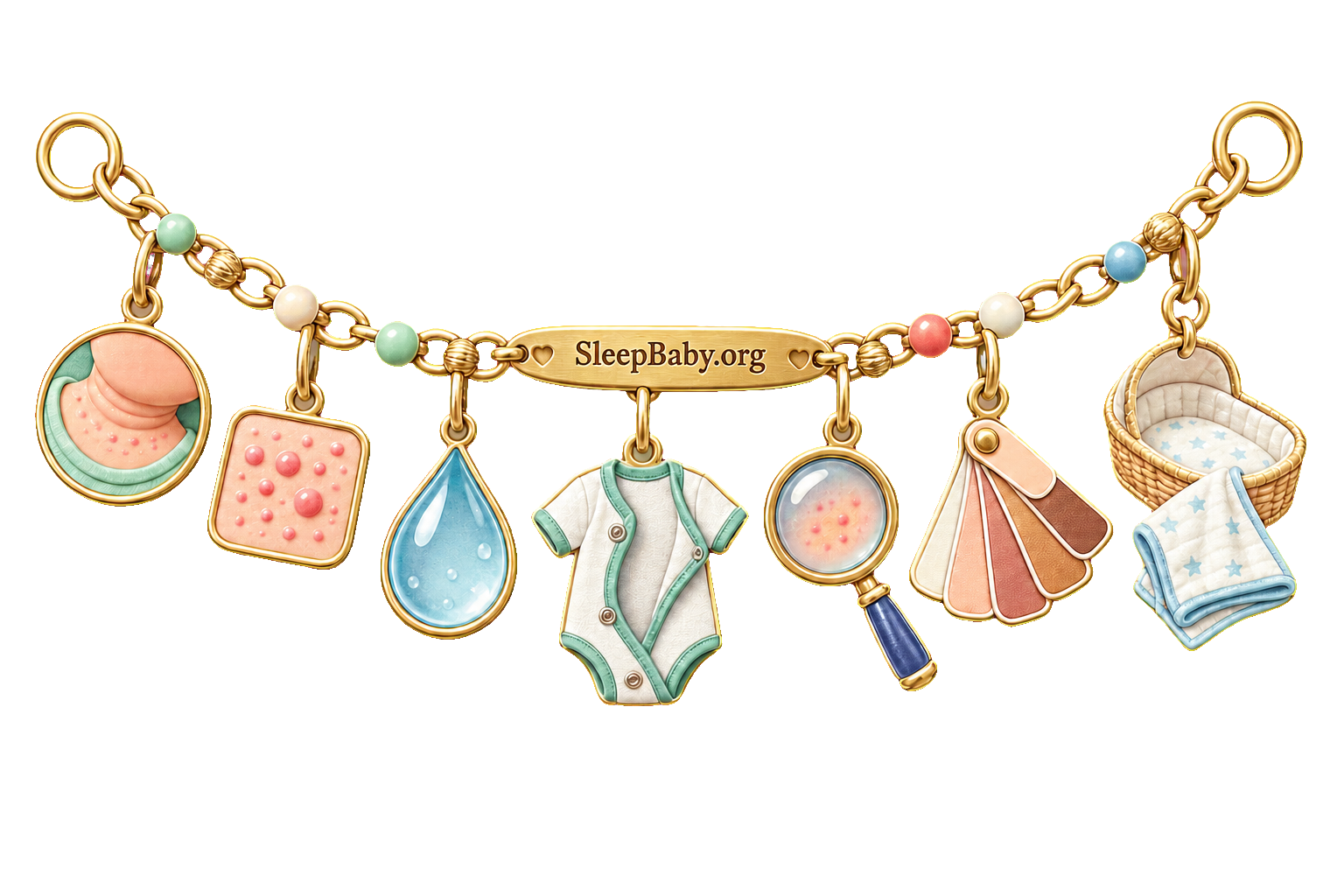
Heat rash or something else?
No article or image gallery can diagnose a baby’s rash. Even clinicians combine appearance with age, temperature, recent products, illnesses, feeding, medications, and how quickly the pattern changed. Use the comparison below to decide what to report and how quickly to seek help, not to name the rash with certainty.
Pattern is a clue, not a verdict
Four different questions hiding under “little red bumps”
- More consistent with heat and occlusion
- Tiny clustered bumps or superficial blisters in warm folds or covered areas, after sweating, with a baby who otherwise seems well and a pattern that begins settling when the skin stays cool and dry.
- A diaper-area problem may need a different plan
- Red or raw skin centered where urine, stool, wiping, and the diaper touch may be irritant diaper dermatitis rather than heat rash. Fold involvement, satellite spots, open skin, or persistence can change the differential. Use the dedicated baby diaper rash guide and call when the pattern is uncertain.
- Dry, recurrent, or product-linked skin needs a broader look
- Dry scaly patches, repeated flares, cracking, or a rash that began after a soap, wipe, detergent, lotion, adhesive, or fabric change may fit eczema or contact irritation better. Stop the new nonessential product and ask the clinician what belongs on the skin.
- Illness or infection signs change the care speed
- Fever, spreading redness, increasing warmth, swelling, pus, yellow crust, marked tenderness, fast worsening, poor feeding, unusual drowsiness, or a baby who looks sick needs medical guidance rather than another product trial.[2]
Newborns deserve an especially low threshold for professional review because normal newborn eruptions and important infections can overlap visually. If the baby is very young, the rash is new and widespread, or you cannot explain what you are seeing without guessing, call. Send a photo only through the clinician’s approved system and include the baby’s temperature, age, feeding, wet diapers, recent heat exposure, and recent products. The context is part of the picture.
A practical cooling plan for the next 24 hours
If the baby is otherwise well and the pattern is reasonable to observe at home, build the day around less heat, less friction, and fewer products. Seattle Children’s says cooling is the main treatment and expects improvement over two to three days; NHS guidance says most cases get better on their own after a few days.[1][2]
1. Keep the environment cooler
Use air conditioning if available, or move to the coolest room with safe airflow. Shade matters outdoors, but a shaded space can still be hot and humid. If you use a fan in the room, position it to circulate air rather than blasting directly into the baby’s face, and keep cords and the device completely outside the sleep space and out of reach. During extreme heat, a reliably air-conditioned location is safer than trying to make a dangerously hot room feel tolerable.[6]
2. Reset clothing one layer at a time
Remove damp clothing promptly and choose loose, breathable pieces. Check the baby’s chest or upper back rather than using cool hands or feet as the layer gauge. If the trunk is hot or sweaty, remove a layer and recheck after the environment changes. You do not need to strip a comfortable baby in a cool room; the goal is comfort, not cold skin.
3. Use water as a cooling tool, not a treatment ceremony
For a small patch, hold a cool, clean wet washcloth against the area for 5 to 10 minutes, then let the skin air-dry. For a larger area, a brief cool bath without scrubbing can help if your baby normally bathes safely. Keep one hand on the baby, prepare everything before the bath, and avoid chilling. Patting is kinder than rubbing.[2]
4. Keep folds clean and genuinely dry
After feeds, drool, spit-up, bathing, or sweating, gently clean the neckline and other folds and allow them to dry before replacing clothing. This is not permission to scrub inside every crease. Friction adds irritation. A clean soft cloth and a few minutes of air are often more useful than another layer of product.
5. Continue the baby’s usual milk feeds and watch the pattern
Keep offering breast milk or formula in the baby’s usual way. Do not add water, electrolyte drinks, or a new feeding schedule based on a web article. The AAP says infants under 6 months should receive breast milk or formula rather than additional water; if intake seems inadequate, call the pediatrician.[7] If the baby feeds less, repeatedly refuses feeds, vomits, has a dry mouth, or makes significantly fewer wet diapers, call the pediatric clinician. Those observations may signal dehydration or illness and deserve a baby-specific plan.[4]
6. Make a small observation record
Write down when you first noticed the rash, where it began, the temperature if taken, what the baby wore, any heat exposure, new skin products, feeding, wet diapers, and whether cooling changed the texture or spread. Take one clear photo in neutral light for comparison if useful. Repeatedly photographing every hour can turn normal lighting changes into false alarms; the baby’s behavior and the rash trend are more useful.
What goes on the skin?
Start with cooling; make products earn their place
Start here
Cooler air, loose clothing, a cool wet washcloth, a brief cool bath, air-drying, and gentle handling.
Ask first
Hydrocortisone, antihistamines, calamine, medicated powders, antibiotic or antifungal products, and anything near the eyes, mouth, genitals, or broken skin.
Avoid for now
Heavy ointments or oils over suspected heat rash, fragranced washes or creams, essential oils, direct ice, vigorous rubbing, and layered home remedies.
Why hold the product line? Ointments and oils can block sweat ducts, and fragrances can add irritation.[1][2] Also, improvement after a medicated cream does not prove the original diagnosis. If itch is strong enough that your baby cannot settle, ask the clinician or pharmacist for an age-appropriate choice rather than translating an adult label.
What if the bumps are under the diaper?
The groin can develop heat rash because it is warm and occluded, but diapers also create a separate moisture, stool, urine, friction, and wiping environment. That distinction matters because a thick barrier can be useful for irritant diaper dermatitis while an occlusive ointment may worsen true heat rash elsewhere.
Change wet or soiled diapers promptly, clean gently, and give the area time to dry. Then use the baby diaper rash guide for the distinct barrier-care pathway. If you see raw skin, bleeding, blisters, pus, spreading redness, marked pain, a fold-heavy rash with separate nearby spots, or no improvement, call the clinician rather than trying to force the rash into one category.
The safe-sleep reset after an overheated nap or night
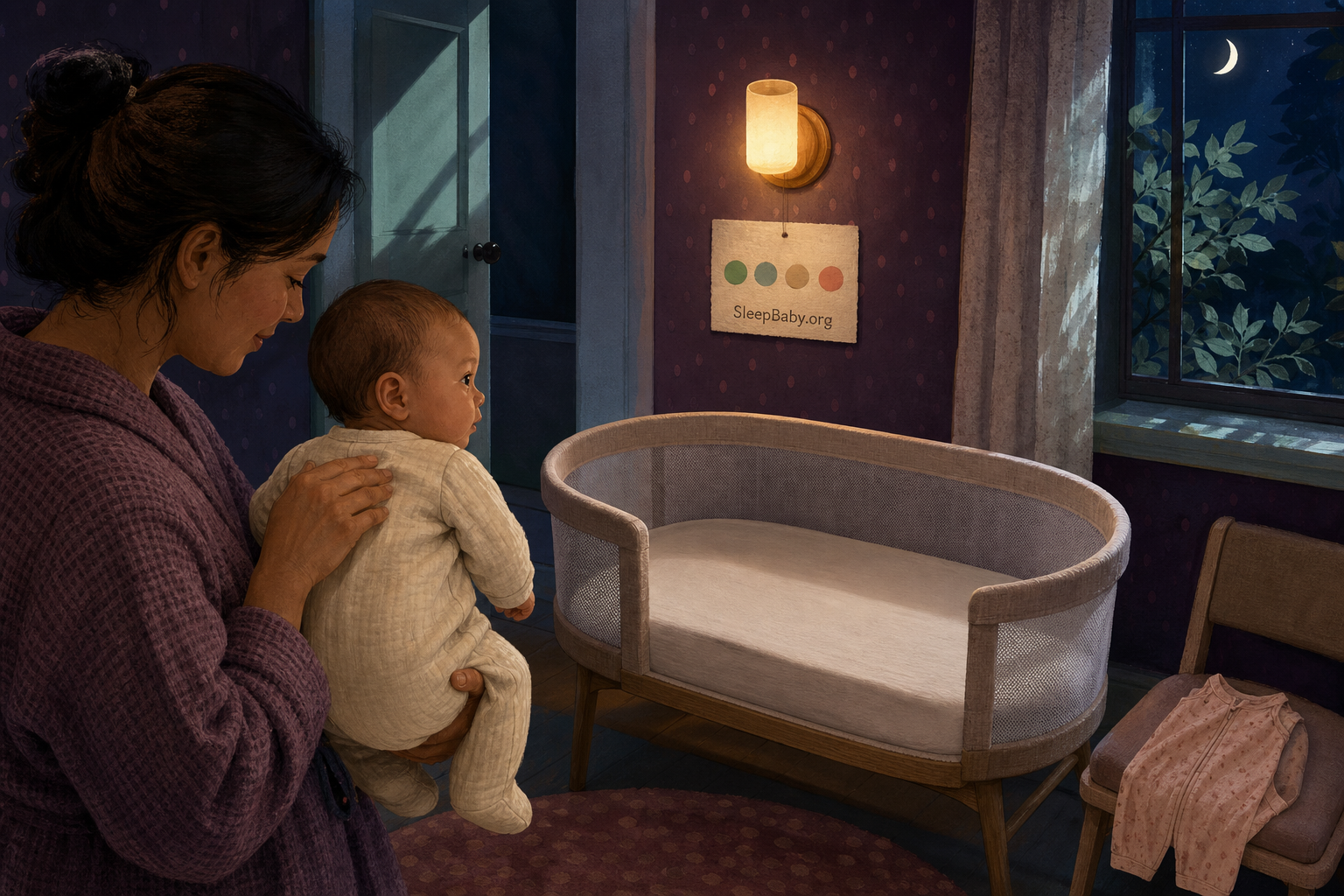
A cooler baby still needs the same safe sleep foundation: place the baby on their back on a firm, flat, level sleep surface with a fitted sheet only. Keep pillows, towels, blankets, washcloths, cooling mats, gel packs, toys, positioners, and fan cords out of the sleep space. Cooling does not create an exception to suffocation and entrapment protections.[5]
The AAP advises avoiding overheating, generally dressing a baby in no more than one layer beyond what an adult would wear in the same environment, and watching for sweating, a hot chest, or flushed skin. Keep the head uncovered indoors after leaving the hospital.[5] The number on a thermostat is useful context, but the baby’s trunk and the actual clothing combination tell you more than a universal internet sleep-temperature promise.
The bedtime heat-load reset
Change the room and layers, not the crib
- Room: cool the room safely and keep air moving around it, with equipment and cords out of reach.
- Layer: replace damp clothing and choose the lightest sleep clothing that keeps the trunk comfortable.
- Head: leave the head uncovered indoors.
- Trunk check: feel the chest or upper back after the baby has settled. Hot or sweaty means reduce heat load; cool hands alone do not mean add a blanket.
- Surface: back, firm, flat, level, fitted sheet only. No towel under the baby to absorb sweat.
- Recheck: if the baby seems ill, is hard to wake, feeds poorly, or remains hot despite environmental cooling, use medical guidance.
In a genuinely warm room, a healthy baby may sleep in minimal clothing. The separate guide, Can Baby Sleep With Just a Diaper?, walks through the layer decision while preserving safe sleep. The important point here is that a bare or lightly dressed baby is not protected from an unsafe mattress, loose cloth, direct fan cord, or an overheated room.
This is the SleepBaby handoff I would keep: the bedtime fix is not adding a gadget to the crib. It is lowering the heat load around the sleep space while the back-sleep, firm-flat, fitted-sheet-only foundation stays untouched. The calm comes from having fewer variables, not more equipment.
How to reduce the chance of another heat rash
Prevention is mostly heat-load management. Choose loose, breathable clothing; change damp layers; dry folds after feeds and baths; and avoid smearing heavy products over unaffected warm skin. During a carrier or contact nap, remember that the adult body is another heat source. Pause to feel the baby’s trunk and reposition or cool down before the baby becomes sweaty.
In a car seat, keep straps fitted correctly and never add an unapproved liner or bulky insert to solve sweating. Move the baby out of a parked vehicle with an adult; no rash question makes a hot car safe. In a stroller, use the designed shade and keep airflow open rather than draping the entire stroller with a blanket. For a hot outdoor event, the better plan may be a shorter visit, a cooler time, real shade, and an exit that does not depend on crossing a packed route. The guide to taking a baby to a parade builds that heat-and-exit plan.
If heat rash keeps returning even after reasonable cooling and clothing changes, or if it appears during cool conditions without an obvious occlusive trigger, ask the pediatric clinician to review the diagnosis and products touching the skin. Repetition is information, not proof.

When to call about baby heat rash
Use the faster lane whenever signs overlap. A baby with a rash and altered responsiveness is not a routine skin question. A young infant with fever is not a wait-for-the-bumps question.
Choose the care speed
Emergency now, clinician now, or follow-up
Call emergency services
- Unresponsive or cannot be awakened.
- Seizure.
- Severe breathing trouble or blue/gray coloring.
- Very high temperature plus severe heat exposure and altered behavior.[6]
Call the clinician right away
- Younger than 3 months with rectal temperature 100.4 F (38 C) or higher.[4]
- Looks or acts very ill, feeds poorly, or is unusually drowsy.
- Significantly fewer wet diapers or other dehydration concern.
- Fever after dangerous heat exposure.
Prompt review or follow-up
When you call, lead with the baby’s age and overall condition: “My baby is 7 weeks old, the rash began after a hot nap, the rectal temperature is 99.1 F, feeding and wet diapers are normal, and the bumps are spreading despite cooling.” That gives the clinician more to work with than “Is this heat rash?” If you did take a photo, say when it was taken and whether the skin looks different now.
Common questions about baby heat rash
How long does baby heat rash last?
Many cases begin improving once the skin stays cooler and drier and clear within two or three days. NHS guidance says it usually gets better after a few days; DermNet says most cases resolve after changing to a cooler environment.[1][3] If the rash is worsening or not beginning to improve in that window, call. A long-lasting rash may have another cause or a complication.
Can baby heat rash spread?
Heat rash can appear in more than one sweaty or covered area, and NHS guidance notes that it can spread across the body even though it is not contagious.[1] Fast expansion plus fever, illness, increasing warmth, swelling, pain, pus, or crust is not something to explain away as ordinary spreading.
Does heat rash leave scars?
Uncomplicated superficial heat rash usually resolves without a lasting mark. Scratching, deeper inflammation, or secondary infection can change healing. Keep nails smooth, reduce rubbing, and call for open skin, drainage, marked pain, or persistent discoloration rather than scrubbing or trying a lightening product.
Can I use breast milk on heat rash?
Breast milk is food, not a proven heat-rash treatment. Putting it in a warm fold adds moisture and makes the result harder to interpret. Use cooling and drying first. If the skin is broken or the rash is near the eye, mouth, or genitals, ask the clinician before applying anything.
Can I use diaper cream, petroleum jelly, coconut oil, or another oil?
Do not spread a heavy ointment or oil over suspected heat rash simply because it protects another kind of irritated skin. Occlusive products can block sweat ducts.[2][3] A clinician may still recommend a specific barrier for a separate diaper or friction problem; location and diagnosis matter.
Should I use baby powder?
Do not make powder the default for an infant rash. It does not replace cooling, and a product chosen for one skin problem can make another harder to assess. If a clinician recommends a specific powder for your baby, follow the exact application instructions and never shake it near the baby’s face.
Can I use hydrocortisone or an antihistamine?
Ask the baby’s clinician or pharmacist first. NHS guidance specifically says children under 10 need medical advice before hydrocortisone for heat rash, and an infant’s age, rash location, skin integrity, and diagnosis all matter.[1] Never use an adult dose or combine products to chase itch.
Is a cool bath safe?
A brief cool bath can be soothing for a larger area if your baby normally bathes safely. Cool means comfortable, not icy. Keep hands-on supervision, avoid scrubbing, and prevent chilling. For a small patch or a newborn whose bath routine is not established, a cool wet washcloth is the simpler option.[2]
Can my baby go to daycare?
Typical heat rash is not contagious.[1] The decision still depends on whether the baby is otherwise well, whether fever or another illness is present, and the childcare setting’s policy. Tell the caregiver what cooling changes help and what symptoms should trigger a call. If the diagnosis is uncertain, ask the clinician rather than using noncontagiousness as the only test.
Can a doctor diagnose heat rash from a photo?
A photo can help document texture, distribution, and change, but it cannot show temperature, tenderness, feeding, hydration, or alertness. Lighting also changes how color appears across skin tones. A clinician may be able to triage from a secure image plus history, or may need to examine the baby. Do not crop away all the location context, and never delay urgent care to obtain a perfect picture.
What is the bottom line?
For a well baby with tiny bumps after sweating, start with a cooler environment, fewer damp or tight layers, a cool wet cloth or brief cool bath, air-drying, and observation. Skip the product pile. Use fever, feeding, wet diapers, breathing, responsiveness, spread, pain, warmth, swelling, and drainage to decide how quickly to call. If you are unsure, especially with a newborn, let a pediatric clinician make the diagnosis.
Sources
- NHS: Heat rash (prickly heat)
- Seattle Children’s: Heat Rash
- DermNet: Heat rash (miliaria)
- American Academy of Pediatrics: Fever Without Fear
- American Academy of Pediatrics: How to Keep Your Sleeping Baby Safe
- CDC/NIOSH: Heat-related Illnesses
- American Academy of Pediatrics: Choose Water for Healthy Hydration
Cool skin, clear care lane, calm sleep space
Keep the cooling plan outside the crib and the sleep plan beautifully simple
Once your baby is comfortable and medical concerns are ruled out, SleepBaby can help you make the next rest easier to read: a lighter layer, an empty safe sleep space, and a whole-baby check that tells you when the schedule can wait.
SleepBaby does not diagnose a rash or replace your baby’s clinician. Use the urgent thresholds above whenever fever, illness, infection, or severe heat exposure is possible.






What viewers said10 comments · 4 replies+
Archived comments from the original Baby Sleep Miracle presentation. Not independently verified by SleepBaby.org; individual experiences vary.
Thank you so much for this video! I had no idea about the dangers of baby swings :O
Hi Mary-Ann. I have a question: Is method in any way similar to the ones recommended by Dr Bucknam, Dr. Weissbluth or Dr. Karp? We tried those but none of them help.
Hi Regina, thank you for your question. The short answer is no. The techniques I share in my guide are based on newest scientific research and this is why I have never seen any approach similar to the one I recommend.
This method really works! I tried it on my son Jesus and after just one week he went from waking up more than 5 times a night to waking up just once or twice. You are a lifesaver, Mary-Ann!
I'm truly impressed with how much information you share in your video. And all for free! I can feel that you truly care about mothers like myself, and that's hard to find these days. I have recommended your site to several of my friends already.
Mary-Ann, our child suffers from autism. Is your approach still suited?
Chloe, I made sure my method can be used with any child, even babies who are special like yours. Please note that I'm not a doctor and that I always advice to consult with your physician because nothing is more important than the safety and well-being of your love.
Hallo Mary-Ann, I'm from Germany. Do you have your guide in German?
Hello Heide, we do! Normally you should already see our video in German. If not, please contact our support so they can guide you
Thenk you for your answer, Mary-Ann!
I just completed your approach and I have to say, it worked almost too well. Yes, it took a bit of getting used to with your bedtime routine but the difference is huge. My son George used to take 1 hours to go down and now he's firmly asleep in no more than 10 minutes! You're the best!
It seems I'm the only man watching this video, lol! What you shared about the 'emotional backpack' made immediate sense to me and I can't wait to help my little girl Mila to unpack it!
Hey there, just discovered your site and this really sounds different. Just wanted to say thanks for sharing :)
For everyone who's still thinking about getting Mary-Ann's guide I want to advise you to go ahead. I wasn't sure myself but now I'm so thankful I invested in this program. It made a huge difference in our life as a family and yes, my baby girl does sleep through the night now.