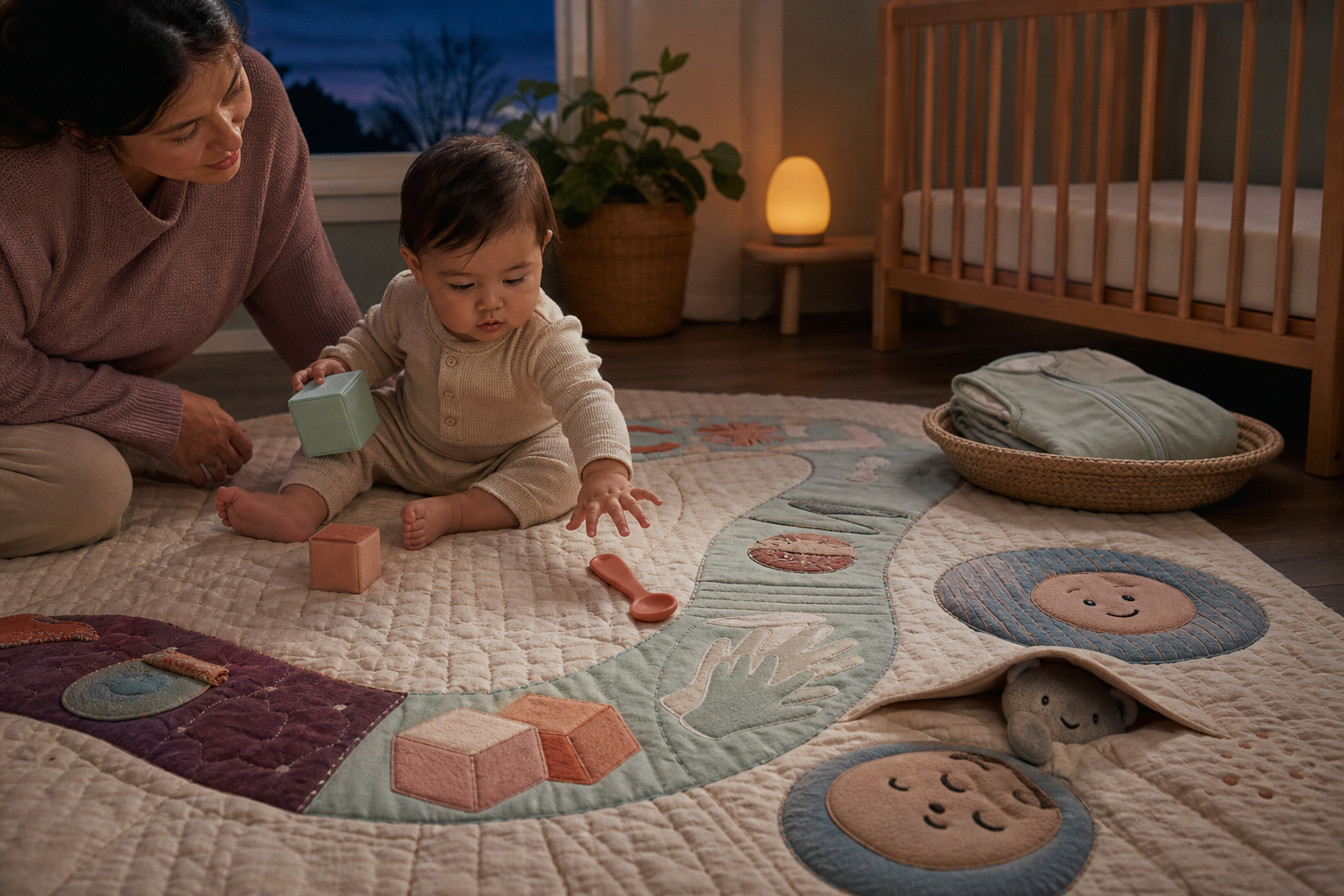
The useful way to read 9 month old milestones is as a whole-child pattern, not a tiny performance review. The current CDC checklist names 13 skills that most babies—at least 75%—can do by 9 months across social-emotional, communication, thinking and play, and movement domains. Some babies arrive at those skills in a different order, and a baby may be busy polishing one area while another is only beginning to show.
The internet tends to spotlight the skills that are easiest to film: crawling across the rug, pulling to stand, waving on cue. I would look first at a quieter set of clues. Can your baby sit without support and get into sitting? Move an object from hand to hand? Make varied strings of sounds? Look when you call their name? Search for the spoon that rolled beneath the high-chair tray? Those ordinary moments tell a much fuller story than one dramatic party trick.
A missing milestone is not a diagnosis. It is a reason to bring the observation to your child’s clinician and ask whether a validated developmental screen or a more focused evaluation would help. Loss of a skill, persistent one-sided movement, no response to everyday sounds, or a concern you cannot shake deserves prompt attention rather than a long experiment at home.
SleepBaby.org · The original video
A little help
for the night ahead.
Take a moment to watch the original Baby Sleep Miracle presentation. Your article will be right here when you’re ready to keep reading.
Ready to get started?Take the next step with SleepBaby.
Help my baby sleep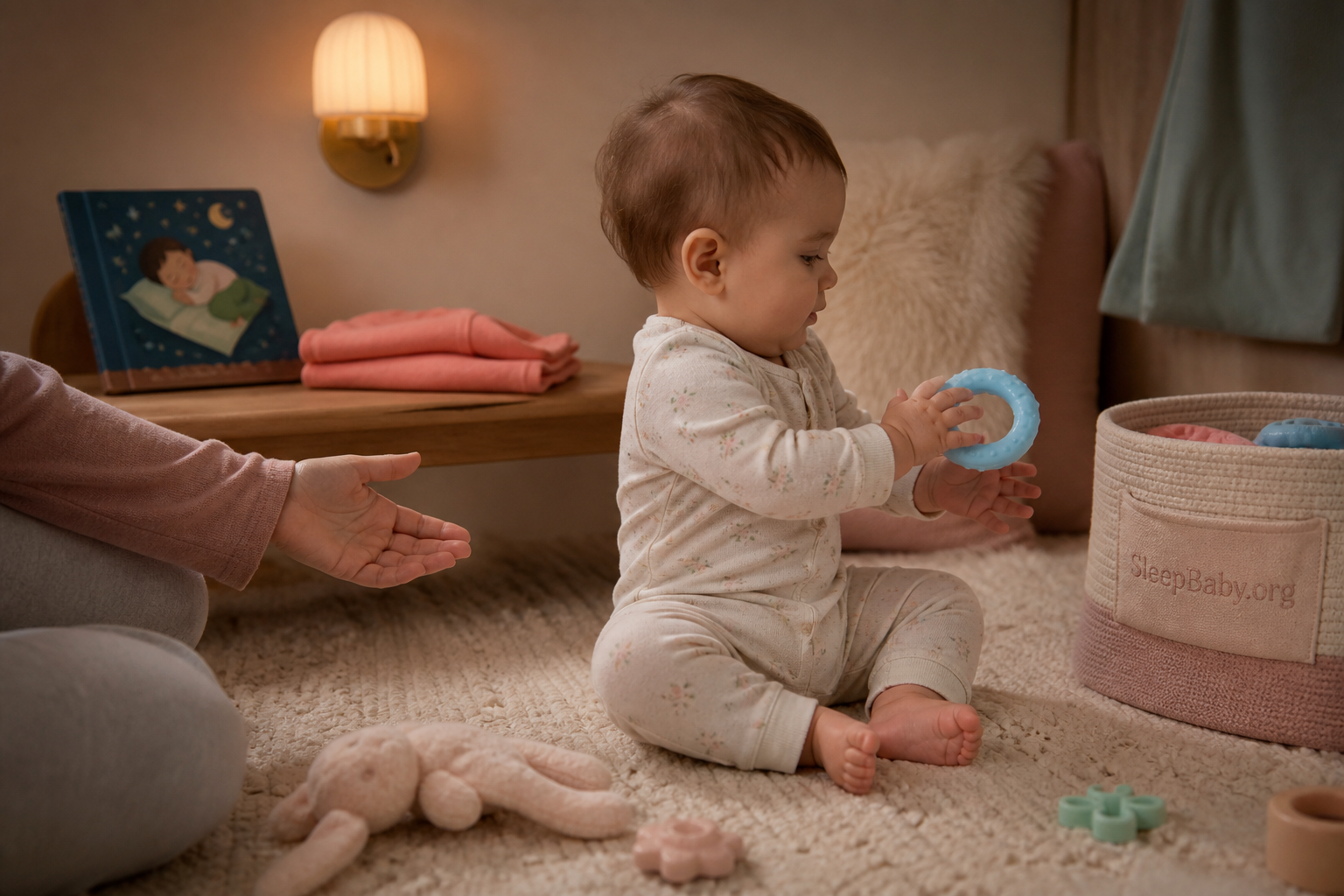
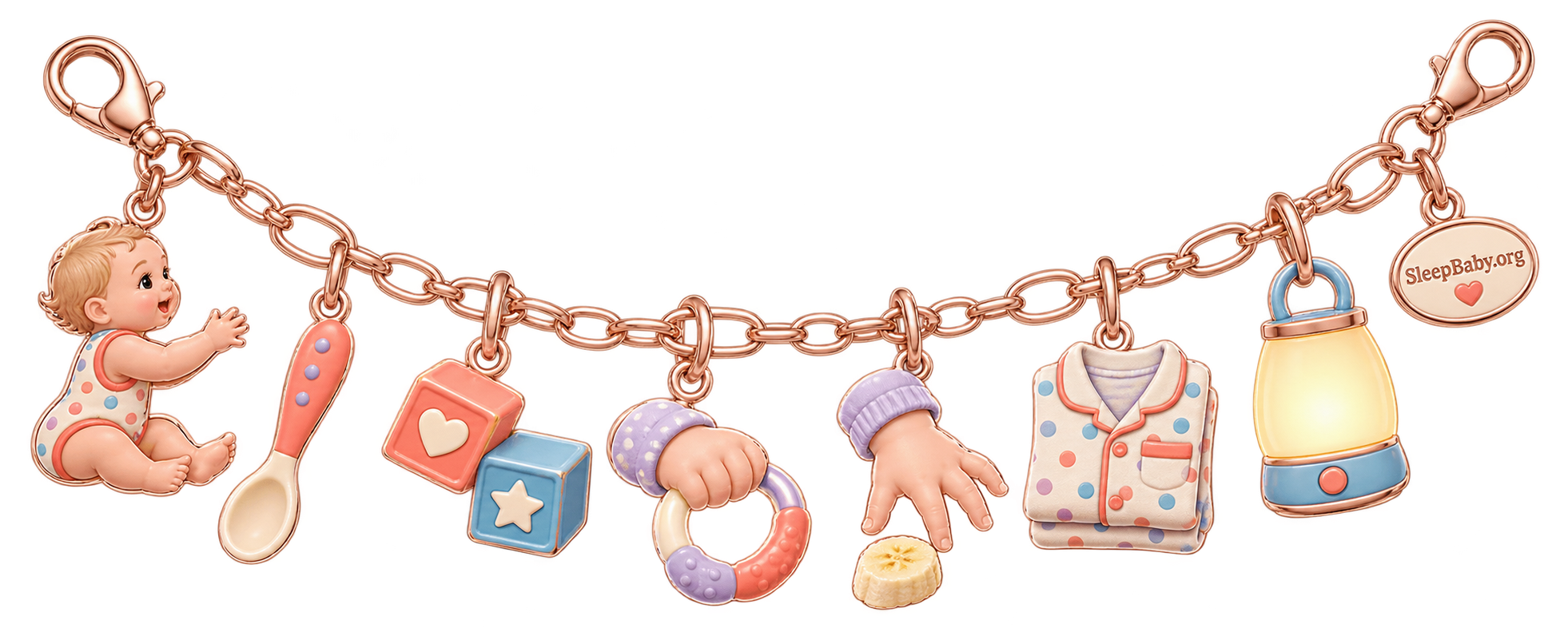
The nine-month skill constellation: 13 things to notice
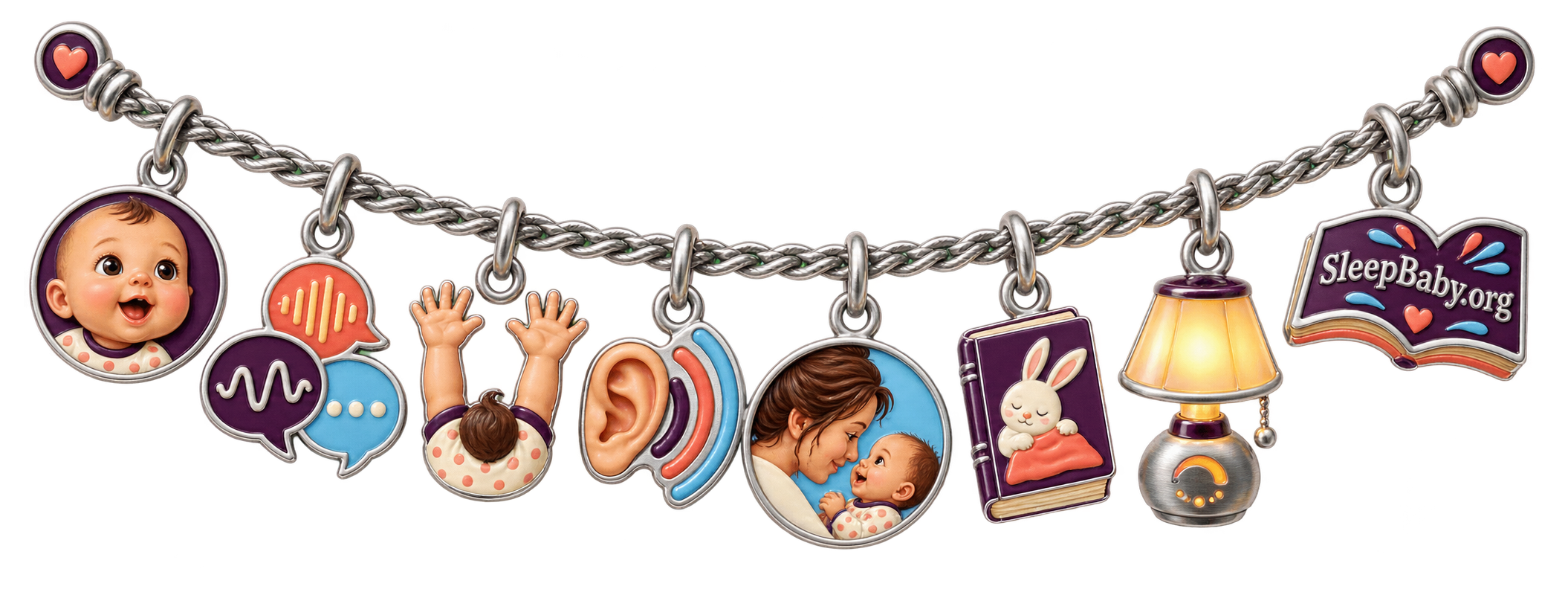
The CDC’s current 9-month checklist groups development into four connected areas. I like the word connected here. A baby who reaches up to be held is communicating, moving, anticipating what comes next, and participating in a relationship all at once. Development stubbornly refuses to stay in tidy website categories.
Four paths, one developing baby
These are observations to bring into everyday life—not boxes to drill until somebody performs.
- Social and emotional: is wary, clingy, or fearful around strangers; shows several facial expressions; looks when called by name; reacts when a caregiver leaves; and smiles or laughs during peek-a-boo.
- Communication: makes several different sounds, including repeated babble such as “mamamama” or “babababa,” and lifts both arms to be picked up.
- Thinking and play: looks for an object after it drops out of sight and bangs two things together.
- Movement and hand skills: gets into a sitting position, sits without support, moves an object from one hand to the other, and rakes food toward the hand with the fingers.
SleepBaby note: If one of these skills is absent, write down what you see and discuss it. Do not convert the list into a score, and do not wait for several missing boxes before asking a question.
SleepBaby.org milestone map · based on the current CDC checklist
How to use a milestone list without making everybody miserable
The CDC chose milestones that at least 75% of children can do by the listed age. That threshold is useful because it gives families and clinicians a shared set of things to notice. It does not mean 25% of babies have a disorder. It also does not make the checklist a test that a baby can pass after three determined rounds of peek-a-boo while an adult hovers with a clipboard.
Parents often search for “9 month baby milestones,” but the useful answer is not a longer list. It is knowing which observations are current, which skills may simply be emerging, and which details change the next step.
Observe your baby in familiar moments over several days: on the floor after a nap, at the high chair, during a diaper change, while greeting someone, and while winding down with a book. New skills do not always appear on demand. Temperament matters too. A cautious baby may show stranger wariness from across the room; an outgoing baby may study a new face before warming up without clinging dramatically.
Look for progress, variety, symmetry, and responsiveness. Is your baby adding sounds? Using both sides of the body? Becoming steadier in sitting? Trying to recover a dropped toy? Turning toward familiar voices? One snapshot cannot answer every developmental question, but a pattern across ordinary life can tell you what deserves celebration, more opportunity, or a professional look.
For babies born early, use corrected age when comparing common developmental goals during the first 2 years. Subtract the number of weeks your baby was born before 40 weeks from their chronological age. That adjustment gives a fairer comparison; it does not replace individualized follow-up when a baby has medical or developmental risks.
Movement and hand skills: sitting matters more than a perfect crawl
Crawling gets an astonishing amount of publicity for a skill that is not on the current CDC 9-month checklist. Some babies crawl on hands and knees, some scoot, some roll to the object they want, and some seem to spend several weeks reverse-parking themselves under the sofa. The question is not simply, “Is my baby crawling?” It is, “What does the whole motor pattern look like?”
At 9 months, the CDC emphasizes two sitting skills: sitting without support and getting into a sitting position independently. It also includes transferring an object between hands and using the fingers in a raking motion to bring food toward the palm. The American Academy of Pediatrics adds useful motor-surveillance observations at this age, including rolling both ways, sitting well, grasping and transferring, moving symmetrically, and not showing a fixed hand preference this early.
The WHO Motor Development Study illustrates why one birthday is a poor finish line. In its sample of 816 children, the 1st-to-99th-percentile window was about 3.8 to 9.2 months for sitting without support and about 5.2 to 13.5 months for hands-and-knees crawling. Thirty-five children—4.3% of the sample—never showed that classic crawling pattern. Those population windows describe variation; they are not a reason to postpone a conversation when a current milestone is absent or something feels wrong.
Give movement room rather than trying to manufacture a crawl. Offer supervised floor time on a firm, clear surface. Place an interesting object slightly to the side so your baby can turn, reach, shift weight, and decide how to get there. Put safe objects near both hands. You are offering a problem, not grading the solution.
Call the pediatrician promptly if your baby is not sitting without support, cannot get into sitting, consistently uses one side much more than the other, has developed a fixed hand preference, seems unusually stiff or floppy, or loses a skill. I would rather bring a specific observation early than spend six weeks trying to talk myself out of it.
Communication before first words
A 9-month-old does not need a meaningful “mama” or “dada” to pass a language test. The current milestone is varied sound play: long, repeated strings such as “ba-ba-ba” or “ma-ma-ma.” At this stage, those sounds may be joyful experiments rather than labels for a person. The distinction matters, especially when every relative is campaigning to have the first word officially recognized.
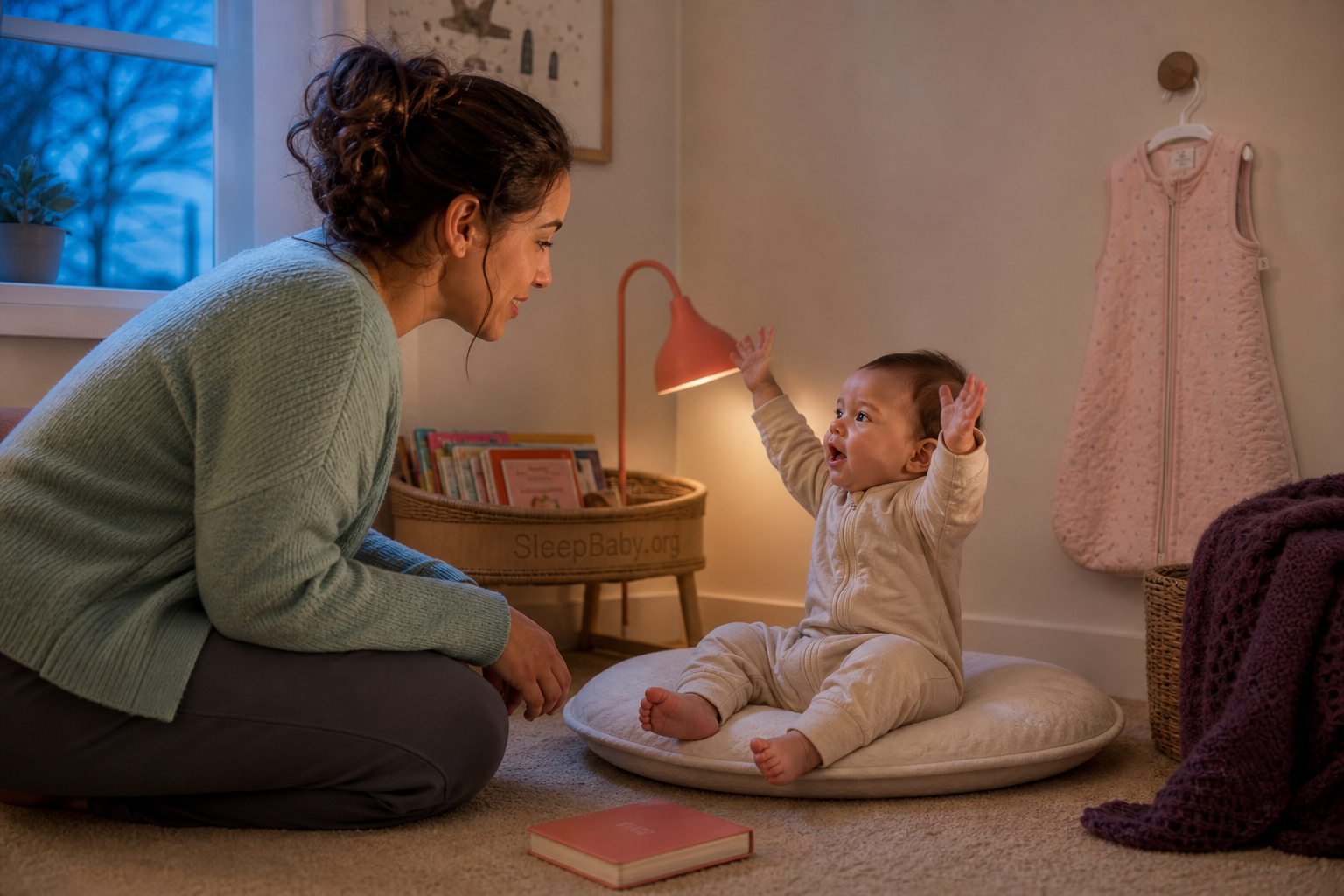
Communication also happens without words. Lifting both arms to be picked up is on the CDC checklist. Looking when called by name, taking turns with sounds, watching your face, and pausing to listen all show that communication is becoming a shared exchange rather than a one-person broadcast.
ASHA’s 7-to-9-month communication guidance includes orienting to a name, pausing at “no,” babbling long strings, recognizing some familiar words, and using gestures such as raising the arms. The NIDCD hearing and communication checklist also highlights turning toward sounds, listening when spoken to, babbling varied sound groups, and beginning to imitate sounds.
Try a simple conversation: copy one sound, pause, and let your baby answer—or stare at you as if your pronunciation needs work. Name the object they are touching. Pair a gesture with the same short phrase. Read a board book slowly enough for them to pat the page and interrupt. The goal is not vocabulary drilling. It is the back-and-forth rhythm underneath language.
If your baby rarely responds to their name or familiar voices, does not turn toward everyday sounds, makes very little varied babble, or loses communication skills, mention it promptly. Ask whether hearing should be checked as part of the developmental evaluation. One missing response does not diagnose autism or hearing loss, but a persistent pattern deserves more than guesswork.
Thinking and play you can actually see
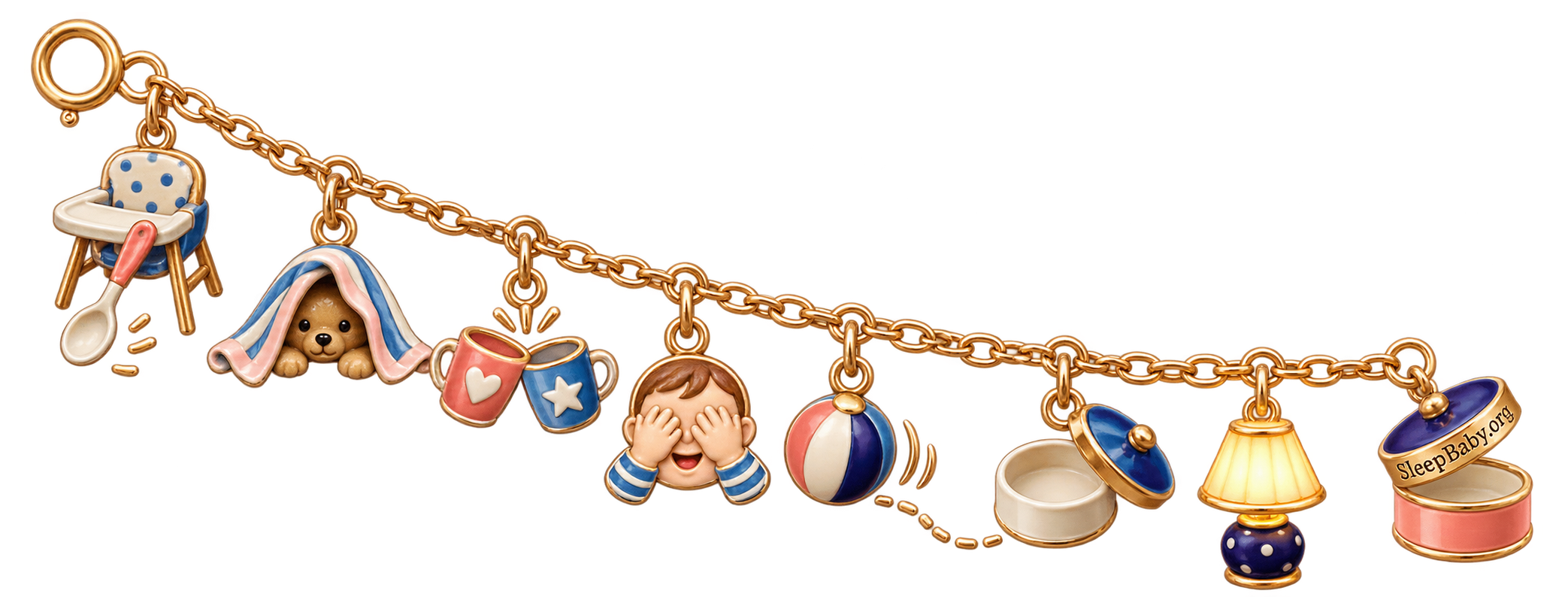
Two cognitive milestones sound almost comically modest: looking for something that dropped out of sight and banging two things together. Yet both reveal a baby running small experiments. Where did the spoon go? What happens when this cup meets that block? Can I make the same sound again, preferably during the quietest part of the evening?
“Looks for a dropped object” is an early, visible clue that your baby is holding the object in mind after it disappears. You might see them lean over the tray after a spoon falls, pull back a cloth that partly covers a toy, or watch the floor where a ball rolled. You do not need a special object-permanence kit. A clean washcloth and a familiar toy have survived nine months of product innovation quite well.
Banging two safe objects together lets a baby explore sound, force, rhythm, and cause and effect. Offer two light objects that are too large to choke on, then imitate the beat. Let your baby drop something and return it a few times. Peek-a-boo adds shared anticipation and social pleasure. Stop when they turn away or become frustrated; learning does not improve because the adult is committed to completing another round.
Social and emotional changes: more feeling, more visible opinions
By 9 months, many babies show several facial expressions, smile or laugh during peek-a-boo, react when a caregiver leaves, look when called by name, and become shy, clingy, or fearful around unfamiliar people. These behaviors can arrive with surprising force. Yesterday a new face was interesting; today it is apparently a formal security concern.
Temperament changes the volume. One baby may bury their face in your shoulder. Another may stare solemnly, then warm up after a few minutes. Look for connection across settings rather than demanding a particular performance. Does your baby share enjoyment, seek a familiar caregiver, notice departures, and use expression or movement to communicate?
For separations, keep goodbyes brief and predictable. Name what is happening, let the caregiver comfort your baby, and return warmly. Sneaking away may avoid one protest but can make your disappearance more confusing. None of this guarantees a tear-free handoff. The aim is a repeated, trustworthy pattern—not a baby who has learned to approve every adult scheduling decision.
Mealtime is a skill lab, with non-negotiable safety rules
Raking soft food toward the palm is a current 9-month milestone. A precise pincer grasp—thumb and forefinger meeting neatly—may be emerging, but it is not required on the CDC list at this age. Hand transfer and raking can be practiced naturally at meals without turning the high-chair tray into occupational-therapy homework.
The CDC notes that babies can begin practicing with an open cup at about 9 months and can explore appropriately prepared finger foods. The mess is not evidence that the lesson failed. It is evidence that the student currently has limited wrist control and no respect for your floor.
Low-pressure ways to support your 9-month-old’s development
You do not need to recreate a therapy clinic in the living room. Choose one small invitation, notice what your baby does, and respond. I use a three-part mental rhythm: Notice, Name, Nudge. It keeps the adult attentive without making the baby responsible for producing a result.
Notice → Name → Nudge
A three-step play path for ordinary days—and for the gentler stretch before the next sleep.
- Notice what is already happening. Your baby searches for the dropped spoon, repeats “ba-ba,” passes a ring to the other hand, or leans toward a toy.
- Name the action in plain language. “The spoon fell.” “You found it.” “You moved the ring.” “I hear ba-ba.” This gives language to the experience without testing.
- Nudge one small next try. Partly hide the spoon, answer the babble and pause, offer the ring across the body, or move the toy just far enough to invite a weight shift.
Then stop. A yawn, turned head, arching body, or rising frustration can mean the experiment is over. Rest is part of learning too.
Created for SleepBaby.org · a milestone practice loop, not a developmental test
Other easy invitations include putting one safe toy in each hand, rolling a ball within reach, filling and emptying a shallow container, looking at family photos, playing peek-a-boo with a cloth, naming pictures, and taking turns making sounds. Rotate activities; do not pile them into one frantic “enrichment hour.” A baby who is hungry, tired, or overwhelmed is allowed to be uninterested.
Watch for the strategy your baby invents. The slightly awkward reach, the pause before looking beneath the cloth, and the proud glance after making an enormous noise are often more informative than whether a task is completed exactly as you pictured it.
CDC families on milestone monitoring
Milestones become useful when they start a conversation
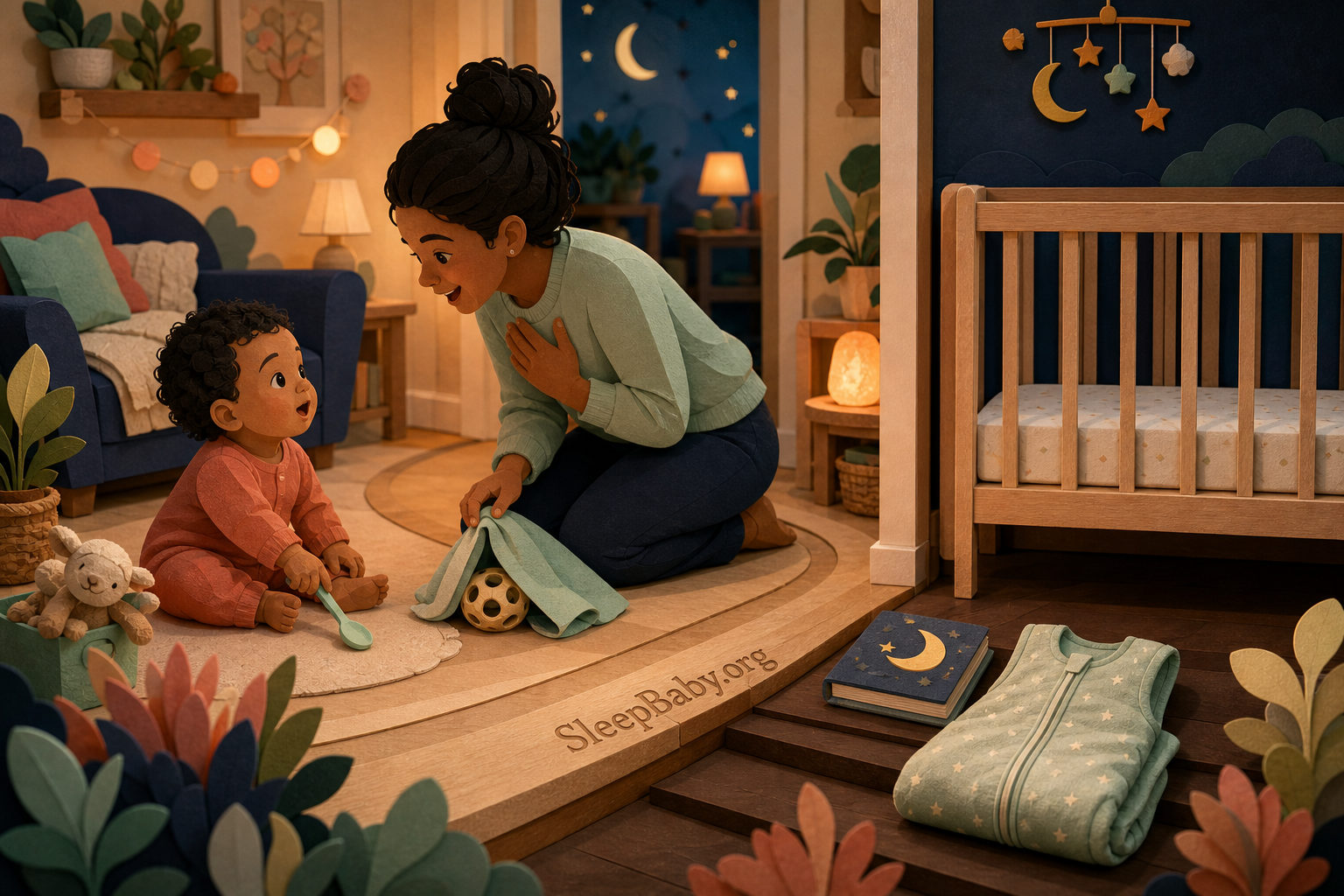
A milestone list becomes useful when it helps you notice a pattern and start a conversation. In this CDC video, families explain how they used milestone tools to recognize development and decide when to ask for help.
Takeaway: Use the video for the process—notice, record, discuss—not as a substitute for the current 9-month checklist or a validated screen.
Watch “Milestones Matter for Families!” on the CDC’s YouTube channel.
When to call the pediatrician—and what to ask for
Developmental guidance becomes unhelpful when it offers only two settings: “everything is fine” or “panic.” There is a calmer middle path. A concern is information. Bring it forward, ask for structured screening, and let the next step be based on the whole child rather than on an internet label.
Concern → next step
- Monitor calmly: a common but non-required skill such as crawling, pulling to stand, waving, pointing, a refined pincer grasp, or a true word has not appeared, while your baby is progressing across domains with no loss, asymmetry, hearing concern, or feeding concern.
- Contact the clinician and ask about screening: one or more current CDC milestones is absent; your baby is not sitting unsupported or getting into sitting; produces little varied babble; does not respond to name or everyday sounds; uses one side persistently; has an early fixed hand preference; or you are concerned.
- Act promptly: your baby loses any skill, shows a sudden developmental change, or has a known medical risk without the recommended follow-up. Do not wait for the next routine visit to mention regression.
- Use the next doorway: ask for a validated developmental screen and any focused hearing, vision, motor, or communication evaluation recommended. In the United States, you can also contact your state or territory’s early-intervention program directly; a physician referral is not required.
SleepBaby.org decision path · missing is a reason to look closer, not a diagnosis
The American Academy of Pediatrics recommends developmental surveillance at every health visit and a validated general developmental screen at 9, 18, and 30 months. Screening asks a broader, standardized set of questions than a milestone checklist. It can identify who may benefit from evaluation; it does not diagnose a condition by itself.
Autism-specific universal screening is recommended later, at 18 and 24 months, though concerns at any age should still be evaluated. Do not try to diagnose autism at 9 months from one behavior such as inconsistent name response, limited stranger anxiety, or not pointing yet. Describe the pattern you see and ask for the right assessment.
Bring useful evidence to the appointment: a completed checklist, a few dated notes, and short videos of ordinary play when they capture the concern. Write concrete descriptions—“uses the right hand for nearly every reach” or “does not turn toward the vacuum or my voice”—instead of trying to choose a diagnosis. Ask:
- Can we complete a validated developmental screen today?
- Should hearing or vision be checked?
- Does the motor pattern need physical or occupational therapy assessment?
- Should we contact early intervention now?
- What specific change should prompt a faster follow-up?
The CDC’s early-intervention guide explains how families in the United States can find their state or territory program. Eligibility varies and is based on evaluation. Reaching out does not assign a label to your baby; it opens a door to information and support.

Quick answers about nine month milestones
Should my 9-month-old be crawling?
No classic hands-and-knees crawl is required by the current CDC checklist at 9 months. Crawling has a wide developmental window, and some babies never use that exact pattern. Sitting, getting into sitting, symmetric movement, hand transfer, progress, and any loss of skill are more useful parts of the motor picture. Ask the clinician if those foundational skills are missing or the movement pattern concerns you.
Should my baby pull to stand or cruise?
Some babies do, but neither pulling to stand nor cruising is a universal current 9-month milestone. Provide safe floor space and stable surroundings; do not pull a baby into a position they cannot reach or control independently just to meet an online list.
Does a 9-month-old need a pincer grasp?
No. The current fine-motor milestones are transferring an object between hands and raking food toward the hand. A refined thumb-and-forefinger pincer grasp is a later refinement for many babies. Feeding safety still depends on appropriate food preparation, posture, and supervision—not on how elegantly a piece of food was picked up.
Should a 9-month-old say words?
Varied repeated babble is the current milestone; a meaningful first word is not required at exactly 9 months. Pay attention to the broader communication pattern: sound variety, response to name and familiar voices, gesture, shared attention, and turn-taking. Limited babble or poor response to sound deserves a clinician and hearing conversation.
Is stranger anxiety a good sign?
Wariness, clinginess, or fear around unfamiliar people appears on the current milestone list, but temperament affects how it looks. It is one social-emotional clue, not a test of attachment or personality. Look at the wider pattern of expression, connection, shared play, name response, and reaction to a caregiver leaving.
What if my baby was premature?
Use corrected age for common developmental comparisons during the first 2 years. A 9-month-old who arrived eight weeks early may be compared with typical 7-month expectations while still receiving individualized follow-up based on medical history.
What if just one CDC milestone is missing?
Bring it up. The CDC advises acting early when a milestone is absent, a skill is lost, or a caregiver has a concern. That does not mean one unchecked item equals a diagnosis. It means the observation belongs in a real developmental conversation rather than in a private cycle of searching and second-guessing.
Where development meets the next sleep
A baby who has spent the day practicing sitting transitions, repeating new sounds, and tracking every departure may carry some of that energy into wind-down. You may see more crib practice, more protest at separation, or a brain that seems determined to rehearse “ba-ba-ba” after the lights are low. Development can change the texture of bedtime without proving that a specific milestone caused every wake-up.
Keep the lanes separate. This guide owns whole-child development. If you need timing, naps, and wake-window context, use your 9-month-old’s sleep schedule. If sleep changed suddenly and you are wondering about a temporary disruption, read the separate 9-month sleep regression guide. A sleep label should never explain away skill loss, hearing concerns, asymmetry, illness, pain, or a developmental worry.
Tonight, I would choose one calm observation instead of retesting the whole list. Notice what your baby reaches for, listens to, searches for, or shares with you. Write down the detail that matters. Then let the day close. Development is built through thousands of ordinary exchanges; it does not need a final exam before pajamas.
Sources
- CDC: Milestones by 9 Months (updated May 15, 2026).
- American Academy of Pediatrics: Promoting Optimal Development Through Surveillance and Screening (reaffirmed with updates in 2024).
- American Academy of Pediatrics: Motor Delays—Early Identification and Evaluation.
- WHO Motor Development Study: Windows of Achievement for Six Gross Motor Milestones.
- ASHA: Communication Milestones—Birth to 1 Year.
- NIDCD: Your Baby’s Hearing and Communicative Development Checklist.
- CDC: Fingers, Spoons, Forks, and Cups.
- CDC: Choking Hazards.
- CDC: Early Intervention.
- HealthyChildren.org: Corrected Age for Preemies.
SleepBaby.org · The original video
A next step for
the next bedtime.
Still thinking about sleep? Watch the presentation here, then explore the SleepBaby program whenever you’re ready.
Ready to get started?Take the next step with SleepBaby.
Help my baby sleep