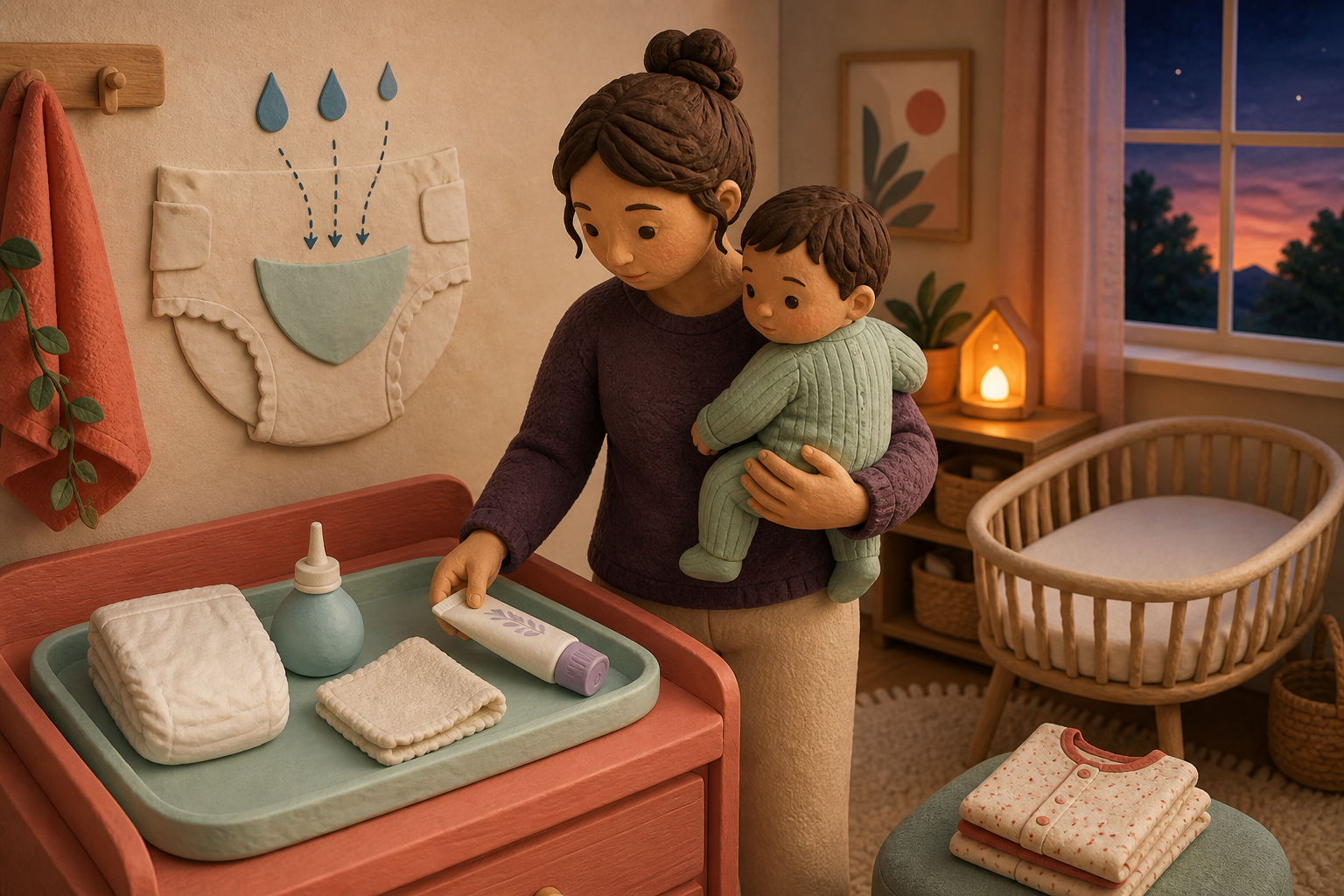
Most diaper rash is irritant dermatitis: moisture, stool, friction, and repeated cleaning wear down the skin barrier. The useful first steps are to change wet or soiled diapers promptly, clean with water or a gentle fragrance-free option, pat or air dry, and apply a thick layer of zinc oxide or petrolatum barrier paste.[1][2] If the rash is getting worse, looks infected, is unusually painful, or is not beginning to improve after two to three days, call the pediatrician.
I would look at two things before buying another cream: where the rash sits and what changed before it appeared. Irritation usually hits the rounded skin that touches the diaper and often leaves the deep groin folds less affected. A shiny, sharply edged rash that reaches into the folds and has smaller bumps around it makes yeast more plausible, especially after antibiotics, but it still does not turn a bathroom glance into a diagnosis.[1][3]
What diaper rash is doing to the skin
The diaper area is a small climate system: warmth, moisture, friction, urine, stool enzymes, and frequent cleaning all meet in one place. Healthy skin can handle ordinary mess. Once it stays wet or rubs for long enough, its outer barrier softens and becomes easier to irritate. Stool is especially rough on already-injured skin, and diarrhea raises the number of exposures in a day.[1][3]
That is why one missed change is rarely a useful moral explanation. A baby can develop a rash during diarrhea even with attentive care. A new diaper fit can rub. Antibiotics can change the local balance and make yeast more likely. A fragranced wipe can irritate sensitive skin. Several of those can happen together. The job is not to find the guilty parent; it is to reduce the next round of irritation and watch how the skin responds.
Mild irritant rash may look pink or red, dry, and patchy. A more severe version can become swollen, raw, cracked, ulcerated, or painful. Color is not the only useful observation, especially when redness is harder to see against a baby’s usual skin tone. Compare the area with nearby skin and notice warmth, swelling, texture, tenderness, oozing, and whether the rash is spreading.
A skin-barrier routine
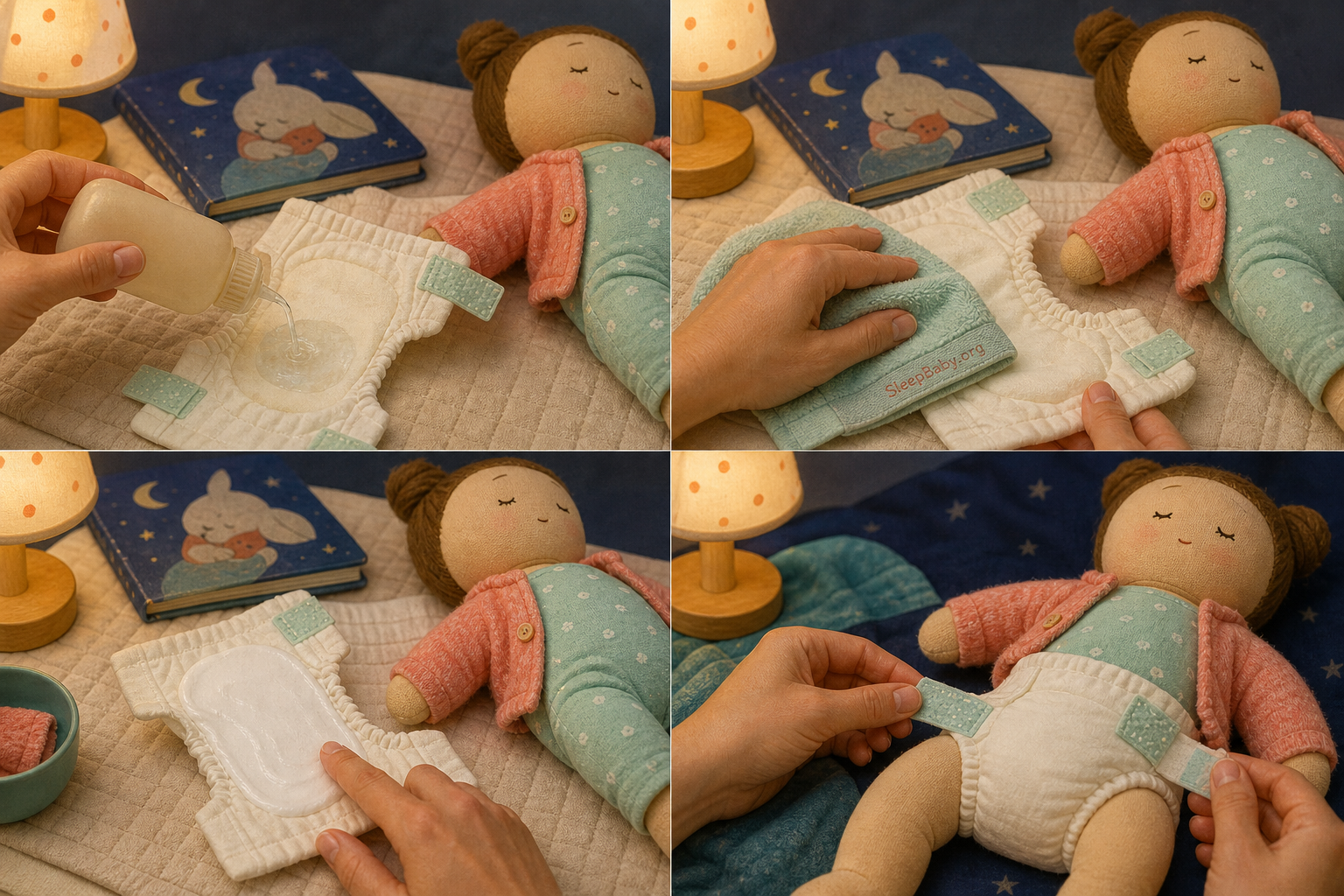
Clean, dry, shield, then stop touching it
1. Clean
Remove the irritant
Use warm water or a fragrance-free, alcohol-free wipe. Rinse stool from folds without scraping tender skin.
2. Dry
Pause the friction
Pat with a soft cloth or let the area air dry while your baby is awake and directly supervised.
3. Shield
Build a real barrier
Use enough zinc oxide or petrolatum paste to leave an opaque protective layer between skin and the next diaper.
4. Protect
Leave clean paste alone
At the next change, remove visible stool and add more. Do not polish the skin clean just to rebuild the same layer.
The last step is the one many instructions whisper. If the barrier is still clean, it can stay. The American Academy of Pediatrics and the Royal Children’s Hospital both advise removing visible soiling rather than rubbing away every clean trace before adding more.[1][3] Skin that already hurts does not need a cleanliness performance. It needs protection.

Where the rash sits changes the question
Rashes overlap. Irritated skin can also develop yeast or bacterial infection, and a baby can have an underlying skin condition at the same time. Use the patterns below to decide what to report and how quickly to ask for help, not to name the condition yourself.
Often irritation
Rounded contact areas, folds less affected
Pink or red patches sit where the diaper, urine, or stool touches most. The deeper groin folds may look relatively clear. Recent diarrhea, long moisture exposure, rubbing, or frequent cleaning fits this pattern.[1]
Yeast becomes more plausible
Folds involved, sharp bright edges, smaller spots nearby
A shiny or intensely colored rash in the folds, with little bumps or satellite lesions around the main patch, can fit Candida. Recent antibiotics or persistent moist skin adds context. Ask the clinician which treatment fits.[1][2]
Needs medical assessment
Crust, weeping, pus, spreading pain, or sharply red skin around the anus
Yellow crusts, drainage, pus-filled bumps, painful spreading redness, or bright well-defined redness around the anus can signal bacterial infection or another condition. Do not treat this as ordinary chafing.[1][3]
Product or another skin condition
The shape follows exposure, or the rash will not behave like irritation
A rash that appears wherever a new wipe or cream touches may suggest contact allergy. A severe, unusual, recurrent, widespread, or treatment-resistant rash needs a clinician to consider eczema, psoriasis, seborrheic dermatitis, nutritional problems, or rarer causes.[1][3]
Do not photograph exposed skin for a parenting group or public social feed. If your clinician asks for an image, use the office’s secure portal or the method they recommend, crop out identifying details where possible, and keep the photo off shared camera rolls. A private timeline is often just as useful: when the rash began, where it started, what the stool has been like, whether antibiotics or a new product appeared, what you tried, and whether the rash is improving.
What changed before the rash appeared?
A useful timeline is narrow. You do not need to audit every bite, bath, and laundry load from the last month. Look back two or three days and identify the variables that actually touch the skin or change what reaches it.
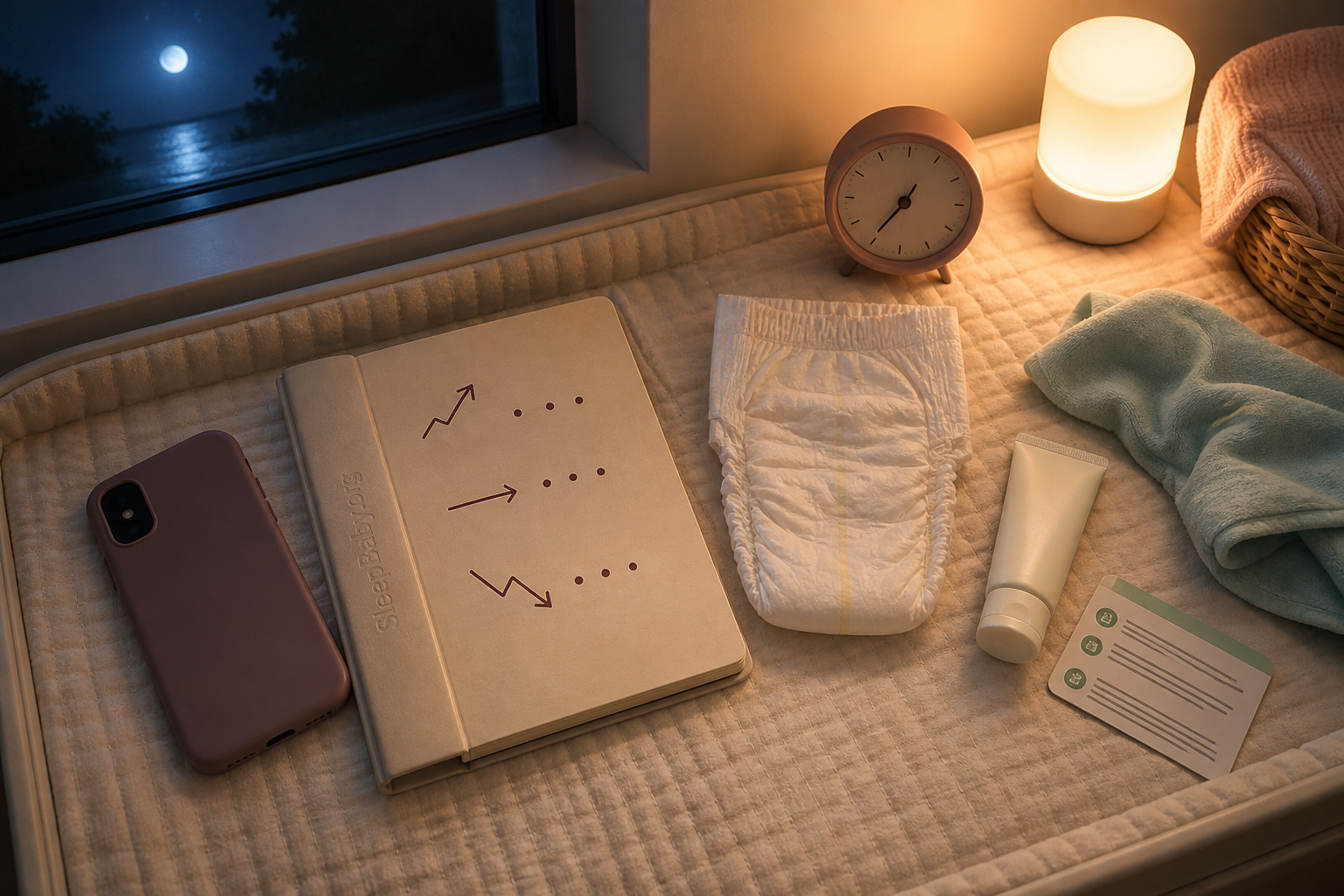
A two-minute timeline
Five changes worth mentioning
- Stool
- Diarrhea, more frequent stools, or a new pattern means more irritating contact and more cleaning.
- Medicine
- Antibiotics for the baby, and sometimes antibiotics taken while breastfeeding, can make yeast more likely.[1]
- Product
- A new wipe, soap, detergent, cream, diaper brand, dye, fragrance, or preservative may shape where irritation appears.
- Fit and friction
- A too-tight diaper, a new size, heat, or rubbing at the waist and thighs can keep damaged skin from settling.
- Time and direction
- Write down whether the rash is better, unchanged, or worse after 24 and 48 hours of one consistent routine.
New solid foods sometimes arrive at the same time as changes in stool frequency or consistency. That can increase irritation without proving that one food is an allergy or that the breastfeeding parent’s diet caused the rash. Do not remove a useful food or make broad diet changes for a diaper rash alone. Bring a repeated food-and-symptom pattern, blood in stool, vomiting, hives, breathing symptoms, or poor growth to the child’s clinician.
Teething gets blamed for nearly every wet household event. The more useful observation is not the tooth. It is whether stool became looser or more frequent, whether the baby is taking an antibiotic, and whether the rash follows skin contact. Treat what the skin is experiencing rather than making a teething theory carry more certainty than it can.

How to use diaper rash cream without making the change harder
For ordinary irritation, choose a fragrance-free barrier with zinc oxide or petrolatum. The brand matters less than whether the product protects the skin and whether you can use it consistently.[1] Ointments tend to spread easily. Pastes can create a thicker physical shield. Either can be useful when the ingredients are simple and the product does not sting.
Apply enough to make a visible layer. The AAP compares the amount to icing on a cupcake, which is memorable because a nearly transparent smear is not much of a shield.[1] Cover the irritated contact surfaces without forcing paste into the vagina, under the foreskin, or inside the anus. Fasten the diaper loosely enough to avoid rubbing but securely enough to contain stool.
Do you need to remove all the cream at every change?
No. If the barrier is clean, leave it. Gently remove stool and contaminated paste, then add a fresh layer. Mineral oil on a cotton pad can help loosen stubborn paste when it truly needs to come off, but ordinary changes should not become a scraping project.[4]
What if wipes make the baby cry?
Stop the repeated swipe. Use warm water from a squeeze bottle or a very soft wet cloth, then pat dry. Choose alcohol-free and fragrance-free wipes only when they do not sting.[1][2] If crying begins with urination, stooling, leg movement, or a touch somewhere other than the rash, the separate diaper-change crying guide can help you organize those clues without assuming the skin explains everything.
Can you use hydrocortisone or an antifungal?
Sometimes, but this is where I would stop guessing. A clinician may recommend a short course of low-strength hydrocortisone for significant inflammation, an antifungal for Candida, or antibiotics for a bacterial infection.[1][4] The right product, strength, location, and duration matter on infant skin. Ask the child’s clinician or pharmacist before using a steroid, antifungal, antibiotic ointment, numbing cream, or combination product.
Do not layer several medicated creams because the rash looks severe. That makes it harder to know what helped, can expose injured skin to unnecessary ingredients, and may hide a pattern that needs examination. At 1:47 a.m., the bathroom shelf can start to look like a seven-product roulette wheel. The calmer plan is one gentle barrier routine and a clear threshold for stopping home care.
What not to put on a diaper rash
- Talcum powder: particles can be inhaled. Keep powders away from a baby’s diaper area.[2]
- Fragranced lotion, bubble bath, or harsh soap: scent and repeated washing can add irritation.
- Alcohol-containing wipes: they can sting and dry injured skin.
- Adult pain, itch, hemorrhoid, or antibiotic products: baby skin is not the place to improvise with active ingredients.
- Essential oils, vinegar, baking soda paste, cornstarch, or food-based remedies: these are not more trustworthy because they came from a kitchen or a plant. Some can irritate skin or complicate infection.
- A new product every few hours: changing five variables at once prevents you and the clinician from seeing the pattern.
If a product clearly seems to trigger the rash, stop it and use a simple fragrance-free routine. The AAP notes that a contact allergy may show up wherever the product is applied and that a carefully observed product switch can help identify the culprit.[1] Seek care if the rash is severe, spreading, or not improving rather than conducting a long series of experiments on raw skin.
When diaper rash needs the pediatrician
Match the finding to the next door
Home care, call soon, or get urgent help
Home care is reasonable
The rash is mild, limited to the diaper contact area, the baby is feeding and behaving close to usual, and the skin begins to settle with prompt changes, gentle cleaning, drying, and barrier paste.
Call the clinician soon
The rash is very raw, bleeding, unusually painful, spreading beyond the diaper, began in the first six weeks, followed antibiotics, keeps recurring, or is not improving after two to three days of consistent care.[1][2]
Get urgent medical advice
There is fever with an ill-appearing baby, pus, blisters, open or oozing sores, yellow crusting, rapidly spreading painful redness, unusual drowsiness, poor feeding, or dehydration signs. A temperature of 100.4°F (38.0°C) or higher under 3 months is an immediate call.[5]
Call earlier if your instincts say the baby is not acting right. A rash can be common and still deserve care. The skin does not need to reach a dramatic internet-photo threshold before pain, fever, spreading redness, or a sick baby becomes important.
What should you tell the pediatrician?
- When the rash started and whether it is better, worse, or spreading.
- Where it appears: rounded contact skin, folds, around the anus, or beyond the diaper.
- Whether there are small surrounding bumps, crusts, drainage, blisters, cracks, bleeding, or open sores.
- Any fever, diarrhea, vomiting, poor feeding, reduced urine, unusual sleepiness, or marked pain.
- Recent antibiotics, illness, new foods, and stool changes.
- Every wipe, soap, diaper, detergent, cream, oil, powder, or medicine used on the area.
Bring the actual product or a photo of its ingredient label if needed. Do not bring a guessing game with six unlabeled jars. A clean timeline helps the clinician decide whether this is irritation, yeast, bacterial infection, contact allergy, or something else.
What improvement should look like over the first 48 hours
A mild irritant rash should start moving in the right direction when the skin spends less time wet, stool is removed promptly, rubbing stops, and the barrier stays in place. The first improvement may be behavioral: the baby flinches less during cleaning or settles more easily after the diaper is fastened. Then the edges look less angry, the skin feels less hot or swollen, and no new raw areas appear.
Do not demand perfectly clear skin by the next morning. Depending on severity, healing can take several days.[4] What matters is direction. Take one private note at the same time each day: better, unchanged, or worse. If you need a photo for comparison, keep it on a private device, exclude the baby’s face and identifying details, and delete it when it is no longer needed. Never make an exposed medical image part of a public request for opinions.
Keep the experiment small
One routine, three observations
- Comfort: Is cleaning less painful? Is the baby feeding, playing, and settling close to usual?
- Border: Is the rash staying inside the same area, or is it spreading into folds, thighs, abdomen, back, or other skin?
- Surface: Are there new bumps, blisters, cracks, drainage, crusts, bleeding, or open sores?
Call sooner rather than waiting 48 hours when any urgent sign appears. Otherwise, if a consistent gentle routine produces no improvement after two to three days, the AAP advises contacting the child’s doctor.[1] That is not failure of the barrier cream. It is evidence that the rash may need a different diagnosis or a prescription treatment.
If diaper rash keeps coming back
Recurring rash usually deserves a pattern review, not a larger shopping bag. Start with the timing. Does it follow diarrhea, antibiotics, daycare days, overnight leakage, a particular wipe, a detergent load, a cloth-diaper cover, or a diaper size that leaves red pressure marks? Does it fully clear between episodes, or does a smaller patch remain?
Then look beyond the diaper without turning the baby into a home dermatology project. Mention rash on the scalp, face, mouth, hands, feet, or other folds; oral white patches that do not wipe away; persistent diarrhea; poor feeding; or concerns about growth. RCH advises considering other causes when a rash is severe, unusual, or not responding to appropriate care, because eczema, psoriasis, seborrheic dermatitis, infection, nutritional problems, and rarer conditions can resemble or complicate diaper rash.[3]
The right next move may be as simple as changing a fit or removing a fragranced product. It may be a clinician-confirmed antifungal. It may be an examination for something that is not diaper rash at all. The useful distinction is that recurrence changes the question from “Which cream is stronger?” to “What keeps recreating this pattern?”
Do certain diapers cause diaper rash?
A diaper can contribute through fit, friction, trapped moisture, dye, elastic, or another material, but no single diaper type is automatically rash-proof. Highly absorbent diapers can help keep moisture away from skin.[1] If the rash follows a new brand or size, return to the previous well-tolerated option for a limited comparison and change nothing else at the same time. Look for improvement where the elastic or diaper surface touched.
Can diaper rash bleed?
Very raw or cracked skin can bleed, but bleeding is not a reason to keep trying routine home care indefinitely. Call the clinician, especially when bleeding is more than a tiny surface spot, keeps recurring, accompanies ulcers or blisters, or the baby is in significant pain. Do not put powder or a numbing product over broken skin.
Is yeast diaper rash contagious?
Candida normally lives in the body and grows readily in warm, moist environments. A yeast diaper rash does not mean the baby was dirty or caught something because a caregiver failed. Wash hands before and after diaper changes, do not share open creams between children, and follow the clinician’s treatment and cleaning instructions.[1]
Diaper rash in a newborn or very young baby
Age changes the threshold for calling. MedlinePlus advises contacting the provider when diaper rash develops during the first six weeks of life.[2] Newborn skin conditions can overlap, feeding and hydration can change quickly, and a clinician may need to see whether the rash is truly limited to the diaper area.
Measure temperature rather than relying on how the forehead feels. For a baby younger than 3 months, 100.4°F (38.0°C) or higher is an immediate medical call.[5] Also call promptly for poor feeding, unusual sleepiness, repeated vomiting or diarrhea, significantly fewer wet diapers, or a baby who seems unwell. Do not delay because the rash itself looks mild.
Make the care plan repeatable across caregivers
A rash can stall when each caregiver uses a different routine. Write one short plan for home, daycare, grandparents, or a babysitter: which cleanser or wipe to use, how to dry, which barrier to apply, how thickly to apply it, which medicated product is clinician-directed, and what finding should trigger a call. Send the product in its original labeled container. Never transfer medicated cream into an unlabeled travel jar.
Ask for stool changes promptly rather than at the end of the day. If frequent changes are medically necessary, make that explicit. If a prescription has timing or application instructions, follow the prescriber’s written plan rather than asking a caregiver to identify yeast from appearance.
Keep creams, wipes, and medicines out of reach before, during, and after the change. Babies are remarkably efficient at finding the one open tube in a carefully prepared room. If ingestion happens, use the product label, poison-control guidance, and the linked ingestion article below; do not use the rash-care routine as ingestion advice.

How to prevent the next diaper rash without over-washing
Prevention is mostly repetition, not perfection. Change stool promptly. Check wet diapers often enough to keep skin from sitting in moisture. Use an absorbent diaper that fits without digging into the waist or thighs. Clean gently, dry, and use a barrier when the skin is vulnerable.[1][3]
During diarrhea
Expect to change more often. Rinse rather than repeatedly rub. Put a substantial barrier between stool and skin at each change. Watch hydration as well as the rash; fewer wet diapers, dry mouth, unusual drowsiness, or poor intake belongs in a medical call, especially with fever or vomiting.
If you use cloth diapers
Rinse thoroughly so detergent does not remain in the fabric, avoid fabric softener and plastic or rubber covers that trap moisture, and consider a temporary highly absorbent disposable diaper while a significant rash heals if that is practical for your family.[1][2] This is a skin-management choice, not a verdict on cloth diapering.
When trying a new product
Change one thing at a time. Fragrance-free and alcohol-free is a useful starting point, but even a product labeled gentle can bother one baby’s skin. If a rash repeatedly follows the same wipe, cream, elastic, dye, or detergent exposure, stop it and tell the clinician.
Give the skin air while the baby is awake
A few supervised diaper-free minutes on an easy-clean floor surface can reduce moisture. Keep the baby awake and within reach. Do not use diaper-free naps as an airflow strategy, and do not add a towel, disposable pad, or other loose layer to a crib or bassinet. For sleep, use the normal firm, flat, level approved infant sleep surface with only a fitted sheet.
If room temperature and safe sleep clothing are part of the question after the rash is cared for, the separate guide to whether a baby can sleep in just a diaper explains the temperature and layering decision. It does not replace the skin-care plan.
What to do about diaper rash at night
Night does not change what heals skin. It changes how hard the routine feels. Keep water, clean cloths, diapers, and barrier paste together so a 2 a.m. change does not become a bright-light cabinet search. Change stool promptly. With an active rash, check wetness more often and follow the clinician’s plan. Use the same gentle clean-dry-shield steps, keep the room dim, and return to the normal safe sleep setup.
A sore bottom can make settling harder, and a baby may cry when urine, stool, or a wipe touches broken skin.[3] Treat the skin and pain first. A sleep schedule cannot out-negotiate an infection or raw skin. Once comfort and medical concerns are addressed, avoid changing the entire bedtime routine because of one rough night. Familiar steps can remain familiar.
There is a quiet parental trap here: if the baby finally falls asleep after a difficult change, every small decision can suddenly feel like a referendum on the whole night. It is not. A clean diaper, an intact barrier, the usual safe surface, and a clear plan for when to call are enough for this moment. Common does not mean painless, and needing help does not mean you missed something obvious.


Watch the barrier technique
An AAP dermatologist shows how diaper cream should protect the skin
The American Academy of Pediatrics video demonstrates gentle diaper-rash care and how much barrier cream to apply. It cannot diagnose your baby’s rash, so keep the warning signs and call thresholds above in charge.
Takeaway: protect rather than scrub. Clean gently, let the skin dry, use a generous barrier, and ask the pediatrician when the pattern or progress does not fit simple irritation. Watch directly on YouTube.
If the rash cream itself was swallowed, move out of skin-care mode and use the separate guidance for when a baby ate diaper cream. Keep the container with you and follow poison-control or medical instructions for the exact product and amount.
Sources
When the skin is cared for and the night is still wobbly
Bring the next sleep back to a familiar plan
Diaper rash needs skin care and, sometimes, medical care. Once your baby’s comfort and warning signs are addressed, SleepBaby can help you think through the settling, schedule, and night-waking pieces without changing five things at once.
SleepBaby does not diagnose or treat rashes. Use the medical care thresholds in this guide and your child’s clinician’s advice.