I once watched a baby spend an entire evening perfecting three unrelated skills: dropping a spoon, making a sound like a tiny outboard motor, and leaning six inches sideways for a toy he could already reach. The skill his parents were worried about—crawling—did not make the agenda. Babies are not especially interested in completing our checklists in order.
If you searched for 8 month old milestones because you are trying to decide whether your baby is “on track,” start with this: eight months is a developmental window, not a report-card date. Look at the growing pattern across movement, hand use, communication, play, and connection. Some skills that were established around six months should be familiar; other skills commonly listed by nine months may only be coming into view.
The useful answer
Eight months is a window, not a test
Notice change over time. A baby may be sitting steadily but not crawling, babbling constantly but quiet with strangers, or moving everywhere while using only a few sounds. One missing headline skill does not diagnose a delay, and one flashy new trick does not summarize the whole child. Loss of a skill, an overall pattern that worries you, or a concern you cannot shake deserves a conversation with your baby’s clinician now—not after you have collected more evidence from the internet.
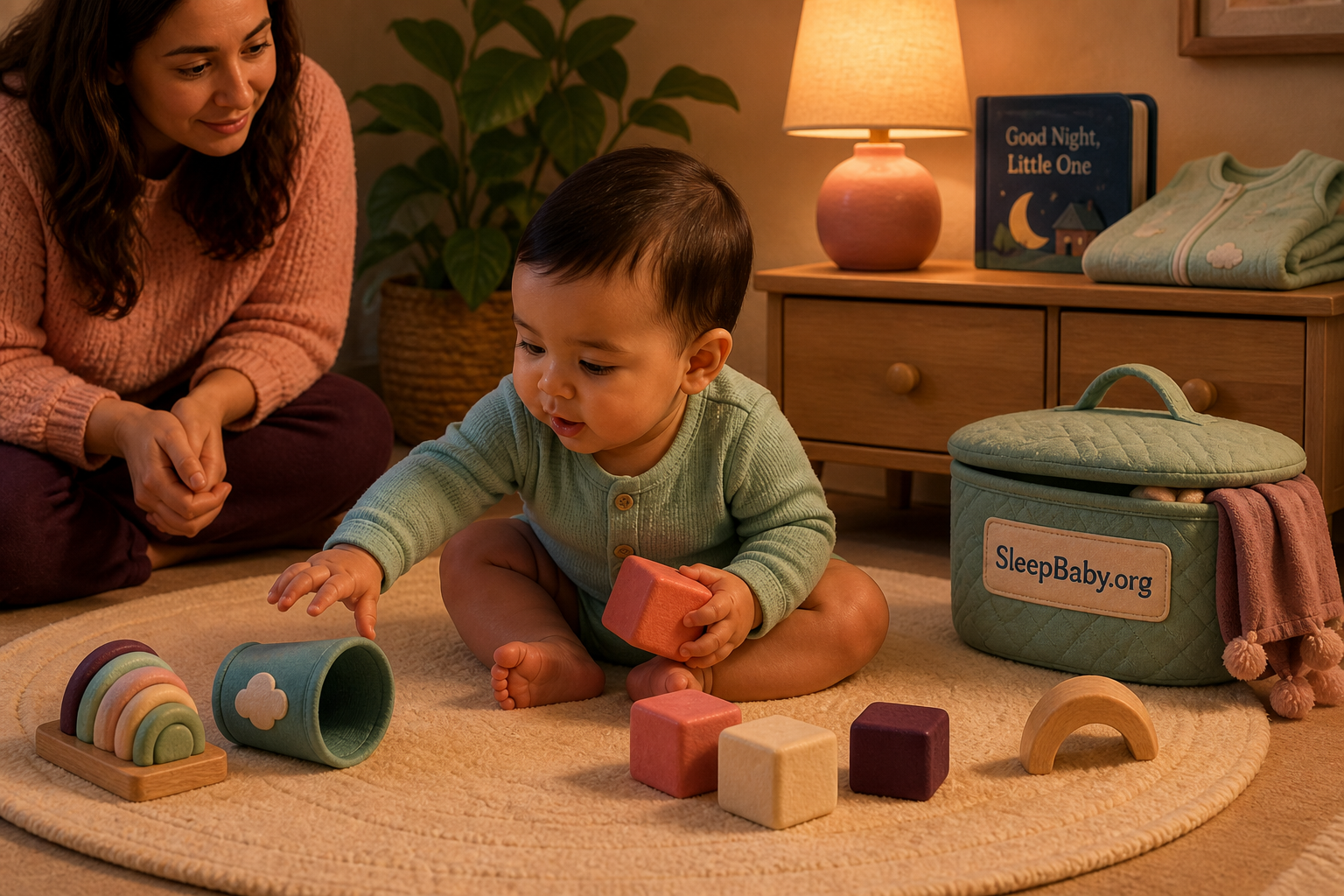
What should an 8-month-old be doing?
There is no official CDC checkpoint at exactly eight months. The CDC publishes milestone lists for six months and nine months, and those lists describe what most children—75% or more—can do by the stated age. They are developmental-monitoring tools, not diagnostic screens.
That distinction saves a great deal of unnecessary panic. At eight months, I would use the six-month list as an earlier anchor and the nine-month list as a view of what may be emerging next. I would not take the nine-month list, move the deadline forward, and then grade a baby who has had one fewer month to practice.
The six-to-nine-month bridge
Three ways to read the month honestly
Earlier anchors
Skills from the six-month window may include laughing, taking turns with sounds, reaching for a wanted toy, rolling from tummy to back, pushing up on straight arms, and leaning on the hands while sitting.
Coming into view
Around eight months you may notice steadier sitting, object transfers, longer babble strings, searching for a dropped toy, stronger reactions to familiar and unfamiliar people, or a new way of getting across the floor.
By the next checkpoint
The CDC’s nine-month list includes sitting without support, getting into sitting, moving an object between hands, raking with the fingers, varied babbling, responding to a name, peek-a-boo, and looking for something that fell out of sight.
Not required on the eight-month birthday: crawling on hands and knees, pulling to stand, waving, pointing, saying a meaningful word, or performing every nine-month skill at once.

A quick guide to 8 month baby milestones that are easy to overread
Some skills carry more emotional weight online than they do in a clinician’s full developmental picture. Pulling to stand can look advanced, crawling is easy to compare, and a sound that resembles “mama” is wonderfully tempting to count as a first word. None of those observations is useless. They simply need context.
- Pulling to stand: exciting when it appears, but not required at eight months. Floor-level balance and transitions may be the work happening first.
- Pointing and waving: these gestures commonly develop later. At this stage, gaze, reaching, raised arms, facial expression, and pushing something away may carry more of the message.
- A meaningful word: long babble strings are communication practice. A sound can resemble a name before your baby uses it consistently for that person.
- Teeth: tooth timing is not a developmental score. A baby can be busy learning to sit, search, and converse with a completely gummy smile.
- One impressive day: babies do not demonstrate every skill on request. Fatigue, hunger, setting, temperament, and interest change what you see in a single moment.
I would be more interested in a widening pattern over time than in collecting the most photogenic milestone first. That is also why comparing two babies of the same age can become misleading so quickly: they may be investing their attention in different parts of the same developmental system.
Look at the whole child, not the loudest milestone
Crawling gets excellent publicity. It is obvious, easy to compare, and likely to send everyone in the room lunging toward the electrical cord they were certain was out of reach. But development is happening in quieter places too: the pause after you say a familiar name, the wrist turn that lets a toy pass from one hand to the other, the look toward the floor after a spoon disappears.
Those smaller changes matter because developmental skills cooperate. Sitting gives the hands more freedom. Reaching teaches balance. Dropping and searching build an early understanding that objects still exist when they cannot be seen. Babbling becomes a conversation when another person answers. The whole system is more informative than a single trick.
A whole-child constellation
Five paths you can notice in an ordinary day
None of these paths needs to look dramatic. You are watching for an expanding repertoire, not a performance.
- Movement
- Rolling, pivoting, sitting with more control, reaching outside the base of support, scooting, rocking, belly-crawling, or crawling on hands and knees.
- Hands
- Reaching, grasping, rotating, banging, releasing, raking, and passing an object from one hand to the other.
- Communication
- Longer strings of sounds, vocal turn-taking, looking when called, lifting arms to be picked up, and using gaze or gesture to keep an interaction going.
- Thinking and play
- Searching for a dropped or hidden object, repeating an action to see what happens, exploring texture and sound, and anticipating a familiar game.
- Connection
- Different reactions to familiar and unfamiliar people, several facial expressions, delight in peek-a-boo, and a clearer protest when a caregiver leaves.
A calm evening can be a useful observation point, but do not audit your baby’s entire development during one overtired bedtime. None of us does our best work when we wanted to be asleep twenty minutes ago.
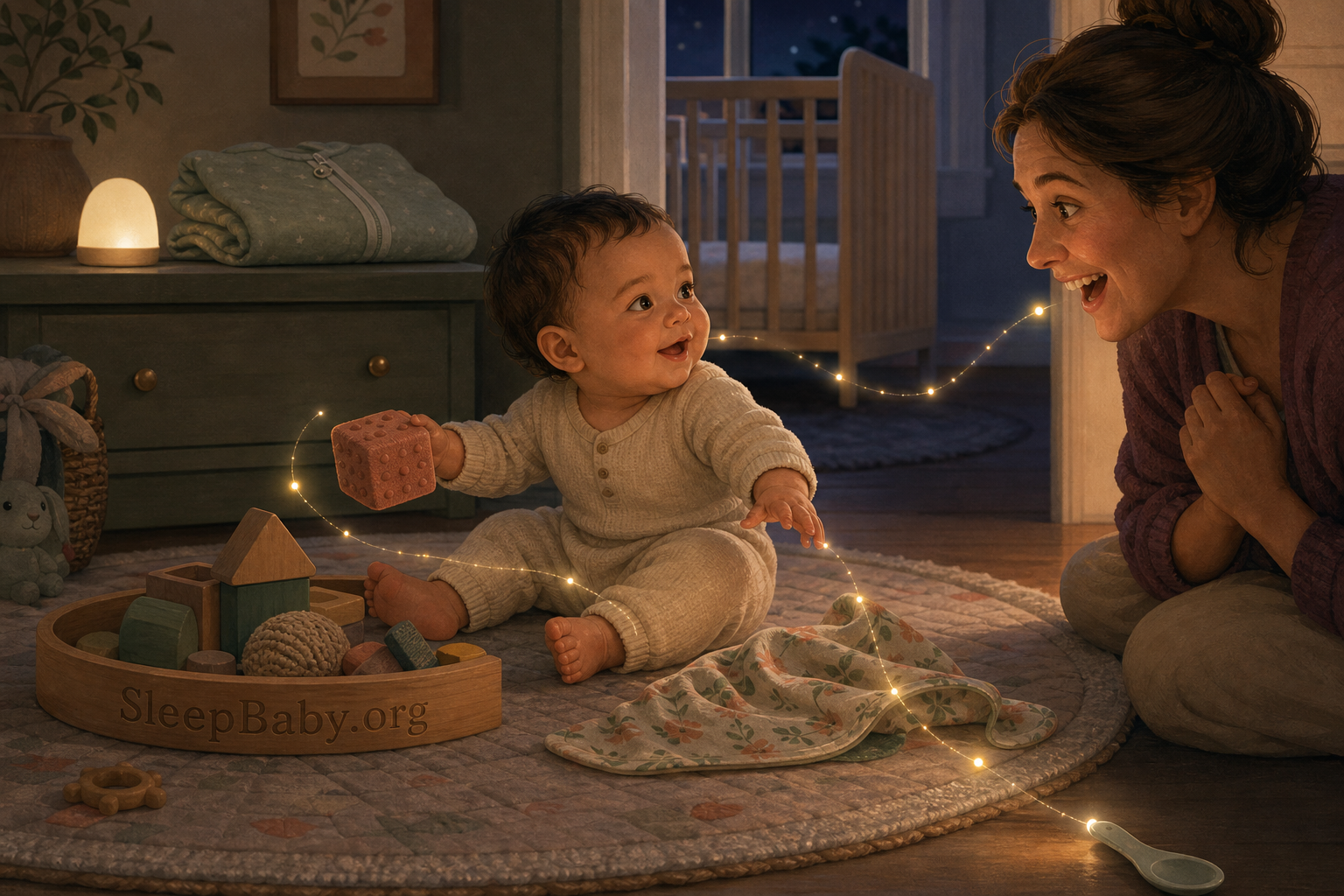
Movement milestones at eight months: sitting, scooting, crawling and everything between
Many eight-month-olds are building sitting balance. Some can sit without using their hands; some still plant both palms in front like a tiny, determined tripod; some can sit once placed but are still learning how to get there. If your baby leans forward while sitting, the more specific guide on why babies lean forward as they build balance may help you separate a normal practice posture from a pattern you want to discuss.
Floor travel varies even more. A baby may roll with suspicious efficiency, pivot in a circle, push backward, belly-scoot, crawl on hands and knees, or remain mostly stationary while becoming much better at reaching. If yours has started rotating across the play mat, this explanation of why a baby may pivot or move in circles covers that narrower skill.
The useful question is not “Has crawling happened?” It is “What is changing?” A baby who is not crawling but is increasingly stable in sitting, reaching farther, pivoting, and experimenting with weight shifts is showing a different picture from a baby whose overall movement has stalled or who has lost a skill.
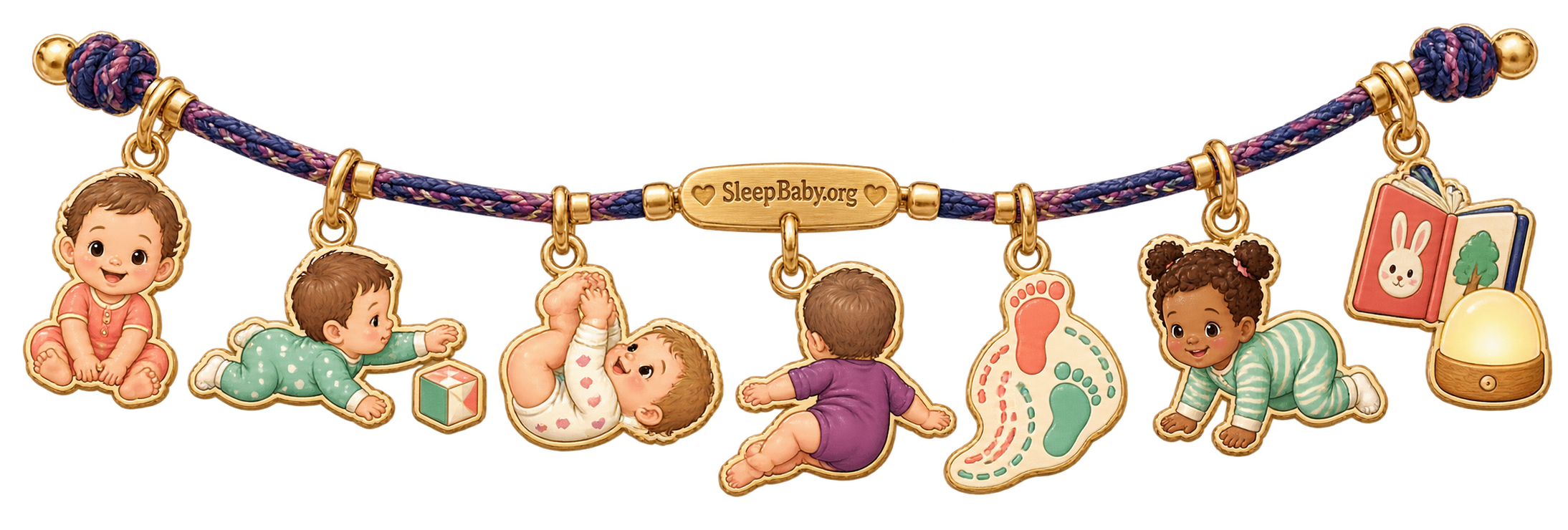

Hand skills: the small work happening in plain sight
At this age, the floor is often covered in very serious research equipment: one cup, one spoon, one soft block, and whatever household object was not purchased as a developmental toy. Watch how your baby reaches, holds, turns, taps, transfers, and releases.
Moving a toy from one hand to the other is a common nine-month milestone that may be emerging now. So is using the fingers in a raking motion. A neat thumb-and-forefinger pincer grasp belongs later for many babies, so do not turn every snack pickup into a fine-motor examination.
A momentary hand preference is not enough to interpret. What matters more is the pattern: Does your baby use both arms and hands across the day? Reach across the body? Open both hands? Adapt the grip to different objects? If one side seems persistently much less active or movement looks notably uneven, write down what you see and bring it to the clinician rather than trying to name the reason yourself.
Communication is already much bigger than words
An eight-month-old does not need a spoken vocabulary. Communication may look like a long “babababa,” a squeal followed by an expectant pause, arms raised toward you, a gaze that moves from your face to the object they want, or a brief stop when they hear a familiar word.
ASHA groups several communication skills in a seven-to-nine-month range, including looking when called by name, long strings of babble, raising the arms to be picked up, recognizing some familiar names, and pushing away an unwanted object. The range matters. These skills develop through hundreds of ordinary exchanges, not in a single reveal.
“Mamama” may be joyful sound practice before it becomes a specific name. Answer it anyway. Copy the sound, pause, and add one simple word. If your baby says “ba-ba,” you might answer, “Ba-ba. Ball.” You are not testing speech; you are showing that sounds can travel between two people and mean something.
The milestone underneath babbling is not a perfect syllable. It is the growing idea that I do something, you answer, and we can keep this going. That little loop is the beginning of a conversation.
Temperament affects what you hear. One baby performs for the grocery-store cashier; another saves the full monologue for the dim nursery after the lights go down. Persistent concern about response to sound, name, vocalizing, or social connection is worth bringing up, but one quiet afternoon cannot answer a developmental question.
Thinking, play and the irresistible dropped-object experiment
If your baby keeps dropping the same spoon, they have not forgotten what happened the first seven times. Repetition is the experiment. The spoon falls. You retrieve it. The spoon falls again. You begin to suspect you are the unpaid research assistant.
By nine months, many babies look for an object that drops out of sight and bang two objects together. Around eight months, you may see early versions: staring at the edge of the high-chair tray, leaning toward the floor, uncovering part of a hidden toy, or repeating a bang to reproduce the sound.
Peek-a-boo bundles several skills into one tiny game. Your baby watches a face disappear, holds the person in mind, anticipates the return, and shares the joke. If the baby looks away after two rounds, the game is over. More repetitions are not automatically more developmental.
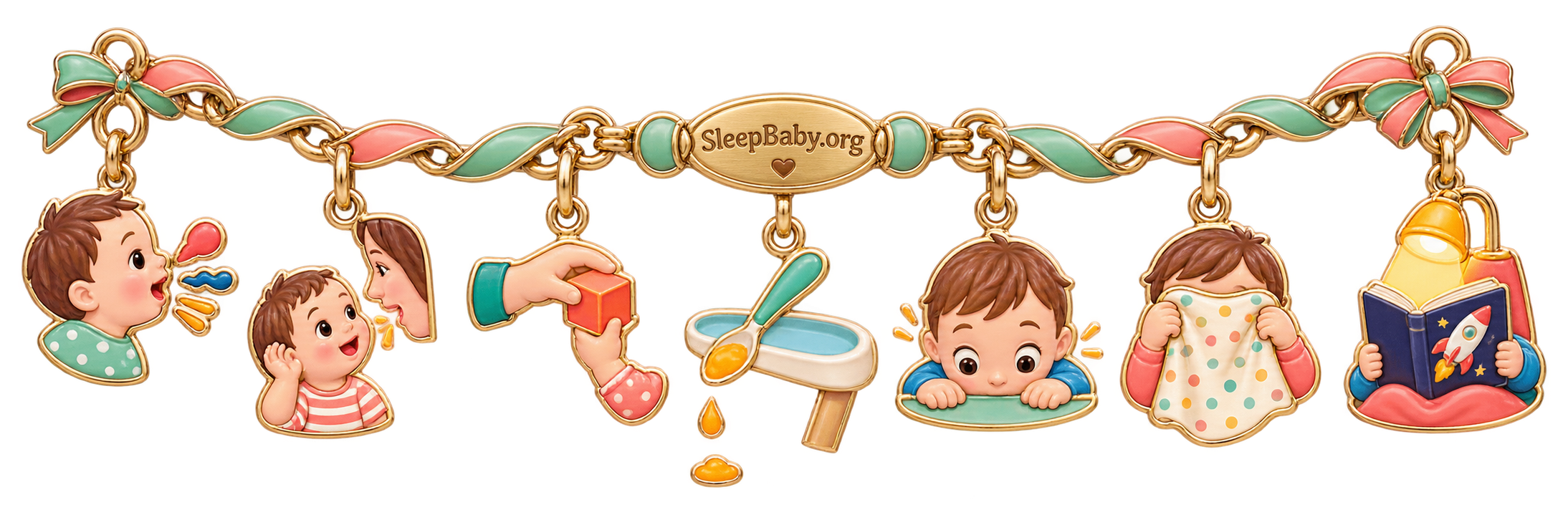
Social milestones can get louder around eight months
A baby who once went happily to anyone may suddenly study a new face, cling, reach back, or cry when you leave. That change can feel alarming, especially if you have childcare transitions coming. It can also fit a growing ability to distinguish familiar people, anticipate separation, and remember that you still exist when you are out of view.
Do not measure connection only by how dramatically your baby reacts. Some babies broadcast every feeling; others watch quietly. Look for a range of facial expressions, shared smiles, interest in back-and-forth play, recognition of familiar people, and ways of asking for comfort or help.
A short, predictable goodbye is usually kinder than disappearing while the baby is distracted. Say that you are leaving, let the trusted caregiver take over, and make the return warm but ordinary. You are building a pattern the baby can learn, not trying to prevent every protest.
Corrected age can change which milestone window fits
If your baby was born preterm, chronological age may not be the most useful comparison. The American Academy of Pediatrics’ parent guidance recommends using adjusted or corrected age when tracking development through age two.
One useful calculation
Chronological age minus weeks born early = corrected age
That is the chronological age.
Subtract about two months.
A younger milestone window may fit better.
This is context, not a substitute for the follow-up plan made for your baby. Gestational age, health history, growth, hearing, vision, muscle tone, and earlier development can all affect what the clinician watches.
Simple ways to support 8-month baby milestones
You do not need a home therapy gym or a color-coded curriculum. A safe patch of floor, a few ordinary objects, and an adult who notices when the baby has had enough will cover a surprising amount of developmental ground.
The low-pressure play lab
Invite, watch, answer, stop
-
Place one toy just beyond the easy reach.
Let your baby choose the strategy: lean, roll, pivot, scoot, or decide the toy was overrated. Move it closer if frustration replaces curiosity.
-
Have a sound conversation.
Copy one sound, pause long enough for an answer, and attach a simple word. The pause is important; it leaves room for the baby to take a turn.
-
Hide only part of a toy.
A cloth over half the object makes the search easier. As the game becomes familiar, hide more and wait to see what your baby does.
-
Pass, tap and release.
Offer two safe, easy-to-grasp objects. Let your baby transfer them, bang them, drop them, or hand one back. No special “developmental” label is required.
-
Read the gaze, not the whole book.
Name the picture your baby is looking at. If the page gets grabbed, mouthed, or flipped backward, that is still participation.
-
Finish before bedtime becomes practice camp.
Active floor play belongs earlier in the awake period. When your baby turns away, rubs their face, fusses, or loses interest, let the activity end and make room for winding down.
As movement changes, childproof for the skill that may arrive next. Keep play on the floor rather than a bed, couch, changing table, or counter. Remove choking hazards, unstable furniture, cords, hot drinks, medicines, cleaning products, and breakable objects from reach. Development has a habit of advancing between the moment you checked the room and the moment you turned toward the laundry basket.

When should I worry about eight month milestones?
You do not have to decide whether something is a delay before asking about it. Your job is to notice and describe. The clinician’s job is to put those observations beside the baby’s history, examination, and a validated screening tool when one is appropriate.
The American Academy of Pediatrics recommends developmental surveillance at every health-supervision visit and standardized general developmental screening at 9, 18, and 30 months. Screening can also be used whenever a parent, caregiver, or clinician has a concern. A milestone article cannot perform that screen.
If a concern remains, ask what comes next. That may be a validated developmental screen, an earlier follow-up, hearing or vision assessment, a developmental or medical evaluation, a specialist referral, or contact with your state’s early-intervention program. Early intervention does not require a parent to predict the diagnosis first.
Watch the skill, not just the label
See what nine-month milestones look like in real babies
A short official milestone demonstration can be more useful than another list because it shows the range of ordinary movement, sound, gaze, and play. Watch for the behavior itself, then compare it with your baby’s broader pattern rather than copying one child’s exact style.
Takeaway: Use video to understand what a skill can look like—not to run a side-by-side contest. Your baby’s trend, corrected age, and full developmental picture still decide which questions are worth bringing to the clinician.
Keep sleep and feeding questions in their own lanes
Development can become very visible near sleep—a baby sits up in the crib, rehearses a sound after lights-out, or seems far more interested in rolling than settling. But this page is not a sleep schedule. If timing, naps, bedtime, or night waking is the real problem, use the dedicated sleep schedule for an 8-month-old so you get the full answer instead of a thin paragraph tucked inside a milestone guide.
The same boundary applies to food. Raking, grasping, and pushing something away are developmental observations; milk amounts, solids, meal timing, textures, and menus belong in the 8-month-old feeding schedule. Keeping those jobs separate makes each guide more useful and keeps this one focused on the whole child.
When I think about eight month milestones, I do not picture a row of boxes turning green. I picture a baby on the floor, trying something, pausing, adjusting, and trying again—while an adult nearby slowly realizes that the object being studied with greatest intensity is the tag on the blanket. Progress is often obvious only after you stop demanding that it arrive in the form you expected.
Sources
- CDC: Milestones by 6 Months
- CDC: Milestones by 9 Months
- ASHA: Communication Milestones, Birth to 1 Year
- American Academy of Pediatrics: Developmental Surveillance and Screening
- WHO Motor Development Study: Windows of Achievement
- HealthyChildren.org: Preterm Development and Corrected Age
- HealthyChildren.org: Baby Walkers—A Dangerous Choice
- U.S. Consumer Product Safety Commission: Infant Walkers
When the new skills follow you into the night
Your baby can be developing beautifully and still make bedtime feel newly complicated
A milestone guide can tell you what to notice. It cannot tell you whether tonight’s resistance is timing, a schedule mismatch, a practiced new skill, hunger, discomfort, or simple baby unpredictability. SleepBaby can help you sort the night into a smaller, more useful next step—without turning every wobble, babble, or midnight sit-up into a diagnosis.
Sleep guidance supports your family’s routine; it does not replace developmental screening or medical care.





What viewers said10 comments · 4 replies+
Archived comments from the original Baby Sleep Miracle presentation. Not independently verified by SleepBaby.org; individual experiences vary.
Thank you so much for this video! I had no idea about the dangers of baby swings :O
Hi Mary-Ann. I have a question: Is method in any way similar to the ones recommended by Dr Bucknam, Dr. Weissbluth or Dr. Karp? We tried those but none of them help.
Hi Regina, thank you for your question. The short answer is no. The techniques I share in my guide are based on newest scientific research and this is why I have never seen any approach similar to the one I recommend.
This method really works! I tried it on my son Jesus and after just one week he went from waking up more than 5 times a night to waking up just once or twice. You are a lifesaver, Mary-Ann!
I'm truly impressed with how much information you share in your video. And all for free! I can feel that you truly care about mothers like myself, and that's hard to find these days. I have recommended your site to several of my friends already.
Mary-Ann, our child suffers from autism. Is your approach still suited?
Chloe, I made sure my method can be used with any child, even babies who are special like yours. Please note that I'm not a doctor and that I always advice to consult with your physician because nothing is more important than the safety and well-being of your love.
Hallo Mary-Ann, I'm from Germany. Do you have your guide in German?
Hello Heide, we do! Normally you should already see our video in German. If not, please contact our support so they can guide you
Thenk you for your answer, Mary-Ann!
I just completed your approach and I have to say, it worked almost too well. Yes, it took a bit of getting used to with your bedtime routine but the difference is huge. My son George used to take 1 hours to go down and now he's firmly asleep in no more than 10 minutes! You're the best!
It seems I'm the only man watching this video, lol! What you shared about the 'emotional backpack' made immediate sense to me and I can't wait to help my little girl Mila to unpack it!
Hey there, just discovered your site and this really sounds different. Just wanted to say thanks for sharing :)
For everyone who's still thinking about getting Mary-Ann's guide I want to advise you to go ahead. I wasn't sure myself but now I'm so thankful I invested in this program. It made a huge difference in our life as a family and yes, my baby girl does sleep through the night now.