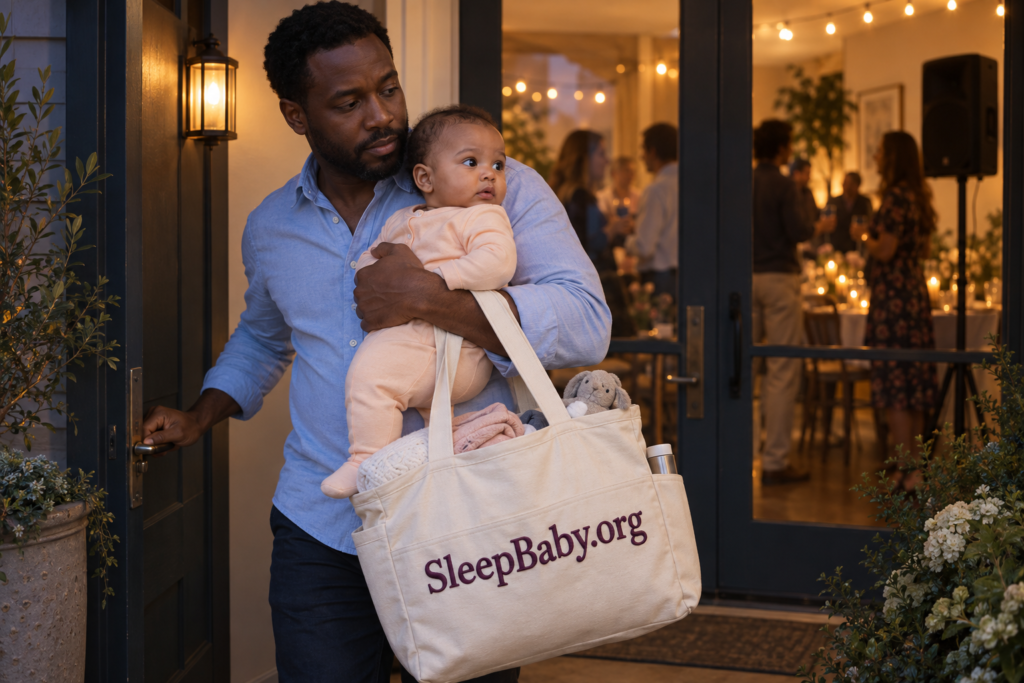
Yes—babies can attend many graduation ceremonies, but the exact venue rules and the plan around your baby matter more than the word “graduation.” Before you promise anyone a tiny cap photo, confirm the ticket, bag, stroller, feeding, seating, and re-entry rules. Then give the baby a dedicated adult who is not the graduate and can leave immediately if the room is too loud, hot, crowded, or simply done for the day.
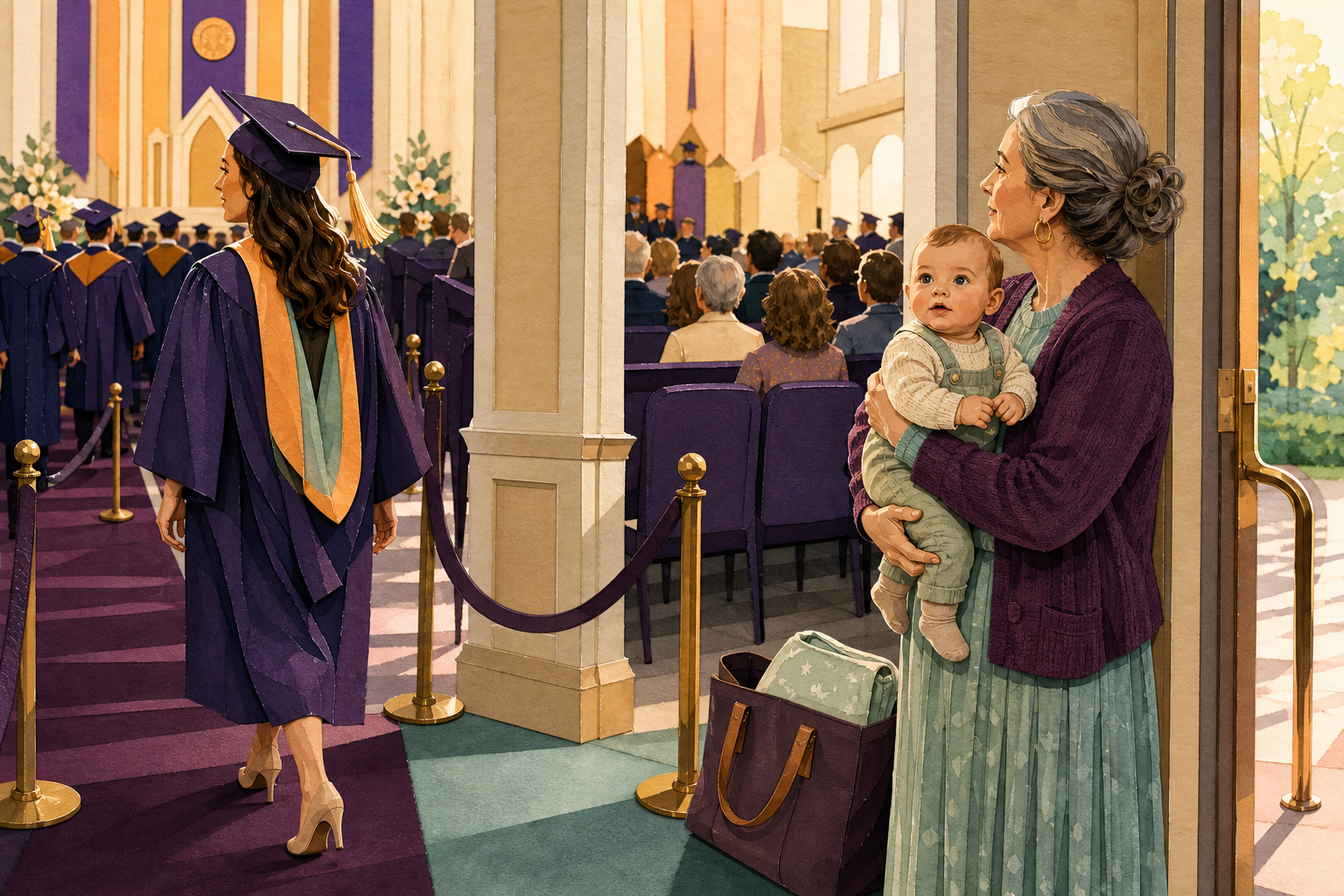
Picture the five minutes before the processional. The graduate is waved through a door marked for candidates. The diaper bag, the baby, and the adult who knows where the spare bodysuit lives stay on the other side. That small separation is the whole planning problem. The graduate may be close enough to see, but not close enough to handle a feed, fix an earmuff, or take a fussy baby into the hall.
So I would not ask, “Can my baby make it through the ceremony?” Babies are not auditioning for the role of Quietest Guest. I would ask whether the adults have built a day that still works when the baby needs something at the least cinematic moment—during the processional, halfway through the names, or just as the tassel is about to turn.
The best graduation plan is not the one that keeps a baby in a seat the longest. It is the one that makes leaving easy before anyone needs to leave.
Check the exact ceremony before you pack the diaper bag
Graduation policies vary more than families expect. Current university examples include ceremonies that prohibit strollers, ceremonies that permit them, diaper-bag exceptions to clear-bag rules, different lap-child ticket ages, and different rules for bottles and feeding supplies. Those examples prove only that the rules differ; they do not tell you what your ceremony will allow.[14]
Read the page for the exact ceremony—not the university’s generic visitor page and not a relative’s memory from three years ago. If the policy is incomplete, contact the venue or commencement office. A two-minute answer now is better than unpacking a carefully cooled bottle on a security table while a line forms behind you.
If your family has done another long formal event with a baby, the broader logistics in our guide to taking a baby to a conference can help. Graduation adds one crucial twist: the person being celebrated is often seated away from the baby and cannot be the backup caregiver.
Before the doors open
Six answers to get from the venue
On a small screen, the table scrolls sideways. Write the answers in one shared note so the caregiver is not searching an FAQ at the metal detector.
| Ask the venue | Write down the usable answer |
|---|---|
| Does an infant need a ticket? | Ticket or lap rule, age cutoff, assigned seat, and whose account holds the ticket. |
| Which baby-care bags and feeding items pass security? | Bag dimensions, clear-bag or diaper-bag exception, bottles, formula, milk cooler, pump, and screening process. |
| Can a stroller or carrier enter? | Where it can go, whether it must be checked, and what happens if storage fills. |
| Where may the caregiver sit and step out? | Assigned section, aisle availability, accessible route, quiet space, changing area, and nearest permitted exit. |
| Can the caregiver re-enter? | Which door, what credential is needed, and whether leaving means watching the rest elsewhere. |
| What is the weather and overflow plan? | Indoor or outdoor, shade, doors-open time, estimated length, livestream, overflow room, and severe-weather instructions. |
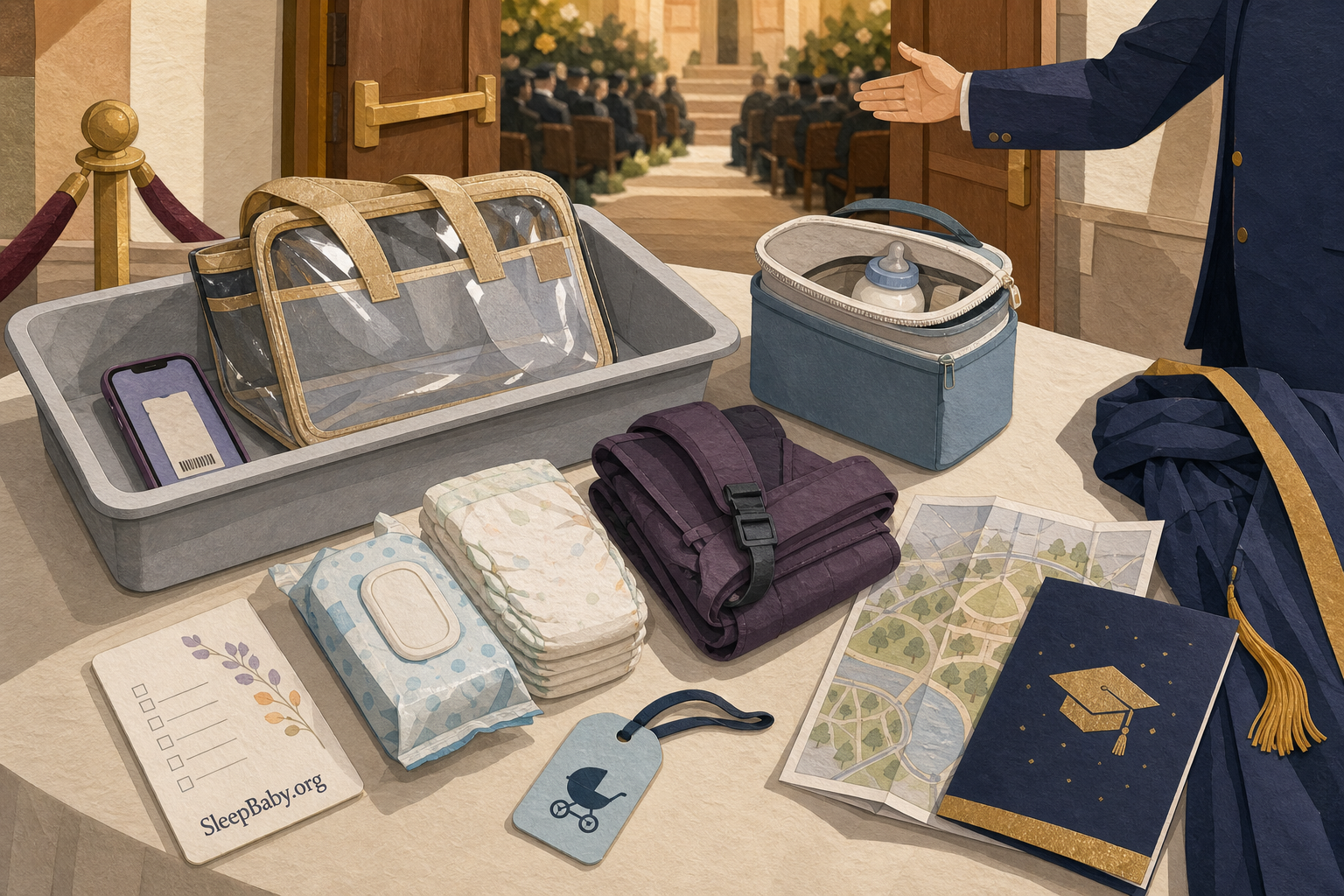
Keep the written answers with the person carrying the baby, not only with the graduate. If the graduate’s phone is silenced in a robe pocket two buildings away, it is not the family operations center.

Decide whether to go, modify, or skip the auditorium
Venue permission answers “may we enter?” It does not answer “is this the right plan for this baby today?” That second answer depends on the baby’s health and feeding needs, the environment, the length and sound of the event, and whether one adult can leave without discussion.
There is no responsible universal age when crowds become fine. A healthy older baby at a short indoor ceremony with an aisle seat is a different situation from a premature newborn at a packed outdoor event in the heat. If your baby was born prematurely, is immunocompromised or medically fragile, is very young, or has an individualized feeding or travel plan, ask the baby’s clinician about the actual event rather than searching for a magic age online.
One ceremony, three workable plans
Go, modify, or skip the auditorium
Go as planned
- The exact venue permits the baby and required supplies.
- A non-graduate caregiver owns the whole ceremony.
- There is a usable aisle/exit and a plan if re-entry is denied.
- Sound, weather, feeding, travel, and safe sleep can be handled without improvising.
- No individualized medical guidance points toward a different plan.
Modify the day
- Use an overflow room, livestream, or brief appearance.
- Have the baby arrive after seating or leave before the final recessional.
- Choose a quieter section farther from speakers and bands.
- Split adults so one attends while one walks, feeds, or rests with the baby nearby.
- Meet the graduate outside for the family moment that matters most.
Skip the auditorium
- The needed baby-care items are not allowed.
- No adult can leave promptly with the baby.
- The sound, heat, cold, crowd, or travel cannot be made workable.
- The baby is unwell or individualized medical guidance favors staying away.
- The plan depends on the baby sleeping, staying quiet, or delaying a needed feed.
What changes the answer: a new fever, a weather alert, a venue-policy update, a missing caregiver, or a safe exit that disappears when seats are assigned. Re-deciding on graduation morning is planning, not failure.
SleepBaby.org original planning aid
I like “modify” because it removes the strange all-or-nothing pressure that gathers around family milestones. The baby can appear in the photos, meet the proud relatives, and be part of the story without spending every name in every department under arena speakers.
Choose the adult who can actually leave
The dedicated caregiver needs more than a warm lap. That adult needs the ticket, permitted supplies, directions to the exit, the reunion point, the baby’s feeding information, and explicit authority to go. “Text me first” is not an exit plan when the graduate’s phone may be off and the brass section has just started.
Choose someone who is comfortable reading the baby’s cues and using the feeding, carrier, car-seat, and medical plan the family already follows. If the baby will not settle with that person yet, solve that before ceremony day—or choose a shorter appearance. Graduation is not the ideal first trial of a new caregiver, new carrier, new bottle, and new nap strategy all at once.
The family run-of-show
Put the handoff in order before the processional
Before doors
Feed or change as needed, confirm the bag passed screening, and photograph the reunion point.
Candidate call
The caregiver takes the baby, supplies, ticket, and decision authority before the graduate leaves.
In the seat
Stay near the approved route out, away from loud sound when possible, and act on the baby’s cues early.
Exit branch
Leave first. Send one factual text from the hall. Do not wait for the graduate to approve the obvious.
Reunion
Meet at the named landmark, then protect the ride, feed, nap, or bedtime that comes next.
A successful exit may look almost boring: the caregiver notices the baby turning away, stands, slips through the aisle, and sends “We’re at the library steps” from the hall. No family council. No apology tour. The plan did its job.

Treat loud sound as a distance-and-exit problem first
Graduation sound is not steady. A quiet speech can be followed by a marching band, amplified music, cheers, horns, or a speaker stack that looked much farther away on the seating chart. The American Academy of Pediatrics advises avoiding or leaving excessively noisy venues and using protective earmuffs for children, including infants, when loud environments cannot be avoided.[3][4]
Start with distance. Ask where bands and speakers will be, choose the farthest practical seating area, and keep the route out clear. Properly fitting infant protective earmuffs can be another layer, but they do not turn every seat or sound level into a safe one. Do not place foam earplugs or other objects in an infant’s ears. A phone sound app can help an adult notice that a space is loud; it cannot certify safety for every baby, position, and duration.
Watch the setting and the baby. If the noise is excessive, the earmuffs will not stay fitted, or the caregiver is uneasy about the exposure, leave. You do not need to wait for crying to prove that the room is loud. That is Kacey’s line in the hard folding-chair carpet: hearing protection is not a promise to stay. It is equipment for the time it takes to make a sensible plan—including the plan to go.
Choose a seat for the exit, not for the photograph
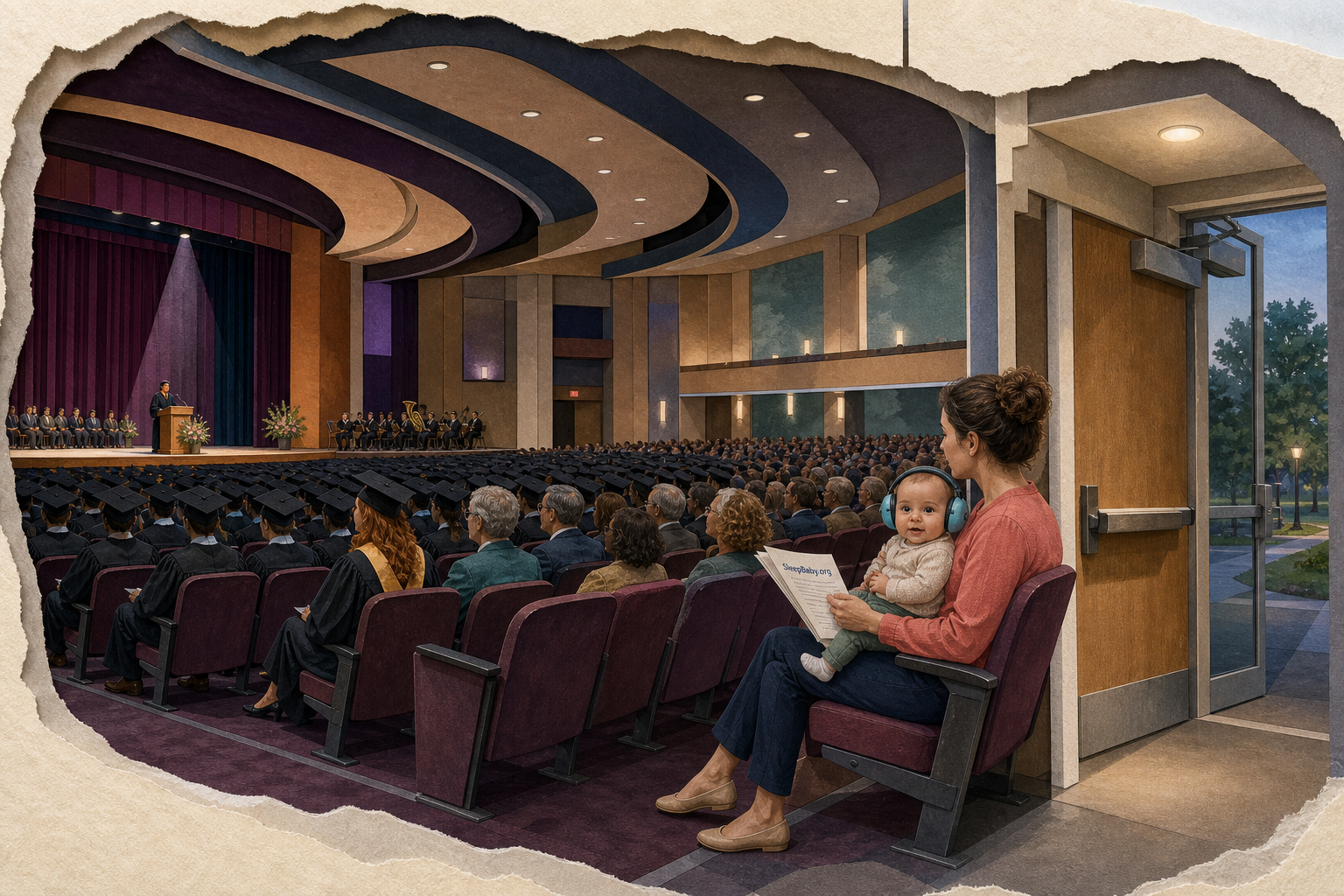
An aisle or rear seat is often useful, but only if the venue permits it. Assigned seating, accessible routes, security barriers, and reserved sections may decide what is possible. Ask rather than assuming. If the only available seat puts the baby beside speakers or traps the caregiver in the middle of a long row, that is a reason to use overflow, watch a stream, or meet outside.
Before sitting down, walk the approved route to the exit. Locate the changing space and the place where feeding is permitted. Confirm whether a stroller must be checked and whether a carrier can stay on. Notice any stairs, narrow aisles, or heavy doors that make a quick exit less quick while holding a baby and a bag.
The caregiver should not balance a baby on one hip while filming the graduate with the other hand and guarding six relatives’ seats with a program. Pick the job. The ceremony will produce hundreds of photographs. The baby needs one available adult.
Keep feeding and diapers ordinary
Feed before seating if that timing genuinely fits your baby, but do not delay a needed feed to protect the ceremony schedule. Bring the feeding supplies the baby already uses and the venue has approved. Avoid debuting a new bottle, formula, nipple flow, nursing cover, or pumping routine in a crowded arena simply because it packed neatly.
Formula and expressed milk have different handling rules. CDC guidance says prepared formula should be used within two hours of preparation and within one hour after feeding begins; leftovers from a used bottle should be discarded.[6] For nursing families traveling with expressed milk, CDC says an insulated cooler with frozen ice packs can keep milk for up to 24 hours under its travel guidance.[7] Follow the current handling guidance and any individualized plan for your baby rather than blending the two rule sets into one ceremony shortcut.
Pack diapering by function, not by fear. For most families that means enough diapers and wipes for the travel and event window, a portable changing surface, disposal bags, one complete clothing change, and any skin product the baby already uses. Add a shirt for the caregiver if your baby has a gift for sharing the occasion. That is not pessimism. It is respect for formalwear.
Find the changing location before the room goes dark or the names begin. A restroom counter is not automatically a safe changing surface, and the stroller seat is not a substitute for a stable, protected place. If the venue has no workable option, the car or another private location may be the real plan—provided an adult stays with the baby and the vehicle is never used as a waiting room in unsafe heat or cold.
Give each piece of baby gear one job
Graduation invites gear creep. The car seat becomes a carrier, the stroller becomes a nap station, the carrier becomes the only place the baby can breathe through a crowded exit, and suddenly one convenient object is doing four jobs it was not designed to do. Separating those jobs keeps the plan clearer.
Graduation-day gear check
One device, one job—and one clear boundary
On a small screen, scroll the comparison sideways. The boundary matters most when the baby falls asleep in transit.
| Item | Its useful job | The boundary |
|---|---|---|
| Rear-facing car seat | Correctly installed and correctly harnessed restraint for the vehicle ride. | Not the baby’s routine sleep place after travel; follow the seat and vehicle manuals. |
| Stroller | Moving the baby and approved supplies when the venue permits it. | May be prohibited or checked; do not treat a sitting device as the planned safe-sleep destination. |
| Carrier or sling | Hands-supported carrying within the product’s fit, age, and weight instructions. | Keep the face visible, nose and mouth clear, and chin off the chest; use extra caution with young or medically vulnerable babies. |
| Firm, flat sleep surface | The destination for sleep after the ride or event. | Keep it non-inclined and follow the complete safe-sleep setup; convenience devices do not replace it. |
The AAP advises moving a baby who falls asleep in a car seat, stroller, carrier, sling, or other sitting device to a firm, non-inclined sleep surface as soon as possible.[1] An in-transit nap is not a moral failure. It is a transition with a destination. Our guide to waking and moving a sleeping baby gently can help with that handoff after the ride.
During vehicle travel, use an appropriate rear-facing seat according to the baby’s size, the seat instructions, the vehicle manual, and current NHTSA guidance.[2][12] Do not loosen the harness for comfort while the vehicle is moving or add unapproved padding. For a carrier or sling, keep the baby’s face visible, the nose and mouth unobstructed, and the chin off the chest. The CPSC urges particular caution for babies younger than four months and babies with relevant medical vulnerability.[5]
Watch “Rear-Facing Car Seat Tips” on YouTube if the embedded player is unavailable.

Let weather and crowds change the plan
Outdoor graduations can mean reflected sun, warm bleachers, sudden rain, or cold wind with nowhere quiet to reset. Infants rely on adults to keep them cool and hydrated, and a baby should never be left in a parked car—not for a quick feed setup, not while someone finds the graduate, and not while the air-conditioning “catches up.”[8]
For babies younger than six months, HealthyChildren emphasizes keeping them out of direct and reflected sunlight and using shade and protective clothing.[9] A stroller canopy is not proof that the space underneath remains cool. Check the actual baby, airflow, temperature, and setting. If the weather plan is “we will hope the clouds stay,” move to a livestream or a shorter outdoor photo.
Crowd decisions also need more nuance than “wait until the first shots” or “newborns can never go.” Hand hygiene, cough etiquette, and avoiding close contact with people who are ill are useful layers, not guarantees.[10][11] A very young, premature, immunocompromised, or medically fragile baby may need a different plan based on individual guidance. The family photo is meaningful; it is not an infection-control strategy.
Pack the minimum viable graduation bag
A useful bag supports the agreed plan. It does not contain every object that has ever calmed the baby since birth. Pack by job:
- Admission: caregiver ticket, photo ID if required, exact venue policy or exception, parking/transit information, and reunion point.
- Feeding: the baby’s usual approved supplies, correctly handled formula or expressed milk, feeding cloth, and any clinician-directed items.
- Diapering: diapers, wipes, portable changing surface, disposal bags, and a complete clothing change.
- Sound: properly fitting infant protective earmuffs if the plan calls for them, tried before ceremony day.
- Weather: safe age-appropriate shade/clothing layers and the decision point for leaving; never loose bedding around a sleeping infant.
- Movement: only the stroller or carrier the venue permits and the family already uses safely.
- Adult survival: water, a small snack if permitted, phone battery, and the humility to wear the practical shoes.
If the bag rule forces a choice, protect feeding, diapering, medical, hearing, weather, and ticket needs before adding entertainment. One quiet toy may help an older baby. Seven rattles will not negotiate with a marching band.
A graduation-day timeline that leaves room for the baby
Use the event’s actual timing and your baby’s current cues. This is a sequence, not a prescribed infant schedule.
- The day before: recheck the venue alert page, weather, tickets, route, bag, car seat, earmuff fit, feeding supplies, and caregiver handoff. Do not add a new baby product because shipping was fast.
- Before leaving: follow the baby’s ordinary feeding and care plan. Build travel time for a safe stop if the drive is long rather than racing a processional.
- Before doors: handle a feed or diaper change if needed, pass security, identify the exit and changing/feeding location, and photograph the reunion landmark.
- When candidates separate: the caregiver takes full possession of supplies, ticket, phone plan, and authority. The graduate graduates.
- During the ceremony: respond early to hunger, temperature, sound, airway position, and tired cues. Use the planned exit. Re-entry is a bonus only when the venue confirmed it.
- After the name is called: do not assume the event is almost over. Decide whether the baby and caregiver should stay, move to the reunion point, or head home.
- After the reunion: use the car seat correctly for travel, then move sleep to a safe surface after arrival. Return to familiar feeding, nap, and bedtime cues without trying to “make up” the day mathematically.
The only person who needs every detail of this timeline is the caregiver. Everyone else needs the reunion point and the emotional maturity not to say, “But they only have twenty names left.”

Staying out of the auditorium can still mean showing up
A sitter, livestream, overflow room, outdoor family photo, brief campus visit, or separate celebration can be the most loving version of attendance. None is automatically easy or available, and families should not be shamed when trusted care is scarce. But the baby does not need to occupy the ceremony seat for the graduate to be a parent, for the family to be proud, or for the milestone to count.
If the graduate most wants the cap-and-baby photograph, plan that moment outside the noisiest, most crowded part of the day. Let the baby arrive for the reunion, not for three hours of proving devotion from row 42.
After the tassel turns, make sleep ordinary again
A graduation may move a nap, stretch a wakeful period, or produce a longer-than-usual car nap. It may also have almost no effect. Watch the baby you brought home rather than imposing a dramatic reset because the day looked dramatic on the calendar.
Use the familiar sequence that normally signals the next sleep: the usual feed, a dimmer room, ordinary pajamas or sleep sack, the normal short routine, and the usual safe sleep surface. If the baby took an unusually long nap, our guide to a baby napping longer than usual can help you look at waking, feeding, breathing, behavior, and the wider day before deciding what—if anything—to change.
Avoid skipping a needed feed, forcing a wake-up, or inventing one wake-window rule for every age. If the baby is hard to wake normally, has trouble breathing, seems unwell, or shows another urgent symptom, seek appropriate medical help rather than calling it graduation fatigue.
The tassel, the bright hall, the relatives, and the late parking-lot photo can all belong to one lovely day. They do not need to follow the baby into the crib. The quiet finish is not an anticlimax. It is how the family brings the milestone home.
Sources
- American Academy of Pediatrics / HealthyChildren.org: How to Keep Your Sleeping Baby Safe
- HealthyChildren.org: Is it safe for my baby to travel in a car seat a few hours at a time?
- AAP News: Advice on preventing excessive noise exposure
- Pediatrics: Preventing Excessive Noise Exposure in Infants, Children, and Adolescents
- U.S. Consumer Product Safety Commission: Sling carrier warning and infant positioning
- CDC: Infant Formula Preparation and Storage
- CDC: Travel Recommendations for Nursing Families
- CDC: Heat and Infants and Children
- HealthyChildren.org: Preventing Sunburn in Babies
- HealthyChildren.org: Cocooning a Newborn
- CDC: Hygiene and Respiratory Viruses Prevention
- National Highway Traffic Safety Administration: Car Seats and Booster Seats
- USDOTNHTSA: Rear-Facing Car Seat Tips
- Official policy examples reviewed for variation: University of Cincinnati, Stanford University, University of Texas at Arlington, University of Notre Dame, and Regent College London.