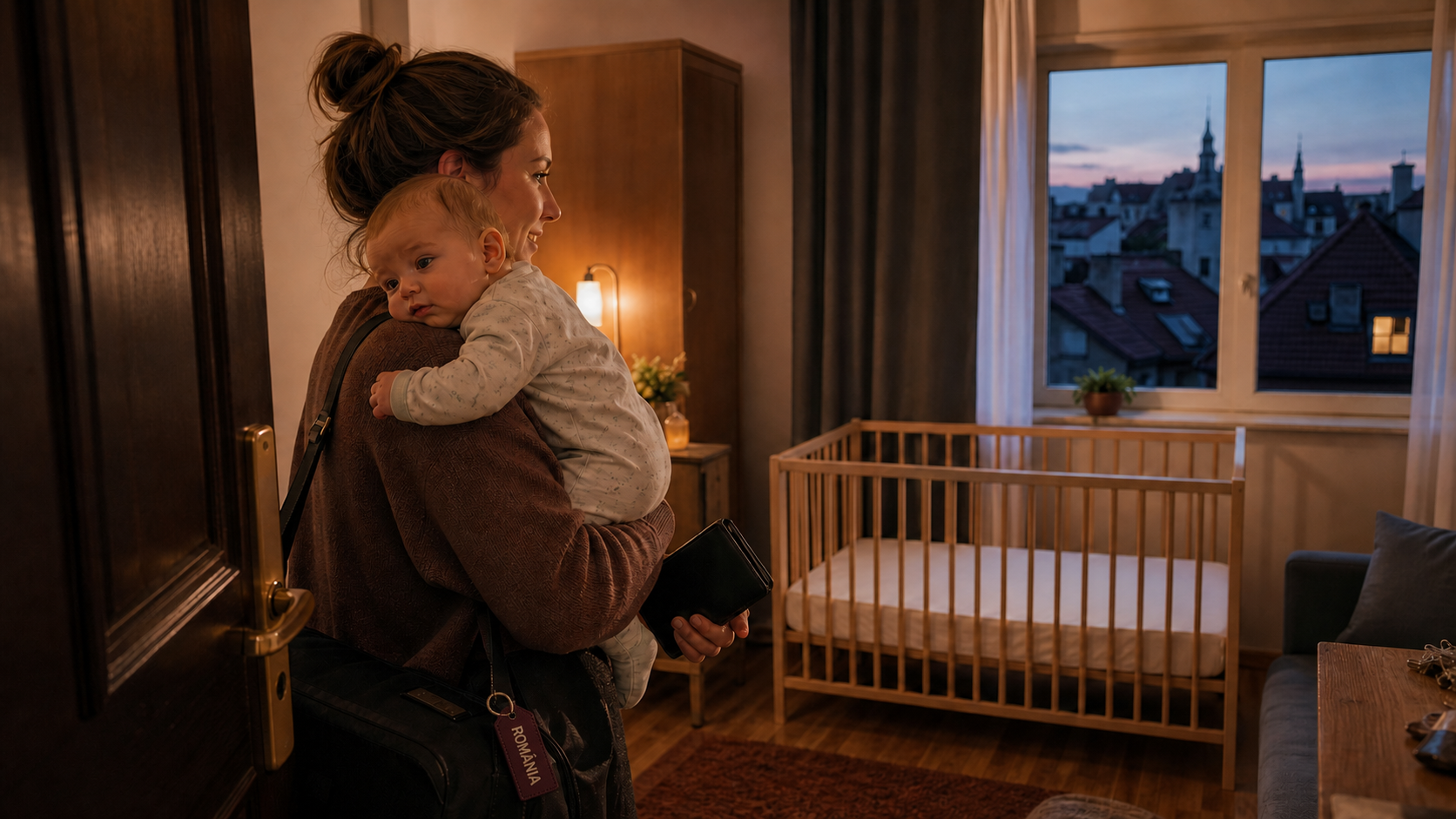
The tiny passport photo is beside the half-packed diaper bag, and somehow the baby looks like a stern customs official. That is usually the moment a Romania trip stops feeling hypothetical.
Yes, taking a baby to Romania can be workable. The safe answer, though, is not one universal packing list or a promise that one document gets every family through every border. Before booking, identify the baby’s citizenship and residence, every transit country, who is traveling, the length and purpose of the stay, and the operating airline for each segment. Then confirm the baby’s own travel document, any visa or authorization, the carrier’s infant rules, feeding and health plans, Romanian ground transport, and a safe place to sleep.
I would do those jobs in that order. It keeps a bright hotel room or a stroller question from stealing attention before the decisions that can actually stop a trip. This guide uses a U.S.-based caregiver taking a baby to Romania for tourism for fewer than 90 days as its lead example. Change the baby’s nationality, dual citizenship, custody arrangement, residence, route, trip purpose, stay length, carrier, aircraft, airport, or age, and the answer may change too.
Your two-minute go/no-go map
Clear five gates before the suitcase gets a vote
- Name the travelers and route. List every citizenship, residence, caregiver relationship, transit point, operating carrier, and day in the Schengen area.
- Clear the document path. Confirm the baby’s individual passport or other accepted travel document, plus any visa or authorization that applies on the actual travel date.
- Clear every flight segment. Verify the infant ticket, seat, restraint, baggage, stroller, bassinet, feeding, and check-in rules with each operating airline.
- Clear the care handoffs. Plan feeding, medicines, insurance, emergency contacts, and a child restraint for travel on the ground.
- Clear the first sleep. Inspect the lodging sleep space before the first nap, then use local light, feeds, and familiar cues to help the baby’s body clock catch up.
This map organizes questions; it does not calculate legal eligibility, promise boarding, or guarantee entry.
Write the traveler and route at the top of the plan
The private question beneath “taking baby to Romania” is often not What should I pack? It is What am I forgetting that could become a problem while I am holding a baby, a bag, and three documents at a counter? I would make that fear smaller by turning it into a one-page fact sheet before searching individual rules.
Practical parent suggestion
The six lines to write before you buy a nonrefundable piece
- Baby
- Every citizenship, residence, current travel document, age on each flight, and relevant health or feeding context.
- Caregiver
- Who travels, who has parental authority or custody, whether surnames differ, and who is not traveling.
- Route
- Origin, every connection, first Schengen entry point, Romanian destination, and the complete return path.
- Time
- Trip dates, length of stay, and each traveler’s other Schengen days in the rolling 180-day period.
- Flights
- Ticketing airline and, separately, the operating carrier, aircraft, fare, and airport for every segment.
- On the ground
- Lodging, safe sleep plan, feeding setup, medicine and insurance contacts, and child-restraint plan.
Practical parent suggestion Put this sheet in the same folder as the booking references. Do not build your own legal Schengen-day calculator in the margins. If the 90-in-180 rule matters to your itinerary, use the current official EU information and the appropriate authority for your case.
Why be so fussy about the route? A family can hold a ticket to Bucharest but first enter the Schengen area somewhere else. A flight can carry one airline’s name while another airline operates the airplane. A U.S. departure checkpoint follows TSA processes; a European connection follows the rules and procedures at that airport. “International travel rules” is not one rulebook following your diaper bag around the world.
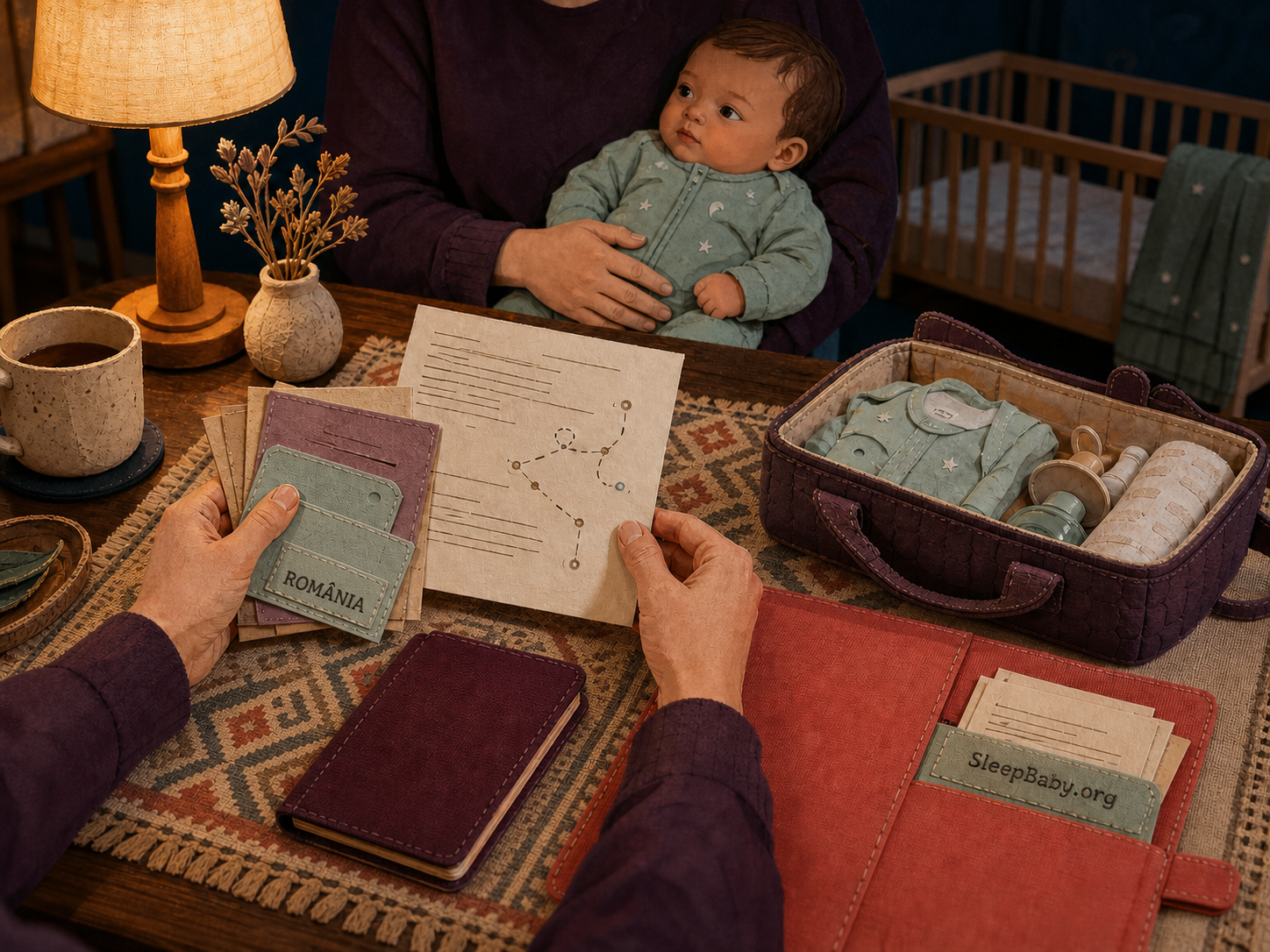
The baby’s document path: passport, visa, Schengen time, then the date-sensitive systems
Border or government guidance A baby needs an individual valid travel document. A baby is not covered by a parent’s passport simply because the baby is very small or will spend much of the flight attached to that parent. Whether the baby also needs a visa depends on nationality, residence, purpose, length of stay, and the route. Start with the issuing authority for the baby’s document and Romania’s current entry guidance, not a travel-blog summary or a screenshot somebody saved before your baby was born.
Border and government decision path
Ask these questions in sequence
- What travel document will the baby present? Confirm that it is valid for the baby’s exact nationality and journey.
- Does that nationality require a short-stay visa? Check Romania’s official eVisa/entry source and the EU visa framework for the actual traveler.
- How much Schengen time is available? Count Romania together with other Schengen stays; do not count Romania as a separate 90-day bucket.
- Does an authorization system apply on the travel date? Treat EES and ETIAS as different systems and reopen the official EU page before travel.
- What evidence might the border ask to see? Keep lodging, onward or return travel, trip-purpose, and means-of-support information accessible.
A visa or pre-travel authorization is not an admission guarantee. Border authorities decide entry under the rules that apply at the time.
For the U.S.-passport tourist example
At the research checkpoint for this guide, current U.S. Department of State guidance for Romania says U.S. citizens do not need a visa for a tourist stay under 90 days. Romania’s official conditions of entry describe the covered passport-validity conditions: the travel document is generally issued within the previous 10 years and remains valid for at least three months after the intended departure from the member states, subject to the traveler’s status and any applicable exception.
That paragraph is an example, not a promise. A baby traveling on another passport, staying longer, visiting for another purpose, residing elsewhere, or connecting under a different immigration status needs the rule for that case. A caregiver should also check the passport processing timeline before booking around a document that does not yet exist. I would rather move a reservation than discover at check-in that the baby’s passport photo was the only part of the plan that had reached maturity.
Romania is in the Schengen short-stay framework
Border or government guidance Eligible short-stay visitors generally count days across the Schengen area against the 90-days-in-any-180-day framework. If the family spent time in France, Italy, or another Schengen country before Romania, those days do not disappear when the train or airplane crosses into Romania. Use the official EU material and obtain qualified advice if the calculation or status is uncertain.
Border officials may ask for evidence of the purpose and conditions of the trip, lodging, onward or return plans, and sufficient means. Keep the useful pieces reachable rather than packed below twelve diapers. But do not interpret a neat folder as a guarantee of entry; it simply makes it easier to answer a legitimate question with the correct document.
EES and ETIAS are not the same thing
At the August 2026 research checkpoint, the EU says the Entry/Exit System is operational. ETIAS is a separate pre-travel authorization system, scheduled by the EU for the last quarter of 2026, with the exact start date still unannounced. Because the publication and the trip may fall on different sides of that launch, this is a high-change item. Check the official EU explanation of EES and ETIAS immediately before travel. Do not apply through a lookalike site simply because it bought a convincing ad.
I would write the official page and the date checked on the trip sheet. The goal is not to memorize European system names while rocking a baby. It is to know where the current answer lives.
Consent, custody, and the separate path for a Romanian-citizen child
There is no universal letter that solves every minor-travel situation. A caregiver traveling alone, a grandparent or other third party, different family surnames, a custody order, a deceased parent, or a connection through another country can change what officials or the carrier may ask to see.
Border or government guidance The U.S. Department of State’s guidance on traveling with children tells caregivers to check destination and transit requirements and carry the relationship, custody, or consent documents applicable to the route. That may include a birth certificate copy, custody documentation, or a notarized consent letter, but the correct set depends on the family and itinerary. This article does not provide a fill-in form because a generic form can create false confidence.
Legal requirement: separate path
If the baby is a Romanian citizen or dual Romanian national
Romania has specific exit rules for Romanian-citizen minors under Law 248/2005. Those rules may matter when the child leaves Romania even if the family entered on another passport or thinks of the trip as a U.S. family visit.
Use current Romanian Border Police guidance for Romanian minors or the appropriate Romanian consulate. Explain the child’s citizenships, who travels, who does not, and the custody facts. Do not apply the U.S.-visitor checklist to this legal path or guess at an exception.
If advice from two official sources appears to conflict, narrow the question instead of choosing the easier answer. Ask which authority controls the specific departure, transit, or citizenship issue. Save the response or reference with the trip documents. Legal uncertainty is not improved by adding more confident prose.
Book the flights one operating segment at a time
A single confirmation email can hide several sets of rules. The airline that sold the ticket may not operate every flight. The operating carrier’s infant ticket, baggage, stroller, child-restraint, bassinet, seating, and check-in policies are the ones I would verify for that segment, then save with the reservation.
Airline or airport policy
Ask the operating airline these questions in writing
- Does the baby have a lap-infant reservation or a ticketed seat on this exact segment?
- If using a child restraint, which approval label, installation direction, dimensions, and seat locations are accepted on this aircraft?
- How will the family be seated, and can the selected child restraint block an aisle or exit path?
- What are the infant’s cabin and checked-baggage allowances for this fare?
- Where is the stroller surrendered, and where is it returned during a connection?
- If a bassinet is offered, what are its age, size, weight, aircraft, and reservation limits?
- How are breast pumps, cooling packs, formula, baby food, medicines, and any powered medical equipment handled?
- What check-in documents and airport arrival time does this carrier require?
Repeat the questions when the operating carrier changes. A codeshare logo does not make the policies interchangeable.
Where the child-restraint advice comes from
Government aviation guidance For a U.S.-regulated flight, the Federal Aviation Administration says the safest place for a child under two is in an approved child restraint system or other approved device in the child’s own seat, rather than on an adult’s lap. The restraint needs the required approval label, must fit the child, and must be installed according to its instructions and the airline’s seating policy.
That is FAA guidance for the scope the FAA governs. It does not automatically control a foreign-operated segment. Ask each operating carrier what it permits, provide the exact restraint model and dimensions, and read the manufacturer’s aircraft instructions before choosing a seat. Buying a separate seat and carrying a car seat through an airport are real logistical decisions; they should be made with the safety information and the actual itinerary visible, not as a surprise at the gate.
A TAROM baggage example, not a worldwide allowance
Airline policy example — recheck At the research checkpoint, TAROM’s current checked-baggage page lists, for a non-seat infant on a TAROM-operated flight, one checked piece up to 10 kilograms and 115 centimeters in combined dimensions, plus a foldable stroller. The exact ticket and fare control, and a codeshare operated by another airline can differ. Reopen the operating carrier’s page before packing. Do not use this paragraph to measure a bag for Lufthansa, Air France, British Airways, or any other carrier.
Official FAA video
Let the airport sequence feel familiar before travel day
The FAA’s short “Kids’ First Flight” video shows the basic progression from packing and security to boarding, takeoff, weather, landing, and arrival. It is designed for children, but it also gives a caregiver a clean way to picture the handoffs that need separate rules.
Romania-trip takeaway: write one owner beside each handoff—airline for the ticket and onboard rules, checkpoint authority for screening, and caregiver for feeding, documents, and the next safe sleep. The video does not replace the infant-specific carrier check.
Watch “Kids’ First Flight” on the FAA’s verified YouTube channel.

Airport liquids: the rule can change while the bag stays the same
At a U.S. departure checkpoint, TSA rules apply. At a transfer checkpoint in the EU, that airport’s security process applies. At Bucharest on the way home, the local airport process applies. The airline’s cabin-bag allowance is another question. I would not let any one employee’s answer become a universal rule for the entire itinerary.
Airline and airport policy
Follow the bag through five different owners
- Home packing: label and separate milk, formula, baby food, cooling accessories, pump parts, and medicine so they can be presented without emptying the entire carry-on.
- U.S. checkpoint: TSA allows breast milk, formula, toddler drinks, baby food, and cooling accessories in reasonable quantities beyond the ordinary 3.4-ounce limit, subject to declaration and screening.
- Connection checkpoint: use the current rule of the airport and country screening the bag; do not assume the TSA exception is the wording staff will use.
- Bucharest arrival: customs and border questions are separate from what passed security before departure.
- Return checkpoint: verify Bucharest airport and EU security instructions again, then verify the operating airline’s cabin allowance.
U.S. checkpoint policy The TSA breast-milk guidance says breast milk, formula, toddler drinks, and baby food may exceed the ordinary liquids limit in reasonable quantities. Tell the officer at the beginning of screening and separate the items as instructed. Ice packs, freezer packs, and gel packs used to cool them are allowed subject to screening. A caregiver does not need to be traveling with the child for expressed milk to qualify under the TSA rule, but the article’s trip plan still assumes the baby and caregiver travel together.
EU checkpoint policy The European Commission’s aviation-security guidance allows essential medicines and baby food or milk needed for the journey to exceed 100 milliliters, with the possibility that the traveler may need to show authenticity. Follow the exact departure or transfer airport’s process. The allowance does not create extra cabin baggage or override what the airline permits on board.
Bucharest airport example — recheck Bucharest Airports has published a passenger guide telling caregivers to place baby food and drinks for children from birth to age two separately in a tray. It is a useful picture of the process, not a timeless promise. Recheck the current airport instructions before the return flight and allow time for additional screening without assuming something is wrong.
The practical move is simple: put the baby liquids in one reachable zone, carry the relevant policy page offline, and arrive early enough that a screening conversation is an inconvenience rather than a missed connection. A zippered pouch buried beneath spare pajamas is not technically inaccessible, but it has a talent for feeling that way when the line behind you develops opinions.
Feeding in Romania: plan the setup, not just the supply
Feeding logistics begin before the airport and continue into the hotel or rental. The questions differ for direct breastfeeding, expressed milk, powdered formula, ready-to-feed formula, combination feeding, and solids. None is a moral category. The useful question is whether the caregiver can feed the baby safely through normal days and a delay.
Medical and public-health guidance
Four feeding systems to verify
Supply
Bring enough familiar formula or food for the planned trip plus a reasonable disruption buffer. Do not assume a specific Romanian store carries the exact product or formulation.
Water and cleaning
Know how the actual lodging supplies safe water and a hygienic place to wash and dry bottles or pump parts. Do not make a countrywide claim about Romanian tap water.
Cold storage
Confirm refrigerator access and temperature control rather than relying on a listing icon. Plan transport between airport, lodging, and day trips.
Delay
Keep one reachable feed plan for a missed connection, late check-in, long transfer, or baggage delay.
Formula and water
Medical or public-health guidance CDC’s food and water guidance for travelers recommends considering enough familiar formula for the trip. Ready-to-feed sterile formula can be useful when safe-water access or hygienic preparation is uncertain. Powdered formula is not sterile; prepare it with water known to be safe, follow the product label, and follow the baby’s clinician’s instructions.
CDC gives additional hot-water preparation precautions for babies younger than three months and other higher-risk infants. Keep that scope intact. It is not a rule that every family must use one formula type, and it is not permission for an article to invent a temperature or preparation shortcut. Ask the baby’s clinician how the guidance applies to the baby’s age and health before the trip.
I would contact the lodging with concrete questions: Is the refrigerator in the room or shared? Can it reliably store expressed milk? Is there a clean sink separate from a bathroom-use problem? Is an electric kettle provided, and is its voltage compatible with nothing you are bringing? A listing that says “kitchenette” can mean a beautiful feeding setup or one spoon and a very optimistic cupboard.
Breastfeeding, pumping, and solids
Medical or public-health guidance A breastfeeding caregiver can continue feeding while traveling. CDC’s travel and breastfeeding guidance emphasizes safe-water cleaning for pump parts and appropriate cold storage for expressed milk. Confirm a private pumping plan if desired, but do not treat privacy as a reason to delay a hungry baby when feeding is otherwise allowed.
For babies eating solids, bring a small familiar backup and choose foods that match the child’s current texture and choking-safety needs. Travel is not the ideal moment to introduce several unfamiliar allergens without a clinician-informed plan. Wash hands, use food prepared and stored safely, and avoid turning “local food experience” into an obligation for an infant.
The disruption buffer should be realistic, not apocalyptic. Enough to cover a delayed bag or late arrival is useful. Packing the entire feeding aisle can create a different problem: nothing needed for the first feed is reachable.
Health, medicines, insurance, and the emergency plan
This section is where I would become less entertaining and more exact. A travel guide cannot decide whether a particular baby is fit to fly, prescribe medicine, or promise what care will be available. It can make sure the right people and authorities are asked before departure.
Medical or public-health guidance CDC advises families to review destination guidance and the child’s routine vaccinations with a clinician, ideally at least a month before international travel when possible. Reopen the current CDC Romania traveler page for routine vaccine, measles, and age-dependent hepatitis A recommendations. The right plan depends on the baby’s age, health, prior doses, departure date, and itinerary.
Most healthy infants and children can travel by air, but CDC notes that children with chronic heart or lung disease, sickle cell disease, a recent illness, or another relevant condition may need individualized advice. Call the baby’s clinician and the operating carrier when appropriate. A carrier approving travel does not replace medical advice; a clinician discussing health does not control the airline’s operational policy.
Government and medical planning
Put the care plan where both adults can find it
- Baby’s medication list, allergies, relevant diagnoses, clinician contact, and a concise health summary.
- Medicines in original labeled packaging, with prescriptions or documentation the authorities and carrier require.
- Written confirmation of what the family’s health insurance covers in Romania, how payment works, and whether evacuation or trip-interruption coverage fits the trip.
- Nearest appropriate clinic or hospital to each base, plus a transportation plan that still works at night.
- Romania’s emergency number, 112, saved in both phones and written on the trip sheet.
- A plan for who stays with the baby, who handles documents, and who calls the insurer during an urgent visit.
For severe breathing trouble, unresponsiveness, a seizure, serious injury, or another emergency, call 112. Do not wait for a travel article or insurer callback.
Government guidance Romania uses 112 as its national emergency number. Save it, but do not let the number become the entire plan. It does not guarantee a particular language, response time, pediatric service, destination hospital, or insurance outcome.
The U.S. Department of State’s Romania information also tells travelers to understand their insurance coverage. Ask the insurer what happens if care is out of network, whether advance authorization is required when practical, and how reimbursement works. “Covered internationally” is not specific enough when a baby is sick and the desk is closing.
Carry medicine legally and usefully
Border or government guidance Medicine legality, quantities, packaging, and documentation can differ between Romania and transit countries. Keep medicines in original labeled containers, carry the supporting prescription or clinician letter when required, and ask the Romanian authority or consulate and each transit-country authority about the exact medicine. Check the airline separately for refrigeration, needles, batteries, liquids, or powered medical equipment.
Do not decant a prescription into an anonymous snack bag because it saves two inches. Do not begin a baby medicine, supplement, sedative, or jet-lag product because another traveler recommended it. A clinician who knows the baby is the right person for treatment and dosing questions.
Romania ground transport: separate the law from the safest practical plan
The airport doors open, the family is tired, and a driver says a seat is not needed because the ride is short. That is exactly when a written plan matters. The legal rule and the family’s safer choice are related, but they are not identical.
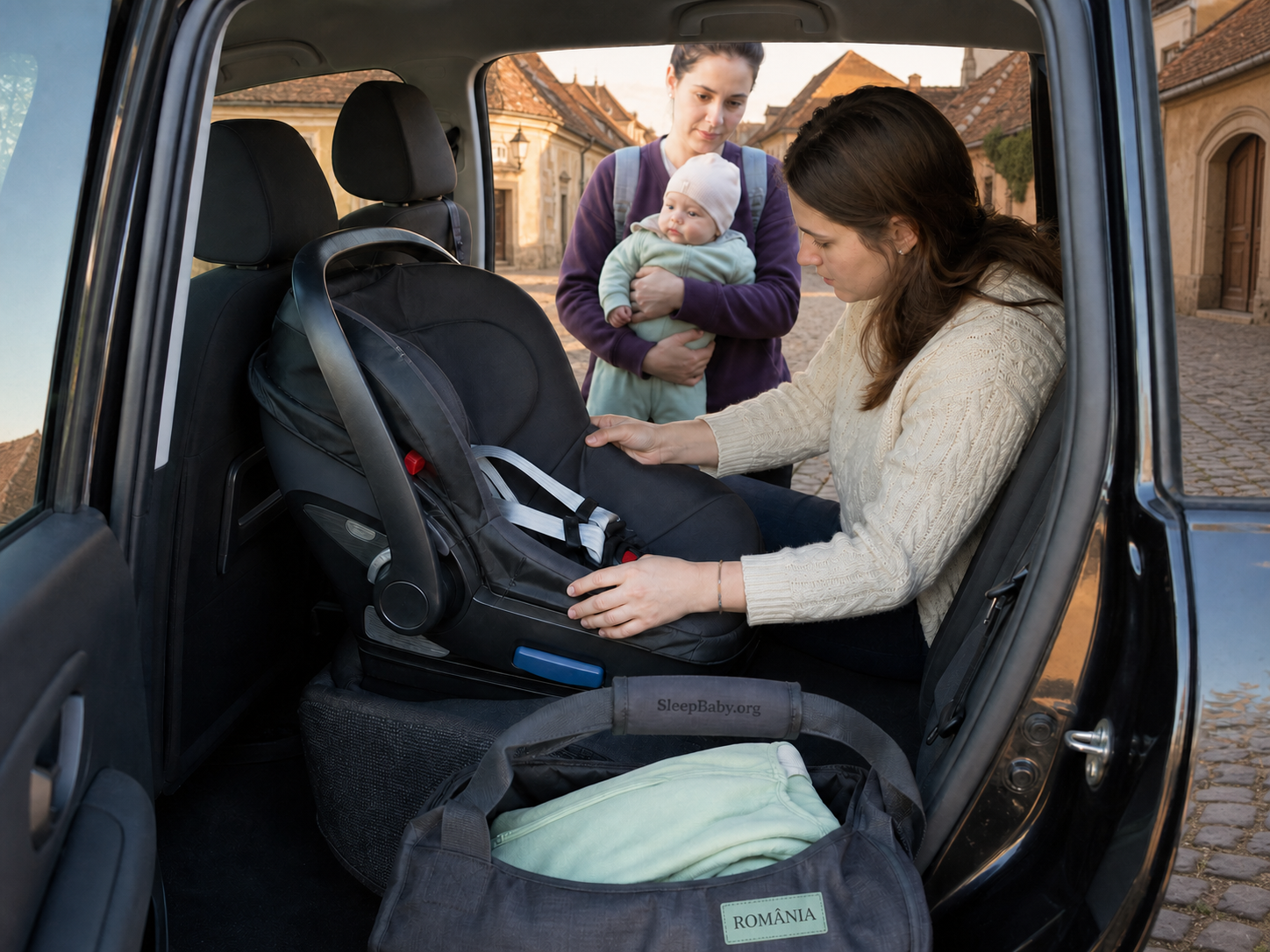
Legal requirement Under the current Romanian road-code implementing regulation, Article 97, a child up to 135 centimeters in a vehicle equipped with safety systems must be secured in an installed child-restraint system. A child over 135 centimeters uses the adult belt correctly positioned or an appropriate child restraint. For a baby, the practical implication is not merely “book a car seat.” It is to arrange a restraint that fits the child and the vehicle and can be installed correctly.
Legal requirement + practical safety plan
A promised seat is not yet a usable seat
- Child fit: confirm the restraint’s current height, weight, developmental, and direction limits against the baby.
- Vehicle fit: confirm the seat belt or anchor system, seating position, and space in the exact vehicle class.
- Lawful installation: follow Romanian law, the restraint instructions, and the vehicle instructions.
- Caregiver inspection: allow time before departure to check installation and harness fit; do not accept “the driver always does it” as evidence.
- Ride decision: if the restraint is missing, unsuitable, damaged, or cannot be installed, change the vehicle or transport plan.
Legal exception, not a safety recommendation Article 97 contains limited exceptions involving taxis and public transport. An exception can mean a particular ride is treated differently under the law; it does not make an unrestrained baby immune to a crash. I would still plan an appropriate restraint where practicable and choose transport that can accommodate it.
Three common options are worth comparing before booking:
- Bring a known compatible seat. This gives the caregiver familiarity, but it requires carrying, aircraft acceptance if used on board, protection from damage, and vehicle compatibility.
- Reserve a provider-supplied seat. Get the exact model, condition, fit range, installation arrangement, and vehicle compatibility in writing. “Baby seat available” is not enough.
- Change the transport. If neither option can be verified, use another provider or a route where the family can use an appropriate restraint rather than improvising after arrival.
I would photograph the restraint label and the installed setup for my own reference before the first ride, not as a legal certificate. If something looks wrong, pause. The ten minutes saved by leaving quickly are not worth turning the first drive into a guessing exercise.
The first five minutes in the room belong to safe sleep
I know the instinct after a long arrival: put the bags down, find the charger, open every cupboard, and become briefly furious that nobody knows where the wipes are. I would give the first five minutes to the baby’s sleep space instead. The first nap can arrive before the room feels organized.
Kacey and Benjamin — clearly labeled composite illustration
The Romania room I picture with Benjamin
This is a composite scene, not a claim that Benjamin and I traveled to Romania. I picture us arriving in a Bucharest room at 6:17 p.m. local time. Benjamin is heavy against my shoulder, one suitcase is open just enough to release a single sock, and the curtains are glowing like they have been personally assigned to defeat bedtime.
I want to unpack. Instead, I leave the bag closed. I check the crib frame, mattress, fitted sheet, gaps, added padding, loose items, and the cord beside the window. I note the next feed and the local time. Only when the sleep space passes do I set down the familiar sleep sack nearby for later. The scene is imagined, but the order is the useful part: safe sleep first, room darkening second, luggage eventually.
Medical and public-health guidance
Inspect before the first nap
- Confirm the crib or other infant sleep product is intact, stable, and appropriate for the baby.
- Use a firm, flat, non-inclined sleep surface with a snug fitted sheet.
- Remove pillows, blankets, bumpers, toys, positioners, and other soft or loose items.
- Look for gaps, broken parts, added padding, reachable cords, blind loops, furniture hazards, and nearby objects.
- Place the baby on the back for every sleep unless the baby’s clinician has given a specific medical instruction.
- If the setup fails, request a replacement or use a verified alternative. Do not repair uncertainty with folded towels or extra bedding.
Medical or public-health guidance The American Academy of Pediatrics’ HealthyChildren guidance says to inspect a hotel crib and reject damaged equipment, added padding, a poor-fitting sheet, or placement near accessible cords and objects. For every sleep, place the baby on the back on a firm, flat, non-inclined surface and keep soft and loose items out.
Travel does not create a safe-sleep holiday. It does create unfamiliar equipment, unusual room layouts, and tired adults, which is why the inspection needs to happen before it is urgently needed. For the full room-by-room process, use SleepBaby’s narrower guide to checking a baby’s safe sleep setup in a hotel. This Romania page keeps only the arrival decision so it does not duplicate that guide.

One useful Romania lodging item—after the sleep space passes
Optional travel-room tool
Tommee Tippee Sleeptime Portable Baby Blackout Blind, Large
A bright Romania hotel or rental can make a destination-time nap or bedtime harder, especially when the baby’s body still thinks the day belongs to another clock. This removable travel blind has one narrow job: darken a suitable temporary window after you have already checked the room and the sleep space.
I prefer this fit for this trip over a portable crib, a generic power adapter, or a formula cooler. A crib adds bulk and sleep-product compatibility questions; an adapter has voltage and device caveats; a cooler only helps certain feeding plans. The blind addresses the arrival-to-sleep handoff shared by many families without claiming to make the crib safe or the baby sleep.
Why buy it for this trip: it gives you a packable way to manage an unexpectedly bright temporary room during naps and bedtime instead of relying on the lodging’s curtains. Use it only on a suitable window, follow the product instructions, and keep the blind, attachments, and cords completely inaccessible to the baby.
Check the Tommee Tippee portable blackout blind on Amazon
As an Amazon Associate, SleepBaby may earn from qualifying purchases.
Boundary: this is a room-darkening convenience, not a sleep surface, monitor, restraint, medical device, border document, airline approval, or substitute for the safe-sleep inspection.
Pack for the exact Romanian place and date, not the country name
Romania is not one forecast. Bucharest in late summer, Brașov in shoulder season, and a mountain stay in winter can demand very different layers and travel buffers. I would check the exact city, elevation, travel dates, and current forecast shortly before packing. Avoid a countrywide temperature chart copied from a tourism page; it will not tell you whether the baby needs rain protection during the actual transfer from the airport.
Practical parent suggestion Pack in systems rather than one enormous list. A system remains useful when the weather or itinerary changes.
A modular packing board
Six bags, six jobs
Documents
Baby’s travel document, caregiver documents, consent or custody evidence where applicable, itinerary, lodging, return travel, insurance, and offline authority pages.
First 12 hours
Feeds, diapers, wipes, one clothing change for baby and caregiver, sleep clothing, medications, charging, and the items needed before checked baggage becomes available.
Feeding
Familiar supply, cleaning method, water plan, cold-storage plan, and a reasonable delay buffer matched to the baby’s feeding method.
Health
Original labeled medicines, clinician documents, a simple health summary, thermometer or other clinician-recommended supplies, insurer details, and emergency contacts.
Transport and sleep
The verified child-restraint plan, familiar sleep clothing and cues, and only the equipment that has a defined fit and safe use.
Weather
Layers and protection based on the live local forecast, plus one dry or warm backup for the transfer between airport, vehicle, and lodging.
The “first 12 hours” bag is the one I care about most. If the stroller is returned somewhere unexpected, the room is not ready, or checked baggage is delayed, the family can still feed, change, medicate as prescribed, and settle the baby. Put irreplaceable documents and medicines in the caregiver’s control, subject to airport and airline rules.
Do not publish or follow a universal number of diapers, ounces of formula, sets of clothing, or medicine doses. The useful quantity depends on the baby, access to laundry or shops, trip length, feeding method, season, and disruption tolerance. Write the family’s daily use, add the chosen buffer, and keep the first day separate. That is a planning method, not a magic number.
Naps and baby jet lag in Romania: work with local light, not against the baby
The schedule may wobble. That is expected. A baby crossing several time zones is not failing a routine, and the caregiver did not erase months of sleep work by boarding an airplane. The job is to offer the baby’s body repeated clues about where the day now lives while protecting enough rest to avoid an exhausted spiral.
Medical or public-health guidance HealthyChildren suggests that, when practical, families can shift sleep and meal timing gradually toward destination time for two or three days before departure. CDC notes that jet lag and schedule disruption can disturb infant and child sleep. Neither source promises a clock-perfect arrival, and neither supports giving an infant adult jet-lag drugs or supplements.
Local-light handoff
A flexible first-three-day rhythm
- Before departure, if it is practical: nudge sleep and meal timing toward Romania by a small amount for two or three days. Skip this if it creates more disruption than it solves.
- On the travel day: feed responsively, use safe sleep opportunities, and avoid forcing a dangerously tired baby to stay awake for a perfect schedule.
- On arrival: use daylight during Romania’s daytime, ordinary household light and activity when awake, and a simple wind-down as local evening approaches.
- For naps: protect age-appropriate rest without turning every nap into a battle over the home clock. Use the inspected sleep space and familiar cues.
- At night: keep care calm and boring, meet feeding and comfort needs, and return to the safe sleep space. Expect some waking while the body clock adjusts.
- Each morning: anchor the day with local light, feeds, and normal interaction, then adjust based on the baby’s actual sleep rather than a spreadsheet designed before the flight.
Practical parent suggestion Choose two or three familiar cues that travel well: the same short song, sleep sack when appropriate, a feed-and-diaper sequence, or the same final phrase before laying the baby down. Keep the safe-sleep setup constant even if the clock is messy. Familiarity does not require recreating the entire nursery in a suitcase.
Daylight is a useful time cue, not a reason to overheat the baby, skip needed sleep, or stay outdoors in unsafe weather. A bright temporary room can be darkened only after the window and cord setup is safe. If the blackout blind cannot be installed with every part inaccessible, leave it packed and work with the room another way.
What I would do with a disastrously timed nap
If the baby falls asleep in the late afternoon after a brutal travel day, I would not treat that nap as a referendum on the entire trip. I would first protect a safe sleep location, then consider the baby’s age, how much sleep has already happened, the next feed, and local bedtime. Sometimes a shorter bridge nap helps; sometimes the baby needs recovery sleep. A rigid universal instruction would pretend those facts do not matter.
What I would avoid is keeping an exhausted baby awake for hours to “force” the time zone. That can make the evening louder without making the body clock wiser. Keep local light and daily timing consistent, but let the baby’s condition set sensible limits. If illness, poor feeding, dehydration concerns, breathing trouble, unusual lethargy, or another health issue appears, stop calling it jet lag and contact appropriate medical care.
The return-home reset begins before the return flight
On the final day, I would reopen the same handoff plan in reverse. Check the operating carrier and Bucharest airport process again. Keep the first-home-night items reachable. Note the arrival time, expected feeds, and the simplest safe sleep plan at home. Nobody needs a color-coded recovery calendar while trying to find the car in airport parking.
Practical parent suggestion
Reverse the five gates without demanding an instant reset
- Before leaving Romania: recheck documents, the return route, checkpoint rules, carrier policy, feeding supply, medicines, and ground transport.
- During travel: meet feeding and sleep needs safely; use the home clock only as context, not a command.
- On arrival: expose the baby to home-time daylight when appropriate, resume familiar feeds and ordinary daytime interaction, and use the usual safe sleep space.
- For several days: make bedtime familiar, calm, and repeatable. Move timing gradually if needed rather than changing six variables after one difficult night.
- If the pattern persists: look at the baby’s age, illness, feeding, total sleep, and schedule before assuming the trip permanently changed sleep.
The first night home may be surprisingly smooth. The second may not. Body clocks are rude enough to send their invoice after the vacation has ended. That does not mean the family has to start over. Restore home daylight, feeds, wind-down cues, and the usual safe sleep setup, then give the rhythm time to settle.
SleepBaby’s guide to helping baby sleep after travel covers the longer recovery path without making this Romania guide repeat a generic schedule article. Use it if bedtime, naps, or night waking remain scrambled after the return.
A final pre-booking and pre-departure check
The rules most likely to change are also the ones most tempting to remember from an earlier search. I would run this list twice: once before committing money and again close to departure, reopening each issuing authority’s current page rather than relying on a saved snippet or an earlier answer.
Recheck, do not remember
Open the issuing source again for each item
- Baby’s passport validity, visa status, Schengen-day position, and any authorization active on the travel date.
- EES and ETIAS timing on the official EU site.
- Consent, custody, and Romanian-minor exit requirements for the family’s exact facts.
- Every operating carrier’s infant ticket, seat, restraint, baggage, stroller, bassinet, feeding, and check-in rules.
- Each airport’s current baby-liquid, medicine, screening, and connection process.
- CDC Romania health guidance and the baby’s clinician plan.
- Medicine legality and documentation for Romania and every transit country.
- Romania’s emergency information and the family’s actual nearby-care and insurance contacts.
- Current Romanian child-restraint law and the booked vehicle’s restraint details.
- The lodging’s real crib, refrigerator, window, and room setup.
- The exact-city forecast and any route disruption close to travel.
When the passport photo is back beside the bag, the scene should feel different from the opening. The document is no longer a tiny mystery with a serious face. It belongs to a known traveler on a known route, with each rule attached to the authority that owns it and each ordinary parenting problem attached to a practical plan.
I would still expect surprises. Babies remain unimpressed by logistics, borders, and carefully chosen bedtimes. But the family does not need certainty about every nap to be prepared. It needs clear ownership of the decisions that matter: border questions to border authorities, carrier questions to the operating airline, medical questions to the baby’s clinician, safe-sleep boundaries in every room, and a few familiar cues for the next stretch of sleep.
Claim-level references
Sources
- Romanian Ministry of Foreign Affairs, Conditions of Entry into Romania.
- European Union, Your Europe, Travel documents for non-EU nationals.
- U.S. Department of State, Romania International Travel Information.
- European Commission, Schengen visa policy.
- European Commission, The main differences between EES and ETIAS.
- U.S. Department of State, Traveling with Children.
- Romanian Border Police, Conditions for Romanian minors leaving the country.
- Federal Aviation Administration, Kids’ Corner — Flying with Children.
- TAROM, Checked baggage.
- Transportation Security Administration, Breast Milk.
- European Commission, Mobility and Transport, Liquids, aerosols and gels.
- Bucharest Airports National Company, Guide for an easier and quicker airport security check.
- U.S. Centers for Disease Control and Prevention, Food and Water Precautions for Travelers.
- U.S. Centers for Disease Control and Prevention, Travel and Breastfeeding.
- U.S. Centers for Disease Control and Prevention, Romania — Traveler View.
- U.S. Centers for Disease Control and Prevention, Traveling Safely with Infants and Children.
- European Commission, 112 — the EU’s emergency phone number.
- Romanian Government legislative portal, Road-code implementing regulation, Article 97.
- American Academy of Pediatrics, HealthyChildren.org, Hotel Dangers that Put Baby Safety at Risk.
- American Academy of Pediatrics, HealthyChildren.org, Back to Sleep, Tummy to Play.
- American Academy of Pediatrics, HealthyChildren.org, Travel Safety Tips.
When the suitcases are home but the clocks are not
Bring the next sleep back to something familiar
Romania can change the light, the timing, and the room. It does not have to change every cue at once. SleepBaby’s home resources can help you choose a calm, repeatable next step for naps, bedtime, and the return-home rhythm.
Explore SleepBaby’s practical sleep help
SleepBaby provides education, not medical diagnosis, legal advice, border approval, or a guarantee of sleep outcomes.






What viewers said10 comments · 4 replies+
Archived comments from the original Baby Sleep Miracle presentation. Not independently verified by SleepBaby.org; individual experiences vary.
Thank you so much for this video! I had no idea about the dangers of baby swings :O
Hi Mary-Ann. I have a question: Is method in any way similar to the ones recommended by Dr Bucknam, Dr. Weissbluth or Dr. Karp? We tried those but none of them help.
Hi Regina, thank you for your question. The short answer is no. The techniques I share in my guide are based on newest scientific research and this is why I have never seen any approach similar to the one I recommend.
This method really works! I tried it on my son Jesus and after just one week he went from waking up more than 5 times a night to waking up just once or twice. You are a lifesaver, Mary-Ann!
I'm truly impressed with how much information you share in your video. And all for free! I can feel that you truly care about mothers like myself, and that's hard to find these days. I have recommended your site to several of my friends already.
Mary-Ann, our child suffers from autism. Is your approach still suited?
Chloe, I made sure my method can be used with any child, even babies who are special like yours. Please note that I'm not a doctor and that I always advice to consult with your physician because nothing is more important than the safety and well-being of your love.
Hallo Mary-Ann, I'm from Germany. Do you have your guide in German?
Hello Heide, we do! Normally you should already see our video in German. If not, please contact our support so they can guide you
Thenk you for your answer, Mary-Ann!
I just completed your approach and I have to say, it worked almost too well. Yes, it took a bit of getting used to with your bedtime routine but the difference is huge. My son George used to take 1 hours to go down and now he's firmly asleep in no more than 10 minutes! You're the best!
It seems I'm the only man watching this video, lol! What you shared about the 'emotional backpack' made immediate sense to me and I can't wait to help my little girl Mila to unpack it!
Hey there, just discovered your site and this really sounds different. Just wanted to say thanks for sharing :)
For everyone who's still thinking about getting Mary-Ann's guide I want to advise you to go ahead. I wasn't sure myself but now I'm so thankful I invested in this program. It made a huge difference in our life as a family and yes, my baby girl does sleep through the night now.