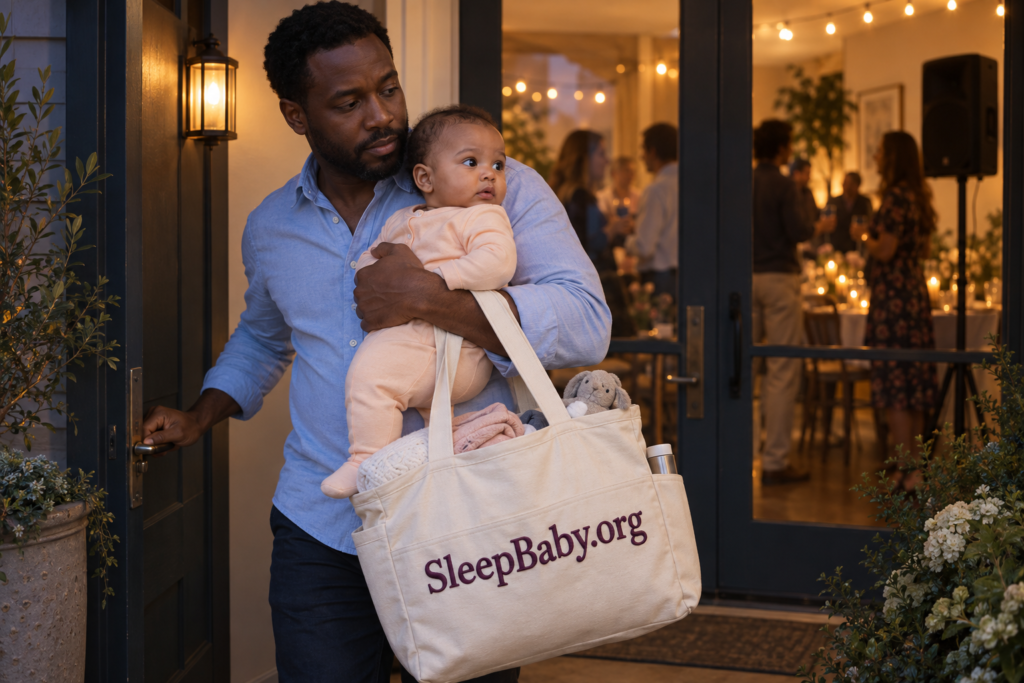
Yes, you can take a baby to many conferences. But “the venue allows children” is not enough. Before you book the flight or print a tiny badge with a job title your baby has not technically earned, ask the organizer whether your baby may enter the specific rooms and events you need.
Conference policies are startlingly inconsistent. One event may welcome nursing infants in sessions. Another may require every child to have a pre-registered pass. A third may offer a lactation room but no childcare. Receptions, expo halls, keynotes, and presentation rooms can all have different rules.
So my answer is yes—with two conditions:
- Get the exact policy in writing.
- Make one plan for your baby and a separate plan for your work.
That second part is what turns “technically allowed” into “actually possible.” A diaper bag is useful. It is not a staffing plan.
In the editorial-composite version of this day, Benjamin had an adorable little visitor badge clipped to the stroller. Five minutes later, the badge met a spectacularly mistimed diaper situation and disappeared into the backup-onesie compartment. It was a concise demonstration of conference life with a baby: the professional plan and the baby plan will keep meeting, often without checking each other’s calendars first.
If the question underneath your search is, “Will people think I’m unprofessional?” I want to answer that too. Bringing a baby does not make you unserious. Arriving without checking the policy, without coverage for your presentation, or without a way to step out of a quiet session can make the day harder for everyone—including you. Preparation is the professional part. Parenthood is not the apology.

Before anything else, ask what “babies are welcome” actually means
I would not rely on a general family-friendly label. Current conference rules show why.
- ICML 2026 [1] says nursing infants and older teens may attend without a fee, while children from four months through age 13 must use reserved childcare; it also excludes minors from some alcohol-centered events.
- CHI 2026 [2] requires children entering the conference area to have a pre-registered child pass. Its childcare serves specified ages, has limited space, and must be arranged rather than assumed.
- EMBC 2026 [3] lists a lactation room and family lounge but does not provide childcare.
- The NACCHO Preparedness Summit [4] explicitly welcomes children and dependents at conference components without a registration fee, while keeping supervision with the accompanying adult.
- The ACC.25 Parents’ Room [5] offers a family space with a session livestream, feeding areas, cold storage, a microwave, and pram parking.
Those are examples, not a master rule. The event you are attending may do something entirely different. A baby-friendly hotel does not make the plenary baby-friendly.
The 12 questions I would send the organizer
Ask before the cancellation deadline, not from the registration desk while your baby studies the badge printer with dangerous enthusiasm.
- May my baby enter the keynote, breakout sessions, expo hall, meals, and presentation room?
- Does the baby need a child pass or advance registration even if the pass is free?
- Are minors excluded from receptions, alcohol-centered events, site visits, labs, or evening programs?
- May a caregiver enter the venue, and do they need a paid, companion, or childcare badge?
- Can my caregiver wait directly outside the room where I am presenting?
- Is onsite childcare available, and what ages does it accept?
- Must childcare be reserved, and what happens if the space fills?
- Who operates the childcare, and where can I review its supervision, illness, allergy, feeding, pickup, and emergency procedures?
- Is there a private lactation room with power, a chair, cold storage, a sink, or another way to clean pump parts?
- Is there a family room or quiet room, and does it carry live session audio or video?
- Where may I park a stroller, and are there room, aisle, elevator, or escalator restrictions?
- Who can answer a day-of question if the written policy and what happens onsite do not match?
Written policy, room by room
The conference credential folio
“Family friendly” is a mood. These four written answers are the credential you can actually plan around.
- 01 · Access
- Name the rooms, sessions, receptions, and expo areas the baby may enter—and whether a child pass is required.
- 02 · Care
- Confirm caregiver badges, childcare ages and hours, the operator, pickup rules, and the failed-handoff plan.
- 03 · Feeding
- Locate the lactation or family room, power, cold storage, cleaning route, and the time the walk will really take.
- 04 · Exit
- Map stroller storage, elevators, a quiet reset point, the nearest proper sleep surface, and one day-of contact.
Why this matters tonight: written room-level answers protect the baby’s next rest and the work block you cannot repeat.
A copy-and-send email
Hello—I’m registered for [conference] and plan to attend with my [age]-month-old baby. Could you confirm in writing whether the baby may enter [name the keynote, session, expo, reception, and presentation room you need], whether a child pass is required, and whether my caregiver needs a badge? Please also tell me about childcare age limits and reservations, lactation or family-room access, stroller storage, and any events where minors are not admitted. I am presenting on [day/time], so I need to know whether my caregiver can reach that room or wait immediately outside it. Thank you for helping me plan accurately.
Save the reply on your phone. If the answer is vague, follow up with the exact room or event name. “Children are generally welcome” and “your six-month-old may enter Ballroom C during your panel” are not the same sentence.
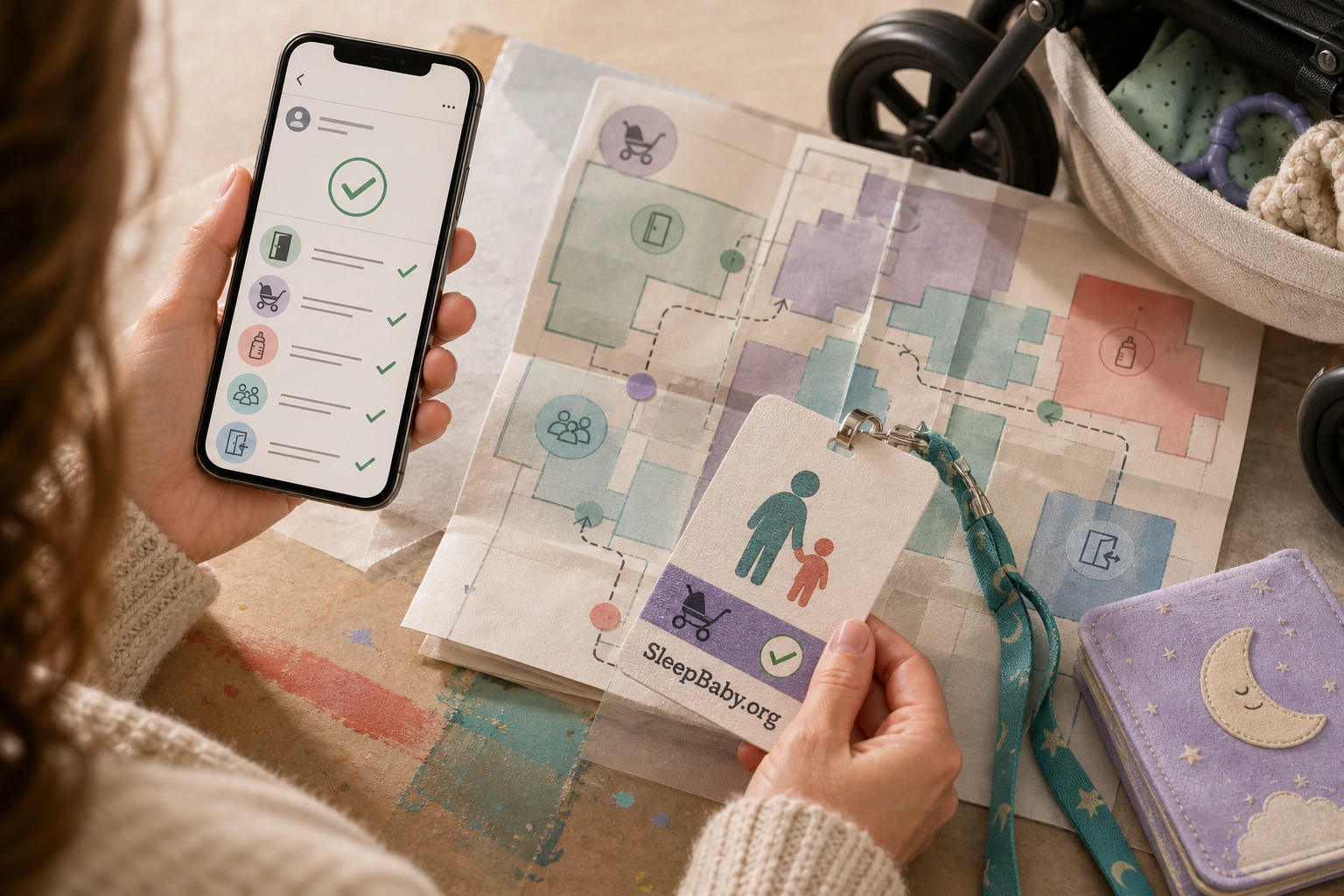

Use the Two-Plan Conference Test
Most advice about attending a conference with a baby becomes one enormous packing list. Packing matters, but it does not answer the hard question: Who is doing what when the baby and your work need you at the same time?
I use a simpler test.
Two responsibilities · one clock
The Two-Plan Conference Test
Write the baby plan and the work plan separately. Only then place them on the same lanyard-length timeline.
Baby plan
- Who owns feeds, changes, soothing, and the next safe sleep return?
- Who can leave immediately if the room stops working?
- Who receives the childcare call?
Work plan
- Which session, meeting, or presentation cannot move?
- Who protects your setup and question time?
- What is the named professional backup?
Collision checkpoint
If both plans name you at the same time, resolve the handoff before travel—not in the ballroom doorway.
Sleep connection: the person who owns the collision also owns the route back to a firm, flat sleep surface when the conference block ends.
Original planning tool by SleepBaby.org.
Plan A: the baby plan
Name the adult responsible for:
- feeds;
- diaper changes;
- the next nap or safe return to the hotel;
- soothing and a fast exit;
- medications or health needs;
- collecting the baby from childcare;
- getting everyone safely back to the room.
Plan B: the work plan
Name the adult responsible for protecting:
- your presentation or panel;
- the one session you traveled to attend;
- a scheduled interview or meeting;
- the professional conversation that cannot happen later;
- your laptop, notes, badge, and ten uninterrupted minutes before you speak.
The collision check
Put the two plans on the same timeline. If both say you at 10:30 a.m., you do not yet have a plan. You have a hopeful overlap.
Resolve the collision before the event with a registered caregiver, reserved childcare, a trusted colleague handoff, a virtual option, a shorter conference day, or a deliberate decision to skip that block. I would rather see one protected professional hour and a calm baby plan than eight hours of trying to be two adults in one lanyard.
Which attendance model fits your actual day?
There is no universally “best” way to do this. The right model depends on the policy, your baby, your role, and how much of the conference truly matters.
1. You attend alone with the baby
This can work when the event explicitly permits babies, your schedule is flexible, you are comfortable leaving sessions, and you do not have a presentation or meeting that depends on uninterrupted attention.
It is a poor fit when the entire value of the trip sits inside one quiet session you cannot leave. A baby may sleep through the opening remarks and object vigorously during the only sentence you flew 900 miles to hear. That is not a character flaw. It is also not a useful professional strategy.
If you go solo, choose a seat near the exit, tell the session chair quietly, and decide beforehand which sessions you are willing to miss. Do not build a schedule that requires your baby to nap on command in a fluorescent convention center.
2. You bring the baby and a caregiver
For a parent who is presenting, leading meetings, or hoping to network, this is often the most workable model. The caregiver does not need to occupy the baby every minute. Their job is to own the collision points.
Confirm that the caregiver can access the venue or meet you at a practical handoff point. A “guest” who must wait six security doors away is less helpful than the plan looked at home.
Breastfeeding does not make a caregiver pointless. The caregiver can handle the stroller, diapers, walking, soothing, your bag, a return to the hotel, and the minutes before and after a feed. You remain available for feeding without remaining the only person holding the entire day together.
3. You reserve conference childcare
Onsite childcare can protect longer work blocks, but inspect the details. Age minimums can exclude young infants. Spaces may fill early. Hours may not cover receptions. The childcare room may be in another building. Feeding, allergy, illness, diaper, pickup, and caregiver-access policies vary.
Ask who runs it and what happens if your baby cannot settle. Keep your phone reachable, but also define what deserves an interruption. Otherwise you may spend your panel checking your pocket every twelve seconds, which is a very expensive form of not being in either place.
4. The baby stays home, or you attend virtually
This may be the kindest plan when travel is medically unwise, the venue excludes infants, no appropriate childcare exists, you need focused recovery after birth, or the logistics cost more than the conference can return.
Choosing not to bring your baby is not more professional. Choosing to bring your baby is not more devoted. Both can be thoughtful decisions. The useful question is whether the plan protects the baby, the caregiver, and the reason you are attending.
Four badge routes
Choose the attendance model that survives the collision
Compare the model against the obligation you cannot move, not against the fantasy version of the day.
Read down one badge route at a time—each card keeps the work fit, collision, access check, and sleep exit together.
-
Solo + baby
- Best when
- Flexible day; no immovable speaking block
- Collision to solve
- Baby needs you during the one valuable session
- Access check
- May the baby enter every room you need?
- Exit + sleep
- Exit seat; short blocks; real hotel reset
-
Baby + caregiver
- Best when
- Presentation, meetings, or focused networking
- Collision to solve
- Caregiver cannot reach the handoff point
- Access check
- Which badge or security route do they need?
- Exit + sleep
- Two meeting points; caregiver owns the safe return
-
Onsite childcare
- Best when
- Longer protected work blocks
- Collision to solve
- Age limit, full room, or failed settling
- Access check
- Who operates it and how are you contacted?
- Exit + sleep
- Pickup trigger; feeding route; post-care reset
-
Home or virtual
- Best when
- Travel risk, recovery, policy, or cost defeats the value
- Collision to solve
- Trying to recreate full in-person attendance remotely
- Access check
- Can the essential talk or meeting move online?
- Exit + sleep
- Keep the familiar sleep setting; protect one work block
Why this matters tonight: the best route leaves enough caregiver margin for the safe sleep setup after the badge comes off.

If you are presenting, protect that hour first
Presenting changes the answer because you cannot simply step out midway through your own talk. Start with that immovable block and plan outward.
I would protect:
- 20 to 30 minutes before the session to use the restroom, feed or pump if needed, test slides, and find the room;
- the full session rather than only your speaking minutes;
- a short buffer afterward for questions and a clean handoff back to baby duty.
Give the caregiver your room name, start and end time, and two meeting points: the preferred one and the “security would not let me through” one. Put the baby’s essentials with the caregiver, not under your chair while you are onstage.
Tell the session chair what they need to know, not your entire family logistics history. “My infant and caregiver are nearby; if I need to leave after the panel, I may skip the informal discussion” is enough. If you are attending solo and the organizers allow the baby in the room, ask whether another presenter or moderator can cover if you must step out. Hope is lovely. A named backup is better.
The tender part is that many parents feel guilty whichever direction they walk. You may hear your baby fuss with the caregiver and feel your whole body lean toward the door. You may stand in the hotel room during a nap and feel the conference happening without you. Neither feeling proves the decision is wrong. It proves you care about two things at once.
Build a smaller conference day than your pre-baby self remembers
Conference schedules are built by people who believe coffee can replace sitting down. A baby will challenge that theory early.
Choose three levels:
- Must: your presentation, one meeting, or one essential session.
- Worth it: the events you will attend if feeding, naps, and energy cooperate.
- Bonus: everything else.
That hierarchy prevents the 8:00 a.m. keynote from quietly spending the energy you needed for a 2:00 p.m. panel. It also gives you permission to leave an expo hall after twenty useful minutes instead of completing every aisle like someone will stamp your passport at the end.
Make a base camp
Identify one place where the day can reset: a family room, lactation room, quiet lobby corner where babies are permitted, your hotel room, or a nearby caregiver-accessible space.
The base camp should answer four questions:
- Where can the baby feed?
- Where can you change a diaper?
- Where can you lower stimulation or leave quickly?
- Where is the nearest proper sleep surface if the baby needs more than an on-the-go doze?
Take a photo of the venue map and mark elevators, restrooms with changing facilities, family/lactation rooms, exits, and the room you must reach. The badge app will probably choose the exact moment you are holding a baby and a bottle to request a password reset.
Pack by job, not by fear
You do not need every object your baby has ever liked. Pack for the jobs the day requires:
- Feed: milk/formula/food as appropriate, bottles or nursing supplies, bib, burp cloth, pump and cleaning/storage items if used.
- Change: diapers, wipes, changing pad, bags, cream, and at least one full clothing change.
- Move: an age-appropriate carrier used exactly as directed, stroller if permitted, rain or weather protection that does not obstruct airflow, and transport restraints required for the trip.
- Reset: one or two quiet familiar objects, a pacifier if your baby uses one, and the smallest repeatable wind-down cue.
- Work: badge, charger, slides in two places, notes, water, and the item you absolutely cannot buy at the convention center.
Keep the high-frequency items reachable. The spare outfit under three days of “just in case” clothing is not really a spare outfit. It is an archaeological layer.
Plan naps without turning the stroller into the hotel crib
Some babies will doze in a stroller or carrier during a busy day. That does not make a sitting or carrying device the planned sleep space. The American Academy of Pediatrics’ safe-sleep guidance [11] recommends a firm, flat infant sleep surface such as a compliant crib, bassinet, portable crib, or play yard, with the baby placed on their back and the space kept clear. If a baby falls asleep in a car seat, stroller, sling, or carrier, move them to an appropriate sleep surface as soon as practical.
For a short conference day, that may mean the caregiver returns to the hotel for the main nap. For a longer day, you may schedule a hotel-room reset between sessions. If neither is possible, treat that as a real limitation when deciding how long to stay.
If travel or stimulation produces a surprisingly long nap, our guide to checking a baby who is napping longer than usual helps separate an ordinary catch-up nap from a schedule or health question. If you need to end a nap, transfer out of a sitting device, or wake for a clinician-directed feed, use a gentle wake-up plan rather than escalating stimulation.
Check the hotel sleep space before bedtime
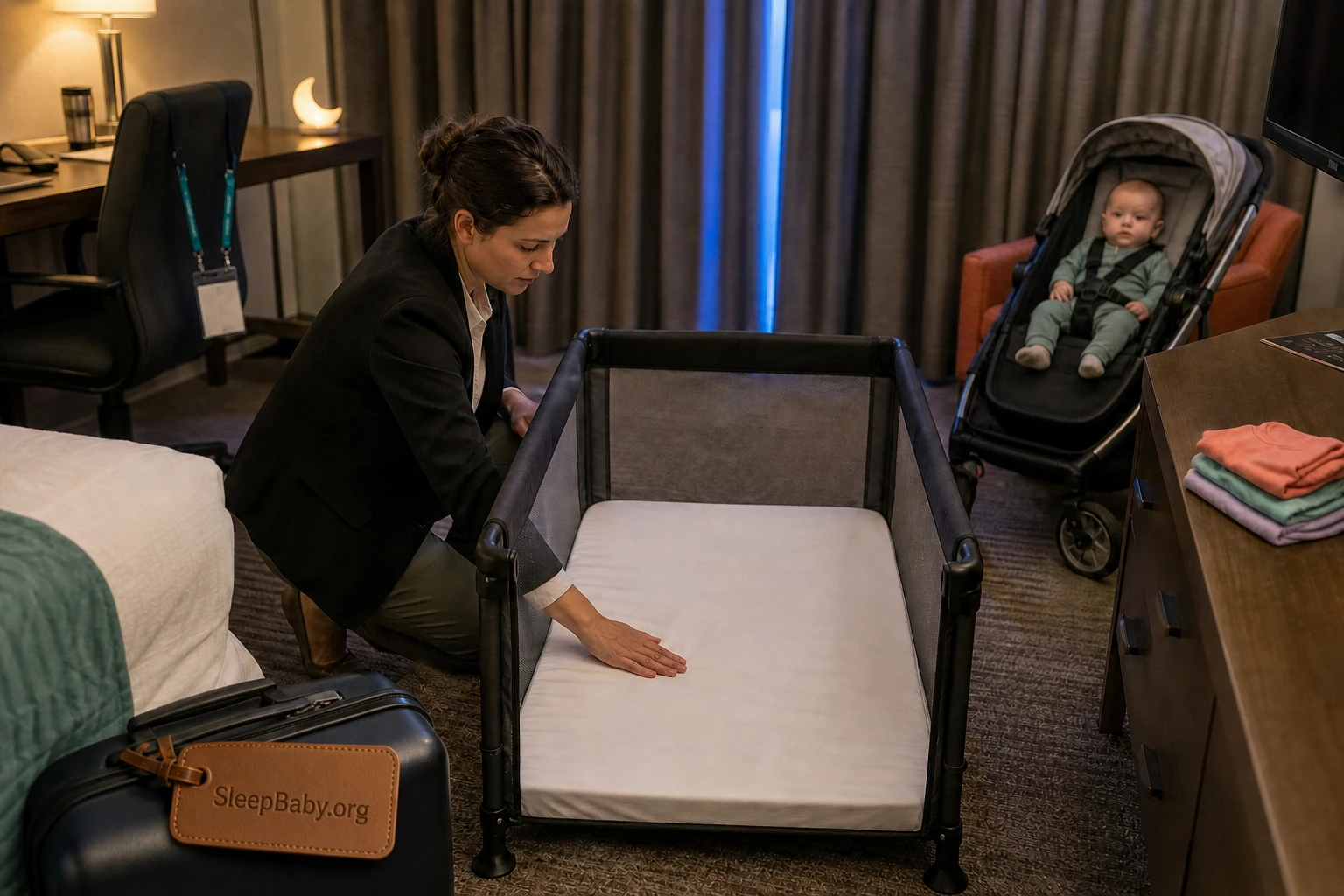
“Crib available” is the beginning of a question, not proof of a safe setup. Ask what product the hotel provides, whether it is available for your dates, and whether it comes with its intended mattress and fitted sheet. Inspect it when you arrive. Follow the manufacturer’s limits and current safe-sleep guidance; remove pillows, loose blankets, bumpers, toys, and improvised padding.
Bring the minimal safe parts of your bedtime routine: sleep clothing appropriate to the room, a brief book or song, and whatever consistent cue does not require recreating your nursery in a suitcase. If travel shifts the whole day, adjust gradually when you return rather than moving naps, bedtime, feeds, and morning all at once. This guide to adjusting a baby’s sleep schedule can help you think in smaller changes; use your baby’s age, health, and feeding plan rather than copying a generic clock.

Feeding and pumping need a route, not merely supplies
The CDC’s travel recommendations for nursing mothers [6] suggest planning how you will feed or express milk on the baby’s usual rhythm, clean pump parts, and arrange cold storage when needed. The useful conference translation is to put those actions on the schedule before every open block fills itself.
Ask where the lactation room is, when it is unlocked, who has access, and whether “refrigerator available” means a dedicated cold-storage option you are comfortable using. A room across a convention center can turn a 20-minute pump break into most of a session. Walk the route on arrival if the timing matters.
If you are flying in the United States, TSA’s current guidance [13] permits formula, breast milk, toddler drinks, baby food, and necessary cooling accessories in carry-on baggage under special screening rules, including quantities greater than the usual 3.4-ounce liquid limit. Tell the officer what you are carrying at the start of screening and allow extra time. Check current airport, airline, and destination rules for the rest of the trip.
For formula or solid food, plan safe water, preparation, storage, hand cleaning, and how long the food will be out. Do not assume the expo-hall sink or a hotel coffee station solves those jobs.
Noise, crowds, carriers, and indoor air
An expo hall can be louder than it looked in the promotional photos. The National Institute on Deafness and Other Communication Disorders [15] advises avoiding loud sound, moving farther from the source, and using properly fitted hearing protection when appropriate. Infant earmuffs are not permission to stand beside a speaker. Distance and a shorter visit still matter.
Crowded indoor events also increase exposure to respiratory viruses. The CDC’s cleaner-air guidance [16] includes steps such as improving ventilation and spending time outdoors when practical. For a very young baby, a recently ill baby, or a child with medical vulnerabilities, ask the pediatric clinician who knows them how the trip changes the risk—not a conference Facebook group.
If you use a soft carrier, follow the manufacturer’s age, size, fit, and positioning directions. Keep the baby’s face visible, airway open, and chin away from the chest. The CPSC’s carrier guidance [14] is a worthwhile safety review, especially for young infants. A carrier can make movement easier; it does not make every environment or sleep arrangement safe.
Age and temperament change what is realistic
I do not love advice that declares one perfect age for conferences. A younger baby may be less mobile but need frequent feeding and may be too young for onsite childcare. An older baby may handle longer gaps between feeds but object to sitting quietly and regard every lanyard as a personal invitation.
Consider the baby in front of you:
- Young infant: ask the pediatric clinician about travel timing, feeding, illness exposure, and any vaccine or medical considerations. Childcare may have a minimum age.
- Predictable napper: protect the nap that most affects the day instead of assuming all naps will happen onsite.
- Light sleeper or easily overstimulated baby: use shorter venue blocks and a real quiet return point.
- Mobile baby: assume they will want floor time and safe movement; a full day confined to a stroller is not a satisfying plan.
- Separation-sensitive baby: rehearse caregiver handoffs before the conference and keep the first childcare block modest.
- Baby who dislikes the carrier or stroller: believe the evidence you already have. The conference is an expensive place to debut equipment your baby has rejected at home.
Temperament is not a problem to solve before registration. It is information to use.
A calmer airport start
Watch the infant-care screening handoff
If your conference trip includes a U.S. flight, this 76-second TSA explainer shows what happens to strollers, car seats, formula, breast milk, baby food, and other infant-care items at security.
What to carry forward: group infant liquids and gear, tell the officer what you have before screening begins, and leave time for extra checks. That keeps the airport handoff from consuming the margin meant for registration.
The footage was published in 2016, so use it for the screening sequence—not as a substitute for current rules. Recheck TSA’s current traveling-with-children guidance [13] before departure.
A sample conference day that leaves room for a baby
This is a planning example, not a prescribed baby schedule. Move every time to fit your baby, feeds, health plan, and event.
A conference day with breathing room
One Protected Hour
This is a planning example, not a prescribed baby schedule. Move every time to fit your baby, feeds, health plan, and event.
- 7:00 a.m.Hotel reset: feed, diaper, ordinary morning, confirm the first handoff.
- 8:15 a.m.Arrive: collect badges; locate family, lactation, and presentation rooms.
- 9:00 a.m.Flexible session: stay near an exit, or let the caregiver walk nearby.
- 9:45 a.m.Handoff: caregiver takes full baby duty; parent checks slides and settles.
- 10:15–11:15Protected work block: presentation, panel, and questions. No simultaneous baby assignment.
- 11:15 a.m.Reconnect: feed or pump if due; decide whether the baby needs the hotel.
- 12:00 p.m.Main nap/reset: caregiver returns to the safe sleep space.
- 2:00 p.m.One worthwhile block: attend the session or meeting that earned its place.
- 3:30 p.m.Honest decision: continue only if baby, caregiver, and parent still have margin.
- EveningProtect bedtime—or revise it deliberately: a reception is not mandatory because appetizers exist.
Sleep connection: the day ends at a decision point, not after every adult has spent the margin needed for a safe hotel reset.
Conference-day planning by SleepBaby.org.
The most important line is the 3:30 decision point. Make it while you still have choices. Leaving before everybody melts down is not quitting; it is suspiciously competent logistics.
When I would choose virtual attendance or skip the trip
I would pause the plan if:
- the organizer cannot confirm that the baby or caregiver may access the spaces you need;
- your presentation has no realistic coverage for feeding, crying, illness, or a failed childcare handoff;
- onsite care does not accept your baby’s age and no trusted caregiver can come;
- the baby is ill, recently ill, medically vulnerable, or the treating clinician advises against the trip;
- you are still recovering and the travel burden is greater than the professional benefit;
- the only nap plan is prolonged sleep in a sitting or carrying device;
- the trip requires you to ignore feeding, pumping, medication, or safe transport needs;
- the cost of caregiver travel and lodging changes the value of attending;
- you already know the baby cannot tolerate the essential equipment or setting.
Sometimes the plan becomes “present remotely, attend one day, and schedule two meaningful calls afterward.” That can preserve more professional value than physically appearing for three days and being available to nobody.

Quick answers parents ask before taking a baby to a conference
Can I bring my baby into conference sessions?
Only if the event’s current policy allows it. Confirm the exact session types and rooms; a child pass, caregiver badge, or advance registration may be required.
What if my baby cries during a talk?
Sit near an exit and step out promptly. That is courtesy, not shame. If the talk is your must-attend event, assign a caregiver or childcare plan so leaving does not erase the reason for the trip.
Can I present while holding my baby?
Possibly, if the organizers allow it and you genuinely want to—but do not make it the only plan. Slides, microphones, audience questions, and an infant’s needs are all capable of arriving together. Protect the presentation with a caregiver, childcare arrangement, or named backup.
Is onsite conference childcare automatically safe?
No service is automatically right for your baby. Ask who operates it, which ages it accepts, how caregivers are screened and supervised, what the illness and emergency procedures are, how feeding and allergies are handled, and how you will be contacted.
Should I use a stroller or baby carrier?
Use the option your baby already tolerates and the venue permits. Check stroller storage and accessibility. Use carriers within manufacturer directions with a visible face and open airway. Neither device replaces a firm, flat sleep surface once travel or movement has ended.
How do I keep my baby on schedule during a conference?
Protect the part of the rhythm that matters most—often a feed, main nap, or bedtime sequence—then leave margin around it. Do not rebuild the entire day around a sample schedule from the internet. If the conference day goes sideways, change one part at a time afterward.
Is bringing a baby to a professional conference unprofessional?
No. The professional question is whether you respected the event policy and protected your responsibilities. A clear handoff, an exit seat, and a named presentation backup say far more about preparation than the presence of a stroller.
What if I spend most of the conference caring for the baby?
That can happen, especially without a caregiver. Decide before the trip what minimum outcome would make attendance worthwhile. If the honest minimum cannot coexist with the baby plan, change the attendance model before you spend the money.
Give the day one job
Your conference does not need to look like the version you attended before your baby existed. Give the day one protected professional job. Give your baby a separate care and sleep plan. Then let everything else be optional.
If travel has left naps, feeds, and bedtime pulling in three directions after you get home, SleepBaby can help you read the next 24 hours as one pattern rather than “fixing” every strange nap separately.
The goal is not to prove you can carry a baby, a laptop, a pump bag, and an impossible agenda through a convention center. The goal is to leave with the part of the conference you came for—and bring your baby back to a safe place to sleep.
Sources
- International Conference on Machine Learning. “Childcare at ICML 2026.” icml.cc. Accessed August 9, 2026.
- ACM CHI Conference on Human Factors in Computing Systems. “Childcare at CHI 2026.” chi2026.acm.org. Accessed August 9, 2026.
- IEEE EMBC 2026. “Children & Caregiver Participation.” embc.embs.org. Accessed August 9, 2026.
- NACCHO Preparedness Summit. “Preparedness Summit Child Policy.” virtualcommunities.naccho.org. Accessed August 9, 2026.
- Australasian College of Cardiovascular Nursing. “ACC.25 Parents’ Room.” conference.acc.org.au. Accessed August 9, 2026.
- Centers for Disease Control and Prevention. “Travel Recommendations for Nursing Mothers.” Updated February 13, 2026. cdc.gov.
- Centers for Disease Control and Prevention. “Travel and Breastfeeding.” CDC Yellow Book, 2026 edition. cdc.gov.
- Centers for Disease Control and Prevention. “Traveling Safely with Infants and Children.” CDC Yellow Book, 2026 edition. cdc.gov.
- Centers for Disease Control and Prevention. “Travel Vaccines for Children.” cdc.gov.
- American Academy of Pediatrics, HealthyChildren.org. “Flying With Baby: Parent FAQs.” healthychildren.org.
- American Academy of Pediatrics, HealthyChildren.org. “A Parent’s Guide to Safe Sleep.” Updated January 8, 2026. healthychildren.org.
- American Academy of Pediatrics, HealthyChildren.org. “Hotel Dangers that Put Baby Safety at Risk.” healthychildren.org.
- Transportation Security Administration. “What Can I Bring? Formula, Breast Milk, Toddler Drinks and Baby/Toddler Food.” tsa.gov. Accessed August 9, 2026.
- U.S. Consumer Product Safety Commission. “Infant Deaths Prompt CPSC Warning About Sling Carriers for Babies.” cpsc.gov.
- National Institute on Deafness and Other Communication Disorders. “Protect Your Child’s Hearing.” nidcd.nih.gov.
- Centers for Disease Control and Prevention. “Taking Steps for Cleaner Air for Respiratory Virus Prevention.” cdc.gov.