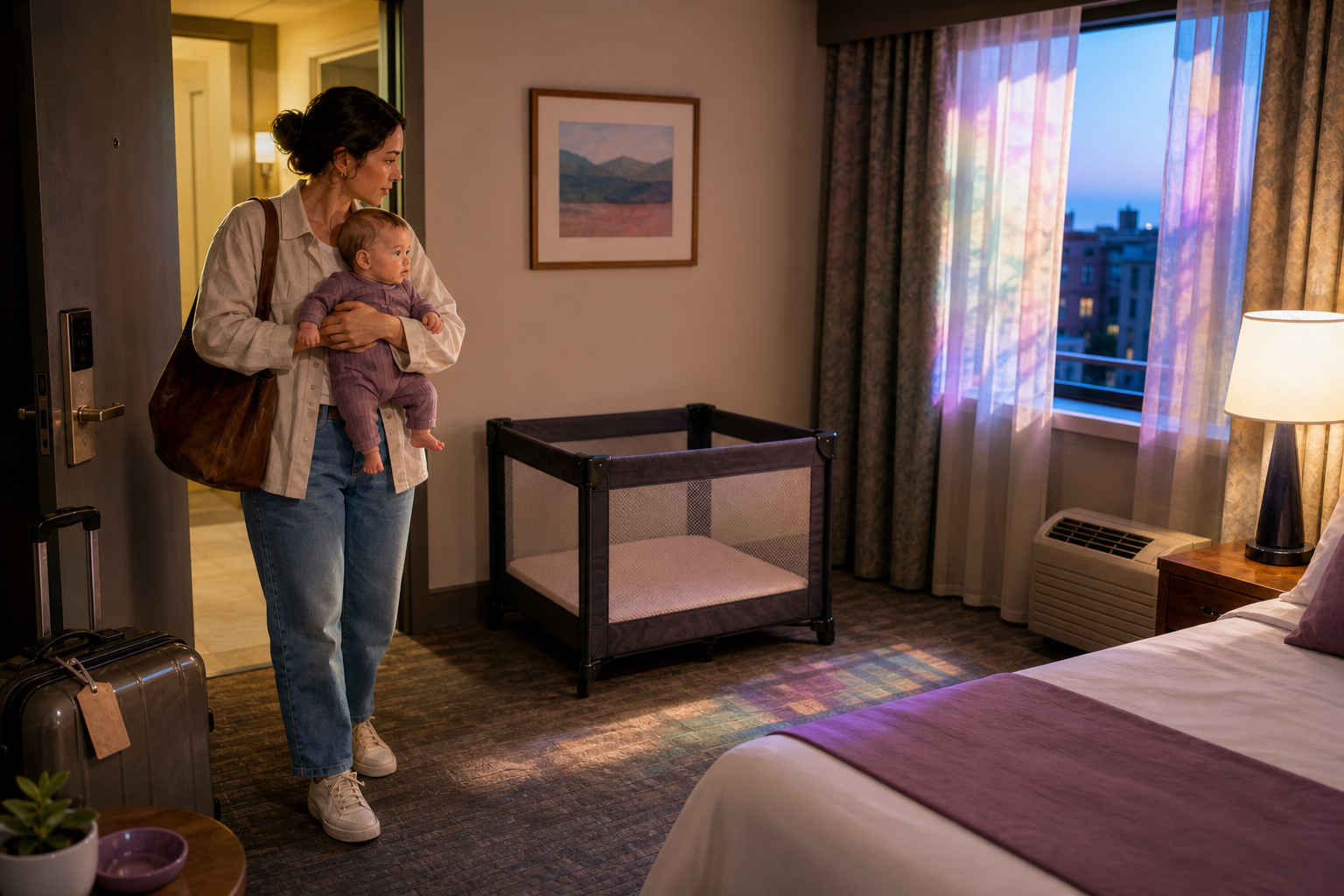
A hotel crib is a reservation until the bedside check says yes
Recreate the same safe sleep space you use at home
A healthy baby under 1 can sleep safely in a hotel, but not simply in the hotel bed. Put the baby on their back in a separate crib, bassinet, portable crib, or play yard intended for infant sleep, on a firm, flat, level surface with only a snug fitted sheet. Keep that sleep space in your room, not in the adult bed.2345
Ask what the hotel supplies before you travel. On arrival, inspect the exact unit, original mattress or pad, locks, parts, mesh or slats, recall status, fitted-sheet fit, and placement. If it does not pass, replace the unit or change the plan. Do not add padding, repair unfamiliar hardware, or build an improvised nest.167
Hotel rooms have a way of making ordinary objects look official. The folded card has a logo. The crib has arrived from somewhere behind the front desk. Everyone is tired enough to want the noun crib to finish the decision.
It cannot. The front desk can reserve the crib; the bedside audit earns the yes.
That distinction is not an invitation to spend the first hour of a trip conducting a forensic investigation. It is a short physical check with a useful ending: use this unit, ask for another one, bring in the known portable sleep space, or change the accommodation so the baby has a real place to sleep. Once the space passes, the familiar parts of bedtime can be surprisingly small: the same order, the same voice, the same sleep clothing, the same darkening of the room. Familiarity does not have to live inside the crib.
Before booking, reserve a sleep surface – not a vague promise
Ask the property what it means by “crib.” Is it a full-size crib, a portable crib, a bassinet, or a play yard? Is the item confirmed or merely requested? Does the property have a replacement if the first unit is damaged, missing, or already assigned? The American Academy of Pediatrics advises arranging a portable crib or play yard instead of using the adult bed and checking hotel sleep equipment for current safety and condition.1
A reservation note is still useful. It tells you what the property expects to provide, and it gives the staff a chance to solve an inventory problem before bedtime. It just does not tell you whether the delivered unit has its original pad, a working lock, intact mesh, complete hardware, or a safe place to stand in this particular room.
Three decisions before the room key
Reserve, bring, and name the backup
RESERVE
Ask for the exact product type, availability, and replacement process. Save the confirmation, but treat it as an inventory note rather than a safety certificate.
BRING
If safe sleep depends on the item, consider bringing a known compliant portable crib or play yard that you can assemble exactly as its instructions require.
BACK UP
Know whom to call, where a verified rental could come from, or which nearby room or accommodation could provide a real infant sleep surface if the supplied unit fails.
The useful booking question: “What happens if the delivered unit cannot be used?” A specific answer is more valuable than another cheerful promise that the request is in the system.
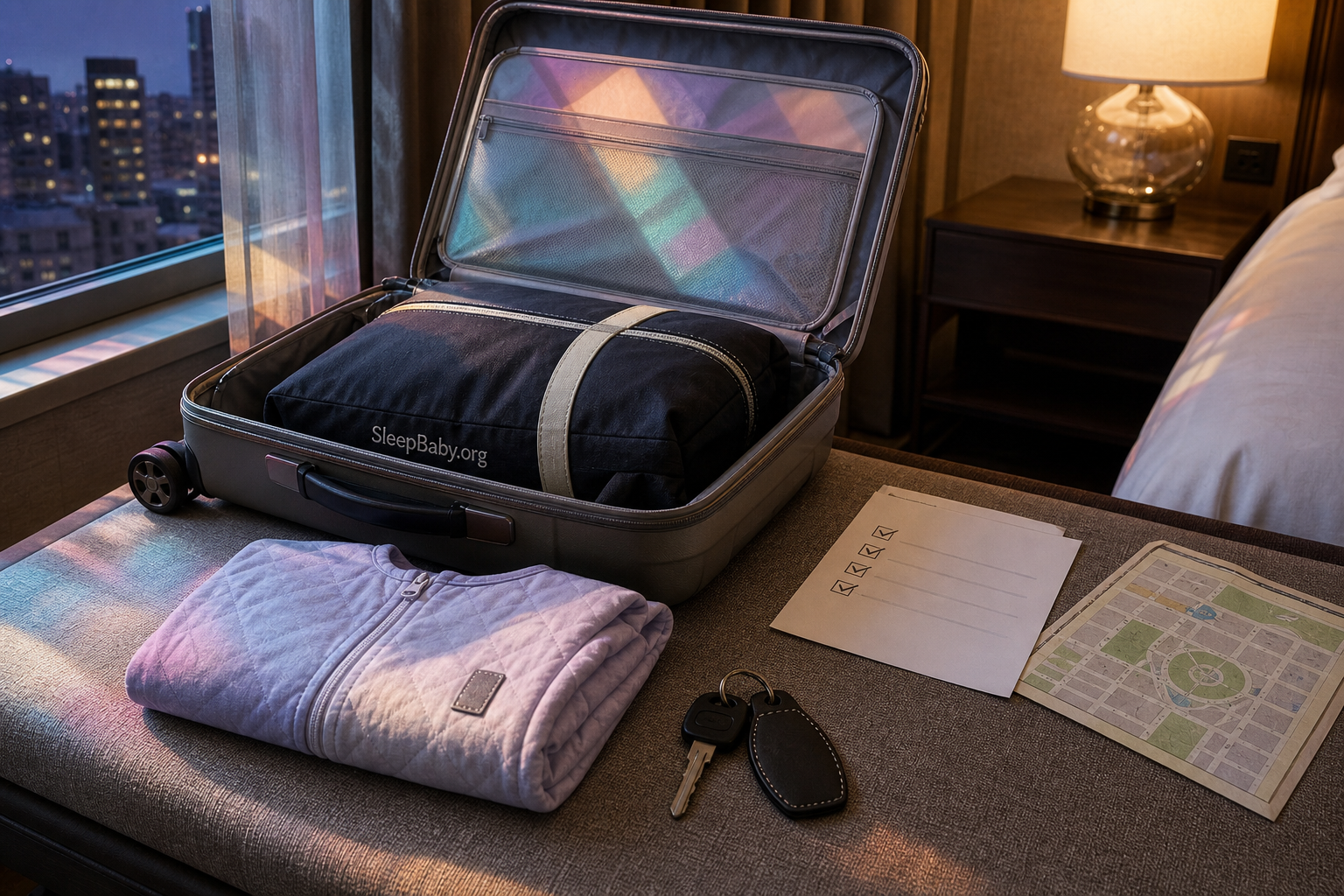
Pack routine cues, not crib fillers. Ordinary sleep clothing, a correctly fitted non-weighted wearable blanket, an already-used pacifier, and the familiar order of feed, story, song, or goodnight can travel. A pillow, loose blanket, bumper, positioner, weighted item, aftermarket mattress, folded towel, or drape-over cover cannot become safe because it fits in a suitcase.256
A familiar fitted sheet is optional, not essential. Use it only if it is the correct size for that exact product, fits tightly with no bunching or gaps, and the manufacturer allows it. The hotel sheet is not automatically wrong; your sheet is not automatically right. Fit and product instructions get the deciding votes.
On arrival, give the exact unit a six-part bedside audit
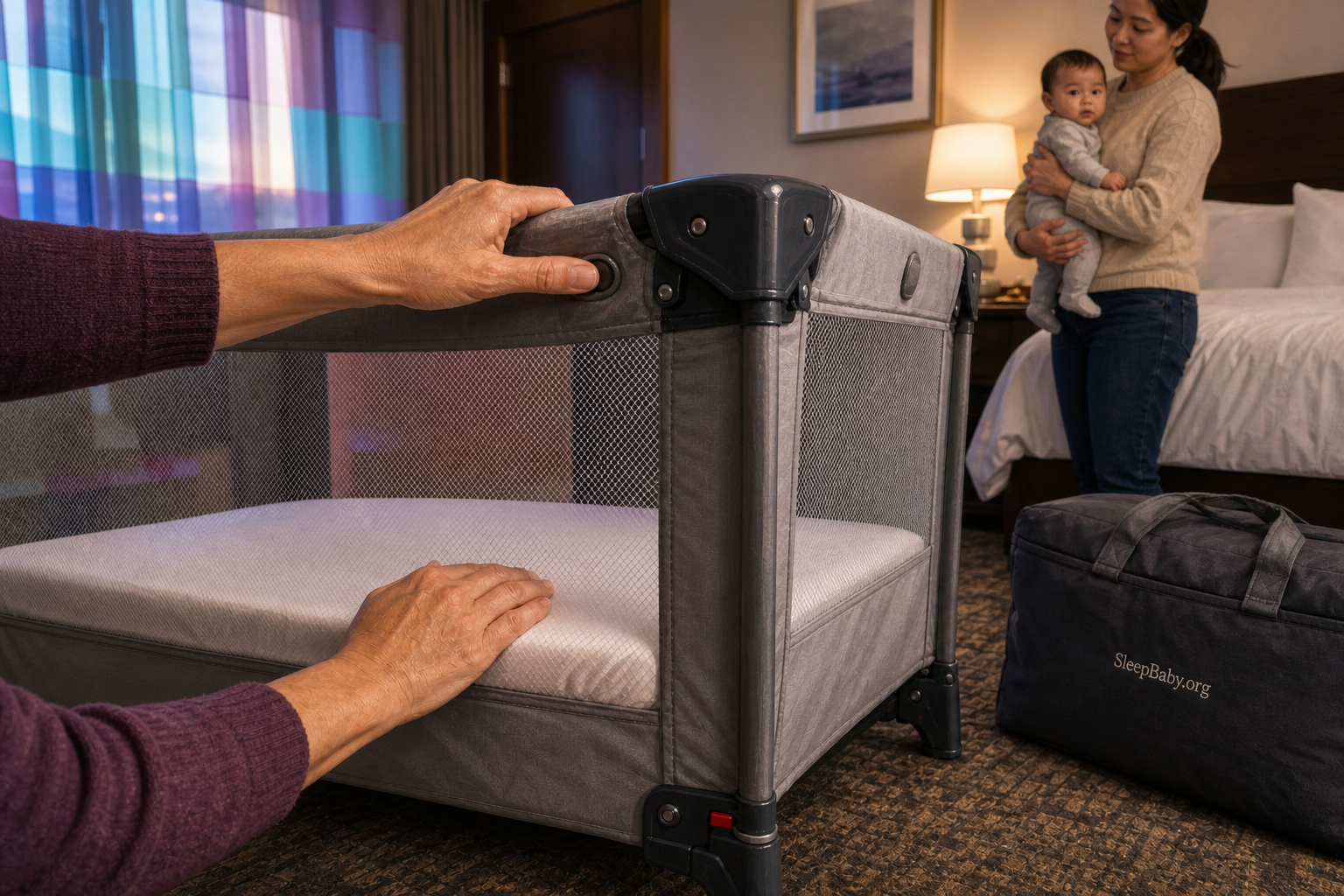
Keep the baby out of the unit while you inspect it. Turn on enough light to see the label, corners, locks, and mattress or pad fit. This is one of those moments when atmosphere can wait thirty seconds. A dim, peaceful room is lovely after you know what the baby is lying in.
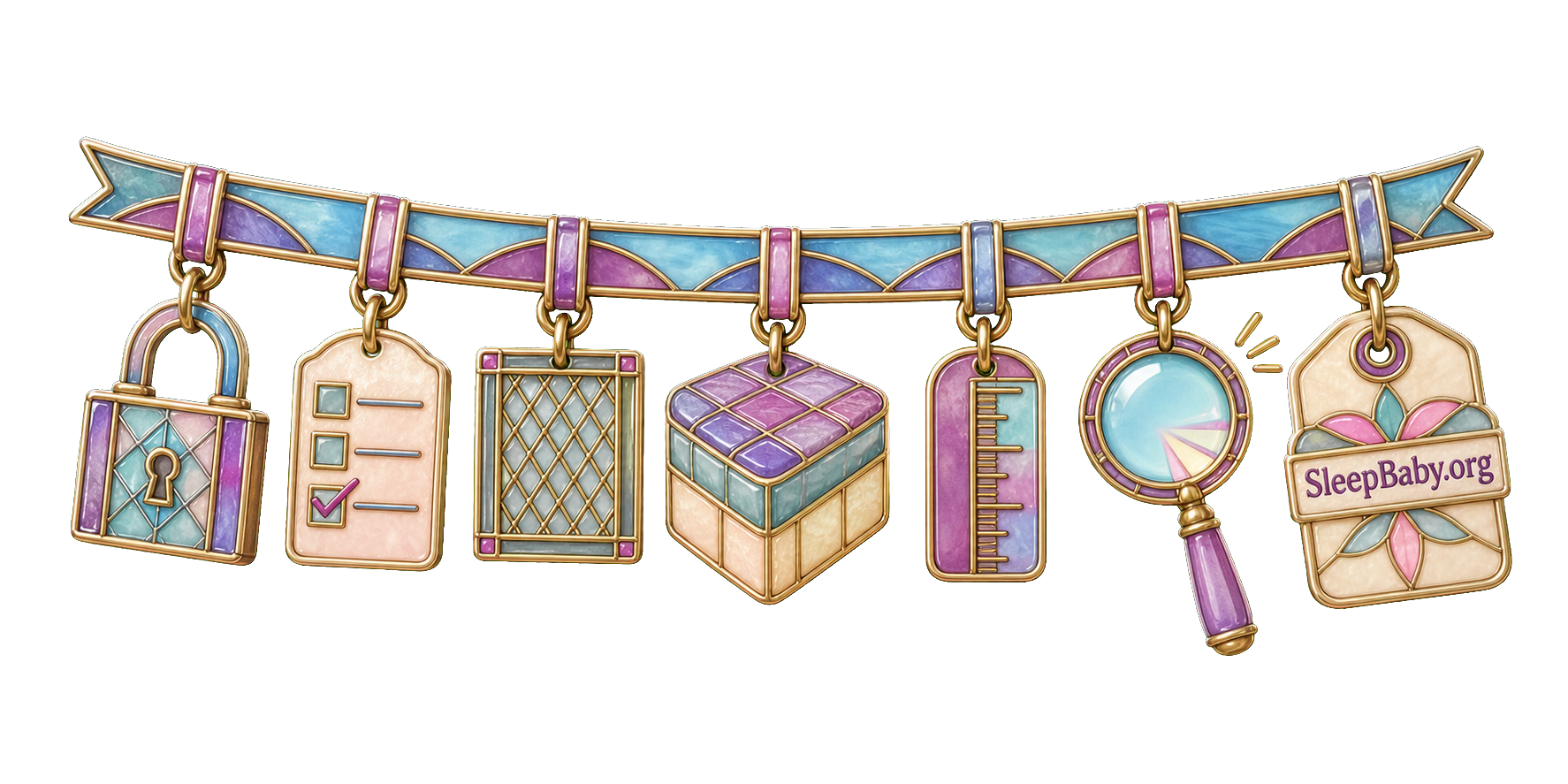
SleepBaby.org Safe Sleep Space Passport
Six stamps before the baby goes down
- IDENTITY. Find the manufacturer and model information or instructions. Confirm that the product is intended for infant sleep, not a lounger, napper, stroller, carrier, or improvised hotel item.
- LIMITS AND RECALL. Check the manufacturer’s height, weight, mobility, and setup limits for your baby. Check the model against current recall information. If the label is missing or the product cannot be identified, ask the hotel to verify it or replace it.
- STRUCTURE. Fully open and lock every side or rail exactly as directed. Reject broken, bent, loose, missing, improvised, or incorrectly installed parts, exposed hardware, cracked slats, holes, torn mesh, or loose threads.
- ORIGINAL SURFACE. Use only the original firm, flat, level mattress or pad designed for the unit. It should sit correctly with no dangerous gap. Do not add a topper, second mattress, pillow, folded blanket, or towel.
- FITTED SHEET. Use one snug fitted sheet intended for that sleep product. Reject a sheet that bunches, slips, pulls the pad upward, or creates a gap.
- BARE FINISH. Place the baby on the back. Nothing else goes inside: no pillow, blanket, toy, bumper, positioner, monitor, weighted item, or cover.
What earns the stamp: something you can identify, inspect, and use exactly as designed – not a product that looks close enough after a long travel day.
The CPSC advises using products intended for sleep that meet federal requirements, keeping the space bare, checking recalls, and moving sleeping infants out of products that are not safe sleep spaces.6 Its crib guidance also tells caregivers to look for missing, broken, or loose hardware and structural defects.7
In the United States, cribs supplied by hotels, motels, and other public accommodations are covered by federal crib requirements established for these facilities after the 2012 compliance date.8 That legal floor matters, but it is not a live inspection report. It cannot tell you whether this unit has been assembled correctly, damaged since purchase, paired with the wrong pad, or placed beside a blind cord. Outside the United States, ask the property which current local standard applies rather than treating U.S. rules as worldwide law.
The finding decides the next move
Use it, replace it, or leave this setup
USE
The unit is identifiable, within limits, unrecalled, complete, correctly locked, structurally sound, paired with its original firm flat pad or mattress, covered by one snug sheet, safely placed, and bare.
REPLACE
A part, lock, label, limit, surface, sheet fit, assembly step, or placement cannot be verified or corrected by ordinary repositioning. Keep the baby out and ask for a different compliant unit.
LEAVE THIS SETUP
The hotel cannot provide a passing replacement and no known compliant portable unit or verified rental is available. Change the room, accommodation, or sleeping plan so the infant has a real sleep surface.
There is no repair lane: a caregiver should not tighten mystery hardware, tape torn mesh, stack mattresses, wedge a gap, or improvise a barrier on an unfamiliar hotel unit.
Clear the room around the crib, not only the crib itself
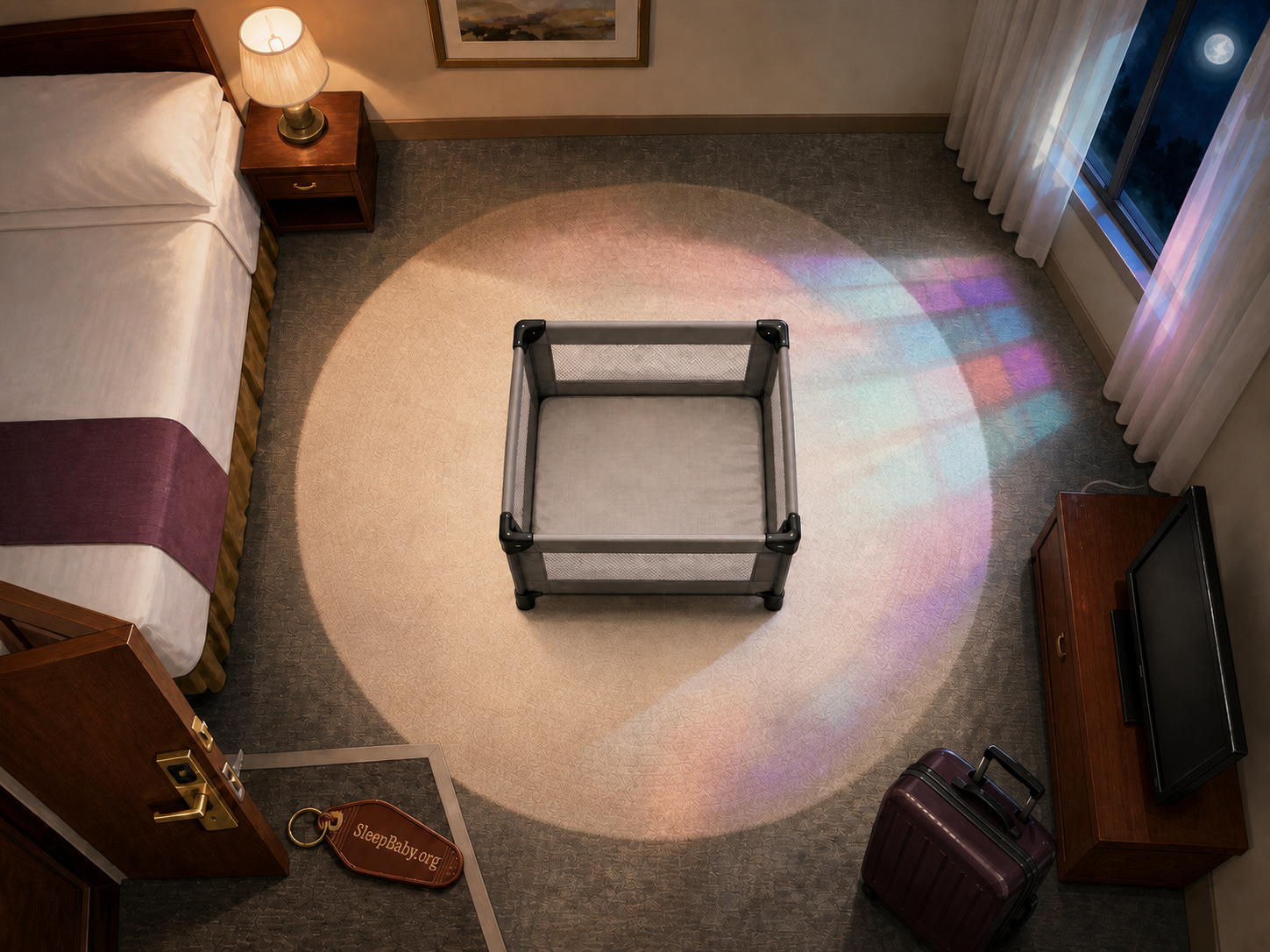
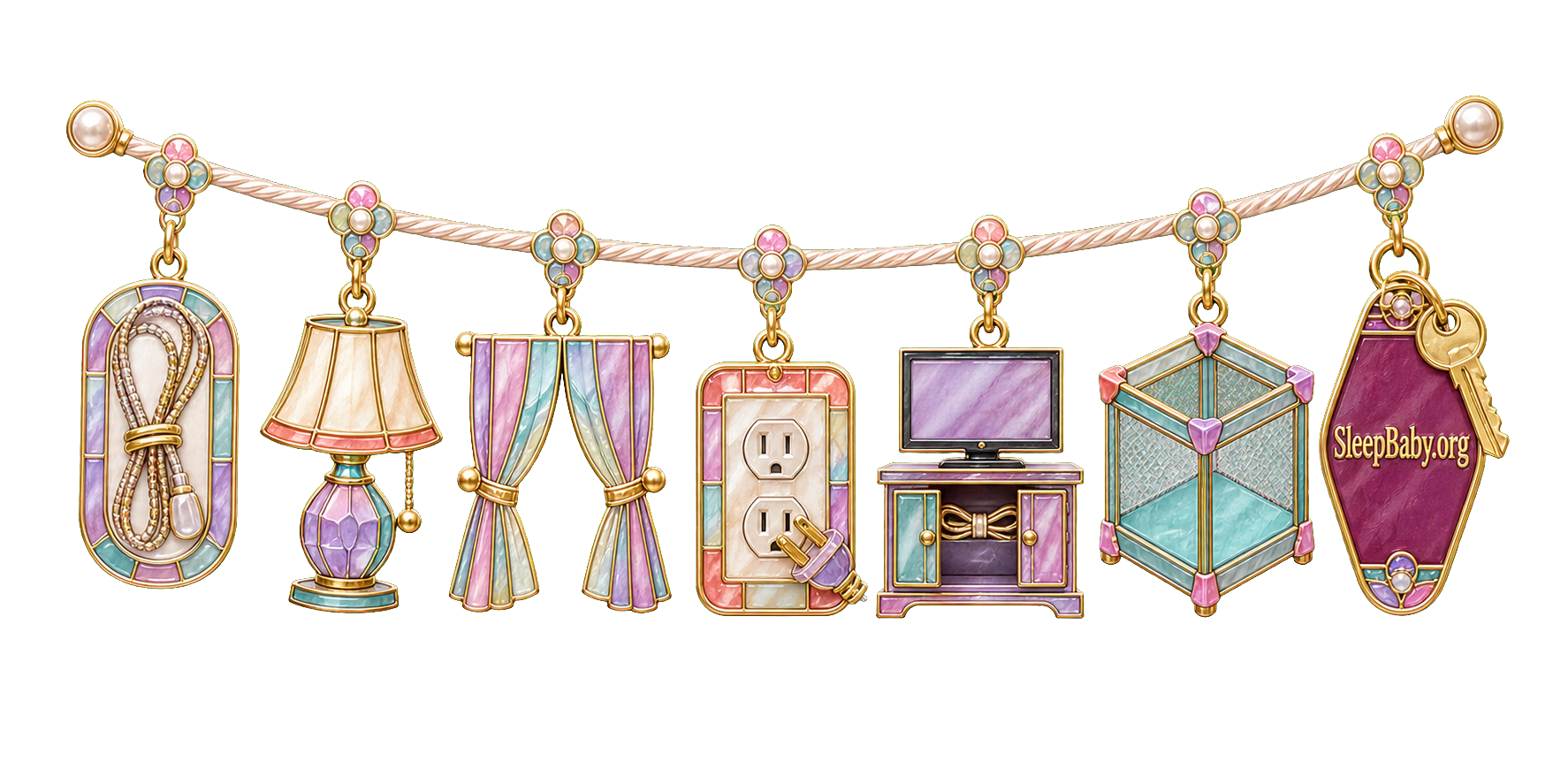
A bare sleep surface can still sit in a hazardous place. Before lowering the baby in, stand where the crib will stand and trace what a small hand could pull, what could fall, and what could heat, trap, or cover the sleep space. The AAP’s hotel guidance specifically calls out cords, lamps, televisions, windows, and other objects that can be reached or fall.1
Near the caregiver, outside the hazard orbit
Place the infant surface where care is close and pull-in hazards are not
KEEP CLOSE
- The separate infant surface in the caregiver’s room
- A clear adult path for feeding and comforting
- Needed supplies outside the crib and within awake reach
- Enough light to inspect and return the baby safely
MOVE AWAY
- Blind, drapery, electrical, charging, and monitor cords
- Lamps, televisions, unstable furniture, frames, and shelves
- Windows, heaters, vents that overheat, and heavy curtains
- Anything that could fall, tip, spill, or be pulled into the unit
The view from the crib matters: a charger that looks neatly tucked from adult height can become the longest, most interesting object in the room from mattress level.
Room sharing means the infant has a separate surface in the caregiver’s room. It does not mean pushing the crib flush against the adult bed, leaving the baby alone in a hotel room with a monitor, or placing the baby in a connecting room because the door is open. A monitor can help an adult hear something. It cannot provide supervision or transform a separate room into the recommended room-sharing setup.125
If you use a sound machine, keep the device and cord well away from the infant surface. This guide will not invent one universal volume or distance number. Follow the product instructions and solve the actual room problem rather than turning louder sound into the plan.
Keep bedtime familiar without filling the crib
A travel routine can be recognizable without being identical. Keep the order: feed, change, sleep clothing, book or song, lights down, into the separate sleep space. The room key may be on a desk where the night-light usually sits, and somebody may have to read the book from a phone because the paper copy is in the wrong suitcase. The baby does not need a perfect replica. The baby needs the safe parts to stay safe and the sequence to remain understandable.
Stories, singing, touch, and a pacifier happen before or around the put-down; they do not need to remain loose beside the baby. Use ordinary sleep clothing or a correctly fitted non-weighted wearable blanket instead of a loose blanket. Avoid overheating and indoor hats. The AAP advises dressing a baby in no more than one layer beyond what an adult would wear comfortably and avoiding weighted sleep products.2
Do not drape a towel, blanket, blackout fabric, or improvised cover over a crib or play yard. A darker room is a reasonable goal; a covered infant space with altered airflow, pull-in fabric, or hidden visibility is not the way to get it. Use room shades that stay out of reach, dim safe lights, and accept that one vacation nap may occur in a room that is less cinematic than the internet promised.
Transfer after the drive
A car seat, stroller, carrier, swing, or lounger is not the destination sleep space. If the baby falls asleep during travel, move them to the firm, flat, level infant surface on the back as soon as possible after the travel use ends.356 If arrival requires a gentle wake or transfer, use a calm way to wake a sleeping baby rather than extending the car-seat sleep because check-in took longer than expected.
A travel nap that runs much longer than usual may change feeding, alertness, and the evening rhythm. The separate guide on what to notice when a baby naps longer than usual can help with that branch. A baby who is unusually hard to wake or looks or acts seriously unwell needs medical guidance, not another schedule adjustment.9
For an older baby whose family is already using a settling plan, the unfamiliar room may change how the plan feels. After the safe sleep space is complete, what to do when an older baby still cries after sleep training may help with the response lane. It is not newborn guidance, and no settling method outranks hunger, illness, distress, or the safe-sleep setup.
When the supplied sleep space fails, stop improvising and move up the fallback ladder
The hardest hotel question usually arrives after the answer everyone wanted has failed: the requested crib never came, the replacement has torn mesh, or the original pad is missing. This is where vague advice becomes dangerous. “Make do for one night” sounds practical until making do means an adult bed against a wall, rolled towels under a sheet, a pillow barrier, a sofa, a recliner, a drawer, a bathtub lined with blankets, or a car seat left on the floor.
None of those becomes an approved infant sleep surface because the alternative is inconvenient. Keep the baby with an awake caregiver while a real solution is arranged.
- ASK FOR A DIFFERENT UNIT. Explain the observable failure without attempting a repair. Inspect the replacement from the beginning; a second trip from storage is not an automatic pass.
- USE THE KNOWN PORTABLE UNIT. Assemble the family’s own compliant crib or play yard exactly to instructions, with the original pad and one snug sheet. Passing at home does not excuse a rushed setup in the hotel.
- ARRANGE A VERIFIED RENTAL. Confirm the exact product, instructions, recall status, condition, and delivery time. Inspect and assemble it as carefully as any hotel unit.
- CHANGE THE ACCOMMODATION. If the property cannot support a real infant sleep surface, move rooms or properties or otherwise obtain one before the baby sleeps. The reservation is allowed to be wrong; the sleep surface is not required to cooperate with it.
The fallback has one standard: every step ends at a product intended for infant sleep. The ladder does not descend into progressively softer improvisations.
Plan the night-feed return before everyone is exhausted
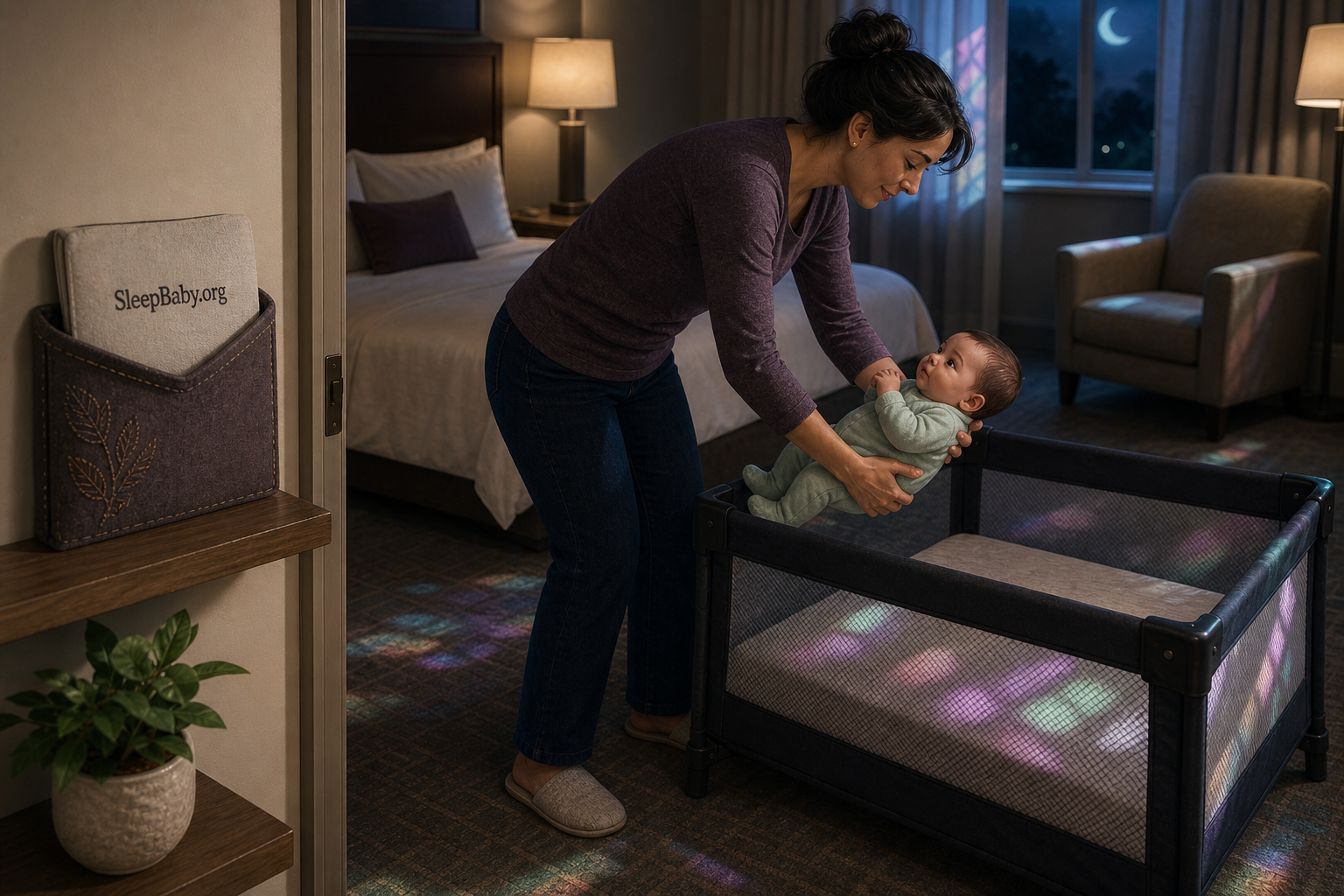
Place the infant surface close enough that feeding and comforting do not require a dark obstacle course. Set out what you need outside the crib. Clear the floor between the sleep space and the feeding spot. Know which light you can use without reaching across a cord or balancing a phone on the rail.
Avoid feeding on a sofa or armchair when there is a chance you will fall asleep; those surfaces are especially hazardous for infant sleep.35 If you bring the baby into the adult bed for feeding or comforting and accidental sleep is possible, remove pillows, blankets, and loose bedding from the caregiver’s area before the feed. If you do fall asleep, return the baby to the separate infant sleep surface as soon as you wake.5
That is harm reduction, not a recommendation to bed share. The planned destination is still the baby’s own surface.
The return path is part of the setup
Prepare, feed or comfort, then return
PREPARE
Clear the walking route, choose a safer feeding place than a sofa or armchair, put supplies within awake reach, and keep cords away from both surfaces.
FEED OR COMFORT
Use low light, meet the baby’s need, and keep the adult bed free of loose items in the caregiver’s area if accidental sleep is possible. This does not make the adult bed the baby’s sleep space.
RETURN
Place the baby on the back in the separate bare infant surface. If the caregiver wakes after accidental sleep, make that return as soon as they wake.
The quiet truth: the safest hotel routine is not the one with the prettiest bedtime. It is the one whose tired detours still lead back to the baby’s own surface.
Know when this is no longer a hotel sleep setup problem
Care first, room troubleshooting later
Get the baby into the right care lane
GET EMERGENCY HELP
Severe difficulty breathing, blue or gray lips or face, unusual unresponsiveness, a seizure, or another life-threatening change needs emergency care.9
Do not troubleshoot past a changed baby: a room can be unfamiliar without explaining severe breathing, color, responsiveness, feeding, or fever changes.
Hotel sleep questions worth answering before lights-out
Can my baby sleep in the hotel bed for one night?
No. An adult hotel bed is not an infant sleep surface, even if the mattress feels firm, the baby is placed between adults, the bed is pushed against a wall, or pillows are arranged as barriers. Use a separate safety-approved infant product on a firm, flat, level surface with only a fitted sheet.235
Is a Pack ‘n Play or play yard safe for hotel sleep?
A play yard can be an appropriate infant sleep space when it is intended for sleep, meets current requirements, is within the manufacturer’s limits, is fully and correctly assembled, is unrecalled and undamaged, and uses only its original firm pad with one snug fitted sheet. Pack ‘n Play is a brand name, not a pass; inspect the exact product.16
Should I bring my own crib sheet?
You may bring one, but use it only if it fits that exact unit snugly and the product instructions allow it. A familiar sheet can support the routine; it cannot repair a wrong pad, gap, damaged unit, or poor fit. Do not put a blanket or towel under the sheet for softness.
Can the baby sleep in the other room of a suite?
For an infant, keep the separate sleep surface in the caregiver’s room. A suite is useful when it gives awake adults another place to talk or watch television after bedtime; it should not move the infant out of the recommended room-sharing arrangement. A monitor is not a substitute for an adult staying with the baby in a hotel room.12
Can I cover the hotel crib to make it darker?
Do not drape blankets, towels, sheets, or blackout fabric over the unit. Keep loose material and pull-in hazards away, preserve visibility, and use room-darkening options outside the baby’s reach. Do not add an aftermarket crib tent or cover as a hotel workaround; this guide does not recommend one.
Do the same rules apply to hotel naps?
Yes. Back placement, the separate firm flat level infant surface, one fitted sheet, a bare sleep space, and room-sharing supervision apply to every sleep, including naps.24 A short nap does not make the adult bed, stroller, or car seat the destination sleep space.
The lights-out check
One pass before the room goes dark
Ten yeses, then bedtime
- The product is intended for infant sleep.
- The baby is within its manufacturer limits.
- The model is not recalled.
- Locks, parts, hardware, mesh, or slats pass.
- The original firm, flat, level pad or mattress fits.
- One snug fitted sheet is in place.
- The sleep space is completely bare.
- Cords, lamps, windows, heat, furniture, and falling objects are outside the orbit.
- The infant surface is in the caregiver’s room.
- The baby goes down on the back, and the feed return leads here.
If one answer is no or unknown: pause and solve that item. Bedtime does not improve an unidentified or damaged sleep surface.
A hotel night does not need to feel exactly like home. It needs the part of home that protects the baby: a separate surface you can identify, inspect, clear, and return to. The room may have a different ceiling, a louder hallway, and a lamp switch nobody can find on the first try. The safe decision can still be wonderfully boring.
I would call that a successful travel night: not one where the routine performs perfectly, but one where every tired shortcut has already been given a better destination.
Sources
- American Academy of Pediatrics: Hotel Dangers That Put Baby Safety at Risk – arranging and inspecting hotel sleep equipment, original mattress use, room hazards, and supervision.
- American Academy of Pediatrics: How to Keep Your Sleeping Baby Safe – back placement, approved products, firm noninclined surfaces, bare sleep space, room sharing, clothing, and weighted-item guidance.
- American Academy of Pediatrics: Sleep-Related Infant Deaths – Updated 2022 Recommendations – the clinical evidence base for safe sleep surfaces, room sharing, bed-sharing avoidance, and sitting-device transfer.
- CDC: Helping Babies Sleep Safely – back placement, firm flat surface, fitted sheet, clear sleep area, and room sharing.
- NICHD Safe to Sleep: Safe Sleep Environment – separate firm flat level surfaces, sitting-device transfer, adult-bed and couch hazards, and accidental-sleep harm reduction.
- U.S. Consumer Product Safety Commission: Safe Sleep – intended sleep products, federal requirements, bare space, recalls, back placement, and transfer from other devices.
- U.S. Consumer Product Safety Commission: Crib Safety Tips – missing, broken, or loose hardware and structural inspection.
- U.S. Consumer Product Safety Commission: Hotel and Rental Crib Standard Notice – the U.S. federal crib requirement for public accommodations.
- American Academy of Pediatrics: Urgent Care, ER or Pediatrician? – emergency signs including severe breathing difficulty, abnormal color, unresponsiveness, and seizure.
- American Academy of Pediatrics: Fever and Your Baby – the prompt medical-evaluation threshold for a baby younger than 3 months.
When this room passes tonight
Carry the safe sequence into the nights after travel
The sleep space is only one part of a recognizable night. Bring the order you just used – notice, prepare, repeat, and return – into the SleepBaby.org Workshop to sort the wider bedtime decisions without pretending every baby or trip needs the same routine.
The workshop supports family sleep routines; it does not replace pediatric or emergency guidance.