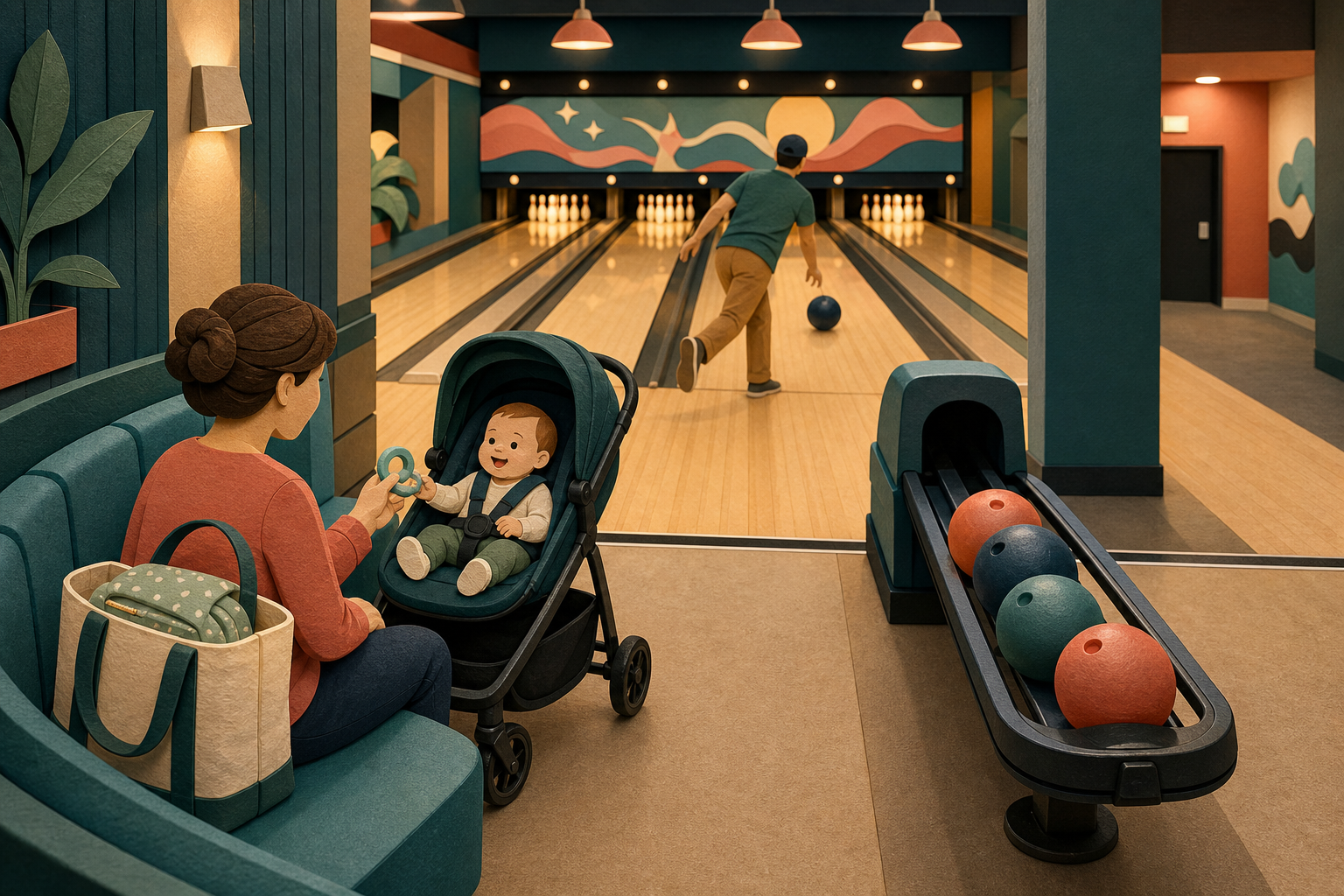
Many families can take a baby to a bowling alley when the exact center permits infants, the sound is manageable, and the group can create a protected seating zone. One named adult must be fully responsible for the baby during every active frame. Nobody should hold or wear the baby while bowling. If the room is too loud, smoky, crowded, or unable to offer a safe place away from the approach, ball return, neighboring-lane traffic, and walkways, shorten the visit or leave.
A bowling alley is one of those places that can feel perfectly manageable from the parking lot and very different once ten lanes release a ball at once. The lights are brighter, the music is closer, people are stepping backward from the foul line, and the ball return has opinions about personal space. Add a baby, a diaper bag, and three adults who all assume someone else is watching the stroller, and a casual afternoon can become a logistics exercise before the first frame.
There is no universal minimum age for this outing and no trustworthy universal decibel number for every bowling center. The building, machinery, speakers, arcade, crowd, and time slot all change the answer. For a baby born prematurely, a baby with hearing or respiratory concerns, or a child with another clinician-managed condition, ask the baby’s pediatric clinician whether this particular outing and hearing-protection plan make sense.
The before-you-reserve decision
Go, change the plan, or skip this round?
Go
The center confirms babies are allowed at that time. You have a quiet or ordinary open-bowling slot, a smoke-free room, one adult who will stay with the baby, an approved seating position, and permission to leave the lane whenever the baby needs it.
Change the plan
The late session is age-restricted, cosmic bowling is the only option, the stroller cannot sit safely, or every adult expects to bowl at once. Ask for an earlier slot, reserve an end lane, shorten the visit, add a non-bowling caregiver, or let one parent join only for part of the game.
Skip today
The center permits smoking, the baby or caregiver is sick, sound is immediately overwhelming, no protected zone exists, sleep is due with no safe sleep plan, or nobody can own the baby handoff. A rain check is a successful safety decision, not a failed family outing.
The answer can change after arrival. A workable reservation becomes a leave-now plan if the actual room is louder, busier, smokier, or less navigable than promised.
Call the exact bowling center, not bowling in theory
A policy found on a national operator’s website does not necessarily describe the branch down the road. Age limits can vary by location and time, especially for late-night sessions.11 Open bowling at 11 a.m. can also be a completely different sensory event from a birthday party or glow-bowling session at 8 p.m. The useful phone call is short, specific, and made for the exact date and time you are considering.
| Ask | Why the answer changes your plan |
|---|---|
| Are infants allowed during this exact session? | A center may welcome families during open bowling and restrict minors later in the evening. |
| Is this open bowling, a league block, a party block, or cosmic bowling? | Music, lighting, crowd density, and lane turnover may be very different. |
| When is the room usually quietest? | A lower-traffic slot gives you more room to assess sound and establish the baby zone. |
| May we request an end lane or a lane near an easy exit? | Fewer cross-traffic paths and a short route outdoors make quiet breaks easier. |
| Where may a stroller be parked without blocking service or exit routes? | Staff, not wishful thinking, decide which seating position works in that layout. |
| Is the entire indoor center smoke-free? | There is no safe level of secondhand tobacco-smoke exposure.6 |
| Is there a changing station and a quieter feeding area? | You can avoid a lane-side diaper change or feeding improvisation. |
| Can we step away and re-enter if the baby needs a break? | The best exit plan is one the venue will actually allow. |
Ask whether outside feeding supplies are permitted and whether the center has stairs, narrow doorways, or a bag-check policy that will affect arrival. If you are going with a large family group, decide who will reserve and who will call. Five relatives each assuming another person checked the stroller rule is how the stroller rule remains unchecked.
Make a sound plan before the first crash of pins
Bowling sound is not one thing. A ball rolling down one quiet lane, ten pin decks cycling at once, an arcade alarm, overhead music, and a birthday announcement all reach the baby differently. Hearing risk depends on intensity, duration, repetition, and distance, which is why a fixed internet claim about what “a bowling alley” measures cannot settle the question for the room in front of you.1
Start with control measures that do not depend on gear: choose a quieter time, sit farther from speakers and pin-setting machinery, keep the visit short, and take quiet breaks. NIDCD recommends avoiding loud sound, moving away, and reducing the volume when possible before relying on hearing protection.2 The plan is not to place earmuffs on a baby and then tolerate any room for any length of time.
The quiet-lane ladder
Use the least complicated control that works
- Change the time. Try ordinary open bowling before a league, party, or glow session.
- Change the position. Move away from a speaker, arcade doorway, or the busiest lane cluster.
- Change the duration. Bowl fewer frames, rotate adults, or let the baby and caregiver leave first.
- Add correctly fitted child hearing protection. Use it as one layer, never as permission to remain in clearly excessive sound.
- Leave. If the practical warning signs remain, the parking lot is the next quiet zone.
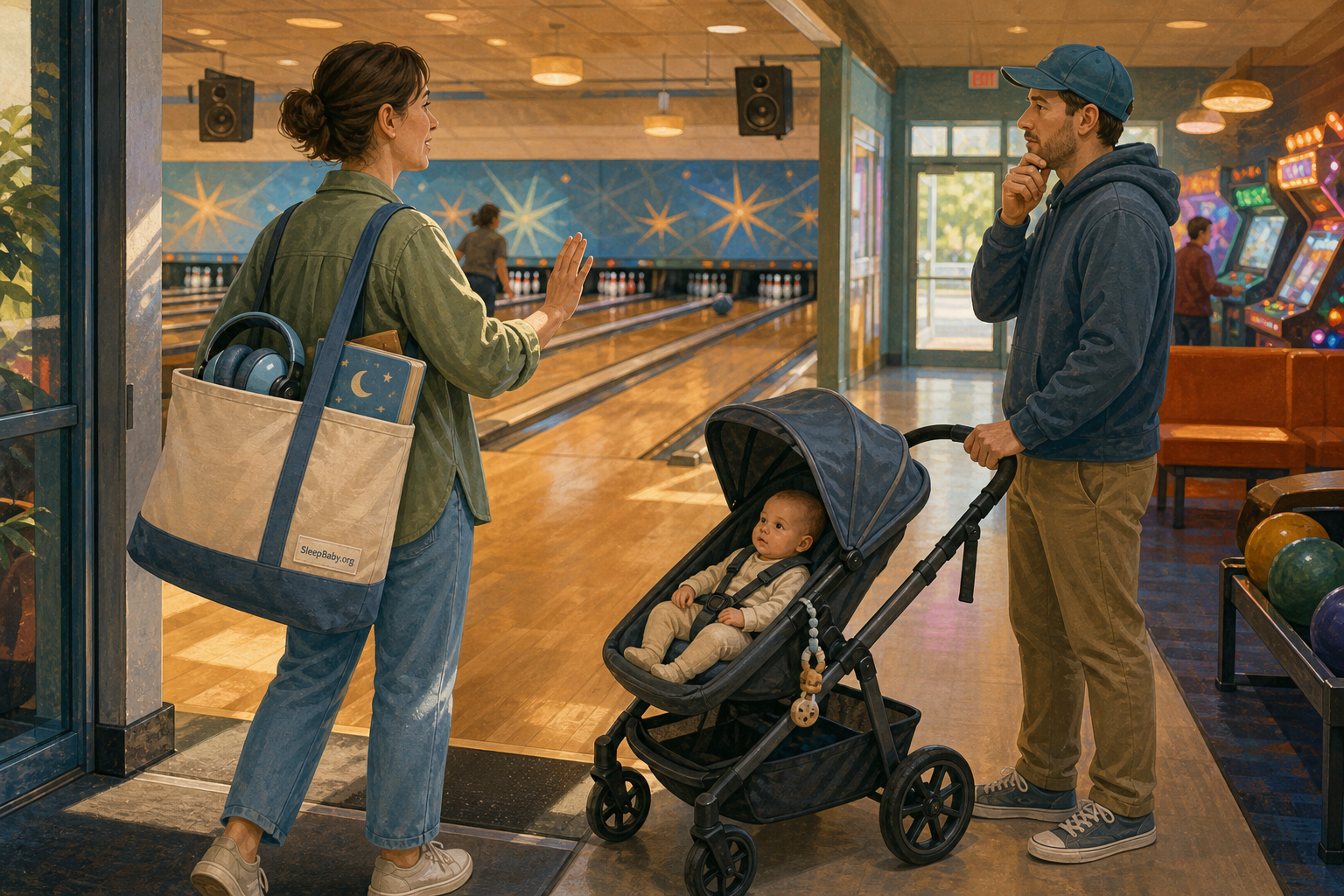
The American Academy of Pediatrics offers a simple warning signal: if you need to raise your voice to speak to someone an arm’s length away, the environment may be too loud for a child.3 This is not a calibrated measurement and it does not diagnose danger. It is a useful prompt to move, take a quiet break, or leave. A phone sound-meter app can be a rough screen for comparison between positions, but it is not professional equipment and should never be treated as proof that an infant is safe.
Choose earmuffs for the baby, not tiny earplugs
Properly fitted protective earmuffs are generally easier to use correctly with young children than earplugs. The cups should fully surround the ears, the headband should be sized for the child, and hair, hats, or glasses should not break the seal. Check fit according to the product instructions. Do not place adult foam earplugs in an infant’s ears; small earplugs can also be a choking hazard for young children.23
Watch the room and the baby. A startle, escalating fussiness, frantic turning away, or an inability to settle can tell you the outing is not working, but behavior cannot certify hearing safety. Some babies look calm while asleep in a noisy place. Calm is welcome; it is not a sound meter. Keep using distance, time limits, quiet breaks, and your own voice check even when the baby seems unbothered.

Build the baby zone behind the game
The dangerous part of the bowling area is not only the polished lane. Bowlers step forward and backward on the approach. Balls sit high on racks and return quickly through a mechanical opening. Drinks or crumbs can make the approach slippery. Players from neighboring lanes need room to move. USBC materials tell bowlers to keep hands and faces away from the ball-return opening, lift a ball from its sides, give neighboring bowlers approach space, and keep walkways clear.910
Those are bowling rules, not infant-placement instructions. The conservative family rule is to keep the baby and all baby gear in a staff-approved seating area, well away from the approach, return, rack, neighboring traffic, food-service path, and emergency exit. A stroller brake keeps wheels from rolling; it does not make every parking spot safe.
SleepBaby.org original planning aid
The bowling-alley safety map
Read this from the lane backward. The baby zone is not wherever the stroller happens to fit; it is the place left after every active path stays clear.
No-baby zone
Lane, foul line, approach, ball-return opening, ball rack, and the floor around them. No carrier, stroller, diaper bag, crawling, holding, or babywearing here.
Keep-clear zone
Neighboring-lane traffic, server path, walkway, restroom route, and exit. People and hot food may move through without seeing low gear.
Protected baby zone
A staff-approved settee position with brakes set, no edge or elevated placement, a fully attentive caregiver within reach, and a clear route out.
Reset zone
A quieter lobby, outdoor spot, family room, or car departure route used for feeds, regulation breaks, and ending the visit.
Do the map in person before shoes are rented. One adult stands at the proposed baby position while another walks the full path a bowler, server, and neighboring player may take. Check whether the stroller narrows the aisle, whether a diaper bag creates a trip hazard, and whether the caregiver can leave without squeezing past someone holding a ball. If the geometry fails, ask staff for another lane or do not set up.
Never bowl while holding or wearing the baby
This guide’s rule is firm: nobody bowls while holding a baby or wearing one in a carrier. Bowling combines a weighted swinging object, a forward approach, a potentially slippery surface, other people moving nearby, and a backward walk after release. AAP and CPSC carrier guidance emphasizes fit, visible airways, and fall risks; the bowling environment adds hazards the carrier was not designed to solve.1212
Do not place an infant carrier on the approach, a bench edge, a table, or the floor beside the ball return. Do not leave the baby unattended because the bowler will be “right back.” A frame lasts long enough for a rolling ball, a bumped seat, or a blocked airway to matter.

The caregiver handoff needs a name
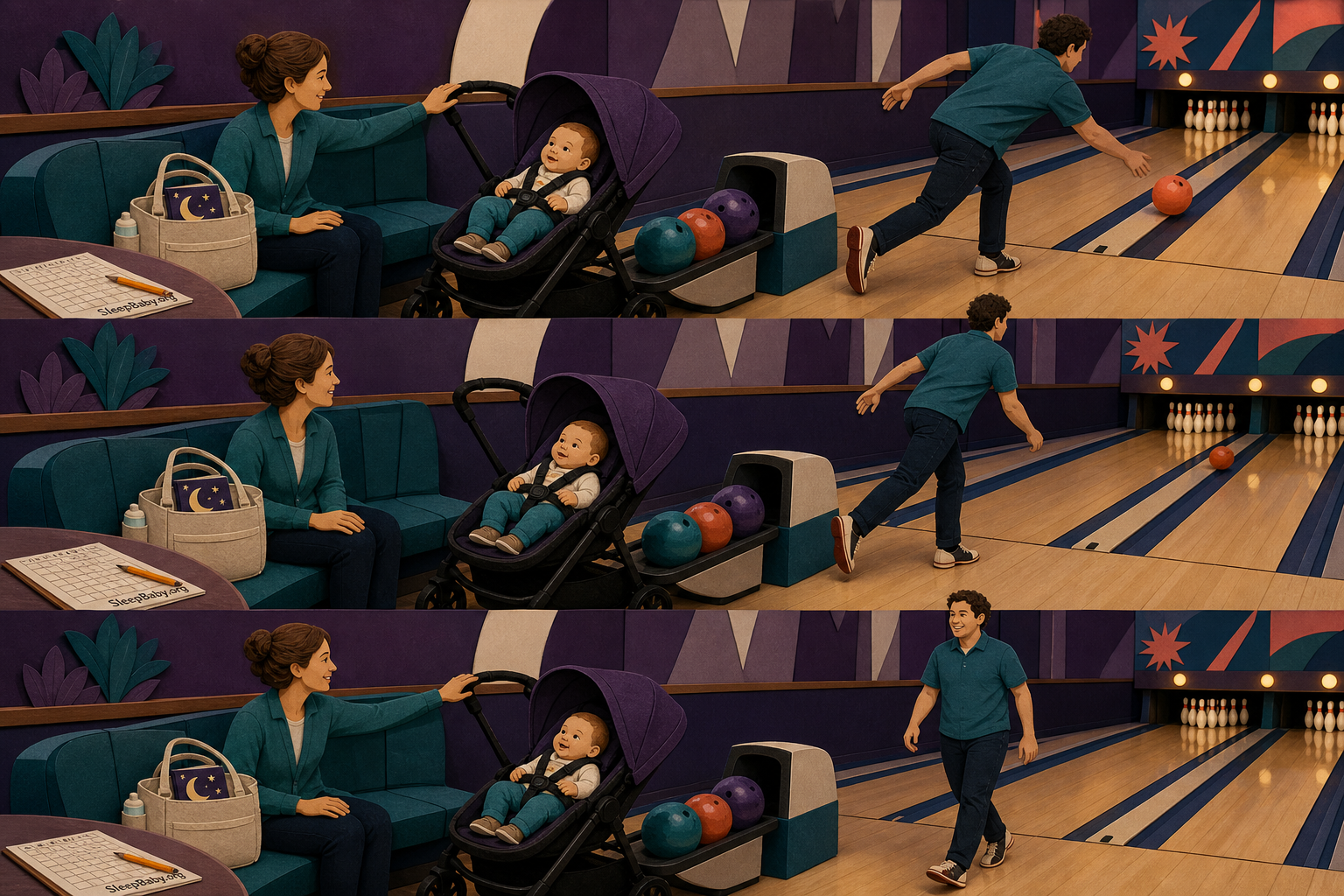
“We’re all watching the baby” sounds generous and works poorly. The group chat does not count as a caregiver. Before every bowler steps onto the approach, one adult has explicit baby duty and stays off the approach for that entire turn. That adult is close enough to respond, sober and attentive, and free to leave the building without asking permission from the score screen.
The caregiver relay
Say the handoff out loud before the ball is lifted
- 1. Name the owner: “You have the baby while I bowl.” Wait for a clear yes.
- 2. Transfer the essentials: caregiver has the diaper bag, feeding plan, phone, and exit route – not a stroller marooned behind three bowling bags.
- 3. Bowl one turn: the bowler stays out of baby duty until both hands are free and they have returned to the protected zone.
- 4. Close the relay: “I have the baby now.” Only then may the other caregiver bowl, eat, or step away.
Choose one adult as the exit lead, too. That person can abandon a frame, a meal, or the group photo if the baby needs quiet, a feed, a diaper change, safe sleep, or home. If the parent who must leave is also the only person whose name is on the reservation, untangle that before arrival. The formal-event version of this same problem appears in our guide to taking a baby to graduation: the person caring for the baby needs real authority to miss the main moment.
Give every piece of baby gear one job
Baby equipment becomes risky when convenience quietly changes its purpose. The car seat is for vehicle travel. The stroller is for movement and staff-approved parking. A carrier can support hands-free movement when fitted correctly and the airway remains visible, but it is not bowling equipment. Routine infant sleep belongs on a firm, flat, noninclined sleep surface that meets applicable safety standards.4
| Item | Useful job | Bowling-alley boundary |
|---|---|---|
| Rear-facing car seat | Correctly installed vehicle restraint, used to the manufacturer’s height or weight limit.5 | Not a lane-side routine nap plan and never placed on a table, bench edge, or approach. |
| Stroller | Moving the baby and supplies; parking only where staff approves. | Brakes set, caregiver within reach, and every walkway, service path, neighboring lane, and exit kept clear. |
| Soft carrier or sling | Movement with correct fit, supported positioning, and the baby’s face and airway visible. | Never worn while bowling. Move a sleeping baby to an approved firm, flat surface as soon as practical. |
| Diaper bag | Feeding, changing, hearing, and comfort supplies. | Stored under control in the protected zone, not in a walkway or against the ball return. |
Plan feeding, diapers, and sleep without lane-side shortcuts
Feed in a seated, cleaner, quieter place
Bring the supplies your baby already uses; a bowling outing is a poor laboratory for a new bottle, nipple, formula, or feeding routine. Ask about outside feeding supplies, identify the cleanest available hand-washing point, and choose a seat away from the approach and passing trays. Hold the baby close and follow hunger and fullness cues. Never prop a bottle or leave it in the baby’s mouth while you bowl, eat, or update the score.7
If you use formula, prepare and store it according to CDC guidance and the product directions rather than improvising with venue water or stretching a partly used bottle across the game.7 Pack clean bottles in a way that separates them from used ones. Bring a small cloth for your own lap and the baby’s mouth, not for wiping a shared bowling table and then returning to feeding.
Breastfeeding or pumping may be more comfortable in a quieter corner, family room, or the car if that is the caregiver’s preference and the temperature is safe. The practical question is not whether feeding is allowed to exist near bowling. It is whether the feeding adult can sit securely, support the baby, keep supplies clean, and remain outside the lane’s moving traffic.
Use a changing station, not the settee
Locate the restroom or family changing area before shoes are laced. Pack a portable changing mat, wipes, diapers, a sealable bag, and one complete outfit change. A bowling bench is shared seating, often beside food and bags, and it offers neither sanitation nor privacy. If the venue has no workable changing station, use your family’s usual safe alternative, such as the cargo area of a parked vehicle when conditions are appropriate and the baby is continuously supervised. Never use the approach, a table, or an elevated seat edge.
Do not make the car seat or stroller the nap plan
The American Academy of Pediatrics recommends a firm, flat, noninclined infant sleep surface that meets applicable safety standards. If a baby falls asleep in a car seat, stroller, swing, carrier, or sling, move the baby to a firm sleep surface on their back as soon as possible.4 At most bowling centers, that means the outing should be short enough to end when real sleep is due.
Do not build a soft nest in a stroller, loosen the car-seat harness, add a head-support product that did not come with the seat, or set the carrier somewhere out of sight because the baby finally fell asleep. If the transfer from vehicle to home wakes the baby, this guide to waking and moving a sleeping baby gently can help you make the transition without treating uninterrupted sleep in a sitting device as the goal.
A brief, unusual outing can also shift the next nap. If the baby sleeps longer after the trip, look at the whole picture – feeding, breathing, temperature, alertness when awake, and the baby’s usual pattern – rather than trying to force the clock back instantly. Our guide to a baby napping longer than usual explains when a long nap is ordinary and when other symptoms deserve a clinician’s advice.
Respond to overload before it becomes a rescue mission
Bowling layers sound, light, movement, unfamiliar faces, and interrupted routines. Early signs that the visit has used up its welcome may include repeated turning away, stiffening, frantic rooting, escalating fussing, rubbing the face, or being unable to settle in the quieter zone. None of these proves a hearing problem. They are ordinary reasons to reduce input, offer the next feed or diaper change, and decide whether home is kinder than frame six.
Try one simple reset: the designated caregiver takes the baby to the predetermined quieter place for several minutes. Keep the reset quiet; do not add a bright phone video, three relatives, and a fresh round of bouncing. If the baby settles and the environment is workable, the caregiver may return. If not, use the exit plan. The score will survive.
Smoke, illness, crowds, and the ride there still matter
Confirm that the entire indoor center is smoke-free. The CDC states that there is no safe level of secondhand tobacco-smoke exposure, and infants and young children are especially affected.6 A separate smoking area, an open door, or a strong ventilation claim is not the same as eliminating indoor smoking exposure. If smoke is present where the baby would be, leave.
Stay home when the baby or a close caregiver is sick. Regular hand hygiene, cleaner air, and current recommended immunizations are useful prevention layers, while an off-peak session may reduce close contact; none guarantees that an indoor gathering is infection-free.8 Ask the baby’s clinician about extra precautions if the child is medically vulnerable or community illness is elevated.
For the drive, use a correctly installed rear-facing car seat in the back seat and follow both the vehicle and restraint manuals. Keep the child rear-facing until the seat manufacturer’s height or weight limit.5 The bowling plan begins after safe travel and ends only after the baby is secured for the ride home; do not loosen the harness for bulky clothing or convenience.
Leave now when the plan has stopped being true
- You must raise your voice at arm’s length and cannot find a quieter position or break.
- Smoke is present, or illness makes the outing a poor choice.
- The protected baby zone is no longer protected because of crowds, service traffic, or neighboring players.
- No attentive adult can remain on baby duty for the next turn.
- The baby needs a real feed, diaper change, regulation break, or safe sleep that the venue cannot support.
- A fall, breathing concern, unusual unresponsiveness, injury, or other urgent symptom occurs; seek appropriate emergency help instead of troubleshooting at the lane.

Pack for one short game, not a small relocation
The easiest diaper bag is organized around the decisions above. Pack child-sized hearing protection, the baby’s usual feeding supplies, two more diapers than the minimum math suggests, wipes, a changing mat, a sealable bag, one outfit change, a light layer for the temperature, and any clinician-directed medication you normally carry. Add a small familiar comfort item that can stay controlled in the protected zone; skip loose toys that roll into walkways or under the ball return.
Keep the bag compact enough to fit entirely inside the staff-approved area. Bowling shoes, jackets, purses, and food already compete for space. A diaper bag that opens like a yard sale makes the exit slower exactly when the baby is done.
A first-visit run of show
Make the first test deliberately small
- Before leaving: feed and change the baby if timing allows, confirm the reservation, and name the first baby-duty adult.
- On arrival: one adult checks sound, smoke-free conditions, lane location, stroller placement, restroom, and exit before the whole setup moves in.
- Before frame one: establish the protected zone, set brakes, contain bags, fit hearing protection, and say the first handoff aloud.
- During the game: rotate only through explicit handoffs, take quiet breaks, and stop at the first failed condition rather than waiting for several.
- Before the last possible minute: leave while packing and transfer are still calm. A shorter good visit teaches you more than a long unraveling one.
Common questions about taking a baby bowling
How old should a baby be before going to a bowling alley?
There is no universal evidence-based minimum age for every baby and center. Venue permission, sound, smoke-free conditions, the baby’s health, the family’s ability to maintain a protected zone, and the timing of feeds and sleep matter more than an invented cutoff. Ask the baby’s pediatric clinician before going if the child was born prematurely, has hearing or breathing concerns, or has another condition that changes indoor-outing advice.
Is cosmic bowling too loud or bright for a baby?
Not every cosmic-bowling session is identical, so a universal ban would overstate the evidence. It is often a poor first test because music, flashing lights, crowds, and later hours can add sensory load. Ask about the exact session, choose ordinary daytime open bowling when possible, and be willing to change the booking if the live room fails your sound or comfort plan.
Does my baby need hearing protection at a bowling alley?
Child-sized, correctly fitted protective earmuffs are a sensible layer when sound cannot be fully avoided, but they are not a guarantee and do not make unlimited exposure safe. First reduce sound through timing, distance, shorter duration, and quiet breaks. If adults must raise their voices at arm’s length and moving does not help, leave rather than asking the earmuffs to do an impossible job.
Can I bowl while babywearing if I use a light ball?
No. The safety rule in this guide is that nobody bowls while holding or wearing the baby, regardless of ball weight or bowling experience. The approach, swing, release, neighboring traffic, and potential slip all remain. Hand the baby to the named caregiver, receive a clear yes, bowl your turn alone, and complete the hand-back afterward.
Where should the stroller go?
Only in a position approved by staff, with brakes set and a caregiver within reach. It must stay outside the approach and ball-return area and must not narrow a walkway, neighboring lane, server path, restroom route, or exit. If the center cannot offer such a position, request another lane or change the outing.
Can the baby sleep in the car seat or stroller while we finish?
Do not make a sitting device the routine sleep plan. AAP guidance says a baby who falls asleep in a car seat, stroller, carrier, or sling should be moved to a firm, flat sleep surface on their back as soon as possible. Since a bowling center rarely provides an approved infant sleep space, the practical plan is usually to end the visit and go home.
How long should the first bowling visit be?
There is no magic number. Make the first test shorter than the baby’s usual comfortable wake window and shorter than the adults’ preferred game. One game shared among several adults may already be too long if sound, feeding, or sleep conditions deteriorate. Decide your stop condition before arrival so “just one more frame” does not become the plan.
What if the baby cries every time the pins fall?
Move immediately to the quieter reset zone and reassess sound, hunger, diaper, temperature, fatigue, and the baby’s need for less stimulation. Do not keep repeating the noise to help the baby “get used to it.” If the baby does not settle away from the lane or the sound plan cannot be improved, leave.
Watch: bowling footwork shows how much movement the approach requires
What to carry into your baby plan: This USBC footwork lesson is not infant guidance, but the bowler’s starting position, steps, swing, and finish make the approach’s movement footprint visible. Watch that full path, then build the protected settee zone behind it rather than letting low baby gear drift into traffic. The lesson comes from the USBC International Training and Research Center’s current video collection; loaded-player and playback proof belongs to the media and live-render gate.
Sources
- National Institute on Deafness and Other Communication Disorders: Noise-Induced Hearing Loss
- National Institute on Deafness and Other Communication Disorders: Hearing Protectors
- American Academy of Pediatrics: Excessive Noise and Risks to Children
- American Academy of Pediatrics: A Parent’s Guide to Safe Sleep
- National Highway Traffic Safety Administration: How to Install a Rear-Facing Car Seat
- Centers for Disease Control and Prevention: About Secondhand Smoke
- Centers for Disease Control and Prevention: About Feeding From a Bottle
- Centers for Disease Control and Prevention: Infant Formula Preparation and Storage
- Centers for Disease Control and Prevention: Respiratory Virus Prevention
- United States Bowling Congress / USA Bowling: Bowling 101 Team Leaders Guide
- United States Bowling Congress: Bowling Etiquette
- Bowlero: Frequently Asked Questions (operator-policy example only)
- American Academy of Pediatrics: Baby Carriers
- U.S. Consumer Product Safety Commission: Sling Carriers FAQ
When the last pin falls, protect the landing
Bring the baby home without bringing the whole bowling alley to bedtime
The best outing ends before everyone is depleted. Pack while the handoff is calm, keep the ride home quiet, offer the next feed or sleep in the baby’s usual safe place, and let the scoreboard stay at the lanes. SleepBaby.org can help you shape the softer part of the evening.