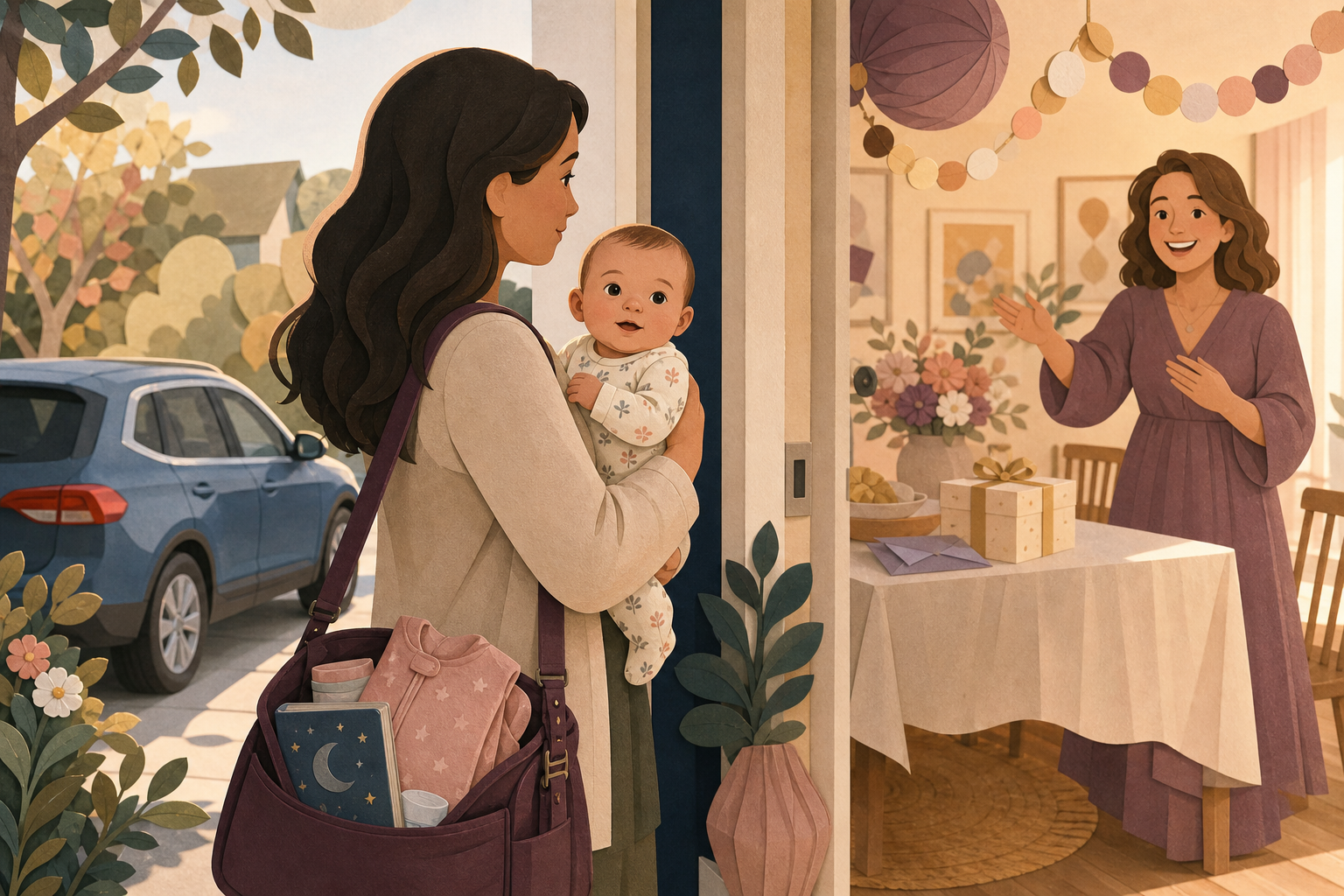
The invitation is cheerful. The gift is wrapped. The complicated part is the small person currently asleep on your chest, because the words baby shower do not automatically answer whether your baby is invited, whether thirty people will want a cuddle, or where a feed and a real nap are supposed to happen.
You can take a baby to a baby shower when the host explicitly says babies are welcome and the plan fits your baby’s age, health, feeding, sleep, and exposure risk. For a very young baby, a baby born prematurely or with a relevant medical condition, a crowded indoor gathering, known illness among guests, or a caregiver who is not ready for the outing, a short solo appearance or staying home may be the safer and kinder choice. When your baby’s individual risk is unclear, ask the clinician who knows your baby.
There is no universal age or vaccine milestone that makes every shower safe. A two-week-old at a quiet porch gathering with six healthy adults is not the same proposition as a two-month-old in a packed event room during a respiratory-virus surge. The useful question is not, “Am I allowed to go?” It is, “Can this particular baby and caregiver attend this particular event with a workable exit?”
Start with permission, then risk
A reasonable yes has three parts
- The host says yes. Do not assume that an event celebrating a baby is automatically an event for every guest’s baby.
- Your baby’s health and the setting make sense together. No known illness, no risk factor you have been told to handle differently, and no venue problem you cannot solve.
- You can feed, rest, travel, hold boundaries, and leave. A plan that works only if the baby needs nothing for three hours is not yet a plan.
Ask the host before you plan the diaper bag
Even when babies are welcome in the family generally, ask about this event. The host may have booked a small restaurant, planned an adults-only game, arranged limited seating, or simply pictured the guest of honor having one afternoon that is not organized around somebody else’s newborn. Asking is considerate; it is not an apology for having a baby.
A text you can send:
“I’d love to celebrate with you. Is the shower set up for babies too, or would you prefer an adults-only afternoon? Either answer is completely fine – I can make a short solo visit or celebrate another way.”
If the answer is vague – “Oh, whatever you want” – ask one useful follow-up: “Would having the baby there make the room or plans harder?” You are trying to get a real answer, not secure a reluctant permission slip. If the baby is welcome, tell the host you may arrive late, step out to feed, or leave early. That removes the little cloud of surprise that otherwise follows you toward the door.
You do not need to disclose private medical details to justify declining. “We are keeping outings small right now” is enough. Nor do you need to attend because a relative has already announced that everyone is desperate to meet the baby. An invitation is not a summons, and your postpartum recovery belongs in the decision too.
Choose the visit that fits: go, make it brief, or skip it
Most families do not need a single rule for all baby showers. They need a way to combine the baby’s health, the room, the caregiver’s capacity, and the practical plan. Use the three doors below. If several facts point in different directions, choose the more cautious door or call your baby’s clinician.
An invitation-card decision path
Go, make it brief, or skip it
Go with your plan
- The baby is explicitly welcome.
- Baby and caregiver are well.
- The setting is small or manageable.
- Feeding, safe sleep, and travel are workable.
- You can keep the baby with you and leave freely.
Make a short appearance
- You want to attend, but the crowd, noise, drive, feeding window, or caregiver stamina narrows the visit.
- You can arrive for one meaningful moment, keep the baby close, and leave before a nap or feed becomes a scramble.
- A second adult can attend alone if the plan changes.
Skip or ask the clinician
- Someone is ill or recently exposed.
- The baby is very young, premature, medically higher-risk, or has instructions that limit exposure.
- The venue is crowded, loud, hot, or has no safe feeding or sleep option.
- The caregiver is unwell, depleted, or does not want to go.
Why the evening belongs in the decision: a shorter visit can protect the next feed, nap, and wind-down. That is not letting a schedule run your life; it is refusing to spend the whole party borrowing energy from bedtime.
Age matters, but it does not work like a green light that switches on at eight weeks. A baby’s own medical history matters. So do the number of guests, whether the gathering is indoors, how well the air moves, whether people are coughing, the length of the drive, and whether you can create distance without turning the afternoon into a security operation.
A small outdoor shower may be easier to manage than a crowded indoor room, but outdoors is not a magic shield. You still need shade, suitable temperature, a clean feeding plan, and a safe place to take the baby if the weather changes. Likewise, a brief indoor visit may be reasonable for one family and wrong for another. The decision is allowed to be specific.
Why a newborn changes the calculation
Newborns are too young for some vaccines and can be more vulnerable to infection than older children and adults. The American Academy of Pediatrics describes protecting a newborn as a “cocoon”: keeping household vaccinations current, using good hygiene, limiting close contact from anyone who may be sick, and communicating the family’s boundaries clearly. Those layers reduce risk; they do not make a crowd risk-free. AAP guidance on cocooning a newborn is a useful basis for the plan.
The CDC recommends covering coughs and sneezes, washing hands often, and using hand sanitizer with at least 60% alcohol when soap and water are not available as core respiratory-virus hygiene. Those hygiene steps belong at a gathering, but they are not a promise that the baby cannot become ill. Babywearing can discourage casual handoffs, yet it is not an infection shield either.
Ask anyone with respiratory symptoms, vomiting, diarrhea, fever, or a recent contagious illness to keep their distance. A guest who says, “It’s probably just allergies,” does not need to win a tiny diagnostic hearing beside the cupcakes. You can say, “We are being cautious while the baby is little, so we’ll wave from here.” Nobody who may be sick should kiss or hold the baby.
RSV can be more serious in younger infants. Prematurity, chronic lung disease, congenital heart disease, weakened immunity, and certain other conditions can increase the risk of severe illness, according to the CDC’s guidance on RSV in infants and young children. If any of those details apply, or if your clinician has given you special exposure guidance, use that individualized advice rather than a general internet timeline.
Vaccination is an important protective layer, not a date stamp that makes every event equivalent. “After the two-month shots” is too blunt to be a universal rule: different vaccines cover different illnesses, protection develops over time, and no routine infant vaccine erases the effect of a symptomatic guest or a packed room. Ask the baby’s clinician if you need help weighing a specific gathering.
Your own health belongs here as well. Postpartum pain, bleeding, feeding difficulty, sleep loss, anxiety, or simply not wanting the baby passed around can make the event too much. You are not required to translate that into a cheerful excuse. Send the gift, arrange a quieter visit later, and let that be the whole plan.
Build the outing around feeding, sleep, and the ride
Plan from the baby’s ordinary needs outward. Do not invent a new bottle, feeding method, formula routine, sleep product, or medication solely to make the shower easier. If the baby usually nurses, ask whether there is a private, reasonably clean place where you can sit. If the baby takes expressed milk or formula, know how you will keep it safe and where you can wash or sanitize your hands.
Keep feeding familiar and safely stored
Expressed breast milk can be transported in an insulated cooler with frozen ice packs for up to 24 hours, then used, refrigerated, or frozen at the destination, according to the CDC’s breast-milk storage guidance. Label what you bring, keep the cooler closed, and bring the feeding supplies your baby already uses.
Prepared formula should be used within two hours of preparation and within one hour after a feeding begins; leftovers from that feeding should be discarded. Babies younger than two months, babies born prematurely, and babies with weakened immune systems need extra formula-preparation precautions. Review the CDC formula preparation and storage guidance before the outing if those rules are not already part of your routine.
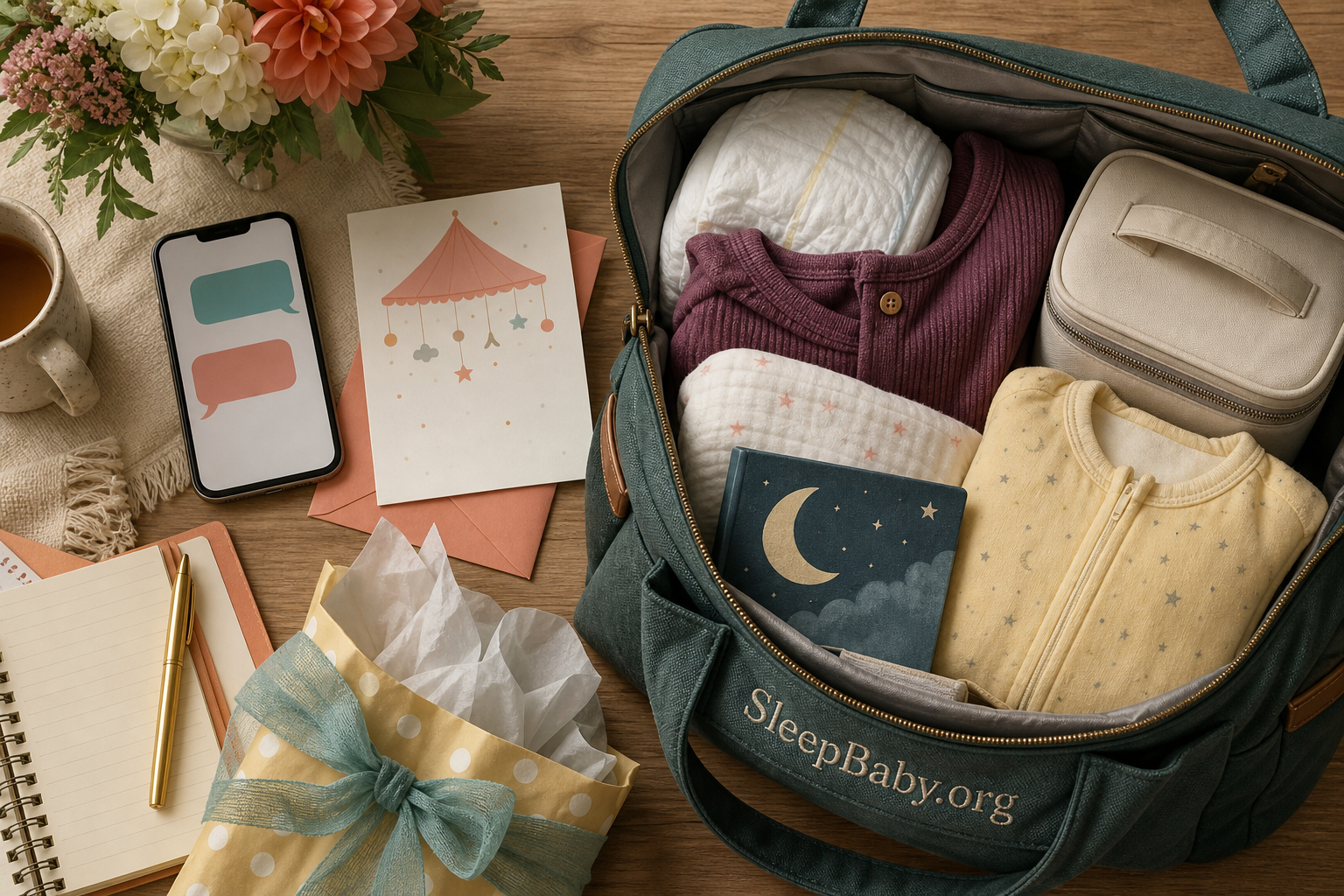
Pack one more burp cloth than optimism says you need. Pack a change of clothes for the baby and, if space allows, one for the adult whose shoulder will receive the ceremonial spit-up. But do not let the bag become the plan. The plan is knowing when and where the next feed can happen, and being willing to leave if the setup does not work.
Use a real safe-sleep option
A car seat, stroller, swing, carrier, or sling is not the party nap plan. The AAP recommends placing babies on their backs on a firm, non-inclined sleep surface. If a baby falls asleep in a sitting device or carrier, move them to a firm, non-inclined sleep surface as soon as possible. AAP safe-sleep guidance also rules out improvising with an adult bed, sofa, armchair, cushion, or gift-room floor nest.
If the visit crosses a true nap, either keep the appearance brief enough to return home or arrange an approved portable crib or play yard in a quiet space. Confirm the sleep space before you leave home. “There will probably be a spare room” is how a caregiver ends up considering a pile of winter coats as infrastructure.
If the baby falls asleep in the car seat during the drive, keep the seat correctly installed and the baby buckled while the vehicle is moving. At the destination or home, transfer the baby out rather than carrying the seat inside as a portable crib. If that transfer is the part that makes your stomach tighten, our guide to waking and moving a sleeping baby gently gives you a calm sequence without pretending every transfer stays asleep.
Travel rear-facing and read the manuals
Children under one should ride rear-facing. The car seat must fit the baby’s size, fit the vehicle, and be used according to both the seat and vehicle instructions; the National Highway Traffic Safety Administration’s car-seat guidance is the authoritative starting point. A shower invitation does not justify adding a bulky coat under the harness, loosening the straps for a long drive, or using an unapproved insert.
For a longer trip, build in an adult-accessible stop rather than assuming the baby will tolerate the whole route because the GPS says forty-two minutes. If two adults are going, decide who will respond to the baby and who will drive. If one adult is going, pull over safely before tending to the baby. A crying baby is urgent to your nervous system; it is not permission to unbuckle on the road.
A sequence that protects the exit
The door-to-door outing plan
- 1Feed and change before departure. Start with a comfortable baby, while accepting that babies consider plans a light suggestion.
- 2Travel correctly rear-facing. Leave enough time that a safe stop does not make you late and frantic.
- 3Make a small arrival. Greet the guest of honor, choose a low-traffic seat away from speakers, and keep the baby with you.
- 4Use one quiet reset. Feed, change, or soothe away from the crowd. If the reset does not help, that is your exit information.
- 5Leave on the first clear signal. Do not wait for the baby and caregiver to be fully spent in order to prove the outing counted.
- 6Transfer and wind down safely. Move the baby out of the car seat after travel, dim the evening, and return to the next familiar feed or bedtime cue.
Keep the baby close without making a speech
A shower can turn into a relay race when affectionate people see a baby. You are allowed to decline that entire activity. Decide before you arrive whether anyone will hold the baby, whether kissing is off-limits, and whether you want guests to wash their hands first. Tell the adult attending with you so you are not negotiating from opposite sides of the dessert table.
Use short statements. Long explanations sound, to a determined relative, like the opening round of a debate. You do not have to prove that one person’s hands are uniquely dangerous or produce a doctor’s note for keeping your baby.
Words you can borrow
Holding boundaries, without the family summit
- When someone reaches for the baby
- “I’m keeping the baby with me today, but come say hello from here.”
- For clean hands and no kissing
- “Please wash your hands first, and no kisses while the baby is little.”
- When somebody keeps asking
- “No passing around today. We are comfortable with this plan.”
- When it is time to leave
- “We are heading out while everyone is still doing well. We loved celebrating with you.”
If a boundary is ignored: take the baby back, create distance, and leave if necessary. A calm tone is kind; compliance is not optional.
Babywearing may make the boundary easier because the baby is already close to you, but only use a carrier you know how to fit. The baby’s neck should remain straight, chin off the chest, face visible, and nose and mouth unobstructed. Premature babies and babies with respiratory problems need extra caution and clinician guidance. Review the AAP’s baby-carrier safety guidance and continue checking the baby’s airway and temperature throughout the visit.
Do not cover the baby’s face with a blanket to discourage attention. Do not loosen a carrier so relatives can peek inside. If the baby slumps, turns hot, has the face pressed into fabric or your body, or cannot be seen clearly, stop and reposition or remove the baby. The carrier’s social usefulness never outranks airway safety.
Read the room before the baby has to shout about it
Choose a seat away from speakers, the gift-opening traffic lane, and the doorway where every guest pauses. A baby who starts turning away, stiffening, fussing, yawning, splaying fingers, feeding poorly, or struggling to settle may need a quieter space or the ride home. Those cues are not a stopwatch or a diagnosis; they are information about this baby in this room.
Distance is the first protection from loud sound. The National Institute on Deafness and Other Communication Disorders notes that sound at or above 85 dBA can damage hearing, with faster harm at louder levels, and recommends avoiding or moving away from loud noise. Properly fitted protective earmuffs are available for infants and children. NIDCD’s child hearing guidance can help you plan, but earmuffs do not turn an unsuitable venue into a suitable one.
If you have to raise your voice to be understood by the person next to you, move the baby farther from the sound or leave. Do not place anything inside a baby’s ear canal. Check that infant earmuffs fit as directed and do not interfere with the baby’s airway, position, or temperature.
Watch heat as closely as noise. A carrier adds body warmth. A crowded room, festive outfit, and blanket can add more. Check the baby’s chest or back rather than judging by cool hands alone, remove unnecessary layers, and move to a comfortable space. If the setting cannot be made comfortable, the answer is the door, not a better accessory.
Leave while leaving is still simple
The best exit plan is one you can use before everyone agrees. Park where you can leave. Keep the diaper bag with you. If another adult drove, agree on a signal and decide in advance that either caregiver can call the visit. Do not tuck the car seat behind a mountain of gifts or accept a drink that makes you dependent on somebody else’s departure time.
Set a first check rather than a promised duration: “We will come for the welcome and see how the baby does.” At that check, look at the whole picture. Is the baby feeding comfortably? Is a nap approaching? Is the room getting louder? Is the caregiver’s body saying enough? You do not have to wait for crying to become the official exit bell.
When it is time, thank the host and go. The long goodbye can outlast the entire useful portion of the visit, especially when every person would like one final look. A warm, “We loved seeing you; we are leaving while the baby is settled,” is complete. Put the baby into the correctly installed car seat, check the harness, and save the recap for after the vehicle is safely parked.

Once home, aim for familiar rather than perfect. Feed if due, lower the lights, change the diaper, and return to the ordinary bedtime sequence. You do not need to compensate for a short nap with a complicated new routine. If the baby is alert and calm, let the evening be boring in the best possible way.
If the outing lands on a rough newborn night, use our guide for what to do when a newborn will not settle at night rather than assuming the shower caused a new sleep problem. One stimulating afternoon can shift timing; it does not explain every feeding, medical, or sleep concern.
After the shower, check the whole baby
A different nap, an extra feed, or an earlier bedtime after an outing can be ordinary. Look at how the baby wakes, breathes, feeds, moves, and responds, not just whether the schedule moved. If your baby naps longer than expected but otherwise wakes normally and seems well, our guide to checking a longer-than-usual baby nap can help you decide what to notice next.
Illness can appear after any community exposure, but timing alone does not prove where an infection came from. Avoid blaming one guest or diagnosing the baby from the calendar. Use clear medical thresholds and call the baby’s clinician when you are concerned.
Keep this line plain
Leave the gathering and call now
The AAP’s young-infant fever guidance supports the immediate fever call. The CDC lists breathing difficulty, inadequate fluid intake, worsening symptoms, and the less obvious infant signs above in its RSV guidance. If your baby looks seriously unwell or you believe there is an emergency, use local emergency services.
You are allowed to call before you have the perfect description. Have the baby’s age, temperature and how it was taken, recent feeds and wet diapers, breathing changes, activity, relevant medical history, and the timing of symptoms ready. Do not give leftover medicine or use a new treatment simply because another guest recommends it.
Watch: protecting a baby who is too young for some vaccines
This American Academy of Pediatrics / HealthyChildren video explains why family and caregiver vaccination, hygiene, and avoiding sick contact work together around a baby who is too young for some vaccines. The takeaway for a baby shower is simple: use several sensible layers, communicate them before people are reaching for the baby, and remember that no layer guarantees zero exposure.
Watch “How Can I Protect My Baby if They’re Too Young to Get Vaccinated?” on YouTube. The finished page should include a responsive, visible player with captions when available and this normal watch link as the fallback. The video supports the plan above; it does not replace individualized medical advice.
Your plan can be kind to everyone, including you
The kind plan is not always attendance. Sometimes it is a twenty-minute visit with the baby snug against you. Sometimes one adult goes while the other stays home. Sometimes the gift arrives with a note and you celebrate in a quieter week. The guest of honor can feel loved without your family proving its endurance in a crowded room.
If you go, decide the boundaries before the invitation starts making decisions for you: the host has said yes, nobody sick comes close, feeding stays familiar, sleep happens on a safe surface, travel stays rear-facing, the baby’s face stays visible in the carrier, and either caregiver may leave. That is enough structure to make room for the sweet parts – the tiny clothes, the happy tears, and the extraordinary amount of tissue paper required to reveal one pair of socks.
When the party follows you home
Bring the evening back down gently
The gift tissue is still in the diaper bag, the nap shifted, and the evening somehow feels louder than the party did. SleepBaby can help you look at the whole pattern – timing, feeding, settling, and repeat waking – without turning one outing into a verdict on your baby’s sleep.
Sources
- CDC: Hygiene and Respiratory Viruses Prevention
- American Academy of Pediatrics / HealthyChildren: How to Cocoon a Newborn
- CDC: RSV in Infants and Young Children
- American Academy of Pediatrics / HealthyChildren: Safe Sleep
- National Highway Traffic Safety Administration: Car Seat and Booster Seat Safety
- National Institute on Deafness and Other Communication Disorders: Protect Your Child’s Hearing
- American Academy of Pediatrics / HealthyChildren: Baby Carriers
- CDC: Breast Milk Storage and Preparation
- CDC: Infant Formula Preparation and Storage
- American Academy of Pediatrics / HealthyChildren: Fever and Your Baby