If your baby is younger than 3 months and has a rectal temperature of 100.4 F (38 C) or higher, call the pediatrician immediately. Get urgent help now if your baby is unresponsive or very hard to wake, is struggling to breathe, looks blue, gray, or unusually pale, has a seizure, or seems seriously ill.[17][20]
Otherwise, a newborn who will not sleep for one long stretch at night is often doing something maddeningly normal: sleeping in short pieces, waking to feed, needing help to settle, and treating midnight like an entirely reasonable time to study the ceiling. Newborn sleep is spread across day and night, and regular sleep cycles take time to mature.[2][3] The useful goal tonight is not to force a brand-new baby to “sleep through.” It is to check that the baby is well and feeding, make each wake-up quiet and safe, and protect the exhausted adult holding the night together.
At 2 a.m., a newborn can look as though sleep has been personally canceled. Often the night is not empty of sleep; it is chopped into pieces too small for the adult brain to count. I would look first at the whole pattern: Is the baby waking and feeding? Are there wet diapers and alert moments? Can the baby be soothed at least some of the time? Or is this a real change in feeding, breathing, color, temperature, alertness, or cry?
Decide what kind of night this is
Common tonight, call today, or urgent now
Common newborn pattern
Short sleep stretches, waking every few hours or more often to feed, cluster feeding, needing contact to settle, noisy sleep, and a day-night pattern that feels backward – while the baby wakes for feeds, has expected diapers, and has alert, responsive moments.
Call the baby’s clinician
Feeding much less, being too sleepy or uninterested to feed, fewer wet diapers than expected for this baby, repeated vomiting, unusual lethargy, a new or worrying cry, or a sleep/wake change that does not fit the baby’s usual pattern or care plan.
Get urgent help now
A rectal temperature of 100.4 F (38 C) or higher in a baby under 3 months; breathing trouble, grunting or pulling in at the ribs; blue, gray, or very pale color; unresponsiveness, extreme difficulty waking, seizure, or another sign of serious illness.
The detail that changes the answer: ordinary newborn wakefulness still comes with feeding and responsive moments. A baby who cannot wake well enough to feed or does not seem like themselves is not a sleep-training problem.
A SleepBaby.org midnight distinction: count the baby, not just the minutes.
A newborn can sleep a great deal over 24 hours and still leave the adults feeling that no sleep happened. The pieces may be one or two hours long, or shorter around feeds, and the longest stretch may land in the afternoon. That is why “awake all night” can mean several different things: truly awake for a long period, drifting off only while held, feeding so often that sleep disappears from the caregiver’s view, or sleeping lightly and noisily enough that every grunt wakes the room.
Do not diagnose the pattern from one hard night. Look for what would change your next action. A baby who roots, brings hands toward the mouth, and settles into a feed is giving you a different problem from a baby who is limp, unusually quiet, breathing hard, or too tired to eat. A baby who wakes bright-eyed after sleeping much of the day is different from one who is rarely alert. The American Academy of Pediatrics notes that lots of newborn sleep can be normal when the baby wakes every few hours, eats well, and is alert for some of the day; being rarely alert or too tired or uninterested to eat deserves medical attention.[18]
If your worry is really that your newborn sleeps almost all day and is difficult to wake, read the distinction in why babies sleep so much and call the baby’s clinician when feeding or alertness has changed. If the baby simply took one unexpectedly long nap but wakes and feeds normally, a longer-than-usual nap gives you a more useful whole-day check than repeatedly nudging the bassinet.

The newborn clock is still learning what night means
Adults arrive at midnight with years of body-clock practice. Newborns do not. Day-night reversal is common, and the change toward more nighttime sleep is gradual. The practical teaching tools are ordinary daytime light and household activity, then dim light, quiet voices, and low-stimulation care at night.[1][4]
That does not mean keeping a newborn awake all day. A tired newborn may become harder to feed and settle, and deliberate sleep deprivation asks a brand-new nervous system to pay tomorrow’s sleep in advance. Let the baby sleep when sleep comes. Change the surroundings around the sleep instead of turning daytime into a stamina test.
Gentle cues, not a forced schedule
Let the house tell the baby where the day is
- Morning and day
- Open curtains, use normal household voices, feed in daylight when practical, and let ordinary life happen. Offer supervised awake interaction when the baby is calmly awake. Still allow every needed nap.
- Evening
- Lower the volume and light without performing a complicated routine. A feed, fresh diaper when needed, sleep clothing, a brief cuddle, and the same safe sleep surface are enough to begin a pattern.
- Night wakes
- Use the minimum light needed to feed and care safely. Keep voices quiet, skip entertainment, change only when needed, soothe responsively, and return the baby to the separate safe surface.
- The next morning
- Begin the daylight cues again even if the night was rough. Consistency means repeating the distinction gently, not demanding an immediate result.
Why this helps the next sleep: daytime feels open and ordinary; nighttime feels safe, quiet, and unrewarding as a social event. The teaching happens around the baby’s needed sleep, not instead of it.

A simple routine is useful because tired adults can repeat it, not because a newborn earns sleep by completing the steps. If the routine has seven songs, three lotions, a special lamp setting, and a parent searching for the one clean swaddle while the baby cries, it is serving the routine more than the room. Keep the pieces that calm the baby and make safe sleep easier. Drop the choreography.
Newborn nights also change quickly. A pattern that feels permanent on Tuesday may shift with feeding, growth, recovery from birth, or simple maturation. I would give gentle day-night cues time while watching feeding, diapers, and alertness. I would not keep tightening a schedule around a baby who is showing me that the current question is hunger, illness, or the need for help settling.
If the feed is finished and the baby is still awake
A full feed does not act like an off switch. A newborn may finish eating, look around quietly, need time to settle, want more contact, or become uncomfortable or overstimulated. The next step depends less on how many minutes have passed than on what the baby is doing with the wakefulness.
Match the response to the baby in front of you
Calm, restless, or concerning
Calm and looking around
Keep the light low and the room quiet. Hold the baby close, offer a brief cuddle or familiar soothing cue, or place the baby on the back in the safe bassinet while you stay nearby. Calm wakefulness does not need to be fixed with entertainment.
Restless or repeatedly startling awake
Recheck the diaper, clothing and room temperature, positioning, need to burp, and whether the last few minutes became too bright or busy. Change one thing, then give the baby time to show whether it helped.
Inconsolable or not acting well
Check temperature and look again at breathing, color, alertness, feeding, vomiting, and diapers. Call the baby’s clinician when the cry or behavior worries you; use urgent help for urgent signs.
Why this helps: a calm awake baby needs a quiet runway toward sleep, not a new activity. A concerning baby needs assessment, not stronger settling tricks.
If the baby is quiet with eyes closed, pause long enough to see whether you are hearing a brief sound or a true wake-up before picking the baby up. Newborn sleep can be light and fragmented.[3] Observation does not mean ignoring sustained crying or a change in breathing. It means you do not have to turn every grunt into a full feed-and-diaper production when the baby is still safely sleeping.
If the baby is plainly awake but comfortable, protect nighttime rather than forcing sleep. Keep the phone screen away from the baby’s face, leave the overhead light off, and resist beginning the cheerful daytime conversation because you are relieved the crying stopped. You can be warm without making midnight interesting. A quiet hand on the chest while the baby lies safely on the back, a low voice, or a brief cuddle may be enough. If not, pick the baby up and continue responsive care.
A routine should also be small enough to survive a night when one clean sock has vanished and the bottle brush is somehow in the wrong sink. Choose a few repeatable cues: dim light, feed, necessary diaper care, sleep clothing, one soothing action, safe surface. The NHS notes that a simple soothing routine can help babies settle, while newborn sleep still varies widely.[4] The routine is a handrail for the household, not a contract the baby signs.
If an awake stretch happens at roughly the same time for several nights and the baby otherwise feeds and behaves normally, keep the day-night contrast gentle and consistent. If the stretch arrives with poor feeding, unusual sleepiness at other times, repeated vomiting, breathing or color change, fever, or a baby who is no longer acting like themselves, stop treating it as a timing puzzle and call. The point of a pattern is to make the next decision clearer, never to explain away a change that deserves care.
For the next twenty minutes, make the loop smaller
When a newborn is awake again, the adult brain tends to open twenty tabs at once: Is this gas? Is the swaddle wrong? Did the nap ruin bedtime? Should I add a wake window? Is the bassinet cursed? Close the tabs that do not change the next safe action. Check the baby, check for hunger, provide the care that is actually needed, soothe without turning on the whole house, and return to the sleep surface.
One quiet pass through the basics
The feed, soothe, sleep loop
- 1. Look at the baby before the clock. Check breathing, color, temperature when illness is possible, alertness, diaper, positioning, and what has changed from the baby’s usual pattern.
- 2. Read the early feeding cues. Hands moving toward the mouth, rooting, lip smacking, and clenched hands can appear before crying. Feed according to the baby’s established plan rather than stretching the interval to chase sleep.
- 3. Do only the care that helps. Burp if your baby needs it, change a soiled diaper or a wet diaper that needs changing, and keep the room dim enough to remain nighttime but bright enough to work safely.
- 4. Soothe responsively. Hold close, rock gently, use a quiet voice, offer a pacifier if it is part of your safe plan, or repeat another calm method the baby already tolerates. Change one thing at a time.
- 5. Return to the safe surface. Place the baby on the back in the empty crib, bassinet, portable crib, or play yard that meets safe-sleep requirements. If the baby wakes, the loop can begin again without declaring the night broken.
Why this helps: the sequence keeps hunger, necessary care, soothing, and safe sleep in order. It also gives two depleted adults the same plan when language has narrowed to “Did you already check the diaper?”
A SleepBaby.org loop for a night that may need repeating, not perfecting.
Feed the newborn you have, not the schedule you hoped for
Frequent feeding can make a newborn seem awake all night because the adult’s sleep ends at every cue. Breastfed newborns commonly feed 8 to 12 times in 24 hours, feeds may be close together, and cluster feeding can happen even more often. Some babies need to be woken for feeds under an individual plan.[13] Formula-fed newborns also take small, frequent feeds, with timing and amount changing by baby and over the early weeks.[14]
Those patterns are context, not instructions to ignore the clinician who knows your baby’s weight, gestational age, jaundice risk, feeding transfer, or medical history. Do not stretch feeds, drop night feeds, or decide that a sleepy baby no longer needs to be woken when the current care plan says otherwise. In the other direction, do not wake a thriving baby on a new internet timetable when the clinician has already told you the baby can feed responsively. If the waking plan is the hard part, use gentle ways to wake a sleeping baby only inside that individualized plan.
The wake-up is information, not a diagnosis
What to notice before trying another sleep trick
| What you notice | What it may ask you to check | What not to assume |
|---|---|---|
| Rooting, hands to mouth, lip smacking | Offer the feed that fits the baby’s plan. Early cues are easier to answer than a full cry. | One cue does not prove low milk supply, reflux, or that every wake is hunger. |
| Turning away, closing the mouth, relaxed hands | Pause and see whether the baby is full, needs a burp, or wants a different kind of comfort. | Do not pressure a baby to finish a bottle solely because a printed amount remains. |
| Fussing after a complete feed | Check diaper, temperature, clothing, positioning, need for close contact, and whether the baby became overstimulated. | Do not diagnose gas, allergy, reflux, or “bad habits” from fussing alone. |
| Too sleepy to feed, weak interest, difficult to wake | Check for other illness signs and contact the baby’s clinician promptly; use urgent help when breathing, color, responsiveness, fever, or other serious signs are present. | Do not call this a successful long sleep and wait for the next scheduled feed. |
Small-screen note: this comparison is one keyboard-focusable horizontal region. Swipe inside it to reach the final column, then continue down the page normally.
The CDC describes hands to mouth, rooting, and lip smacking as hunger cues and crying as a later cue. It also notes fullness cues such as turning away or relaxing the hands.[15] These observations are useful because they help you act sooner; they are not a home test for why a newborn wakes. A baby may want to feed and still need medical help when feeding, diapers, weight, or behavior are concerning.
Diaper output and growth give the care team more useful intake context than how peaceful the baby looks after one feed.[16] If the baby seems hungry after breastfeeding, wants to nurse again almost immediately, or feeds in a long evening cluster, look at transfer, cues, diapers, and growth together rather than treating repeated feeding as proof that something is wrong. Reach out to the pediatrician or a qualified feeding professional when the pattern and the baby’s intake do not add up.
Do not put cereal in a bottle to make a newborn sleep longer. The CDC says cereal in a bottle does not help babies sleep longer and can increase choking risk.[16] Do not add extra water, medicine, melatonin, herbal drops, or supplements as a sleep experiment. A newborn is not a tiny recipe that improves when one more ingredient is stirred in.


When the baby sleeps only while held
A newborn may settle against a warm chest and wake during the transfer to a cooler, still surface. That does not prove the baby is manipulative, spoiled, or incapable of sleep. It proves that closeness is powerful and that the difference between moving arms and a flat bassinet is obvious to a small nervous system.
Responsive care is appropriate in the early months; controlled-crying style sleep modification is not the newborn tool in this guide.[5] You can still practice a repeatable transfer without turning it into a test the baby must pass:
- Prepare the safe surface first. The fitted sheet is on, the space is empty, the room is comfortable, and nothing needs to be cleared while you are carrying the baby.
- Finish the feed and necessary care. Keep the night low stimulation. If the baby needs burping or a diaper change, do it before the transfer rather than after the baby has settled.
- Wait for a calmer body, not a magic minute. Breathing may become more regular and the hands may soften. There is no universal transfer countdown.
- Lower close to your body. Support the head and body, move slowly, place the baby on the back, and keep your hands gently in place for a brief moment while you remain awake and attentive.
- If the baby wakes, choose the next safe step. Soothe at the bassinet if that helps, pick the baby up, trade with another awake adult, or repeat the loop. The wake-up is not evidence that you ruined anything.
Some babies accept a drowsy transfer; some transfer only after falling asleep; some protest both for a while. Older-infant advice about independent sleep cannot be pasted over the newborn stage simply because the search results sit beside each other. The AAP separates its older-baby self-settling guidance from the newborn period, when sleep remains fragmented and feeding frequent.[3]
If your clinician has told you to wake for feeds, the safe surface is still the destination between feeds. If the baby falls asleep in a car seat, stroller, swing, carrier, or sling, move the baby to a firm, flat, level sleep surface as soon as practical after travel or the activity ends.[10] A sitting device can be useful equipment without becoming the place you plan a night of sleep.
Exhaustion is not a character flaw; it is a safety condition
The most important plan may not be how to get the baby down. It may be what happens if the adult holding the baby starts to go down too. A sofa or armchair is an especially dangerous place to fall asleep while feeding or comforting an infant. If sleep feels possible, move away from those surfaces and prepare the baby’s separate safe sleep space before the next feed.[2][6]
Decide before the next feed
If you might fall asleep, change the setup now
Leave the sofa and armchair
Do not wait for the head nod. Move the feed or soothing session before fatigue makes the decision for you.
Ready the baby’s own surface
Empty crib or bassinet, fitted sheet, clear path, low light, and everything else out. Make the safe transfer the easiest available move.
Wake another adult if you can
Trade a feed, diaper, burp, or settling shift. A helper can protect one uninterrupted block of adult sleep even when the newborn still wakes often.
If you accidentally fall asleep while feeding: move the baby back to the separate safe sleep surface as soon as you wake. Do not let shame spend the minute you need for the transfer.
If feeding happens in an adult bed and dozing is a real possibility, remove pillows, sheets, blankets, and other items from the baby’s area before the feed, then return the baby to the separate sleep surface as soon as you are awake. This is risk reduction for an exhausted moment, not an endorsement of bed sharing. The planned sleep location remains the baby’s own firm, flat, level, empty surface in the caregiver’s room.[6][8]
Build shifts around tasks, not fairness at 3 a.m. One adult might feed while another handles the diaper and return to the bassinet. A breastfeeding parent may still need to wake, but another adult can bring the baby, watch for dozing, settle afterward, wash bottle or pump parts as applicable, and protect the next block. If you are alone, put the safe surface within the approved room-sharing setup, prepare water and feeding supplies before the night, and call someone early enough that help can still be useful.
If frustration is rising, place the baby on the back in the safe crib or bassinet and step away briefly while you breathe and summon help. The AAP and NHS both support putting the baby somewhere safe before the adult loses control; never shake a baby.[19][20] If anger at the baby’s waking is becoming frightening, use this safe plan for anger and sleep deprivation before the feeling becomes an action.
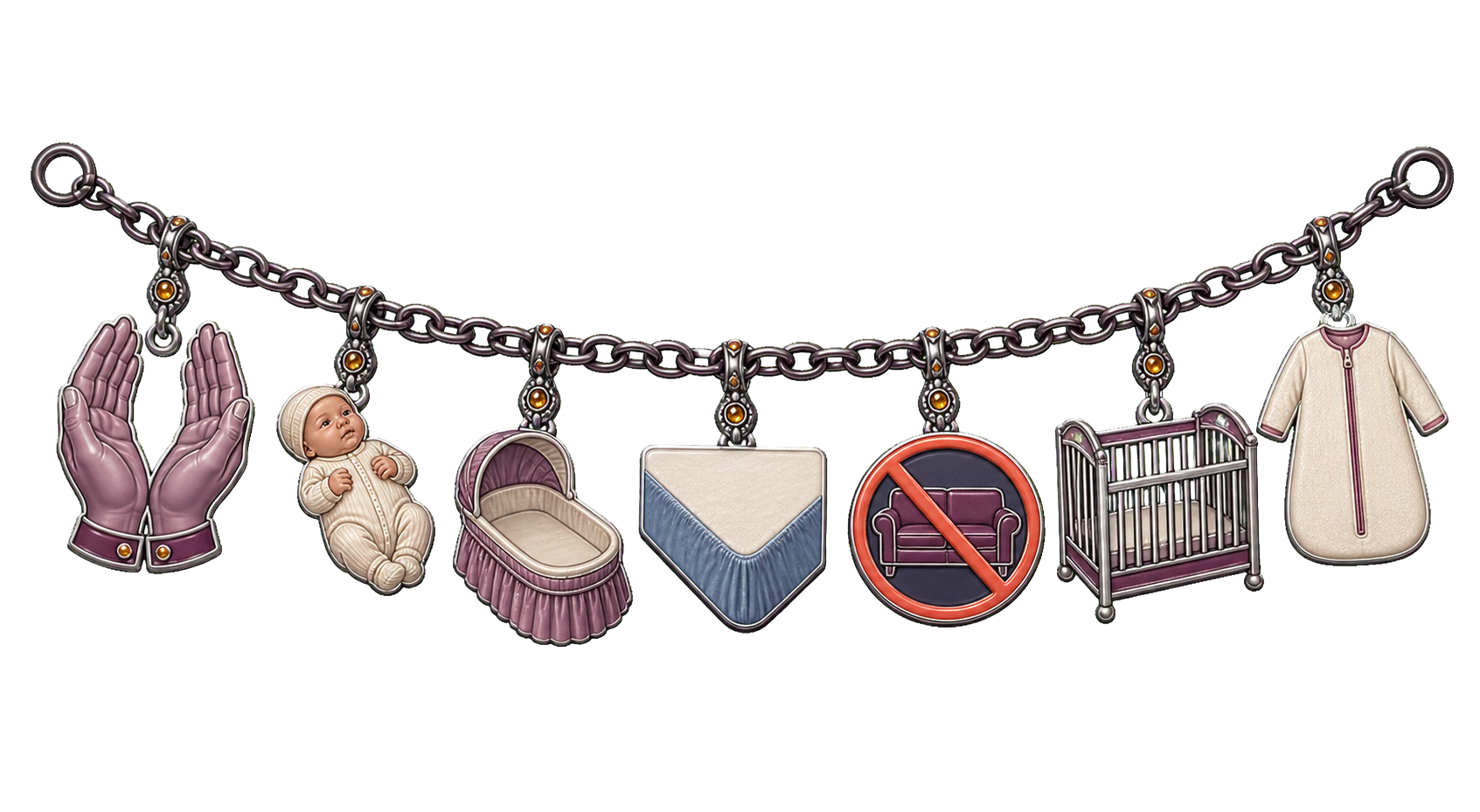

Make every return to sleep boringly safe
A safe newborn sleep space is intentionally plain: baby on the back, on a firm, flat, level, non-inclined surface made for infant sleep, with a fitted sheet and nothing else in the space. The baby sleeps on a separate surface in the caregiver’s room, without pillows, blankets, bumpers, toys, positioners, or other soft objects.[6][7]
Plain can feel emotionally wrong after an hour of trying to settle a baby. The room seems to ask for one more cozy thing: a rolled towel, a small pillow, a blanket tucked “very tightly,” a wedge for spit-up, a stuffed toy that looks reassuring. This is where I would let the evidence be firmer than the mood. The safest bassinet is boring on purpose. Warmth comes from appropriate sleep clothing and an available caregiver, not from filling the sleep space.
Check the destination, not the product promise
The five-part reset before every transfer
Back
Place the baby on the back for every sleep, including naps and after feeds. Reflux does not create a routine exception.
Firm, flat, and level
Use the approved crib, bassinet, portable crib, or play yard surface as designed. No incline, wedge, nest, or improvised padding.
Empty
Only the fitted sheet belongs with the baby. Keep blankets, pillows, toys, bumpers, positioners, and loose items out.
Separate and nearby
Room share on the baby’s own surface. The adult bed, sofa, recliner, and armchair are not the planned newborn sleep space.
Comfortably dressed
Avoid overheating. Use appropriate sleep clothing and keep the head uncovered; do not add a loose blanket for comfort.
Why this helps the whole night: every adult can make the same five checks after every feed. Safe sleep stops depending on who is most awake or which product looked convincing in an advertisement.
Babies with reflux are still placed on the back for sleep. NICHD explains that back sleeping does not increase choking risk in healthy babies, including babies with reflux, and inclined sleep is not the fix.[9] If your baby has a medical condition that changes ordinary care, follow the baby’s clinician. Do not build a wedge, prop the mattress, or move the baby to the stomach because spit-up looks uncomfortable.
Do not use a sleep positioner. The FDA warns that infant positioners can lead to suffocation or entrapment, and no product is FDA-approved to prevent SIDS.[11] A home monitor also does not replace the safe-sleep setup or prevent SIDS simply because it watches a number. Use medical monitoring only when prescribed and explained for your baby’s specific needs; keep the ordinary sleep space safe either way.
Swaddling may calm some newborns, but it does not make an unsafe surface safe. Place a swaddled baby on the back, keep hips able to move, avoid overheating and weighted swaddles, and stop swaddling when the baby shows signs of trying to roll.[12] If a swaddle repeatedly rides over the face, comes loose, or turns every wake-up into a difficult rewrap, use an appropriate alternative sleep garment rather than tightening or layering improvised fabric.
The useful takeaway from this official Safe to Sleep video: clear the crib. The baby’s sleep area stays firm, flat, level, and empty because every extra soft or positioning item adds risk without teaching the newborn to sleep.
If the player does not load, watch NICHD’s Clear the Crib video on YouTube. The written safe-sleep guidance above remains complete without the player.
Do not solve a newborn night with an older baby’s tools
A newborn who needs feeding and responsive care is not failing a sleep-training program. There is no prize for starting controlled crying, rigid wake windows, or “drowsy but awake” before those ideas fit the baby’s age, health, and family plan. You can build gentle cues and practice safe returns without leaving a newborn to manage hunger or distress alone.
Shortcuts that change the risk, not the newborn
Not for tonight
Keeping the baby awake all day
Use daylight and normal household life by day. Do not withhold needed sleep to manufacture nighttime tiredness.
Stretching or thickening feeds
Do not delay a needed feed or add cereal, extra water, medicine, or supplements to chase a longer stretch.
Inclines, nests, and positioners
No wedge for reflux, rolled-towel nest, pillow, sleep positioner, or propped mattress. Use the flat approved surface.
Weighted sleep items
Skip weighted swaddles, blankets, sleep sacks, and other weighted products for infant sleep.
A swing or car seat as the night plan
Transfer from sitting devices and travel gear to the firm, flat, level sleep surface as soon as practical.
A monitor as a safety substitute
A consumer reading cannot clear bedding, flatten a surface, move a baby from a sofa, or prevent SIDS.
The right plan can still include a pacifier if it fits current safe-sleep guidance and feeding is established as advised for your baby. It can include swaddling within the boundaries above. It can include rocking, singing, walking, or holding while an adult is fully awake. The question is not whether a soothing tool looks “independent.” The question is whether it is age-appropriate, safely used, and followed by sleep on the proper surface.
There is also no need to make the night silent in a way the household cannot sustain. Quiet voices and low stimulation are useful; fear of one floorboard is not. If ordinary gentle movement wakes the baby every time, the answer is still not to pad or tilt the sleep space. Keep the environment simple and safe, then work with the baby’s current feeding and settling needs.
Know when to stop troubleshooting and call
Sleep advice ends where illness concern begins. Call the pediatrician immediately for a rectal temperature of 100.4 F (38 C) or higher in a baby younger than 3 months.[17] Seek emergency help for breathing difficulty, grunting with effort, pulling in around the ribs, blue or gray color, seizure, unresponsiveness, or another sign that your baby may be seriously ill.[20]
Call promptly when a newborn is much harder to wake than usual, rarely alert, too tired or uninterested to feed, feeding markedly less, having substantially fewer wet diapers than expected, repeatedly vomiting, or behaving in a way that worries you.[18] The exact urgency depends on the symptom and the baby. When you are unsure whether a sign is urgent, call the baby’s clinician or local nurse line rather than testing another sleep tip first.
Crying can be intense without being an emergency, and a caregiver cannot always identify one cause. Check hunger, diaper, clothing, temperature, positioning, and the need for contact; use gentle repeated soothing; and take the baby’s temperature when inconsolability raises concern.[19] A new weak, high-pitched, or otherwise worrying cry alongside poor feeding, unusual sleepiness, fever, breathing trouble, or color change belongs in a clinical conversation, not in a search for the perfect shushing sound.
Your own condition matters too. If you are having thoughts of hurting yourself or the baby, feel unable to keep the baby safe, or cannot stay awake enough to provide care, put the baby on the back in the safe sleep space and get immediate human help. Call emergency services when there is immediate danger. A brief safe step-away is part of responsive care when it prevents an overwhelmed adult from escalating.[21]
Keep one useful note, not a midnight surveillance project
If the pattern is worrying or you need to call, a small 24-hour note can help: when feeds began, roughly how the baby fed, wet and dirty diapers, sleep stretches, temperature readings, vomiting, breathing or color changes, and the moments when the baby was alert. Add the baby’s age and the feeding or waking plan you were given. That is enough to give the clinician a timeline.
Do not let tracking become the person who stays awake after the baby finally sleeps. Exact minute-by-minute charts can create false precision, especially when newborns drift between drowsy, active sleep, and waking. Record the details that change a medical or feeding decision. Let the rest of the night remain unmeasured.
By daylight, decide which problem actually needs help. If feeds feel ineffective, call the pediatrician or feeding support. If the baby is healthy but the adults cannot sustain the night safely, ask family, friends, a postpartum professional, or the care team for a concrete shift rather than general encouragement. “Can you hold the awake baby from 7 to 9 while I sleep?” is easier to answer than “Let me know if you need anything.”


A hard newborn night can be normal and still need support
Normal does not mean easy, and it does not mean you must absorb every wake-up alone. The newborn may need frequent feeds and help settling while the adults need a safer division of labor, a feeding check, or one protected block of sleep. Those truths can sit beside each other without turning the baby into a problem to solve.
Tonight, begin with the detail that changes the answer. A well, feeding, responsive newborn with short sleep stretches needs a small safe loop and gentle day-night cues. A baby with fever, breathing trouble, poor alertness, poor feeding, or another concerning change needs medical help. An adult who may fall asleep holding the baby needs a different setup and another pair of hands if any are available.
Then let the goal be modest: one feed answered, one light kept low, one sofa avoided, one safe return to the bassinet. The night may repeat itself. Repetition is not failure. For a newborn, it is often the entire shape of the night – and dawn still arrives without anyone winning an argument with the clock.
Sources
- AAP: Reversing Day-Night Reversal
- AAP: Safe Sleep Tips for Sleep-Deprived Parents
- AAP: Getting Your Baby to Sleep
- NHS: Helping Your Baby to Sleep
- Wirral NHS: Safer Sleep, 0-3 Months
- AAP Pediatrics: Updated 2022 Safe-Sleep Recommendations
- AAP Pediatrics: Evidence Base for Updated Recommendations
- NICHD Safe to Sleep: Ways to Reduce Risk
- NICHD Safe to Sleep: Back Sleeping
- AAP: How to Keep Your Sleeping Baby Safe
- FDA: Infant Positioners and SIDS-Prevention Claims
- AAP: Swaddling Safety
- CDC: How Much and How Often to Breastfeed
- CDC: How Much and How Often to Feed Formula
- CDC: Hunger and Fullness Cues
- CDC: Infant and Toddler Nutrition FAQs
- AAP: When to Call the Pediatrician for Fever
- AAP: Common Conditions in Newborns
- AAP: Responding to Your Baby’s Cries
- NHS: Soothing a Crying Baby
- CDC: Milestones by 2 Months
When tonight is a series of small returns
Build the next safe sleep step, not a perfect newborn night
A newborn night can hold feeds, contact, false starts, tiny sleep stretches, and an adult who has forgotten where the fresh burp cloths went. SleepBaby can help you keep the next decision clear: what is normal for this stage, what makes sleep safer, what can wait until daylight, and when to stop guessing.