Before the doors close
Most babies can ride a train or subway – the plan succeeds or fails at the transfers
Check the exact operator and stations, choose only the gear you can physically manage, keep well back from the platform edge, let riders exit, and board without racing the doors. Once inside, sit or hold on, keep the aisle clear, and make feeds, diaper changes, noise, and the first and last mile part of the route. A local subway, commuter train, reserved intercity train, and rideshare are four different environments, so one system’s stroller, fare, or car-seat rule does not automatically apply to another.
The hardest part is rarely the train. It is the three minutes between the sidewalk and a stable place inside it.
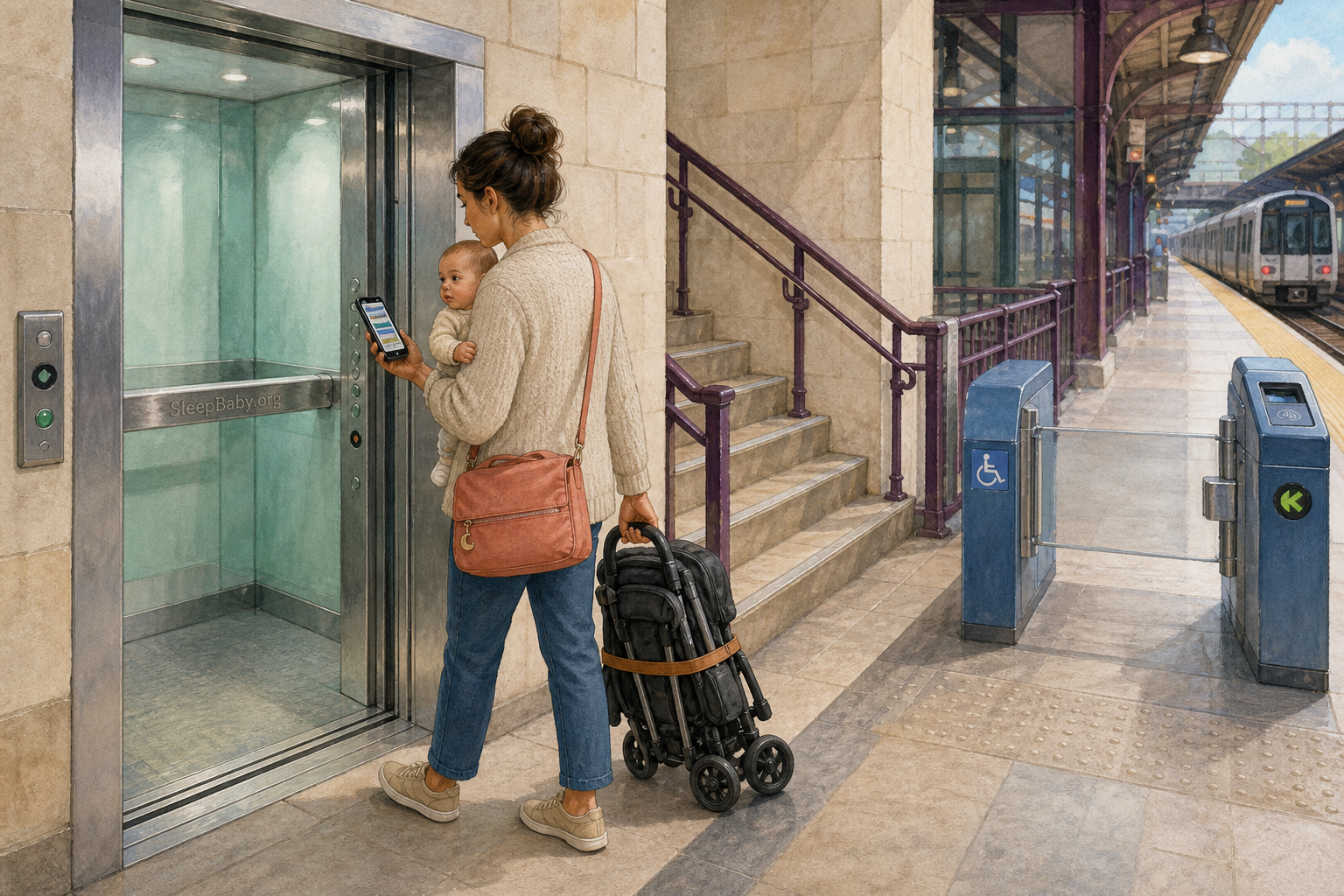
On a map, the trip is a clean colored line. In real life, there may be a broken elevator, a narrow gate, one flight of stairs, a platform change, a stroller brake, a bag that has migrated to the least useful shoulder, and a baby who has decided that this exact tunnel is where lunch should happen. None of that means the trip is a bad idea. It means the route needs to be planned as a sequence of physical handoffs, not just a departure and arrival time.
Start by naming the kind of ride. A subway or metro usually means frequent stops, short dwell times, standing passengers, stairs, gates, and quick decisions. Commuter rail may offer more room and a longer ride but still involve busy platforms and transfers. Intercity rail may have reservations, luggage rules, designated family areas, and an infant fare policy. If any part of the trip uses a taxi, rideshare, or private car, that leg needs its own child-restraint plan.
The useful goal is not to make the baby sleep for the whole journey or to carry every possible object. It is to keep one adult hand, one adult decision, and one exit option available. A trip with a compact stroller and one small bag can be easier than a trip with a full travel system. A carrier can be brilliant until the adult also has a suitcase, a winter coat, and stairs. The best setup is the one that still works at the hardest transfer.
I judge the setup by the ugliest transfer on the route, not the calmest station photo. If one adult cannot secure the baby, control the gear, and keep a hand free when the elevator fails, it is too much gear for this trip – even if every item is lovely on its own.
Choose the carrier, stroller, or both by the hardest part of the route
There is no universal winner. A carrier removes wheels and can simplify gates and stairs, but it also puts the baby’s weight on the adult and can make heat, bending, luggage, and long standing harder. A stroller gives the baby and supplies a stable base, but only when elevators, wider gates, platform space, and the adult’s ability to fold or lift it are genuinely available. Bringing both can create flexibility or simply create two items to control.
Plan for the hardest transfer, not the prettiest platform
Which setup can one adult still control when the route changes?
CARRIER FIRST
Useful for stairs, narrow gates, short trips, crowded stations, and a baby who is within the carrier’s fit limits. The adult must still be able to see footing, monitor the baby’s airway and temperature, hold a rail, and manage the bag.
COMPACT STROLLER
Useful when step-free access is confirmed, the stroller turns easily, the brake is reliable, and the adult can fold and carry it if access changes. Keep the basket light enough that folding does not create a second unpacking project.
BOTH, WITH A SWITCH PLAN
Useful on a long day when the carrier handles stairs and crowds while the stroller handles distance. It works only if the baby can be transferred in a safe place and the adult can secure one item before handling the other.
Sleep connection: the setup that prevents frantic lifting and repeated transfers also gives the baby a better chance of reaching the next feed or nap without arriving already overwhelmed.
If you are traveling alone, test the whole load at home. Put on the carrier. Add the real bag. Fold and lift the stroller with one hand only if the manufacturer permits that handling. Walk through a doorway, turn, sit, stand, and reach the diaper pouch without putting the baby or bag on the floor. This is not a fitness challenge. It is how you find out that a water bottle in the wrong pocket can turn a simple fold into a small domestic scandal.
Do not plan to carry an occupied stroller on stairs. MTA tells New York riders to use elevators whenever possible and, on stairs or escalators, to fold the stroller and carry the child separately.1 Other agencies may publish different operating details, but the planning principle is sound: the baby stays controlled by an adult while the stroller becomes luggage. If that is not possible with the people and gear you have, choose a step-free route or a different trip.
Audit the route from door to door, not station name to station name
Look up the exact entrance you intend to use. A station can be listed as accessible while the elevator is on the far side of a major road, connects only some platforms, or is temporarily out of service. Check current service before leaving and again near departure. MTA’s current rider guide specifically points passengers to real-time service information and its app.1
Then work through the route in order:
- Street entrance: Which entrance has the elevator or ramp? Is there a wide gate? Can you reach it without crossing stairs?
- Fare area: Can you tap or scan without letting go of the stroller? Does the baby need a ticket? Is a staffed gate available?
- Platform: Which direction, level, and car position reduce transfers? Is there a designated accessible boarding area?
- Onboard: Is there a space for a stroller, a seat reservation, or a place to keep luggage out of the aisle?
- Arrival: Does the exit elevator actually lead toward your destination? What is the backup if it does not?
- First and last mile: Are you walking, using a bus, or entering a car that needs the baby’s approved restraint?
A transit map can show where the line goes. It cannot show whether the elevator is working, whether the stroller fits the turn, or whether your baby has decided that this exact tunnel is where lunch should happen.
Three rides with different pressure points
What changes between subway, commuter rail, and intercity train?
Mobile note: this comparison scrolls sideways inside its own bounded region when needed; vertical page scrolling remains free.
| Ride | Plan first | Likely pressure point | Verify directly |
|---|---|---|---|
| Subway or metro | Entrance, elevator, gate, platform, door, and where to stand. | Stairs, crowds, short door time, standing, and fast service changes. | Stroller policy, step-free route, fare, accessible boarding area, and live elevator status. |
| Commuter rail | Platform, gap, carriage access, peak crowding, luggage, and return schedule. | Longer wait between trains, high steps or gaps, and limited stroller space. | Child fare, stroller placement, accessible boarding, toilets, and off-peak options. |
| Reserved intercity rail | Ticket, seat, baggage, stroller storage, feeding supplies, toilets, and arrival transfer. | Luggage plus baby, longer confinement, and a motion nap that changes the day. | Infant ticket, seat or lap rule, car-seat rule, family area, baggage allowance, and onboard amenities. |
If the train is one piece of a larger city day, the broader logistics in our guide to taking a baby to New York can help with lodging, walking, and the parts that happen after you leave the station. The exact transit agency still controls the fare, stroller, elevator, and boarding rules.
Use the same street-to-seat sequence every time
A repeatable sequence reduces the number of decisions made beside moving people and moving trains. It also makes it easier for two adults to divide jobs without both reaching for the same stroller at once.
Picture one ordinary platform minute: one adult says, “baby and stroller,” the other says, “bags and tickets,” and nobody quietly changes jobs because the doors have opened. It is not a dramatic family-travel moment. That is precisely why it works.
- Stop before the entrance. Put away the phone, secure loose straps, zip the bag, check the line and direction, and decide who controls the baby. Do not reorganize at the top of stairs.
- Pass the fare gate one unit at a time. Use the wider gate when available. One adult takes the baby and stroller completely through; the second adult follows with luggage. Never leave the stroller half through a closing gate.
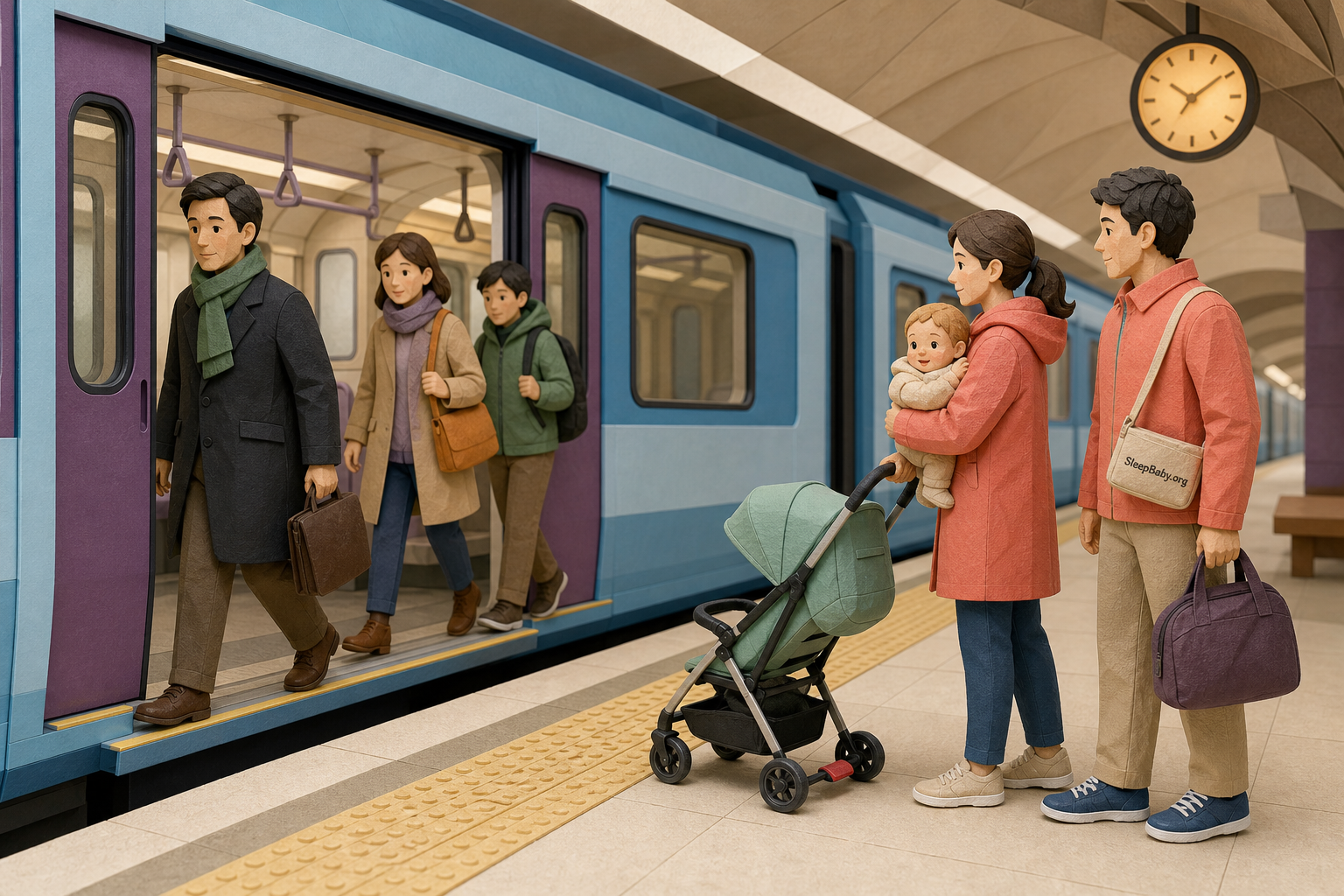
- Build a platform buffer. Move well back from the edge, set the stroller brake on level ground, keep a hand on it, and orient the group so passing riders do not push the stroller toward the track.
- Let the train empty. Stand to the side of the doors. Do not angle the stroller into the exit stream. If the carriage remains too crowded or the doors begin closing, take the next train.
- Cross the threshold deliberately. Watch the gap, keep wheels straight, and move fully inside before turning. A second adult follows rather than pulling from the front and creating two competing forces.
- Become stable before doing anything else. Sit if possible, hold a pole or rail, set the stroller brake where permitted, clear the doors and aisle, and only then check the baby, map, bottle, or messages.
New York MTA tells riders to stand back from the platform edge, let customers exit before boarding, hold on once aboard, and avoid blocking doors. When no designated area exists, it generally suggests the center car because the conductor is often there.1 Treat those details as MTA-specific guidance and ask your own operator where strollers or mobility spaces belong.
The platform and doors deserve your full attention
Keep the baby and all wheeled gear well back from the platform edge until the train has stopped and people are exiting. A stroller brake helps, but it does not replace an adult hand. Platforms can slope, vibrate, become crowded, and collect the sideways pressure of people trying to see whether this is their train.
Do not park the stroller nose-first toward the tracks. Keep the group positioned so an unexpected roll or bump is not directed at the edge. Stay away from the crowd gathering at a single door when another part of the platform is calmer and the agency allows boarding there. If a marked accessible boarding area exists, follow the operator’s instructions and leave priority space available for riders who need it.
When the train arrives, let riders get off. This is not only etiquette; it opens a straight path and reduces the chance that one stroller wheel meets three hurried shoes. If the doorway is crowded, the gap looks difficult, or the warning chime has started, stop. Missing one train is cheaper than converting a ten-second door cycle into a family emergency.
I would rather watch one train leave than watch a caregiver try to win a closing-door sprint with a baby and stroller. The timetable gets another chance. That threshold does not.
Accept help only in a way that keeps control clear. A stranger can hold a door-side bag or alert staff, but the caregiver should keep the baby. If someone helps lift a folded stroller on stairs, say exactly which end they have and where to stop. Do not let two people lift an occupied stroller from opposite ends over a platform gap.
Once aboard, solve stability before comfort
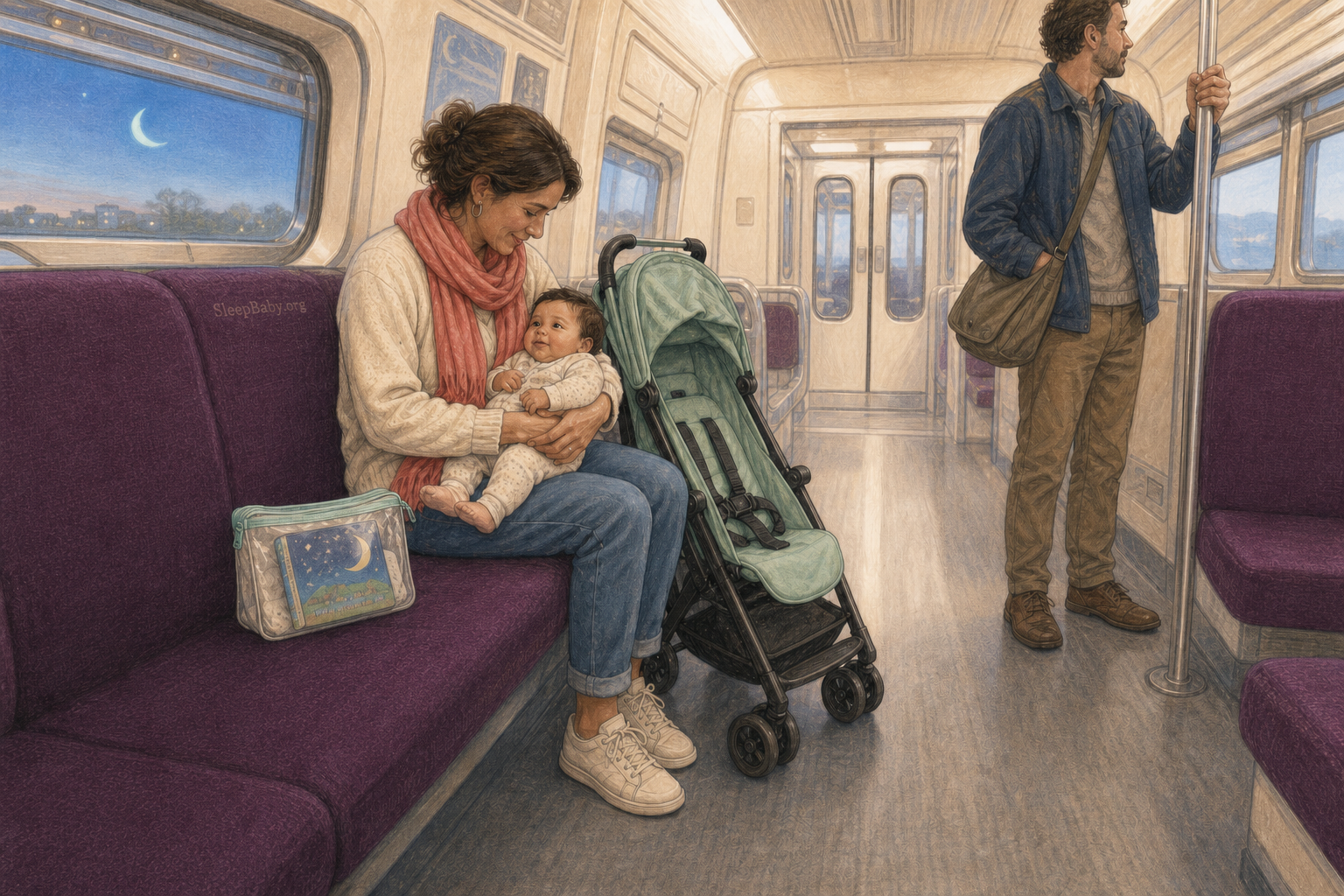
The first job is to get the adult, baby, stroller, and bag out of the doorway and into a stable position. Sit when a seat is offered. If standing, keep one hand on a fixed rail and the baby’s weight close to your center. A carrier does not give the adult extra balance; it raises the cost of losing it.
Use the stroller brake where the operator permits an open stroller, keep the harness fastened, and maintain a hand on the stroller. Do not wedge wheels into a door, block an aisle, or hang heavy bags from the handle until the stroller can tip backward. If the system requires folding, secure the baby first, fold away from the doors, and store the stroller as directed.
Keep bags compact and reachable. Amtrak requires carry-on items to stay out of aisles, doorways, and vestibules.3 That rule does more than keep staff happy. It preserves the family’s exit path and prevents another passenger from tripping into the baby or stroller.
Do not place a car seat, stroller, or carrier on an adult seat unless the operator expressly permits it and the item is stable under its own instructions. Amtrak specifically says child car seats cannot be secured to its train or bus seats.2 An empty seat is not automatically a tested installation point.
Treat noise as dose, distance, and duration – not a reason to panic
Trains can be calm for ten minutes and then produce a brake squeal, tunnel roar, announcement, or rushing platform sound that makes an infant startle. NIDCD explains that hearing risk depends on how loud a sound is, how long it lasts, how often it happens, and how close the listener is. Sounds at or below 70 dBA are generally unlikely to cause hearing loss, while long or repeated exposure at or above 85 dBA can.4
You do not need to turn every ride into a live decibel experiment. Use distance first: move away from a screeching speaker, open carriage connection, or noisy platform equipment when you safely can. Shorten the exposure if the route is predictably loud. For repeated loud travel, consider properly fitting, age-appropriate protective earmuffs and follow their instructions. Do not put adult earbuds or loose earplugs into a baby’s ears.
Watch the baby, too. Repeated startles, distressed crying, trying to turn away, or being unable to settle after each loud section are useful reasons to move, pause, or leave. Hearing protection should not block your ability to monitor breathing, temperature, or the baby’s cues.
If crowds and noise are the main concern, our guide to taking a baby to a parade goes deeper on hearing protection, sensory breaks, and a fast exit. The environment is different, but the dose-and-distance thinking carries over.
Make one bag reachable for feeding, diapers, and hands
Pack for the stretch between reliable surfaces, not for the entire age of infancy. The bag you need should remain on the adult or under direct control. A backup outfit in a suitcase at the far end of the carriage is inventory, not a plan.
One reachable bag, three small jobs
Pack what changes the next 20 minutes
FEED
- The baby’s usual milk or food plan
- One clean cloth and a sealable waste bag
- Supplies arranged so nothing rolls away
- A known place to pause if feeding cannot wait
CHANGE
- Diapers, wipes, and a compact change mat
- One complete clothing change
- Closed bags for wet or soiled items
- The nearest usable toilet or changing room noted
RESET
- Age-appropriate hearing protection if needed
- One familiar small comfort item while awake
- A light layer you can add or remove
- Enough free space to put the phone away
Why this matters tonight: the bag that solves the immediate feed or diaper keeps a small delay from turning into an overtired, hungry arrival.
Feed while seated or in a stable waiting area rather than balancing a bottle while standing on a moving train. Follow the baby’s usual feeding and milk-storage practices. Do not prop a bottle in a stroller or car seat. If the baby needs a feed while the platform is crowded, step away from the edge and find a bench, station room, or calmer place; the next train is allowed to leave without you.
Change the baby only in a designated changing area or another clean, stable, private place permitted by the operator. Never use an adult seat, tray table, platform bench beside passing crowds, or the carriage floor as a changing surface. On a long train, locate the toilet before the situation becomes urgent and ask staff which one has the most usable space.
CDC recommends washing hands with soap and water at key times and using sanitizer with at least 60% alcohol when soap and water are unavailable.7 Clean hands before preparing a feed and after a diaper change. Keep sanitizer closed and out of the baby’s reach, and let hands dry before touching the baby. You do not need to wipe every rail in the carriage; you need clean hands at the moments that matter.
A motion nap can happen; the safe-sleep boundary does not move
Some babies sleep through the first tunnel. Others remain wide awake for the entire trip and then fall asleep during the two-minute car ride from the station. Neither response is a referendum on the outing. Motion, noise, light, and novelty can shift sleep in either direction.
The American Academy of Pediatrics advises moving a baby who falls asleep in a car seat, stroller, carrier, sling, or other sitting device to a firm, flat sleep surface on the back as soon as possible.5 A travel nap may happen while you are in motion, but the stroller or carrier does not become the baby’s regular sleep space. Keep the harness and positioning correct, monitor the baby’s airway and temperature, and transfer to the usual safe sleep space when you reach a place where that is possible.
Do not cover a stroller or carrier with a thick blanket to create darkness; airflow and temperature matter. Do not loosen a carrier so a sleeping baby slumps. Do not place a car seat on a train seat, luggage rack, table, or floor as a makeshift bassinet. If the journey includes a sleeper train, check the operator’s infant arrangements and bring or reserve only a sleep space that meets current infant safe-sleep guidance.
If the baby sleeps late in a car on the way home, use the practical choices in Baby Fell Asleep in the Car Before Bedtime. The aim is a small decision based on the baby’s age, the length of the nap, and how close you are to bedtime – not a dramatic attempt to erase the ride.
For Amtrak, check the infant, stroller, baggage, and car-seat rules as separate questions
Amtrak currently says one infant younger than 2 may ride free on an adult’s lap, and children ages 2 through 12 may receive 50% off the adult base fare when traveling with an adult.2 That may make the fare simple. It does not answer whether the family wants a separate seat, where the stroller goes, how the baby sleeps, or how the car seat is handled.
Amtrak also says child car seats cannot be secured to its train or bus seats. If a seat is unoccupied and not needed by a paying passenger, a car seat may sometimes be placed there, but it is not secured; a child younger than 2 may need to remain on an adult’s lap and the seat may need to be stored.2 Confirm the current rule for your route directly with Amtrak before travel. Do not assume that bringing the car seat creates an approved onboard installation.
For carry-on baggage, Amtrak says a traveler with a child younger than 2 may bring one additional infant item, such as a stroller or diaper bag, without it counting toward the standard carry-on limit.3 Ask whether the exact train has stroller storage, whether it must be folded, how early to arrive, which car has accessible boarding, whether there is a family restroom, and whether a reserved seat or private room changes the plan.
For another rail operator, start over. Ask about the infant ticket, proof of age, stroller size and placement, car-seat policy, family or quiet carriage, platform assistance, luggage, food, toilets, and sleeper accommodations. Save the answer with the ticket rather than trusting a forum comment written for a different train.
Watch: what Amtrak wants families to plan before boarding
This official Amtrak video introduces family-travel logistics and onboard planning. Use it to see the operator’s own framing, then verify the details for your exact train because equipment, station access, baggage, and family amenities can differ by route.
Watch Amtrak’s Travel by Train With Kids video on YouTube if the embedded player is unavailable or not useful with your assistive technology.
Written takeaway: check the ticket and family policy, arrive with enough time to ask staff where to board and store gear, keep aisles clear, and know how the family will handle feeding, changing, and arrival. The video does not replace the written platform, hearing, child-restraint, or safe-sleep boundaries in this guide.8
The first and last mile may need a car seat even when the train does not
A family can ride a subway without installing a car seat and still need one 20 minutes later in a taxi, rideshare, rental car, or relative’s vehicle. NHTSA recommends using the correct child restraint on every car trip and keeping infants rear-facing as long as allowed by the seat’s height or weight limit.6
Local law may include an exception for certain taxis or hired vehicles. An exception is not evidence that riding unrestrained is the safer choice. Arrange a vehicle with an appropriate correctly installed seat, bring the baby’s own seat and know how it will be installed, or choose a walking or transit connection that removes the car leg.
If you bring a car seat for the car portion, decide how it travels on the train before leaving home. Can it attach to a compatible stroller for walking without creating an unsafe train-seat assumption? Does the operator have a storage location? Can the adult carry it along with the baby and bag? A car seat that cannot be secured onboard may still be essential later; it simply needs to be treated as equipment, not a rail restraint.
A solo caregiver needs a route that works without rescue
Build the solo trip so a stranger’s help is welcome but not required. That usually means fewer items, step-free stations, off-peak timing when practical, a carrier or genuinely one-hand-fold stroller, a tap-ready fare, and a known place to stop before the platform.
Put identification, ticket, phone, and one payment method where they can be reached without opening the diaper bag. Keep the phone charged, but put it away while moving through gates, stairs, platforms, and doors. Share the route and expected arrival with someone if the trip is long or unfamiliar.
If an elevator fails, do not improvise by carrying an occupied stroller down stairs. Ask staff for the accessible alternative, exit and use another station, switch to the carrier only in a stable place if that was already part of the plan, or abandon the trip. A route change is annoying. It is not a moral test of whether you are adventurous enough.
With two adults, name the roles before entering. One adult controls the baby and stroller. The other handles luggage, tickets, doors, and questions. At each transfer, say the handoff aloud before the baby changes hands. This avoids the peculiar family dance in which both adults grab the stroller and neither adult has the bag that contains the ticket.

Practical questions before the first ride
Can a newborn ride a train or subway?
A healthy newborn may be able to ride, but age alone does not settle the decision. Consider prematurity, feeding, temperature control, current illness, crowding, journey length, access to care, and whether the adult can avoid peak congestion. Ask the baby’s clinician for individual guidance when the baby was premature, has a medical condition, is currently unwell, or the trip is long and difficult to interrupt. A newborn does not need a first subway ride on a deadline.
Can I leave the baby in an open stroller on the subway?
Only when the exact operator permits it and you can keep the stroller controlled, harnessed, braked, out of doors and aisles, and away from the platform edge. MTA permits strollers used to transport children, but tells riders to fold them and carry the child on stairs or escalators and to use elevators when possible.1 Another system may require folding onboard or may direct strollers to a specific area.
Is a baby carrier always easier than a stroller?
No. A carrier often simplifies stairs and tight gates, but the adult still needs balance, a clear view of footing, safe airway positioning, temperature awareness, and enough capacity for the bag. Long standing, heat, recovery after birth, back or pelvic pain, and a larger baby can make a step-free stroller route the better choice.
Should I avoid rush hour with a baby?
If your schedule allows it, yes. MTA advises riders with bulky items to avoid rush hour when possible.1 Off-peak travel can mean more platform space, more time to board, and a better chance of sitting. If peak travel is unavoidable, reduce gear, know the exact car or boarding area, and be willing to wait for a less crowded train.
What if the baby cries on the train?
Check the ordinary things first: position, temperature, hunger, diaper, noise, and the need for a calmer view. Sit or move to a stable place before opening the bag. Feed or change only where it is safe and permitted. If the baby remains distressed, get off at a staffed or familiar station where you can reset without the doors controlling the clock. Other passengers can tolerate a baby making baby sounds; you do not need to perform a silent miracle between stops.
How do I protect bedtime after a long train ride?
Do not try to repay the whole day. Note when the baby actually slept and fed, lower light and activity after arrival, and use the familiar bedtime sequence. If travel shifted several naps or time zones, our guide to baby sleep problems after travel can help you choose one small reset rather than forcing the old clock in a single evening.
After the ride, give the baby’s body an ordinary ending
A train day can be full even when nothing went wrong: bright platforms, tunnel noise, strangers’ faces, an elevator detour, a feed in a station, motion, waiting, and the abrupt stillness of arriving. Once you are home or at your lodging, change the baby’s clothes if needed, offer the usual feed, dim the room, and return to the familiar sleep routine.
If the baby took a short motion nap, use the baby’s age, the nap’s length, and the time left before bedtime to make the smallest reasonable adjustment. If the baby did not sleep, an earlier calm bedtime may help more than adding another stimulating activity to keep the old schedule intact. The aim is not mathematical repayment. It is to help the baby’s nervous system recognize that the moving part of the day is over.
What I want you to remember is this: a good transit trip ends with enough adult bandwidth left to help the baby come back down. The train does not have to be empty. The baby does not have to sleep on cue. You only need a route that lets the adults stay physically in control, make one decision at a time, and leave when the plan stops working.
When the train stops but their body is still moving
Give the evening a quiet final station
Bright platforms, rumbling tunnels, a lap nap, and a feed in a different place can leave the baby’s evening slightly out of order. Use the familiar routine and one small adjustment, then let SleepBaby help with the night instead of trying to reverse the whole trip at bedtime.
Sources
- MTA: Riding the Subway – current service, platform, stroller, elevator, boarding, door, and onboard guidance.
- Amtrak: Children Discounts – infant and child fares plus Amtrak’s child-car-seat limitation.
- Amtrak: Carry-On Baggage – the extra infant item and keeping bags out of aisles and vestibules.
- NIDCD: Noise-Induced Hearing Loss – loudness, duration, distance, exposure reduction, and hearing protection.
- American Academy of Pediatrics: How to Keep Your Sleeping Baby Safe – sitting-device naps, firm flat sleep, and overheating.
- NHTSA: Car Seats and Booster Seats – appropriate restraints for every car trip and rear-facing guidance.
- CDC: About Hand Hygiene – handwashing and at least 60% alcohol sanitizer when soap and water are unavailable.
- Amtrak: #AmtrakHowTo Travel by Train With Kids – official family-travel video companion.