The short answer
Compression sheets may feel calming, but they are not a proven toddler sleep treatment
A compression sheet may be a comfort preference for some older toddlers, but direct evidence that it improves toddler sleep is extremely limited. Do not use one in an infant sleep space, as a restraint, or with a child who cannot uncover themselves and get completely out without help. If an older toddler can communicate discomfort and move independently, the most cautious next step is a brief, fully awake fit-and-exit trial—not an overnight experiment.
Skip the product and call your child’s clinician when snoring, gasping, breathing pauses, pain, persistent itching, unusual sweating, or daytime sleepiness may be driving the sleep problem. A stretchy sheet can change a sensation. It cannot diagnose why a child is not sleeping.
The evidence boundary matters here. Studies of weighted blankets, compression clothing, or daytime deep-pressure activities cannot automatically prove that a stretchy mattress sleeve is safe or effective overnight. This guide separates those different questions so you can make a steadier decision without asking one product to carry the whole night.
What a compression sheet is—and what it is not
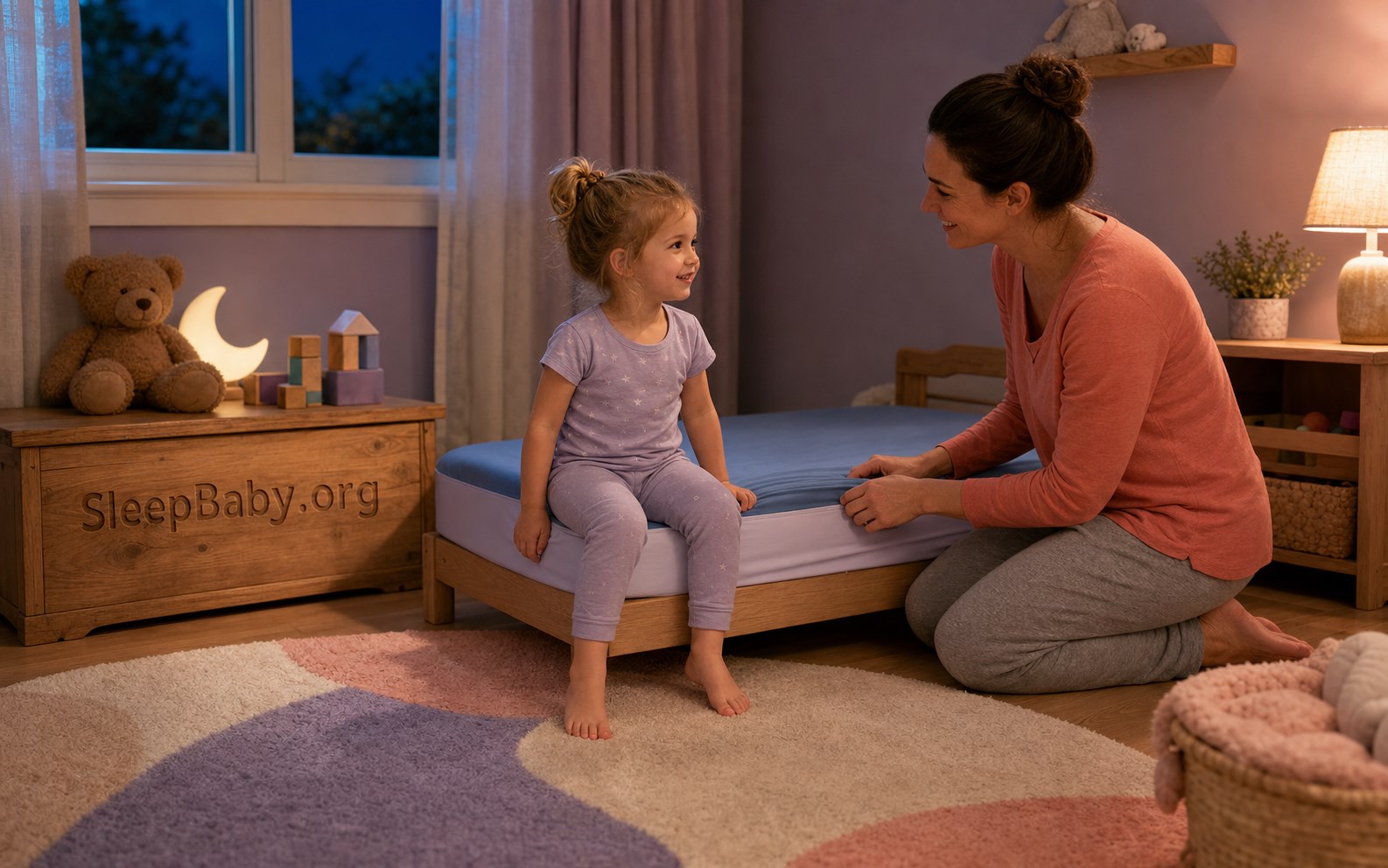
A toddler compression sheet is usually a tube or sleeve of stretchy fabric that wraps around a mattress. The child lies beneath the upper stretch layer while the ordinary fitted sheet remains on the mattress. As the child pushes against the fabric, it provides resistance around part of the body. The sensation comes from tension in the fabric, not from added weight.
That makes a compression sheet different from a weighted blanket, weighted sleeping bag, weighted stuffed animal, or a caregiver pressing down with their hands. It is also different from a body sock used during supervised play. Those products may all be described with the same warm-sounding phrases—“deep pressure,” “proprioceptive input,” or “a calming hug”—but the forces, body coverage, duration, heat, and ability to exit are not the same.
Marketing language often jumps from a plausible sensation to a promised sleep result. “Provides pressure” can describe how fabric behaves. “Helps your toddler sleep through the night” is an outcome claim that needs direct testing. A product page can explain its dimensions, materials, washing instructions, and intended use. It cannot supply missing independent evidence simply by adding the word “therapeutic.”
There is no trustworthy universal age printed in the sky. A third birthday does not suddenly create the strength, motor planning, communication, temperature regulation, or judgment needed to use every product safely. Age guidance on the label is one input. Your child’s actual ability to say no, uncover their face, sit up, turn, push the sheet away, put both feet on the floor, and leave the bed is the more useful test.
The shopping-tab moment
This is a disclosed editorial composite drawn from common parent questions, not one family’s medical history.
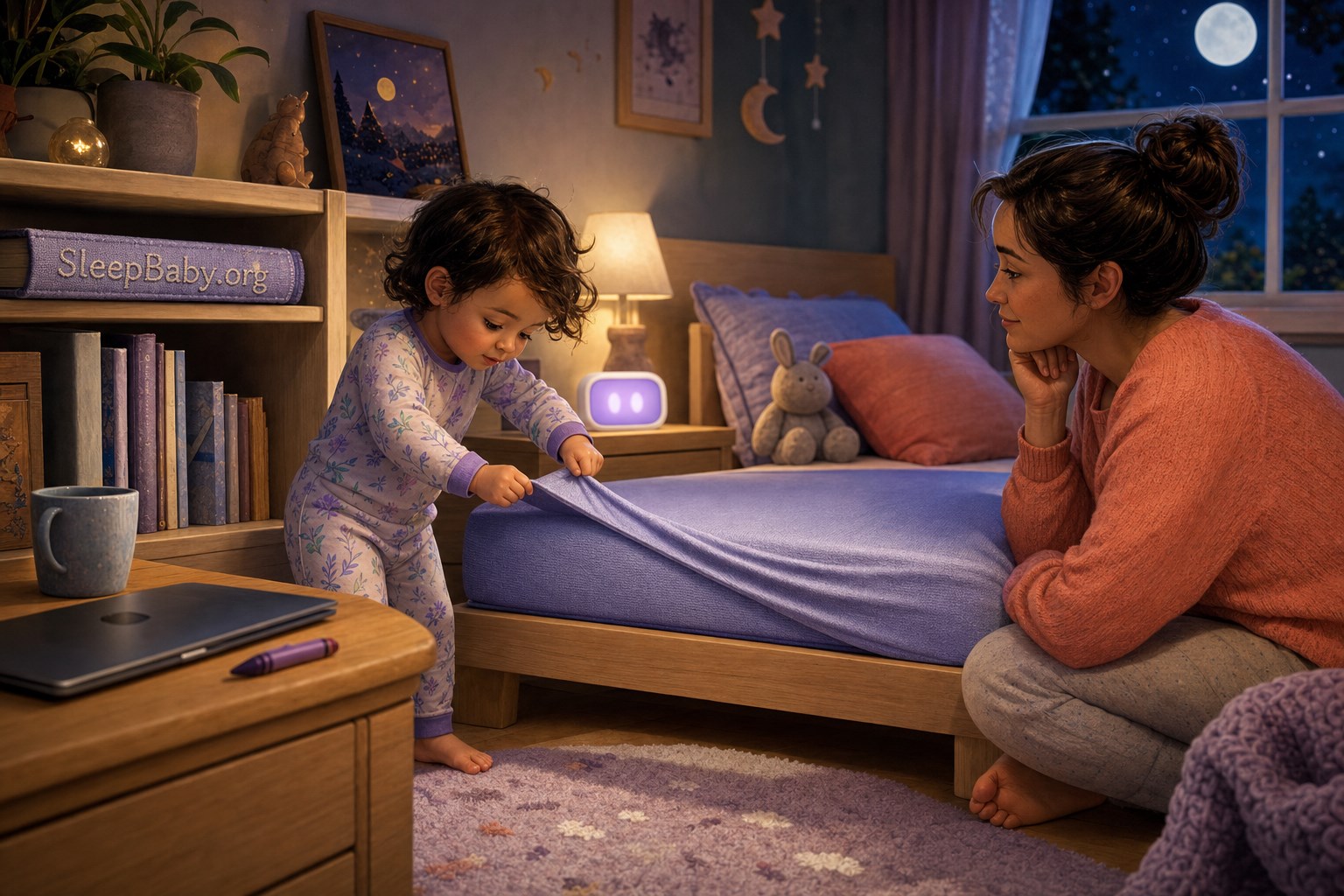
It is 11:47 p.m. The dishwasher says “End,” although nothing about the day feels finished. A parent has one compression-sheet review open, one pediatric sleep page open, and a cold mug parked beside a purple crayon. Their toddler finally fell asleep after forty minutes of rolling, kicking off the blanket, asking for the blue cup, rejecting the blue cup, and curling under the parent’s arm as if firm contact were the only quiet switch left in the room.
The sheet seems to offer an irresistible equation: child likes pressure + fabric stays on the mattress = sleep solved. That hope is not foolish. It is what tired brains do when a product appears to organize a messy problem. But the equation is missing several terms: What kind of pressure? For which child? Awake or asleep? For how long? With what heat? Can the child leave? And did measured sleep improve, or did the product simply look calming for a few minutes?
In the composite parent’s own words: “I am not trying to win bedtime. I just want to find the sensation that lets my child’s shoulders soften without taking away their way out.”
The tender part is easy to recognize. The parent is not trying to win bedtime. They are trying to find the sensation that lets their child’s shoulders soften. The safer way to honor that instinct is to make the promise smaller and the observation better.
Your first decision
Choose one of three paths before pajamas
Use this as a screening guide, not medical clearance. Read the words, the explanation, and the child’s abilities together; the decision does not depend on color.
Three-path decision guide
-
Skip it tonight
The exit is not unquestionably easy. Do not trial the sheet if your child is under 12 months, cannot communicate distress, cannot remove the fabric and leave independently, is ill, is already overheated, or has current breathing difficulty. Do not use it to prevent climbing, wandering, or getting out of bed.
-
Ask first
Health or developmental factors change the question. Bring the exact product to the pediatrician—and, when sensory participation is the concern, a qualified occupational therapist—if your child has breathing, heart, circulation, muscle-tone, mobility, seizure, skin, temperature-regulation, or developmental concerns, or cannot reliably report discomfort.
-
Cautious awake trial
An older toddler has a clear voice and a clear exit. Consider only a brief daytime test when the product fits the mattress exactly, your child freely chooses it, the face and neck remain clear, breathing and temperature look normal, movement is easy, and the child can get fully out several times without coaching.
A child-controlled safety screen
The SleepBaby.org Open-Door Check
Comfort is a door your child can open from the inside. A compression sheet does not pass because an adult can quickly pull it away. It passes only when the child can recognize discomfort, uncover themselves, sit up, push the fabric aside, and leave—calmly, independently, and repeatedly.
This is a practical screening framework, not a guarantee of safety or effectiveness.

The infant boundary is simple: do not add a compression sheet
The American Academy of Pediatrics’ infant safe-sleep recommendations apply through the first birthday. They call for a firm, flat, noninclined sleep surface with a fitted sheet and no soft or weighted objects in the sleep area. The policy specifically advises against weighted blankets, weighted sleepers, weighted swaddles, and other weighted objects for infants. It does not establish compression sheets as approved infant sleep equipment. [1]
That is why this guide draws a bright line at 12 months: do not add a stretchy compression layer to an infant crib, bassinet, portable crib, or play yard. A product being unweighted does not make it part of the tested infant sleep setup. “But it is tight, not loose” is not evidence that it is safe for a baby’s airway, movement, temperature, or sleep environment.
If you arrived here with a child near the first birthday, use the infant recommendation until they are past it, then reassess the entire question based on development—not on the package’s most optimistic age range. Our guide to a 22-month-old sleep schedule can help you look at timing and nap pressure without adding a product to the sleep space.
Evidence decoder
What research actually says about compression and sleep
A pilot study was registered in the United Kingdom to test one commercial compression sheet in autistic children with chronic insomnia. The planned crossover study included sleep diaries, under-mattress pulse and breathing monitoring, and wrist actigraphy; the University of Southampton now lists the project as inactive, with no research output attached. We found no published, peer-reviewed results from that project and no trial specifically answering whether stretchy mattress compression sheets improve sleep in toddlers. A registered study is encouraging evidence that the question is being taken seriously—but it is not a result. [12]
The closest published direct-compression sleep study we found evaluated sensory compression garments in four autistic children ages 4 to 10. Sleep responses varied by child and were not consistent across the small single-subject study. A garment is not a mattress sheet, and four older children cannot answer the toddler question. [4]
The best-known pediatric weighted-blanket trial is also indirect. In a randomized crossover trial involving autistic children ages 5 to 16, weighted blankets did not improve total sleep time, sleep-onset latency, or night waking on objective measures, although children and parents tended to prefer the weighted blanket. Preference was real; objective sleep improvement was not. [2]
A later randomized trial in children with ADHD found small average improvements with weighted blankets: roughly eight additional minutes of total sleep, a modest increase in sleep efficiency, and a small reduction in wake time after sleep onset, with no significant improvement in sleep-onset latency. The participants were about nine years old on average, and the intervention was a weighted blanket. That result may justify more research; it does not establish that a compression sheet works for toddlers. [3]
A 2025 systematic review of sensory-based interventions found stronger evidence for some deep-pressure techniques than for many other sensory approaches, but outcomes and methods varied and the authors still called for better research on specific interventions and functional results. “Deep pressure has some evidence somewhere” is not the same statement as “this sheet improves this toddler’s sleep.” [7]
Evidence strength by question—not by marketing category
| Question | What we found | What you may conclude | What remains unknown |
|---|---|---|---|
| Do toddler compression sheets improve overnight sleep? | A child study was registered, but no peer-reviewed results were found; no toddler-specific trial answered this question. | Effectiveness remains unproven. | Results of the pilot, toddler applicability, who benefits, tension, durability, adverse events, and long-term outcomes. |
| Do compression garments improve children’s sleep? | A four-child study showed variable, inconsistent responses. | Some individual preference is possible; general benefit is not established. | Whether garments and sheets produce comparable effects. |
| Do weighted blankets improve pediatric sleep? | One autism RCT found no objective benefit; one ADHD RCT found small average changes. | Evidence is mixed and indirect for this question. | Relevance to toddlers and unweighted stretch fabric. |
| Can sensory input feel calming? | Professional guidance and broader deep-pressure research support individualized, observed use in some contexts. | A child’s calm response can be noted as preference. | Whether that feeling produces safer or better sleep overnight. |

A calm-looking child and a better night are two different outcomes
A parent can truthfully say, “My child asked for it,” “Their body looked less wiggly,” or “They smiled when they climbed under it.” Those observations matter. They describe comfort and preference. They do not, by themselves, tell us whether sleep began sooner, lasted longer, involved fewer calls for help, or left the child more rested.
This distinction protects families from two opposite mistakes. The first is dismissing a child’s preferred sensation because the group evidence is thin. The second is promoting that preference into a medical claim because the child looked peaceful once. You can respect the individual response and still keep the evidence label honest.
Ask the product to earn only one job at a time. If the goal is settling, record settling. If the goal is fewer wakes, count wakes. If the goal is less distress around pajamas and bedding, note distress. “Sleep was better” is too roomy; hope can move into it before the data arrives.
A useful outcome includes the next day. Five fewer bedtime minutes do not count as a win if the child wakes sweaty, calls for rescue, refuses the bed the following night, or is unusually tired in the morning. The whole night gets a vote.
Before any trial, screen the risks the product page cannot see
This is the no-joke section. A child who cannot breathe easily, stay at a comfortable temperature, move freely, and end the experience does not belong in the sheet. Stop the trial rather than adjusting the child to tolerate it.
Breathing and airway
Do not place compression fabric over the neck, face, or head. Skip the trial and talk with the pediatrician if your child snores loudly and regularly, gasps, has observed breathing pauses, breathes through the mouth most nights, sleeps in unusual positions to breathe, or is notably sleepy or behaviorally changed during the day. These can be clues associated with pediatric sleep-disordered breathing; they require assessment, not more bedtime pressure. [9]
Remove the fabric immediately for new breathing difficulty. In the United States, call 911 for severe trouble breathing, a child who has stopped breathing or passed out, or lips or face that look blue or gray. [11] Our sleep red-flags guide can help organize nonemergency symptoms to bring to your clinician, but it does not replace urgent care.
Heat and skin
Stretch fabric adds another layer and may trap warmth differently from ordinary bedding. Start in daytime, in the room and pajamas you expect to use, and touch the child’s chest or back rather than judging by hands and feet alone. Stop for unusual sweating, flushing, clammy skin, a complaint of feeling hot, or behavior that says the child is uncomfortable. If sweating is frequent without the sheet, review the possible causes and warning signs in our guide to sweating during sleep and tell the pediatrician what you observe.
Do not use a torn, frayed, pilled, or stretched-out product. Stop for pain, numbness, tingling, swelling, cold or discolored hands or feet, new rash, broken skin, or pressure marks that do not fade promptly. Those are not “getting used to it.”
Movement and exit
The child should be able to roll both directions, bend hips and knees, sit up, uncover the upper body, find the sheet’s edge, place both feet on the floor, and leave without an adult opening the fabric. Test when the child is calm and again after ordinary wiggling has shifted their position. One lucky exit is not enough.
Never tuck, clip, pin, tie, double, knot, or layer the sheet to increase tightness. Never pair it with a weighted blanket or other weighted sleep product to “boost” the effect. Different products can add heat, resistance, and exit difficulty in ways that have not been studied together.
Communication and consent
A verbal “yes” helps, but behavior counts too. Pulling away, freezing, nervous laughter, pushing at the neck, repeatedly checking the opening, becoming unusually still, or refusing the bed are reasons to stop. A quiet child is not automatically a comfortable child. Compliance is not the sleep outcome.
When to ask a pediatrician or occupational therapist
Start with the pediatrician when the sleep difficulty may have a medical driver: persistent snoring or gasping, breathing pauses, eczema or itching, reflux symptoms, pain, restless legs, seizures, frequent overheating, medication changes, developmental regression, or major daytime sleepiness. Bring a short video of the concerning sleep behavior when it is safe to record, plus a one-week log. A product should not blur a symptom that needs diagnosis.
An occupational therapist can help when the central question is how sensory preferences affect daily participation: dressing, toothbrushing, transitions, play, regulation, or the bedtime routine. AOTA describes sleep preparation and participation as part of occupational therapy’s scope, but that does not mean every OT recommends compression products or that a diagnosis automatically makes one appropriate. The assessment should be individualized. [10]
Bring the actual item or exact product page, not just the words “sensory sheet.” Ask the clinician to look at material, mattress fit, tension, openings, age range, cleaning wear, body coverage, and how your child would exit. If a recommendation depends on a specific setup, write that setup down.
Five useful questions for the appointment
- What problem are we trying to solve: sensory comfort, bedtime resistance, night waking, or something medical?
- What child-specific factor makes this product reasonable—or unreasonable?
- What would a successful trial look like in measurable terms?
- What signs mean stop immediately, and what signs mean call you?
- What lower-risk awake strategy or routine change should we try first?
Cart-page translation
Turn common marketing claims into answerable questions
A claim decoder for the moment when every product sounds “clinically inspired”
| Claim you may see | What it may reasonably mean | What to ask before believing more |
|---|---|---|
| “Provides calming deep pressure” | The fabric is intended to create a firm stretch sensation. | Was calm measured? In what ages, setting, duration, and comparison group? Was this exact product tested? |
| “Promotes melatonin” | Usually a proposed mechanism borrowed from broader pressure claims. | Is there a human study measuring melatonin while children used this product? If not, it is not established. |
| “Safer than a weighted blanket” | The item may add no mass. | Safer for whom, against which outcome, and supported by what independent comparison? Unweighted does not mean risk-free. |
| “Recommended by therapists” | Some individual professionals may use or discuss sensory tools. | Which licensed profession, what conflicts of interest, what child selection, and is the statement an endorsement or evidence? |
| “Fits ages 3+” | The manufacturer has chosen an age range. | What functional abilities are still required? What mattress sizes and contraindications are listed? |
| “Parents report better sleep” | Some customers perceived benefit. | Were outcomes defined, independently collected, compared, and tracked beyond the first few nights? |
Parent reviews can tell you about seams, heat, washing, durability, sizing surprises, and whether children tended to enjoy the sensation. They cannot establish a medical benefit or reveal how many families quietly stopped using the item and never reviewed it.

The awake fit-and-exit sequence
Test the doorway before you test sleep
Do this in daylight or with the room fully lit, while your child is healthy, calm, and wide awake. Keep the first trial short. An awake test cannot prove overnight safety, but it can reveal obvious reasons not to proceed.
- Verify the product and mattress. Read the complete instructions, warnings, age guidance, mattress dimensions, orientation, fabric-care limits, and replacement guidance. Confirm the exact mattress size; do not improvise with a similar-looking bed.
- Inspect the fabric. Look for tears, weak seams, stretched openings, pilling, loose threads, or damage from washing. Make sure no zipper, tie, clip, pin, cord, or repair creates a catch point.
- Use ordinary pajamas and one change at a time. Do not introduce a new heavy pajama, weighted item, medicine, white-noise setting, and compression sheet on the same night. You need to know what changed.
- Invite, do not place. Show your child how it works and let them choose whether to slide under. Agree on a simple stop word or gesture. “Off” ends the trial immediately, even if the parent thinks the fit looks fine.
- Check face, neck, breathing, and temperature. The sheet stays below the shoulders. Watch easy, quiet breathing, normal color, ordinary movement, and a comfortable chest or back. Stop for distress or heat.
- Ask for normal movement. Have the child roll each direction, bend knees, lift hips, sit up, reach the edge, and reposition without help. The task should not look like a strength test.
- Run three independent exits. From different comfortable positions, the child uncovers the upper body, sits up, pushes the fabric away, places both feet on the floor, and leaves the bed. Do not point to the opening or pull it wider.
- Listen after the novelty wears off. Pause. Ask how the belly, chest, legs, and temperature feel. Then notice the unprompted answer: do they climb back in, move away, or become watchful?
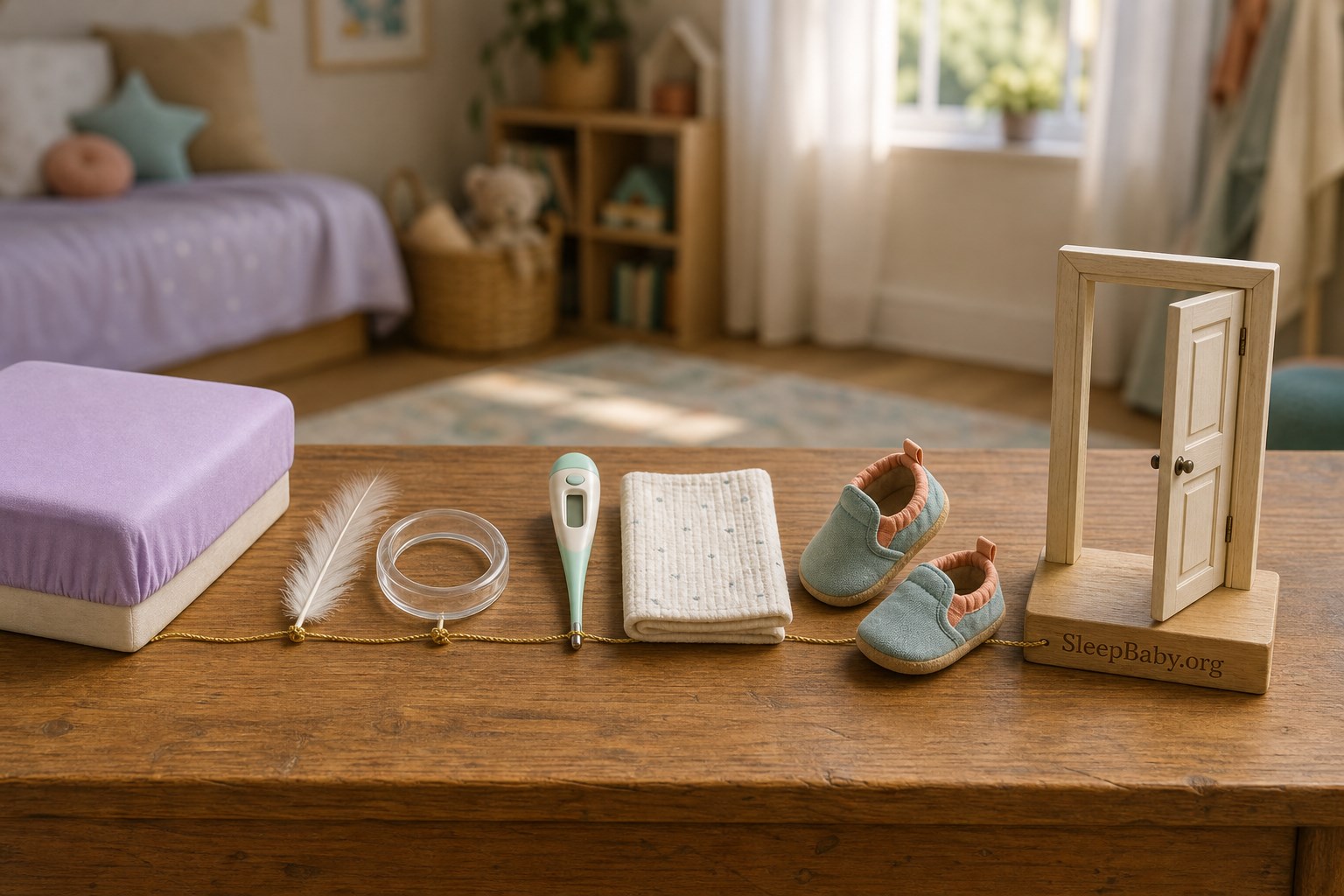
NHS occupational-therapy sleep guidance mentions Lycra or compression sheets as a possible source of calming pressure and explicitly says the child must be able to get out. That is practice guidance, not a clinical trial showing better sleep. [8]
My rule for this test is deliberately strict: if I have to point to the opening, widen it, or coach the next move, I have not watched an independent exit.
If any exit requires help, the result is no. Do not train the child to pass the test. The point is to discover the ability they already have in this exact setup.
If a clinician agrees, use a small trial with a real stop rule
Before considering sleep use, collect a baseline for three to seven ordinary nights without the sheet. Record only details you can observe consistently. Then, if your child’s clinician and the product instructions support proceeding, compare a short planned trial. Do not keep going because the item was expensive or because night one happened to be good.
A simple seven-night outcome log
| Night | Sheet used? | Minutes to sleep | Wakes / calls for help | Heat, distress, or exit problem | Morning mood and energy |
|---|---|---|---|---|---|
| 1 | Yes / No | ___ | ___ | ___ | ___ |
| 2 | Yes / No | ___ | ___ | ___ | ___ |
| 3 | Yes / No | ___ | ___ | ___ | ___ |
| 4 | Yes / No | ___ | ___ | ___ | ___ |
| 5 | Yes / No | ___ | ___ | ___ | ___ |
| 6 | Yes / No | ___ | ___ | ___ | ___ |
| 7 | Yes / No | ___ | ___ | ___ | ___ |
Choose the stop rule before the first sleep trial. Stop immediately for any safety symptom, inability to exit, or child refusal. Also stop if the sheet makes no clear, repeatable improvement in the outcome you selected. “Maybe it will work if we make it tighter” is not a next step.
Expect normal night-to-night noise. A late nap, illness, travel, new skill, exciting visitor, or unusually active day can change sleep. The goal is not to publish a household clinical trial. It is to keep one hopeful night from becoming a permanent conclusion.
Give the ordinary sleep levers a fair turn first
A predictable bedtime routine has better direct evidence in toddlers than compression bedding. In a study of 405 mothers and children ages 7 to 36 months, introducing a consistent nightly routine improved sleep onset, night waking, sleep continuity, and maternal mood. [5] A newer randomized trial of a parent-focused behavioral sleep program for preschool children also found improvements in child sleep and related family outcomes. [6]
That does not mean every hard bedtime disappears after “bath, book, bed.” It means timing, repetition, response patterns, and the child’s actual sleep opportunity deserve attention before a sensory product becomes the lead character.
- Check the schedule. A child who is not sleepy yet can look sensory-seeking because the body is still ready to move. Use our flexible 2-year-old sleep schedule to compare wake time, nap timing, and bedtime without treating one clock time as law.
- Protect a short, repeatable sequence. Three or four calm steps usually work better than a twelve-step bedtime pageant no adult can sustain.
- Watch the last nap. If sleep close to bedtime is stealing pressure from the night, use the three-way late-nap test.
- Respect bedding preferences. Some toddlers genuinely dislike fabric over their bodies. Our guide for a toddler who hates covers can help separate warmth, texture, and autonomy.
- Change one variable. If bedtime, nap, pajamas, lighting, and bedding all change together, you learn nothing from a better night.
Toddlers can reject a sock seam as if it filed paperwork against them. Believe that specificity. A child who seeks bear hugs in the kitchen may still hate steady pressure in bed. Sensory preference changes with context, fatigue, temperature, and control.
Let the shape of the sleep problem choose the next step
“My toddler does not sleep” can describe several different nights. A compression sheet is unlikely to answer all of them, and treating them as one problem makes a product review more persuasive than it should be. Name the pattern before you name the solution.
The child is cheerful and busy long after lights-out
This often points first to timing, nap pressure, or a routine that begins before the child is biologically ready for sleep. Compare wake time, nap end, activity, and actual sleep onset for a week. A sheet may make the child look contained without making the child sleepier. If bedtime moves thirty minutes later and sleep onset becomes easier, the useful intervention was timing.
The child is tired but becomes frantic during the routine
Look at transitions, separation, sensory irritants, and how many decisions arrive at once. Is the bathroom fan loud? Are pajamas itchy? Does the child fear the dark room but relax when the hall light is visible? Does firm contact help only when the child requests it? Reduce the routine to a few predictable steps and offer controlled choices. A compression product may be one preference to discuss, but the pattern is broader than fabric tension.
The child falls asleep, then wakes repeatedly
Do not assume that more pressure will “keep” sleep. Record when wakes occur, what the child asks for, whether they are hot or itchy, whether they snore, and whether they can return to sleep in the same conditions present at bedtime. Frequent waking can reflect schedule, environment, learned response patterns, discomfort, illness, or a medical sleep problem. It deserves its own investigation.
The child thrashes, snores, gasps, or sleeps in unusual positions
This is not a home sensory-product experiment. Video a representative episode if it is safe to do so, note frequency, and talk with the pediatrician. A child may look as though they need something to hold the body still when the body is actually working to breathe or escape discomfort. The aim is not to make the sleep look quieter; it is to understand what the movement is communicating.
The child dislikes loose covers but likes fitted clothing
Separate three possible needs: warmth, predictable texture, and pressure. Fitted pajamas may solve the first two without adding a mattress sleeve. Ask what the child likes—the absence of shifting fabric, the warmth, the smooth seam, or the snug sensation. The smallest accurate solution is usually easier to evaluate and easier for the child to control.
The child asks for squeezes, crashing, or heavy work all day
Bring that whole-day pattern to an occupational therapist rather than treating bedtime in isolation. The therapist may look at regulation, motor planning, transitions, communication, school or daycare demands, and which activities help the child participate. A night product should not become a substitute for understanding a daytime need.
This pattern-first approach produces a quieter kind of confidence. You are no longer asking, “Is this product good?” You are asking, “Does this exact tool fit this exact problem, for this exact child, without creating a new one?”
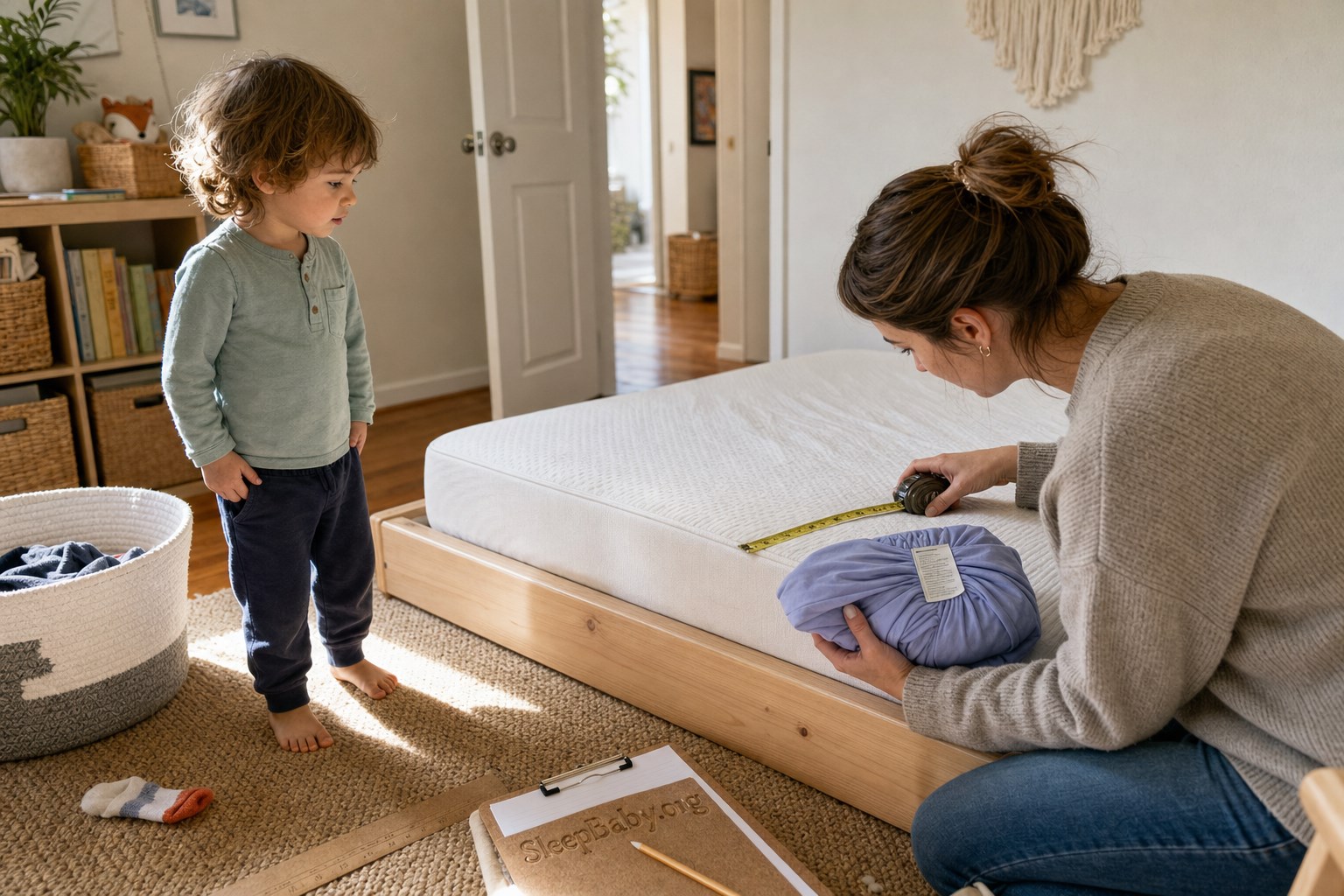
If you still plan to buy, inspect the product like safety equipment
Before checkout, save or print the instructions. Product listings change, and marketplace summaries may omit warnings that appear only on the manufacturer’s page or packaging. If you cannot find complete sizing, use, cleaning, inspection, and contraindication information, do not fill the gaps with reviews.
- Exact fit: the listing names your mattress dimensions, not merely “toddler bed” or “crib size.”
- Clear openings: the child can locate and use the exit without a hidden zipper, drawstring, clip, or adult release.
- Coverage: instructions keep fabric below the shoulders and away from the face and neck.
- Material disclosure: the fiber content and care limits are available, including what happens after repeated washing and drying.
- Warnings: age guidance, health cautions, supervision language, and stop conditions are specific rather than buried in “use responsibly.”
- Return policy: you can return a product your child dislikes without feeling forced to continue the experiment.
- No restraint framing: the company does not advertise the sheet as a way to prevent leaving bed, wandering, or climbing.
Also check whether the photographs show the same setup described in the instructions. A polished image of fabric near the shoulders can normalize a position the small print does not recommend. Pixels are not safety directions.
Lower-stakes ways to explore the need your child may be expressing
If your toddler seems to seek firm input, explore it while awake, where the child can choose, communicate, and move. The right option depends on the child and may be as ordinary as carrying books, pushing a laundry basket, climbing cushions on the floor, kneading dough, receiving a requested firm hug, or being wrapped briefly in a blanket during supervised play with the face completely clear. A qualified occupational therapist can help select activities around function and response rather than a generic “sensory diet.”
If the real request is predictable closeness, try moving connection earlier: ten quiet minutes on the rug, one repeated story, a hand on the back that fades before sleep, or a goodbye phrase the child can finish. If the request is warmth, adjust pajamas or room conditions rather than adding tension. If the request is protection from loose covers, consider whether ordinary fitted sleepwear meets the need more simply.
If your child buries their face or head under bedding, do not use a compression sheet to hold the covers in a preferred position. Review the safety considerations in our guide to a toddler sleeping with their head under covers and keep the face and airway clear.
The best alternative is not always another product. Sometimes the useful discovery is that the child settles after heavy play before bath, needs a later lights-out, prefers no blanket, or becomes more alert—not calmer—after pressure. “No purchase” is a legitimate result of good research.

Questions parents ask before buying
Are compression sheets safer than weighted blankets?
They do not add the same mass, but “unweighted” is not the same as “proven safe.” A stretch sheet can still affect heat, movement, body coverage, and exit. We did not find a direct independent comparison showing that toddler compression sheets are safer than weighted blankets.
What age can a child use a compression sheet?
Do not use one in an infant sleep space. For an older toddler, there is no evidence-based birthday that substitutes for function. Follow the product’s age and mattress rules, then apply the stricter test: clear communication, free movement, normal breathing and temperature, and repeated independent exits. Ask the pediatrician when health or developmental factors could change risk.
Can I combine it with a weighted blanket?
Do not stack pressure products as a home experiment. Combining them may add heat and make movement or exit harder, and the combination has not been established as safe or effective for toddler sleep.
Does liking tight hugs mean my toddler will like the sheet?
No. A chosen hug is brief, social, adjustable, and easy to end. A child may love firm hugs and dislike continuous fabric pressure at bedtime. Let the child’s response in the exact context decide.
Could it help an autistic or sensory-seeking child?
It may be a preferred sensation for an individual child, but diagnosis alone does not predict benefit. Direct sleep evidence for toddler compression sheets is lacking, and related studies involve different products and older children. Discuss the actual goal and setup with professionals who know your child.
How tight should it be?
Do not invent a tension level. Use only the exact mattress size and orientation specified by the manufacturer, and never tighten, double, clip, or modify the sheet. If the instructions are vague, the product is not a good candidate for a toddler sleep trial.
What if it helps falling asleep but not staying asleep?
Record those as separate outcomes. A shorter settling time does not prove fewer wakings or better rest. Check schedule, routine, environment, and medical red flags, and keep the sheet only if the defined benefit is repeatable without any safety or comfort cost.
Watch a child-led sensory-strategy demonstration
Watch: Calming Sensory Strategies — NHS Tayside CYP Occupational Therapy Service
Calming Sensory Strategies, NHS Tayside Children and Young People’s Occupational Therapy Service. The video offers examples of calming input; it does not endorse compression sheets or replace an individual assessment.
Quick takeaway: Offer sensory strategies with the child, observe whether the input is actually calming, and stop when it is alerting or uncomfortable.
Your decision can be careful without becoming fearful
A compression sheet does not have to be declared a miracle or a menace. The honest middle is more useful: direct toddler sleep evidence is missing, related evidence is indirect and mixed, and an individual child may still have a clear sensory preference.
Keep the standard beautifully plain. The child chooses it. The face and neck stay clear. Breathing is easy. Temperature is comfortable. Movement is ordinary. The child can open the door from the inside every time. Then you measure the sleep outcome you actually hoped to change.
If the sheet cannot meet that standard—or if it simply does not help—folding it into the basket is not a failed bedtime. It is a parent listening closely enough to let the evidence get smaller, the pressure come off, and the child stay in charge of their own exit.
Tonight’s next step
Make a one-page bedtime plan before you make another purchase
Write down the problem you are solving, the one routine change you will test, the symptoms you will bring to the pediatrician, and the exact stop rule for any sensory product. A calmer plan gives you something no compression sheet can: a way to learn from tonight.
Sources
-
Source 1
Moon RY, Carlin RF, Hand I; AAP Task Force on Sudden Infant Death Syndrome and AAP Committee on Fetus and Newborn. “Sleep-Related Infant Deaths: Updated 2022 Recommendations for Reducing Infant Deaths in the Sleep Environment.” Pediatrics. 2022;150(1):e2022057990. DOI: 10.1542/peds.2022-057990. PMID: 35726558. PubMed record. Reviewed August 2, 2026.
-
Source 2
Gringras P, Green D, Wright B, et al. “Weighted Blankets and Sleep in Autistic Children—A Randomized Controlled Trial.” Pediatrics. 2014;134(2):298–306. DOI: 10.1542/peds.2013-4285. PMID: 25022743. PubMed record. Reviewed August 2, 2026.
-
Source 3
Lönn M, Svedberg P, Nygren J, Jarbin H, Aili K, Larsson I. “The Efficacy of Weighted Blankets for Sleep in Children with Attention-Deficit/Hyperactivity Disorder—A Randomized Controlled Crossover Trial.” Journal of Sleep Research. 2024;33(2):e13990. DOI: 10.1111/jsr.13990. PMID: 37452697. PubMed record. Reviewed August 2, 2026.
-
Source 4
Mische Lawson L, Foster L, Hodges M, Murphy M, O’Neal M, Peters L. “Effects of Sensory Garments on Sleep of Children with Autism Spectrum Disorder.” Occupational Therapy International. 2022;2022:2941655. DOI: 10.1155/2022/2941655. PMID: 35241995; PMCID: PMC8858038. Full text. Reviewed August 2, 2026.
-
Source 5
Mindell JA, Telofski LS, Wiegand B, Kurtz ES. “A Nightly Bedtime Routine: Impact on Sleep in Young Children and Maternal Mood.” Sleep. 2009;32(5):599–606. DOI: 10.1093/sleep/32.5.599. PMID: 19480226; PMCID: PMC2675894. Full text. Reviewed August 2, 2026.
-
Source 6
Donovan CL, Shiels A, Legg M, Meltzer LJ, Farrell LJ, Waters AM, Gradisar M. “Treating Sleep Problems in Young Children: A Randomised Controlled Trial of a Group-Based, Parent-Focused Behavioural Sleep Intervention.” Behaviour Research and Therapy. 2023;167:104366. DOI: 10.1016/j.brat.2023.104366. PMID: 37421900. PubMed record. Reviewed August 2, 2026.
-
Source 7
Piller A, McHugh Conlin J, Glennon TJ, Andelin L, Auld-Wright K, Teng K, Tarver T. “Systematic Review of Sensory-Based Interventions for Children and Youth (2015–2024).” Frontiers in Pediatrics. 2025;13:1720179. DOI: 10.3389/fped.2025.1720179. PMID: 41321460; PMCID: PMC12658592. Full text. Reviewed August 2, 2026.
-
Source 8
Essex Partnership University NHS Foundation Trust. “Bedtime and Sleep Advice.” Produced September 2023; review date September 2026. PDF guidance. Reviewed August 2, 2026.
-
Source 9
National Heart, Lung, and Blood Institute. “Sleep Apnea in Children.” NHLBI guidance. Reviewed August 2, 2026.
-
Source 10
American Occupational Therapy Association. “Sleep.” Professional practice overview. Reviewed August 2, 2026.
-
Source 11
American Academy of Pediatrics, HealthyChildren.org. “Trouble Breathing.” Pediatric symptom guidance. Reviewed August 2, 2026.
-
Source 12
UK Health Research Authority. “Fidgetbum for Insomnia in Children with ASD.” IRAS ID 287539; London–Bromley Research Ethics Committee reference 21/LO/0583; favorable opinion October 18, 2021. Study summary. Cross-checked against the University of Southampton project record, which lists the project as inactive and shows no research output. Reviewed August 2, 2026.