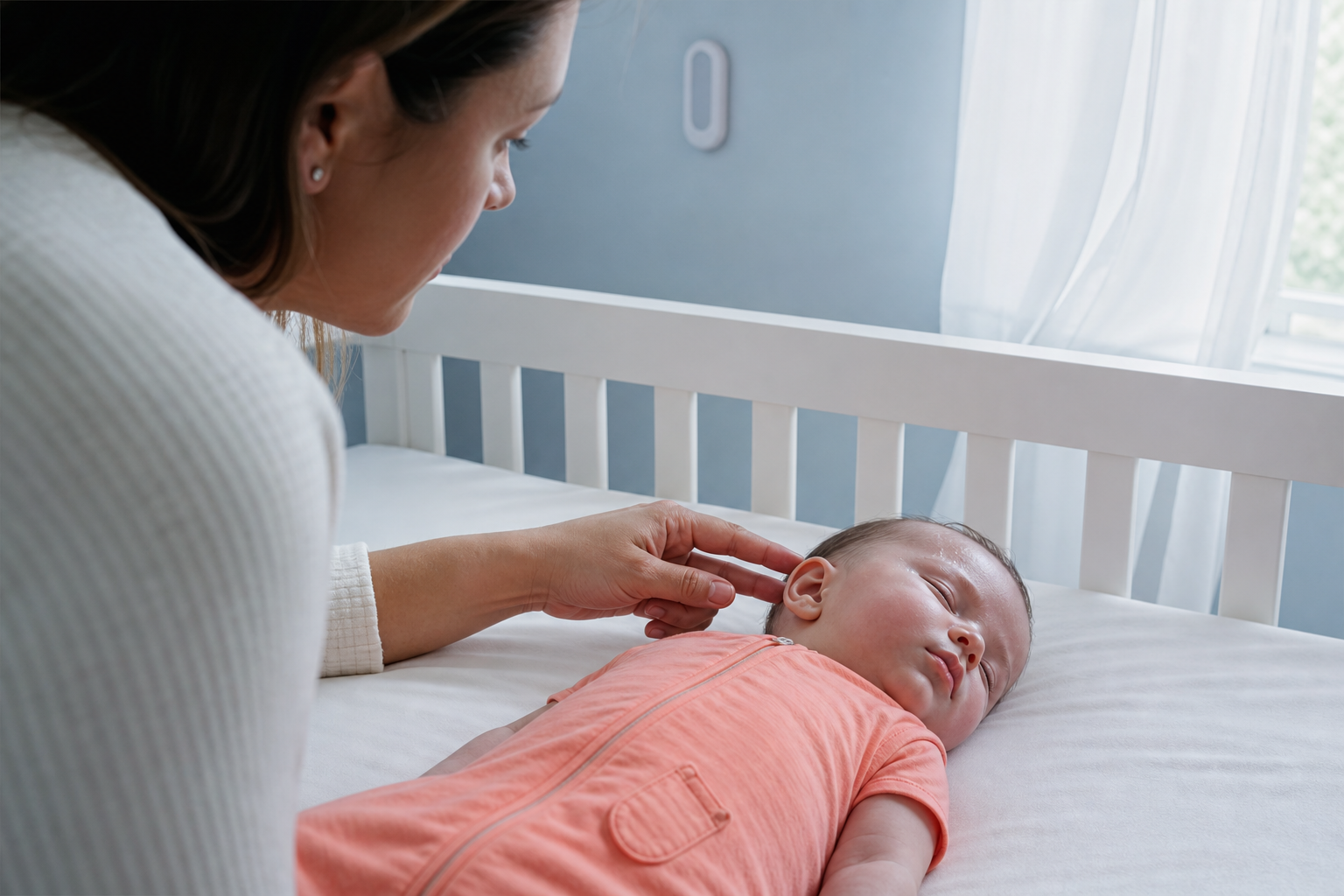
The damp crescent where your baby’s head rested can look startlingly large at 2:08 a.m. You touch the pajamas, then the chest, then your own forehead as though the household has appointed you night-shift meteorologist with no training and one dim lamp.
Check this before troubleshooting the room
Get urgent help when sweating comes with breathing, color, or responsiveness changes
Call emergency services now if your baby is struggling to breathe, grunting, pulling in under the ribs, blue, grey, very pale or blotchy, floppy, unresponsive, or unusually difficult to wake. Those signs matter more than how wet the pajamas are. If your baby is under 3 months and has a measured temperature of 100.4°F (38°C) or higher, seek prompt medical guidance. Follow the age-specific instructions from your pediatrician or local urgent-care service.
The short answer: a baby sweating in sleep is often too warm because of the room, clothing, swaddle, or covered head—but sweat alone cannot tell you why. Check the baby’s chest or back of the neck, remove an excess layer, keep the head uncovered, and preserve a firm, flat, empty sleep space. If illness is possible, measure the baby’s body temperature with an appropriate thermometer. Repeated drenching sweat in a comfortably dressed baby, especially with breathing trouble, poor feeding, poor growth, fever, or unusual tiredness, deserves a pediatrician’s review.
The private question underneath this search is usually not “Do babies have sweat glands?” It is “Am I dismissing something important?” I would make that question smaller and more useful: What is happening alongside the sweat, and does one safe change alter the pattern?
“Temperature” means two different things tonight
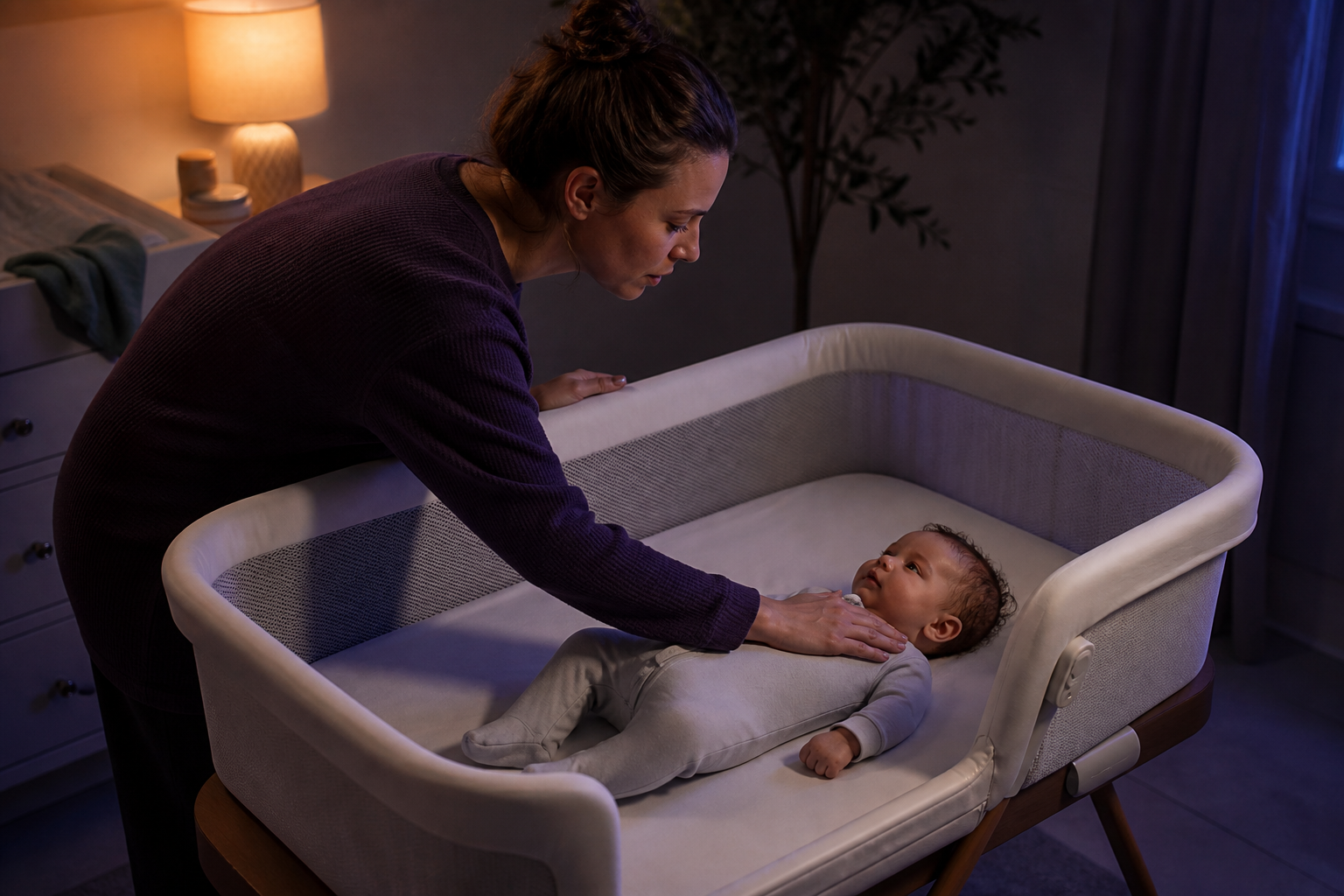
Parents are often told to “check the temperature,” which is admirably concise and spectacularly ambiguous. There is the room temperature, which helps you judge the sleep environment, and the baby’s body temperature, which helps identify fever. One does not substitute for the other.
The room question
Is the sleep environment adding heat? Look at pajamas, sleep sack or swaddle, indoor hat, direct sun, heating, airflow, and the conditions near the crib. A room thermometer can give you a number to compare across nights.
The body question
Does your baby have a fever or look unwell? Use an age-appropriate body thermometer and follow medical guidance. A nursery display cannot diagnose fever, and sweaty hair cannot rule it in or out.
This distinction prevents two common wrong turns. First, a warm room reading should not make you assume the baby is ill. Second, a comfortable room reading should not reassure you past a measured fever or a baby who is breathing poorly. The number belongs to the question it actually answers.
Start with the chest, not cold hands
Hands and feet can feel cooler than the baby’s core, so they are unreliable costume directors. The CDC and American Academy of Pediatrics point parents toward the chest and signs such as sweating, flushed skin, or a hot chest. Slide a hand against the chest or back of the neck. Is the skin comfortably warm, hot, clammy, or soaked? Is the head covered? Are there more layers than an adult would comfortably wear in the same room?
If your baby is breathing easily, has normal color, wakes and feeds normally, and simply feels hot, make one modest change: remove a layer or switch to lighter sleep clothing. Do not add loose bedding, a pillow, cooling pad, positioning device, or soft mattress topper. A sweaty baby still needs the same safe setup—on the back, on a firm and flat approved surface, with only a fitted sheet in the sleep space.
The wet spot is evidence, not a verdict. It tells you to look more carefully. It does not tell you, by itself, whether the cause is a warm room, too many layers, fever, or something that needs medical evaluation.
SleepBaby.org observation principle
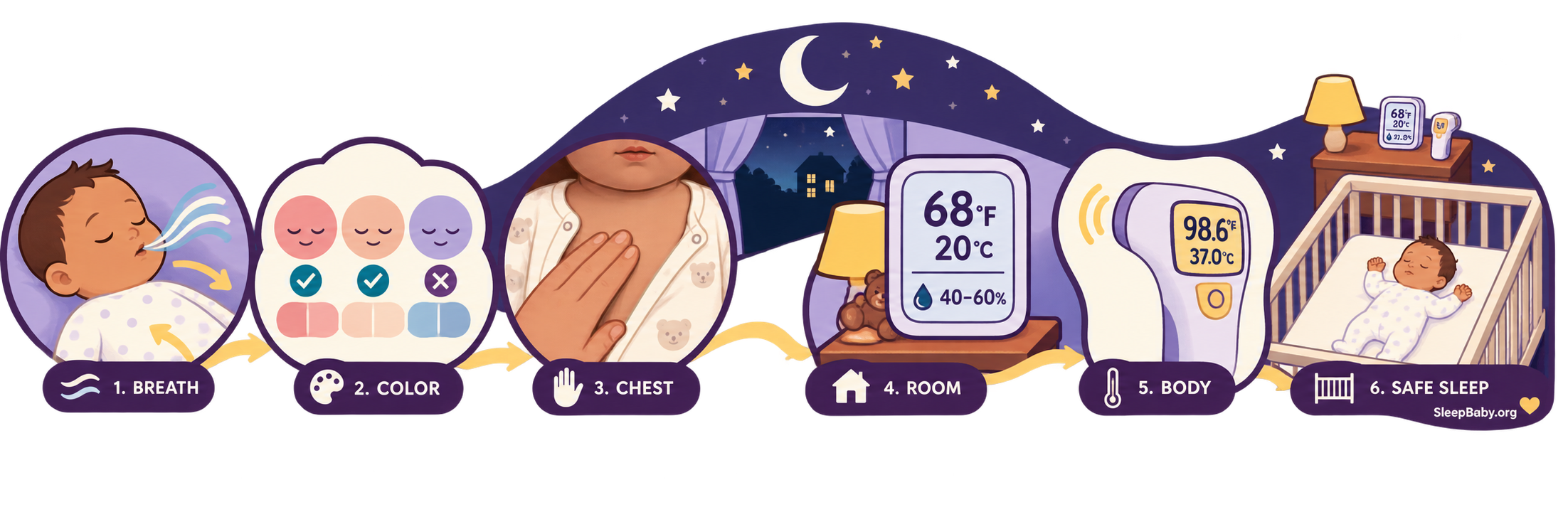
Use the CHEST check before changing the whole night
I prefer a short observation path to a frantic room makeover. CHEST is not a diagnostic score and it does not certify that a sleep product is safe. It is a way to notice the details that change the next step.
- C — Color and breathing. Is your baby’s color usual? Is breathing quiet and easy, without grunting, nostril flaring, ribs pulling in, or sustained rapid breathing? If not, stop troubleshooting and seek urgent help.
- H — Heat at the chest. Feel the chest or back of the neck. Note hot skin, damp clothing, wet hair, flushed cheeks, a covered head, or heavy layers.
- E — Environment. Measure conditions near the sleep area, never inside the crib. Check heating, sun, closed doors, and sleepwear before assuming the thermostat tells the whole story.
- S — Symptoms elsewhere. Look for measured fever, poor feeding, fewer wet diapers, cough, vomiting, unusual lethargy, or sweating during feeds.
- T — Trend. Was this one warm night after fleece pajamas, or does your baby repeatedly soak sleepwear despite comfortable conditions and light clothing?
The point is not to complete a perfect midnight worksheet. It is to prevent a damp collar from becoming either instant panic or instant dismissal. The details around the sweat are the part your pediatrician can use.
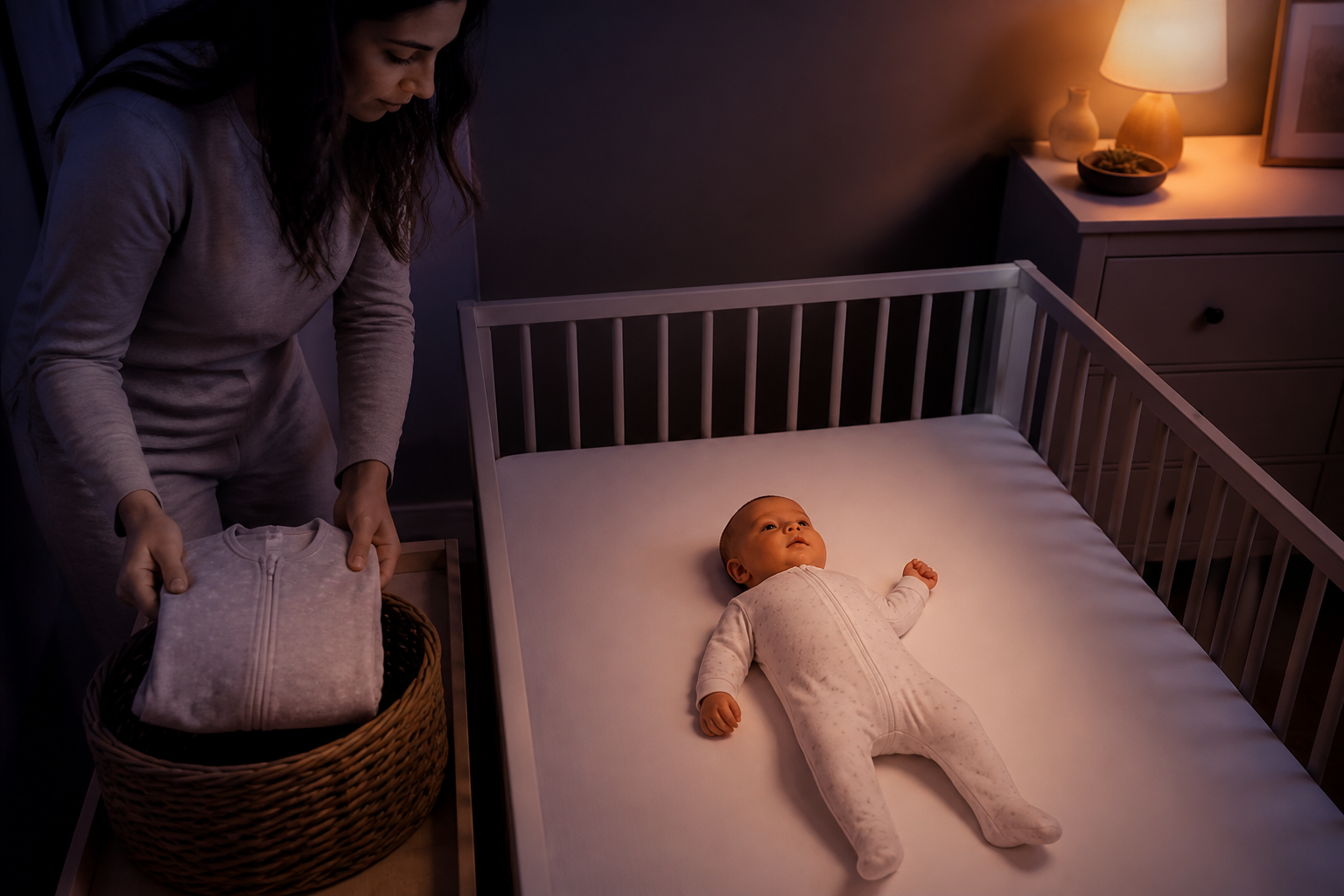
The pajama autopsy at 2:08 a.m.
This is a clearly labeled hypothetical Kacey-and-Benjamin scene, not documentary family history or medical evidence.
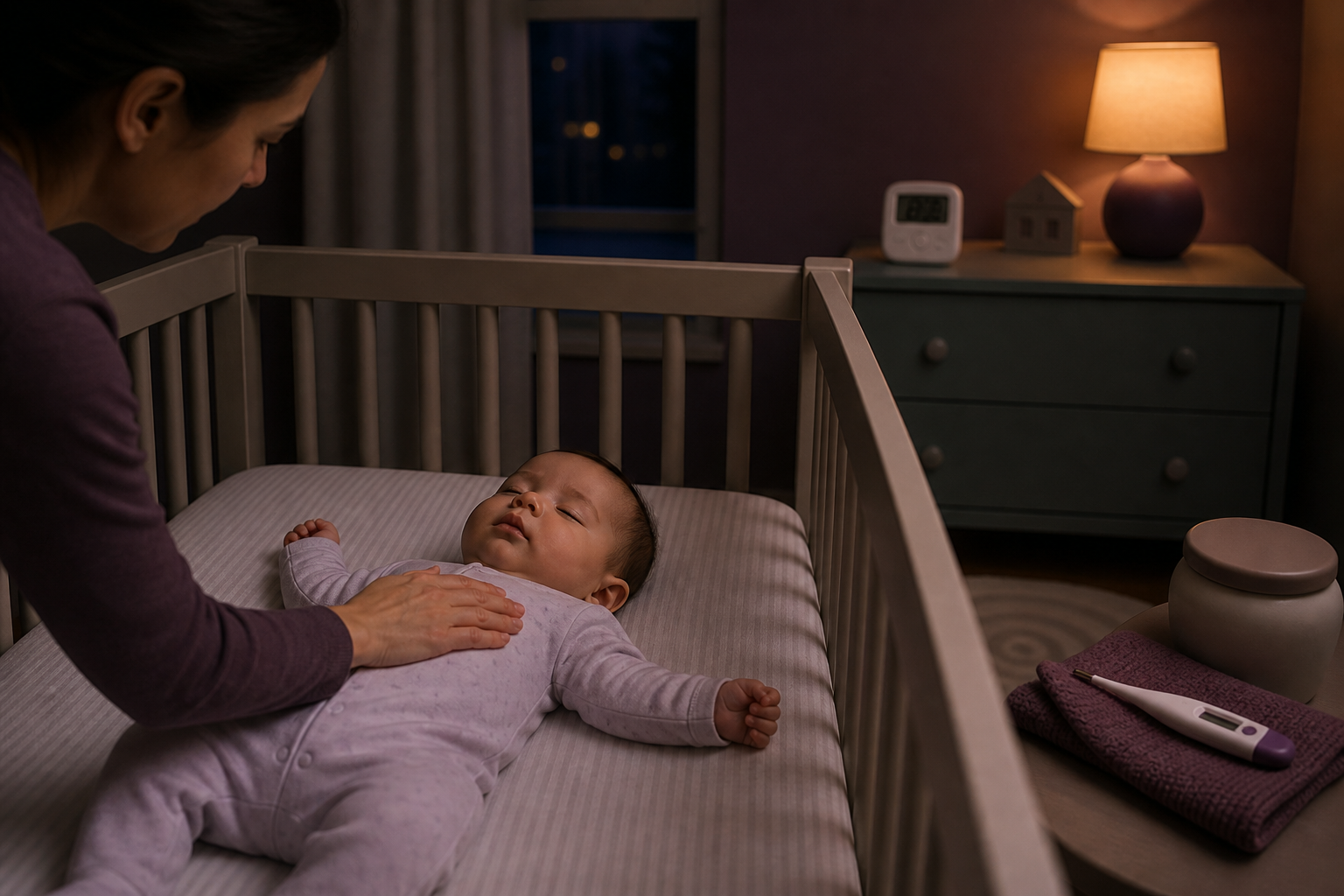
Imagine I lift a sleeping Benjamin and find the back of his cotton pajamas damp. My first impulse is to hold the fabric toward the hallway light as if it might submit a written explanation. It does not. Pajamas remain notoriously poor witnesses.
So I slow the scene down. His color looks usual. His breathing is quiet. His chest feels hot, not feverishly knowable—because hands cannot measure fever—but warmer than comfortable. The room display is higher than it was at bedtime, and the sleep sack is heavier than the one I thought I had grabbed. That combination gives me a sensible first move: one lighter layer, head uncovered, safe crib unchanged, and another check after he settles.
The scene matters because the sweat did not answer the question. The sequence did. If Benjamin were breathing hard, difficult to wake, feeding poorly, or repeatedly drenched in a comfortable room, I would not keep conducting wardrobe experiments. I would bring the pattern to a clinician.
What to adjust—and what to leave completely alone
Overheating invites overcorrection. A parent finds damp hair and suddenly every object in the nursery is being cross-examined. Change the smallest likely heat source first, then observe.
| If you notice | A reasonable first change | Do not substitute |
|---|---|---|
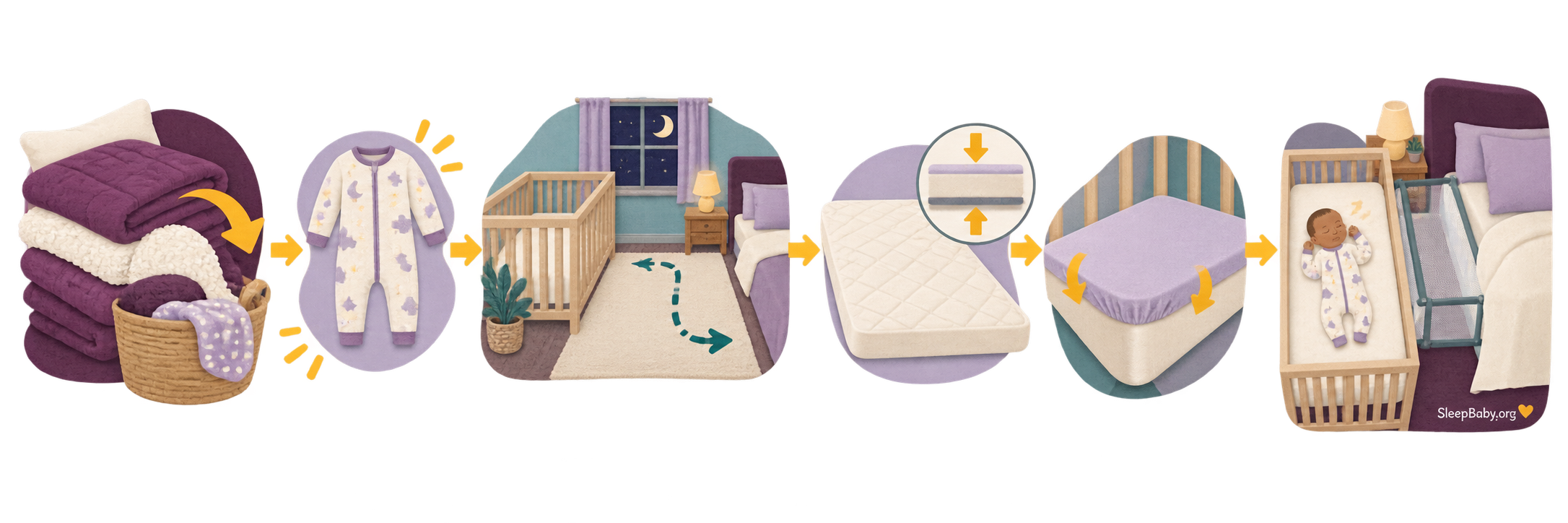
| Hot chest with heavy clothing | Remove one layer and recheck. | Loose blankets or an uncovered adult bed. |
| Indoor hat or covered head | Keep the head and face uncovered for sleep. | A pillow or positioner meant to “cool” the head. |
| Warm room | Adjust household temperature or clothing; keep cords and devices away from the crib. | Direct fan blast, cooling gel, or a mattress topper. |
| Sweating in a swaddle | Use lighter layers; stop swaddling at any sign of trying to roll. | A tighter wrap or weighted swaddle. |
The crib does not need a summer renovation. It needs to remain boring in the most protective way: firm, flat, fitted sheet, no soft objects, no weighted products, and no improvised cooling surface. Adjust the environment around safe sleep, not the safe-sleep standard itself.
Sweat is not a fever measurement
A baby can sweat because the room is warm. A fever may break with sweating. Some sick babies do not sweat. That is why touch and damp hair cannot replace a body-temperature reading when illness is possible.
The NHS defines fever as 100.4°F (38°C) or higher. Age matters enormously in deciding what happens next, especially for a baby under 3 months. Use the thermometer and method recommended for your baby’s age, then follow your pediatrician’s or local health service’s instructions. Do not use the room thermometer, a monitor’s ambient reading, or a forehead that merely “feels warm” as proof that fever is present or absent.
Call the pediatrician when sweating is joined by poor feeding, fewer wet diapers, vomiting, cough, unusual irritability, marked sleepiness, or a measured fever. Seek urgent help for breathing difficulty, color change, floppiness, unresponsiveness, or unusual difficulty waking. This is where I would stop trying to make the pajamas explain the baby.
Which sweating patterns deserve a pediatrician’s attention?
A single damp head after a warm evening is different from pajamas repeatedly soaked in a comfortable room. The second pattern still does not diagnose anything, but it is useful information to bring to the pediatrician.
- Repeated drenching: sleepwear or sheets are soaked on multiple nights despite light clothing and a comfortable room.
- Sweating with feeds: especially when feeding also brings breathlessness, fatigue, poor intake, blue or unusual color, or poor weight gain.
- Breathing during sleep: sustained fast breathing, grunting, ribs pulling in, gasping, pauses, or color change.
- Growth or energy changes: poor weight gain, much less interest in feeding, unusual tiredness, or reduced responsiveness.
- Illness signs: measured fever, cough, vomiting, diarrhea, fewer wet diapers, or a baby who simply looks unwell.
- A new unexplained trend: sweating that is becoming more frequent or intense without an obvious clothing or room change.
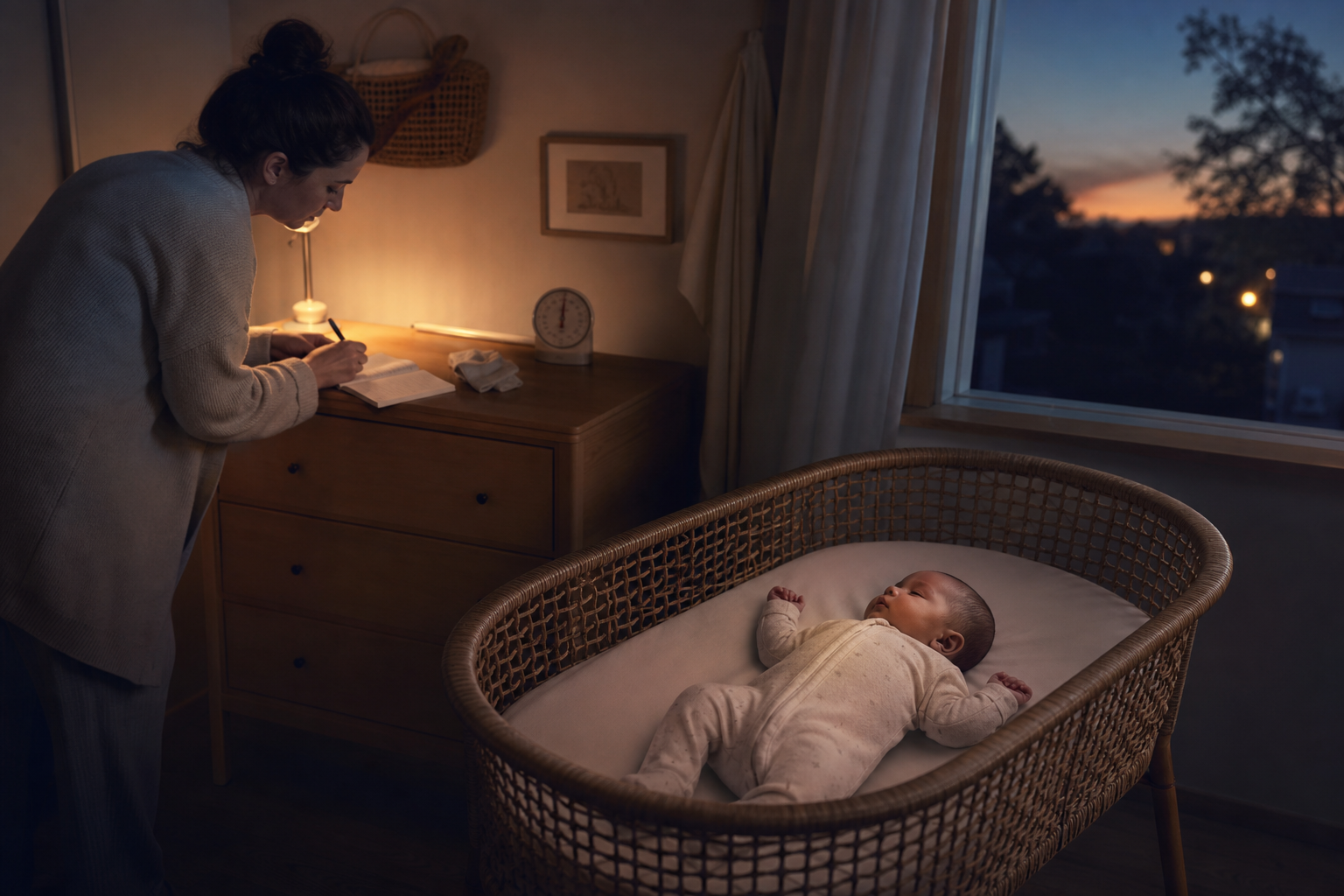
Write down when it happens, what the baby wore, the room reading, whether the chest felt hot, the measured body temperature if you took it, feeding, wet diapers, and what breathing looked like. A short factual pattern is more useful than a heroic attempt to remember three nights while sitting in an exam room.
Questions worth taking to the pediatrician
- Does the combination of sleep sweating and feeding or breathing behavior need evaluation?
- Which body-temperature method is appropriate for my baby’s age?
- Could current medication, illness, or a medical condition change how my baby regulates temperature?
- What exact breathing, color, feeding, or responsiveness change should send us to urgent care?
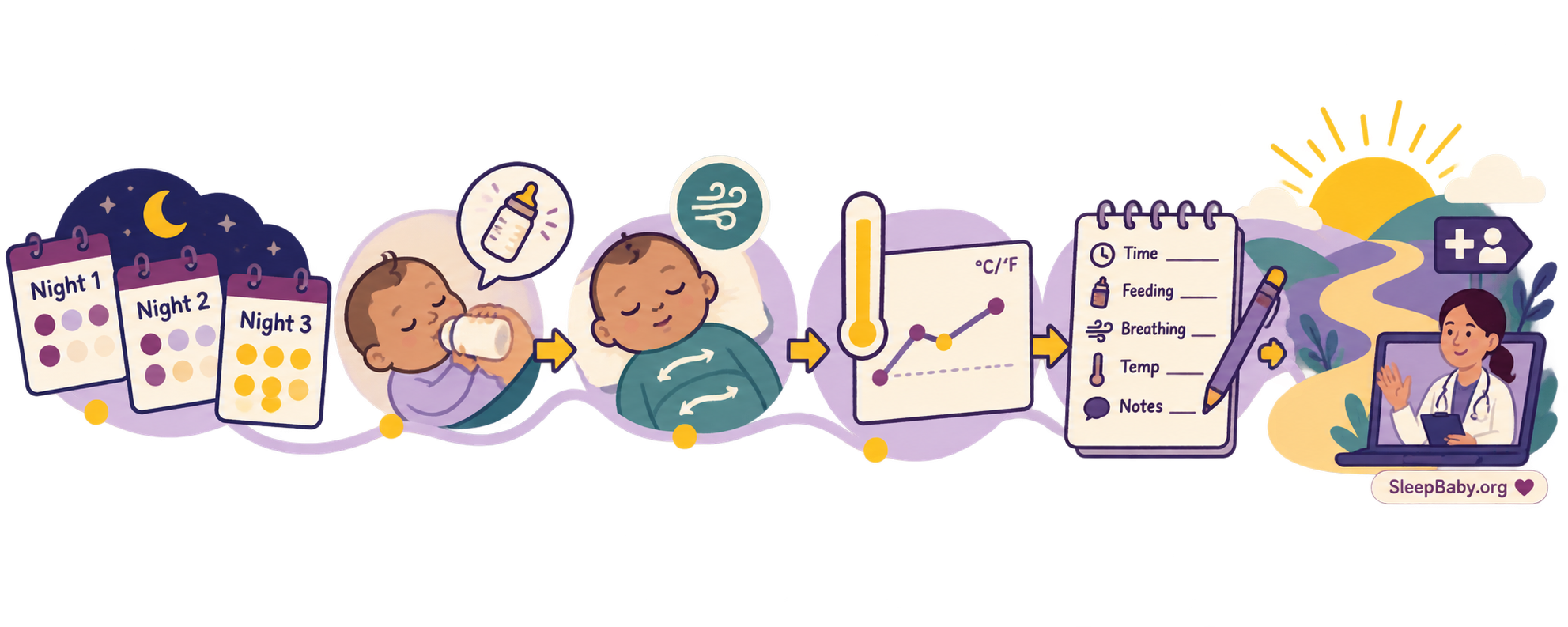
A room thermometer can answer one narrow question well
Once your baby is breathing comfortably, has normal color and responsiveness, and does not need urgent medical attention, an ambient reading can help you test the room instead of guessing from the back of the pajamas.
A practical room-check tool
ThermoPro TP50 Digital Indoor Hygrometer/Thermometer
The TP50 gives you a temperature and humidity reading near the nursery, refreshes every 10 seconds, and records high and low readings. That makes it useful for the exact question sweat raises after urgent concerns are excluded: Did this room become warmer overnight than it was at bedtime?
I prefer this job-specific tool to buying a fan first, because a fan changes airflow without telling you what the room is doing. It is also a better fit than a wearable sensor for this question because nothing needs to touch, wake, or travel into the crib with your baby. A medical thermometer remains the separate tool for body temperature.
Place the TP50 on a stable surface near the sleep area but outside the crib and completely out of the baby’s reach. Treat its “comfort” label as a device feature, not pediatric medical advice. The persuasive reason to buy it is simple: it turns “this room feels warm to me” into a reading you can compare at bedtime and after a sweaty wake.
Check the ThermoPro TP50 on Amazon
As an Amazon Associate, SleepBaby may earn from qualifying purchases.
A room reading does not tell you whether your baby has a fever, and no monitor prevents overheating or SIDS. The value is narrower and more honest: one objective environmental clue, compared with clothing, chest warmth, symptoms, and trend.
Age and context change what I would do with the same damp pajamas
A sweaty newborn, a rolling six-month-old, and an active toddler may leave a similar wet patch, but the questions around it are not identical. Age changes fever urgency, feeding expectations, swaddling safety, mobility, and the words a child can use to show discomfort.
For a newborn or young infant
I would keep the threshold for medical advice low. A young baby may show illness through feeding, alertness, breathing, color, wet diapers, or temperature rather than a dramatic complaint. If a baby under 3 months has a measured temperature of 100.4°F (38°C) or higher, seek prompt medical guidance. If the baby is sweating through feeds, tiring before finishing, breathing harder, showing unusual color, or gaining poorly, tell the clinician the whole pattern rather than leading with “night sweats.”
Skin-to-skin contact can warm both parent and baby, and feeding itself is work. Those facts may explain moisture in a specific moment, but they should not be used to wave away breathing difficulty or poor feeding. The useful comparison is before, during, and after: Does the baby recover easily? Is feeding effective? Does color remain usual? Is sweating limited to close contact, or does it recur during quiet sleep in comfortable conditions?
For a baby who is swaddled or beginning to roll
Swaddling can add warmth. Check fabric weight and the layers underneath; do not tighten the wrap because a sweaty baby seems restless. The moment your baby shows signs of trying to roll, stop swaddling. That developmental boundary does not move because the swaddle is familiar or because sleep was better in it.
A rolling baby should still be placed on the back for every sleep. If the baby rolls independently after being placed down, keep the sleep space firm, flat, and empty rather than adding a positioner. The same rule that protects the airway also keeps troubleshooting honest: you adjust clothing and room conditions without turning the crib into a collection of proposed solutions.
For an older mobile baby or toddler
Movement, warm pajamas, illness, and a heated room can all contribute. An older child may also push hair against the mattress or sleep with the head in one warm spot. Even then, repeated drenching sweat, snoring or gasping, breathing pauses, unusual daytime tiredness, poor growth, or a new illness pattern belongs in a clinician conversation. “Toddlers run hot” is not a diagnosis.
Use a one-change overnight protocol
When urgent signs are absent, I would resist changing the thermostat, pajamas, sleep sack, sound machine, and bedtime all at once. Five simultaneous changes can produce a cooler baby and absolutely no idea why. Use one safe change and watch what happens.
- Record the starting scene. Note the room reading, sleepwear layers, whether the head is uncovered, chest warmth, and whether clothing is slightly damp or soaked.
- Make one likely heat adjustment. Remove one layer or use lighter sleep clothing. Do not add a loose item, cooling pad, positioner, or modified mattress surface.
- Preserve the sleep setup. Back placement, firm flat surface, fitted sheet only, and empty crib remain unchanged.
- Recheck the whole baby. Look again at breathing, color, chest warmth, responsiveness, and comfort—not merely whether the hair dried.
- Compare the next sleep. If the pattern repeats in comfortable conditions, capture the details for the pediatrician rather than layering on more experiments.
This approach is intentionally unexciting. At midnight, unexciting is useful. It gives you a before-and-after comparison without letting a product, a thermostat number, or one better night make a larger claim than the evidence supports.
Bring a six-line record, not a theory, to the pediatrician
Parents sometimes delay calling because they cannot explain the cause. You do not need to solve the cause first. A clinician can work with observations. Write down:
- When: bedtime, first sleep cycle, early morning, naps, or during feeds.
- How much: damp hair, wet collar, soaked pajamas, or a wet sheet that requires changing.
- Environment: room reading, clothing and sleep-sack layers, head uncovered, heat or air-conditioning changes.
- Body: measured temperature when indicated, chest warmth, color, breathing, alertness, and ease of waking.
- Feeding and hydration: interest in feeds, fatigue or breathlessness during feeds, wet diapers, vomiting, or diarrhea.
- Trend: first occurrence, number of nights, increasing intensity, and whether one lighter layer changed it.
A short video of unusual breathing may help a clinician if you can record it without delaying urgent care or disturbing the baby. Never wait for better documentation when the baby is struggling to breathe, changing color, floppy, unresponsive, or difficult to wake. The record serves the appointment; the baby does not serve the record.
The questions that usually arrive with the wet pajamas
Is it normal for a baby’s head to sweat while sleeping?
It can happen when a baby is warm, especially around the head, but “common” is not the same as “ignore it.” Check the chest, clothing, covered head, room conditions, breathing, color, feeding, body temperature when illness is possible, and whether the pattern repeats.
Should I turn on a fan?
Start by checking the room and clothing. If you use a fan as part of normal household cooling, keep it stable, keep cords completely away from the crib, and avoid a strong direct blast at the baby. A fan does not replace safe sleep or medical evaluation.
Should I wake my baby to change damp clothes?
If clothing is wet enough to leave the baby chilled or uncomfortable, change it while preserving safe positioning. More importantly, assess breathing, color, responsiveness, chest warmth, and illness signs. A quiet clothing change is not the priority when urgent symptoms are present.
Can teething cause night sweats?
Do not attribute a measured fever, breathing change, poor feeding, or repeated drenching sweat to teething without medical guidance. “Probably teething” is not a useful explanation when other symptoms change the picture.
Does sweating mean my baby is in deep sleep?
The wetness does not reliably identify a sleep stage. Treat it as a temperature and symptom cue, not proof that sleep is deeper or more restorative.
What should my baby wear to sleep?
The AAP’s practical rule is no more than one additional layer compared with what an adult would wear comfortably in the same environment. Keep the head uncovered. Use appropriately sized sleep clothing or a nonweighted wearable blanket when needed, and stop swaddling when the baby shows signs of trying to roll.
Tonight, make the observation calmer—not the crib more complicated
Return to that damp crescent on the sheet. It no longer has to carry the entire question. You know to look first at breathing, color, and responsiveness; to separate the baby’s body temperature from the room’s temperature; to feel the chest rather than judge cold hands; and to change one layer without adding anything unsafe to the crib.
If the room was warm and a lighter layer ends the pattern, you learned something useful. If the room was comfortable and the sweating keeps returning—or feeding, breathing, growth, fever, or energy changes join it—you have a clearer reason to call the pediatrician and better observations to share. The goal is not to explain every bead of sweat at midnight. It is to know which question you are answering next.
Keep the safe-sleep baseline visible
Cool the situation without complicating the crib
Sweating can tempt a midnight product experiment. This American Academy of Pediatrics video keeps the nonnegotiable baseline clear while you adjust room conditions or clothing: back placement, a firm flat surface, and an empty sleep space.
Takeaway: change one likely heat source outside the crib; do not add cooling pads, loose bedding, positioners, or soft surfaces.
Sources
- Centers for Disease Control and Prevention. Providing Care for Babies to Sleep Safely.
- American Academy of Pediatrics, HealthyChildren.org. How to Keep Your Sleeping Baby Safe: AAP Policy Explained.
- American Academy of Pediatrics, HealthyChildren.org. Back to Sleep, Tummy to Play.
- American Academy of Pediatrics, HealthyChildren.org. Swaddling: Is it Safe for Your Baby?.
- NHS. How to take your baby’s temperature.
- NHS. High temperature (fever) in children.
- Dorset County Hospital NHS Foundation Trust. Heart Murmurs in New-Born Babies.
- U.S. Consumer Product Safety Commission. Safe Sleep — Cribs and Infant Products.
From a wet collar to a steadier night
Build tonight’s SleepBaby plan around the clue that actually changed
Choose one safe adjustment, keep the crib simple, and write down the breathing, temperature, feeding, and trend details you would want at 9 a.m. A calmer plan protects sleep without asking one damp patch to explain everything.



What viewers said10 comments · 4 replies+
Archived comments from the original Baby Sleep Miracle presentation. Not independently verified by SleepBaby.org; individual experiences vary.
Thank you so much for this video! I had no idea about the dangers of baby swings :O
Hi Mary-Ann. I have a question: Is method in any way similar to the ones recommended by Dr Bucknam, Dr. Weissbluth or Dr. Karp? We tried those but none of them help.
Hi Regina, thank you for your question. The short answer is no. The techniques I share in my guide are based on newest scientific research and this is why I have never seen any approach similar to the one I recommend.
This method really works! I tried it on my son Jesus and after just one week he went from waking up more than 5 times a night to waking up just once or twice. You are a lifesaver, Mary-Ann!
I'm truly impressed with how much information you share in your video. And all for free! I can feel that you truly care about mothers like myself, and that's hard to find these days. I have recommended your site to several of my friends already.
Mary-Ann, our child suffers from autism. Is your approach still suited?
Chloe, I made sure my method can be used with any child, even babies who are special like yours. Please note that I'm not a doctor and that I always advice to consult with your physician because nothing is more important than the safety and well-being of your love.
Hallo Mary-Ann, I'm from Germany. Do you have your guide in German?
Hello Heide, we do! Normally you should already see our video in German. If not, please contact our support so they can guide you
Thenk you for your answer, Mary-Ann!
I just completed your approach and I have to say, it worked almost too well. Yes, it took a bit of getting used to with your bedtime routine but the difference is huge. My son George used to take 1 hours to go down and now he's firmly asleep in no more than 10 minutes! You're the best!
It seems I'm the only man watching this video, lol! What you shared about the 'emotional backpack' made immediate sense to me and I can't wait to help my little girl Mila to unpack it!
Hey there, just discovered your site and this really sounds different. Just wanted to say thanks for sharing :)
For everyone who's still thinking about getting Mary-Ann's guide I want to advise you to go ahead. I wasn't sure myself but now I'm so thankful I invested in this program. It made a huge difference in our life as a family and yes, my baby girl does sleep through the night now.