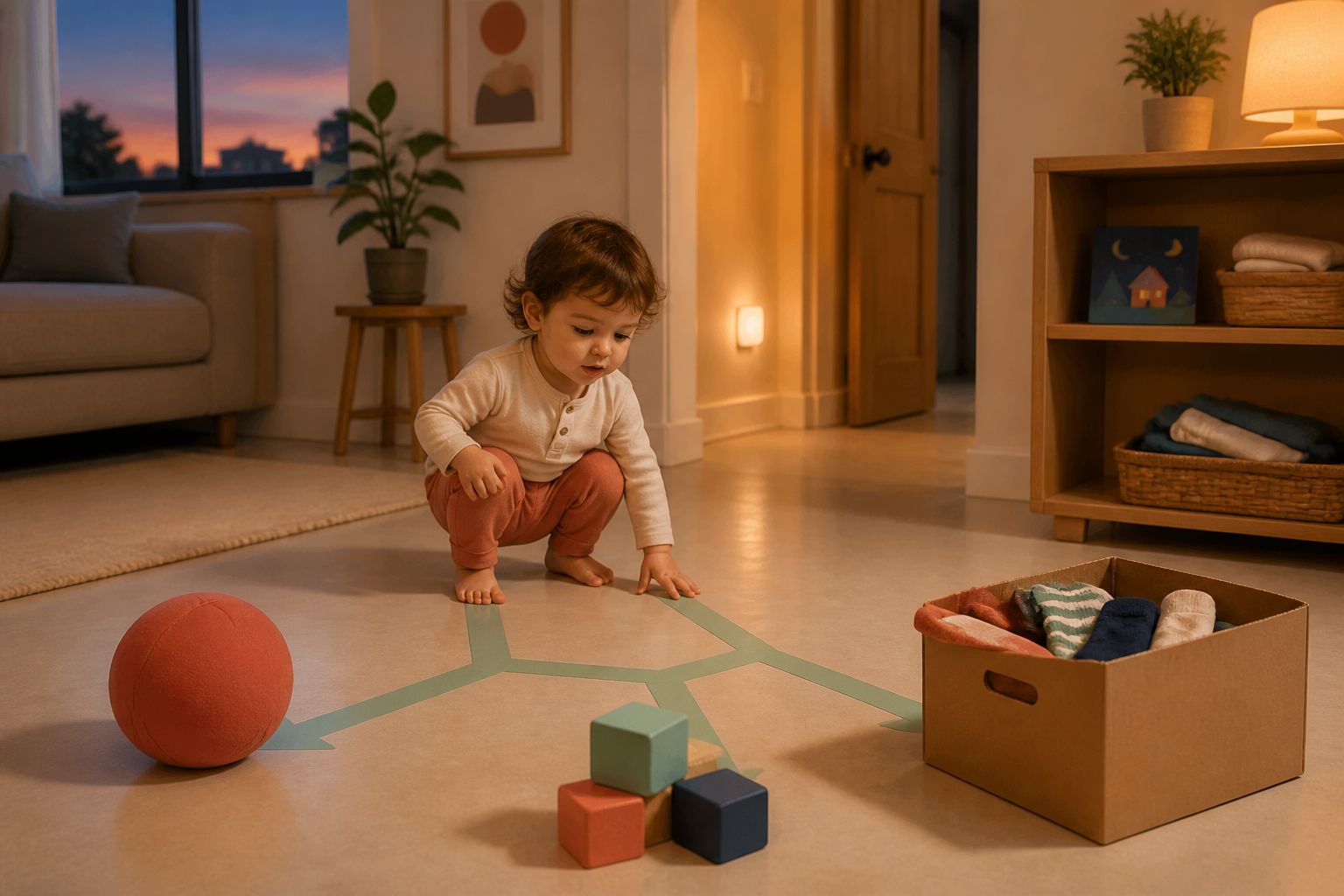
The best toddler activities are short, simple, and matched to the child and room you have right now. For ages 1 to 3, start with large safe objects, one obvious action, and an adult close enough to help. Rolling a soft ball, posting full-size socks into a box, following a tape line, washing one large toy, or carrying leaves to a picture spot can all be real play. You do not need a themed supply bin, a laminated curriculum, or the stamina to become cruise director of the living room.
Use this guide by choosing the energy you want, not merely the energy your toddler arrived with. A high-energy child may need a clear movement job. A tired or overstimulated child may do better with a board-book hunt or one basket of familiar objects. Repeating yesterday’s game counts. Stopping after four useful minutes counts too.
Pick a toddler activity in 20 seconds
When the internet gives you 75 activities, it has technically answered the search and quietly assigned you another task. This smaller selector begins with four things that decide whether an idea will actually happen: your child’s energy, the space, the mess you can tolerate, and how hands-on you can be.
SleepBaby.org activity selector
Start with the constraint that matters most
Try a tape trail, soft-ball roll, animal walk, hallway ready-set-go, chalk path, or shadow copy.
Try box posting, nesting containers, a picture hunt, sock matching, stuffed-animal care, or family-photo stories.
Try jumbo crayons, a wash-and-wipe station, outdoor water transfer, chalk, or one simple snack-helper job.
Choose a familiar book hunt, sock basket, shadow game, large-toy wash, or pajama-and-book choice. Familiar is a feature.
Then shrink it: put out one ball, one box, one piece of chalk, or three books. A clear invitation usually works better than a carpet covered in possibilities.
The safety floor for activities from ages 1 to 3
Toddler play changes quickly because toddlers change quickly. A material that stayed on the table last month may go directly into a mouth today. A child who walked around the basket yesterday may attempt to summit it today. Supervision means watching the activity in front of you and changing it when the child changes it.
Before the first turn
Five checks beat one giant disclaimer
- Use large, intact materials. Skip loose rice, dried beans, beads, pom-poms, bottle caps, marbles, small magnets, button batteries, and any piece that can be swallowed. Products for children under 3 are subject to small-parts protections for good reason.[6]
- Keep movement floor-level. Clear cords, sharp corners, stairs, doors, pets, and unstable furniture from the route. This guide does not use couch cushions as climbing equipment.
- Stay within arm’s reach around water. Give water your full attention and empty every bucket, bowl, or tub immediately when play ends.[7]
- Inspect the specific object. Check cardboard for staples, toys for loose parts, fabric for long loops, crayons for broken swallowing-sized pieces, and containers for cracks.
- Use the stop cue. End or simplify the activity when materials are mouthed, thrown at people, used for climbing, or met with escalating frustration or fatigue.
There is no supervision loophole that turns a small choking hazard into a good default for a 1-year-old. That is why the sensory ideas below use touchable everyday surfaces, water with touch supervision, jumbo art materials, and large household objects. No one needs a sensory bin that quietly converts the living room into a dried-lentil archaeological site.
How toddler play changes from 1 to 3
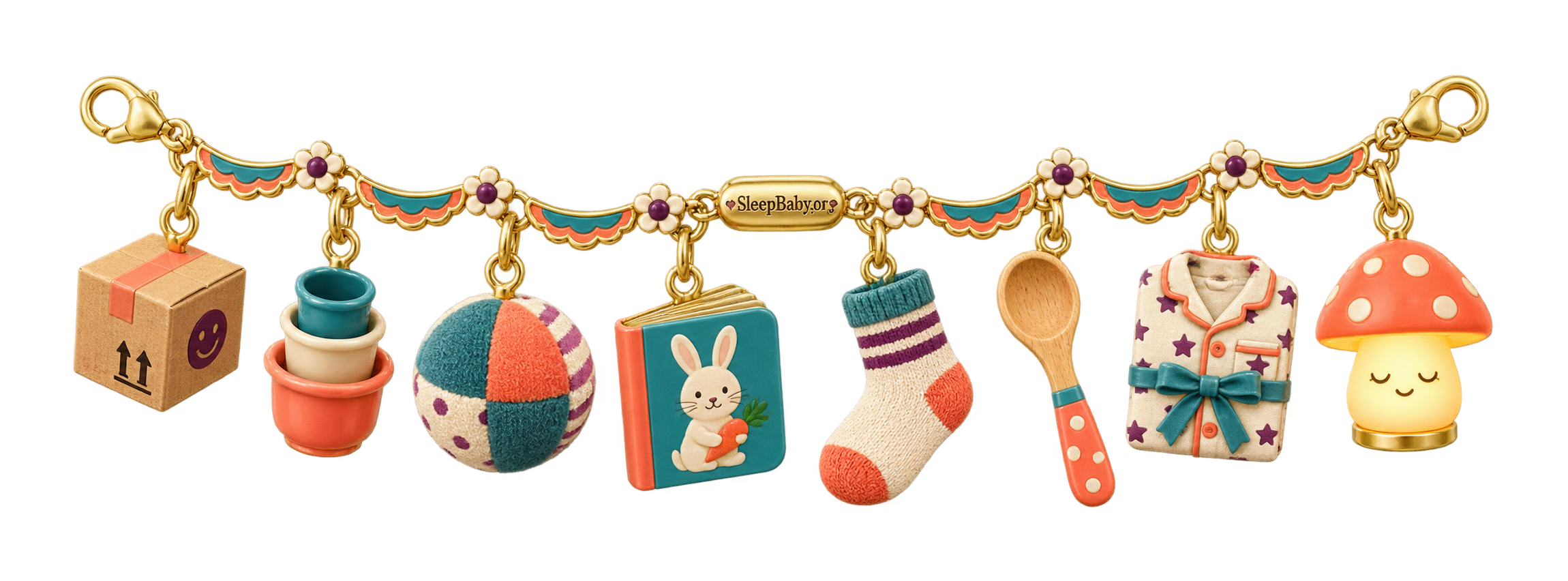
Development does not divide neatly at the half-birthday. These lanes describe what the activity asks the child to coordinate, not what every child must do on schedule. The CDC’s milestone lists are guideposts based on things most children can do by a given age; they are not home exams.[1][2][3]
The age-and-access ladder
Adjust the demand, not the child’s worth
About 12 to 18 months
Offer one large object and one visible action: put in, take out, roll, carry, push, pull, point, stack, or copy. Make success physically easy.
About 18 to 24 months
Add simple choices, two objects used together, one-step pretend jobs, short routes, large-piece matching, and words attached to action.
About 2 to 3 years
Add a two-step sequence, a simple clue, a role, counting a few real objects, or a choice about how the game changes next.
If a version is not working, move one rung down: fewer objects, a shorter route, a larger target, one instruction, or your hand demonstrating the first turn.
The American Academy of Pediatrics describes developmentally appropriate play with caregivers and peers as supporting language, thinking, self-regulation, social-emotional development, and responsive relationships.[4] The phrase doing the important work there is developmentally appropriate. An activity supports the child when the child can enter it. A complicated setup that produces two minutes of adult correction is not automatically more educational than rolling a ball back and forth.
I once watched Benjamin post a full-size wooden spoon through a wide slot in a cardboard box, retrieve it, and repeat the exact sequence until I began to suspect he had accepted a position in quality control. Nothing new happened on turn nine. That was the point. He knew what the action would do, could make it happen, and enjoyed sharing the result. Repetition is not evidence that you have failed to entertain a toddler. Often it is the work.
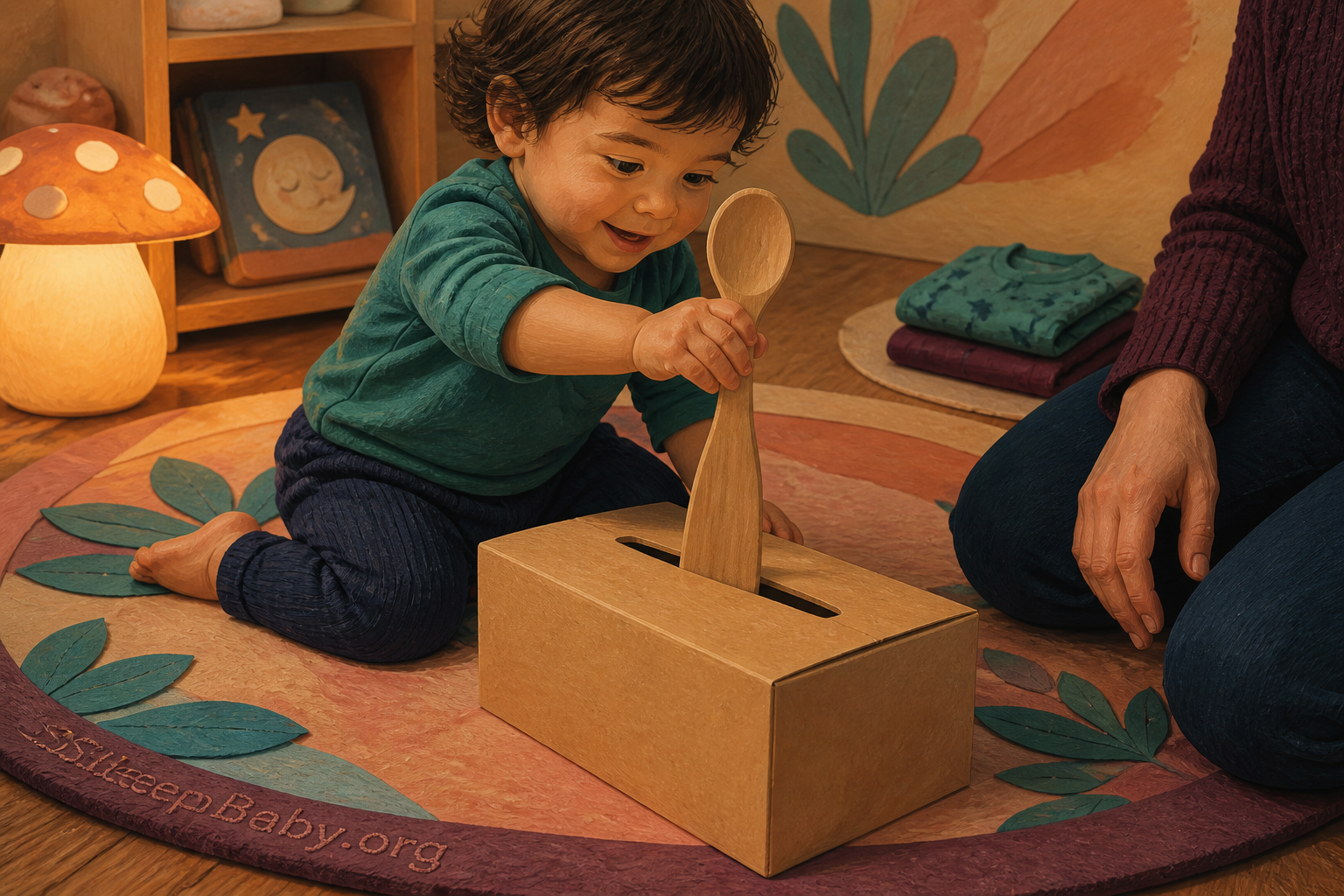
Six easy indoor toddler activities with very little mess
1. Big-box posting
You need: a sturdy cardboard box with no staples or torn edges, plus three to five large safe objects such as full-size socks, a soft ball, a wooden spoon, or a large washcloth. Cut a generous opening while the child is elsewhere, remove every loose scrap, and check that the box cannot collapse around them. Play: post one object, open the top, retrieve it, and offer the next turn. Adjust: use one object and a wide opening for a younger toddler; nearer 3, ask for the sock and then the spoon. Close: say, \”Two more in, then the box goes away,\” and count them together. The box is for posting, not climbing or wearing.
2. Nest and unstack kitchen containers
You need: three or four large lightweight plastic bowls or nesting cups made for the child’s age. Skip glass, cracked plastic, and anything swallowing-sized. Play: stack, nest, knock down, and hide one full-size sock under a bowl. Adjust: at the younger end, offer two containers and model in/out; later, compare big and small or build a simple red-blue-red order. Close: put the smallest inside the largest and carry the single stack to its shelf. That final satisfying collapse is cleanup disguised as the last round.
3. Board-book picture hunt
You need: two or three sturdy familiar books. Play: ask, \”Where is the dog?\” or \”Can you find something round?\” Point, name, make one sound, and let the child turn the page. Adjust: younger toddlers can choose between two pictures; older toddlers can find an action, describe what happens next, or locate the same idea in another book. Close: choose one final page and return the books together. If the toddler would rather inspect the spine or reread page four, that is still a book activity. Conversation around pictures is more useful than completing your list.
4. Painter’s-tape road
You need: low-tack painter’s tape tested first on the floor and one or two large age-appropriate vehicles. Apply a short wide road yourself, press every edge down, keep loose tape away from the child, and remove it after play. Play: drive to a taped parking square, stop, turn, and return. Adjust: begin with one straight line; later add a slow curve or two destinations such as bookshop and bed for the stuffed bear. Close: park both vehicles and peel up the road while the toddler carries the cars. Stop if tape is pulled loose, wrapped, or mouthed.
5. Full-size sock match and basket toss
You need: four to six clean adult socks and a shallow stable basket. Do not use small clothing items or let the child pull the basket over their body. Play: find two socks that look alike, carry them to the basket, or toss from one toddler step away. Adjust: younger toddlers simply carry and drop; older toddlers can match colors or deliver \”one striped sock, then one plain sock.\” Close: tip the basket once for a final reset, then put it out of the play space. The match does not have to be correct to make the carrying job worthwhile.
6. Stuffed-animal care station
You need: one washable stuffed animal with no loose parts, a washcloth, a toy cup too large to swallow, and perhaps a small blanket used only during awake play. Play: wash the bear’s paw, offer a pretend drink, name a feeling, and tuck the bear into a basket. Adjust: a younger toddler can copy one action; an older toddler can choose what the bear needs and tell a two-sentence story. Close: put the cup and cloth away, then move the stuffed animal and blanket out of any infant sleep space. Pretend care is not required to look tender every second. The bear may receive an energetic medical examination.
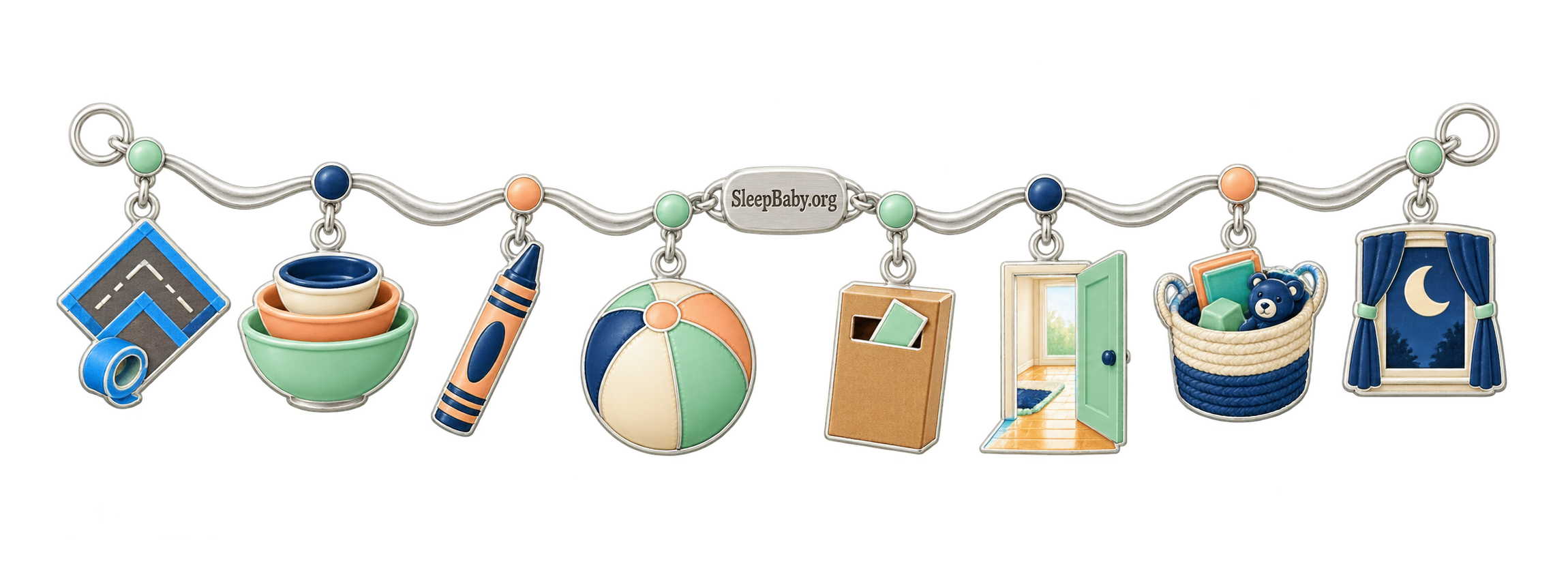
Six indoor movement activities for busy toddler energy
WHO guidance treats movement as something spread across the day, not one workout bolted onto childhood.[5] These ideas offer a job for a moving body without turning the furniture into equipment. Clear the route first, use bare floor or another stable nonslip surface, and stay close enough to intercept the toddler’s inevitable creative revision.
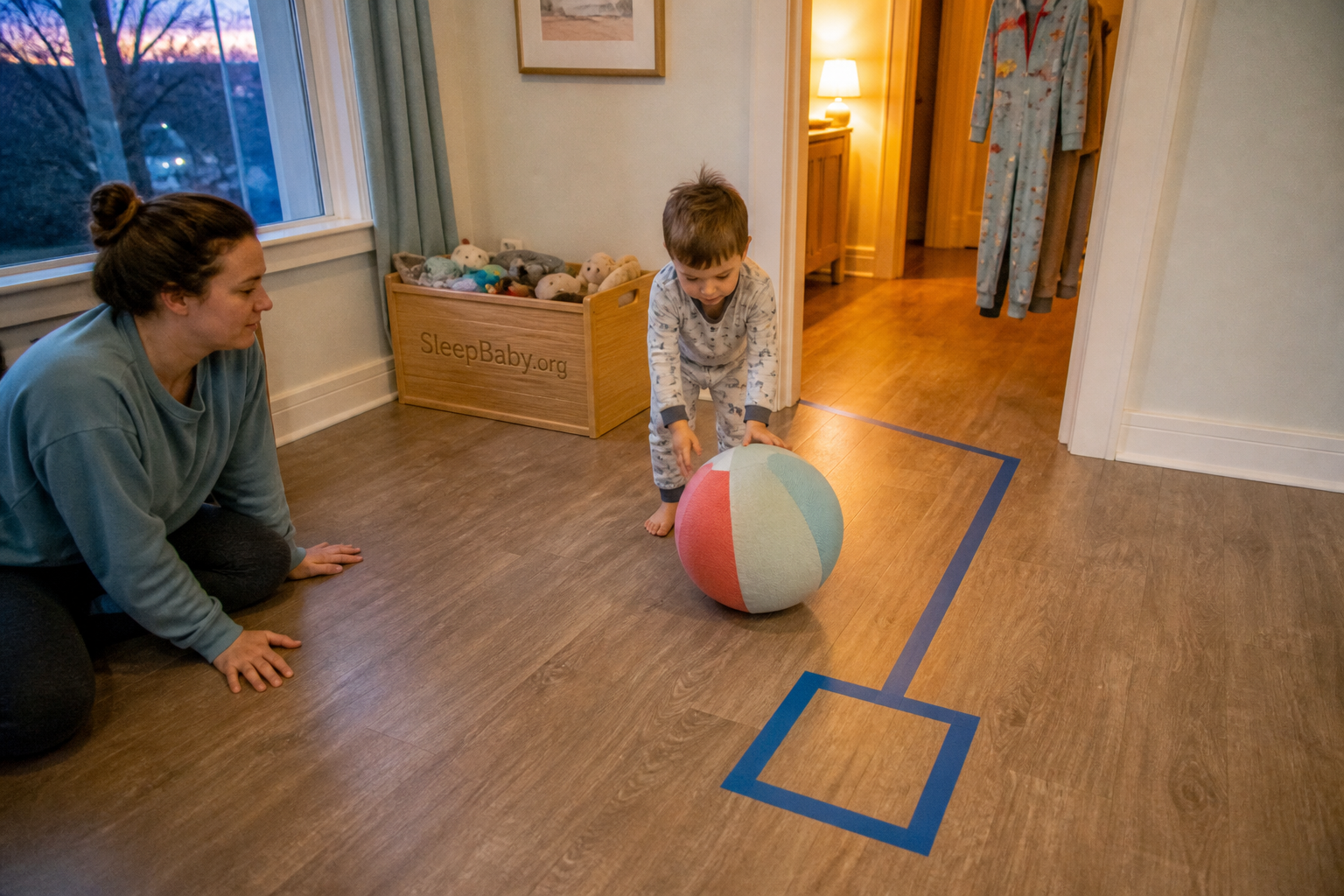
7. Roll and chase a soft ball
You need: one soft ball too large to swallow and a clear floor. Play: sit facing the child and roll it between you. Then stand and roll it toward an open stopping area for a chase. Adjust: younger toddlers can push from sitting; around 2, add a gentle kick; nearer 3, make a wide gate with two stable objects and count successful passes. Close: announce the final roll and place the ball in a visible basket. Avoid hard balls, stairs, glass, pets, and a route toward a doorway.
8. Follow the floor-tape trail
You need: a short painter’s-tape line, firmly pressed down, on a clear nonslip floor. Play: walk beside the line, step over it, stop at a square, turn, and come back. The line is a visual cue, not a balance beam. Adjust: for a new walker, make two destination squares and hold hands if wanted; for an older toddler, use a sequence such as walk, stop, clap. Close: reach the final square, take one proud bow, and remove the tape. Stop immediately if the child pulls off long strips or heads toward stairs or furniture.
9. Animal walks on a clear floor
You need: a clear floor and your own willingness to become a slow bear for approximately 40 seconds. Play: stomp like an elephant, waddle like a duck, crawl like a bear, or stretch tall like a giraffe. Adjust: younger toddlers copy one body movement; older toddlers choose the animal, add a sound, or move to a named spot. Close: let the animals \”go to their quiet cave\” by sitting together for one breath and a drink. Keep it floor-level; do not add jumping from furniture, weighted backpacks, blindfolds, or crawling beneath unstable tables.
10. Laundry-basket delivery
You need: a light stable laundry basket and two or three soft full-size items. Play: place one towel in the basket and push or carry it a short clear route to a marked delivery spot. Adjust: younger toddlers can drop in one item and help push with you; older toddlers can deliver a towel to the bathroom and pajamas to the bedroom with an adult beside them. Close: complete one final delivery and park the empty basket. Never let the child ride in it, pull it with a cord, or move it near stairs. A basket arriving confidently in the wrong room is still a successful route.
11. Ready, set, go – and stop
You need: a short uncluttered stretch of room or hallway with doors secured and an adult at the turn. Play: say \”ready, set, go,\” walk or run to the adult, then practice \”stop\” and a gentle high five. Adjust: younger toddlers can walk between two adults a few steps apart; older toddlers can go slow, fast, tiptoe, then freeze. Close: make the final cue \”ready, set, sit\” and settle on the floor. This is not a race, and \”stop\” is practiced when everyone is calm rather than saved for danger.
12. Copy-my-body action song
You need: no props and any familiar tune. Play: tap knees, reach up, touch shoulders, sway, and pause. Keep the sequence short enough to remember without consulting choreography. Adjust: a younger toddler copies one action; an older child chooses the next movement or leads a two-action pattern. Close: make the last verse smaller and slower: big sway, little sway, hands in lap. Avoid ribbons, cords, scarves, and fast spinning. If the room starts tilting or the child loses control of their body, the song is done.
Six low-cost outdoor toddler activities
Outside does some of the novelty work for you. The same walk changes with light, wind, temperature, trucks, birds, and puddles. Check heat, air quality, sun exposure, insects, traffic, water, and the exact ground before starting. If you are heading to play equipment rather than staying on level ground, use the separate guide to taking a baby or toddler to the playground for the outing and equipment safety layer.
13. Jumbo-chalk path
You need: intact jumbo sidewalk chalk approved for the child’s age and a safe paved area away from traffic. Discard pieces once they break small enough to enter the mouth. Play: draw one thick line, a big circle, and a square to stand in. Adjust: younger toddlers can make marks and step on a color; older toddlers can follow a shape route or add three \”parking\” spots. Close: draw a final home circle, park the chalk with the adult, and wash hands. Chalk belongs on the ground, not in mouths, on faces, or near moving wheels.
14. Look-and-point texture walk
You need: a familiar safe route and an adult’s attention. Play: pause to look at rough bark, smooth pavement, a waving leaf, soft moss, or a shiny gate. Name what you see and touch only what you have checked. Adjust: younger toddlers point or copy one word; older toddlers compare rough/smooth, big/small, still/moving, or find two things of one color. Close: choose one last thing to notice and walk home. Leave berries, mushrooms, animal waste, unknown plants, water, and small found objects alone. This is observation, not foraging.
15. Adult-held bubble chase
You need: bubble solution and wand controlled by the adult in a clear outdoor spot. Play: blow a few bubbles for the toddler to watch, point to, pop, or chase. Adjust: younger toddlers can track and pop bubbles within reach; older toddlers can practice high/low, near/far, one/many, or freeze while the next set is made. Close: announce the last three bubbles, cap the solution, and put it out of reach. The adult manages the liquid and wand; stop if solution spills, the surface becomes slippery, or the child tries to drink it.
16. Empty-bucket water transfer
You need: one shallow stable basin, a small amount of water, and two large cups, with an attentive adult within arm’s reach for the entire activity. Play: scoop, pour, fill, and empty. Adjust: younger toddlers use one cup and copy a pour; older toddlers can fill to a taped outside mark or water a suitable plant with help. Close: say \”last pour,\” then immediately empty and invert every container where a child cannot access retained water. Drowning can happen quickly and quietly; shallow does not mean supervision-optional.[7]
17. Shadow copy
You need: a patch of safe shade or mild sun where shadows are visible, plus normal sun and heat precautions. Play: wave, make arms wide, crouch, and watch the shadows copy you. Adjust: younger toddlers notice and stomp near a shadow; older toddlers guess which movement will make it taller, wider, or disappear behind the adult. Close: make one quiet hand wave and walk back into the shade. Keep attention on the ground and surroundings so shadow fascination does not carry the child toward a curb, driveway, pool, or hot surface.
18. Soft-ball roll, kick, and gate
You need: one soft large ball, level ground, and a broad safe boundary away from traffic and water. Play: roll to each other, chase a slow roll, or kick through a wide gate made from two stable landmarks. Adjust: younger toddlers push or carry the ball; older toddlers take turns choosing roll or kick and count a few passes. Close: make the last goal a basket or adult’s hands, then carry the ball inside. Do not create a narrow target that encourages frustration or use hard objects as goalposts.
Six quiet, helping, and wind-down toddler activities
Quiet does not have to mean motionless. It means the activity has fewer surprises, a slower rhythm, and a clear ending. These ideas work well when the household needs to step down from big movement, but no one activity is a sleep treatment. A toddler can enjoy the most tasteful pajama basket on earth and still require a real schedule, a familiar routine, and a parent who can find the toothbrush.
19. Wash and wipe one large toy
You need: one washable large toy, a shallow bowl with a small amount of water, and a washcloth, with the adult within arm’s reach. Play: wet, wipe, squeeze with help, and dry. Adjust: younger toddlers copy one wipe; older toddlers wash named parts or follow wash-dry-put-away. Close: empty the bowl immediately, hang the cloth out of reach, and park the dry toy. Keep water away from electrical or battery toys and stop if the child drinks the water, carries the bowl, or makes the floor slippery.
20. Jumbo-crayon invitation
You need: intact nontoxic jumbo crayons approved for the child’s age and a large sheet of paper secured by the adult. Play: make one line, one dot, and one big curve, then let the toddler explore marks. Adjust: younger toddlers may make brief strokes with close hand support; older toddlers can choose a color, copy a circle-like motion, or add marks to a road story. Close: choose one final mark, name the picture, and count every crayon back into adult storage. Discard broken small pieces and stop at mouthing. The picture does not need to become anything recognizable.
21. One-job snack helper
You need: a familiar age-safe snack already cut and prepared to reduce choking risk, plus one safe job at a stable surface. Play: let the toddler carry a napkin, place a large prepared piece on a plate, or stir a soft mixture with hand-over-hand help. Adjust: younger toddlers deliver one napkin; older toddlers complete two simple jobs and name the foods. Close: move to seated, attentive eating rather than wandering with food. Keep hot, sharp, raw, hard, round, sticky, or otherwise unsafe items and all preparation tools with the adult. This is participation, not unsupervised cooking.
22. Two-step tidy treasure hunt
You need: three large familiar objects and their usual open storage spots. Play: ask for one obvious object: \”Find the ball and put it in the basket.\” Celebrate the action rather than the speed. Adjust: younger toddlers carry one item with you; older toddlers can follow a two-step clue such as \”Find the book, then place it by the chair.\” Close: leave one guaranteed-easy object for the final success and end the hunt there. Do not hide objects in drawers, beneath heavy furniture, or anywhere that invites climbing.
23. Family-photo naming and mini stories
You need: a sturdy bound photo book or images displayed on an adult-held device in a short shared session. Avoid loose small photos or removable parts. Play: name a person, place, pet, or action and pause for the child to point or respond. Adjust: younger toddlers choose between two people; older toddlers can answer what happened, add a feeling, or tell a two-line story. Close: wave goodnight to one final picture and put the album away. If using a screen, keep the adult beside the child and the session purposeful and brief rather than letting autoplay choose the evening.[1][2]
24. Pajama basket, book choice, and one action rhyme
You need: pajamas, two board books, and one familiar gentle rhyme. Play: carry the pajamas to the sleep space, choose between two books, and do the same small hand motion with the rhyme. Adjust: younger toddlers can place one pajama item in the basket and point to a book; older toddlers can complete pajamas-choose book-sit down in that order. Close: end the rhyme the same way and move into the household’s actual bedtime routine. This activity is a transition cue, not a promise about how quickly a child will fall asleep.
How to make one toddler activity last across ages
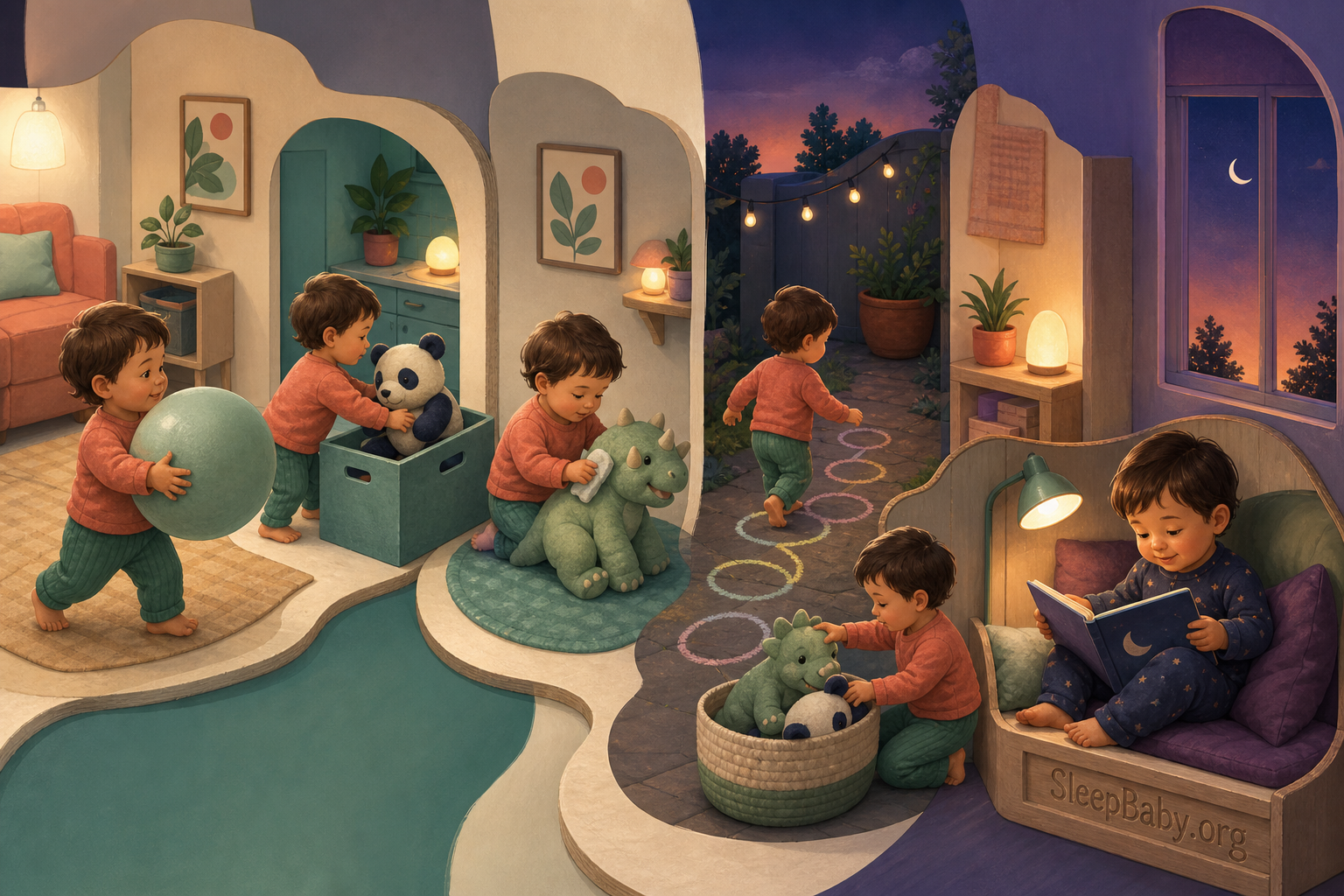
You do not need to replace the game every time the child changes. Keep the material familiar and adjust one demand. With a ball, that might mean push, then roll, then kick, then aim through a wide gate, then take turns choosing the action. With a book, it might mean point, name, find, describe, then tell what could happen next.
Change only one of these at a time:
- The target: wider or narrower, closer or farther.
- The sequence: one action, then two actions.
- The language: show, name, choose, describe, predict.
- The role: copy the adult, take a turn, lead a turn.
- The environment: living room, porch, grass, or a quiet corner.
When play falls apart, reverse the process. Bring the target closer, remove objects, shorten the route, demonstrate one turn, or return to a version the child already understands. Toddlers do not need every invitation to become an independent project. Responsive play includes noticing when your idea was too complicated and editing it without issuing a performance review.
What if my toddler will not join the activity?
First, make sure the activity is actually available to them. Is the room loud? Is the child hungry, tired, wary of the material, unable to make the movement, or still watching before joining? Try sitting nearby and doing one slow turn without repeatedly asking. Some toddlers enter by copying. Others need to inspect the scene, carry one object away, or decide the adult’s plan requires revision.
Make it easier before making it more exciting. Offer two objects instead of ten. Remove the audience. Use a familiar action. Let the child choose between roll and carry. If busy sound is consistently the barrier, the separate guide for a toddler who hates loud noises helps sort ordinary sensitivity, overload, pain, and when to ask for help.
A child who prefers solo play today is not automatically behind. If the concern is specifically that your toddler watches other children but never joins, becomes distressed in groups, or seems unsure how to enter shared play, use the dedicated guide for a toddler who will not join group activities. That is a different reader job from finding something to do at home, and it deserves its own social and developmental context.
When an activity concern deserves a pediatric conversation
One rejected game, one tired afternoon, or one week devoted entirely to rolling the same truck is not a developmental diagnosis. Look at the wider pattern across ordinary routines. Can your child communicate wants in the ways available to them? Do they explore and use their body? Are skills growing over time, even unevenly? Do they respond to people and surroundings in their own consistent ways?
Contact the child’s pediatric clinician when a child has lost a skill, is not meeting one or more milestones, or something about development concerns you. The CDC recommends acting early rather than waiting for a second problem to make the first concern feel official.[1][2][3] Bring concrete observations: what the child does, what they do not yet do, when you notice it, and whether hearing, vision, movement, illness, or sensory load seems involved. Ask about developmental screening and early-intervention resources. A home activity can create useful observations; it cannot diagnose or treat a developmental condition.
Use activity to support the evening, not to exhaust the toddler
A toddler does not need to earn sleep by reaching maximum mileage. Whole-day movement matters, but a frantic final hour can make the transition harder for some children. If bedtime has become a nightly sprint, put bigger movement earlier and let the final stretch become progressively more predictable.
SleepBaby.org evening downshift
Move -> make -> help -> read
- 1. Move
A tape trail, ball roll, or short outdoor walk while there is still time to come down. - 2. Make
One page of crayon marks, a block stack, or a simple pretend scene. - 3. Help
Park the ball, deliver pajamas, wipe the toy, and watch the room get simpler. - 4. Read
Choose between two books, repeat one rhyme, and enter the familiar routine.
You can skip a step. The useful pattern is a gradual reduction in speed, choices, and materials – not a perfect four-part performance.
If sleep timing is the part that does not fit, the guide to a 2-year-old sleep schedule separates total sleep, nap timing, bedtime resistance, and early waking. Activity can support a healthy day and a familiar wind-down. It cannot repair every schedule mismatch or guarantee an uninterrupted night.
Common questions about toddler activities
How long should a toddler activity last?
Long enough to be useful and short enough to end safely. That may be three minutes, 15 minutes, or several returns to the same setup. Watch the quality of engagement rather than a timer. When the child shifts from exploring to escalating, throwing, climbing, mouthing, or repeatedly leaving, simplify or close. You are not required to stretch a good four-minute game into a 30-minute lesson.
Do I need a different activity every day?
No. Repetition lets a toddler predict, practice, and eventually lead. Keep a small rotation of familiar materials and change one detail: the ball’s destination, the book question, the delivery route, or who takes the first turn. Novelty can renew interest, but constant novelty is not the developmental goal.
What are good activities for a 1-year-old?
Choose one-action play with large objects: put in/take out, roll, carry, push, pull, point, stack, look at pictures, copy a body movement, or offer simple pretend care. Keep the target easy, stay close, and expect mouthing and sudden changes in plan. Use the 12-to-18-month lane as a starting point, not a checklist.
What are good activities for a 2-year-old?
Add simple routes, choices, ball kicking, pretend jobs, large-piece matching, washable art, short helping tasks, and one- or two-step directions. A 2-year-old may enjoy doing the same action many times before wanting a twist. The CDC’s examples at this age include balls, pretend play, chores, art, containers, puzzles, blocks, and walks.[2]
What can I do with a toddler indoors on a rainy day?
Pick one from each energy level: a tape trail or ready-set-go for movement, box posting or a stuffed-animal station for focused play, then a book hunt or pajama basket to slow down. You do not need to offer all three at once. Keep the next material out of sight until the current activity is closed.
Are sensory bins safe for toddlers?
The word sensory does not make the filler safe. For a broad ages 1-3 guide, avoid loose rice, beans, beads, pom-poms, water beads, bottle caps, and other swallowing-sized pieces. Use safer sensory experiences such as a texture walk, a closely supervised shallow water pour, jumbo crayons, large washable toys, or nesting containers. Match every material to its age label and the specific child’s mouthing behavior.
Sources
- CDC: Milestones by 18 Months.
- CDC: Milestones by 2 Years.
- CDC: Milestones by 3 Years.
- Yogman M, et al. The Power of Play. Pediatrics. 2018.
- WHO: Physical activity, sedentary behaviour and sleep for children under 5.
- CPSC: Small Parts for Toys and Children’s Products.
- AAP/HealthyChildren: Drowning Prevention for Curious Toddlers.
- Harvard Center: Serve and Return Interaction Shapes Brain Circuitry.
Let the room get simpler
End the activity while it is still working, then carry the calm forward
One last roll, the ball in its basket, pajamas delivered, one book chosen. That small sequence will not force sleep, but it can make the handoff from play to rest easier to recognize. Build the rest of the evening around the child, schedule, and sleep challenge you actually have.