It is common for toddlers to hate loud, sudden, or hard-to-predict noises. A child who covers their ears at the hand dryer, cries when the vacuum starts, or begs to leave a noisy birthday party is not being dramatic, manipulative, or “too sheltered.” Their nervous system got a very big message, very quickly, and they need help finding the exit ramp.
Most of the time, your first job is simple: move to a quieter distance, comfort your child, explain what made the sound, and give them a little control over what happens next. You do not have to make them stand beside the roaring machine to prove they are brave. In fact, forcing a distressed child to stay can make the sound feel even less predictable the next time.
There are also a few important boundaries. Sounds that seem painful, a sudden change in hearing, ear symptoms, speech or communication concerns, or sensitivity that keeps your child from ordinary daily life deserves a conversation with their pediatrician or an audiologist. And an objectively dangerous sound – fireworks, amplified concerts, power tools, sirens at close range – needs distance, less time, and proper hearing protection. That is a hearing-safety problem, not a character-building exercise.
Start here
The Sound Map: three problems, three different responses
Before you decide what to do, ask which lane this sound belongs in. A toddler can move between lanes, and you do not need to diagnose anything to respond well.
Startling but ordinary
Clues: surprise, fear, ear-covering, a fast recovery after the sound stops, or distress around one predictable trigger.
Response: comfort, explain, add distance and control, then practice gently only when calm.
Painful or paired with ear/hearing clues
Clues: pain words, ear drainage, fever, balance changes, hearing some sounds but not others, new speech concerns, or persistent daily restriction.
Response: stop the sound and arrange medical or hearing guidance. Sudden hearing loss needs urgent care.
Objectively hazardous
Clues: fireworks, concerts, power tools, very loud toys or speakers, or any noise where adults must shout at close range.
Response: create distance, shorten the exposure, use well-fitting protection, and leave if you cannot make it safe.
The point is not to label your child. It is to match the help to the problem in front of you.
Why an ordinary noise can feel enormous to a toddler
Toddlers are still learning what causes a sound, whether it will stop, and whether they can get away. A blender you understand as “breakfast in 20 seconds” may arrive in their body as a sudden, vibrating threat. Public hand dryers and self-flushing toilets are especially rude little inventions: they are loud, echo in a hard room, and may switch on before a child knows what is happening.
Pediatric audiology services describe sound sensitivity as common in young children, particularly with loud or unexpected sounds. Many children become less reactive as they understand the source and gain more control. Boston Children’s Hospital notes that hand dryers, vacuums, blenders, and self-flushing toilets are common triggers. The NHS also explains that children can be more sensitive than adults and may improve as they grow.
That does not mean every reaction is “just a phase.” A toddler may dislike the loudness, the pitch, the vibration, the surprise, or the way the room echoes. They may already be tired, hungry, ill, or carrying the last six hard moments of the day. Some children have broader sensory or developmental differences. Some have an ear or hearing issue. The reaction is a clue to observe, not a diagnosis to announce.
I want to take one worry off your shoulders right now: comforting your child does not teach them to be afraid. Calm is not a prize they have to earn. Your steady response helps their body learn, “A loud thing happened, my grown-up understood, and we found a safe next step.”
The first 60 seconds
Pause, Place, Plan
-
Pause the demand.
Do not ask for manners, eye contact, or an explanation while the sound is still flooding the room. Say, “That was loud. I have you.” -
Place the body somewhere tolerable.
Step outside, move behind a door, increase distance, turn the appliance off, or crouch beside your child. If they do not want touch, stay close without grabbing. -
Plan one controllable next step.
“We can wait outside while the toilet flushes.” “You can press the vacuum’s off button.” “We are leaving the party for five quiet minutes.” Leaving is a valid plan.
Parent script: “I believe you. First we get comfortable; then we decide.”
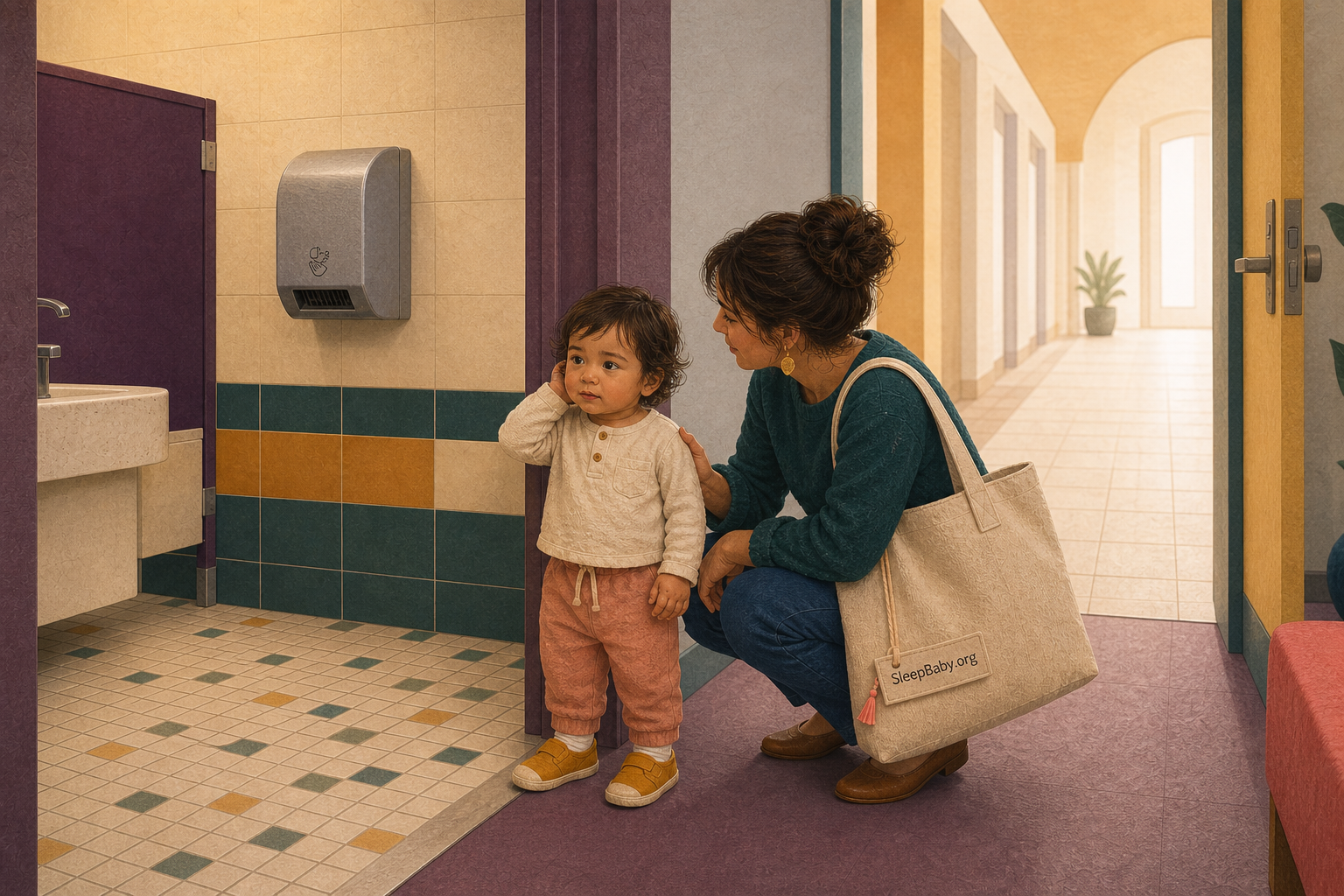
If your child is safe but cannot settle, reduce language. A long explanation about motors, acoustics, and how every other toddler at the sink seems fine is not going to land. Try one accurate sentence: “The dryer made the big sound. It is off now.” Breathe slowly, let the body recover, and save the teaching for later.
Notice recovery time. A child who startles, checks your face, and returns to play within a minute is showing a different pattern from a child who remains panicked for an hour, cannot enter any public bathroom, or begins avoiding preschool because of one sound. Both deserve kindness. The second pattern deserves more support.
Do not force exposure; build a tiny practice your child controls
“They need to get used to it” contains one useful idea and one terrible shortcut. Yes, predictable and tolerable experience can help a child learn that a sound has a source, a beginning, and an end. No, they do not learn that by being trapped beside the vacuum while an adult insists they are safe.
Children’s audiology guidance from Gloucestershire Hospitals and Alder Hey recommends explaining the source, giving the child control, and introducing a difficult sound gently. Alder Hey also says children should not be forced to stay in a situation that is obviously causing distress. That is the line I would keep taped to the imaginary clipboard: practice below the panic point, and stop while the child still trusts the process.
Choose one trigger, not the entire noisy world. Practice when everyone is fed and reasonably rested. Let your child choose an agreed stop signal, even if that signal is simply “off.” Begin with a picture, a silent inspection, or the appliance in another room. You are helping the sound become predictable, not conducting a toughness exam.
Child-controlled, never surprise-based
The Sound Practice Ladder
Rung 1: Look and name
Look at a photo or the quiet appliance. Say what it does and where the sound comes from. The child can end the conversation.
Rung 2: Own the off switch
Practice pressing off while the machine is silent, or let the child direct you: “Ready… on… off.” Stop immediately at their signal.
Rung 3: Far away and very brief
Run the sound in another room, outdoors, or at the lowest useful setting for one or two seconds. End before distress builds.
Rung 4: Approach only by invitation
On another day, the child may choose a little closer or a little longer. “No” means return to an easier rung, not lose the privilege of stopping.
Success is not silence. Success can be looking at the vacuum, pressing off, or recovering faster with support. If practice increases fear, pause and ask the child’s clinician or audiologist for an individualized plan.
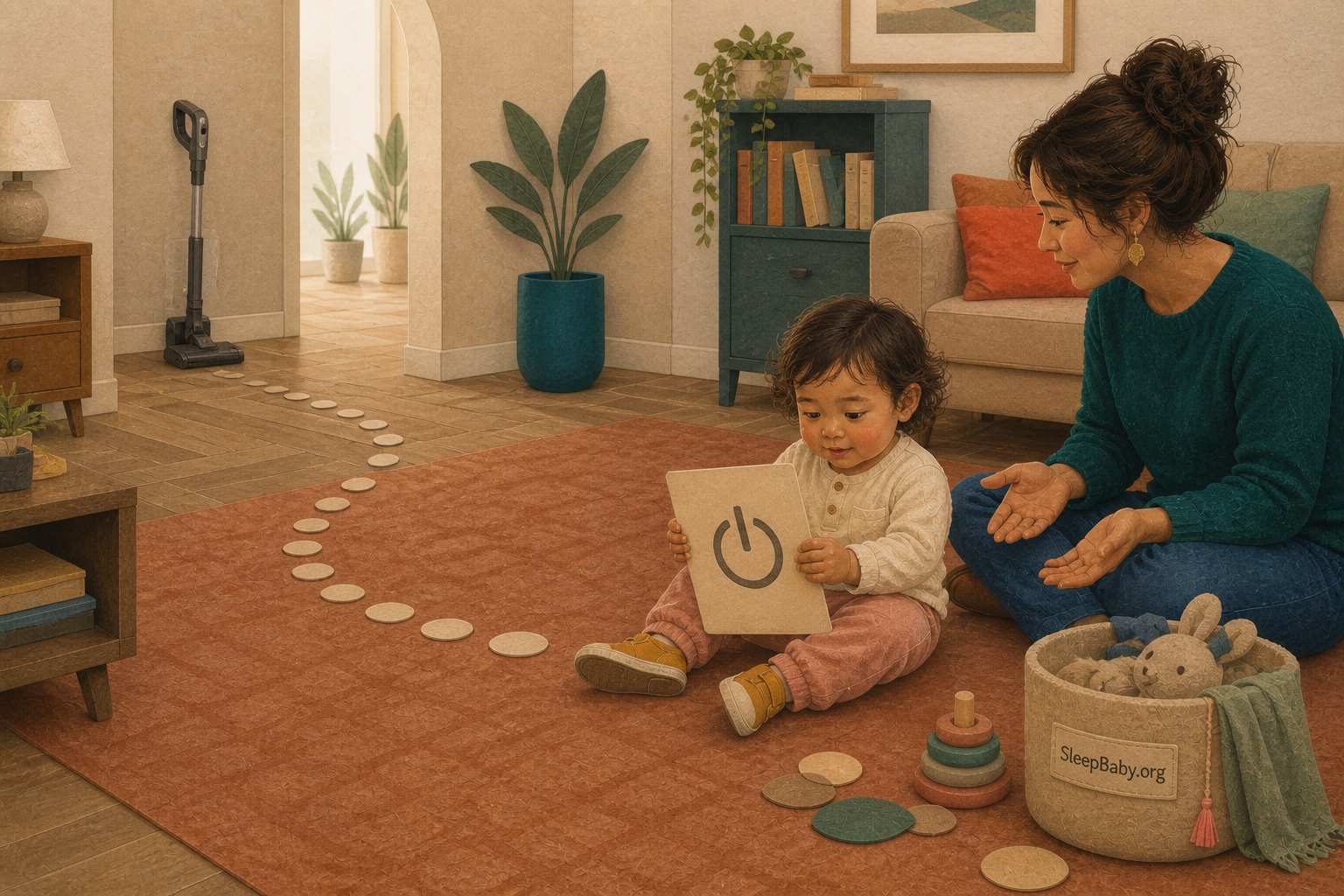
Some days the ladder is the wrong tool. If your child says the sound hurts, has an ear infection, is ill, or is already overwhelmed, choose relief instead. Practice is not treatment for ear pain, hearing loss, or a hazardous noise. It is a gentle way to make an ordinary trigger more predictable.
Predictability outside the practice itself matters too. Before vacuuming, use the same short warning: “Vacuum in one minute. You can go to the bedroom or help me press start.” Before a public toilet, say, “This toilet may flush by itself. I will cover the sensor while you get dressed.” A small visual routine can help a child who likes to know what comes next; the same idea appears in our guide for a toddler who is deeply attached to routine.
Use ear defenders for hearing danger, not as an all-day uniform
Hearing protection is important around truly loud noise. NIDCD explains that sound can damage hearing when it is extremely loud once or loud for a long time. Sounds at or below about 70 dBA are unlikely to cause hearing loss even after long exposure, while repeated or long exposure at or above about 85 dBA can cause harm. Loudness, duration, and distance all matter, so a phone app cannot turn a chaotic event into a guaranteed safe zone.
For fireworks, amplified music, power tools, motorsports, and other genuinely loud settings, use child-sized, well-fitting earmuffs, add distance, shorten the time, and keep an easy exit. Our fireworks guide walks through that high-noise decision. If you are considering an arena event, the toddler hockey guide adds crowd, horn, seating, and exit planning.
Constant ear defenders around ordinary tolerable sound are a different matter. NHS and pediatric audiology guidance cautions that wearing protection all the time or avoiding all normal sound can make sensitivity stronger for some children. That does not mean you should snatch away the one tool helping your child survive a hard day. It means the long-term plan should be individualized: reserve protection for genuinely loud or unavoidable situations, build predictable breaks, and ask an audiologist what fits your child’s pattern.
Check ears and hearing when the pattern gives you a reason
Sound sensitivity can sit beside perfectly normal hearing, but it is still reasonable to ask about hearing when the pattern is persistent or puzzling. A toddler does not need to be able to raise a hand in a silent booth like a tiny office worker. Pediatric audiologists use age-appropriate behavioral tests and other measures. The CDC advises getting a hearing test promptly whenever a parent or clinician has concern.
Tell the clinician exactly what you observe. Useful clues include delayed or unclear speech, not following directions, frequent “huh?”, turning devices unusually high, hearing some sounds but not others, or a new change after illness. A child can pass an earlier hearing screen and still develop a later hearing issue, so “the newborn screen was fine” does not end the conversation.
Also mention ear symptoms. NIDCD lists ear pulling, unusual crying, sleep trouble, fluid drainage, balance difficulty, and trouble hearing quiet sounds among the signs that can accompany a middle-ear infection. Fluid behind the eardrum can temporarily affect hearing. As that fluid changes, the sound world can change too. None of these signs proves why your toddler hates noise, but together they help a clinician choose the right next step.
Sudden hearing loss is a separate urgent boundary. If your child has a rapid, unexplained hearing change over hours or a few days – especially with ear fullness, ringing, or dizziness – seek medical care immediately. NIDCD treats sudden sensorineural hearing loss as a medical emergency because timely assessment and treatment matter.
A calm triage card
Now, Watch, Escalate
Now
- Move to a tolerable place.
- Comfort without demanding an explanation.
- Name or stop the sound.
- Use protection for genuine noise danger.
Watch
- Which sounds and rooms trigger it?
- Was the sound expected?
- How long does recovery take?
- Are there pain, ear, hearing, speech, sleep, or participation changes?
Escalate
- Immediate medical care: sudden unexplained hearing loss.
- Prompt medical advice: significant ear pain, drainage, fever, balance change, or new hearing concern.
- Schedule support: ordinary sound feels painful, daily life is shrinking, the pattern persists or worsens, or you notice lost skills or broader developmental concerns.
Sound sensitivity alone does not diagnose autism
Parents often search this question at 2 a.m. and find a frightening leap: toddler covers ears, therefore autism. That leap is not medically sound. The CDC includes unusual reactions to sound among characteristics that can occur in autistic people, but autism also involves a broader pattern of social communication and interaction differences plus restricted or repetitive behaviors. Children without autism can show some of the same individual traits.
A single sound reaction cannot tell you whether your child is autistic, has another sensory difference, is anxious, has an ear issue, or is simply in a common sound-sensitive phase. Diagnosis is based on developmental history and observed behavior, not a blood test and not one sensory checkbox.
Look at the whole child with curiosity, not a detective’s red string. Are there concerns about language, social connection, play, movement, feeding, clothing, sleep, repetitive behaviors, or lost skills? If yes, share them with your child’s clinician and ask for developmental screening or evaluation. The CDC’s “Learn the Signs. Act Early.” guidance encourages parents to bring up concerns rather than waiting indefinitely. If clothing is another difficult sensory area, our guide about a toddler who will not wear short sleeves can help you organize observations without trying to diagnose from home.
Support does not have to wait for a label. A predictable warning, permission to step out, and a calm adult response are useful whether the eventual explanation is developmental, hearing-related, anxiety-related, temporary, or simply “this particular dryer is a menace.”
Make bathrooms, vacuuming, childcare, and outings more predictable
Public bathrooms
Choose a family or single-stall restroom when available. Cover an automatic-flush sensor with a removable sticky note or your hand while your child uses the toilet, then warn them before uncovering it. Bring paper towels so the hand dryer is optional. The script can be tiny: “The toilet will flush after we step out. You choose hallway or my arms.” Never leave paper or tape behind on the fixture.
Vacuum, blender, and hair dryer
Give the same warning each time. Offer two truthful choices: another room or help with the switch. Do not turn the machine on as a joke, surprise, or test. If your child wants to watch from far away, great. If they want the door closed, that is information, not defeat.
Childcare or preschool
Share one page, not a novel. Name the triggers, early signs, what helps, and who will offer a quiet break. Agree on a simple phrase such as “quiet spot, then back when ready.” For a fire alarm or emergency drill, staff must follow safety procedures; ask how they can warn and support your child without interfering with the drill. A brief planned exit from assemblies or music may help an older toddler or preschooler stay connected to the day instead of avoiding the whole setting.
Parties, stores, and family outings
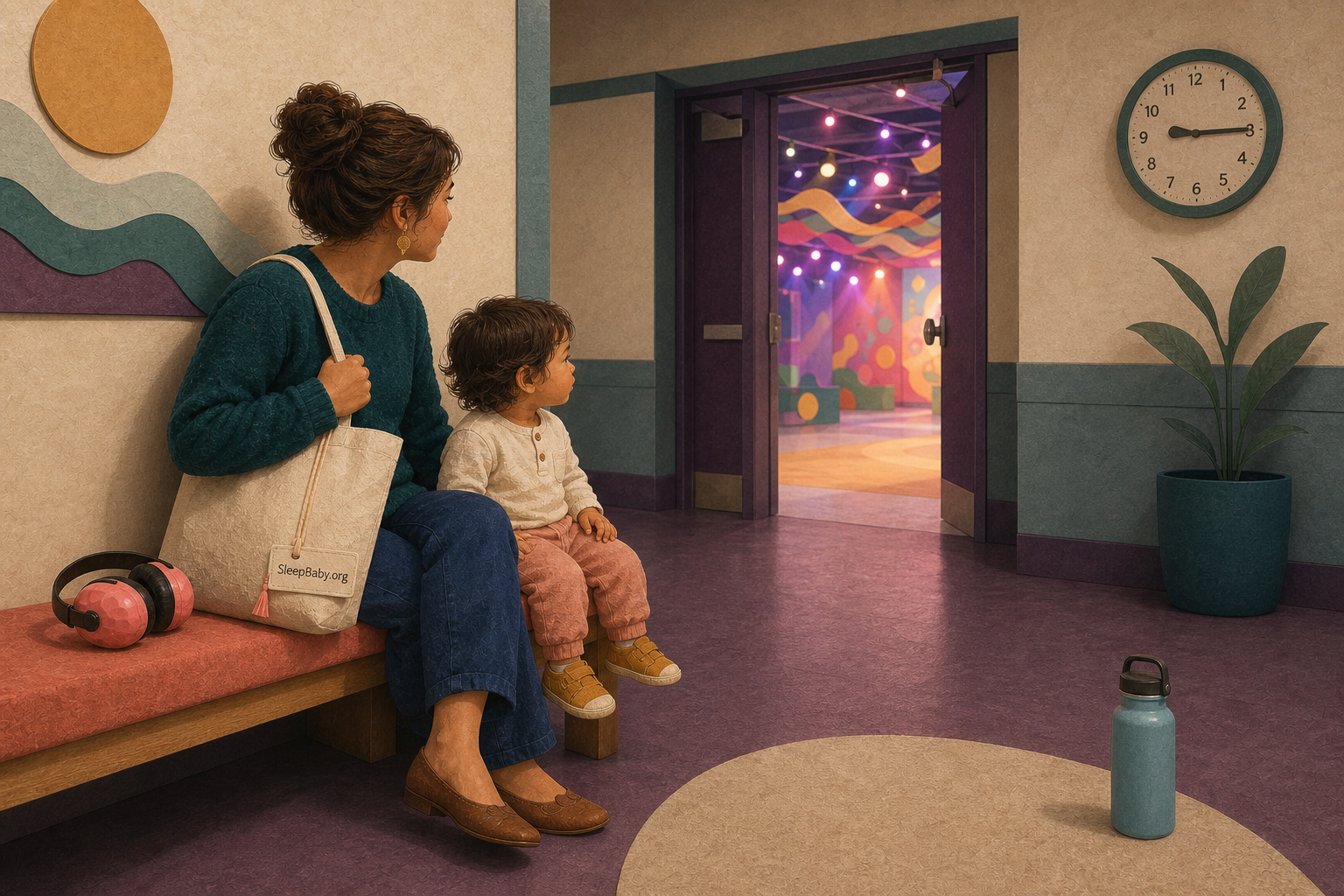
Arrive early when the room is calmer, locate the exit, and name the plan before the noise rises. Bring hearing protection for genuinely loud moments, but do not promise the party will be quiet. Use a family signal that means “we step out now.” A five-minute reset is not a failed outing. Sometimes the kindest ending is simply the ending.
Use a one-week Sound Detective log
You do not need months of notes. Seven ordinary days can reveal whether the problem is loudness, surprise, one echoing room, fatigue, illness, loss of control, or something broader. Keep the log factual. “Covered ears and cried for four minutes” is more useful than “had a meltdown for no reason.”
Observation, not diagnosis
The seven-day Sound Detective log
1. Sound and place
Hand dryer in a tiled bathroom; vacuum at home; birthday singing in a crowded room.
2. Expected or surprise?
Record whether your child got a warning, controlled the switch, or was startled.
3. What the child did or said
Covered ears, ran, froze, cried, said “hurts,” asked for earmuffs, or kept playing.
4. Recovery time
Thirty seconds, five minutes, the rest of the outing, or distress that returned at bedtime.
5. What helped
Distance, warning, control, a closed door, a quiet break, earmuffs in a truly loud setting, or leaving.
Bring the log to an appointment. Patterns help a pediatrician or audiologist decide whether to examine the ears, test hearing, review development, or suggest another kind of support.
Also record the easy moments. If your child tolerates the same vacuum when they control the switch, that is valuable. If a warning helps but a surprise does not, the core problem may be predictability rather than volume. If every sound is harder after poor sleep or illness, the day’s load matters. The log should reveal doors, not build a case against your child.
Questions parents ask about toddlers and loud noises
Will my toddler grow out of sound sensitivity?
Many young children become less sensitive as sounds become familiar and predictable, but no one can promise a deadline. Improvement may look gradual: faster recovery, fewer triggers, asking for a break instead of panicking, or tolerating a sound from farther away. If sensitivity is painful, worsening, persistent, or shrinking daily life, ask for support rather than waiting for a birthday to fix it.
Should I buy ear defenders?
They can be useful for genuinely loud environments and for short, unavoidable situations. Choose child-sized protection that fits, and remember that distance, duration, and leaving still matter. If your child wants defenders for every ordinary sound, do not shame or abruptly remove them. Ask a pediatric audiologist how to preserve participation while avoiding constant overprotection.
What if my toddler says ordinary sounds hurt?
Believe the report and stop or move away from the sound. You cannot measure pain by watching another child tolerate the same room. Arrange a pediatric or audiology evaluation, especially if the pattern is persistent, one-sided, paired with ringing or dizziness, or affecting daily life. A sudden hearing change needs immediate medical care.
Can sound sensitivity affect sleep?
Yes, indirectly. A child who spends the day bracing for unpredictable sound may be keyed up at bedtime, and a household noise may become a learned alert. Keep the bedtime sound environment steady and reasonably quiet rather than perfectly silent. Warn before predictable evening noises, move loud chores earlier, and avoid turning up white noise to cover everything; a sound machine should be kept at a safe volume and distance.
Should we practice with recordings?
A recording can make a sound more controllable, but it should begin very quiet, remain optional, and stop at your child’s signal. It will not perfectly reproduce the vibration or echo of a real room, which is fine. The goal is a small successful experience, not a secret route to full-volume exposure. If your child becomes more afraid, stop and seek individualized guidance.
What happens at a pediatric hearing test?
The exact method depends on age and development. Audiologists can use behavioral play, visual reinforcement, ear-specific measures, and tests of how the middle or inner ear responds. Your toddler does not need adult-level cooperation for the appointment to be worthwhile. Bring the Sound Detective log and any speech, ear, balance, or illness history.
Is this sensory processing disorder?
There is no responsible way to decide that from one article or one trigger. Sound sensitivity can appear by itself or alongside hearing differences, anxiety, autism, developmental differences, migraine, or other conditions. Start with what you can observe, rule out ear and hearing concerns when indicated, and ask the child’s clinician which evaluation fits the whole pattern.
What if relatives say I am coddling my child?
You can say, “We are helping them recover first, then practicing in small steps.” Comfort and boundaries can exist together. You are not promising a sound-free life; you are teaching that hard sensations can be named, made safer, and approached with consent and a plan. That is sturdier than making a toddler endure the hand dryer while three adults offer a motivational speech.
The short version to remember in the noisy moment
Comfort first. Add distance. Name the source. Offer control or leave. Use hearing protection for genuinely loud noise, not as the automatic answer to every ordinary sound. Practice only when calm, below the panic point, with a stop signal your child controls.
Call the pediatrician or an audiologist when sound seems painful, ear or hearing clues appear, speech or development concerns join the pattern, daily life is shrinking, or the sensitivity persists or worsens. Seek immediate medical care for a sudden unexplained hearing change. You do not need to diagnose your toddler before you are allowed to ask for help.
And if today’s whole victory was washing hands with paper towels and leaving before the dryer roared, I am counting it. Safety, trust, and one workable next step are more useful than a performance of bravery.
Sources
- NIDCD: Noise-Induced Hearing Loss
- CDC: About Hearing Loss in Children and hearing screening
- NIDCD: Ear Infections in Children and sudden hearing loss
- NHS: Noise sensitivity (hyperacusis)
- Alder Hey Children’s Hospital: Sound Sensitivity
- CDC: Signs and Symptoms of Autism Spectrum Disorder
Reviewed 2026-08-12. This guide is educational and cannot diagnose your child or replace individualized medical care.
After the dryer, vacuum, or party gets too big
Let the nervous system come home before asking for sleep
A toddler who has spent the afternoon bracing for the next roar may reach bedtime with every little sound turned up. SleepBaby.org can help you shape the quiet landing—predictable evening cues, a steadier sleep setup, and fewer last-minute surprises—while pediatric or audiology care handles pain, hearing changes, or persistent daily limits.