
Many children begin feeding themselves before toddlerhood. Hand-to-mouth practice often appears around 6 to 9 months, finger feeding becomes more purposeful through 9 to 12 months, and spoon, fork, and cup control keep developing across the toddler years. An 18-month-old may still be trying a spoon; by age 2, many children eat with one more reliably. Fingers remain a perfectly respectable utensil throughout.
If your child cannot breathe, cry, talk, or make sound; has an ineffective or absent cough; changes color; becomes limp; or is unresponsive, treat it as a possible choking emergency. Call emergency services and use age-appropriate choking first aid based on current training. Do not wait to finish reading a milestone guide.
The useful question is not, “When can I retire from spoon duty?” It is, “Which part of this meal can my child do safely today?” Holding a loaded spoon is one skill. Scooping yogurt is another. Rotating the wrist without depositing that yogurt behind an ear is yet another. A toddler may be ready for one job and still need you for the next three.
Start with the distinction
Self-feeding is a bundle of skills, not a switch
- Before 12 months: many children reach, grasp, finger-feed, hold a spoon, and begin cup practice.
- From 12 to 24 months: fingers, preloaded spoons, early scooping, forks, and cups often overlap. Spills and adult help are normal.
- From 2 to 3 years: utensil and open-cup control usually becomes more efficient, but independence still varies by food, fatigue, sensory load, and development.
- At every age: the adult still prepares food safely, keeps the child upright and supervised, and helps whenever the meal requires it.
Why this matters tonight: a child does not need to “perform independence” at dinner to earn a calm bedtime. Enough safe food, a connected meal, and less pressure matter more than who held the spoon for every bite.
What does “feeding themselves” actually mean?
It can mean reaching for food. It can mean bringing a soft piece to the mouth. It can mean taking a preloaded spoon from your hand, or holding a cup while you control the tilt. Later, it may mean loading the spoon, spearing food with a fork, stabilizing a bowl with the other hand, chewing a wider range of textures, and deciding when the meal is finished.
Those jobs depend on several systems working together: hand control, posture, mouth and tongue movement, chewing, swallowing, sensory regulation, attention, and communication. A child can be strong in one and need support in another. That is why one clean age cutoff is less useful than looking at the skill in front of you.
One place setting, several different jobs
What progress can look like at the tray
Read across the row that matches the skill you are watching. Early participation counts; help remains part of the meal.
Sleep connection: separating the jobs keeps dinner from becoming one large pass-or-fail test just as the household is trying to land the day.
Original teaching framework by SleepBaby.org
Self-feeding milestones from infancy through age 3
The CDC and the American Speech-Language-Hearing Association describe broad developmental patterns, not deadlines. ASHA’s ranges reflect when at least 75% of children have acquired a skill. One item outside a range does not diagnose a problem. Several missing skills, no forward progress, a loss of skills, or difficulty eating safely is a reason to talk with a professional.
A progression, not a countdown
From hands to a fuller place setting
- 6-9Participation begins. Hands move to the mouth, food is explored, early self-feeding attempts appear, and a spoon may become interesting. The child still needs a supported high-chair position and hands-on adult feeding help.
- 9-12Fingers become more purposeful. Many children finger-feed, hold a spoon, begin open-cup practice, and continue developing chewing. Carrying a loaded utensil is more likely than neat independent scooping.
- 12-18Mixed methods take over. Fingers and utensils share the meal. Open-cup drinking may still spill. A child may use a straw independently while needing a bowl held still or a spoon reloaded.
- 18-24Utensils become more intentional. The CDC’s 18-month example is trying to use a spoon; by age 2, eating with a spoon is a milestone example. Small-cup control improves, while adults still cut challenging foods.
- 2-3Efficiency grows unevenly. Spoon, fork, and open-cup skills become more consistent, although fingers, spills, adaptive tools, and caregiver help can all remain part of ordinary eating.
Keep the return rail: when a new food, utensil, illness, tired evening, or noisy room makes the job harder, go back to the level of help that lets the child eat safely and comfortably.
A child does not need to complete each line before touching the next one. A 14-month-old might drink beautifully from a straw and fling an open cup like a tiny hydration protest. A 2-year-old may use a spoon for oatmeal and fingers for peas because fingers are faster. Look for growth in function, not a ceremony in which the spoon permanently replaces the hand.
Start with a body that does not have to fight the chair
Before deciding that a toddler “will not use a spoon,” look at the body doing the work. A child who slides down, twists sideways, or dangles without support may be spending more control on staying upright than on coordinating hand, mouth, and cup. Stable posture is not decorative high-chair styling. It gives the arms and jaw a steadier base.
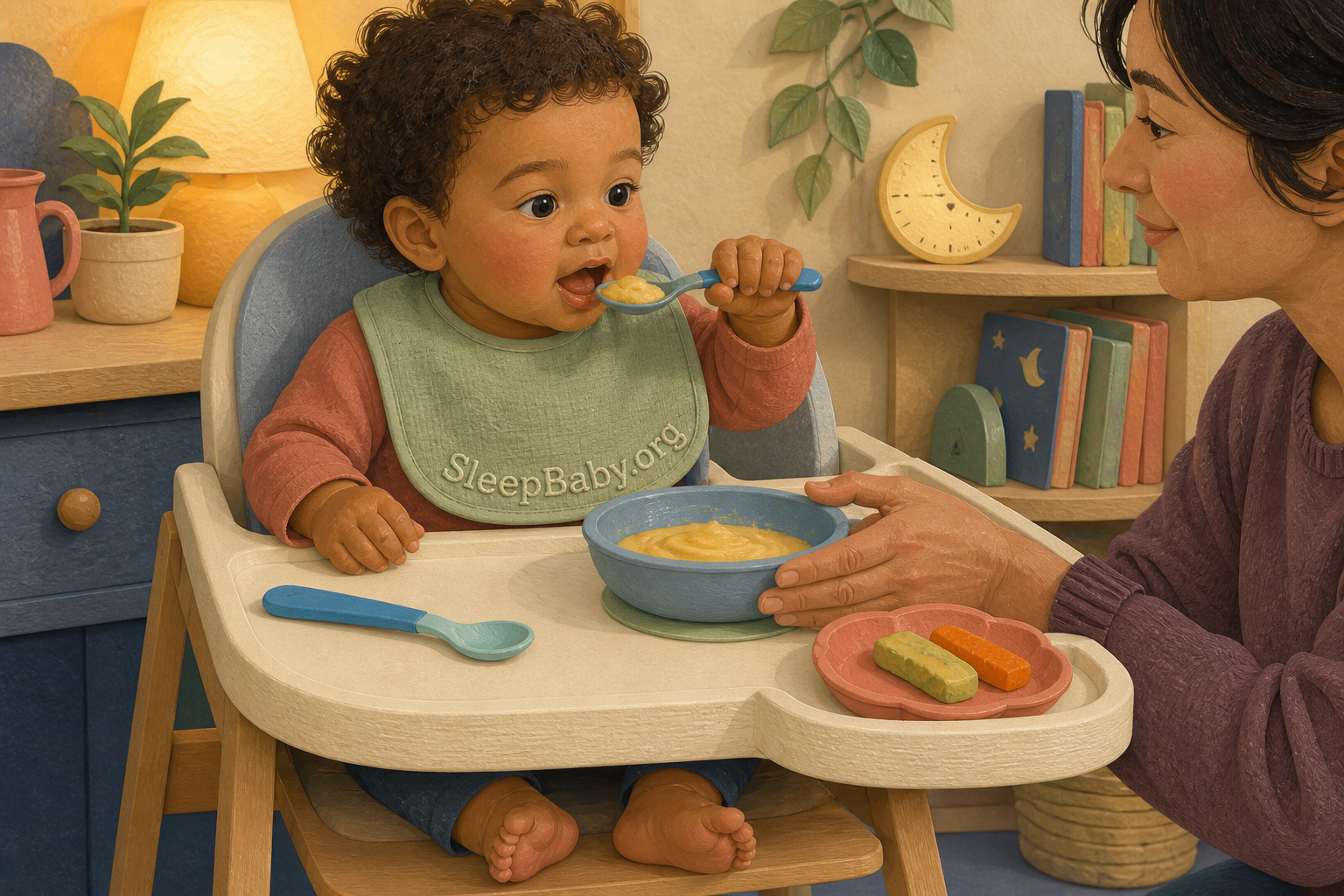
Seat your child upright and alert in a stable high chair or appropriate chair. Support the trunk as needed, bring the tray or table to a useful height, and support the feet when possible. Keep the child still while eating. Walking, crawling, reclining, riding in a car, or moving in a stroller with food in the mouth increases risk and makes careful chewing harder.
How to encourage self-feeding without turning dinner into training
The best practice meal is still a meal. Your child needs a chance to participate, but also enough safe food and enough help to eat comfortably. I would not make hunger the consequence for a hand skill that is still under construction.
Set the tray for one learnable job
Make practice smaller than the whole meal
- Let the fingers stay
- Put the utensil beside manageable finger foods. A toddler can practice a spoon without being required to abandon the method that still works.
- Preload before expecting a scoop
- Load one spoon and let the child practice transport. Use a second spoon so you can reload without wrestling the first one away.
- Reduce the chase
- A shallow bowl, useful edge, nonslip base, or your steadying hand can turn “catch the dish” back into “practice the scoop.”
- Use a small cup and a small pour
- A little liquid gives the child a real chance to grade the tilt without one enthusiastic movement ending the entire tablecloth.
Why this matters tonight: one manageable job creates more useful practice and less end-of-day friction than demanding a complete independent performance.
Foods that cling to a spoon can make transport easier than thin foods that escape immediately, but there is no universal practice menu. Match every texture and piece to the child’s current chewing and swallowing ability, allergy plan, nutrition needs, and clinical advice. The goal is not to find the most photogenic food. It is to create a safe task the child can understand.
Model the action without turning it into a command. Eat nearby when practical. You might say, “The spoon is loaded,” “You want help,” or “You are all done.” Then pause. Reaching, pointing, opening the mouth, or showing excitement may signal hunger. Pushing food away, turning the head, or closing the mouth may signal fullness. The CDC, WHO, and AAP all support responsive feeding: the adult provides safe choices and structure; the child participates and decides whether and how much to eat.
If your toddler keeps offering you bites, that behavior may be imitation, connection, play, a bid for control, or a way to say “I am finished.” Our guide to why a toddler keeps feeding you helps interpret the social message without confusing it with how much the child ate.

What the mess can tell you—and what it cannot
Mess can mean a toddler is exploring, practicing release, learning how hard to tilt, or discovering that mashed potato has adhesive properties previously known only to industrial science. It can also mean the task is too difficult, the portion is overwhelming, the child is tired, or the dish will not stay still. Mess alone does not prove progress, and a clean tray does not prove delay.
Watch what happens inside the mess. Does the child keep participating? Can they get some food to the mouth? Do they recover after a spill? Do they accept help? Are chewing and swallowing comfortable? Is the meal still connected enough that hunger and fullness cues can be noticed? Compare ordinary meals over time. One dinner after a missed nap is not a motor assessment.
Aim for a cleanup you can emotionally afford. Put down a washable mat if it helps, offer smaller amounts and refill, use a bib if your child tolerates one, and keep a cloth nearby. None of this should become a campaign to keep the child spotless. It is simply household engineering in service of letting everyone return tomorrow.
Choking prevention still belongs to the adult
A toddler who can hold a fork is still a toddler with a small airway and developing chewing skills. Prepare food for the child in front of you, not for the utensil in their hand. The CDC and AAP advise changing the shape, size, and texture of common hazards and supervising young children continuously while they eat.
- Modify small, round foods such as whole grapes, cherry tomatoes, and similar berries or pieces.
- Avoid or adapt hard raw produce, nuts, popcorn, tough meat, hot dog rounds, hard candy, cheese chunks, and other hard or difficult pieces.
- Do not offer a spoonful of thick nut butter as a lump; follow current safe-preparation guidance.
- Keep the child upright, alert, calm, and seated. Do not let a child eat while walking, playing, reclining, or riding in a moving vehicle or stroller.
- Stay close enough to see and hear what is happening. A screen across the room is not supervision.
- Make sure older children understand that they cannot hand over food or small objects without an adult checking first.
Know the airway boundary before the meal
Gagging is often noisy; severe choking can be quiet
Gagging may look active
A child may cough, retch, make noise, turn red, water at the eyes, or push the tongue forward. Gagging is a protective response, but no one sign proves that every episode is harmless. Stay close and watch the child’s breathing and recovery.
Severe choking needs immediate action
An ineffective or absent cough, inability to breathe, cry, talk, or make sound, gasping, panic, color change, limpness, or unresponsiveness can signal a blocked airway. Call emergency services and give age-appropriate choking care based on current training.
Do not perform a blind finger sweep. Remove an object only if it is visible and you can do so safely. Infant and child choking techniques differ; learn them from a current certified first-aid course before you need them.
Why this matters tonight: knowing the emergency boundary before dinner lets the ordinary learning stay ordinary and keeps the truly urgent moment unmistakable.
The NHS offers a useful visual distinction between gagging and choking during weaning. The American Academy of Pediatrics and American Red Cross provide current choking-prevention and first-aid guidance. A written article is not a substitute for hands-on child-and-baby first-aid or CPR training.

When self-feeding difficulty deserves professional help
Some children need more time, a different setup, adaptive tools, or a different route into participation. Others are showing a feeding or swallowing problem that should not be treated as stubbornness. I would stop troubleshooting the spoon when the concern is really breathing, swallowing, pain, growth, hydration, or a child who is working far too hard to eat.
Choose the next action, not a diagnosis
Practice, adjust, ask, or act now
Practice now
The child is alert, upright, interested, and handling an appropriate food or tool with ordinary spills, comfortable chewing and swallowing, and useful adult help.
Adjust the setup
The bowl moves, posture collapses, the portion overwhelms, or the task asks for loading, scooping, rotating, and balancing all at once. Change one variable and watch the pattern.
Ask for help
Eating is repeatedly painful, frightening, unusually long, very restricted, or ineffective; skills stall or disappear; or coughing, choking, wet voice, pocketing, vomiting, growth, or hydration concerns appear.
Emergency now
The child cannot breathe, cry, talk, or make sound; has an ineffective or absent cough; changes color; becomes limp; or is unresponsive. Call emergency services and use current trained care.
Sleep connection: meals that are medically difficult can affect intake, energy, and the whole family’s evenings. Professional feeding care addresses feeding; SleepBaby never replaces it.
Bring repeated coughing or choking during or after meals, breathing changes, a wet or gurgly voice, food pocketed in the cheeks, trouble chewing, food or liquid leaking from the mouth or nose, persistent gagging or vomiting, pain, arching, severe distress, or a very narrow texture range to the child’s pediatrician. Meals that routinely last around 30 minutes or longer because eating is difficult, poor weight gain, weight loss, dehydration, fatigue, or recurrent chest infections also deserve attention.
Ask specifically whether a feeding-and-swallowing evaluation would help. A speech-language pathologist with pediatric feeding and swallowing expertise may be part of the team; occupational therapy, nutrition, gastroenterology, allergy, dentistry, or other specialties may be appropriate depending on the problem. The right route is individual. The article’s job is to help you recognize when guessing has stopped being useful.
Development matters too. One missed milestone does not establish a disorder, but several absent skills, no forward movement, or loss of a skill the child previously used should be discussed. Bring a short video only if recording is safe and does not distract from supervision, plus notes about the food, position, what happened before and after, and whether the pattern repeats.
Adaptive help still counts as participation
Independence is not the only respectable outcome. A child may use a built-up handle, angled spoon, nonslip dish, supportive seating, hand-over-hand help, partial caregiver feeding, or another adaptation. Some children communicate “more,” “help,” or “all done” without speaking. Some have sensory, motor, developmental, or medical needs that change how feeding looks.
The useful question remains: can the child participate safely, comfortably, and meaningfully? Participation might mean choosing between two foods, bringing a loaded utensil partway, holding the cup with help, touching a new texture, or telling the adult when to pause. Caregiver assistance does not erase agency. It can be the thing that makes agency possible.
Use one ordinary meal to see the pattern more clearly
You do not need a color-coded feeding dossier. One plain note across a few ordinary meals can separate a setup problem from a larger pattern. Record what the child was asked to do and what support changed the answer.
Before, during, after
A three-part meal note worth bringing to the pediatrician
- Before
- Food and texture, hunger, illness, fatigue, seat and foot support, utensil, noise, and who was helping.
- During
- What the child attempted, what entered the mouth, chewing and swallowing, cough or gag, voice or breathing change, distress, help accepted, and meal length.
- After
- Comfort, breathing, voice, vomiting, fatigue, amount eaten or drunk, and whether the same pattern appears with other foods or settings.
Why this matters tonight: a useful pattern note can replace six anxious theories and help the right professional understand the real meal faster.

When feeding practice and bedtime start stepping on each other
Self-feeding does not fix sleep, and a toddler does not sleep better because they mastered a fork. The honest connection is more ordinary. A pressured or difficult dinner can leave a child underfed, overtired, or upset; a very tired child may have less patience for a hard feeding task; and a late scramble over intake can spill into the bedtime routine.
If your toddler is repeatedly hungry after lights-out, look at the full daytime pattern rather than blaming independence or immediately taking every utensil away. Our guide to a toddler who is hungry at night can help separate genuine hunger, timing, habit, and the rest of the day’s intake. Feeding or growth concerns still belong with the pediatrician.
Protect one familiar ending even when dinner was experimental: wipe hands, offer the usual next step, and let the day move on. No family needs a surprise remedial spoon seminar at the exact moment everyone is looking toward pajamas.
A feeding-skills season does not require a particular sleep-training method. If the evening has you questioning how much support is “too much,” our guide to whether a child can learn to sleep without formal sleep training keeps developmental change separate from the family’s choice of sleep approach.

Watch: feeding and swallowing milestones
The American Speech-Language-Hearing Association’s developmental overview explains how feeding skills unfold and when difficulty deserves professional attention. The useful takeaway is the same one that steadies this whole guide: look at ranges and function, not one birthday or one spilled cup.
Watch ASHA’s feeding and swallowing milestones video on YouTube. The finished page requires a responsive, non-autoplay player, accessible context, a normal fallback link, and a fresh transcript and playback review before publication.
The goal is not a toddler who never needs help
The goal is a child who can take part in eating as safely, comfortably, and meaningfully as possible. For one child, that may be fingers and a preloaded spoon. For another, it may be a fork, open cup, and strong opinions about bowl ownership. For another, it may be adaptive equipment and a caregiver who knows exactly when to assist.
Offer practice without making hunger the exam. Keep the body stable, the food appropriate, the task small, and the cues visible. Watch progress across ordinary meals. Keep the choking boundary sharp. Ask for feeding and swallowing help when the problem is bigger than the utensil. That is self-feeding support: not stepping away, but knowing when and how to stay close.
When the spoon lesson follows everyone upstairs
Let dinner end before bedtime has to begin
The cup tipped, the toddler ate three peas with total independence and the rest with your hand, and now the family is trying to decide whether “hungry” at bedtime is a need or a sequel. SleepBaby can help you read meals, naps, settling, wakes, and caregiver capacity as one household rhythm—without pretending a spoon skill is a sleep cure.
Sources
- Centers for Disease Control and Prevention: Fingers, Spoons, Forks, and Cups
- Centers for Disease Control and Prevention: Milestones in Action—18 Months
- Centers for Disease Control and Prevention: Milestones in Action—2 Years
- American Speech-Language-Hearing Association: What to Expect From Your Child’s Feeding Development
- ASHA: Feeding and Swallowing Milestones—6 to 12 Months
- ASHA: Feeding and Swallowing Milestones—12 to 18 Months
- ASHA: Early Identification of Feeding and Swallowing Problems
- Centers for Disease Control and Prevention: Choking Hazards
- American Academy of Pediatrics / HealthyChildren: Choking Prevention for Babies and Children
- American Red Cross: Infant Choking—How to Help
- World Health Organization: Infant and Young Child Feeding
- Centers for Disease Control and Prevention: Signs Your Child Is Hungry or Full
- American Academy of Pediatrics: Preschooler Food and Feeding
- National Health Service: Choking and Gagging on Food