Before anyone steps into the steam
A baby can join some hot-springs outings, but the baby should stay out of hot soaking water
The CDC says children younger than 5 should not use hot tubs.1 A hot spring is not automatically the same facility, but that guidance gives families a clear boundary for heated soaking water: keep the baby cool, dry, shaded, and away from the edge. If adults want to soak, use one adult for the water and one completely dry adult for the baby, then switch only after the wet adult has dried off and moved to a safe handoff area.
A pretty pool can make this feel like a temperature question. For a baby, it is a boundary question.
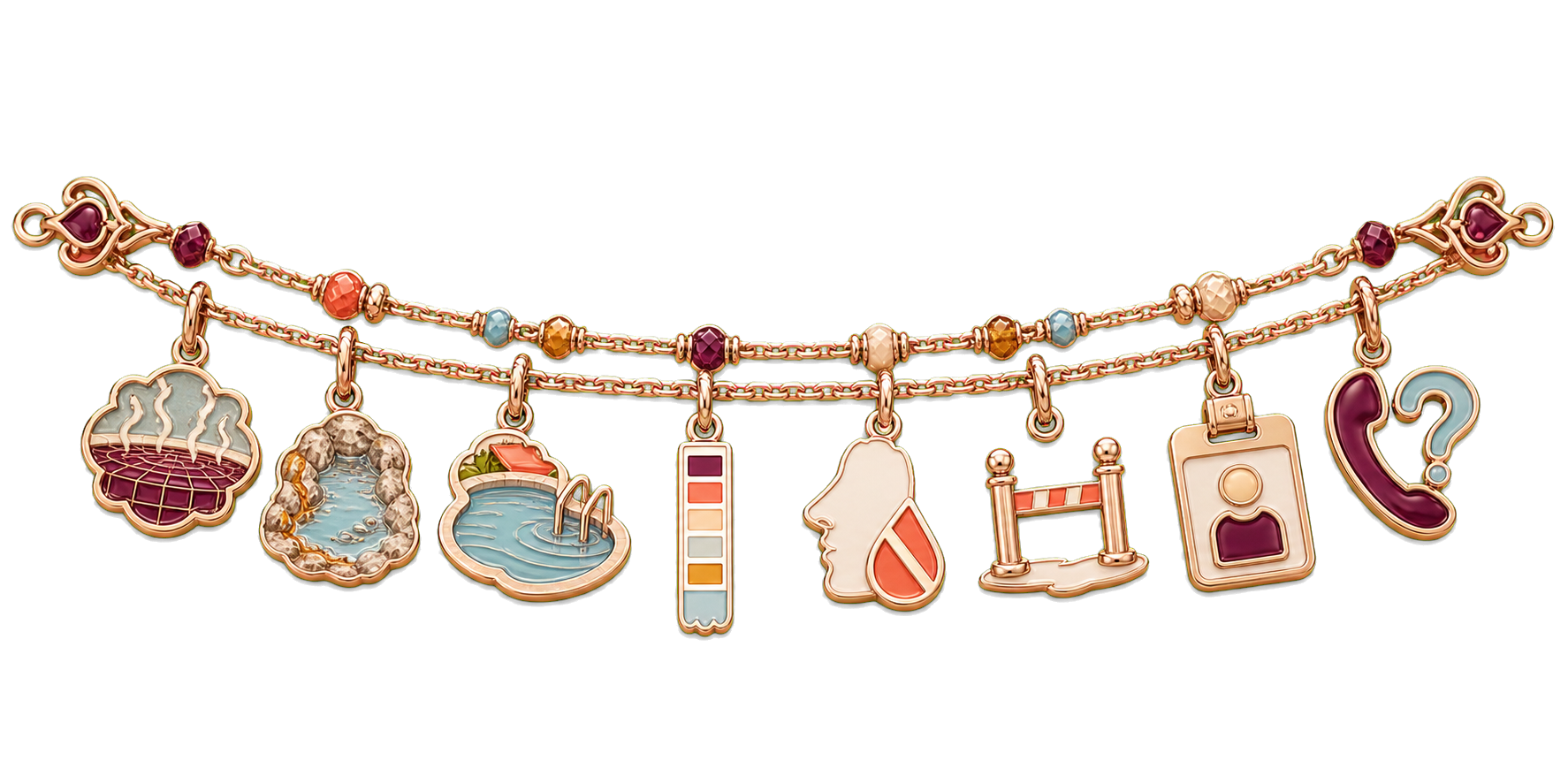
The word hot springs can describe several very different places: a resort with treated soaking pools, an untreated natural spring in the rocks, a geothermal overlook where entering the water is prohibited, or a property with both hot adult pools and a separate ordinary-temperature family pool. The name on the brochure does not tell you the temperature, treatment, age rule, barrier setup, or whether there is a cool place for a baby to wait.
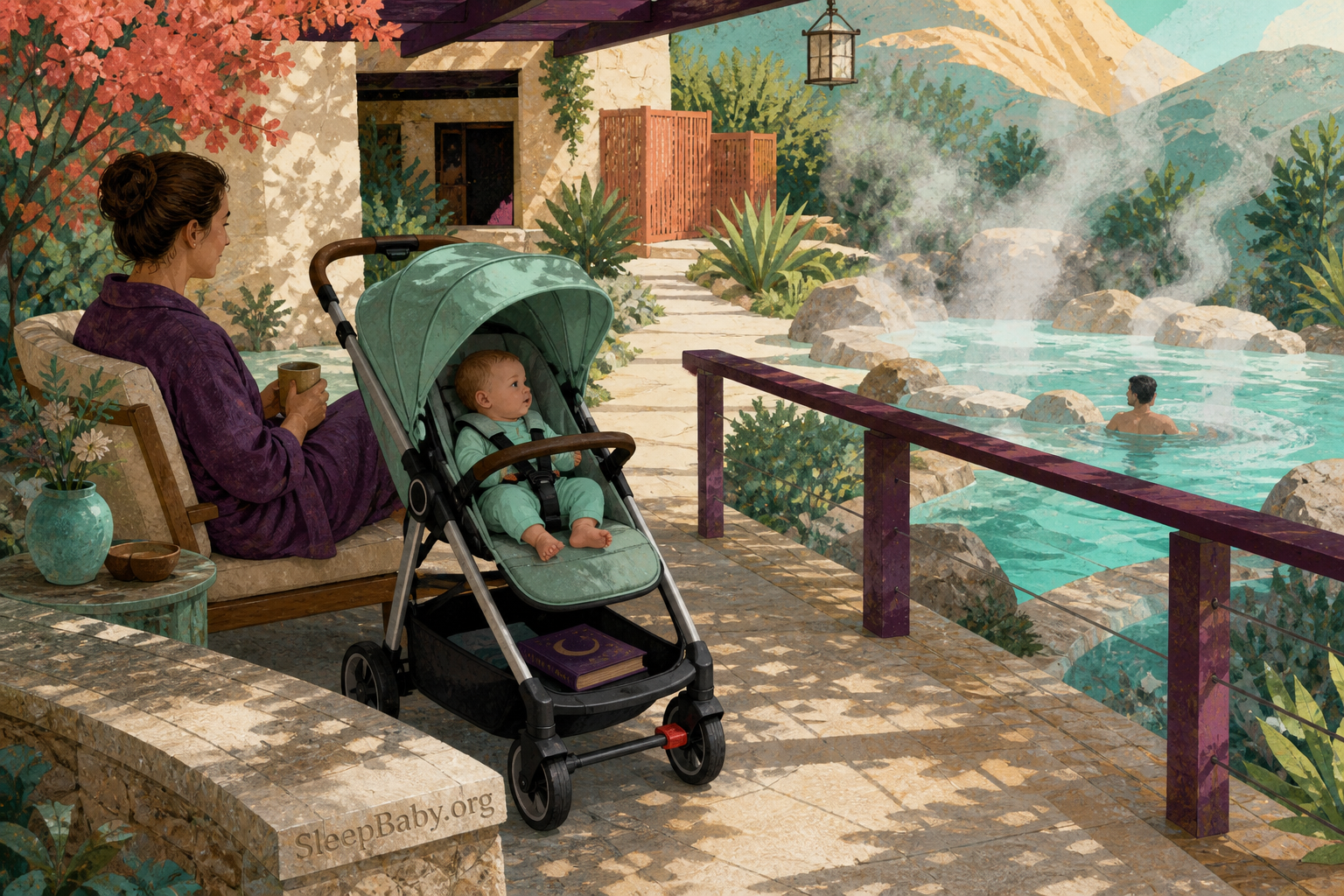
So the useful answer is not, “Try five minutes and see.” Babies do not need a trial soak. They need an adult to decide the water is not their activity. A family visit may still be lovely: one caregiver can walk the grounds, feed the baby in a cool room, sit on a shaded terrace, or trade places with another adult. The outing works when the baby has a safe plan that does not depend on tolerating heat.
I would make the call before packing the towels. Ask the venue exactly what kind of water it has, whether infants are permitted anywhere near the pools, what the posted temperatures are, and whether a dry caregiver can stay with a stroller or baby carrier in a shaded area behind a real barrier. If the answer is vague, the baby plan is dry sightseeing or a different stop.
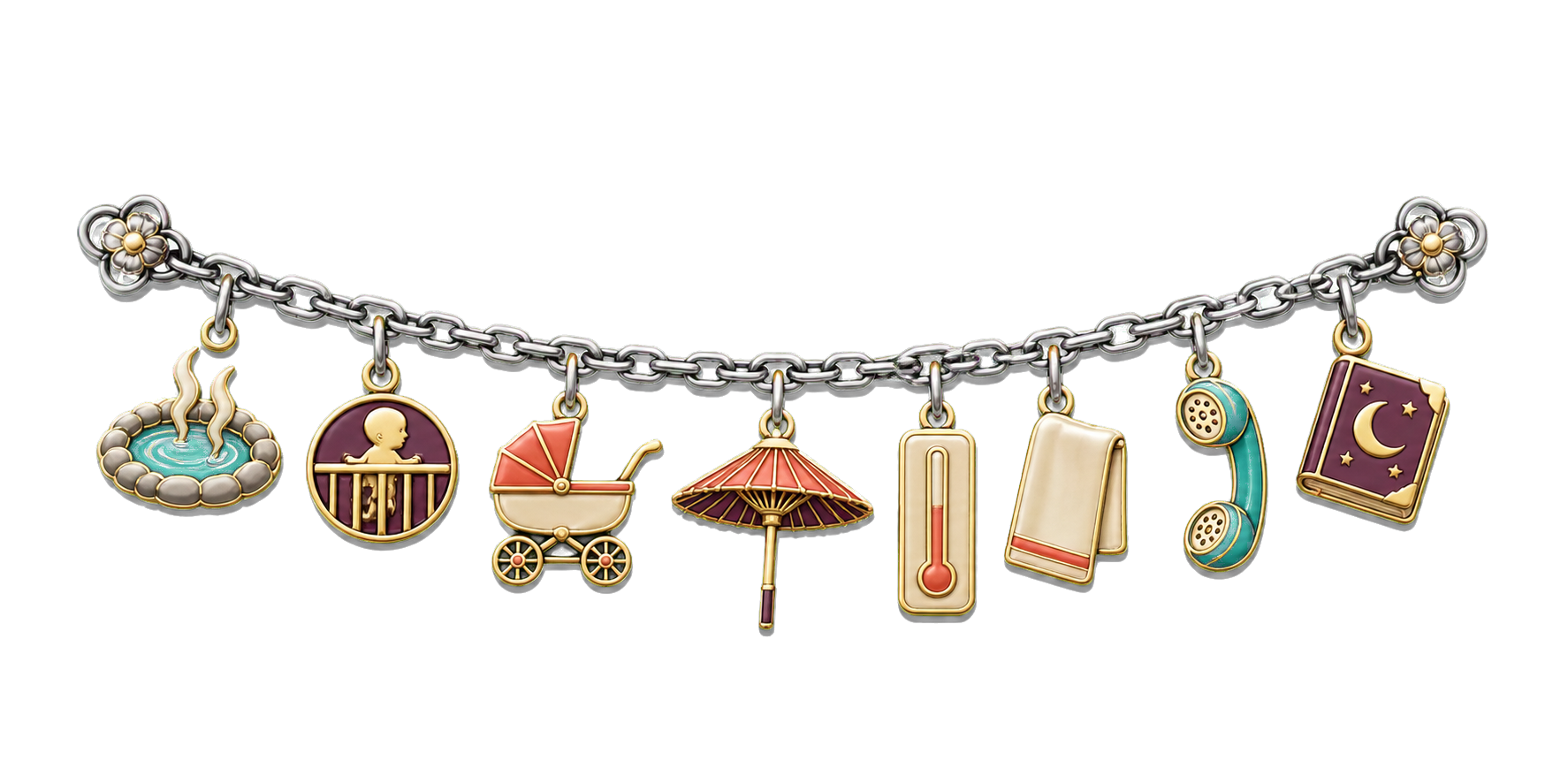
Separate the family visit from the baby soak
Parents often search this question because they want everyone to share one experience. That makes sense. It also creates the pressure to turn a safe adult activity into a baby activity by changing one variable: a shorter time, shallower water, feet only, a lower pool, or a carrier. None of those changes creates evidence that hot soaking water is appropriate for an infant.
Three different plans, one clear baby boundary
Choose the water plan before you choose the towels
DRY FAMILY VISIT
The baby stays in a cool, shaded, dry area with one named adult. Other adults soak in turns. This is the simplest way to include the baby without making the hot water part of the baby’s day.
SEPARATE COOL POOL
Consider it only if the pool is truly ordinary-temperature, treated and maintained for family swimming, the venue allows infants, and your baby’s medical situation does not call for a stricter plan. Use normal infant water-safety rules.
HOT SOAKING WATER
This is for the adults, not the baby. Do not test a short soak, sit the baby on a lap, dip feet, or carry the baby into the pool. If no safe dry-side plan exists, skip the soak.
Why this matters tonight: a baby who never has to cool down from the pool has one less reason for feeding, comfort, and sleep to unravel after the drive home.
The dry visit is not a consolation prize. It is the version that lets the adults enjoy the place without borrowing safety from the baby. One person can soak. One person can stay fully dressed, hold the feeding supplies, monitor the shade, and leave the water area the moment the baby needs something. Then the adults can switch. Nobody has to make a wet, slippery transfer over stone because the baby started crying at the least convenient minute.
Picture the moment the plan has to work: steam on the glasses, one sandal under a chair, the baby suddenly hungry, and the soaking adult saying, “Give me ten seconds.” This is an imagined micro-scene, not evidence; it is simply why the dry adult keeps the baby job until the other adult is fully out, dry, steady, and ready.
A spa wristband can tell you what you paid for. It cannot turn adult soaking water into infant water.
Why the hot-tub rule still matters at a hot spring
CDC hot-tub guidance is direct: do not let children younger than 5 use hot tubs, and keep hot-tub water at or below 104 F (40 C).1 Those statements do two different jobs. The age rule tells families that young children should not use the hot tub. The temperature number tells operators and adult users the upper limit for the water. It is not an infant permission threshold.
I would not turn 104 F into a chart that works backward toward a baby-safe number. There is no reason to experiment when the useful family plan is available without putting the baby in hot water. A lower-temperature mineral pool may feel gentle to an adult and still add heat to a small body that is already dressed for travel, sitting in warm outdoor air, and unable to say, “I am getting too hot.”
Do not use your hand or elbow as the deciding instrument. Adult skin adapts to warm water, source temperatures can vary within a natural pool, and a hand check cannot tell you how an infant will respond over time. A posted thermometer is useful for classifying the venue. It does not override the under-5 guidance.
Do not use “mineral” as a synonym for “mild.” Minerals may affect smell, color, or the way the water feels. They do not remove heat, eliminate drowning risk, sterilize an untreated spring, or create a proven infant treatment. This article does not promise skin, sleep, respiratory, digestive, or developmental benefits from soaking a baby in geothermal water. If a clinician has given your child a specific bathing or skin-care plan, follow that plan in an appropriate setting rather than improvising at a public spring.
Treated hot pool, natural spring, and cool family pool are not interchangeable
The facility should be able to tell you what you are looking at. If staff cannot describe the pool temperature, treatment, testing, cleaning schedule, and infant rule, do not fill the gaps with the word “natural.” Use the dry-side plan.
Read the water before reading the itinerary
What changes with the kind of pool?
Mobile note: this comparison scrolls sideways inside its own clearly bounded region when needed; vertical page scrolling stays free.
| Water setting | What to verify | Baby plan | What not to assume |
|---|---|---|---|
| Managed hot soaking pool | Posted temperature, disinfectant program, inspection record, age rule, capacity, barriers, and staff presence. | Baby stays out of the hot water with a dry adult. | A clean-looking pool or weak smell does not prove correct operation. |
| Untreated natural spring | Whether bathing is legal, source temperature, currents, rock stability, water-quality notices, depth, fencing, and emergency access. | Baby remains out of the water and away from the edge. | Clear, moving, mineral-rich, or remote water is not sterile or automatically safe. |
| Separate ordinary-temperature pool | Actual temperature, infant admission, maintenance, swim-diaper rule, shallow area, barrier, and supervision setup. | Use an infant pool plan only if the venue permits it and no health circumstance calls for a stricter choice. | Being on the same property does not make it a hot spring, and being cooler does not remove drowning risk. |
If the goal is ordinary family water time, our guide to taking a baby to a public pool is the better planning path. It covers a managed swimming setting without pretending a hot soaking pool is the same thing. If the property is large, crowded, and full of changing zones, the exit and handoff planning in taking a baby to a water park can help too.
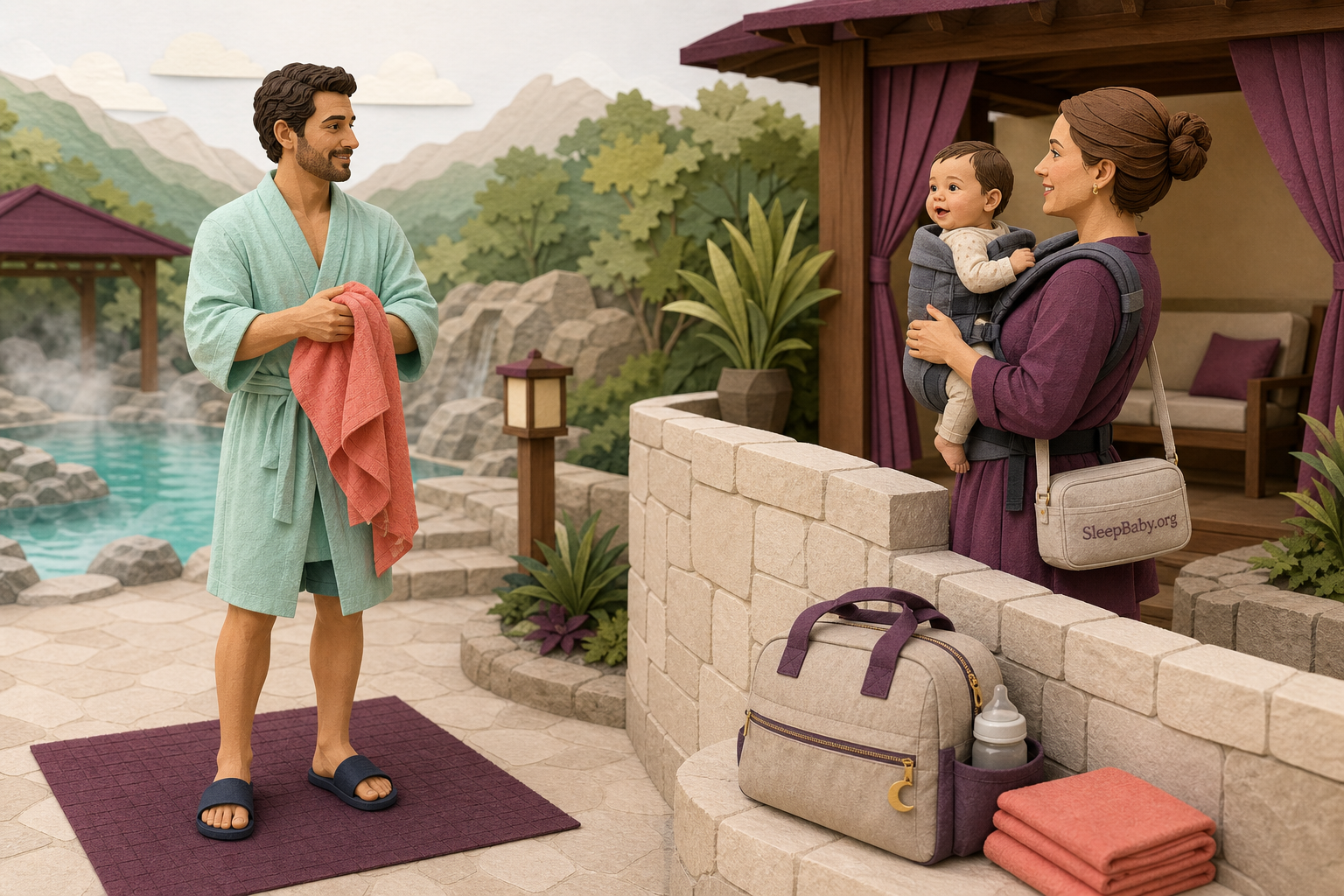
The safest family version uses one wet adult and one dry adult
A hot-springs pool combines water, heat, steam, slippery surfaces, towels, shoes, phones, feeding supplies, and the temptation to say, “Can you just hold the baby for one second?” That sentence is not a supervision plan.
Before anyone changes clothes, assign the jobs. The dry adult is responsible for the baby, the stroller or carrier, feeds, shade, diapering, and the exit. The soaking adult is responsible only for getting into and out of the pool safely. The dry adult does not sit on the edge with the baby, trail fingers through the water, or step onto wet stone for a handoff.
- Build the dry base first. Find shade, a barrier, a stable stroller spot, a cool feeding area, and an exit that does not cross the pool deck.
- Name the dry adult. That person stays dry, keeps the baby within reach, and does not split attention with a phone, book, drink, or another child near the water.
- Keep the wet adult’s exit separate. The soaking adult leaves the pool, reaches a stable dry surface, dries hands and body, puts on secure footwear, and only then approaches the baby zone.
- Transfer in the dry zone. Say the handoff out loud. The new baby adult confirms before the first adult leaves to change or soak.
- End the relay when the baby needs to go. Feeding, heat, distress, a wet diaper, missing shade, or supervision drift ends the soak. The family leaves without a committee meeting.
One adult can take a baby to a scenic geothermal overlook or a cafe beside the springs when the water is securely separated. One adult should not carry the baby into a hot pool in order to make the outing possible. A soft carrier is not a flotation device, not heat protection, and not a safe way to hold an infant in slippery water. It can also make it harder to monitor the baby’s airway and temperature while the adult is dealing with steam and unstable footing.
Floaties do not fix this either. CDC drowning guidance says adults should supervise children closely and constantly near water, and that air-filled or foam toys are not safety devices.3 The baby does not need more equipment in the hot-water zone. The baby needs distance from it.
At the water edge, supervision is one person’s only job
Drowning can happen in seconds and is often silent. CDC advises assigning a responsible adult to supervise each child closely and constantly near water, even when lifeguards are present, and avoiding distracting activities such as reading, phone use, alcohol, or drugs.3
That guidance matters even when the baby is not swimming. A stroller can roll. A wheel can catch on stone. A seated adult can stand up and discover that the pool edge is closer than it looked. Steam can reduce visibility. A towel can block a line of sight. A handoff can happen without either adult realizing that the other one has not fully taken over.
Use the stroller brake and harness on a stable, level, dry surface behind a barrier. Keep the baby within reach of the supervising adult. Do not park the stroller at the coping, on a sloped path, in a steam plume, or where swimmers have to squeeze past. Do not drape a thick blanket over the stroller to make shade; it can trap heat and hide the baby from view. Use a proper canopy or move to a cooler place.
If the venue has no safe dry position, the facility is not workable with the baby that day. This is not a packing failure. It is a site-design fact.
Plan for the heat around the pool, not just the heat in it
A baby can become uncomfortable before touching the water. The outdoor air may be hot. Steam may collect under a roof. Stone can radiate heat. A carrier adds two bodies together. A stroller canopy can turn into a warm pocket. The drive may already have shifted a feed.
The FDA and the American Academy of Pediatrics recommend keeping newborns and babies younger than 6 months out of direct sunlight and using shade and protective clothing. The FDA also notes that younger babies do not cool themselves like adults and can overheat and dehydrate more easily.4 Shade is not a decorative extra at a hot-springs property. It is part of the admission test.
The dry base earns the outing
What the baby zone needs before the adults soak
COOL AND VISIBLE
- Real shade or a cool indoor room
- Fresh airflow without a direct steam plume
- Baby visible and within the adult’s reach
- A stable surface behind a barrier
FEED AND CHANGE READY
- Breast milk or formula handled as usual
- Closed feeding supplies kept out of heat
- A clean changing area away from splash
- Dry clothes and a light layer for departure
EXIT WITHOUT FRICTION
- Secure shoes for the adults
- One bag that closes in seconds
- A route that avoids wet stone
- No item important enough for a second trip
Sleep connection: leave while the baby is still regulated enough to feed and settle normally, not after heat and waiting have turned the drive home into recovery work.
Offer normal breast milk or formula according to the baby’s needs. Do not invent an extra-water plan for a young infant without guidance from the baby’s clinician. Keep feeding supplies closed and cool, and move away from the pool before feeding. A bottle balanced on a warm stone ledge is not efficient; it is a future mystery about how long the milk has been sitting there.
Watch the baby rather than the adults’ reservation time. Leave for unusual fussiness, poor feeding, fewer wet diapers than expected, vomiting, unusual sleepiness, a body that feels very hot, changed breathing, weakness, or behavior that makes you think the baby is not well. Move to a cool place and contact the baby’s clinician or urgent medical service for guidance. Call emergency services for trouble breathing, seizure, collapse, unresponsiveness, or a baby who is very hard to wake.
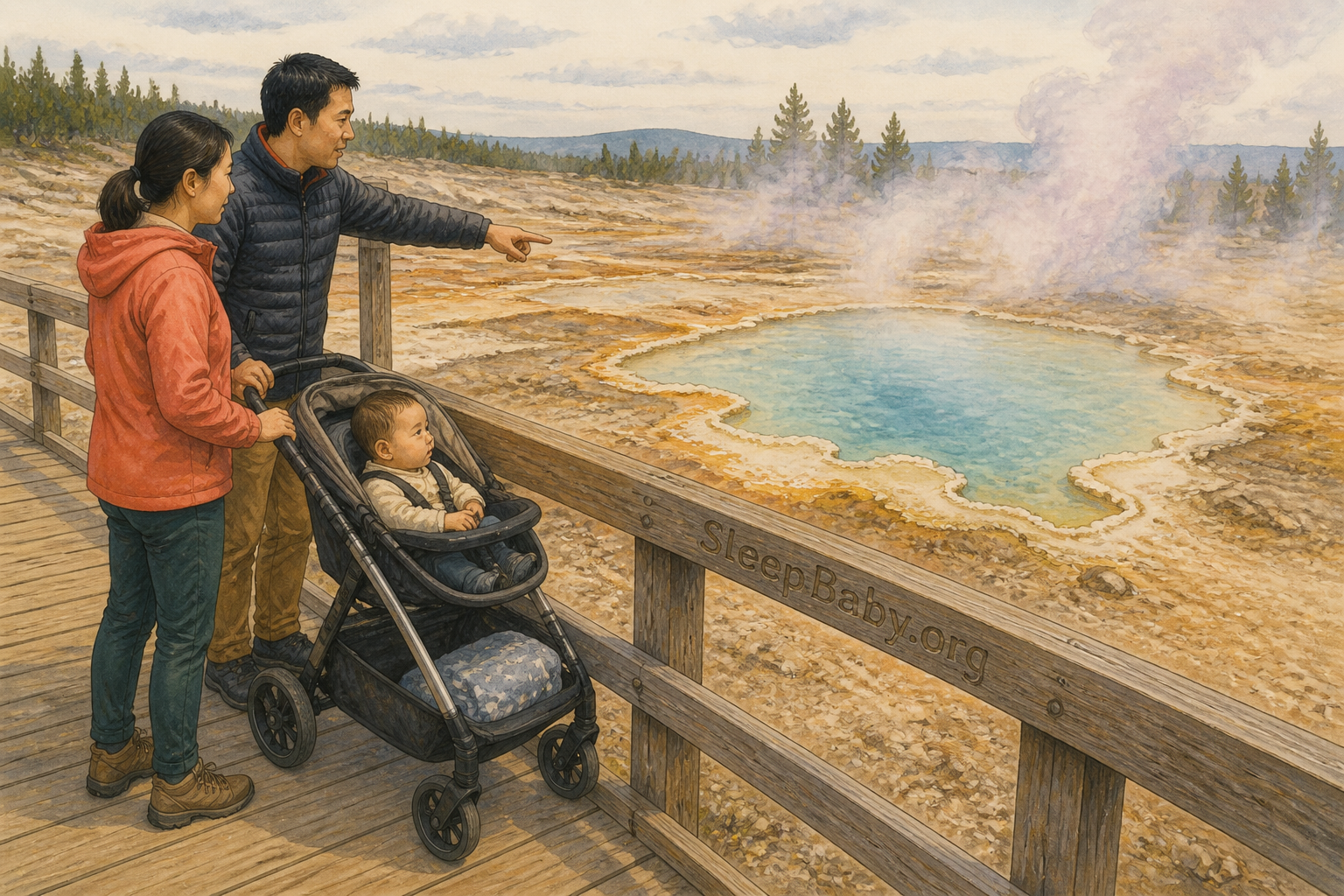
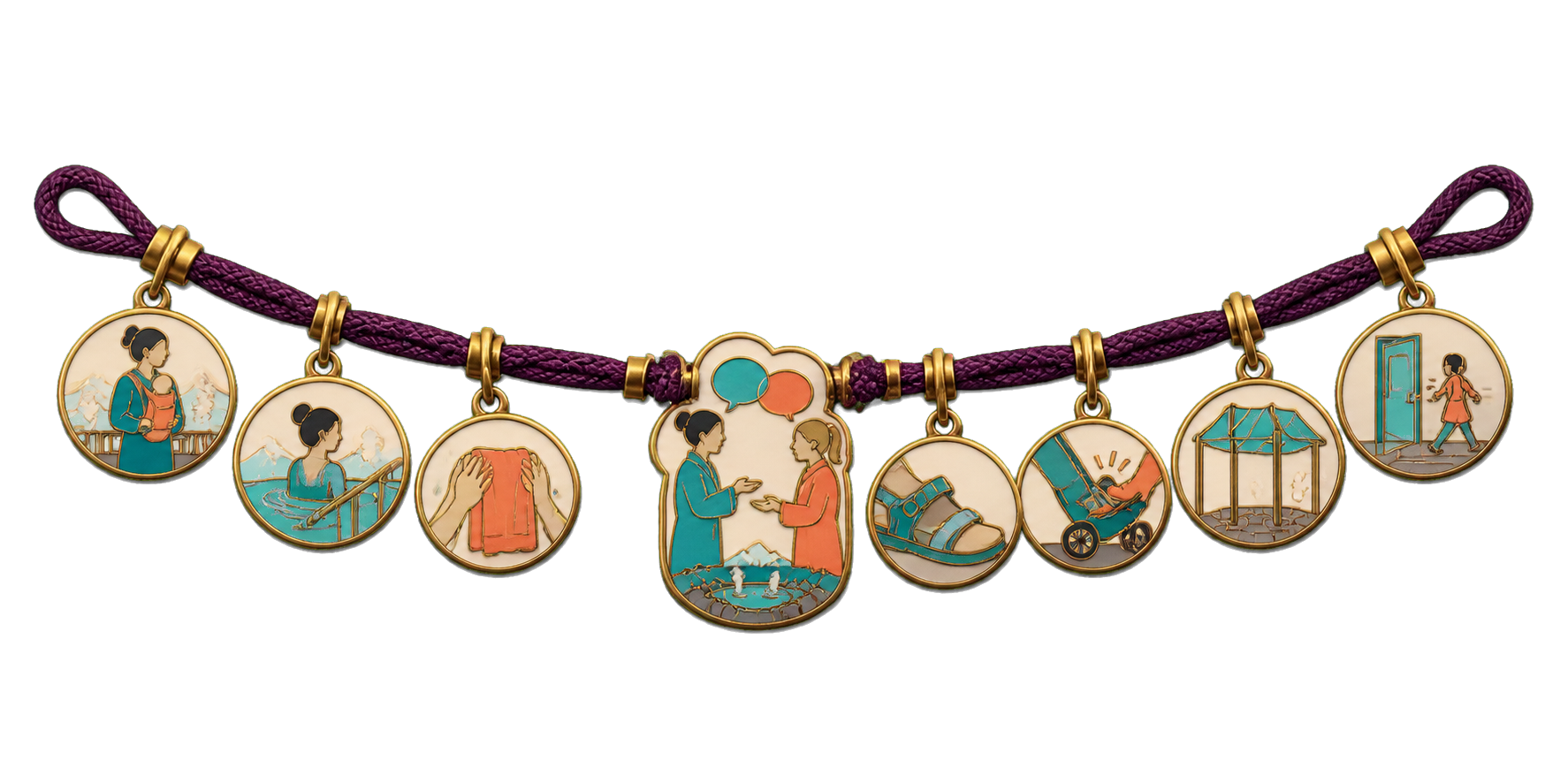
Hot water can carry germs whether the setting looks polished or wild
CDC explains that germs can spread through hot-tub water and cause respiratory, skin, or gastrointestinal illness. Exposure can happen by swallowing contaminated water, touching it, or breathing contaminated mist or aerosols.1 The agency tells users not to enter when sick with diarrhea, not to swallow the water, to shower first, and to pay attention to maintenance signs.
For a managed pool, ask when disinfectant and pH were last checked and whether inspection results are available. CDC says a properly chlorinated hot tub should have little odor; a strong chemical smell can indicate a problem rather than exceptional cleanliness.1 Sticky or slippery tile is another reason to step back and talk to the operator.
Untreated natural springs bring a different uncertainty. Warm freshwater can contain organisms that are not visible. CDC says Naegleria fowleri lives in warm freshwater, including hot springs. Infection is very rare, but it is severe; it happens when contaminated water goes up the nose, not from swallowing. CDC advises keeping the head above water in hot springs.2
This fact belongs in the article because it changes behavior, not because it makes a dramatic headline. Adults who choose a permitted natural spring should follow local public-health and site guidance, keep the head above water, and avoid stirring shallow sediment. The baby stays out. There is no reason to test nose clips, face splashing, or a quick dip with an infant.
Mineral smell, clear water, remote scenery, and social-media photos do not establish water quality. Neither does a stranger saying their children have always gone in. Other families’ outcomes are not a treatment protocol.
Call the exact venue and ask questions that produce usable answers
A good phone call takes less time than finding a dry changing area after everyone is in swimwear. Ask a staff member, not a travel forum, and write down the answer if the policy affects admission.
- Are infants allowed on the property and in which exact areas?
- Separate admission, pool, changing-room, stroller, and age rules. “Family-friendly” is not specific enough.
- Which pools are hot, cool, treated, or natural?
- Ask for actual temperatures and whether the readings are current.
- Where can one adult stay completely dry with the baby?
- Confirm shade, seating, barriers, airflow, feeding space, and whether a stroller is allowed there.
- How is water quality managed?
- For treated pools, ask about testing and recent inspection. For natural water, ask about current public-health notices and closures.
- What does the route look like?
- Ask about stairs, steep paths, wet rock, railings, distance from parking, altitude, cell service, and emergency access.
- What happens if we need to leave early?
- Know the shortest exit, not just the refund policy. A baby plan needs a physical route out.
The six questions that decide whether the baby can come
Why this matters tonight: a clear venue answer prevents the family from stretching a feed or nap while standing at a front desk trying to invent a Plan B.
If the trip involves a natural shoreline, sun, or uneven water access beyond the spring itself, use the practical boundaries in our guide to taking a baby to the beach. The exact venue still controls; the link helps with shade, changing, and leaving before the baby is spent.
Pack for a dry baby and a fast exit
The right bag supports the boundary. Bring the usual feeding and diaper supplies, dry clothes, a sun hat, lightweight protective clothing, a suitable stroller canopy, any routine medicine, and a clean surface for diapering. Keep milk and formula at safe temperatures using the storage method you normally trust. Add secure shoes for adults because the person carrying the baby should not cross wet stone in loose sandals.
Bring fewer loose items than you think. Towels, robes, wet bags, bottles, phones, locker keys, and shoes multiply around water. One adult who has to collect eight objects is not ready to carry a baby. Put the adult soak supplies in one separate bag. Put the baby supplies in another closed, dry bag. If the family must leave, the dry adult takes the baby bag and goes; the wet adult collects the soak bag after exiting safely.
Do not bring a floating infant seat, neck float, or inflatable toy as a way to make hot water possible. Do not put a car seat on the pool deck or an unstable bench. A car seat is for travel, not a makeshift poolside sleep station. If the baby falls asleep during the drive, move the baby to the usual firm, flat, level sleep space when you arrive at your safe lodging and can do so.6
If the baby slips into water or seems overheated, the outing ends immediately
If the baby is submerged or has trouble breathing, remove the baby from the water, call emergency services, and begin CPR if needed and you are trained. Do not wait for coughing to stop before deciding whether the event was serious. A clinician should assess any concerning submersion, breathing change, color change, unusual sleepiness, or change from the baby’s normal behavior.
If the concern is heat, move the baby away from the pool and steam into a cool area, remove unnecessary layers, and seek medical guidance. Call emergency services for severe symptoms such as unresponsiveness, seizure, collapse, or trouble breathing. Do not put the baby into colder spring water as a home remedy; the venue may not have an appropriate temperature, and rapid improvisation near a slippery edge adds another hazard.
If water splashes into the baby’s nose or face at an untreated natural spring, leave the water area and contact the baby’s clinician for situation-specific advice, especially if the baby later develops fever, vomiting, unusual sleepiness, severe irritability, stiff neck, or another serious symptom. The CDC emphasizes that Naegleria infections are very rare, so this is not a reason to panic after ordinary travel. It is a reason not to place an infant in untreated warm water in the first place.2
For diarrhea, rash, ear pain, breathing symptoms, fever, or illness after treated-water exposure, contact the baby’s clinician and mention the water exposure. That detail helps the clinician ask the right questions. Do not diagnose a “detox” or “mineral reaction” from social-media advice.
Watch: water safety is an adult assignment
This American Academy of Pediatrics video explains when children are most at risk around water and how families can build safer supervision. The hot-springs version is straightforward: the adult who has the baby is not soaking, scrolling, reading, or assuming a lifeguard took over.
Watch the American Academy of Pediatrics water-safety and drowning-prevention video on YouTube if the embedded player is unavailable or not useful with your assistive technology.
Written takeaway: name the supervising adult, keep the baby within reach near water, remove distractions, and use barriers and distance. Swimming lessons, floats, a calm pool, or a beautiful resort do not replace constant adult supervision.3
Practical questions families ask before the trip
Can I bring a newborn to a hot-springs resort if the baby does not go in?
Possibly, if the property allows newborns and you have a genuinely cool, shaded, dry plan away from the water edge. Consider travel time, feeding, prematurity, current health, temperature, altitude, crowds, and the distance to medical care. Ask the baby’s clinician when those factors create concern. A newborn does not need steam exposure or a poolside seat in order to be included in the family trip.
Can I dip only the baby’s feet in the hot spring?
I would not. Feet-only still turns adult hot water into a baby experiment, creates a slippery edge interaction, and can lead to the adult lowering more of the baby into the pool. Keep the boundary simple: the baby stays out of hot soaking water.
What if the resort has a warm pool instead of a hot pool?
Ask for the actual temperature, treatment, infant policy, and purpose of the pool. Do not rely on the word “warm.” If it is an ordinary-temperature treated family pool and infants are allowed, use normal infant pool and drowning-prevention guidance. If it is heated soaking water, keep the baby out.
Can I wear the baby in a carrier while I stand in shallow water?
No carrier makes hot or slippery water appropriate. A carrier can trap heat, complicate the baby’s airway position, and make a slip affect both adult and baby. It is not a personal flotation device. Keep the carrier on dry ground and use it according to its manufacturer instructions.
Are natural hot springs safer because they do not have chemicals?
No. Untreated water avoids pool disinfectants, but it can have variable heat, unstable footing, hidden depth, microbes, sediment, currents, and no lifeguard or testing program. “Chemical-free” is not the same as risk-free. The baby stays out of untreated warm water.
How long can the family stay if the baby remains dry?
There is no universal baby visit length. Stay only while the dry area remains cool, the adult assignment remains clear, feeding and diapering are manageable, and the baby is comfortable. Leave before the baby is hot, hungry, distressed, or overtired. A calm 30-minute relay can be a better family memory than stretching a reservation until everyone needs recovery.
After the outing, cool the evening down instead of chasing the schedule
Even a dry-side baby can collect a lot from the day: a long drive, steam, bright water, unfamiliar voices, changed feeding, a short stroller nap, and adults moving in and out of view. Once you leave, change damp or warm clothing, offer the usual feed according to the baby’s needs, and lower the sensory volume. Use the familiar sleep routine rather than adding five new techniques because the nap landed differently.
If travel shifted the whole day, our guide to baby sleep problems after travel can help you choose a small reset instead of forcing the old clock in one evening. Look at the baby’s current cues, protect a calm bedtime sequence, and make the least dramatic reasonable adjustment.
The best family hot-springs plan gives the baby nothing to recover from. The adults may come home pink-cheeked and pleasantly tired. The baby comes home dry, fed, cool, and mostly unimpressed. That is not missing the experience. That is the experience working.
When the soak ends but the steamy day is still in their system
Bring the evening back down to room temperature
A new place, bright water, travel, and a shifted feed can make the next nap or bedtime wobble even when the baby never entered the pool. Use one cool, quiet reset at home, then let SleepBaby help with the sleep plan instead of trying to repay the entire day at bedtime.
Sources
- CDC: What You Can Do to Stay Healthy in Hot Tubs – under-5 guidance, heat limit, germs, water checks, and operator questions.
- CDC: Naegleria fowleri Infections – warm freshwater and hot springs, nose exposure, rarity, and risk reduction.
- CDC: Preventing Drowning – close and constant supervision, named adults, barriers, distraction, and flotation limits.
- FDA: Should You Put Sunscreen on Infants? Not Usually – shade, clothing, infant cooling, feeding, and heat awareness.
- CDC: About Heat and Your Health – staying cool, hydration, and signs of overheating.
- NICHD Safe to Sleep: Safe Sleep Environment – a firm, flat, level sleep surface and moving a sleeping baby from a sitting device when possible.