Yes, you can generally take a baby through a short automatic car wash with the baby correctly buckled in the appropriate car seat. The safe version is pleasantly boring: the restraint stays unchanged, the windows and sunroof stay closed, you follow the instructions for that exact wash and vehicle, and nobody reaches back, gets out, feeds the baby, or changes the harness while the car is moving.
I could not find a special car-wash minimum age in current NHTSA, CDC, NIH/NIDCD, or American Academy of Pediatrics guidance. Those authorities do give us the rules that matter here: use the correct child restraint every ride, limit excessive noise, never leave a child unattended in a vehicle, and move a sleeping infant to a firm, flat sleep surface when travel ends.12345
The detail that changes the answer is not whether your baby is eleven days old or eleven weeks old. It is whether this baby, in this car, at this wash, can stay safely buckled while you keep your attention on the instructions. A premature or medically fragile baby, a child with clinician-directed hearing or breathing precautions, or a baby who is already unwell deserves a different plan. So does a wash that feels punishingly loud or a vehicle procedure you do not understand.
The wash can be theatrical. The buckle should be boring. Let the foam do the drama; keep the car-seat rules exactly the same as they were before you joined the line.
Decide before you join the line
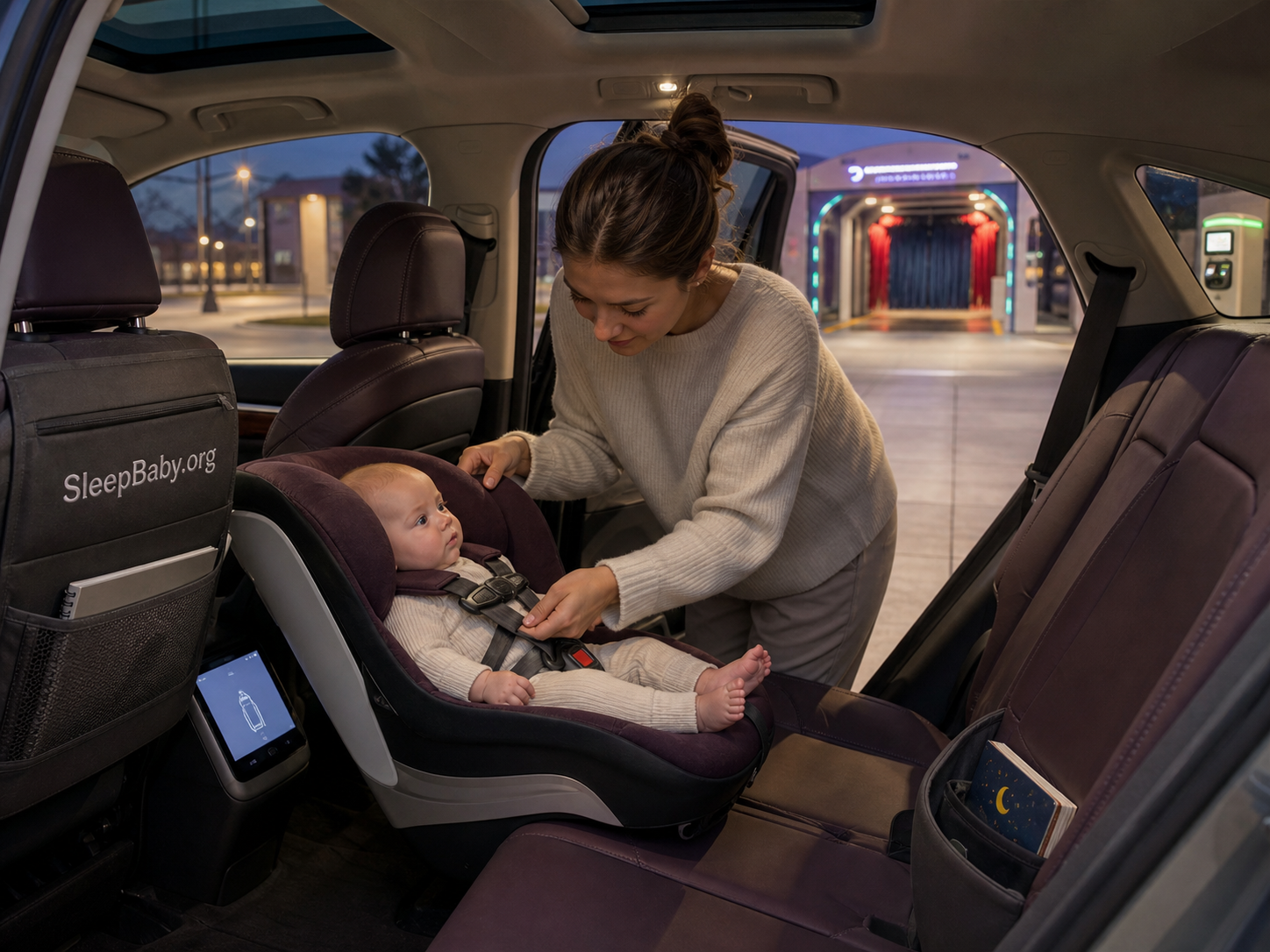
An automatic wash is an optional errand, which is useful because optional errands are allowed to have standards. You do not need to prove that your baby can tolerate the loudest tunnel in town. You need a setup that lets you protect the restraint, follow the vehicle procedure, and leave without improvising.
Before the payment kiosk
Choose the lane that protects your attention
Green lane
Go today
- Baby is well, settled enough, and correctly restrained.
- You know the wash type and exact vehicle procedure.
- The cabin seals, and you can stay seated and focused.
- You know where to pull over after the exit.
Amber lane
Change one piece
- Choose an in-bay wash instead of a conveyor.
- Bring another adult who can observe while belted.
- Pick the quieter actual facility.
- Wait until feeding, fit, or car-seat crying is easier.
Exit lane
Choose another route
- Baby is unwell or has clinician-directed precautions.
- The controls or instructions remain unclear.
- The entrance already feels painfully loud.
- The plan requires reaching, feeding, unbuckling, or leaving.
Why this matters tonight: choosing the calmer route before the tunnel protects both the buckle now and the family’s ability to settle afterward.
SleepBaby.org · car-wash decision path
That last reason counts. A clean car is not a developmental milestone. If most of the plan works but one piece does not, change one piece. A smaller plan is still a plan.
Which kind of car wash works best with a baby?
The word automatic hides several different experiences. Some washes pull the car through a tunnel on a conveyor. Some keep the car still while equipment moves around it. Some are touchless but use strong sprays and dryers. The right choice is the one whose instructions you can follow without dividing your attention.
Five wash bays, five different tradeoffs
Compare the machinery, not the marketing name
Conveyor tunnel
- Car movement
- Wheels are guided or pulled; neutral or other exact actions may be required.
- Baby challenge
- Brushes, changing light, water, track movement, and dryer noise.
- Best when
- You understand the facility and vehicle procedure before entering.
In-bay automatic
- Car movement
- The car generally remains in one marked position.
- Baby challenge
- Sprayers and dryers can still be loud; equipment looks close.
- Best when
- Staying parked simplifies the exact vehicle procedure.
Touchless automatic
- Car movement
- Varies by facility; water and chemicals clean without brushes.
- Baby challenge
- High-pressure spray and drying noise may still startle.
- Best when
- Brush movement is the concern and this actual site sounds manageable.
Self-service wand
- Car movement
- The adult gets out and operates the equipment.
- Baby challenge
- A solo caregiver would leave the child unattended or split supervision.
- Best when
- Another responsible adult remains with the baby.
Hand wash or drop-off
- Car movement
- Staff clean the car or the caregiver leaves it for service.
- Baby challenge
- More planning, time, or cost.
- Best when
- A medically sensitive baby or family needs no tunnel exposure.
Sleep connection: the best wash type is the one that leaves the adult with enough attention and calm to handle the transition home.
SleepBaby.org · wash-bay comparison
There is no universally calm option. One older in-bay wash may rattle more than a modern conveyor. One touchless dryer may be the loudest part of the block. If sound is the deciding factor, listen from outside before paying and choose the quieter actual facility, not the nicer category name.
The self-service distinction is about supervision, not the length of the hose. NHTSA’s rule is never to leave a child unattended in a vehicle for any length of time.4 If one adult has to stand outside with the wand, another responsible adult needs to remain with the baby.
Is an automatic car wash too loud for a newborn?
A car-wash tunnel can be startling. That is different from proving that every tunnel causes hearing damage, and it is also different from proving that every tunnel is safe.
For context, not as a car-wash pass/fail line, the NIH’s National Institute on Deafness and Other Communication Disorders explains that sound can harm hearing when it is extremely loud even briefly or when it is loud for a long time. Sounds at or below 70 dBA are unlikely to cause hearing loss even after long exposure; long or repeated exposure at or above 85 dBA can cause harm. The louder the sound, the less time it takes, and distance from the source matters too.3
Those numbers do not turn into a universal car-wash verdict. In-cabin sound changes with the wash equipment, the dryer, the vehicle’s insulation, the seat position, and whether the glass seals properly. I did not find a strong source that measured infant exposure across those combinations. A phone app can help you notice that one environment is louder than another, but it is not a clinical sound-level meter and cannot certify safety.
Use a protective hierarchy instead:
- Avoid an obviously forceful wash. If the entrance is already painfully loud, choose another facility or another day.
- Reduce the exposure you control. Keep the audio system off or low. Use the shortest adequate wash rather than repeating the tunnel for entertainment.
- Choose distance before you enter. In a tunnel you cannot move the baby farther from the equipment, so the useful distance decision happens when you choose the facility.
- Watch without turning around. Repeated hard startling, frantic escalation, or distress that does not settle is a reason not to repeat that wash.
- Take a concern seriously afterward. If you notice a new lack of response to sound, apparent ear pain, or another hearing concern, contact the child’s clinician or a licensed audiologist rather than testing with louder sounds.
The CDC similarly recommends avoiding or limiting excessively loud sound, moving away from the source when possible, and using hearing protection when sound cannot be avoided or reduced.2 Our guide to taking a baby to a parade goes deeper on the same three variables: loudness, time, and distance.
Should a baby wear earmuffs in the car wash?
For an optional routine wash, I would choose a quieter facility before making hearing protection the whole plan. Proper hearing protection can reduce sound, but it does not make an excessively loud environment automatically suitable.
Anything placed around an infant’s head also has to coexist with the car seat exactly as its manufacturer allows. Do not use a bulky band, improvised padding, or any accessory that pushes the baby’s head forward, changes the harness path, or prevents the head and body from resting as the seat was designed. If your baby needs hearing protection because of a medical condition or known sensitivity, ask the baby’s clinician or pediatric audiologist and the car-seat manufacturer about the exact setup. The answer should come from the equipment and the child, not a product listing that says “baby safe.”
Prepare the car while you can still stop
The useful work happens before the payment kiosk. Once a conveyor has your wheels, that is a poor time to learn that your vehicle’s automatic hold feature disagrees with the machinery.
Check the restraint first
NHTSA says to choose a car seat based on a child’s age and size, use it every ride, follow the child-seat and vehicle manuals, and keep children in the back seat at least through age 12. A child under one should always ride rear-facing, and a child should remain rear-facing until reaching the seat manufacturer’s height or weight limit.1
- The seat is installed as the manufacturer directs.
- The harness lies flat and follows the correct routing and height for that seat.
- Clothing is not bulky enough to interfere with the fit.
- Only approved inserts and accessories are present.
- Loose toys, bottles, detailing tools, and wash supplies are secured where they cannot become projectiles.
Do not add a dangling car-wash toy to make the outing educational. The actual car wash has brought enough props.
If the car seat is already a source of intense crying, work on that problem outside the tunnel. Baby Hates the Car Seat? explains how to keep protection fixed while checking fit, heat, feeding, motion, overtiredness, and health one variable at a time.
Read two sets of instructions
You need the facility’s instructions and the vehicle manual. They are a pair. A conveyor may tell one driver to select neutral while another vehicle requires a dedicated car-wash mode. An in-bay system may require park. Rain-sensing wipers, automatic braking, parking sensors, auto hold, powered mirrors, a rear wiper, antennas, roof accessories, or a hands-free liftgate may need attention depending on the car and wash. Do not copy a stranger’s sequence from memory.
- Identify the wash type and read the entrance signs.
- Look up the vehicle’s car-wash instructions if anything is unclear.
- Ask the attendant before the conveyor starts.
- Close every window and the sunroof completely.
- Confirm doors, hatch, hood, and fuel door are secure as the vehicle manual directs.
- Set navigation, music, climate, and anything else you need while parked.
If the exact procedure still does not make sense, leave the line. Confusion is not a cue to hurry.
Meet the baby’s needs before the wash
Feed and change the baby before entering if those needs are due, then allow enough time for the baby to settle. Do not feed a baby in a moving vehicle or prop a bottle in the car seat. If hunger becomes the likely reason for crying, finish the wash safely, pull over, and feed while parked. Our guide to feeding milk in a car seat explains why a moving car is not the place to solve that problem.
Choose an awake, reasonably content moment when you can. A sleeping baby may pass through without noticing, but I would not wake a baby specifically for “exposure,” and I would not schedule the wash at the final frayed edge of a wake period just because the queue is short.
What to do from the entrance to the exit
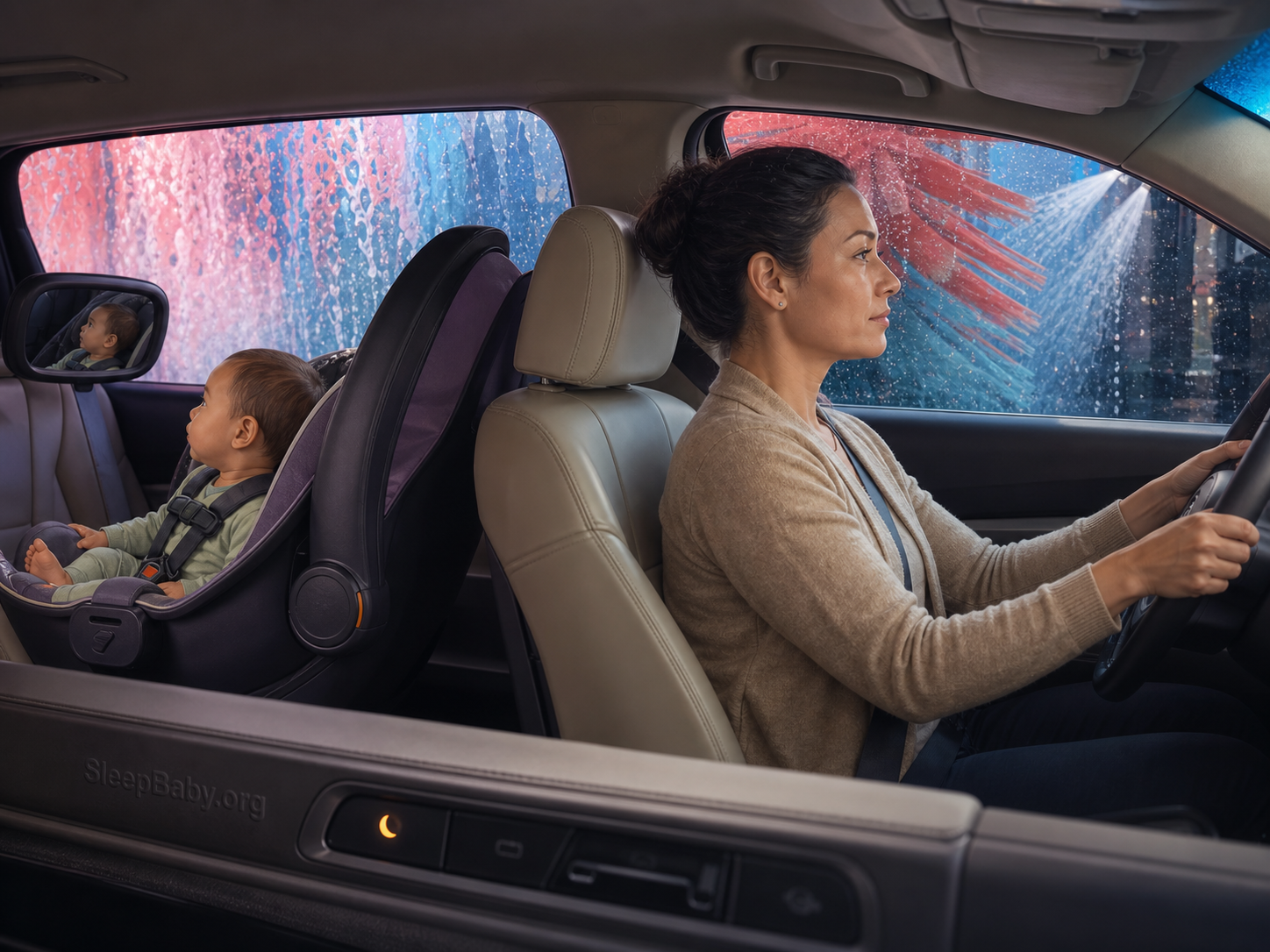
The sensory sequence is usually more predictable than it feels. The light changes. Water hits the glass. Soap may turn the windows blue, pink, or white. Brushes or spray equipment move close to the car. Then the dryer arrives with the subtlety of a weather system.
Imagine the exact moment: the foam curtain erases daylight, a brush lands with a hollow thump, and the mirror shows two suddenly wide eyes in the back seat. This is an imagined micro-scene, not evidence about one family. Its useful truth is that you may see the reaction at the moment you are least able to reach back. Plan for that before it happens.
The tunnel in four fixed steps
Move through the sequence without changing the buckle
-
Before the line
Finish the fit check, read both instructions, close the vehicle, secure loose objects, and decide what would make you leave.
-
Entering
Follow the attendant, lights, track, and vehicle manual. Keep both hands and attention available for the driving task.
-
Inside
Keep everyone restrained. Use a calm ordinary voice without turning, filming, feeding, or manufacturing delight.
-
After the exit
Complete the facility procedure, drive to a safe parking place, then comfort, feed, change, or check the baby.
Why this matters tonight: a predictable exit and quiet pull-over keep one intense minute from becoming a chain of frantic decisions.
If another adult is present, that person can watch the baby’s face and speak calmly while remaining correctly seat-belted. They still do not loosen the harness, add a bottle, or lift the baby out.
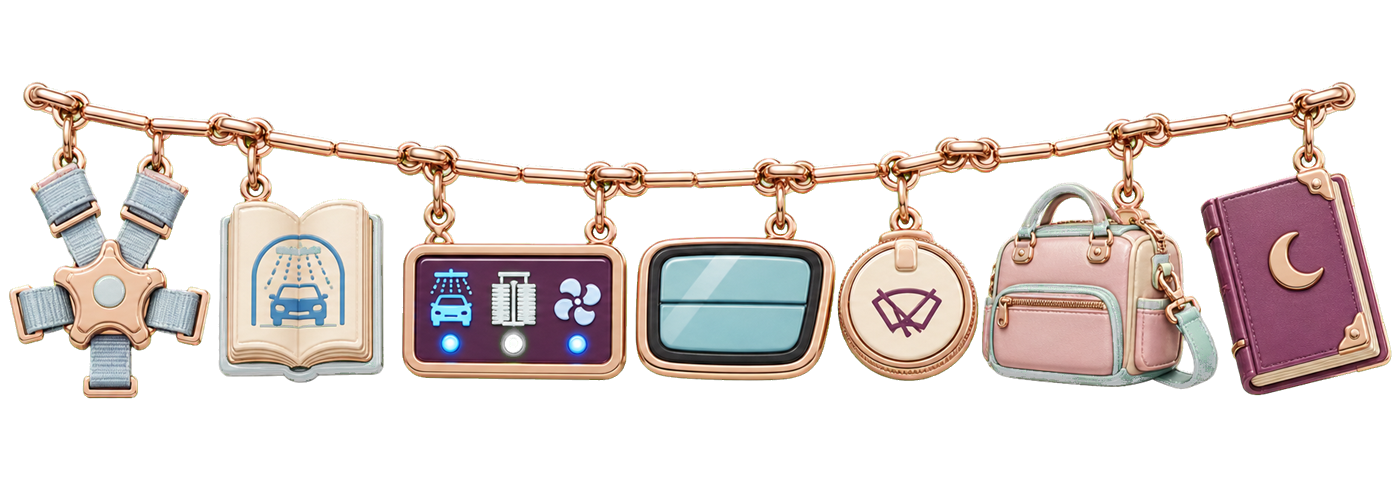
If your baby cries in the tunnel
Crying does not mean you have injured your baby, and it does not mean you must teach them to tolerate the rest of the wash. It means the baby is communicating while you have a temporary safety job that comes first.
Read the baby; keep the machinery rules fixed
Three response paths
Startles or fusses; breathing and color look normal
Keep following the wash procedure. Speak calmly without turning. Exit as directed and pull over safely afterward.
Crying rises hard and does not settle
Do not unbuckle, change gear against the machinery, open a door, or get out. Use the facility’s help procedure for a malfunction; otherwise complete the short exit and park safely.
Breathing trouble, blue or gray color, limpness, seizure, or another emergency sign
Call emergency services immediately and follow the dispatcher. Use the facility’s emergency stop or help procedure; do not open a door into moving equipment or improvise against a conveyor.
Sleep connection: after a non-emergency scare, comfort and lower stimulation once parked; the tunnel is not the place to solve the whole night.
Once parked after hard crying, check restraint fit, heat, clothing, diaper, hunger, pain, and whether the reaction began with a specific sound or motion. If the baby calms after leaving, that wash may simply be too intense for now. You are allowed to retire it without a farewell tour.
If spray or fumes enter the cabin and cause coughing, eye pain, or breathing symptoms, leave the equipment area as safely as possible, move to fresh air, and seek medical or poison-control guidance appropriate to the symptoms and product. Water and cleaning products are intended to remain outside the sealed passenger compartment; a leaking window or strong chemical entry is a reason to stop using that facility, not a reason to reassure yourself harder.
A newborn does not need “car-wash training”
There is no developmental prize for an early first tunnel. A calm newborn may sleep through one. Another may startle at the first spray. An older baby may love the colored foam one week and object to the dryer the next. None of those reactions predicts bravery, sensory development, or future sleep.
- Point out a car wash from outside before you use it.
- Describe the order in one sentence: water, soap, brush or spray, dryer, all done.
- Preview the inside-view video yourself first; decide whether a low-volume glimpse would help an older child or add stimulation.
- Bring a familiar voice and routine, not loose objects.
- End after one pass. Repeating the tunnel to “fix” a frightened reaction is not necessary.
For a newborn, the better preparation is mostly adult preparation: know the controls, choose the wash, and protect the exit.
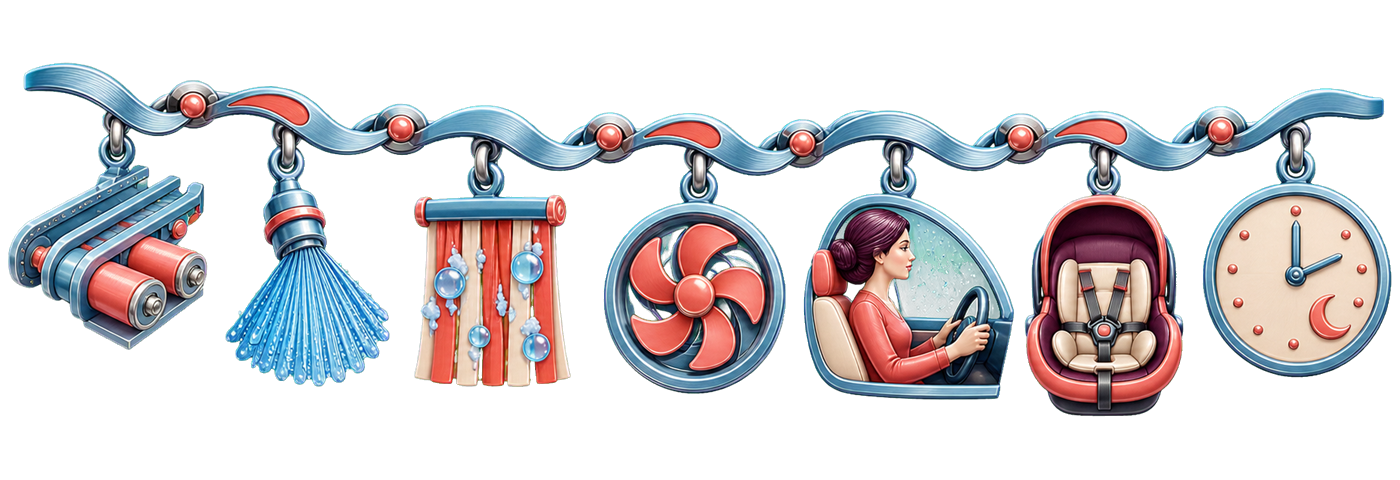
Watch the tunnel before you bring the baby
The optional video below shows a real automatic wash from inside the vehicle. It is useful because the light, brush, water, and dryer changes are easier to understand when you can see their order. It is not child-safety guidance, it does not measure the sound inside your car, and its facility instructions may not match yours.
Lower your device volume before pressing play, especially if a baby is nearby.
Watch the inside-view car-wash video on YouTube if the embedded player is unavailable or not useful with your assistive technology.
Written takeaway: the most intense changes arrive in a short sequence, and the dryer may be the loudest-feeling stage. Keep the restraint fixed, keep your attention forward, and know where you can park immediately after the exit.
If the car wash runs into nap time
A short tunnel can wake a baby, or the steady car motion may put one to sleep. Neither outcome requires you to rebuild the day around a perfect wake window.
While the car is traveling, the baby remains correctly buckled. When travel ends, the American Academy of Pediatrics says that an infant who falls asleep in a car seat should be moved to a firm, flat sleep surface on their back as soon as possible.5 Do not loosen the harness, carry the seat inside as a nap space, cover it with a blanket, or leave the baby parked in the vehicle to finish sleeping.
- Keep the ride home quiet.
- Dim the house rather than adding a second exciting activity.
- Offer the normal feed or care step when safely parked or home.
- Use the familiar bedtime sequence.
- Let the next sleep opportunity be guided by the baby’s condition and the real day, not panic over one missed minute.
Wake windows are planning ranges, not sleep deadlines. The car wash may nudge the evening; it does not get custody of the entire night.
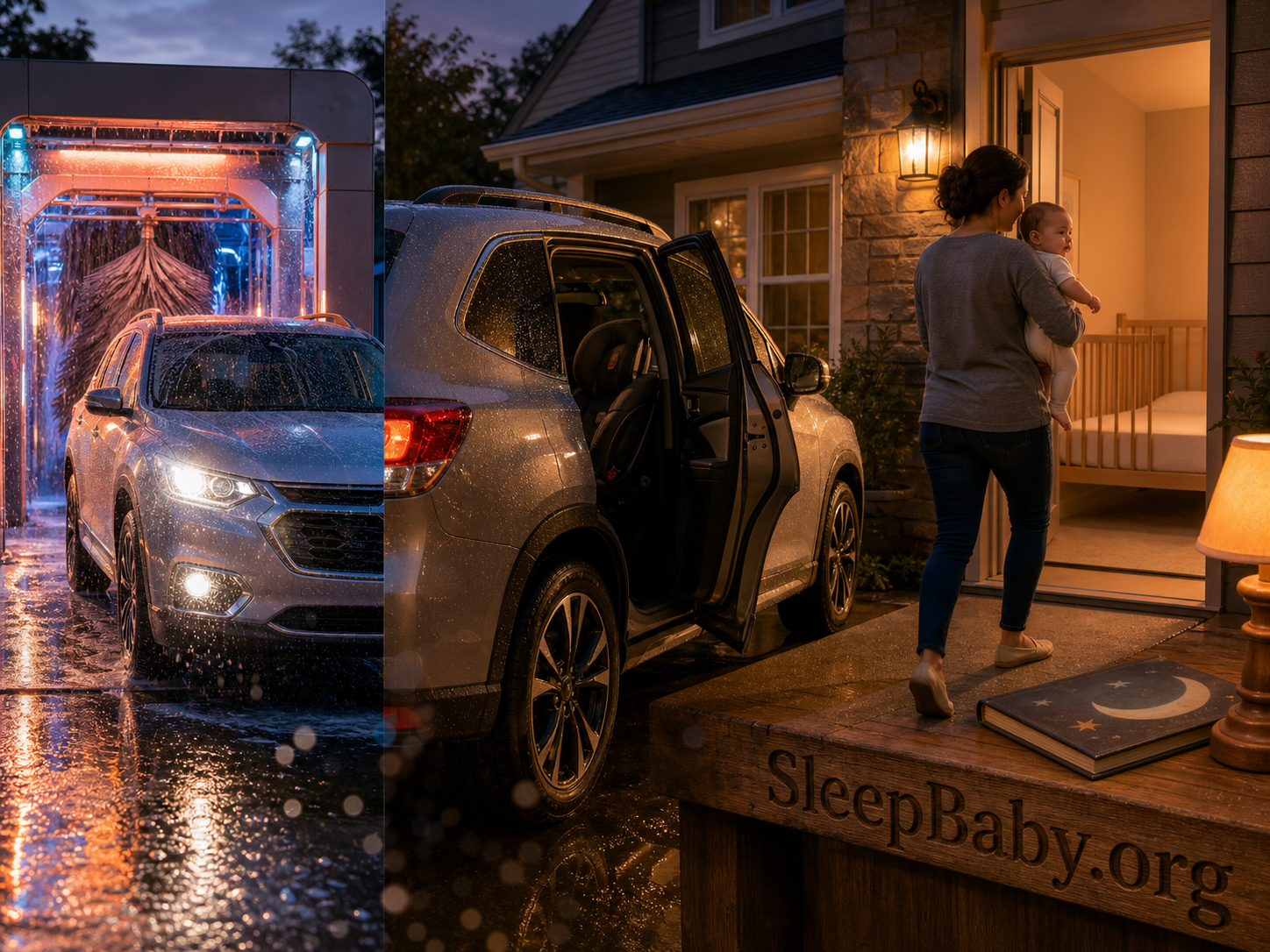
A five-minute check before you pay
The queue check I would actually use
Eleven quiet decisions before the dryer starts
- Baby well enough for the errand today.
- Correct car seat, correct fit, harness unchanged.
- No loose bottle, toy, detailing tool, or wash item.
- Feed and diaper needs handled while parked.
- Exact wash type identified.
- Exact vehicle and facility instructions understood.
- Windows and sunroof fully closed.
- Adult attention available for controls and track.
- No plan to reach, feed, unbuckle, get out, or leave the baby.
- Safe pull-over spot identified.
- Quieter alternative already allowed.
Why this matters tonight: five quiet minutes now are cheaper than twelve loud decisions inside.
If the list feels fussy, remember what it replaces: trying to read a dashboard message while the dryer starts and the back seat announces a separate emergency.
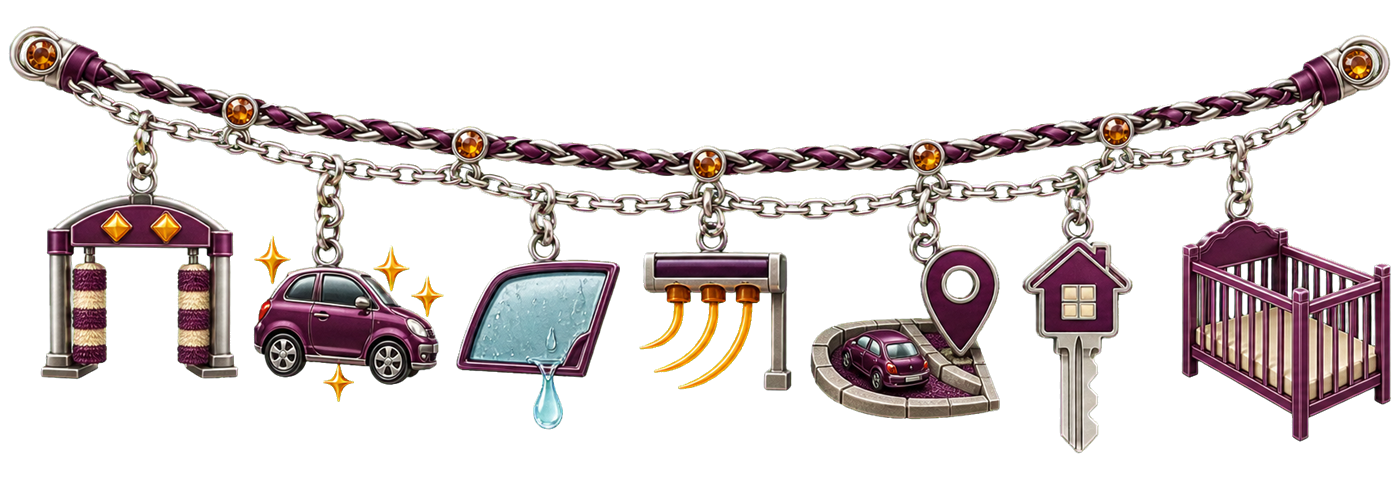
Sources
- NHTSA: Car Seats and Booster Seats — restraint selection, rear-facing guidance, manufacturer instructions, and back-seat use.
- CDC: Preventing Noise-Induced Hearing Loss — avoiding, limiting, distancing from, and protecting against excessive sound.
- NIDCD: Noise-Induced Hearing Loss — loudness, duration, distance, and hearing-risk thresholds.
- NHTSA: Child Heatstroke Prevention — never leaving a child unattended in a vehicle.
- HealthyChildren/AAP: How to Keep Your Sleeping Baby Safe — firm, flat, back sleep and transfer from sitting devices after travel.
After the last dryer
Let the wash be the loud part of the evening
Soap on the windows, brushes at the glass, and a dryer roaring overhead can leave a baby bright-eyed long after the clean car reaches home. You do not need a heroic recovery routine. Bring the next few minutes down gently: quiet voice, ordinary care, dimmer light, and the same familiar path toward sleep. SleepBaby can help you shape that calmer next stretch without pretending one loud errand has rewritten your whole night.