Quick answer
Kids’ sleep patches have not been shown to improve children’s sleep
No strong clinical evidence was identified that commercially sold sleep patches help children fall asleep faster, wake less, or sleep longer. A scented sticker made for pajamas is different from a skin patch claiming to deliver melatonin or another active ingredient. The first may become a familiar scent cue, although aromatherapy evidence for insomnia is limited. The second raises dose, absorption, interaction, skin, storage, and accidental-exposure questions and should not be used for a child unless the child’s clinician reviews the exact product. If a patch was already used, remove it, keep the package, and follow the safety path below.
There is a particular kind of bedtime hope that arrives in a flat little packet. It is tidy. It does not require measuring. The moon on the front looks rested. Meanwhile, your child has rejected the blanket for being “too blanket” and would like to discuss one urgent question about dinosaurs.
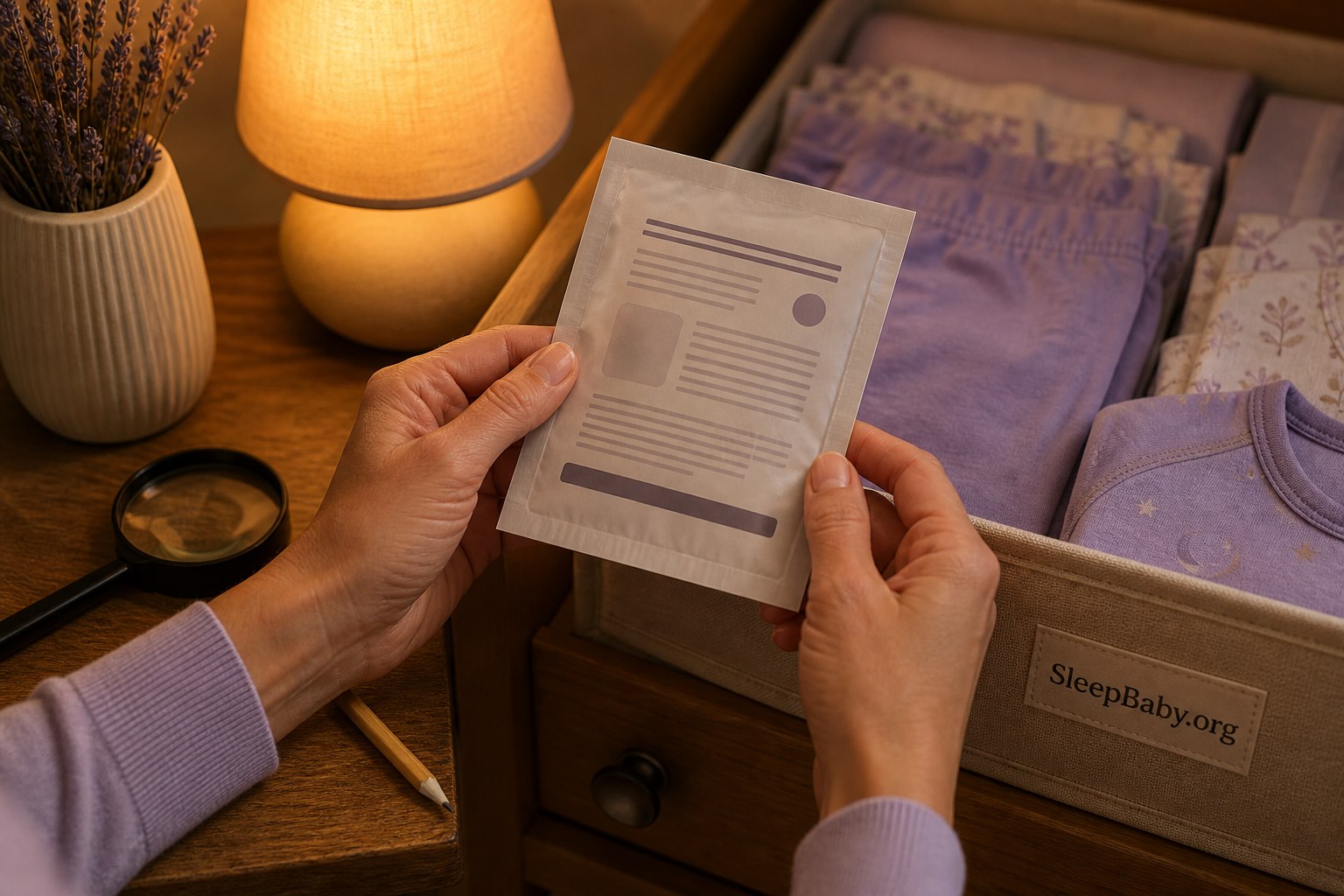
In a composite scene built from ordinary parent moments, a caregiver opens the pajama drawer at 9:17 p.m. and finds a packet of sleep stickers beside the socks. The front says calm. The back says where the real questions live: ingredients, placement, age language, warnings, storage, and disposal. Turning the packet over is not overthinking. It is the useful part.
My rule here is simple: do not let one small word – patch – hide three different decisions. What is on it? Where does it go? Which child is using it? A sticker attached to fabric, a skin patch marketed for transdermal delivery, and a loose scented object near a child’s mouth are not the same exposure.

Do sleep patches work for kids?
They have not been shown to work in good pediatric clinical trials. I did not find strong evidence that a commercially sold kids’ sleep patch improves sleep onset, night waking, total sleep time, anxiety, or night terrors. That does not prove every possible patch can never have an effect. It means a product page should not turn a pleasant scent, an adult study, or a proposed ingredient mechanism into a child sleep guarantee.
Sort the product before the promise
Three products can all be sold as a “sleep patch”
Pajama scent sticker
Intended route: aroma from a sticker placed on clothing or another labeled surface, not drug delivery through skin.
Evidence boundary: a familiar scent may become a cue, but rigorous evidence that aromatherapy treats childhood insomnia is lacking.7
Skin patch with an active claim
Intended route: an ingredient such as melatonin or a botanical blend is claimed to cross skin.
Evidence boundary: predictable pediatric delivery and sleep benefit have not been established. Oral melatonin guidance cannot be converted into patch instructions.
Unclear novelty sticker
Intended route: uncertain because the packet, retailer listing, and product directions may not agree.
Evidence boundary: if ingredients, placement, age limits, warnings, or manufacturer details are unclear, do not use it on or near a child.
The category name does not settle the exposure. The exact label does.
Why the claims can sound more settled than the evidence
Commercial pages often build a smooth bridge: lavender is associated with calm; melatonin is related to sleep timing; a patch stays in place; therefore the child will enter deeper sleep. Each step may sound familiar. The bridge still needs testing. A mechanism is not an outcome, and an ingredient name is not proof that the ingredient reaches the body in a predictable amount.
When the patch contains or claims melatonin, the questions become especially concrete. The American Academy of Sleep Medicine advises parents to discuss melatonin or other supplements with a pediatric health professional before giving them to children and notes that many childhood sleep problems are better addressed first with schedules, habits, and behavior.1 The American Academy of Pediatrics similarly describes melatonin as a hormone-like substance, not a sleeping pill, and recommends pediatric guidance after healthy sleep habits are in place.2
A patch does not float outside that advice. If anything, it adds a route question: how much, if any, enters the body; how quickly; how consistently; and how that varies with formula, skin, placement, wear time, heat, or damage to the patch. NCCIH notes that studies in children are limited and that uncertainty remains around dose, timing, and long-term safety.3 You cannot solve that uncertainty by translating an oral amount into half a patch, a smaller patch, or fewer hours.

The route sorter above is deliberately plain. If the product belongs on pajamas, keep it in the scent-cue lane and follow its clothing-placement directions. If it belongs on skin and claims to deliver an active, pause in the clinician-review lane. If the packet does not make the route clear, the answer is not “probably fine.” The answer is “not enough information to use this on a child.”

Can melatonin move through skin?
Engineered transdermal systems can sometimes move drugs through skin, but that fact does not validate every consumer patch. One small 1997 crossover study tested an engineered melatonin system in 12 adult men. Plasma concentrations were delayed and highly variable, and the system did not reproduce the usual physiological profile.9 That study is useful as a warning against easy assumptions. It is not a trial of a retail kids’ patch, not a dosing guide, and not evidence that children slept better.
Use the LABEL / ROUTE / CHILD check
A tiny patch can carry a very large claim. This three-part check keeps the decision close to what can actually be known.
SleepBaby signature check
Start with the label, then the route, then your child
LABEL
- Every ingredient and amount disclosed
- Intended placement and wear time
- Clear age language and warnings
- Storage, removal, and disposal directions
Stop if: the packet, retailer listing, and directions conflict or leave basic ingredients and use unclear.
ROUTE
- Fabric scent cue or direct skin contact
- Aroma claim or transdermal active claim
- Intact patch or cut, damaged, heated, or covered
- Possible mouth, eye, or ingestion exposure
Stop if: you would need to cut, combine, heat, cover, or improvise to make it fit the child.
CHILD
- Age and tendency to mouth small objects
- Eczema, rash, broken skin, or fragrance sensitivity
- Medicines, supplements, and health conditions
- The actual sleep symptom you are trying to solve
Stop if: the child has a reaction, the exposure is uncertain, or the exact active product has not been reviewed by the clinician.
Created by SleepBaby.org to keep marketing, exposure route, and the individual child in the same decision.

How to read a sleep-patch label in ninety seconds
Start at the ingredient panel, not the stars beside the reviews. Write down the exact active ingredients and amounts if amounts are given. If the product uses a “proprietary blend,” an aroma complex, or a list that does not make clear what touches the child, that uncertainty belongs in the decision. A front-label phrase such as “infused with” does not tell you how much is present, how much is released, or how much reaches the body.
Next, find the intended surface. Look for direct language: attach to pajamas, place on bedding, apply to clean dry skin, or keep off skin. Then find age language. “For families” is not an age range. “Kid-friendly” is not a dose. If the label provides no clear child age, do not use a retailer’s category placement as permission.
Read the warnings all the way through. Look for allergy, asthma, sensitive-skin, medicine, pregnancy, seizure, eye, mouth, heat, bathing, and disposal cautions. Not every warning applies to every formula; that is precisely why generic internet advice cannot substitute for the packet in your hand. Finally, find the maker’s contact information, lot or batch details, tamper evidence, and an expiration date if one is expected. A product asking for trust should make itself traceable.
What about lavender or essential-oil pajama stickers?
A clothing sticker can be lower stakes than an active skin patch when it is used exactly as labeled, stays off the child’s skin, cannot be mouthed, and does not bother breathing or trigger symptoms. Lower stakes is not the same as proven treatment. NCCIH says aromatherapy has been used for insomnia but that little rigorous research is available and its usefulness remains uncertain.7
A scent may still become part of the sequence. Pajamas, sticker, two books, lights down. Children are excellent pattern learners, and bedtime cues do not need a medical mechanism to feel familiar. If the child settles more easily, the honest conclusion is: this ritual may be useful for our family. It is not: the oils treated insomnia or produced deeper sleep.
Essential oils also deserve ordinary exposure respect. Poison Control notes that they can cause skin reactions and can be harmful if swallowed or aspirated; children may be more susceptible to toxic effects.8 Keep the sticker away from the face, mouth, and hands; do not place it on skin unless the exact product is designed and labeled for that use; and stop if the scent causes coughing, wheezing, headache, nausea, or irritation.
“Natural” is not a toxicology result. “Drug-free” is not a complete ingredient list. “Science-backed” is not a citation to a pediatric trial of that exact product. The front of the packet can introduce the claim. The back has to carry the decision.

If your child already wore, chewed, or swallowed a patch
First, do not spend five minutes deciding whether you are overreacting. Remove the patch. Keep the packet. Check whether the patch is intact and where it was placed. Then use the pathway that matches what happened.
Already-used patch path
Six steps, in order
- Remove it. Do not replace it with a fresh patch and do not add another sleep product.
- Preserve the evidence. Keep the packet and directions or photograph the full label. Note the time, placement, and approximate wear time.
- Check the patch. Is it intact? Could the child have chewed, swallowed, or hidden part of it? Was it on skin, clothing, near the mouth, or near an eye?
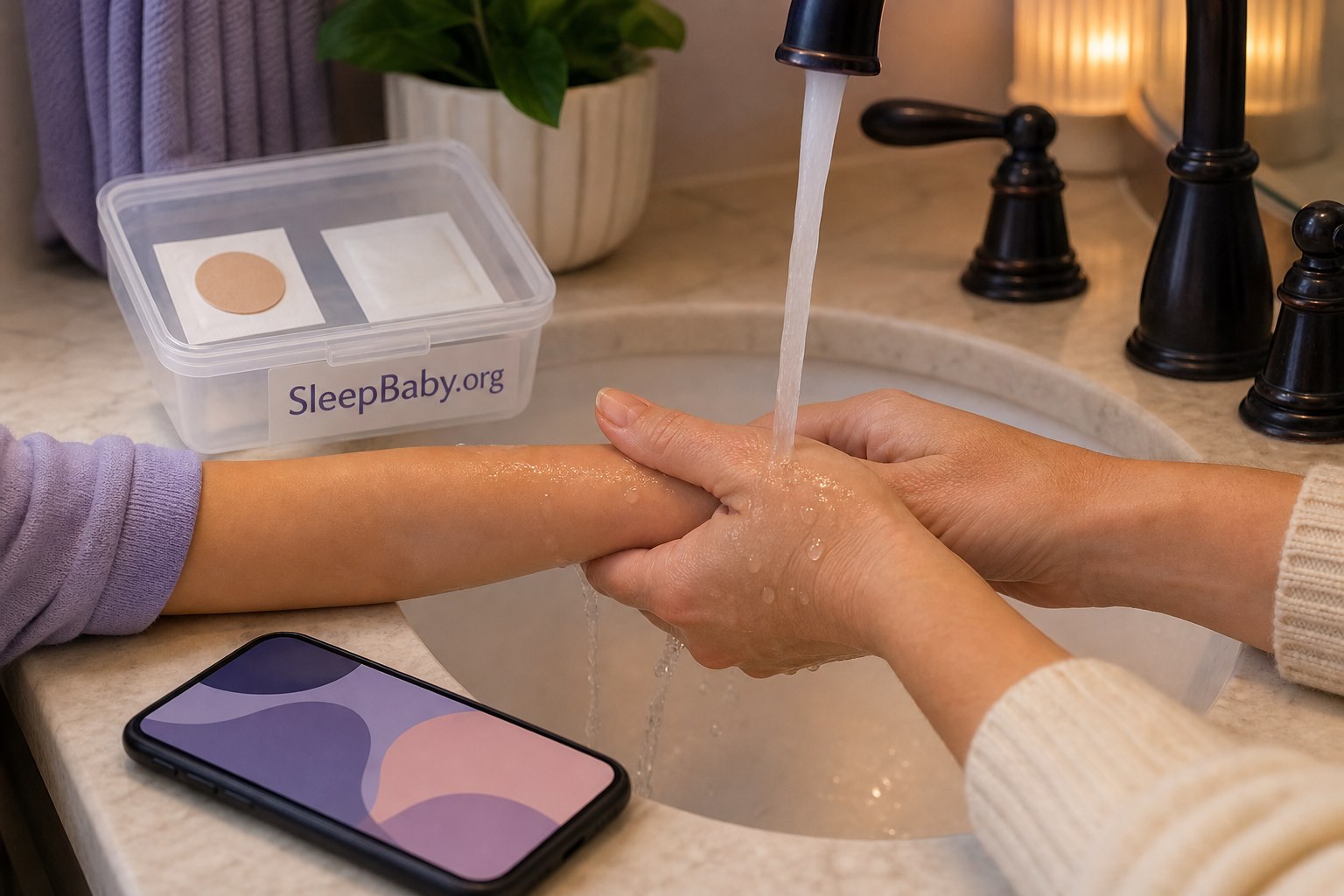
- Respond to skin. For redness, itching, or burning, remove the patch, gently wash the area, and avoid re-exposure. Adhesives and fragrances can trigger irritant or allergic contact dermatitis.6
- Call Poison Control for an exposure question. In the United States, call 1-800-222-1222 or use poison.org for a chewed, swallowed, missing, uncertain, or symptomatic patch. Do not induce vomiting unless instructed.5
- Call 911 for an emergency. Trouble breathing, collapse, seizure, or a child who cannot be awakened needs immediate emergency care.2
Melatonin exposure deserves secure storage even when the product is small and colorful. CDC reported 260,435 pediatric melatonin ingestions to U.S. poison centers during 2012-2021, with a 530% increase in annual ingestions. Most were unintentional, and most involved children age 5 or younger.4 Those surveillance data do not tell us that every exposure involved a patch, and reporting details have limitations. They do tell us that melatonin products belong out of sight and reach, handled like medicine.
What a patch reaction can look like
Adhesives, fragrances, and preservatives are among the substances that can cause contact dermatitis. Redness, itching, burning, tenderness, rash, or blisters can appear where the patch touched.6 Remove the product, wash gently, and do not test it again on another spot while a reaction is active. Contact the child’s clinician for a concerning, spreading, blistering, painful, or persistent reaction.
Facial or lip swelling, widespread hives with other symptoms, trouble breathing, collapse, or marked unresponsiveness is not a watch-and-wait situation. Call emergency services.
What if the child seems fine?
If the patch is intact, there was no ingestion or uncertain exposure, and the child has no symptoms, document the exact product and timing. Do not treat one sleepy night as a dose-finding experiment. A child can settle differently because of activity, nap timing, illness, daylight, connection, routine, or ordinary variation. If an active-ingredient patch was used without clinical review, tell the pediatrician what it contained and how it was used before using it again.
Watch: a one-minute melatonin safety explainer
Boston Children’s Hospital medical toxicologist Dr. Michael Toce gives a short overview of what melatonin is, its intended use, and side effects. The video is context for the melatonin safety conversation. It is not evidence that a retail patch delivers a predictable dose or helps children sleep.
Watch the Boston Children’s melatonin safety video on YouTube if the embedded player is unavailable or not useful with your assistive technology.
Written takeaway: melatonin is an active sleep-related substance, not a harmless bedtime sweet or sticker. Use it for a clear reason only after the child’s clinician has reviewed the situation and the exact product, and store it where a child cannot reach it.10

What to try tonight instead of adding a patch
Routine-first advice can sound suspiciously like someone asking an exhausted family to become a small hotel. That is not the assignment. The useful plan is the smallest sequence you can repeat on a normal Tuesday, not a fourteen-step performance with matching baskets.

The small-night plan
Choose one cue, one boundary, and one thing to observe
One cue
Use the same short sequence: toilet or diaper, teeth, pajamas, one book, lights down, one closing phrase. If touch is welcome, a brief cuddle or hand rub can be the cue without a new product.
One boundary
Pick the friction point with the clearest payoff: screens off earlier, snacks finished before teeth, or choices limited to two. Keep the words short and the order visible.
One observation
For seven nights, note routine start, lights-out, approximate settling, wakings, wake time, and unusual symptoms. Change one variable at a time so the pattern remains readable.
If your preschooler’s evening has become a traveling production, our sleep routine for a 3-year-old gives the sequence a workable spine. If you are deciding between another device and a simpler cue, the Yoto and Toniebox bedtime guide separates useful routine from product promise. And if the real question is whether a lotion or nutrient claim deserves trust, the magnesium lotion evidence guide uses the same route-first discipline.
Do not use a routine plan to explain away symptoms. Persistent loud snoring, pauses or struggling to breathe, unusual movements, pain, severe daytime sleepiness, or a sleep problem regularly disrupting the child or family belongs with the pediatrician. Our guide to when to worry about a child’s sleep can help you organize what you have seen.
What to bring to the pediatrician
You do not need a perfect sleep diary or a diagnosis. Bring the exact problem in ordinary language: “It takes about ninety minutes to settle,” “she snores most nights,” “he wakes scratching,” or “bedtime changed after a new medicine.” Add the child’s usual bedtime and wake time, naps, how long the pattern has lasted, and what the next day looks like. That is more clinically useful than arriving with only a product name.
If you are asking about a patch, bring the physical packet or clear photographs of the front, ingredient panel, directions, warnings, manufacturer, and lot information. Include all medicines, vitamins, gummies, powders, lotions, oils, and other sleep products. A product can matter because of an ingredient, an interaction, a skin exposure, or because it distracts from a breathing, pain, sensory, schedule, or developmental issue that needs a different plan.
Four useful questions
- What problem are we actually trying to treat? Difficulty settling, early waking, anxiety at separation, itching, snoring, restless movement, and an irregular schedule are not one diagnosis.
- Does this exact ingredient make sense for this child? Ask about health conditions, medicines, supplements, skin, and developmental mouthing risk.
- What should we try first, and how will we judge it? Agree on one change, a realistic observation period, and the outcome that matters.
- What would make you want to see the child sooner? Leave with clear symptom and emergency thresholds rather than a vague instruction to monitor.
Sleep patches for kids FAQ
Do sleep patches help kids sleep?
They have not been shown to improve pediatric sleep in strong clinical trials. A scented pajama sticker may become a familiar bedtime cue, but that does not prove the fragrance treats insomnia. A skin patch claiming to deliver melatonin or another active ingredient requires separate clinical review because delivery, dose, interactions, and pediatric outcomes are uncertain.
Are sleep patches safe for toddlers?
There is no universal answer across products. Toddlers are especially likely to touch, peel, chew, or swallow small objects. Do not use a patch unless the exact label clearly covers the child’s age, placement, ingredients, warnings, and disposal. An active-ingredient skin patch should be reviewed by the child’s clinician before use. If the information is incomplete, skip it.
Should a sleep patch go on pajamas or skin?
Use only the placement stated on the exact label. A pajama sticker should not be moved to skin to make it “stronger.” A skin patch should not be cut, heated, covered, combined, or worn longer than directed. If placement is unclear, do not experiment on a child.
Are melatonin patches safer than gummies?
No evidence supports a blanket claim that the patch route is safer for children. It may avoid chewing a gummy, but it adds uncertain skin delivery, adhesive reactions, residual ingredient in a used patch, and the possibility that a child peels or mouths it. Both forms need secure storage and clinician-guided purpose.
Do lavender sleep stickers work?
A familiar lavender scent may feel pleasant or become a cue, but rigorous evidence that aromatherapy treats childhood insomnia is lacking.7 Stop if the child develops coughing, wheezing, headache, nausea, skin irritation, or discomfort. Keep stickers off skin and away from the mouth unless the exact label specifically directs otherwise.
How long should a child wear a sleep patch?
There is no universal wear time. Follow the exact product directions if the product is appropriate at all. Do not extend wear, use multiple patches, or replace a patch overnight to chase a stronger result. With an active-ingredient product, ask the child’s clinician rather than treating duration as a home dosing adjustment.
Can I cut a sleep patch in half for a child?
Do not cut a patch unless the exact manufacturer instructions and the child’s clinician explicitly say the product is designed for it. Cutting can change delivery, expose contents, damage the adhesive system, or create a loose piece that can be swallowed. A smaller piece is not automatically a smaller or predictable dose.
When should I call Poison Control?
In the United States, call Poison Control at 1-800-222-1222 or use poison.org if a patch was chewed, swallowed, is partly missing, caused symptoms, or the exposure is uncertain. Have the packet with you. Call 911 for collapse, seizure, trouble breathing, or a child who cannot be awakened.
You can keep the ritual and skip the claim
The wish behind the packet is tender: please let tonight be softer. You are not foolish for wanting that. You also do not owe a large medical conclusion to one small sticker.
If a pajama cue is clearly labeled, stays safely out of the child’s mouth, and everyone likes the scent, let it be a cue. If the patch claims to deliver an active ingredient through skin, let the clinician carry the dose-and-safety question. If the label is vague, let the packet remain closed. And if the real sleep pattern is loud, painful, persistent, or disruptive, bring the pattern to someone who can examine the child.
When the patch question is answered but bedtime is still hard
Build the night around your child’s real pattern
SleepBaby can help you turn timing, settling, waking, breathing, sensory needs, caregiver handoffs, and daytime clues into one practical next step – without asking another product to explain the whole night.
Sources
- American Academy of Sleep Medicine: Melatonin Use in Children and Adolescents. Clinician discussion, storage, product variability, and routine-first guidance.
- American Academy of Pediatrics: Melatonin for Kids. Pediatric use, sleep habits, poisoning, and emergency guidance.
- NCCIH: Melatonin – What You Need To Know. Pediatric evidence and long-term safety uncertainty.
- CDC MMWR: Pediatric Melatonin Ingestions, 2012-2021. U.S. poison-center surveillance and limitations.
- Poison Control: Melatonin. Exposure symptoms and response guidance.
- MedlinePlus: Contact Dermatitis. Adhesive, fragrance, and skin-reaction context.
- NCCIH: Aromatherapy. Limited rigorous evidence for insomnia and other uses.
- Poison Control: Essential Oils. Skin, ingestion, aspiration, and child-susceptibility boundaries.
- Benes L, et al. Transdermal Melatonin Delivery. Small 1997 adult engineered-system study; delayed and variable concentrations.
- Boston Children’s Hospital: Is Melatonin Safe for Kids? One-minute clinician explainer; reviewed with companion guidance.