The short answer
A good 3-year-old sleep routine is a familiar runway, not a perfect bedtime performance
Most 3-year-olds do best with a short sequence that happens in the same order for about 20 to 30 minutes: bathroom, teeth, pajamas, two books, a small dose of connection, then lights out. Keep morning wake time in a steady neighborhood, adjust bedtime around whether a nap really happened, and protect enough time for the recommended 10 to 13 hours of total sleep in 24 hours, including naps.
The private worry underneath this search is often, “If I comfort my child, am I creating a habit—and if I hold the boundary, am I being cold?” You can be responsive without reopening the whole evening. Meet a real need, name a real fear, and let the ending stay recognizable.
A routine cannot treat a breathing or medical problem. Frequent loud snoring, pauses, gasping, labored breathing, unusual daytime sleepiness, pain, or a sudden persistent sleep change deserves a pediatrician’s attention. If your child is struggling to breathe, seek urgent help.
I like to think of bedtime as a runway because the goal is not to entertain a child until sleep happens. The goal is to make the direction obvious. Every familiar step removes one small decision. The light changes. The house gets quieter. The same two or three jobs happen. Your child still gets connection, but the night does not need a new ending every time.
Three is a wonderfully inconvenient age for this. A 3-year-old can remember yesterday’s special exception, invent a surprisingly persuasive reason for a fourth drink, fear the shadow behind the chair, and genuinely need the toilet—all in the same ten minutes. If you treat every request as manipulation, you will miss real needs. If you treat every request as a new assignment, bedtime can stretch without a limit. The skill is not becoming harder. It is learning to sort what is happening.

Build a bedtime runway your 3-year-old can recognize
Start with the last 20 to 30 minutes, not with a complete redesign of the family evening. A routine works because it is repeatable. It does not need twelve sensory activities, a printed chart, a reward economy, and a song for every transition. Choose a few steps you can still carry out on a tired Tuesday.
The six dependable landings
- 1. Reset: one last drink if needed, toilet or diaper/pull-up, and a quick bedroom check.
- 2. Care: brush teeth, wash face, put on pajamas.
- 3. Choose: offer two acceptable books or two acceptable pajamas—not whether bedtime happens.
- 4. Settle: read, cuddle, or talk for a bounded few minutes.
- 5. Close: use the same short ending phrase, turn lights to their sleep setting, and place the safe comfort object.
- 6. Return: if you need to come back, use fewer words than you used at bedtime and return to the same ending.
SleepBaby.org teaching note: choices belong inside the runway. They do not move the runway.
The strongest routines begin before the first bedtime step. A consistent wake-time neighborhood anchors the day. Physical play and daylight happen earlier. Screens stop before the routine rather than flickering through it. The bedroom becomes boring in the best way: dim, comfortable, and free from a parade of stimulating toys.
You do not have to land on the same minute every night. A routine can be steady without being brittle. A family dinner running fifteen minutes late is not a failure. A child who skipped a nap may need the runway sooner. A child who slept late at daycare may not be ready at the usual lights-out time. Keep the order stable while making small, deliberate timing adjustments.

Two sample schedules: nap day and no-nap day
These are examples, not prescriptions. Work backward from your child’s fairly stable morning wake time and actual sleep. The target is enough total sleep and a bedtime your child can realistically reach—not winning a contest for the earliest lights out.
| Anchor | Nap day | No-nap / quiet-time day | What to watch |
|---|---|---|---|
| Morning | Wake around 7:00 | Wake around 7:00 | Keep this in a steady neighborhood. |
| Midday | Nap roughly 1:00–2:15 | Quiet time roughly 1:00–2:00 | A later or longer nap may push sleep later. |
| Runway | Begin around 7:30 | Begin around 6:45–7:00 | Start before the child is unraveling. |
| Lights out | Around 8:00 | Around 7:15–7:30 | Judge sleep onset across several nights. |
If your child lies peacefully awake for forty-five minutes most nap days, do not immediately add more soothing. The nap may be reducing sleep pressure, especially if it ends late. Try moving the nap earlier, limiting its length in collaboration with daycare, or moving lights out slightly later while keeping the runway intact. If your child melts down through dinner on no-nap days, begin the runway earlier instead of expecting heroic self-control.
The AASM and CDC range—10 to 13 hours including naps—gives you a frame, not a stopwatch. Count actual sleep as best you can. Time in bed can be a little longer than sleep time, but a routinely enormous gap is information. Your child may need a timing adjustment, help with fear, or evaluation for a problem that routine alone cannot solve.
The four-question check for bedtime resistance
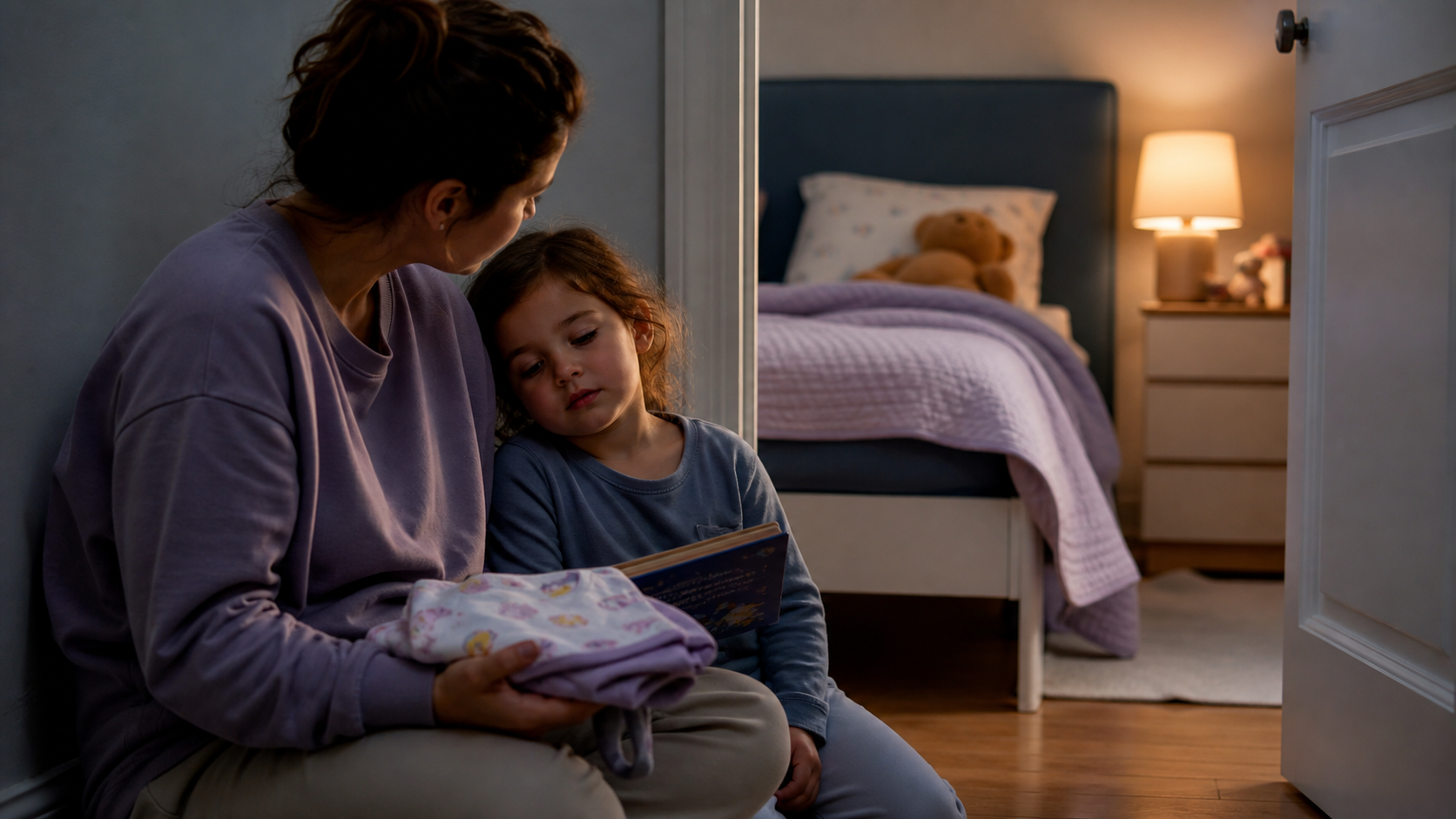
When bedtime suddenly becomes a courtroom, take one breath before responding. You are not trying to diagnose your child from the hallway. You are choosing the next useful response.
1. Is this a real need?
Toilet, thirst, illness, pain, wet clothing, temperature, or a safety issue gets a real response. Meet it simply. Then return to the ending rather than restarting every step.
2. Is fear or separation active?
Name what you see: “That shadow feels scary.” Offer a brief check, a safe comfort object, or a predictable return. Do not shame fear or invite a two-hour investigation.
3. Is this a practiced stall?
If the same request appears after it was already handled, answer with one calm line: “Water is done. It is time to rest.” Fewer words make the boundary easier to understand.
4. Is the timing off?
A calm, bright-eyed child may not be sleepy yet after a long nap. A frantic, silly, tearful child may be overtired. Change tomorrow’s timing, not tonight’s entire rulebook.
If you want a more structured response plan after checking timing, needs, fears, and the environment, use a responsive toddler sleep-training approach rather than borrowing an infant method without adjustment. The aim is a response you can repeat calmly and pause when your child is ill, in pain, acutely distressed, or facing a major transition.
When the nap is changing, protect the rhythm instead of forcing certainty
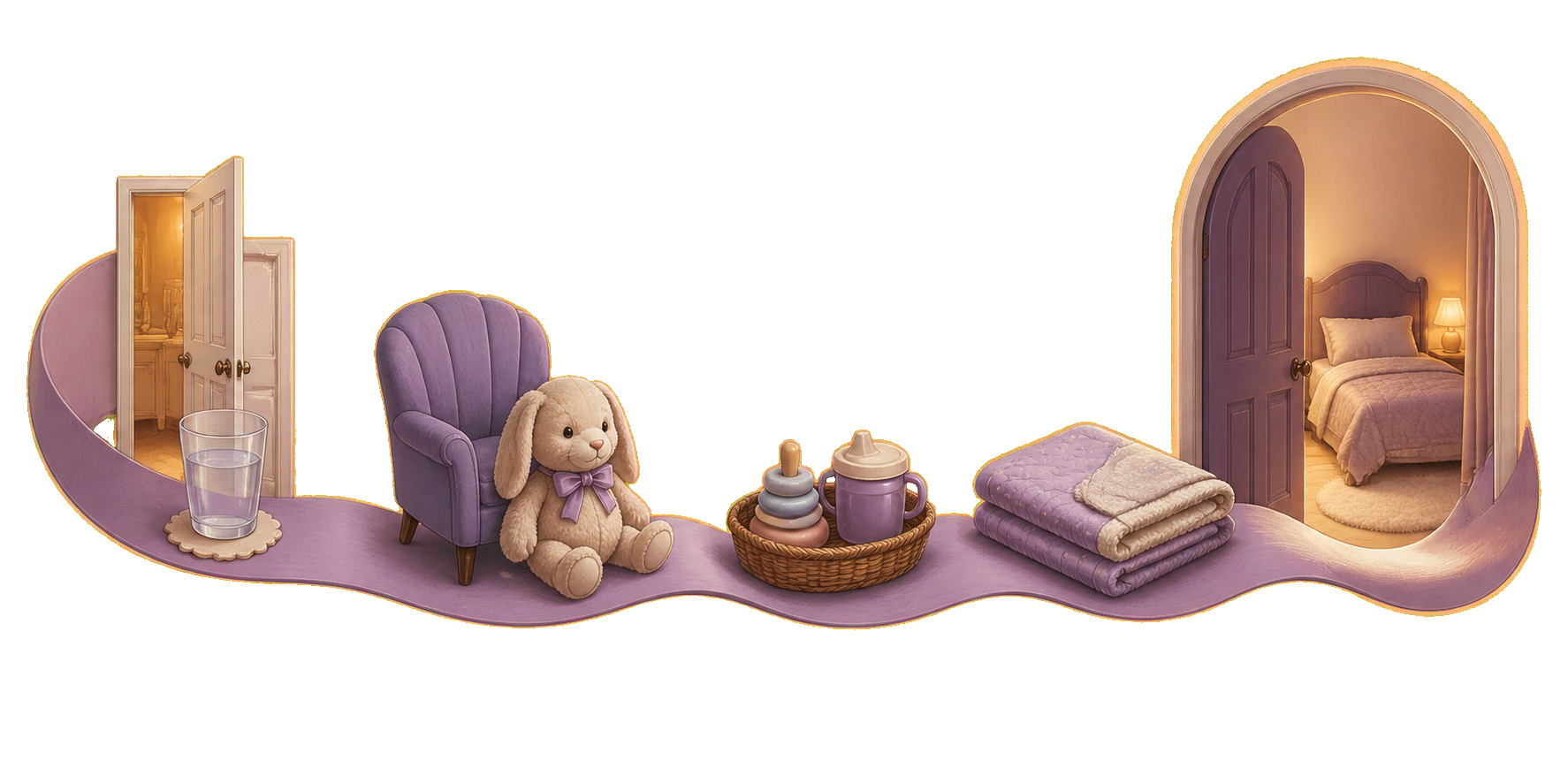
Many 3-year-olds are in an untidy middle. They still need a nap some days, resist it on others, and can look completely fine until 5:15 p.m. Declaring “the nap is gone” after one refusal can create a week of overtired evenings. Forcing a long late nap can move bedtime far beyond when the family can sustain it.
Watch a pattern for about a week. Record only what helps you decide: morning wake time, whether sleep happened at nap, when it ended, routine start, lights out, and your best estimate of when sleep happened. Also notice daytime regulation. Is your child functioning, playing, and recovering from small frustrations? Or are late afternoons becoming a daily collapse?
A gentle nap-transition ladder
- Keep midday quiet time. The body still gets a pause even when sleep does not happen.
- Protect an earlier nap opportunity. A late nap is more likely to collide with bedtime.
- Use an earlier bedtime after no nap. Do not ask a depleted child to stay awake for schedule symmetry.
- Use a slightly later bedtime after a solid nap. Keep the routine order unchanged.
- Judge several days together. One unusual day does not establish a new biological rule.
Some children also become intensely attached to exact phrases, object positions, or parent roles. Familiarity can be comforting; fragility is different. If the routine fails whenever one cup, one person, or one sentence changes, read about when a familiar routine starts becoming rigid. Build two acceptable versions of a few steps so flexibility grows without turning bedtime into a surprise test.
Make the room and the last hour support the message
A routine has a harder job when the television is bright, a tablet is still playing, and the bedroom feels like daytime. The CDC recommends turning off electronic devices before bedtime; HealthyChildren guidance supports keeping screens out of the bedroom and using a predictable wind-down. Choose a boundary your household can repeat. “Screens are parked before pajamas” is easier for a 3-year-old to understand than an abstract lecture about blue light.
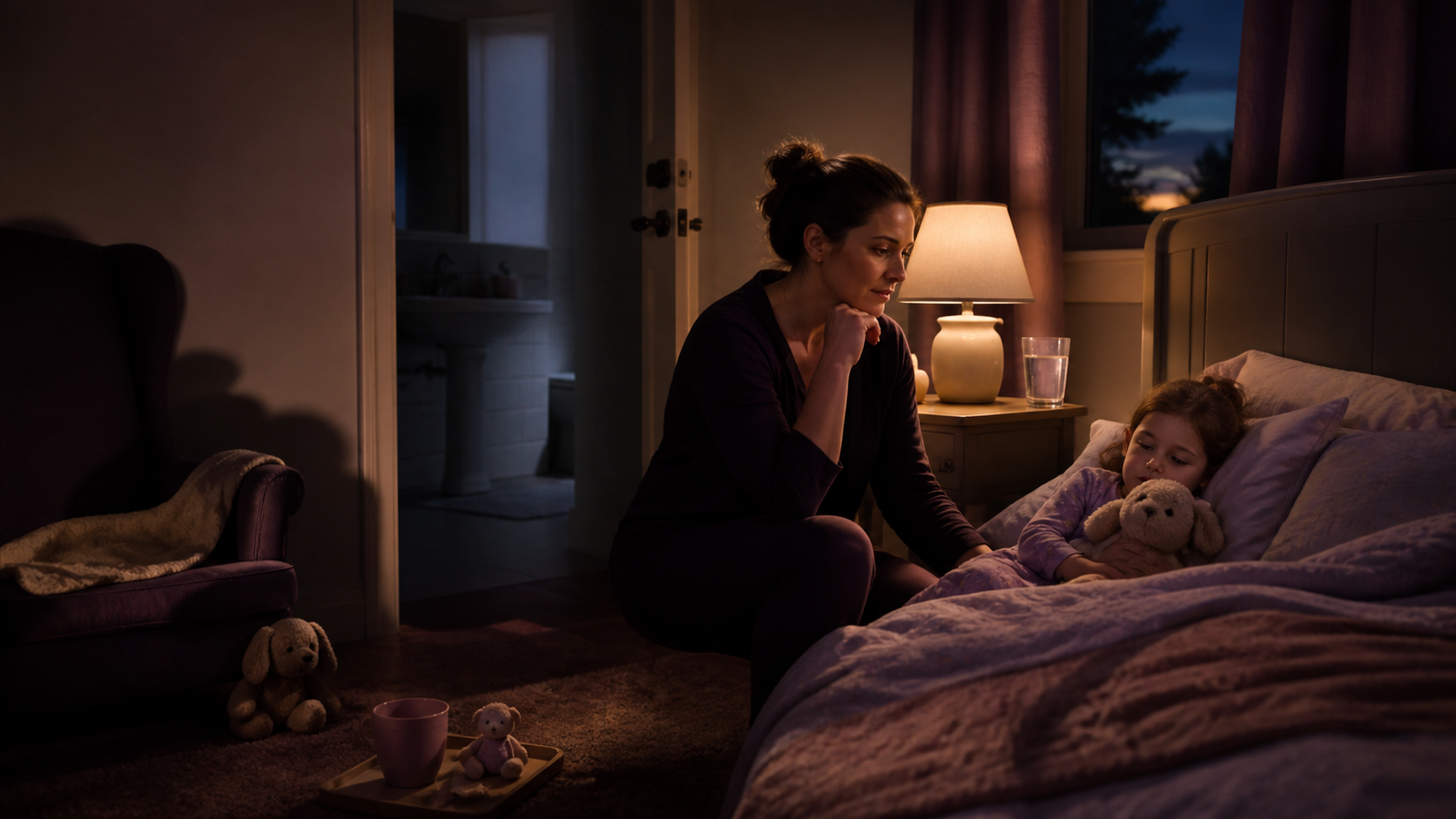
Dim the room gradually. Keep the temperature comfortable. Choose one or two safe comfort objects rather than filling the bed with distractions. If a night-light helps with fear, use the dimmest setting that does the job and position cords out of reach. None of these objects makes sleep happen. They simply prevent the environment from arguing with the routine.
Connection belongs here too. Five fully present minutes can be more settling than twenty distracted ones. Let your child pick between two books. Ask one small question: “What was one good thing today?” Then close the conversation on purpose. If a worry is too large for bedtime, tell your child when you will return to it: “We will draw that scary dream after breakfast.” This acknowledges the worry without assigning the entire night to it.

Use the same language after lights out and during night waking
A child who leaves the room five times can pull you into five different strategies. Try one boring, warm response instead. Walk your child back. Meet an actual need. Repeat the same short phrase. Keep light and conversation low. The message is not “You are on your own.” It is “Night still has the same shape.”
If you promise a check, return. A vague promise that never happens can make a vigilant child more vigilant. Start with an interval you can keep, then make the check brief: tuck, phrase, leave. Some children do better with a chair that moves gradually toward the door; others become more activated by parental presence. The right approach is the one that remains responsive, safe, and repeatable for your child—not the one with the strongest name online.
Early waking needs the same clarity. Decide what counts as morning in your household. Before that point, keep the room and your response in night mode. After it, open curtains and begin the day. A visible wake clock can support a boundary a child already understands, but it cannot replace care or make a biologically early schedule disappear. If your child is routinely awake before the chosen time, revisit total sleep, nap timing, bedtime, light, noise, and hunger rather than blaming willpower.
The three-night, one-change experiment
Choose one variable only: routine start, nap end, screen cutoff, or response wording. Keep the rest recognizable for three nights.
- Write down wake time, nap, routine start, lights out, and asleep estimate.
- Note the type of resistance: need, fear, stall, or timing.
- Do not score your parenting. Look for a pattern.
If the pattern improves, keep the change long enough to become familiar. If it does not, return to the evidence and change the next likely variable. A difficult third night is information, not a verdict.
What I change first when the routine looks right but bedtime still does not
I would not add another calming activity just because sleep is taking a long time. More routine is not always more useful. When the steps are already steady, I look at the day around them. A routine can point toward sleep, but it cannot manufacture sleep pressure that a long late nap has removed.
If a child is calm and awake for a long time, I look first at the nap and lights-out timing. I might move bedtime fifteen minutes later for three nights while holding wake time and the routine order steady. That is a small experiment, not permission for bedtime to drift indefinitely. If sleep onset becomes easier without shortening total sleep too far, the old bedtime may simply have been early for the current nap pattern.
If a child becomes wild, clumsy, tearful, or furious before the books begin, I look for overtiredness. On no-nap days, I would start the runway earlier rather than interpreting every burst of silliness as unused energy. Overtired children do not always look sleepy. Sometimes they look like they have been hired to reorganize the entire house at maximum volume.
If resistance begins at the first transition, I look at how bedtime is announced. A sudden command from exciting play to pajamas asks a lot of a preschool nervous system. I prefer two predictable notices—perhaps ten minutes and two minutes—followed by one bounded choice: “Blue pajamas or green?” I do not keep adding warnings after time is up, because that teaches the child that every notice is optional.
If the trouble appears only with one caregiver, I do not assume that caregiver is doing it wrong. Children test different questions in different relationships. Agree on the few things that matter: the order, the final drink/toilet opportunity, the closing phrase, and how genuine needs will be handled. Each caregiver can still sound like themselves. A routine is more durable when it does not depend on one person performing every word exactly.
My adjustment order
- Check health, discomfort, breathing, and a real toileting or thirst need.
- Check wake time, nap timing, nap length, and actual sleep opportunity.
- Make the routine shorter and more recognizable, not more elaborate.
- Choose one response to repeated requests and make it warm enough to repeat.
- Hold one change for several nights unless safety, illness, or distress says to pause.
This order protects me from trying to solve biology with stricter words or solve a boundary problem with a new product. It also gives the child a fair chance to understand the change. When adults rotate among bargaining, lying beside the bed, threatening, returning ten times, and suddenly refusing to return at all, the child is not necessarily “winning.” The child may be searching for the rule.
Keep a minimum version for daycare, travel, sickness, and hard family nights
A routine that works only under perfect conditions is too fragile for family life. I want a full version and a minimum version. The full version might include bath, pajamas, two books, a song, cuddle, phrase, and lights. The minimum version might be toilet, teeth, pajamas, one book, phrase, and lights. Both end in the same place.
After travel, a new sibling, a move, a caregiver change, or a frightening event, a 3-year-old may need more connection. More connection does not require removing every boundary. I can lengthen the cuddle, sit nearby for a planned interval, or promise a reliable check while keeping the order and ending clear. Once the disruption settles, I reduce the extra support gradually instead of disappearing it without warning.
During illness, I respond to the sick child in front of me. Fever, pain, coughing, vomiting, breathing trouble, or repeated toileting needs change the plan. The routine becomes a comfort scaffold, not an enforcement project. When the child is well again, I say what is returning: “You needed extra help when you were sick. Tonight we are going back to two books and our check.” A simple explanation is kinder than pretending the exception never happened.
Daycare naps can be the hardest variable because parents do not fully control them. Ask for the actual nap start and end rather than only “yes, they napped.” If bedtime is consistently difficult after long daycare naps, share the pattern without demanding that staff keep an exhausted child awake. Sometimes the workable answer is a later bedtime on daycare days and an earlier one on home no-nap days. Consistency can mean consistent logic, not identical minutes.
I also avoid turning a sticker chart into the emotional center of bedtime. A small visual sequence can help a child remember steps, and specific praise can notice effort: “You chose your book and got into bed when the story ended.” But sleep itself is not a behavior a child can perform on command. Reward the parts they control, not unconsciousness. Never take away comfort, food, connection, or safety because sleep did not arrive on schedule.
What progress can look like in the first week
Progress is not always a child who falls asleep alone at 7:30 on night one. I look for smaller signs: fewer new jobs added after lights out, less parental improvising, a shorter argument, one predictable check instead of five uncertain ones, or a child who still protests but understands exactly what will happen next.
The first few nights may feel louder because the old extensions no longer work the same way. That does not prove you must become harsher. Keep checking the four questions. Respond to needs and fear. Use the same few words for the practiced stall. Adjust timing in daylight, when you can think. If everybody is escalating, pause, regulate, and restart the ending. Calm is not a prerequisite for deserving care.
By the end of a week, ask three practical questions. Is the child getting a reasonable total amount of sleep? Is bedtime more predictable for the adults and child? Is daytime functioning acceptable? If the answers are moving in the right direction, keep going. If not, take the pattern to the pediatrician rather than endlessly redesigning the routine.
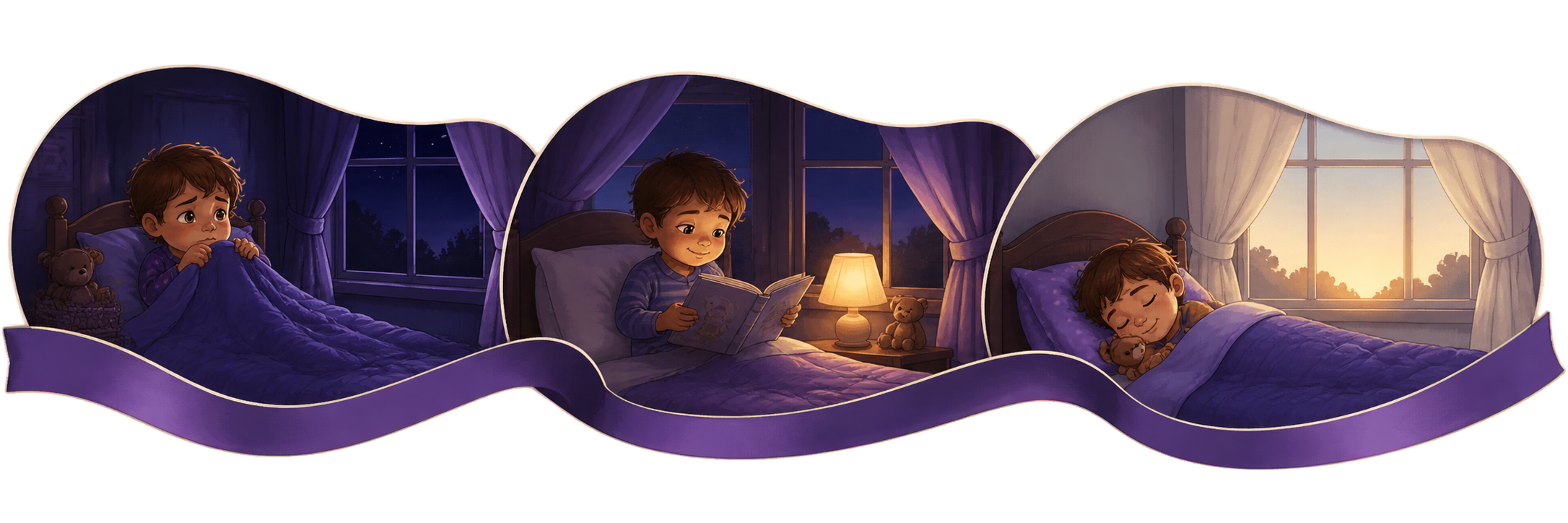
I return to the same image I started with: a runway. Its value is not that every landing is smooth. Its value is that, even on a hard night, the lights still point in one direction. Your child can call for you and still learn the shape of bedtime. You can answer with warmth and still let the day end.
When a bedtime routine is not the right tool
Talk with your child’s pediatrician if sleep difficulty is persistent, worsening, or disrupting daytime functioning despite a reasonable opportunity for sleep. Bring the short pattern notes; they are more useful than saying “bedtime is terrible.” Mention frequent loud snoring, breathing pauses, gasping, labored breathing, unusual sweating, hard-to-explain daytime sleepiness, a major behavior change, recurrent pain, itching, coughing, reflux symptoms, or a sudden change that does not settle.
Do not place commerce inside this decision. A clock, mattress, night-light, supplement, or app does not evaluate breathing. Melatonin and other sleep products should not become an automatic response to a routine problem; discuss persistent sleep concerns and any product use with your pediatrician. If your child is actively struggling to breathe, looks blue or gray, is difficult to wake, or seems acutely unwell, seek urgent help rather than experimenting with bedtime.
Optional bedtime tool
A simple okay-to-wake clock for a boundary you have already taught
If your 3-year-old understands “nighttime” and “morning” but cannot read a clock, a color-based wake clock can make that invisible boundary visible. It fits this situation better than a generic night-light because its job is specific: show when the family’s already-practiced morning response changes. Compare models for dimmable displays, simple controls, backup power, and cords you can keep inaccessible.
This is not a sleep cure, a punishment device, or a reason to ignore toileting, illness, fear, distress, or an unsafe situation. The persuasive reason to buy one is practical: it gives a pre-reading child one consistent cue so the parent does not have to explain the clock at every early waking.
Compare toddler okay-to-wake clocks on Amazon
As an Amazon Associate, SleepBaby may earn from qualifying purchases.
Luxury option for an already-planned transition
Naturepedic 2-in-1 Organic Kids Mattress, Twin
Do not replace a usable mattress to solve stalling. But if your family is already moving to a big-kid bed, this specific two-sided mattress has a topic-relevant job: a wipe-clean waterproof side for the potty-training years and a quilted side for later. That makes it a stronger fit than premium monitoring equipment, which can collect more data without improving a behavioral bedtime routine.
The reason to choose it is its staged usefulness during a real bed transition, not a claim that organic materials, price, or a new sleep surface will make a child sleep longer. Confirm the mattress dimensions, bed-frame fit, care instructions, and current listing details before buying.
Find the Naturepedic 2-in-1 Kids Mattress on Amazon
As an Amazon Associate, SleepBaby may earn from qualifying purchases.
Sources
Your next bedtime
Make the ending familiar enough that both of you can stop searching for it
Tonight, choose six or fewer steps. Offer two small choices. Meet the real need. Name the fear. Close the practiced stall with warmth. Tomorrow, look at the nap and the clock before changing the whole routine.
The goal is not a silent child who never calls for you. It is a child who knows what comes next—and a parent who knows that connection and a boundary can live in the same room.






What viewers said10 comments · 4 replies+
Archived comments from the original Baby Sleep Miracle presentation. Not independently verified by SleepBaby.org; individual experiences vary.
Thank you so much for this video! I had no idea about the dangers of baby swings :O
Hi Mary-Ann. I have a question: Is method in any way similar to the ones recommended by Dr Bucknam, Dr. Weissbluth or Dr. Karp? We tried those but none of them help.
Hi Regina, thank you for your question. The short answer is no. The techniques I share in my guide are based on newest scientific research and this is why I have never seen any approach similar to the one I recommend.
This method really works! I tried it on my son Jesus and after just one week he went from waking up more than 5 times a night to waking up just once or twice. You are a lifesaver, Mary-Ann!
I'm truly impressed with how much information you share in your video. And all for free! I can feel that you truly care about mothers like myself, and that's hard to find these days. I have recommended your site to several of my friends already.
Mary-Ann, our child suffers from autism. Is your approach still suited?
Chloe, I made sure my method can be used with any child, even babies who are special like yours. Please note that I'm not a doctor and that I always advice to consult with your physician because nothing is more important than the safety and well-being of your love.
Hallo Mary-Ann, I'm from Germany. Do you have your guide in German?
Hello Heide, we do! Normally you should already see our video in German. If not, please contact our support so they can guide you
Thenk you for your answer, Mary-Ann!
I just completed your approach and I have to say, it worked almost too well. Yes, it took a bit of getting used to with your bedtime routine but the difference is huge. My son George used to take 1 hours to go down and now he's firmly asleep in no more than 10 minutes! You're the best!
It seems I'm the only man watching this video, lol! What you shared about the 'emotional backpack' made immediate sense to me and I can't wait to help my little girl Mila to unpack it!
Hey there, just discovered your site and this really sounds different. Just wanted to say thanks for sharing :)
For everyone who's still thinking about getting Mary-Ann's guide I want to advise you to go ahead. I wasn't sure myself but now I'm so thankful I invested in this program. It made a huge difference in our life as a family and yes, my baby girl does sleep through the night now.