
The short answer
Choose the bedtime routine first; then choose the player that makes it easiest
For Yoto or Toniebox at bedtime, neither player is automatically better for sleep. Yoto’s card-based system may fit a child who likes choosing from a small visible library and a family that wants clock, light, or routine controls in one device. Toniebox’s character-figure system may fit a child who responds to tactile, simple play. Either can help with a calm transition when an adult chooses one quiet track, sets a comfortable volume, places the player away from the bed, and gives the audio a clear ending.
Check the exact model’s current age guidance, setup instructions, charging rules, content rating, and volume controls before use. Charge it earlier with every cord out of reach. Do not put the player, card, figure, cable, or charger in a crib or leave a hard device pressed beside a sleeping child.
Why an audio box can look like the missing bedtime adult
A child-operated story player promises something deliciously specific: no glowing cartoon, no parent scrolling for the right track, and perhaps one whole cup of tea while a pleasant narrator handles the moon. The promise is not absurd. Tangible controls can make a routine easier for some children.
In a clearly labeled editorial composite, I can imagine standing between a shelf of little cards and a parade of cheerful figures, wondering which one might finally stop the 8 p.m. content committee. The purchase decision feels enormous because it is carrying a second question: “Will this make bedtime easier?”
The box cannot answer that alone. Content, timing, volume, placement, the child’s temperament, and what the audio replaces matter more than the shape of the control.
The Bedtime Fit Map
Match the control style to the child—not the marketing shelf
Card lane
Useful when a tiny visible library feels orderly
A card-based player can make “choose one, insert one, park the rest” easy to see. Thin cards also need a reliable storage place.
Figure lane
Useful when a tactile character makes the action obvious
A figure-based player can make play intuitive. A beloved character can also invite collecting, swapping, and one-more-figure negotiations.
Parent lane
The setup work still belongs to the adult
Age fit, app setup, downloads, network access, charging, content review, volume limits, placement, and the stopping rule are adult jobs.
SleepBaby.org Bedtime Fit Map: card lane, figure lane, parent lane.
What is actually different between Yoto and Toniebox?
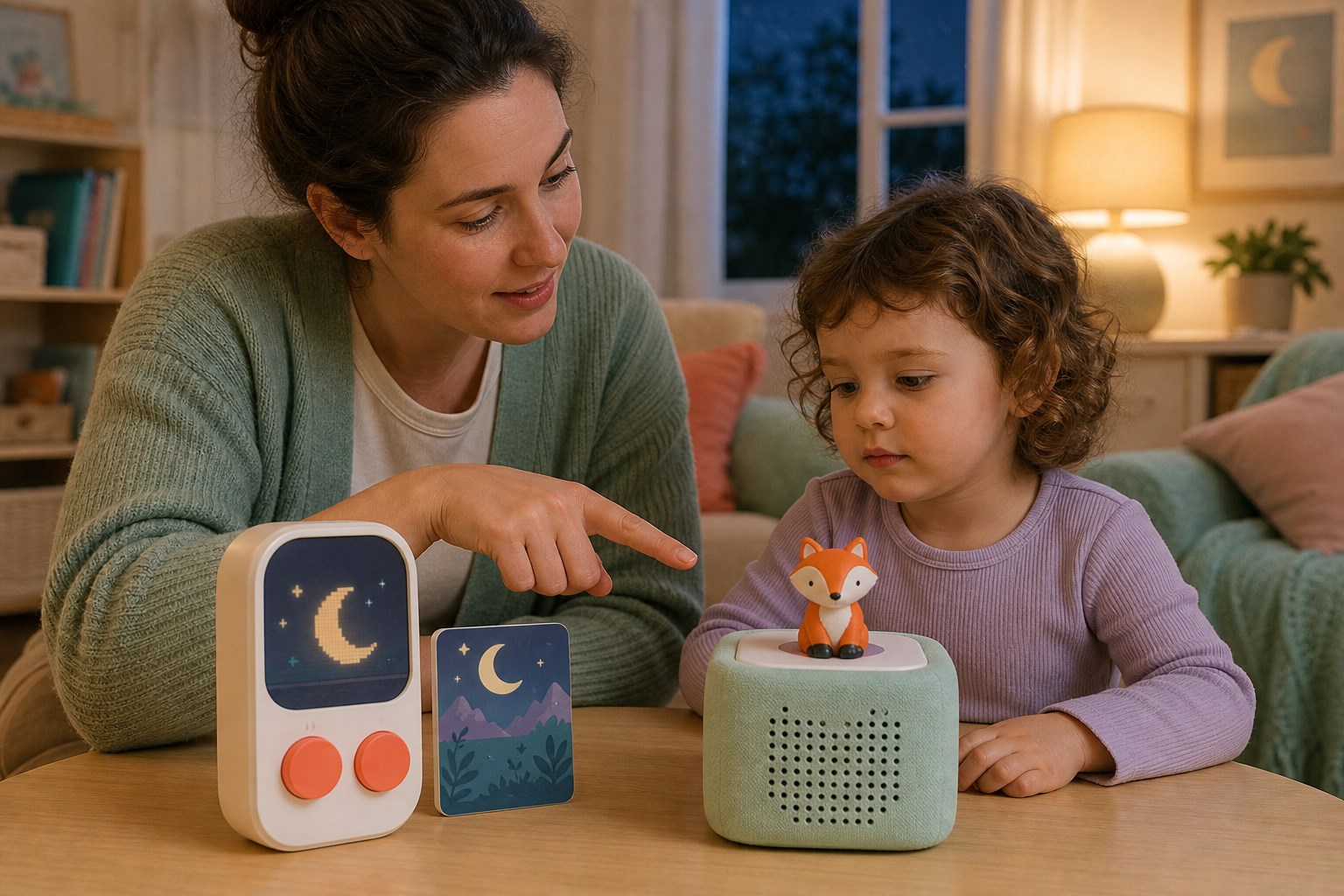
Yoto Player uses physical audio cards and has a small pixel display rather than a conventional video screen. The manufacturer also describes sleep-oriented features and content, with controls managed through its system. Toniebox uses Tonie character figures placed on the box to start audio, with tactile controls built around the soft cube form.
Those differences shape family friction. Cards are flat and easy to sort in a small bedtime ring or case; they can also vanish into the exact dimensional portal that already holds the missing sock. Figures are easy for small hands to recognize; they take more shelf space and may continue the character-play energy you are trying to lower.
Both ecosystems include many kinds of content, not one standardized “sleep effect.” A slow familiar story, an exciting adventure, a dance collection, and a soundscape are different bedtime inputs even when they play through the same box. Review the exact track rather than treating the hardware as a sedative.
Audio-only is different from video, but it is still media
A child listening to a story without fast-moving video avoids some of the visual stimulation of a tablet. That does not make every audio choice calming or every device interaction neutral. An exciting plot, repeated button pressing, bright indicators, unlimited choices, or conflict about stopping can keep bedtime active.
The American Academy of Pediatrics’ 5 Cs framework asks families to consider the child, content, how media is used for calming, what it crowds out, and communication. For an audio player, ask: does this particular child settle or become more alert? Is the track predictable? Does it crowd out conversation or delay sleep? Can the child tolerate the ending?
A randomized trial of removing toddler screen use before bed studied screen media, not Yoto or Toniebox audio. It should not be used to claim that an audio player causes or cures sleep trouble. It does support the larger habit of keeping bedtime media intentional and reducing the bright, interactive device layer around sleep.
Put the speaker in the room, not against the child
Use the lowest comfortable volume and place the player on a stable surface away from the sleep space. Do not put it under a pillow, beside the child’s head, inside a crib, or where the child can pull down the device or a charging cable. Follow the manufacturer’s ventilation, charging, and placement instructions.
The World Health Organization’s safe-listening guidance emphasizes managing sound level and listening time. A bedroom speaker at a comfortable low level is not the same exposure as headphones at the ear, but volume still matters. If you must raise your voice to be heard nearby, turn the audio down.
Charge during the day. Remove the charger before the wind-down. If the device becomes unusually hot, damaged, wet, swollen, cracked, recalled, or unreliable, stop using it and follow the maker’s safety instructions rather than placing it near a sleeping child to “see if it is okay.”
The One-Story Docking Sequence
Give the player five boundaries before it says a word
- Charge earlier. Finish charging before the routine and remove every cable from the child’s reach.
- Choose once. Offer two reviewed calm options, let the child select one card or figure, and park the rest out of sight.
- Place safely. Put the player on a stable dresser or shelf outside the bed, crib, reach zone, and fall path.
- Set low and finite. Choose a comfortable volume and one known stopping point. Disable continuous or surprise playback when the current controls allow it.
- Dock the ending. When the track ends, use the same phrase—“Story is parked; body rests”—then continue the regular final step.
If one small card or figure could turn into six choices after pajamas, I would make the bedtime library physically smaller. The child is not failing at independence; the shelf is simply doing too little boundary work.
SleepBaby.org One-Story Docking Sequence: charge, choose, place, limit, dock.
“Toddler” is not one product age
A one-year-old, a new three-year-old, and a preschooler have different handling skills, language, impulse control, and sleep spaces. Check the current age rating for the exact player, accessory, card, figure, and content. Do not assume a soft exterior makes an electronic device suitable for a younger child or a crib.
Small accessories can be misplaced, chewed, thrown, or brought into bed. Inspect pieces and the player regularly. A card or figure used to start a story does not need to remain in the sleep space. If your child mouths or throws the control, the adult can operate the device and store the accessory immediately.
For a child who is still in a crib, keep the entire audio system outside the crib and beyond reach, including cords and small media pieces. The player is room equipment, not a comfort object.

The Three-Night Audio Audit
Judge the routine by the actual night
- At the choice
- Did two options feel manageable, or did selecting content create ten minutes of bargaining?
- During the track
- Did the child lie down, listen quietly, narrate excitedly, press controls repeatedly, or ask for louder sound?
- At the ending
- Could the track stop with the familiar docking phrase, or did the child become distressed and demand another?
- Overnight and next day
- Note settling time, wakes, requests to restart audio, wake time, mood, and whether the family routine felt easier.
Keep other bedtime variables as steady as practical and look for a pattern, not one miraculous or disastrous night. This is a family observation tool, not a clinical sleep test.
SleepBaby.org Three-Night Audio Audit: choice, listening, ending, next-day result.
Build a routine that survives a dead battery
A helpful cue can become rigid when the child believes sleep is impossible without the exact box, figure, card, connection, or narrator. Keep one human cue alongside the audio from the beginning: the same short phrase, back rub, song, or goodnight sequence before and after playback.
Practice an occasional no-device version when everyone is calm. Retell the familiar plot in three sentences or hum the closing tune yourself. A portable fallback matters during travel, illness, software trouble, lost media, or the evening when the fox figure is discovered in a rain boot.
If the player is already the center of a long conflict, shrink the choice set and the duration before removing it abruptly. State the boundary in advance, let the device end at the same point, and keep the next routine step reliable. Our sleep routine for a 3-year-old can help you position audio as one cue rather than the whole routine. If handheld devices are also taking over, use the no-shame reset in helping a child who is obsessed with a phone.
When the audio is covering a sleep problem instead of helping
A story player cannot treat loud regular snoring, gasping, breathing pauses, pain, reflux, itching, frequent nightmares, unusual night movements, or persistent daytime sleepiness. Bring those patterns to the pediatrician. Stop and reassess if the audio must become louder, longer, or more stimulating to work.
Some children become more alert with spoken stories and settle better with a brief song, steady sound, or no audio. Others listen closely and relax. There is no moral prize for choosing either box, and no parenting failure in discovering that the best bedtime setting is “off.”
Seek urgent help for severe trouble breathing, blue or gray color, a seizure, loss of consciousness, or a child who is difficult to wake. Turn off the audio so you can hear and assess the child while following emergency guidance.
Watch how safe-listening controls are meant to reduce risk
Creator: World Health Organization (WHO). Watch “Safe listening devices: launch of global standards by WHO and ITU” on YouTube.
Why it is here: the event explains the purpose of safe-listening features and standards. It does not review Yoto or Toniebox, prescribe a toddler bedtime volume, or replace the exact product instructions.
Takeaway if you cannot watch: keep playback comfortably low, keep the speaker away from the ear, and use the device’s volume limits and listening controls when available.
The best bedtime box knows how to leave
Choose cards or figures according to the child and the household, but judge success by a quieter test: one calm selection, one comfortable volume, one safe parking place, and one ending the family can tolerate.
The player can carry the story. Let the routine carry sleep.
When the content shelf starts running bedtime
Choose the bedtime anchor before you choose the box
Cards and characters can make the handoff easier, but the durable sleep cue is the one your family controls. SleepBaby can help you turn the real pattern—choice, settling, stopping, and waking—into a one-story landing that still works when the player is parked.
Sources
- Yoto: Yoto Player
- Yoto: Sleep Features and Audio
- Yoto: Product Safety
- Tonies: Tonieboxes
- American Academy of Pediatrics: The 5 Cs of Media Use
- Toddler Screen Use Before Bed and Its Effect on Sleep and Attention: A Randomized Clinical Trial
- World Health Organization: Deafness and Hearing Loss—Safe Listening
- World Health Organization: Safe Listening Devices—Launch of Global Standards