Quick answer
Magnesium lotion has not been shown to improve children’s sleep
There is no good evidence that magnesium lotion helps children fall asleep faster, wake less, or sleep longer, and clinically meaningful magnesium absorption through intact skin remains unproven. A gentle rub-down can still feel calming because touch, attention, scent, and a repeated routine can become bedtime cues. That is a real ritual effect, not proof that magnesium entered the body or treated a sleep problem. If you choose to use a cosmetic lotion, follow the exact age and external-use directions, avoid broken or irritated skin, stop for burning or rash, and store it where a child cannot swallow it.
At 9:08 p.m., a bottle can look wonderfully decisive. The label has a moon. The product page has the word “calm” in a very good font. Your child has requested water, the other blanket, and a full review of tomorrow’s breakfast arrangements. You are not looking for a miracle so much as one gentle thing that does not turn bedtime into another negotiation.
In a composite scene built from many ordinary parent moments, a caregiver stands under the hallway light and turns the bottle around. The front promises a mood. The back contains the information that actually matters: ingredients, age guidance, warnings, and directions. That pause is not cynicism. It is good care.
Magnesium itself is important. NIH describes it as a nutrient involved in muscle and nerve function and many other body processes.1 But a nutrient can be essential without every product containing its name being an effective delivery system or sleep treatment. A soothing ritual can be real even when the ingredient story is not proved.

Three different questions are hiding inside one lotion bottle
Most bedtime-product confusion comes from answering one question with evidence from another. Keep these three lanes separate:
The evidence in three lanes
Nutrient, delivery route, and sleep outcome are not interchangeable
1. Is magnesium important?
Yes. The body needs magnesium. Food, dietary intake, deficiency assessment, supplements, medicines, and topical cosmetics are still different topics. Nutrient importance does not prove a lotion can deliver a useful amount through skin.
2. Does lotion deliver it through skin?
Not convincingly shown. Intact skin is a strong barrier. The available transdermal-magnesium evidence does not demonstrate reliable, clinically meaningful delivery.2
3. Does it improve children’s sleep?
Not shown. Good pediatric topical trials demonstrating better sleep onset, fewer night wakings, or longer sleep were not found. Adult oral-supplement findings cannot answer a pediatric lotion question.
The careful verdict is not “impossible.” It is “not demonstrated, so do not promise the outcome.” That language protects room for future evidence without asking your child to serve as tonight’s clinical trial.
Where magnesium-lotion claims run ahead of the evidence
Bedtime lotion pages commonly connect topical magnesium with relaxed muscles, nervous-system calm, GABA, cortisol, deeper sleep, or faster settling. A chain of plausible-sounding words is not the same as a pediatric outcome trial. To support the promise a parent actually cares about, research would need to show that the exact topical product safely delivers a relevant exposure in children and that children then sleep better than they would with a comparison treatment or the same ritual without magnesium.
A peer-reviewed review of transdermal magnesium found the popular absorption claim scientifically unsupported. It describes the skin barrier and explains that the small body of available evidence included limitations such as tiny samples, commercial involvement, unpublished work, or methods that could not establish clinically meaningful delivery.2 That review is not a pediatric sleep trial. It is useful because it tests the earlier link in the claim: whether lotion is a proven route into the body.
The wording matters. “Magnesium lotion has not been shown to improve children’s sleep” is accurate. “Scientists proved no molecule can ever cross skin” would overstate the evidence. The first sentence tells you how much confidence to place in a bedtime claim. The second pretends the question is more settled and more absolute than it is.
My rule here is small and firm: keep the route attached to the evidence. A study of something swallowed cannot quietly become evidence for something rubbed on, and an adult result cannot be resized into a child recommendation.
The bedtime-products drawer can become a tiny apothecary with excellent typography. You do not have to be embarrassed by that drawer. Parents buy hope in practical containers because nights are hard. The useful move is to give each container a small job: moisturizer if it moisturizes, scent if the family likes the scent and the skin tolerates it, massage if touch is welcome, and no unearned promotion to “sleep treatment.”

Can magnesium be absorbed through the skin?
Skin is not plastic wrap. Its outer layer is designed to limit the movement of water and many dissolved substances in both directions. Magnesium carries an electrical charge in solution, which makes effortless movement through intact skin an especially demanding claim. Hair follicles and sweat glands exist, but the presence of possible pathways does not tell us that a lotion delivers a reliable or clinically useful amount.

The garden-wall image above is a metaphor, not a measurement. It does not mean absorption is literally zero. It means a manufacturer or clinician should be able to show sound human evidence before treating meaningful transdermal delivery as established. A warm or tingling feeling after application cannot measure magnesium absorption. Neither can a relaxed child, because touch, temperature, scent, attention, expectation, and ordinary night-to-night change are all competing explanations.
The ritual can help without proving the ingredient
A child may genuinely soften when a parent slows down, lowers the light, rubs warm hands over arms or legs, and repeats the same quiet words. A familiar scent may become a cue. Five undistracted minutes may reduce the friction of the transition. Those possibilities do not make the parent gullible, and they do not make the product medicine.
SleepBaby signature split
What the moment can tell you – and what it cannot
The ritual lane
- Your child welcomed the touch.
- The pace of bedtime slowed.
- The sequence became more predictable.
- The parent offered calm, focused attention.
Reasonable conclusion: this version of the routine may be worth repeating if everyone is comfortable.
The ingredient lane
- You did not measure skin absorption.
- You did not isolate magnesium from massage, scent, or expectation.
- One night cannot establish a sleep outcome.
- A calmer transition does not diagnose or correct a deficiency.
Reasonable conclusion: the magnesium claim remains unproved even if the ritual felt lovely.
Created by SleepBaby.org to keep a family’s lived experience separate from a product’s medical claim.
If you want to test the ritual, you can make the product question smaller. Try the same slow sequence with a familiar fragrance-free moisturizer already tolerated by your child’s skin, or with no lotion at all if your child dislikes touch. Change one thing, not the whole evening. The goal is not to produce publishable science at home. It is to stop giving one ingredient credit for every peaceful variable in the room.

If you choose to use magnesium lotion, use a label-first safety path
There is no universal age, amount, or body location that can be safely copied across every product. Formulas differ. A lotion may include fragrance, botanical oils, preservatives, cooling or warming ingredients, or other compounds that matter more to a child’s skin than the word magnesium on the front. The exact label and the child’s own health context control.
Bottle-to-bed decision path
Five checks before the pump
- Read the age guidance. If the product does not clearly address your child’s age, do not invent permission from a review, influencer, or another family’s experience. Ask the pediatrician or choose a simpler familiar moisturizer.
- Read every ingredient and warning. Look for fragrance, essential oils, allergens, “external use only,” eye and mouth warnings, broken-skin warnings, and storage directions. “Natural” and “melatonin-free” do not answer these questions.
- Consider the child’s skin. Eczema, a current rash, cracked skin, known fragrance sensitivity, or a history of reactions changes the decision. AAP eczema guidance favors fragrance-free products because fragrance can irritate sensitive skin.4
- Use only as labeled. Do not apply extra pumps to create a stronger sleep effect, cover the skin, use heat, combine products, place it near eyes or mouth, or put it on hands likely to be sucked unless the exact label and clinician allow it.
- Store it like an exposure risk. Close the pump and put the bottle high and secured immediately. A lotion that is harmless on one small patch of intact skin is not automatically harmless when swallowed.
What about a patch test?
A small-area test may help reveal obvious local irritation when the product label recommends one, but it is not a guarantee against allergy or a later reaction. Follow the label’s timing and location rather than improvising. Do not test on broken skin. If the area burns, becomes increasingly red, swells, blisters, or develops a spreading rash, stop using the product and rinse as directed. Contact the child’s clinician for a concerning or persistent reaction.
Lavender and “natural” ingredients still count as ingredients
A scent can become part of a bedtime cue, but it can also irritate sensitive skin or airways. Essential oils are concentrated substances, not a synonym for gentle. AAP eczema guidance recommends fragrance-free creams or ointments for children with eczema-prone skin.4 If a child already tolerates a plain moisturizer, adding a scented sleep product creates a new variable without established sleep benefit.
A cosmetic package is not a pediatric sleep approval
FDA explains that a product’s intended use can determine whether it is a cosmetic, a drug, or both. Claims that a product treats insomnia or changes a body function can move beyond ordinary cosmetic claims such as cleansing, beautifying, or moisturizing.5 FDA also notes that cosmetics generally do not receive premarket approval, except for color additives. That does not mean every cosmetic is dangerous. It means the bottle’s presence on a shelf is not evidence that its sleep promise was reviewed and proved.
What to try first when bedtime is the real problem
If the goal is sleep rather than skin care, start with the parts of the night that have clearer support and fewer unknowns. AAP sleep guidance emphasizes a regular routine, age-appropriate sleep opportunity, daytime activity, a sleep-supportive environment, and screens off at least one hour before bed.3 None is a magic switch. Together they make the sequence easier for a child’s body to recognize.
I would start with the smallest repeatable cue the family can still manage on a messy Tuesday: one dimmer light, one short sequence, one closing phrase. A plan that survives an ordinary night is more useful than a beautiful routine that needs six products and ideal conditions.

A seven-step routine that does not require a sleep product
- Choose a realistic lights-out range. Work backward from the child’s needed wake time and age-appropriate sleep opportunity.
- Put the screen boundary earlier than the argument. Turn screens off at least an hour before bed and move charging out of the bedroom when practical.3
- Make the order visible. Use three to five familiar steps: toilet, teeth, pajamas, one book, lights down.
- Keep choices small. Offer two pajamas or two books, not an open-ended bedtime redesign.
- Use the same closing cue. One phrase, song, or brief cuddle can do the job a scented product is often asked to do.
- Change one variable at a time. A stable week teaches more than three new products and a new schedule introduced together.
- Record the pattern, not a grade. Note bedtime, settling, waking, morning mood, illness, and unusual changes without scoring your child or yourself.
For a preschooler whose evening has expanded into an event series, our sleep routine for a 3-year-old gives the sequence more structure. If crying is the central pattern, start with why children cry before sleep rather than assuming a mineral deficiency. And if a calming object is part of the plan, review the safety and evidence questions in our weighted stuffed animal guide before adding pressure or weight.
Watch: practical sleep habits from the AAP
This American Academy of Pediatrics video offers general sleep guidance. It is not evidence for magnesium lotion, massage, lavender, or any product. The written plan above is complete if video is not useful or accessible for your family.
Written takeaway: predictable timing, age-appropriate sleep opportunity, daytime movement, reduced evening screens, and attention to persistent symptoms are stronger first steps than a topical ingredient promise.7
Use a seven-night one-change log
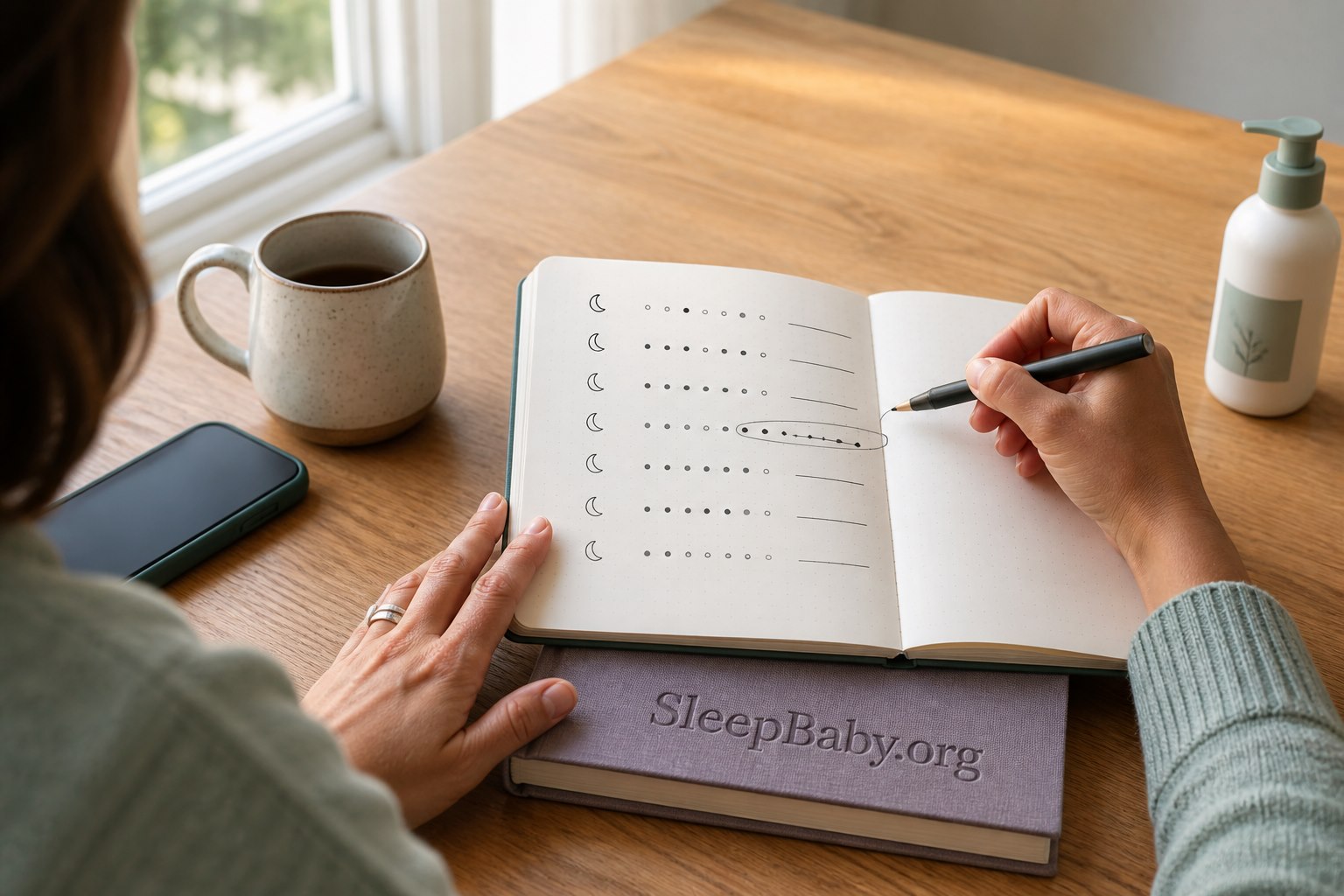
A log is most useful when it is boring enough to finish. Do not track every sigh. Choose one routine change and capture the same few facts for seven nights. Natural variation will still happen, but the record makes it harder for one unusually good or bad night to tell the whole story.
The smallest useful sleep log
| Write down | Keep it concrete | Why it helps |
|---|---|---|
| Routine start and lights-out | Clock times, not “late” or “good.” | Shows schedule drift and actual sleep opportunity. |
| Approximate settling | A range is enough; do not watch the clock all night. | Separates routine length from time to sleep. |
| Wakings and help needed | Number, rough duration, and what helped. | Reveals a repeated handoff or symptom pattern. |
| Morning and daytime clues | Wake time, sleepiness, naps, illness, pain, major change. | Gives the pediatrician context beyond bedtime. |
One-change rule: if you move bedtime, add massage, remove a screen, and start a lotion on the same night, the log cannot tell you which change mattered. Choose the change with the strongest reason and the lowest burden first.

When a child’s sleep belongs with the pediatrician
Bring the pattern, not just the product. Talk with the pediatrician about persistent snoring, loud or labored breathing, pauses in breathing, unusual movements, pain, itching, reflux symptoms, restless legs or uncomfortable sensations, a major behavior or mood change, severe daytime sleepiness, or a sleep problem that is regularly disrupting the child or family. AAP sleep guidance specifically tells parents to watch for snoring, heavy breathing, sleep apnea, sleep resistance, and night waking and to discuss concerns with the pediatrician.3
Also call before starting an oral magnesium supplement, especially if the child takes medicines or has a health condition. NIH notes that magnesium supplements can interact with some medicines and that high supplemental intake can cause diarrhea, nausea, and abdominal cramping.1 Those oral cautions should not be misused to estimate lotion exposure; they are a reason to keep deficiency and supplementation in the clinical lane.
Take the seven-night log, the exact product bottle if you used one, a list of medicines and supplements, and the question you want answered. “Could this be a symptom pattern, and what should we try first?” is more useful than “Which sleep product should I buy?” Our guide to when to worry about a child’s sleep can help organize the handoff.
Magnesium lotion for kids’ sleep FAQ
Does magnesium lotion help kids sleep?
It has not been shown to. Good pediatric topical trials demonstrating faster sleep onset, fewer wakings, or longer sleep were not found, and meaningful magnesium delivery through intact skin remains unproven.2 A child may enjoy the massage or routine, but that does not identify magnesium as the active cause.
What age can a child use magnesium lotion?
There is no universal age that applies to every formula. Follow the exact product’s age guidance and warnings. If the label does not clearly cover your child’s age, do not infer permission from a testimonial or retailer description. Ask the pediatrician or use a familiar, simpler moisturizer already tolerated by the child’s skin.
How much magnesium lotion should I use?
Use only the amount and frequency on the exact label for the exact age, if the product is appropriate at all. Do not convert an oral magnesium amount into pumps or skin area, and do not apply extra lotion to chase a stronger sleep effect. More product can mean more irritation or more material available for accidental ingestion without providing a proven benefit.
Should it go on feet, legs, or the stomach?
No body location has been shown to turn magnesium lotion into an effective pediatric sleep treatment. Follow the label. Avoid eyes, mouth, broken or irritated skin, and hands likely to go into the mouth unless the exact directions and clinician say otherwise. Do not use heat, occlusive wraps, or improvised coverings to try to increase absorption.
Is tingling or stinging proof that it is working?
No. A sensation is not a magnesium-absorption test. Burning, increasing redness, swelling, blistering, or a spreading rash is a reason to stop, rinse as directed, and seek advice for a concerning or persistent reaction. Trouble breathing or facial or throat swelling requires emergency help.
What about Epsom salt baths?
Epsom salt is magnesium sulfate, but a bath still does not establish a clinically meaningful magnesium dose through skin or a pediatric sleep benefit. Warm water and a repeated bath routine may feel calming independently of magnesium. Follow product and bathing safety instructions, supervise continuously, prevent swallowing, and stop for skin irritation.
Is melatonin-free magnesium lotion a safer sleep aid?
“Melatonin-free” tells you one ingredient is absent. It does not prove the remaining formula is effective, nonirritating, age-appropriate, or safe if swallowed. Read the complete ingredient list, warnings, and age directions. The simplest product is often easier to evaluate than a blend of magnesium, fragrance, herbs, and essential oils.
Can I use it every night?
Do not assume nightly use is appropriate because a product is sold for bedtime. Follow the exact label and the child’s skin response. Stop for irritation. If the routine seems useful, ask whether the same calming sequence works with a familiar fragrance-free moisturizer or no product. Persistent sleep difficulty deserves a pattern review rather than indefinite escalation of bedtime products.
You are allowed to skip the promise and keep the tenderness
There is something tender about wanting one small act that says, “I know nights are hard; I am here.” You can keep that act. Warm hands. A slow breath. The same book. A little less light. A closing sentence your child knows by heart.
You do not need to call it magnesium therapy for the moment to matter. You do not need to purchase certainty in a pump bottle. If a familiar lotion makes the routine comfortable and the skin is happy, let it be lotion. If no lotion is needed, let the ritual stay simple. If the sleep pattern is telling you something larger, bring the pattern to someone who can examine the child rather than asking the label to diagnose it.
When the product question is answered but bedtime is still hard
Build the night around your child’s real pattern
SleepBaby can help you turn timing, settling, waking, sensory needs, caregiver handoffs, and daytime clues into one practical next step. Keep the tenderness. Lose the pressure to buy a promise.
Sources
- NIH Office of Dietary Supplements: Magnesium – Consumer. Nutrient functions, dietary and supplement context, adverse effects, and medicine interactions.
- Grober U, et al. Myth or Reality – Transdermal Magnesium? Nutrients. 2017;9(8):813. Review of skin-barrier and transdermal-magnesium evidence.
- American Academy of Pediatrics: Healthy Sleep Habits. Routine, screens, sleep environment, and symptoms to discuss with a pediatrician.
- American Academy of Pediatrics: How to Treat and Control Eczema Rashes in Children. Fragrance and sensitive-skin guidance.
- U.S. Food and Drug Administration: Is It a Cosmetic, a Drug, or Both? Intended-use claims and cosmetic premarket review boundaries.
- Poison Control. Free confidential U.S. guidance for accidental ingestion and other exposures.
- American Academy of Pediatrics: Smart Solutions for Safe and Sound Sleep. Public AAP sleep video, reviewed August 8, 2026.