
Dry, frizzy baby hair often needs gentler handling, not more products. I would first part the hair in good light and look at the scalp. If the skin looks comfortable and your baby is well, start with less rubbing, mild cleansing when needed, and gentle detangling. For longer curls or coils, an age-appropriate conditioner can help the comb move without pulling. The useful result is fewer snags and a comfortable baby; perfectly smooth hair is optional.
If you see painful skin, swelling, drainage, strong itching, or scaly patches with broken hairs, contact your pediatrician instead of treating it as ordinary frizz. A baby younger than 3 months with a temperature of 100.4°F (38°C) or higher needs an immediate call. [1]
You can put the new bottle back on the shelf while you work out which problem you actually have. Hair that looks fluffy and skin that feels sore need different kinds of help.
Look underneath the frizz before changing the routine
The ends are what you notice in a photo. The scalp is what I would check before choosing a product. Sit with your awake baby securely supported, use your fingertips to separate a small section, and look without scraping or picking. Check the hairline, behind the ears, and the part of the head where the hair seems most tangled.
You are looking for a useful description, not trying to make a diagnosis. Is there a knot in the strands? A greasy scale stuck to the skin? A patch that looks different from the surrounding scalp? Does your baby seem bothered when you touch that area? Those observations give a clinician much more to work with than “her hair is a mess.”
Two places to look, two different decisions
Along the strands
Fluff, a knot, or rough-feeling ends, with comfortable skin underneath.
Next: reduce friction and work gently on the hair. Stop when it moves without snagging.
On the skin
Persistent scale, soreness, a changing patch, or itching that interrupts settling.
Next: ask about scalp care. Conditioner on the ends cannot answer a skin problem.
For tonight: comfort comes before another styling attempt. SleepBaby.org
A scalp does not have to look bright red to be irritated. On darker skin, a change may look lighter or darker than the surrounding area. Texture, swelling, discomfort, and changes over time matter too. The NHS cradle-cap guide shows examples across skin tones. Its pictures can help you describe what you see, but a photograph cannot confirm your baby’s diagnosis. [2]
If your baby pulls at their hair, note whether it happens only while getting sleepy or also during the day with obvious itching. Our guide to hair pulling around sleep separates light touching from pulling that injures skin or removes hair. That distinction matters more than how tidy the hair looks afterward.
A fuzzy curl is not automatically damaged hair
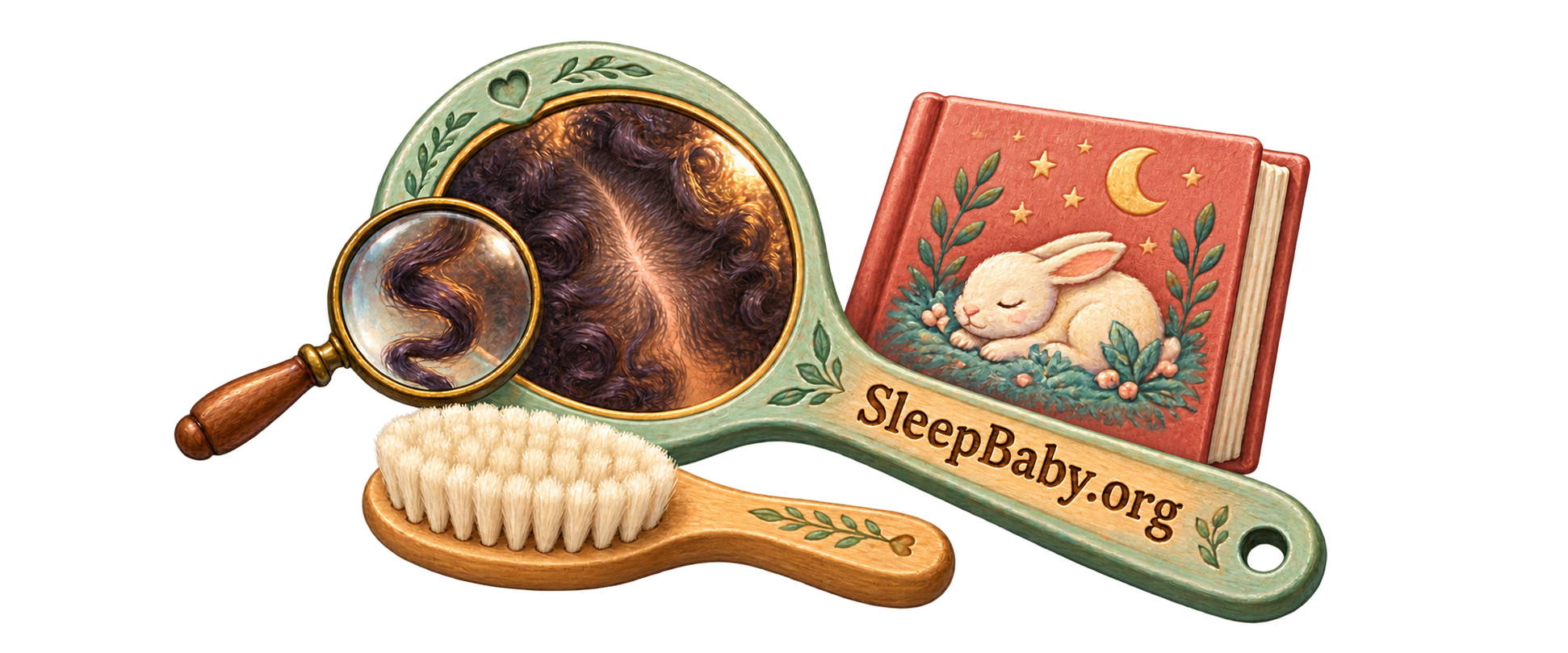
Curly and coily hair does not need to feel like straight hair to be healthy. The American Academy of Dermatology notes that thick curls are more prone to dryness and breakage, and that brushing curls when dry can create frizz. That is a reason to adapt your handling, not a reason to brush until every curl lies flat. [3]
Notice what “dry” means in your house. Does the hair only look airy around the edges? Does it feel rough? Does the comb catch in the same patch every time? A product that makes hair shinier might satisfy the first concern while doing very little for a stubborn knot. I would name the problem before buying something described as a solution.
Newborn shedding can add to the confusion. Babies commonly lose some or much of their first hair during the early months, and the back of the head may look especially sparse. The AAP describes this as common and usually temporary. New shedding with inflamed skin, broken hairs, or a distinct scaly patch deserves a separate assessment rather than a growth-oil experiment. [4]
Your baby’s hair may also look very different after it dries than when it is wet. You do not have to preserve the wet-hair appearance all day. A curl opening up after a nap is not proof that the shampoo failed. Before adding another step, ask whether your baby is comfortable and whether the hair can be handled gently.
I would resist making adult curl routines the default for a baby. Advice about long wash intervals, strong clarifying shampoos, overnight treatments, and elaborate protective styling may be written for someone with a very different scalp, hair length, and ability to speak up when a product stings. Infant care and your child’s own clinician’s advice take priority.
Keep wash day small enough to finish comfortably
For routine baby care, the AAP suggests washing hair two or three times a week with a mild shampoo or body wash. This is a starting point, not a requirement to shampoo clean hair every bath night. Food in the hair, an oily scalp, and a prescribed scalp-care plan can change the schedule. [5]
The AAD recommends lukewarm water and mild, fragrance-free baby cleansers. I would use the amount and rinsing directions on the product you already tolerate, rather than borrowing a large dollop from an adult hair tutorial. A newborn with very little hair does not automatically need conditioner or a styling product. [6]
Get the towel, cleanser, clean clothes, and anything else you need within reach before the bath. Keep a hand on your baby and never leave them alone in water. If something is missing, take your baby with you to get it. Finishing a hair routine never outranks bath supervision. [5]
What your hands do on wash night
- Wet gently. Use comfortably warm water, keeping it away from the eyes and face.
- Clean the scalp. Use gentle fingertips. Avoid twisting the lengths into a soapy pile.
- Rinse thoroughly. For hair that needs conditioner, use an age-appropriate product as directed and rinse it if the label says to.
- Blot, then pause. Press with soft cotton instead of scrubbing. Keep your baby warm while you decide whether any detangling is actually needed.
A bath can end before every flyaway is arranged. Leave time for feeding, comfort, and the rest of bedtime.
The AAD’s child hair-care guidance supports washing the scalp rather than rubbing shampoo through the lengths, avoiding rough towel drying, and using conditioner for dry or curly hair. It is guidance for children broadly, so choose products appropriate to your baby’s age and ask your pediatrician if the skin is sensitive, inflamed, or being treated. [7]
If wash night regularly ends in tears, change the timing before assuming you need a stronger product. Try doing the hair earlier while your baby is awake and comfortable, or separate a necessary wash from the final quiet part of bedtime. You can still have a familiar bedtime sequence on a night without shampoo.

Detangle the knot instead of repeatedly brushing the whole head
For longer curls or coils, damp hair with enough slip is usually easier to work through than dry hair. The AAD recommends fingers or a wide-tooth comb, working in sections. Its curly-hair advice is general, so the infant-specific product and safety limits above still apply. [3]
I would start with the smallest snag you can actually feel. Separate the surrounding hair with your fingers, support the section gently above the tangle, and work on the ends before moving upward. Use tiny movements. If the scalp is moving with each stroke, the pull is reaching your baby rather than staying at the knot.
Do not begin at the roots and drag the comb down through everything at once. You can meet several little tangles in one stroke and make them into one much less cooperative tangle. The comb is allowed to stop. It does not need to win.
If the hair is too short to hold above a knot, use your fingers and stop before you start pinching the scalp. For a tight mat close to the skin, ask a pediatrician or a professional experienced with young children’s textured hair for help. I would not work scissors beside a wriggling baby’s scalp to rescue one patch.
Let your baby’s reaction change the plan. Turning away, crying, or becoming increasingly upset is a reason to pause, support them comfortably, and try a smaller section later. If touching the scalp itself seems painful, stop the grooming attempt and seek advice. You do not need to decide whether a baby is being “dramatic” before responding to discomfort.
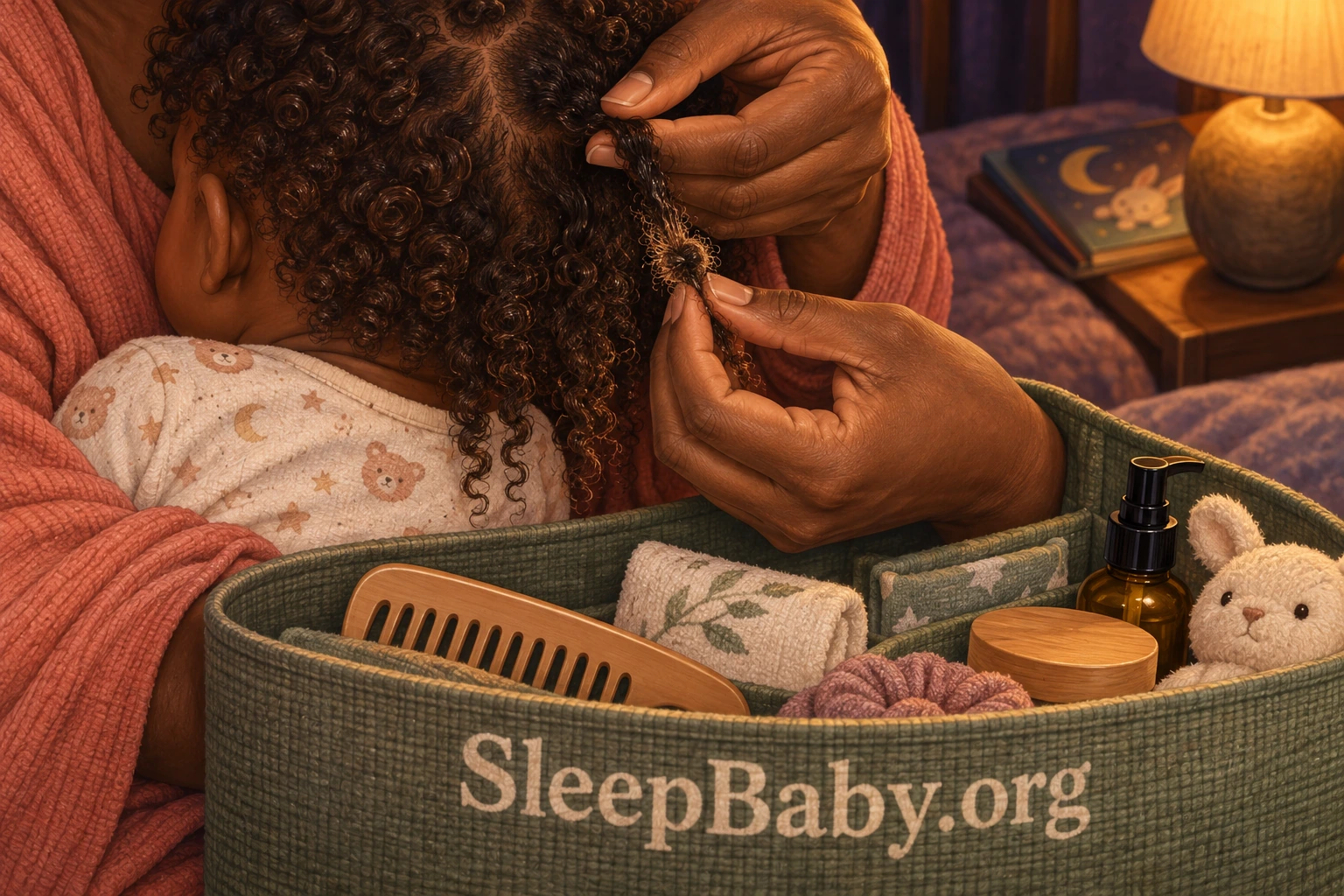
Once the knot releases, leave that section alone. Repeatedly combing a curl that is already free can make the routine longer without solving anything new. Check the spot that catches, finish the necessary care, and let the hair keep some of its natural shape.

When hair care keeps stretching bath night
Put the comb away. Make room for bedtime.

A knot can take up the whole evening if every attempt becomes another round. Once your baby is comfortable and necessary care is finished, a simpler settling routine is a separate next step.
The Baby Sleep Miracle presentation introduces the SleepBaby.org Workshop. The current $9 offer includes 15 guides and five audio tracks for parents exploring baby sleep support.
It does not treat a scalp condition or change hair texture, and sleep results are not guaranteed.
Choose a product for the job you can name
Shampoo cleans. Conditioner helps hair handle more smoothly. A prescribed scalp treatment addresses a particular condition. Putting all three in the same mental category of “moisture” makes it surprisingly easy to keep buying the wrong thing.
For a healthy-looking scalp, begin with the mild baby cleanser you already tolerate. If longer hair is tangling, consider an age-appropriate rinse-out conditioner before building an entire leave-in routine. Read the actual label, including directions and age guidance. “For kids” does not tell you whether a product is intended for an infant or a school-age child.
A leave-in may be useful for some longer, textured hair, but it is not mandatory for every fuzzy head. If you use one, follow its directions and keep it away from the eyes and mouth. I would change one product at a time so that a new rash or an improvement is easier to connect with a specific change.
Fragrance-free is a useful starting preference for sensitive skin, not a promise that a product cannot cause irritation. The AAD identifies fragranced shampoos and soaps among possible eczema triggers. If a new product is followed by itchy or irritated skin, stop it and discuss persistent symptoms with your clinician. [8]
I would skip essential-oil blends, adult styling treatments, and homemade food masks for routine infant frizz. They add ingredients and handling without being necessary to the small care routine described here. “Natural” is a marketing description, not an infant-use instruction. Keep bottles out of reach; applying a product to hair does not make it safe to taste.
And be cautious with growth promises. A brush may help arrange the hair you can see. It is not a reason to expect faster growth, and I would not buy it on that basis. The same goes for a shiny coating that makes a photograph look smoother but leaves you unsure whether the scalp is comfortable.
If more product leaves the hair coated but still tangled
Write down what is actually being applied between washes. A morning cream, an evening oil, and another caregiver’s detangling spray can become several layers even when each person thinks they are using very little. I would compare that list with the problem you wanted to solve. Is the knot easier to release, or is the hair simply shinier and stickier?
Use the next normal wash to follow the cleanser’s directions and rinse carefully. Do not respond by adding a strong adult clarifying treatment. Then keep the routine simple enough to observe. If an infant’s hair seems to need constant corrective products, that is a useful question for your pediatrician or dermatologist, especially when the scalp is also changing.
There is no need to keep a spreadsheet. A note such as “comb caught at the back after the nap; scalp comfortable; used conditioner at the next wash” is enough to remember what you tried. If you cannot tell whether a flake is dried product or attached scale, avoid scraping it to find out. Describe it and ask for help.
When flakes, itching, or hair loss need their own plan
Cradle cap commonly causes greasy scales. It usually does not itch or hurt, and it is not caused by poor parenting. Mild cases can be left alone. If you want to remove scales, use gentle infant scalp-care guidance rather than picking them off. [2] [5]
Notice that cradle-cap washing advice can differ from ordinary dry-hair advice. The AAD describes more frequent shampooing as one option for cradle cap, with individualized instructions when eczema or another skin condition is present. That does not mean every baby with fuzzy ends should suddenly be washed more often. [9]
Oil advice is another place where the diagnosis matters. AAD guidance mentions a non-food-based oil to soften stuck-on scales before shampooing; NHS guidance lists an emollient or coconut oil and advises against olive and peanut oils. These are scalp-care instructions, not interchangeable recipes for an overnight hair mask. Ask your pediatrician or pharmacist which product and method suit your baby. [9] [2]
Itchy, inflamed skin may need an eczema or irritation assessment. I would mention scratching that interrupts sleep, a rash extending beyond the hair, and whether anything new touched the skin. Do not substitute conditioner for a treatment plan or start an adult medicated shampoo because the package says “dry scalp.” [8]
Round scaly patches, black dots, or broken hairs can occur with scalp ringworm. It is a fungal infection and can spread through shared combs or brushes. It generally needs prescribed oral treatment; shampoo alone does not cure it. Arrange medical assessment rather than trying to comb the patch away. [10]
Seek prompt medical advice for swelling, pus, bleeding or leaking crusts, pain, spreading changes, or a baby who seems unwell. For nonurgent but persistent flakes, new bald patches, or uncertainty about a product, contact your pediatrician during office hours. You can bring a clear photo and the product labels. Those are more useful than a list of every remedy someone suggested. [2] [4] [9]
When you call, start with your baby’s age and what changed: skin appearance, itching, broken hairs, shedding, or discomfort. Say when it began and whether a new cleanser or hairstyle came first. Mention fever or a change in feeding or alertness at the beginning of the conversation, rather than leaving it until after the hair-care questions.
Useful questions include: Does this look like a scalp condition? Should we keep the current washing schedule? Which exact product is appropriate at this age, and when should we expect to reassess? If a treatment is prescribed, ask where it goes, how much to use, and whether it is rinsed off. Clear instructions are easier to share with another caregiver than “put something on the dry part.”
If the problem is scale on the scalp
The American Academy of Dermatology’s 4 cradle cap tips from dermatologists explains gentle scale care and when to seek help. This is for the scalp-flaking branch of the question, not a treatment for ordinary frizz.
What to take from it: avoid picking, use gentle care, and get individualized advice when the scalp is painful, very itchy, or worsening. The AAD’s written instructions cover the same decisions if you prefer to read. Watch on YouTube.
Keep the sleep space safe, even when morning hair gets tangled
Adult curl advice often turns quickly to silk pillowcases, scarves, and bonnets. An infant’s sleep setup has different rules. Use a firm, flat, level infant sleep surface covered only by a fitted sheet, and place your baby on their back for sleep. Keep pillows, towels, loose fabric, and other soft items out of the space. [11]
I would not add a bonnet, wrap, loose satin cloth, pillow, or positioning aid to solve morning frizz. Do not change to side or tummy sleeping to protect the hair either. Handle the hair while your baby is awake; the sleep space should not become part of a styling routine.
Choose a correctly fitted sheet that meets the sleep product’s instructions. There is no need to buy a special sheet solely because a curl looks different after a nap. Remove hair accessories before sleep, and avoid a style that pulls on the scalp. Tight repeated styling can contribute to hair loss. [4]
Finish the hair care outside the sleep space
While awake: blot damp hair, gently release a snag if needed, put grooming tools away.
For sleep: remove the towel, hood, and accessories; use the clear infant sleep space.
In the morning: assess comfort and tangles again. A hairstyle does not need to survive the night unchanged.
If your question is whether the hair must be completely dry before bed, our guide to sleeping with damp hair focuses on comfort and keeping the sleep surface dry. Do not leave a drying towel under your baby’s head.
Some babies enjoy a bath; others become quite alert afterward. If you are sorting out the timing, how baths fit into bedtime can help you think through that part separately. A scalp treatment should follow its instructions even if the usual bath slot changes.

In the morning, fix the snag you have
Before washing again, feel gently for an actual tangle. If the scalp is comfortable and the hair is simply fluffy, you may not need to do anything. For a small knot in longer curls, use damp fingertips and the gentle section-by-section approach. Add a suitable product only when the hair needs it and its instructions allow that use.
I would judge a routine over ordinary care sessions by three observations: less pulling, fewer difficult knots, and comfortable skin. Take one change at a time. If you alter the shampoo, conditioner, wash frequency, and comb all together, you will have a new routine but very little idea which part helped.
Success can still have flyaways. Your baby does not need to arrive at breakfast with a finished salon look, and you do not need to start the entire wash process because one side looks different from the other.
If the same area keeps knotting, check how you handle that section during ordinary care. Are you rubbing it vigorously with the towel, pulling a shirt over it repeatedly, or brushing it again whenever it lifts? Change the handling you can control. You do not need to control every movement your baby makes during a nap, and you should not restrict sleep movement to preserve a curl.

A small grooming option
An Amazon brush-and-comb set for gentle everyday care
Dr. Brown’s Soft and Safe Baby Brush + Comb pairs a soft-bristle brush with a rounded comb. I would consider it if you need a simple infant grooming set, particularly for fine hair. It adds tools rather than another product to your baby’s skin.
Check the fit: the comb still needs to pass through your child’s hair comfortably. For dense curls or tightly coiled hair, fingers or a wider-spaced detangling tool may suit the job better. A soft brush is not a reason to brush dry curls repeatedly.
Skip it if: your existing tools work well or fingers handle the small tangles. I am not recommending this as a treatment for cradle cap or as a way to make hair grow faster. Check the current listing, contents, and care instructions before buying.
As an Amazon Associate, SleepBaby may earn from qualifying purchases.
Give the next caregiver one clear instruction
When more than one person does bath time, the most useful handoff is concrete: which product is used, whether it gets rinsed out, where tangles tend to form, and when to stop. You do not need everyone following a complicated curl routine. You need everyone knowing how to avoid pulling and which skin changes need attention.
Leave the actual bottle with its label, rather than an unlabeled mixture. Say that the hair may look fluffy when dry. If there is a clinician’s scalp-care plan, share that plan separately so an ordinary conditioning step does not replace it.
The part I would protect is your baby’s experience of being cared for. You can end a grooming session with a curl still pointing sideways. Comfortable skin, gentle hands, and a baby who has had enough are all good reasons to put the comb down.
Sources
- AAP: Fever and when to call
- NHS: Cradle cap
- AAD: Curly and coily hair care
- AAP: Hair loss in children
- AAP: Bathing your baby
- AAD: Baby skin, hair, and nails
- AAD: Children’s hair-care habits
- AAD: Eczema in babies
- AAD: Cradle-cap care and video
- MedlinePlus: Scalp ringworm
- NICHD: Safe infant sleep environment
- Dr. Brown’s: Brush-and-comb specifications (product features only)
The towel is hung up. The comb can wait.
Let the rest of the evening be about settling
When your baby’s scalp is comfortable and hair care is finished, you can turn to the next part of the night. Explore SleepBaby.org for the current baby sleep presentation and Workshop details, at your own pace.
Sleep support does not replace medical care for a sore or itchy scalp.






What viewers said10 comments · 4 replies+
Archived comments from the original Baby Sleep Miracle presentation. Not independently verified by SleepBaby.org; individual experiences vary.
Thank you so much for this video! I had no idea about the dangers of baby swings :O
Hi Mary-Ann. I have a question: Is method in any way similar to the ones recommended by Dr Bucknam, Dr. Weissbluth or Dr. Karp? We tried those but none of them help.
Hi Regina, thank you for your question. The short answer is no. The techniques I share in my guide are based on newest scientific research and this is why I have never seen any approach similar to the one I recommend.
This method really works! I tried it on my son Jesus and after just one week he went from waking up more than 5 times a night to waking up just once or twice. You are a lifesaver, Mary-Ann!
I'm truly impressed with how much information you share in your video. And all for free! I can feel that you truly care about mothers like myself, and that's hard to find these days. I have recommended your site to several of my friends already.
Mary-Ann, our child suffers from autism. Is your approach still suited?
Chloe, I made sure my method can be used with any child, even babies who are special like yours. Please note that I'm not a doctor and that I always advice to consult with your physician because nothing is more important than the safety and well-being of your love.
Hallo Mary-Ann, I'm from Germany. Do you have your guide in German?
Hello Heide, we do! Normally you should already see our video in German. If not, please contact our support so they can guide you
Thenk you for your answer, Mary-Ann!
I just completed your approach and I have to say, it worked almost too well. Yes, it took a bit of getting used to with your bedtime routine but the difference is huge. My son George used to take 1 hours to go down and now he's firmly asleep in no more than 10 minutes! You're the best!
It seems I'm the only man watching this video, lol! What you shared about the 'emotional backpack' made immediate sense to me and I can't wait to help my little girl Mila to unpack it!
Hey there, just discovered your site and this really sounds different. Just wanted to say thanks for sharing :)
For everyone who's still thinking about getting Mary-Ann's guide I want to advise you to go ahead. I wasn't sure myself but now I'm so thankful I invested in this program. It made a huge difference in our life as a family and yes, my baby girl does sleep through the night now.