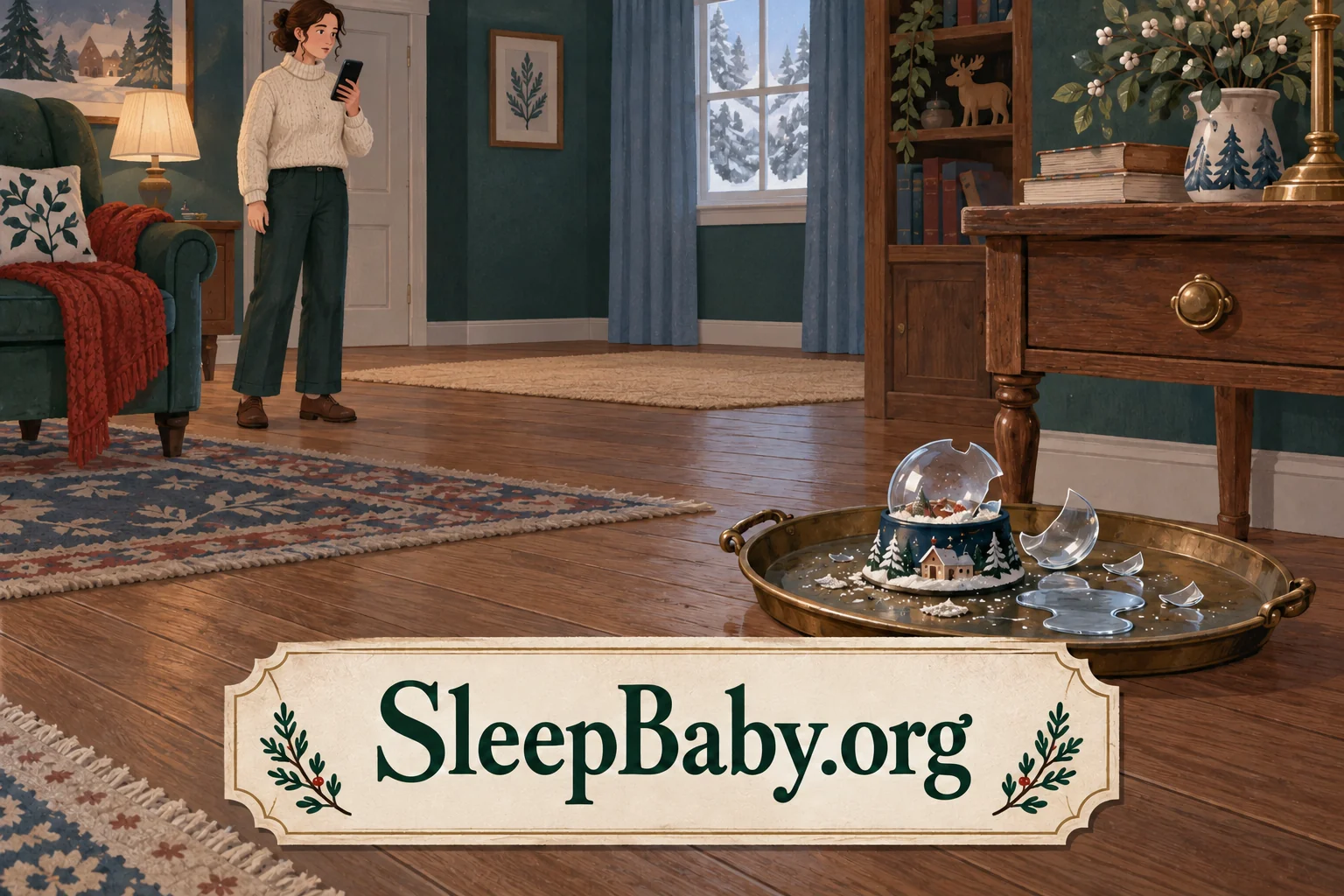
If your child broke a snow globe, move them away from the glass and liquid first. If any liquid may have been swallowed, call Poison Control at 1-800-222-1222 in the U.S. now; do not wait for symptoms. Some globes contain more than water. Suspected swallowed sharp glass needs prompt medical advice. Call 911 for trouble breathing, collapse, a seizure, inability to wake your child, or severe bleeding you cannot stop.
I would put the child before the cleanup, even when the globe was a keepsake. Check how your child is breathing and responding. Then work out whether there was contact with the liquid, broken glass, or both. Do not make your child vomit.
SleepBaby.org · The original video
A little help
for the night ahead.
Take a moment to watch the original Baby Sleep Miracle presentation. Your article will be right here when you’re ready to keep reading.
What viewers said10 comments · 4 replies
Archived comments from the original Baby Sleep Miracle presentation. Not independently verified by SleepBaby.org; individual experiences vary.
Hi Mary-Ann. I have a question: Is method in any way similar to the ones recommended by Dr Bucknam, Dr. Weissbluth or Dr. Karp? We tried those but none of them help.
Hi Regina, thank you for your question. The short answer is no. The techniques I share in my guide are based on newest scientific research and this is why I have never seen any approach similar to the one I recommend.
This method really works! I tried it on my son Jesus and after just one week he went from waking up more than 5 times a night to waking up just once or twice. You are a lifesaver, Mary-Ann!
I'm truly impressed with how much information you share in your video. And all for free! I can feel that you truly care about mothers like myself, and that's hard to find these days. I have recommended your site to several of my friends already.
Mary-Ann, our child suffers from autism. Is your approach still suited?
Chloe, I made sure my method can be used with any child, even babies who are special like yours. Please note that I'm not a doctor and that I always advice to consult with your physician because nothing is more important than the safety and well-being of your love.
Hallo Mary-Ann, I'm from Germany. Do you have your guide in German?
Hello Heide, we do! Normally you should already see our video in German. If not, please contact our support so they can guide you
Thenk you for your answer, Mary-Ann!
I just completed your approach and I have to say, it worked almost too well. Yes, it took a bit of getting used to with your bedtime routine but the difference is huge. My son George used to take 1 hours to go down and now he's firmly asleep in no more than 10 minutes! You're the best!
It seems I'm the only man watching this video, lol! What you shared about the 'emotional backpack' made immediate sense to me and I can't wait to help my little girl Mila to unpack it!
Hey there, just discovered your site and this really sounds different. Just wanted to say thanks for sharing :)
For everyone who's still thinking about getting Mary-Ann's guide I want to advise you to go ahead. I wasn't sure myself but now I'm so thankful I invested in this program. It made a huge difference in our life as a family and yes, my baby girl does sleep through the night now.
Ready to get started?Take the next step with SleepBaby.
Pick your priceStart with these three jobs
- Move people and pets away. Keep bare feet and crawling hands out of the spill. If another adult is available, have them stay with your child in a clear space while you handle the call.
- Get the right help for any contact. Report possible swallowing, a splash in the eyes, cuts, or glass near the mouth. An unwitnessed moment is worth describing; you do not need proof of a swallow to call.
- Keep useful details without handling shards. A safe photo of the base, label or box can help identify the globe. Do not delay a call to find a receipt or collect every piece.
Outside the U.S., use your local poison service and emergency number. If a child is choking and cannot breathe, cry or cough effectively, call emergency services and follow the dispatcher’s age-appropriate first-aid instructions. Do not sweep blindly inside the mouth.
Northern New England Poison Center advises calling after possible swallowing or eye contact with snow-globe liquid. A shattered decoration with no contact is a different situation from liquid on a child’s lips. Keep those two questions separate while you work.

Is the liquid inside a snow globe poisonous?
There is no single snow-globe formula. Tennessee Poison Center reports that some manufacturers have used ethylene glycol, an ingredient associated with antifreeze, while others reported distilled water. Its account is historical; it does not establish what is inside your globe today.
That is the useful distinction: some liquid can present a poisoning concern, but the words “snow globe” do not identify the contents or amount swallowed. A puddle’s size, the glitter, and the country printed on the base cannot settle your child’s risk.
I would not taste the liquid, smell it closely, or search for a home test. Clear liquid may still contain additives. A product described as decorative is not intended to become a drink. Save any available label and let the poison specialist work with what you actually know.
What if it was only a lick?
Say exactly that when you call: a lick from a finger, liquid seen around the lips, or a possible sip from the broken base. Do not turn “only a lick” into an estimated dose you cannot support. Also mention whether glass could have reached the mouth.
Parents often have a fragment of the story. Perhaps the globe was already broken when you entered the room, or your toddler wiped their mouth before you saw the floor. It is useful to say what you saw and what you did not see. A confident guess can hide the detail the specialist needs.
What if my child seems completely fine?
A normal-looking child is information to give the specialist, not a reason to delay the exposure call. Poison Control’s first-aid guidance says to get help promptly when poisoning is suspected. It also identifies breathing difficulty, collapse, seizures and inability to awaken as emergencies.
Do not use an internet timetable to decide that a certain number of symptom-free minutes clears the situation. Get instructions for the actual child, product and exposure. If you have already called and something changes, use the follow-up plan you were given.
Two tracks: the child and the room
I would keep two short notes rather than try to solve everything in one sweep.
- The child: what contact may have happened?
- Liquid swallowed or near the mouth; liquid in an eye; a cut; glass in or near the mouth; symptoms now; and the time you found the child.
- The room: where could debris still be?
- The main spill; nearby rugs and furniture edges; shoes or clothing that crossed it; toys that were beside it; and a bin or bag a child or pet could reach.
Clearing the room does not answer the medical question. A reassuring care plan does not mean the floor is ready for a crawling baby. Finish each track on its own terms.
What to tell Poison Control
Keep your child with you or with another responsible adult while you call. Have their age and approximate weight available, and describe how they are acting now. Give the time of the incident if you know it, or the time you discovered it if you do not.
For the globe, useful details include the maker, model or item number, whether it was homemade, and any ingredient or warning label. If the globe was a gift and the box is gone, say so. Searching shopping listings for an almost identical globe should not delay advice.
For the contact, plain descriptions work best: liquid on a hand that went into the mouth, a splash toward the face, or a shard found next to the lips. Mention other possible exposures rather than leaving the specialist to assume it was only liquid.
Before ending the call, ask what care is needed, what changes should trigger another call, and whether feeding or sleep needs any special instructions. Write the answers down. For a baby under 6 months or several possible substances, call the poison center rather than relying on the online tool.
What if my child swallowed glass?
Tell a healthcare professional promptly if you suspect a sharp fragment was swallowed. Poison Control explains that larger or sharp pieces can injure the throat or gut. The risk depends on the piece; it cannot be judged from how dramatic the broken globe looks.
Get urgent assessment for symptoms such as chest or abdominal pain, blood in stool, or a swollen abdomen after possible glass ingestion. Breathing trouble is an emergency. Report visible mouth bleeding and difficulty swallowing too, rather than trying to inspect farther down the throat yourself.
Do not offer bread or bulky food as a way to “wrap” the glass. Poison Control notes that the suggested benefit of bread or fiber has no scientific evidence behind it. Ask the professional what, if anything, your child should eat or drink while you arrange care.
I would leave decisions about imaging or removal to the treating team. A missing fragment, a tiny chip, and a piece you actually saw swallowed are different histories. Describe yours accurately without promising yourself that a normal-looking mouth rules out a swallowed piece.

AFTER CARE AND CLEANUP
Give the rest of the evening a clear starting point
For a separate look at ordinary bedtime routines and baby sleep schedules, the SleepBaby.org Method homepage explains the current offer.
A broken globe can interrupt several things at once: one adult is on the phone, another is checking the rug, and bedtime is approaching. I would finish the care conversation first. A routine cannot decide whether an exposure needs treatment or whether observation can end.
Once the professional’s instructions are clear and the room is ready for your child, a small handoff can help: the label photo is saved, the care note is available, and everyone knows which space is safe to use. Ordinary sleep planning can come afterward, if that is still a question you want to explore.
The SleepBaby.org Method discusses bedtime routines and baby sleep schedules. You can read the current information on the homepage at your own pace. It does not assess swallowed liquid, treat an injury, or give permission to let a child sleep through concerning symptoms. No purchase is needed for the safety steps in this guide.
Liquid in an eye, on skin, or on clothing
For a liquid splash without a suspected penetrating injury, start rinsing the eye promptly with clean, lukewarm water. Poison Control recommends 15–20 minutes of irrigation. Use a gentle flow and get poison advice; another adult can call while you rinse. Do not put soap or a home remedy in the eye.
If glass may have pierced the eye, seek emergency care. Do not rub, press on the eye, or try to remove a stuck piece. The NHS also identifies severe pain, changes in vision, or inability to keep the eye open after an injury as reasons for emergency assessment. A child who cannot describe their vision still needs professional attention for a concerning eye injury.
For liquid on otherwise uninjured skin, remove contaminated clothing and rinse with running water; Poison Control’s general guidance recommends at least 15 minutes. Avoid dragging clothing with glass fragments across the skin. If glass is stuck or you cannot safely remove an item, get medical help.
Set contaminated items somewhere inaccessible until you have dealt with them. A wet sleeve can bring the liquid back to the mouth, and a towel used on the spill should not become the towel used to dry your child. Keep the care supplies separate from the cleanup pile.
What to do about a cut
If nothing is stuck in the wound, apply firm pressure with a clean cloth or dressing to control bleeding. For embedded glass, do not pull it out or press directly on it; seek emergency assessment. Pressure can be applied to either side while getting help, as described in NHS wound guidance.
Severe bleeding that will not stop is an emergency. Deep wounds, loss of feeling, or trouble moving the injured area also need urgent assessment. Once bleeding has stopped, a small superficial cut can be rinsed with clean water and covered with a clean dressing. Ask a clinician if you are unsure whether glass remains or the wound needs further care.
I would not dig for a glitter-sized speck with a needle or turn a resisting child’s hand into a home repair project. Keep track of where the cut is and how it happened. Tell the clinician that the injury involved a snow globe and possible liquid contamination.


Clean up the glass and liquid without spreading them
Keep children and pets out of the area until the whole cleanup is finished. If you are alone with a baby, safe supervision comes before a spotless floor. Block access and arrange help if you cannot manage both safely. Do not put the baby beside the spill while you reach for towels.
Put on closed shoes and protective gloves before handling debris. Use tools such as a dustpan and stiff cardboard to collect pieces rather than searching with bare fingers. Gloves reduce direct contact but are not permission to squeeze sharp glass.
Northern New England Poison Center recommends paper towels for absorbing the liquid. After collecting visible glass with tools, absorb the remaining spill carefully and contain used towels and debris so a child or animal cannot reach them. Do not leave sharp pieces loose in a thin bag someone may grab. Follow local disposal instructions for broken glass and any product-specific advice.
I would work from the affected area outward and keep a clean place for the tools I have not used yet. Check under the nearby table, along rug edges, and around the shoes that crossed the room. A large piece is easy to notice; the useful second look is for where the splash and small fragments traveled.
What about carpet, soft toys and a vacuum?
Keep a rug or soft item out of use if you cannot confidently remove contamination and sharp debris. Do not hand a toy back just because its top looks dry. Follow the item’s care instructions and get professional cleaning advice when needed; replacing a badly affected item may be the practical choice.
Do not improvise by sucking liquid and sharp glass into a vacuum that is not designed for that material. Check the equipment manufacturer’s instructions. A household appliance is not a substitute for first containing the spill or for knowing what remains in a fabric surface.
Before reopening the area, check the cleanup tools, your footwear, and where the waste went. Wash your hands after removing gloves. If another caregiver takes over, tell them which area is cleared and which items still need attention. “I picked up the globe” is less useful than “the rug is still out of use.”
If a pet licked the liquid
Call your veterinarian promptly and describe the possible snow-globe exposure. Keep the pet away from the spill while seeking advice. Do not apply a child’s care plan to an animal or wait for the room to be clean before making that call.

Help your child settle once safety is handled
A toddler may be more focused on the loud crash or a grown-up’s reaction than the broken object. I would use a short, concrete explanation: the glass is sharp, adults are cleaning it up, and this spot is off limits for now. Save the longer conversation for a calm moment.
If the globe mattered to you, you do not have to pretend otherwise. You can be disappointed about an object and still help your child feel able to tell you what happened. Avoid making a frightened child prove they are sorry before asking whether something got in their mouth or eye.
For an older child, reconstruct the sequence without leading the answers. Ask what they touched or noticed instead of suggesting that they “didn’t drink any, right?” Tell the professional when the answer is uncertain. Reassurance should make truthful information easier to share.
Can I repair the globe or replace it with a plastic one?
I would put repair decisions aside until the exposure question and cleanup are finished. A glued glass shell may look whole without being suitable for handling. Do not return a cracked or repaired globe to a child, and do not treat a household adhesive recommendation as proof that the decoration is safe.
If the keepsake is important, ask its maker or a restoration specialist about options later. Keep damaged parts inaccessible in the meantime. A photograph of the intact globe, if you have one, can preserve the memory without keeping loose glass in a drawer.
Plastic changes the material, not every risk. A decorative plastic globe may still leak, open, or contain small parts. Choose an age-appropriate toy if the purpose is play, and follow its age label and condition checks. There is no need to buy another liquid-filled object to replace this one.
A free alternative is to display a photograph of the globe or let your child look at an intact decoration with an adult while it remains securely placed. For storage, use a suitable existing enclosed cabinet away from climbing routes. Consider nearby chairs, pullable cloths and anything that makes a high surface reachable.

A general poisoning first-aid refresher
St John Ambulance’s “How To Treat Poisoning, Signs & Symptoms” reviews recognizing a possible poisoning, gathering information and seeking help. It is general guidance, not a snow-globe or glass-ingestion treatment guide. The video uses UK emergency numbers; in the U.S., use 911 for an emergency and 1-800-222-1222 for Poison Control.
Written takeaway: stop further contact, keep useful product details, and get professional advice. Do not make the child vomit or delay an urgent call to watch the video.
Before you return to the rest of the day
Keep the call instructions and label photo together. If care is being handed to another adult, tell them what happened, what advice you received and what should prompt another call. Ask about meals, naps or bedtime if those details were not covered; do not use sleep as a test that everything is fine.
Then check the room as a separate job. The waste is inaccessible, affected toys are accounted for, and the floor or rug is ready for your child only when cleanup is complete. That is a useful stopping point: a care plan for the child and a clear answer about the space.
Sources
- Tennessee Poison Center: When snow globes break
- Northern New England Poison Center: Broken snow globes
- Poison Control: Swallowed glass
- NHS: Cuts and grazes
- NHS: Eye injuries
- Poison Control: First aid guidelines
- Poison Control: Getting help
- Poison Control: Telephone and online help
- St John Ambulance: Poisoning first aid
- American Red Cross: Infant choking
AFTER THE IMMEDIATE QUESTION
Keep the care plan. Reset the room.
Save the details you may need on a follow-up call and choose a secure place for fragile decorations. If your next question is about everyday bedtime routines, you can read the current SleepBaby.org Method offer on the homepage.
New symptoms or uncertainty about the exposure belong with Poison Control or your child’s clinician. Sleep information is a separate next step.
SleepBaby.org · The original video
A next step for
the next bedtime.
Still thinking about sleep? Watch the presentation here, then explore the SleepBaby program whenever you’re ready.
What viewers said10 comments · 4 replies
Archived comments from the original Baby Sleep Miracle presentation. Not independently verified by SleepBaby.org; individual experiences vary.
Thank you so much for this video! I had no idea about the dangers of baby swings :O
Hi Mary-Ann. I have a question: Is method in any way similar to the ones recommended by Dr Bucknam, Dr. Weissbluth or Dr. Karp? We tried those but none of them help.
Hi Regina, thank you for your question. The short answer is no. The techniques I share in my guide are based on newest scientific research and this is why I have never seen any approach similar to the one I recommend.
This method really works! I tried it on my son Jesus and after just one week he went from waking up more than 5 times a night to waking up just once or twice. You are a lifesaver, Mary-Ann!
I'm truly impressed with how much information you share in your video. And all for free! I can feel that you truly care about mothers like myself, and that's hard to find these days. I have recommended your site to several of my friends already.
Mary-Ann, our child suffers from autism. Is your approach still suited?
Chloe, I made sure my method can be used with any child, even babies who are special like yours. Please note that I'm not a doctor and that I always advice to consult with your physician because nothing is more important than the safety and well-being of your love.
Hallo Mary-Ann, I'm from Germany. Do you have your guide in German?
Hello Heide, we do! Normally you should already see our video in German. If not, please contact our support so they can guide you
Thenk you for your answer, Mary-Ann!
I just completed your approach and I have to say, it worked almost too well. Yes, it took a bit of getting used to with your bedtime routine but the difference is huge. My son George used to take 1 hours to go down and now he's firmly asleep in no more than 10 minutes! You're the best!
It seems I'm the only man watching this video, lol! What you shared about the 'emotional backpack' made immediate sense to me and I can't wait to help my little girl Mila to unpack it!
Hey there, just discovered your site and this really sounds different. Just wanted to say thanks for sharing :)
For everyone who's still thinking about getting Mary-Ann's guide I want to advise you to go ahead. I wasn't sure myself but now I'm so thankful I invested in this program. It made a huge difference in our life as a family and yes, my baby girl does sleep through the night now.
Ready to get started?Take the next step with SleepBaby.
Pick your price



Thank you so much for this video! I had no idea about the dangers of baby swings :O