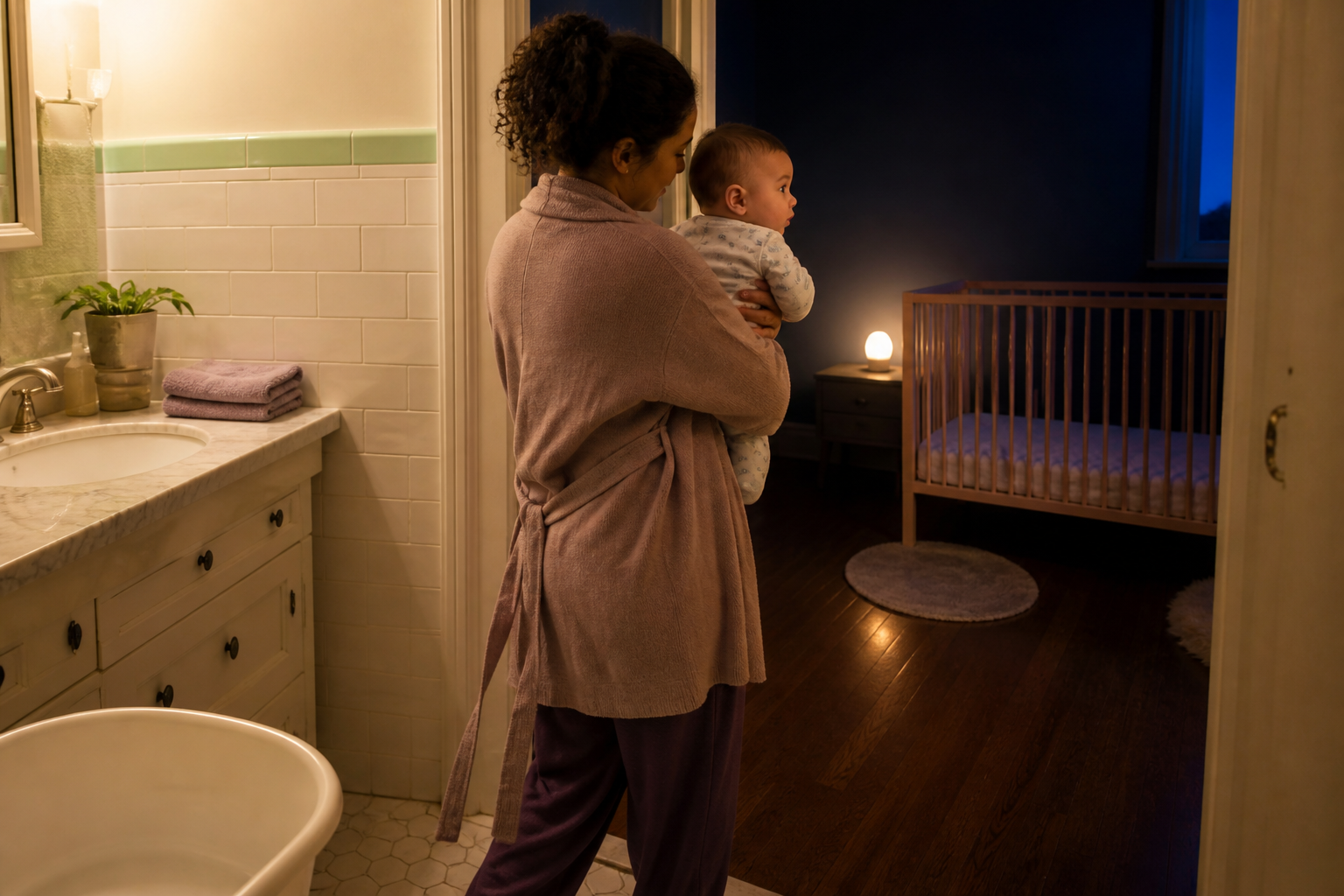
Your baby may sleep better after a bath because the bath has become one calm, recognizable doorway into bedtime—not because warm water is a guaranteed infant sleep treatment. The best infant study tested a whole sequence: bath, massage, quiet activities, then lights out. It did not isolate the bath. If your baby relaxes and their skin stays comfortable, keep the bath as an optional cue. If the bath creates splashing, tears, bright eyes, or dry skin, move it earlier, shorten it, or skip it while preserving the quieter steps that follow.
The small witness is the towel. One moment your evening is warm water and slippery elbows; the next, that towel wraps the whole house in a softer instruction: we are going somewhere quieter now.
I understand why this can feel bigger than a pleasant routine. A baby who has fought sleep for three nights suddenly melts after a bath, and your exhausted brain immediately writes a contract: We must do this every night forever or the sleep will disappear. Underneath “Why does my baby sleep better after a bath?” is a more tender question: Did I finally find the thing that makes me good at bedtime?
I want to give you the relief without handing you another rule. You may have found a useful cue. That matters. But the bath is not a test of devotion, and skipping it is not sabotage. What helps is usually the complete landing: stimulation drops, the order becomes familiar, adults stop changing the plan midstream, and the baby reaches the sleep space dry, fed as needed, comfortable, and ready for whatever settling support your family uses.

What the evidence can—and cannot—tell us
A randomized study followed 405 families with infants and toddlers from 7 to 36 months. The routine group used a three-step sequence that included a bath, massage, and quiet activities, with lights out within 30 minutes after the bath. Parents reported easier sleep onset, fewer or shorter wakings, and better sleep continuity after the routine was introduced.[3] A later analysis of the infant data found the largest changes happened during the first few nights.[4]
That is encouraging evidence for a routine. It is not proof that the water itself produced those outcomes. The study bundled several changes at once. It also relied on parent reports, enrolled babies seven months and older in the infant arm, and involved researchers with product-industry affiliations. Those facts do not erase the result; they tell us how carefully to use it.
The honest translation
A bath can be part of a helpful pattern without being the active ingredient
Your baby may be responding to the same order, dimmer lights, slower adult hands, quieter voices, reduced household motion, or simply the reliable sequence that comes after the tub. A warm-to-cool transition is a plausible contributor, but this infant evidence does not prove that mechanism or establish an ideal bath temperature for sleep. I would keep the explanation modest and the observation practical: the routine works if it helps this baby arrive at bedtime more calmly.
That distinction protects you from chasing perfection. If bath night goes beautifully, notice what happened around it. Was the final nap earlier? Did the feed go smoothly? Were the lights lower? Did Benjamin take over the noisy kitchen while I handled pajamas? Did we stop looking at the clock and begin the routine before the baby became frantic? The bath may be the most visible part of a quieter chain.

Bath safety comes before bedtime strategy
No sleep benefit is worth making the bath more elaborate, hotter, deeper, or harder to supervise. The American Academy of Pediatrics advises preparing everything first and keeping a hand on the baby at all times. If you forgot the pajamas or the phone rings, take the baby with you. A bath seat is not a substitute for an adult within touch reach.[1][2]
- Set out the entire exit before the water starts: towel, diaper, pajamas, washcloth, cleanser only if needed, and a safe dry place for the handoff.
- Use shallow, still water that feels warm—not hot—to your wrist or elbow. The AAP describes about two inches for an infant bath and recommends turning off the faucet before the baby enters because running-water temperature can fluctuate.[1]
- Keep one hand on the baby. Do not step away, even for a moment, and do not rely on a bath seat or ring to prevent drowning.
- Keep the bath brief and gentle. A longer soak is not a stronger sleep treatment. Use soap sparingly and choose a mild product without unnecessary additives when cleanser is needed.
- Dry and dress promptly. The bedtime handoff begins with a warm, dry, awake baby—not a damp towel carried into the sleep space.
The AAP also recommends setting the hottest water available at the faucet no higher than 120°F (48.9°C) to reduce scald risk.[1] That is a household prevention setting, not the target temperature for your baby’s bath. The infant tub should still be filled with comfortably warm water and tested immediately before the baby goes in.
Safe sleep does not change because the bath made your baby drowsy. After drying, feeding, and dressing as appropriate, place baby on their back on a firm, flat, non-inclined infant sleep surface with only a fitted sheet. Keep towels, loose blankets, pillows, bumpers, toys, and positioning products out of the crib or bassinet.[5] If your baby dozes in your arms during the handoff, move them to the safe sleep space rather than settling them on a couch, adult bed, or towel pile.

Prepare the bath before your hands are full
National University Hospital’s demonstration is useful here because bath safety is physical. Watch how the supplies, supporting hand, and exit plan are arranged before the routine starts. This is not a sleep tutorial; it is the foundation that makes a calm handoff possible.
Takeaway for bedtime: gather every item first, keep secure hands-on support, and make the trip from water to towel short. The quieter evening starts with fewer reasons to reach away from the baby. Open the hospital video on YouTube.
Kacey’s Bath-to-Bed Handoff
Keep the ending smaller than the bath
I use four moves because the valuable part is not a spa production. It is the clean handoff from one state of the evening to the next.
The order can flex. Some babies feed before the bath; others feed afterward. There is no universal sleep rule that makes one order correct. Follow your baby’s feeding plan and hunger cues. Do not delay a needed feed to preserve the choreography, and do not rush a bath into the last sliver before bed if hunger makes the whole sequence unravel.
If feeding after the bath is your calmest arrangement, set up the feed before you begin: chair clear, water for the adult nearby, burp cloth ready, and lights already lowered. If feeding before the bath works better, keep the bath brief and comfortable rather than turning it into a high-energy second awake period. For a newborn with weight-gain instructions, reflux concerns, feeding difficulty, or a clinician-directed schedule, the clinical plan outranks the bedtime aesthetic.
Use your baby’s response—not a universal timer
You will often see advice to finish the bath 30 to 60 minutes before sleep. The routine trial used lights out within 30 minutes after the bath, but that study does not establish a universal minute for every baby.[3] Treat timing as a small household experiment.
| What your baby does | What it may mean for the routine | Your next two-night test |
|---|---|---|
| Body softens, voice quiets, pajamas go on easily | The bath is probably sitting in a useful calming place | Keep the same general timing and protect the quiet steps that follow |
| Looks comfortable but no sleepier than usual | The bath may be neutral while the whole sequence still helps | Keep it if it is pleasant; compare a no-bath night using the same pajamas, feed, book, and lights |
| Kicks, squeals, splashes, searches for more play | The bath is stimulating at this hour | Move it 15–30 minutes earlier or shorten it; keep the final cues unchanged |
| Cries during undressing, water, or drying | Discomfort, temperature, hunger, fatigue, skin irritation, or fear matters more than the routine | Stop the experiment, meet the need, and retry another day only if the bath can be comfortable |
| Settles at bedtime but still wakes normally overnight | The bath may help the landing without changing night feeds or developmental waking | Judge it by bedtime ease, not by a promise to sleep through |

Change one thing at a time. If the bath is currently the last event before the crib and your baby emerges ready to host a small water park, move only the bath earlier. Keep the same feed, pajamas, book, phrase, and safe placement. Two comparable nights will teach you more than rebuilding the entire routine after one lively splash.
If bedtime itself floats because naps and feeds move, anchor the routine to a workable window rather than one brittle minute. This guide to building a flexible baby sleep schedule around soft anchors can help you fit the bath into the real day instead of stretching a tired baby toward a prettier clock.
You do not need a nightly bath to keep the cue
Newborns do not need a full bath every day. HealthyChildren notes that about three baths per week may be enough during the first year and that more frequent bathing can dry the skin.[1] Your baby’s needs may differ because of spit-up, diaper messes, heat, cultural routine, skin condition, or medical advice, but “it helps bedtime” does not automatically mean “use soap nightly.”
On no-bath nights, preserve the bridge: wipe the face or folds as needed, change the diaper, put on pajamas, lower the same light, use the same book or song, offer feeding and comfort as needed, then move to the safe sleep space. The baby can learn that the sequence turns toward sleep even when the tub is absent.
Skin looks dry or irritated
Shorten or reduce full baths, use cleanser sparingly, pat dry, and use a fragrance-free hypoallergenic moisturizer if it fits your pediatrician’s or dermatologist’s guidance. Stop a product that appears to irritate the skin.
Baby is still a newborn
Use sponge baths until the umbilical area heals, following newborn-care guidance. Newborn sleep remains fragmented and feed-led; a bath does not create a requirement to sleep a long stretch.
Bath night is too much work
Use the smaller routine. A washcloth, clean diaper, pajamas, feed, one short cue, and safe placement can be more repeatable than a bath that exhausts the adults.
Your baby loves the bath as play
Wonderful—let it be play earlier in the evening. The sleep cue can begin after the splashing ends, when lights and voices come down.
Skip essential-oil promises and scented “sleep” products unless your child’s clinician has given specific guidance. The routine does not need lavender, chamomile, bubbles, or a branded lotion to count. Plain water and a short repeatable sequence are allowed to be enough.

A worked evening that does not depend on magic
Let me make the routine ordinary enough to survive Wednesday. The final nap ended at 4:42 p.m. Your baby has fed and is comfortably awake. At 6:40, you place the towel, diaper, pajamas, and washcloth within reach. The nursery is already dim. The crib is empty except for its fitted sheet. The book is on the chair—not inside the sleep space.
You fill the infant tub with shallow warm water, turn off the faucet, and test it with your inner wrist or elbow. The indicator duck prompts another look, but your own touch and supervision make the decision. You bring the baby in only after everything is ready. One hand stays on the baby. The bath lasts six unremarkable minutes. Unremarkable is excellent.
At 6:49, the towel is around an awake baby on the prepared dry surface. You pat rather than rub, check the skin, diaper, and dress. The baby is relaxed but not asleep. Feeding happens because it is needed, not because the routine chart demands it. Then one board book, one familiar sentence, and back placement in the clear crib.
Suppose sleep comes more easily. Record the relationship, not a victory medal: “Brief bath, feed, book; calm at placement.” Repeat when it is convenient. Now suppose the next bath produces twenty minutes of delighted kicking. That does not invalidate the first night. Move the bath earlier next time and keep the last three cues. The routine is allowed to learn.
Suppose you skip the bath entirely. Use the same towel only if a quick wash is needed, then diaper, pajamas, feed, book, phrase, crib. If the baby still settles, you have learned something freeing: the bath may be a welcome cue, but the quiet landing belongs to the whole sequence.

What if the bath works but the night is still broken?
Bedtime ease and overnight sleep are not the same outcome. A bath may help your baby move from awake to asleep more comfortably while night feeds, developmental waking, illness, teething, discomfort, or ordinary sleep cycles continue. Do not increase the water temperature, make the bath longer, add scented products, or delay a feed in an attempt to force a longer stretch.
For a young newborn, frequent waking can be normal and feeding remains central. If the private worry is no longer “Does the bath help?” but “Why is my newborn awake again?”, use this safe plan for a newborn who will not sleep at night. It keeps feeding, illness checks, quiet care, and safe placement in the right order.
Look for a sudden change rather than grading every wake. A baby who is unusually difficult to wake, struggling to breathe, blue or gray, having a seizure, or appearing seriously ill needs urgent medical help. A rectal temperature of 100.4°F (38°C) or higher in a baby younger than three months requires immediate pediatric guidance. A persistent rash, open skin, apparent pain with bathing, feeding trouble, or a major change from your baby’s normal pattern belongs with the clinician who knows your child—not in a more elaborate bedtime routine.
Questions parents ask once the towel becomes a sleep cue
How long before bed should I bathe my baby?
Start with enough time to dry, dress, feed as needed, and use one quiet cue without rushing. For many families that means the bath begins 20–40 minutes before placement, but your baby’s response matters more than an internet minute. If the bath energizes, move it earlier by 15–30 minutes. If baby becomes frantic from fatigue, shorten the gap or start the whole routine earlier.
Does the bath lower my baby’s body temperature and trigger sleep?
A warm-to-cool transition is a plausible explanation often discussed around sleep, but the infant routine studies did not isolate that mechanism. They changed bath, massage, quiet activities, and household sequence together. Use “the routine may help” rather than treating temperature change as a proven infant sleep switch.
Should I bathe my baby every night?
Not for sleep alone. The AAP notes that roughly three baths per week may be enough during the first year and more frequent bathing can dry skin. You can keep the same pajamas, feed, book, light, phrase, and safe placement on no-bath nights.
Can I use bubbles, lavender, or chamomile to strengthen the cue?
You do not need them. Fragrance and extra products can irritate some babies’ skin, and “sleep” marketing is not proof of an infant benefit. Use plain water or a small amount of mild cleanser when needed, and follow individualized skin guidance from your pediatrician or dermatologist.
What if my baby hates the bath?
Stop making it the bedtime gate. Check water comfort, hunger, fatigue, room warmth, handling, and skin. Try a brief sponge or washcloth routine at another time if appropriate. A baby can have a recognizable bedtime without enjoying a tub.
What if my baby falls asleep while feeding after the bath?
Meet feeding needs and use the settling approach that works for your family. When the feed is finished and you are ready to put baby down, return them to the firm, flat, clear sleep surface on their back. Do not leave a sleeping baby on an adult bed, sofa, armchair, nursing pillow, or in a wet towel.
Is a bath thermometer required?
No single gadget replaces safe setup. Use warm—not hot—still water, test it with your wrist or elbow, keep the faucet off, and maintain hands-on supervision. If you add a temperature cue, treat it as one extra check rather than a certification.
The better night is the one you can repeat kindly
I am happy if the bath helps. I am even happier if you understand how lightly you are allowed to hold that success. Keep it when it is warm, safe, brief, and calming. Move it when it becomes play. Skip it when skin or family bandwidth asks for less. Preserve the landing: dry baby, needs met, lights down, one familiar cue, back to the clear sleep space.
The towel does not have to become a superstition. Let it remain a witness. It marks the edge between water and pajamas, between the bright bathroom and the dim hall, between the part of the evening where everything is happening and the part where you deliberately make less happen. That is a cue a family can use without owing the tub every night.
Sources
- American Academy of Pediatrics / HealthyChildren.org: Bathing Your Baby
- American Academy of Pediatrics / HealthyChildren.org: 5 Bathroom Safety Tips for Infants & Young Children
- Mindell et al.: A Nightly Bedtime Routine—Impact on Sleep in Young Children and Maternal Mood
- Mindell et al.: Implementation of a nightly bedtime routine—How quickly do things improve?
- American Academy of Pediatrics / HealthyChildren.org: Safe Sleep—9 Ways to Reduce a Baby’s Risk of SIDS & Suffocation
- National University Hospital Singapore: How to bathe your baby
- Munchkin: White Hot Ducky documented product features
Carry the calm past the bathroom door
Build the rest of bedtime around what your baby actually showed you
You have a bath-optional handoff now. Use SleepBaby’s practical guides to connect that small sequence to naps, feeds, safe sleep, and the next ordinary wake—without turning one good night into a fragile rule.






What viewers said10 comments · 4 replies+
Archived comments from the original Baby Sleep Miracle presentation. Not independently verified by SleepBaby.org; individual experiences vary.
Thank you so much for this video! I had no idea about the dangers of baby swings :O
Hi Mary-Ann. I have a question: Is method in any way similar to the ones recommended by Dr Bucknam, Dr. Weissbluth or Dr. Karp? We tried those but none of them help.
Hi Regina, thank you for your question. The short answer is no. The techniques I share in my guide are based on newest scientific research and this is why I have never seen any approach similar to the one I recommend.
This method really works! I tried it on my son Jesus and after just one week he went from waking up more than 5 times a night to waking up just once or twice. You are a lifesaver, Mary-Ann!
I'm truly impressed with how much information you share in your video. And all for free! I can feel that you truly care about mothers like myself, and that's hard to find these days. I have recommended your site to several of my friends already.
Mary-Ann, our child suffers from autism. Is your approach still suited?
Chloe, I made sure my method can be used with any child, even babies who are special like yours. Please note that I'm not a doctor and that I always advice to consult with your physician because nothing is more important than the safety and well-being of your love.
Hallo Mary-Ann, I'm from Germany. Do you have your guide in German?
Hello Heide, we do! Normally you should already see our video in German. If not, please contact our support so they can guide you
Thenk you for your answer, Mary-Ann!
I just completed your approach and I have to say, it worked almost too well. Yes, it took a bit of getting used to with your bedtime routine but the difference is huge. My son George used to take 1 hours to go down and now he's firmly asleep in no more than 10 minutes! You're the best!
It seems I'm the only man watching this video, lol! What you shared about the 'emotional backpack' made immediate sense to me and I can't wait to help my little girl Mila to unpack it!
Hey there, just discovered your site and this really sounds different. Just wanted to say thanks for sharing :)
For everyone who's still thinking about getting Mary-Ann's guide I want to advise you to go ahead. I wasn't sure myself but now I'm so thankful I invested in this program. It made a huge difference in our life as a family and yes, my baby girl does sleep through the night now.