
A missing magnet and a baby who looks completely ordinary can create a terrible mismatch: the room looks calm, so the danger feels theoretical. It is not. Known or suspected magnet ingestion needs emergency evaluation even when there is no crying, vomiting, fever, or visible pain. Pediatric and product-safety authorities use urgent language here because serious injury can begin before a child gives you a clear outward clue. [2] [6] [8]
I want to be especially exact about the phrase may have swallowed. You do not need a witnessed swallow, a missing set with a perfect count, or a symptom before you act. Perhaps a small magnet is gone from a toy, a magnetic clasp has come apart, an older child’s desk set is open, or you found one piece on the floor and cannot account for the rest. Suspicion is enough to call this an emergency. The hospital team can sort out what happened; your job is to get the baby to that team without adding delay.
This guide explains why magnets are different, what information helps the emergency team, what may happen at the hospital, and how to make the home safer afterward. It cannot examine your baby, identify the object, interpret an X-ray, or replace Poison Help, emergency clinicians, pediatric gastroenterology, or surgery. If you are reading while deciding whether to leave, the decision is already made: leave now.
Why a swallowed magnet is not an ordinary swallowed object
Many small objects cause trouble because they can block, scratch, or lodge in the digestive tract. Magnets add another force. If two magnets are in different loops of bowel, they can pull toward each other with tissue trapped between them. A magnet can also pull toward another swallowed metal object. That pressure can reduce blood flow, injure the bowel wall, create an abnormal connection between loops, cause a hole, block the intestine, or lead to severe infection. [4] [5]
Why the emergency team moves quickly
The danger can happen between two pieces that never touch each other directly
-
1. Separate pieces travel
Two magnets, magnets swallowed at different times, or one magnet and a metal object can sit in different places in the gastrointestinal tract. -
2. Attraction crosses tissue
The objects can pull together through the walls of neighboring bowel loops, pinching living tissue between them. -
3. Injury may begin quietly
Pressure can interrupt blood supply before the baby has a distinctive symptom. Waiting for the room to look dramatic gives the injury time it does not deserve.
The important distinction: the danger is not measured by how upset the baby looks. It is measured by what the objects may be doing where you cannot see them.
High-powered rare-earth magnets are a particular concern because they can be much stronger than familiar household magnets. But a caregiver should not try to grade magnetic strength, object size, coating, shape, or product category at home. A magnet that came out of a toy, clasp, cabinet accessory, electronic item, jewelry piece, or craft supply still needs professional assessment if it may have been swallowed. The label on the package does not turn an ingestion into a home experiment.
The dangerous part of this emergency is often its quietness. Two tiny pieces can be making one powerful decision inside the body while the whole kitchen still looks like breakfast. That is why I would not spend ten more minutes reconstructing the floor, checking every toy cavity, or asking whether the baby is “acting normal.” Normal behavior is welcome information to tell the team. It is not a clearance test.
“It was only one magnet” is not a safe conclusion at home
A true single magnet may be managed differently from multiple magnets by specialists, depending on its location and the full clinical picture. The words true single matter. Caregivers may not know how many pieces were accessible, whether the swallow was witnessed from beginning to end, whether more than one object was swallowed at different times, or whether a second metal item is involved.
Even imaging requires care: multiple magnets stuck tightly together can look like one object on a radiograph. Pediatric guidance notes that clinicians may use more than one view to help determine number and position. That is a reason to get expert imaging, not a reason to stare at a picture and count dots yourself. [5] [6] [7]
Timing is not one clock when magnets may have been swallowed separately
Two magnets swallowed together can travel as a cluster. Two magnets swallowed at different times may begin in different parts of the digestive tract and later attract across tissue. That staggered pattern is one reason pediatric consensus guidance treats the timeline as more than a single question about when the last piece went missing. [4]
Tell the team every useful time anchor, even when they do not line up neatly: when the product was last known to be complete, when the baby had access to the area, when one loose piece was found, when a symptom began, and whether there was another possible exposure earlier in the day or week. Do not compress several uncertain moments into one confident time just because it sounds more helpful. The gaps may be exactly what alerts the team to a possible staggered ingestion.
This also means that finding one magnet today does not settle what happened yesterday. If a toy or set has been incomplete for an unknown period, say so. If an older sibling reports a spill from several days ago, include that. If the baby had access to more than one location where magnets were used, name both. The clinicians decide what those facts mean; you are simply preserving the real shape of the uncertainty.
I would use the same rule for symptoms. Report the first time you noticed vomiting, feeding refusal, drooling, abdominal discomfort, fever, or a change in behavior, but do not make the symptom time stand in for the ingestion time. A baby can look well for part of the interval, and symptoms may be late or nonspecific. The history is a set of clues, not a stopwatch that proves safety.
This component is not a triage quiz. It is a translation tool: whichever uncertainty you have, carry it intact to people who can examine the baby and obtain imaging. A vague answer such as “probably one” is less useful than the honest sentence “I found one piece missing, but I cannot account for the rest.”
When nobody saw the swallow
Many suspected ingestions begin with evidence around the baby rather than a witnessed event: an empty socket in a toy, two magnetic beads where there should be four, a broken closure, a loose piece stuck to a table leg, or a product count that no longer works. Poison Control notes that magnet ingestions may be unwitnessed and the number may be uncertain. [1]
Do not put the baby through a home reenactment. You do not need to place a matching object near the mouth, see whether the baby reaches for it, test whether it sticks through clothing, or recreate how a toy broke. Those actions cannot locate an ingested object or show whether tissue is trapped. Contain the remaining pieces so no one else can access them, bring an already available clue, and let the emergency team investigate the body rather than the playroom.
If a caregiver saw an object in the mouth but is not sure whether it was swallowed, report exactly that. If the baby coughed and then appeared normal, report the cough. If a magnet was retrieved from the mouth but other pieces remain unaccounted for, report both facts. The emergency branch does not require you to prove which second of the event you missed.
This is also where blame quietly steals time. One adult asks who left the set out; another starts counting; someone checks the camera roll or house camera; the baby still looks fine. Save that reconstruction for later. The most protective sentence in the first ten minutes is not “I know exactly what happened.” It is “We cannot rule out a swallowed magnet, and we are leaving now.”
What to do in the next few minutes
Once breathing is assessed, the useful sequence is short: start the emergency trip, call Poison Help without allowing the call to delay that trip, keep the baby from eating or drinking unless directed, and bring only the information you can collect immediately. This is not the moment for a whole-house search.
The leave-now list
Take what is already within reach. Nothing on this list is worth delaying departure.
- Your baby and phoneBring identification and usual essential medical information if it is immediately available.
- Approximate timeSay when the object may have been available or when you last knew the set was complete.
- Possible countReport what is missing, what was found, and why the number is uncertain.
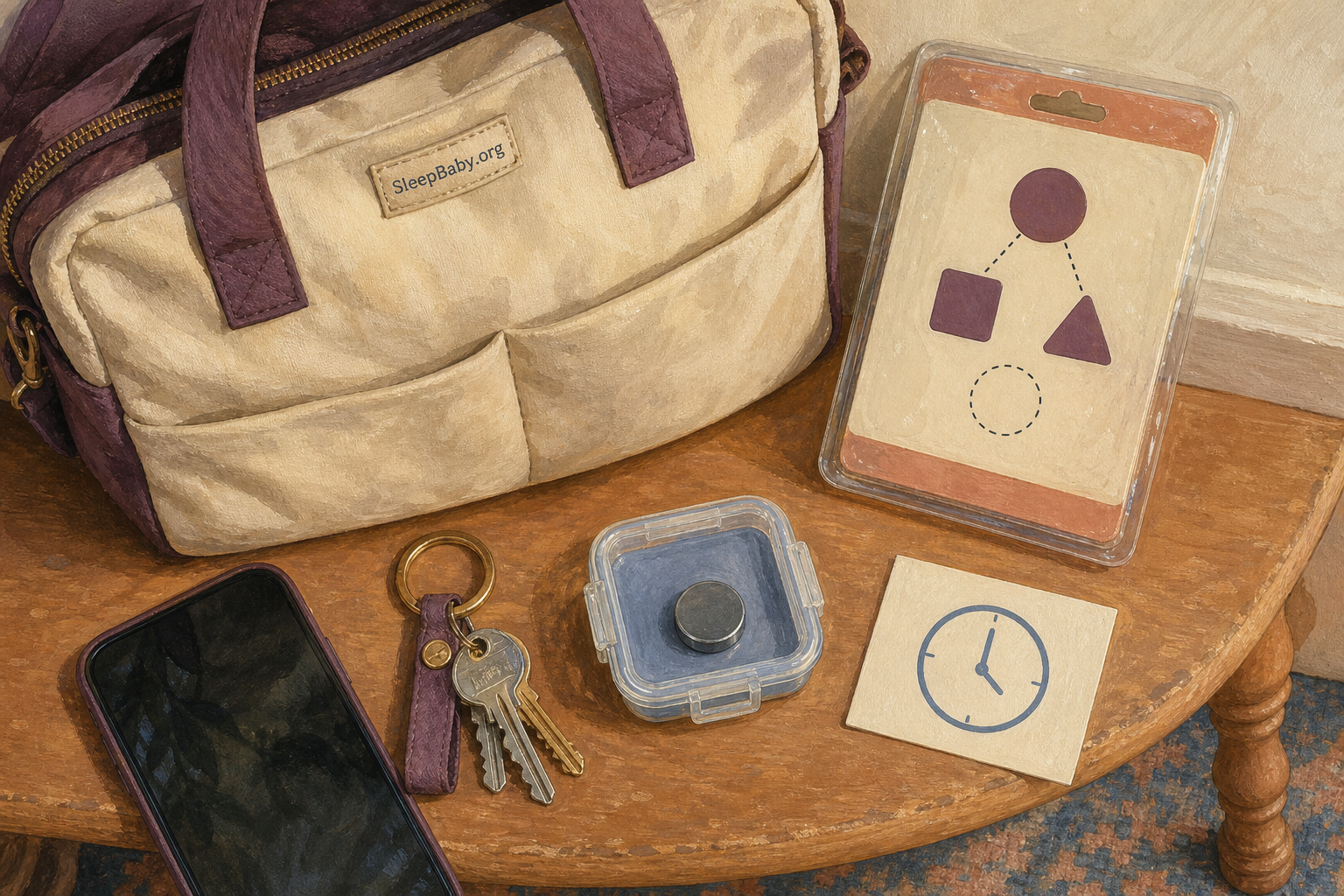
- Product or matching pieceBring the package, a photo, or an identical piece only if it is already at hand and safely contained.
- Other possible objectsMention metal pieces, batteries, jewelry, magnetic beads, broken toy parts, or anything else that may be missing.
- Symptoms and last intakeTell the team what you noticed and when the baby last ate or drank. Do not offer more unless directed.
If another adult is present, one person can drive while the other calls Poison Help. If you are alone, arrange the safest immediate transport available and follow emergency-dispatch or poison-center direction. The principle is not to build a perfect logistics plan; it is to remove avoidable delay.
What not to do while arranging care
Poison Control’s magnet guidance is plain: do not induce vomiting and do not give anything to eat or drink. [1] That means no bottle, breastfeed, snack, water, oil, fiber, bread, banana, or other attempt to cushion or move the object unless the poison specialist or treating clinician gives a specific instruction for this baby.
- Do not use honey as magnet first aid. Honey belongs to a separate, tightly defined button-battery protocol. It is not a general swallowed-object remedy.
- Do not give a laxative. Whether and how an object should move is a clinical decision after evaluation.
- Do not test with another magnet, a phone, a compass, or a household metal detector. These cannot establish a safe count, location, or injury status.
- Do not wait for a bowel movement. Stool watching before emergency evaluation is a delay, not a safety plan.
- Do not search the house until you feel certain. Take the uncertainty with you. Certainty is not the admission ticket to emergency care.
- Do not rely on an online photo comparison. Different hazardous objects can look similar, and a swallowed item may not be the piece you found.
If a poison specialist or clinician later gives instructions that differ because the object is confirmed to be something else, follow that individualized guidance. The boundary here is against improvising before the object and baby have been professionally assessed.
If the object might be a button battery, say that immediately
Magnets and button batteries are both time-critical ingestion hazards, but their first-aid instructions are not interchangeable. Some button-battery guidance includes honey for certain children, within a specific age and time window, while emergency care is on the way. The magnet-specific Poison Control guidance used here says nothing to eat or drink. Trying to decide between those protocols from a round object on the floor is not a safe home task.
A magnet swallowed with a button battery can add magnetic attraction to an already dangerous battery exposure. Pediatric consensus guidance treats simultaneous ingestion of a magnet and another metal object, especially a button battery, as a high-risk situation. [4] Report the possibility even if it feels unlikely.
Do not wait for symptoms
A baby may have no early symptom that points cleanly to a swallowed magnet. When symptoms do appear, they can look like many ordinary childhood illnesses: vomiting, feeding difficulty, fever, abdominal discomfort, or a child who seems generally unwell. Pediatric guidance warns that a child may not become obviously symptomatic until significant bowel injury has occurred. [2] [5]
Report these; never wait for them
Symptoms can signal obstruction, breathing trouble, or developing gastrointestinal injury
Breathing and airway
- Choking or persistent coughing
- Trouble breathing, stridor, or wheezing
- Blue or gray color
- Unresponsiveness or a life-threatening change
Mouth, throat, and feeding
- Drooling, gagging, or painful swallowing
- Difficulty swallowing normally
- Refusing or taking much less of a feed
- A sense that something is stuck
Stomach and whole-body signs
- Vomiting or abdominal pain
- Increasing tenderness or a swollen abdomen
- Fever or looking increasingly unwell
- Blood in vomit or stool, or dark tarry stool
Call 911 for breathing trouble or another life-threatening change. For every other suspected magnet ingestion, the emergency-department-now instruction already applies before any symptom starts. [3] [7]
A symptom list is useful only when it helps you describe what is happening. It becomes dangerous when it turns into a waiting checklist. Do not sit beside the crib asking whether vomiting has started yet. If the baby seems well, say that to the emergency team and keep going. If a symptom begins during transport, report the change immediately and follow emergency instructions.
What may happen at the emergency department
Emergency care is not one fixed conveyor belt. The team will build the plan from the history, examination, likely object, timing, symptoms, imaging, number of objects, and location. Local resources and specialist availability also matter. You may see emergency clinicians, radiology, pediatric gastroenterology, and pediatric surgery involved at different points. [4] [7]
For multiple magnets that are within endoscopic reach, North American pediatric gastroenterology guidance supports urgent removal even when the child has no symptoms. Magnets farther along may require surgical consultation and a plan built around the exact findings. [5] The important caregiver-facing point is not which tool comes next. It is that early imaging and specialist ownership can reduce the time an unsafe configuration remains unrecognized.
You may hear clinicians discuss an “apparent single magnet.” That phrase should not be translated into “nothing to worry about.” It means the team is working through count, views, location, and history. They may ask to see a matching piece or package because it adds context, not because a home comparison can settle the case.

If the team chooses observation, it is still a medical plan
Pediatric magnet guidance includes carefully controlled observation in selected circumstances, after professional evaluation. That may involve serial imaging, repeat examinations, explicit return precautions, and clear responsibility for what happens next. It does not mean a caregiver should create an observation plan before evaluation or borrow another child’s schedule from an online algorithm.
If your baby is discharged, leave with the instructions in a form you can follow when you are tired. Ask the treating team to clarify anything that is not explicit:
- What object and count does the team believe the imaging shows?
- Where is the object now, and what is the next required check?
- May the baby eat and drink normally, or are there temporary restrictions?
- Is repeat imaging required, where will it happen, and exactly when?
- Which symptoms mean return immediately or call emergency services?
- Which service owns follow-up, and what number should you use if the plan becomes unclear?
Those questions organize a clinician-made plan; they do not substitute for one. If you were told to return for imaging, a delay because the baby seems fine changes the plan without medical approval. If symptoms begin, use the return precautions or emergency instructions rather than waiting for the scheduled checkpoint.
The details worth telling the team
A stressed brain tends to offer either every detail or none. The team does not need a polished story. It needs the clues that change count, timing, object type, and immediate risk.
| Detail | Useful wording | Why it matters |
|---|---|---|
| Possible time | “The set was complete after lunch; I noticed a missing piece at 3 p.m.” | Establishes a window without pretending the swallow was witnessed. |
| Count | “One is definitely missing, and three more are not accounted for.” | Preserves uncertainty about multiple or staggered ingestion. |
| Object source | “It came from a broken magnetic building piece.” | Helps identify whether other magnets, metal, or batteries may be present. |
| Current symptoms | “Breathing is normal; there was one episode of vomiting at 3:20.” | Gives the team an observable change without using symptoms to rule ingestion out. |
| Anything already given | “The last feed was at 2 p.m.; nothing has been given since the call.” | Supports procedural and feeding decisions owned by the clinical team. |
If you do not know one of these details, say “I don’t know.” Honest gaps are safer than estimates that sound certain. An unwitnessed ingestion is common enough that uncertainty itself belongs in the medical history. [1]
A matching piece can describe the product, but it cannot diagnose the ingestion
A securely contained matching piece or intact package may help the team understand the product’s size, shape, material, and possible number of components. A photo can be useful when carrying the product would be unsafe or cumbersome. None of these clues can show where an object is, whether more than one was swallowed, whether a second metal item is present, or whether bowel injury has begun.
Keep a loose magnet away from the baby and away from medical equipment unless staff ask for it. Do not hold it against the abdomen, sweep it across clothing, or use its pull as a test. Magnetic attraction outside the body cannot produce a safe internal map. The useful handoff is simple: identify the product, contain the sample, and let the clinical team decide whether it contributes anything to imaging or treatment.
Packaging language also has limits. Words such as toy, educational, for older children, craft, or refrigerator magnet do not clear an object after a suspected swallow. Product labels describe intended use; they do not account for the baby’s actual exposure, the number of objects, or the possibility of damaged components. If the item is subject to a recall or warning, that is important prevention information, but the recall search still waits until emergency care is moving.
Common questions when a baby may have swallowed a magnet
My baby looks fine. Can I watch at home for a little while?
No. Go to the emergency department now. A child may not show a distinctive symptom early, and delayed treatment can allow serious digestive-tract injury to progress. Looking well is good to report; it is not evidence that the bowel is safe. [2] [5]
What if I am almost sure it was only one magnet?
That still requires urgent professional evaluation. More than one magnet can overlap and appear single on an X-ray, and a caregiver may not know whether another magnet or metal item was swallowed. The emergency team decides how to establish the count and what the apparent findings mean.
What if the suspected swallow happened hours ago or yesterday?
Go now and give the team the best timing window you have. Time already elapsed is not a reason to wait longer. Do not assume that a baby who remained comfortable has cleared the danger.
Should I call the pediatrician first?
You can notify the pediatrician while emergency care is being arranged, but do not wait for a routine office callback before leaving. The AAP directs a seen or suspected swallowed magnet to the emergency department, and Poison Help can provide immediate U.S. guidance at 1-800-222-1222. [3]
Can I give milk, formula, breast milk, water, or food?
Not unless a poison specialist or clinician directs you. Poison Control’s magnet guidance says not to give anything to eat or drink. Tell the team when the baby last ate or drank and follow the individualized instruction you receive. [1]
Can I use honey just in case it was a button battery?
Do not combine protocols on your own. Say immediately that the object may be a button battery and follow real-time Poison Help or emergency guidance. Honey is not magnet first aid, and the magnet guidance here is nothing by mouth unless directed.
What if my baby spit up a magnet?
Keep the retrieved object safely contained and continue with immediate professional guidance. One recovered piece does not prove that no other magnet, metal object, or battery was swallowed, and vomiting does not show that the gastrointestinal tract is uninjured.
Will an X-ray show exactly how many magnets there are?
Imaging is an essential part of the evaluation, but pieces can overlap. Pediatric guidance notes that clinicians may use at least two views to help determine count. Leave both the imaging technique and interpretation to the team. [5] [7]
Can I check the diaper or stool instead?
Not as a substitute for emergency evaluation. A specialist may later prescribe observation and follow-up imaging for a selected case, but that is a controlled medical plan after the object has been assessed. Do not create a stool-watching plan first.
Is a refrigerator magnet less dangerous?
Do not use the product’s familiar appearance to decide that ingestion is harmless. Different magnets vary, and the full risk depends on object count, other swallowed material, location, and clinical findings. Bring a matching piece or package if it is immediately available, but let the emergency team make the risk assessment.
What if no magnet is definitely missing?
If you have a credible reason to suspect ingestion, treat the suspicion as enough. An open set within reach, a broken magnetic product, a witnessed object at the mouth, or unexplained missing components can all be relevant. Tell Poison Help and the emergency team exactly what you saw and what you do not know.
After the urgent care is underway: prevent the next loose magnet
Prevention belongs after emergency action, not before it. Once another adult has secured the space or the baby is under professional care, look for the route the magnet took into reach. The point is not to build a case against the caregiver. Magnet ingestions can be unwitnessed, and products can shed pieces no one expected to come loose. The useful question is: what can become inaccessible before the baby returns to the floor?
A magnet sweep that follows the baby’s real reach
Do this after care is moving, never instead of leaving for the emergency department.
- Remove loose high-powered sets from the home. Keep them away from babies, toddlers, older siblings, and teens; do not rely on an age label to contain hundreds of tiny pieces.
- Inspect products for missing or loosening components. Check building toys, magnetic tiles, jewelry, closures, cabinet accessories, craft supplies, desk objects, key cases, electronics accessories, and items brought in by visitors.
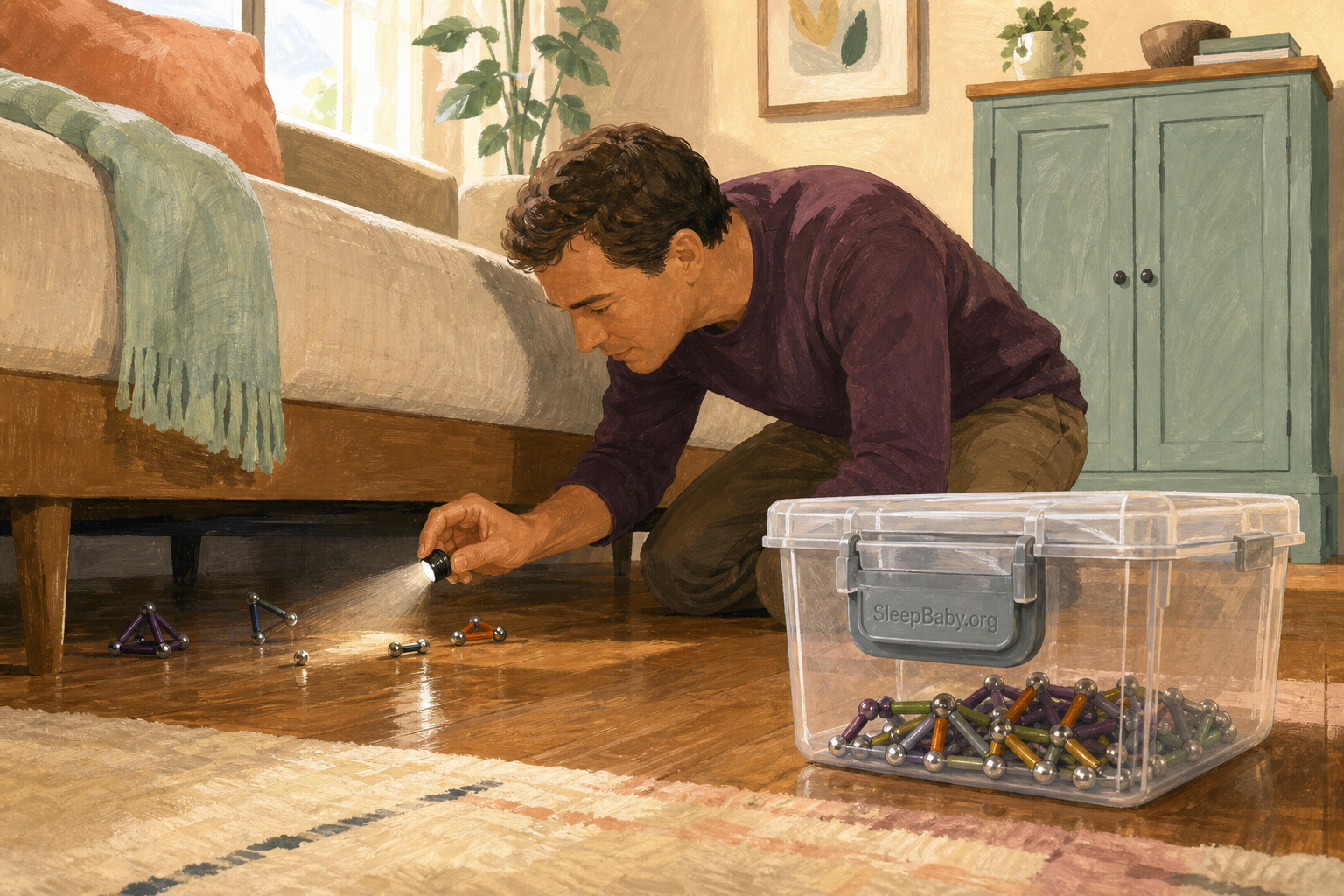
- Search at floor level. Look under furniture edges, rugs, play mats, appliance lips, seat cushions, and the path between an older child’s play area and the baby’s usual floor space.
- Use closed, elevated storage for permitted magnetic items. A lid that snaps shut is more useful than an open bowl on a high shelf that can spill.
- Check current CPSC recalls and warnings. Stop using a recalled or noncompliant product and follow the regulator’s disposal or remedy instructions.
- Teach the whole household one rule. If a magnetic piece is loose or a set’s count changes, contain the product, clear the floor, and tell the caregiver immediately.
The CPSC has repeatedly warned about small, high-powered magnet sets and products that do not meet federal requirements. Its Magnet Safety Center collects warnings and recalls, and it advises immediate medical attention when ingestion is suspected. [6] A product can look tidy in an online photo and still arrive with hundreds of pieces that are nearly impossible to account for after one spill.
Babies explore with their mouths because mouthing is part of development, not because a caregiver failed to deliver the right lecture. Our guide to why babies put everything in their mouths can help you redesign the floor-level environment after this emergency is medically settled. The response to normal exploration is a safer space, not shame.
Watch: the CPSC explains the hidden magnet hazard
The U.S. Consumer Product Safety Commission’s magnet-safety video shows why more than one high-powered magnet can become dangerous after ingestion. The takeaway is deliberately simple: keep these products away from children and seek immediate medical attention for a suspected swallow. The video is background learning for after emergency care is underway; it is not a reason to pause the trip.
Coming home after evaluation
Do not build the home plan from this page. Build it from the discharge instructions for your baby’s actual imaging and treatment. If the team says to return for another X-ray, restrict food, watch a particular symptom, give a medicine, or contact a specialty service, that instruction outranks a general article. Put the paper or portal note where both caregivers can see it, set any required alarm, and write the phone number beside it.
A baby may be tired after a long emergency visit, but tiredness cannot be interpreted in isolation. If the baby is unusually difficult to wake, breathing differently, feeding poorly, vomiting, developing abdominal symptoms, or otherwise not matching the discharge expectations, use the team’s return precautions. Our guide to waking a sleeping baby gently is for ordinary, medically appropriate waking after the clinician has told you what normal responsiveness should look like. It is not a test that clears magnet complications.
Likewise, a longer nap after a frightening day may reflect a disrupted schedule, but the guide to a baby napping longer than usual belongs only after the medical team has defined the safety boundary. If you are wondering whether the baby is “just exhausted” or showing a concerning change, stop guessing and call the service that evaluated the ingestion.
If the baby is medically cleared and the emergency visit has simply turned the entire night inside out, our guide to a newborn who will not sleep at night can help rebuild the rhythm for a newborn. Use it only after the discharge plan is stable; schedule advice never outranks a return precaution.
Keep sleep ordinary and safe unless the treating team gives a medically necessary alternative: use the baby’s normal firm, flat, separate sleep surface and avoid adding pillows, positioners, wedges, or loose bedding to make observation feel easier. If an unsettled baby resists the usual sleep space after the visit, the practical ideas in our guide to a baby who will not settle in the bassinet can wait until the emergency plan is stable. A softer or more crowded sleep surface is not aftercare.
The house may feel electrically alert even when the hospital has given reassuring news. One adult is rereading the discharge line; another is replaying the missing-piece count; every small sound from the crib lands louder than usual. That reaction makes sense. Let the written plan carry the medical decisions so your frightened attention does not have to invent new ones all night.

Sources
- National Capital Poison Center. Toy magnets are dangerous for children.
- American Academy of Pediatrics, HealthyChildren.org. Dangers of magnetic toys and fake piercings.
- American Academy of Pediatrics, HealthyChildren.org. Swallowed foreign object symptom guidance.
- Nugud AA et al. Pediatric Magnet Ingestion, Diagnosis, Management, and Prevention: An ESPGHAN Position Paper. 2023.
- Kramer RE et al. Management of Ingested Foreign Bodies in Children: A Clinical Report of the NASPGHAN Endoscopy Committee. 2015.
- U.S. Consumer Product Safety Commission. Magnet Safety Center.
- Royal Children’s Hospital Melbourne. Clinical practice guideline: foreign body ingestion.
- NASPGHAN and American Academy of Pediatrics. Safety statement on high-powered magnets.