You set your baby down centered on the fitted pad. Minutes later, one shoulder is lifted, both hips are turning, and a cheek is close to the bassinet wall. The room looks exactly the same; the safety decision has changed.
If your baby is trying to roll in a bassinet, stop swaddling for sleep and check the exact bassinet manual before the next sleep. Keep placing your baby down on their back. Move them to a bare, firm, flat crib or play yard as soon as they reach any mobility, weight, or height limit in the instructions – or sooner if the bassinet feels cramped, the baby can press into the sides in a concerning way, or the instructions are missing or unclear.
Do not solve rolling with a wedge, sleep positioner, rolled towel, blanket, bumper, strap, or side-sleeping setup. Those additions can create entrapment or suffocation hazards. A baby learning to roll needs an eligible sleep space, not something that pins their body in place.
I would treat a real rolling attempt as a check-the-manual-now moment. Rolling tells you what the baby can do. The manual tells you what the bassinet is still allowed to do. Those are two different questions. The fear beneath this search is often, “Did the bassinet become dangerous before I noticed?” A kinder, more useful question is, “What changed, and which eligible surface fits that change now?”
SleepBaby.org · The original video
A little help
for the night ahead.
Take a moment to watch the original Baby Sleep Miracle presentation. Your article will be right here when you’re ready to keep reading.
Ready to get started?Take the next step with SleepBaby.
Help my baby sleepBefore the next sleep
Four checks decide what happens tonight
-
Is it a real roll?
Look for the shoulders, hips, and trunk turning together. A newborn curl or head turn is not the same movement. -
Is your baby swaddled?
At signs of trying to roll, stop swaddling for sleep. Free arms matter when a baby changes position. -
What does this exact model say?
Find the model label and manual. The earliest mobility, weight, or height stop rule controls. -
Is the next safe surface ready?
A standards-compliant crib or play yard can be used in infancy. You do not have to wait for a ceremonial “big crib” age.
If any product limit has been reached – or you cannot verify the limit – use the bare crib or play yard rather than guessing.
Is it a real roll, a wiggle, or the newborn curl?
Babies are gloriously inefficient movers before they become deliberate ones. A newborn may turn their head, lift one shoulder, kick both legs, or curl onto a side because of the tucked posture they had before birth. A bassinet mattress can also make every tiny scoot look enormous because the sleep space is small and the sides are close.
A developing roll usually involves more of the body. You may see the head turn, one arm cross the chest, the shoulder rotate, the pelvis follow, and the hips begin to tip. Babies often rehearse by rocking, arching, pushing on their arms during awake tummy time, or swinging their legs across the body. The American Academy of Pediatrics describes rolling as a normal motor milestone that develops as head, neck, trunk, and arm strength improve. Timing varies; some babies surprise everyone early.
Do not use age alone to decide that a movement “cannot be rolling yet.” The National Institute of Child Health and Human Development notes that babies may begin rolling as early as two months. What you saw matters more than the calendar square.
If you are unsure, watch the movement while your baby is awake on a clear floor mat. You are not testing them or trying to force a roll. You are simply looking for whether the trunk turns as a unit and whether the movement repeats. A short phone video of an unusual movement can help your pediatrician understand what you mean, but filming should never delay help for breathing trouble, color change, unresponsiveness, a seizure, or an injury.

Stop swaddling when rolling starts – not after a perfect roll
The swaddle decision comes before the bassinet debate. The AAP and NICHD advise stopping swaddling when a baby looks like they are trying to roll or begins rolling independently. A swaddled baby who reaches the stomach may have less ability to use their arms to lift, shift, or reposition their head.
That means you do not wait for a graceful, repeatable back-to-belly roll witnessed by three adults and a notary. Rocking hard to one side, twisting the shoulders and hips, or repeatedly attempting the movement is enough reason to end the swaddle for sleep.
Use ordinary pajamas or a correctly sized, nonweighted wearable blanket if your baby needs warmth and the product is appropriate for their size. Keep the face and head uncovered. A transition garment is not allowed to restrain the arms or promise to stop rolling. Weighted swaddles, weighted sleep sacks, and weighted blankets should not be used for infant sleep.
The first arms-free nights can be noisy. Hands find cheeks. Legs thump. A baby who previously resembled a very determined burrito suddenly discovers they own elbows. That disruption is frustrating, but it is not evidence that the safer choice was wrong. Keep the routine familiar while the clothing changes: same dim lights, same feed if due, same song, same back placement, different freedom to move.
The bassinet manual decides when the product phase ends
There is no honest universal sentence that says every bassinet becomes unusable on the exact same day or at the exact same movement. Models differ. One may instruct caregivers to stop when the baby begins pushing up on hands and knees. Another may name rolling, a maximum weight, a height or reach boundary, or more than one of those. Convertible play-yard bassinets can have rules different from the lower play-yard level.
Find the brand, model name or number, and manufacture information on the product label. Then read the current manual for that exact model. Look under warnings, fall hazard, maximum child weight, developmental limits, and when to discontinue use. If you inherited the bassinet and cannot identify it, if hardware or instructions are missing, or if the product is recalled, do not improvise continued use.
The U.S. Consumer Product Safety Commission regulates bassinets and cradles under 16 CFR Part 1218. The standard covers structural issues such as stability, side height, openings, mattress fit, and sleep-surface angle. That federal floor matters, but it does not cancel the instructions attached to your particular product. Compliance is not a permission slip to exceed a model’s stop-use warning.
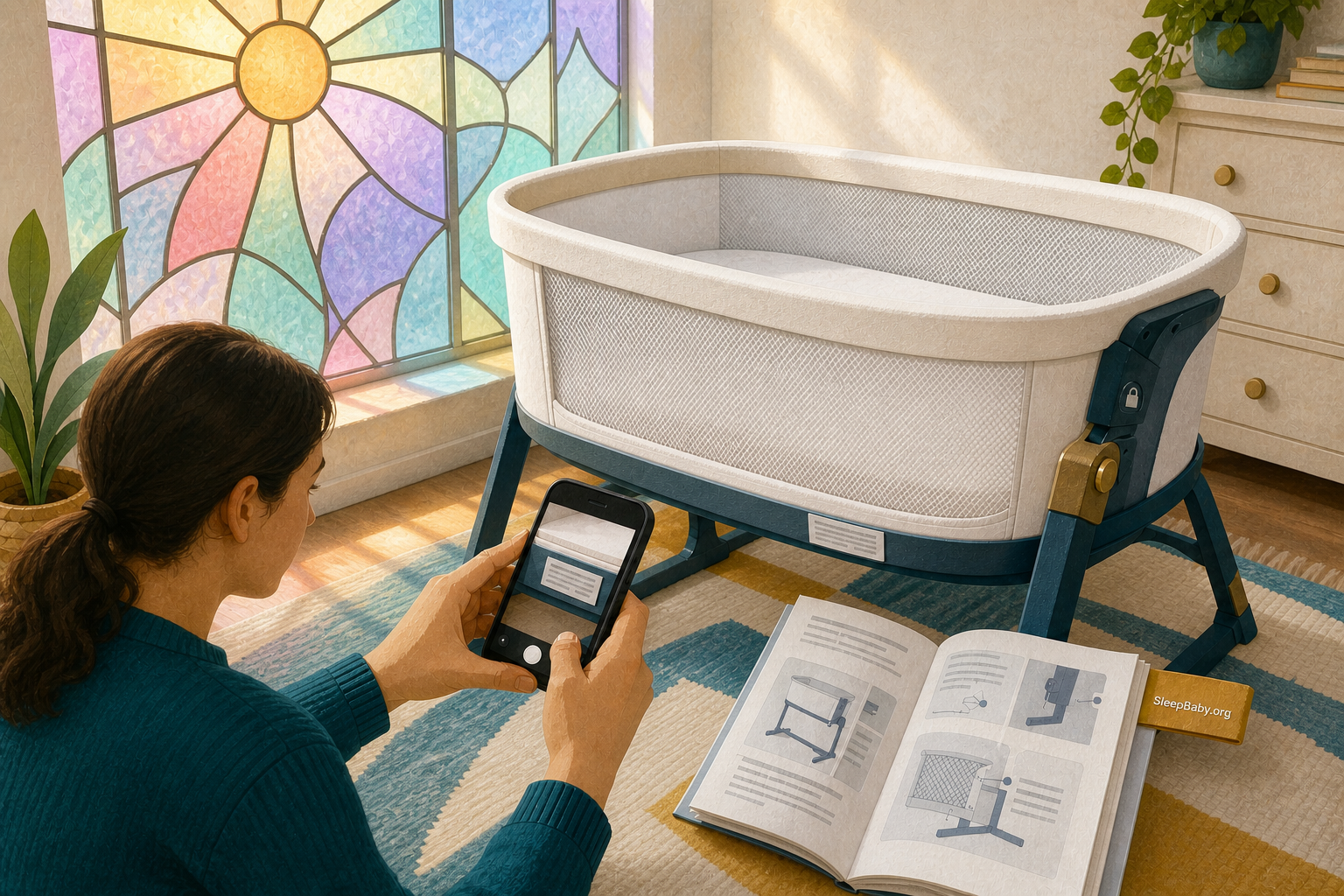
I know “go find the manual” can sound like advice written by someone who has never stood in a dark bedroom with one hand on the lamp and the other trying to lift a fitted pad without waking a baby. Make it smaller: find the model label first. Photograph it. Search the manufacturer’s official support page in daylight if you can. If you cannot verify the limit before the next sleep, the crib or play yard is the clearer choice.
Baby skill + product rule + next surface
The bassinet-to-crib threshold path
The movement is only a curl or wiggle
Keep observing, start sleep on the back, keep the surface bare, and learn the exact product limits now so the transition is not a surprise later.
The baby is attempting or completing a roll
Stop swaddling. Check the manual before the next sleep. If rolling or the current milestone reaches a stop rule, move to the crib or play yard.
The manual limit is reached, unclear, or cannot be found
Do not run an overnight experiment. Use the correct firm, flat mattress and fitted sheet in a compliant crib or play yard.
Breathing, color, responsiveness, injury, or unusual movement is involved
This is no longer only a sleep-space question. Use emergency services for life-threatening signs or contact your baby’s clinician promptly for a concerning new pattern.
The rule I would keep: when the baby’s capability and the product’s permission disagree, the product does not get the benefit of the doubt.

One-way and two-way rolling: what changes after the move
Safe-sleep guidance and bassinet guidance overlap here, but they are not interchangeable. For every nap and night, place your baby wholly on their back. Do not begin sleep on the side or stomach because rolling has started.
On an appropriate bare crib or play-yard surface, NICHD says that if a baby rolls only one way and you notice they have rolled onto the stomach, you can reposition them onto the back. If the baby can roll independently from back to stomach and stomach to back, you can leave them in the position they choose after you start them on the back. Keep the sleep space bare so there is nothing soft for the baby to roll into.
This does not mean you must stay awake conducting a rolling patrol. It means you preserve the start-on-the-back habit, remove hazards, stop swaddling, and use a surface the baby is still eligible to use. If your baby cannot lift or turn their head well, repeatedly seems trapped, or has a medical condition affecting movement, ask their clinician for individual guidance rather than borrowing a rule from a healthy two-way roller.
It also does not mean that two-way rolling somehow re-authorizes an outgrown bassinet. Skill belongs to the baby. Eligibility belongs to the product. A gymnast cannot make a too-small stage larger by being talented.
What if the baby keeps rolling into the bassinet side?
A cheek against the side can look alarming, especially when the bassinet is close enough for you to see every small movement. First look at the baby, not the marketing label: is the face visibly clear, is breathing normal, and can the baby lift or turn the head? If a baby who rolls only one way has moved onto the stomach and you notice it, NICHD says you can reposition them onto the back. Then answer the equipment question instead of trying to engineer a way to keep the baby centered.
Mesh or fabric sides do not cancel a stop-use rule. A bassinet is evaluated as a complete product used according to its instructions – sleep surface, sidewalls, frame, hardware, and developmental limits together. The word breathable is not permission to exceed those limits, unzip a panel that should be closed, add padding, or secure the baby away from the edge.
If the baby repeatedly presses into the side, looks cramped, braces against the walls, or cannot move the head comfortably, a correctly set up crib or play yard gives more usable space without adding a restraint. You may make that move even when you have not squeezed every last eligible night from the bassinet. If anything about breathing, color, responsiveness, or the movement itself looks abnormal, treat that as a medical concern rather than a product-comfort puzzle.
For a bedside bassinet, follow the exact attachment and side-panel instructions. Do not lower or open a panel, bridge a gap with blankets, or treat the adult mattress as an extension of the baby’s sleep surface unless the manufacturer explicitly designed and instructs that configuration. A separate crib or play yard can still stay in your room; moving out of the bassinet does not require moving the baby far away.
How to move from bassinet to crib or play yard tonight
A compliant crib or play yard is not an advanced sleep surface that a baby must earn. Used according to its instructions, with the correct firm, flat mattress or pad and a fitted sheet only, it can be an appropriate infant sleep space. Our guide to using a crib from birth goes deeper on that setup.
The move can still feel surprisingly emotional. The bassinet may be the object you stared into during the first week home, counting breaths and wondering who had authorized you to be in charge of such a tiny person. Ending that chapter because your baby learned a new skill is not failure. It is exactly what the equipment was meant to lead toward.
Keep the routine; change the surface
A six-step transition for the same night
- Read the crib or play-yard instructions too. Use the correct level, pad or mattress, hardware, and fitted sheet for that exact product.
- Make the space bare. No pillow, blanket, bumper, toy, nest, positioner, extra mattress, or added padding.
- Use arms-free sleep clothing. Choose ordinary pajamas or an appropriately sized nonweighted wearable blanket.
- Keep the familiar cues. Use the same bedtime order, sound level, room temperature, phrase, and back placement when those cues are already safe.
- Expect practice, not perfection. The larger surface may invite several dramatic rolls before sleep. Give the baby room to learn without adding objects.
- Comfort outside the hazard. Pick up and calm if needed, then return the baby to the back on the bare surface. Do not make the old bassinet the only soothing plan if its use phase has ended.

If the first crib night is rough, respond to the rough night – not by undoing the safety decision, but by reducing everything else that is new. Move the crib into your room if the product setup and room allow it. Keep one familiar sheet washed in the usual detergent, but never add loose fabric for scent. Use the same short song. Give your baby more supervised rolling practice while awake the next day.
If the real problem was present before rolling – your baby never settled in the bassinet, woke during every transfer, or slept only in arms – our guide for a baby who will not sleep in the bassinet can help separate transfer timing from this new product-limit decision. Do not use that troubleshooting to stretch an ineligible bassinet phase.
Match what you saw to the next safe action
| Observation | Useful distinction | Next action |
|---|---|---|
| Head turns and one shoulder lifts | May be a curl, startle, or early practice rather than a complete roll. | Start on the back, keep the space bare, observe awake movement, and learn the product limits now. |
| Shoulders, trunk, and hips rotate together | A genuine rolling attempt or completed roll is likely. | Stop swaddling and check the exact bassinet manual before the next sleep. |
| Baby rolls one way | The baby may reach a position they cannot yet leave. | Use an eligible bare crib/play yard when the bassinet limit is reached or uncertain; start on the back and reposition if you notice a one-way roll. |
| Baby rolls both ways | The baby can independently change position on an appropriate surface. | Start on the back; on an eligible bare surface, allow the baby to remain in the chosen position. Do not exceed bassinet limits. |
| Baby pushes up, gets onto hands and knees, or looks able to climb | This often reaches a bassinet’s developmental stop rule and increases fall concerns. | Stop using the bassinet and move to the correctly configured crib or play yard. |
| Movement comes with blue/gray color, breathing difficulty, unresponsiveness, seizure, injury, or marked weakness | This is not routine rolling practice. | Use emergency services for life-threatening signs. Contact the baby’s clinician promptly for a concerning new movement pattern. |
Mobile note: This comparison scrolls horizontally inside one labeled region. Swipe within the table for the final column; vertical page scrolling remains available.
Do not stop rolling with products or improvised barriers
A baby’s new movement can trigger a frantic shopping reflex: surely there is a pillow, strap, insert, or clever little triangle that keeps everyone exactly where they started. This is one of those moments when adding less is the safer design.
The U.S. Food and Drug Administration warns against infant sleep positioners, including products marketed to hold a baby on the back or side. Wedges, bolsters, and similar products can create entrapment or suffocation hazards. The same concern applies to homemade versions. A rolled towel is still a loose object. A blanket tucked “very tightly” can still loosen. A bumper is still something a moving face can meet.
A consumer monitor does not change these rules. It may alert you to noise or movement, but it cannot make an ineligible product larger, remove a soft-object hazard, or guarantee that a breathing problem will be detected. Build safety into the surface first.
When rolling practice starts waking everyone
Some babies discover rolling and immediately use every sleep period as rehearsal. They roll, protest, get helped, roll again, and appear personally offended that gravity remains operational. Once the product and safe-sleep decisions are settled, the disruption is usually a separate problem: a new motor skill is exciting, awkward, and not yet automatic.
Give generous supervised floor time while your baby is awake. Place interesting objects where the baby can turn toward them without reaching for something unsafe. Practice both directions naturally rather than drilling one side. If your baby consistently avoids one side, seems unable to use one arm or leg, loses a skill, or has unusual stiffness or floppiness, mention it to the pediatrician.

At sleep time, keep your response boring in the kindest possible way. Low light. Brief reassurance. Help with a one-way trap if you notice it. Return the baby to the back when appropriate. Do not introduce a new toy, light show, or long practice session in the crib. Our guide for a baby waking while learning to roll covers the settling piece in more detail.
If the baby independently reaches the stomach and can roll both ways on the eligible bare surface, you do not need to turn every grunt into a rescue. If the baby sleeps face-down and that position is the worry keeping you awake, read the focused face-down rolling guide for the same start-on-the-back and bare-space boundaries.
When rolling needs a clinician, not another sleep workaround
Rolling by itself is usually a normal developmental skill. The goal is not to medicalize every twist. The goal is to notice when the movement is part of a bigger concern.
Call emergency services now for severe breathing difficulty, blue or gray lips or face, unresponsiveness, a seizure, a serious fall or injury, or any situation that looks life-threatening. Move the baby only as needed for immediate safety and follow emergency instructions.
Contact your baby’s clinician promptly for a sudden loss of a skill, marked weakness on one side, unusual stiffness or floppiness, pain with movement, repeated forceful vomiting, poor feeding, fever in a young infant, a new pattern after an injury, or movement that looks very different from ordinary rolling practice. A short video can be useful when the baby is otherwise safe, but your description of what happened before, during, and after matters too.
Also ask for individual guidance if your baby was born very preterm, has a neuromuscular or airway condition, uses medical equipment, or has been given positioning advice by a clinician. General internet guidance cannot safely override a plan made for the baby’s known condition.
What I would not do is keep changing the sleep setup while waiting to see whether a concerning pattern becomes clearer. Use the simplest eligible surface, preserve the back/flat/bare foundation, and let the clinician answer the medical question.
You are allowed to move the baby before the manual forces you
A stop-use limit is the latest boundary, not a requirement to extract every possible night from the bassinet. If the larger bare surface is correctly set up and gives you a clearer safety plan, moving early is a reasonable choice.
Sources
- American Academy of Pediatrics: 2022 safe-sleep recommendations
- HealthyChildren.org: How to Keep Your Sleeping Baby Safe
- NICHD Safe to Sleep: About Back Sleeping
- U.S. CPSC: Bassinets and Cradles Business Guidance
- 16 CFR Part 1218: Safety Standard for Bassinets and Cradles
- HealthyChildren.org: Movement Milestones, 4 to 7 Months
- U.S. FDA: Recommendations About Infant Sleep Products
- HealthyChildren.org: Urgent Care, ER or Pediatrician?
The bassinet chapter can end without taking bedtime down with it
Build the familiar night around the safer surface
A new rolling skill can change the equipment overnight, but it does not erase every cue your baby already knows. The shoulder and hips that moved toward the bassinet wall are not evidence that you missed your chance to keep your baby safe; they are the information that helps you choose the next eligible surface. Keep the song, the dim room, the steady order, and the back placement. SleepBaby can help you shape the rest of the routine around the crib or play yard without turning safety into another exhausting experiment.
SleepBaby.org · The original video
A next step for
the next bedtime.
Still thinking about sleep? Watch the presentation here, then explore the SleepBaby program whenever you’re ready.
Ready to get started?Take the next step with SleepBaby.
Help my baby sleep